Specs are compiled from manufacturer listings and verified buyer reviews and can change over time — please confirm the key details on the product page before buying.
You want free local TV that keeps a steady picture even in rain. The short answer: buy a directional outdoor antenna aimed at your towers, mount it as high as you safely can, and skip amplified bargain units unless you live far from the transmitters. The nine models below cover that whole spread — from a compact attic Yagi (a directional antenna with a row of elements) that has quietly become the default choice for millions of cord-cutters to a long-boom directional unit built for fringe reception (weak signal at the edge of range).
This guide is built by comparing the manufacturers’ published specifications and the patterns across verified customer reviews, so you get each pick’s real strengths and trade-offs instead of marketing spin.
What separates a good antenna from a frustrating one is rarely the box copy — it is boom length, element count, gain in dBi, and whether the thing survives wind. Below you will find the specs that actually move the needle, plus the honest limits of each model, so you can pick the right target antennas for tv without guessing.
Top Picks


How To Choose The Best Target Antennas for TV
Start with distance, not specs. Look up how far your nearest broadcast towers sit from your roof — most antenna shopping goes wrong because the buyer guesses at range instead of measuring it. Once you know the mileage and the compass direction, every other decision gets easier.
Directional or omnidirectional
A directional antenna (one that points at a specific cluster of towers) concentrates its sensitivity in one arc, so it pulls in weaker stations from farther out. An omnidirectional model (360-degree reception) picks up towers spread around you without aiming, which suits RV owners and renters who move the antenna around. If all your towers sit in one general direction, directional wins on signal strength every time.
The gain number in dBi
Gain in dBi (decibels relative to an isotropic radiator — a measure of how much an antenna focuses signal versus a perfect sphere) tells you how strongly the antenna pulls in distant stations. Higher dBi means a more focused, stronger pull on distant stations — but it also means a narrower balance, so aiming matters more. A fringe-reception build might list 38 dBi on High VHF and 46 dBi on UHF; a compact attic unit will list far less and still work fine inside 30 miles.
VHF versus UHF coverage
Modern digital TV splits between VHF (roughly 170–230 MHz) and UHF (roughly 470–860 MHz). Some antennas are UHF-only in practice even when the box says both, and that is the single most common reason a buyer misses a major network affiliate. Check the frequency range line on the spec sheet before you commit.
Side-by-Side Comparison
Every row uses the same three dimensions so you can scan the trade-offs without re-reading the reviews: rated range, how many channels the maker lists, and what the antenna is built to do best.
| Model | Best For | Rated Range | Channels Listed | Build Type | Amazon |
|---|---|---|---|---|---|
| Televes DAT BOSS Mix LR 149884★ Best Overall | Fringe reception far from towers | 80 miles (spec sheet); up to 100 mi claimed in copy | 29 | Directional stacked triple-boom, amplified | Amazon |
| McDuory TV Outdoor YagiBudget Champion | Budget roof or attic install | 70 miles | 2 | Passive Yagi, pre-assembled | Amazon |
| GE Outdoor HD Digital TV AntennaAttic Friendly | Attic installs with a J-mount | 80 miles | 200 | Yagi style, weather-resistant | Amazon |
| PIBIDI Outdoor TV Antenna | Long-element pull on local channels | 200 miles | 100 | High-gain directional, extended elements | Amazon |
| RCA Compact Outdoor Yagi | Compact attic fit, huge install base | 70+ miles | 100 | Compact Yagi, pre-assembled | Amazon |
| Channel Master Omni+ 50 | Towers spread in every direction | 50 miles | — | Omnidirectional 360°, indoor/outdoor/ RV | Amazon |
| Antennas Direct ClearStream MAX-V | Front-and-back reception with a wide beam | 60 miles | — | Double-loop, multi-directional, 65° beam | Amazon |
| Five Star Outdoor HDTV Antenna | Long-range claims with a full install kit | 200 miles | 100 | Multi-directional, extended elements | Amazon |
| Antennas Direct Element | Clustered towers, precise long pull | 60 miles | 2 | Uni-directional, peak 6.7 dBi VHF / 9.2 dBi UHF | Amazon |
Detailed Reviews
1. Televes DAT BOSS Mix LR 149884 HDTV Antenna
Our pick — 4.5+★ from 500+ verified ratings; the strongest balance of quality and price.
The fringe-reception specialist that adjusts its own amplification band by band so distant stations stop dropping out.
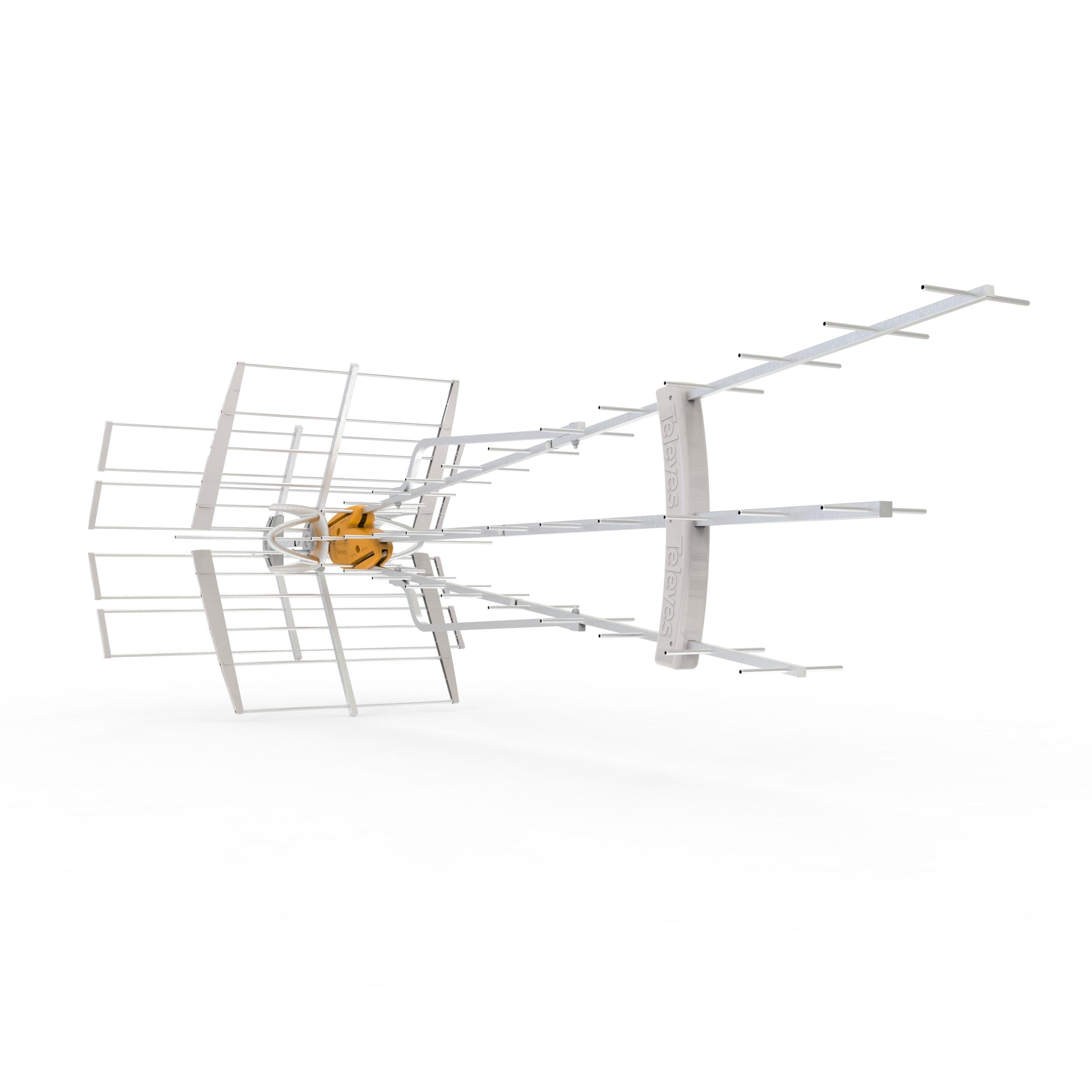
Your towers sit at the edge of usable distance, so you need the Televes. It carries a built-in TForce preamplifier (a signal booster that adjusts amplification independently by band) — 38 dBi on High VHF and 46 dBi on UHF — so a weak channel does not get swamped when a strong local one is blasting in. That split-band control is the whole reason it sits at the top: most amplified antennas boost everything at once and overload.
The physical build is serious. It measures 84.13″L x 33.98″W x 28.94″H, which makes it roughly 2.3 times the overall bulk of the GE Outdoor HD Digital TV Antenna at 37″L x 26.5″W x 19″H. All that boom length buys front-to-back ratios of 12 dB on High VHF and 25 dB on UHF, a measure of how well it ignores signal bouncing in from behind. In practice that means fewer freeze-frames and less pixelation when a plane or a tree interrupts the path.
What wins people over is the raw quality of the thing — the aluminum elements, stainless hardware, and ABS plastics read as genuinely weather-built, and it has survived named storms. Reception is the second story: buyers report signal strength that roughly doubles after the swap. Owners mention excellent reception, doubling signal strength and picking up about 25 channels. It also keeps working unpowered as a passive antenna if the 12V power inserter loses juice, which matters in a storm.
Where it pulls ahead
- Band-by-band gain control (38 dBi VHF, 46 dBi UHF) holds weak stations steady without overload.
- Built-in FM, LTE, 4G and 5G filtering cuts the cellular noise that wrecks fringe reception.
- Dual mode keeps passing signal in passive operation when the power inserter is off.
- Ready for ATSC 3.0 broadcasts with an ATSC 3.0 tuner.
The honest catches
- Assembly instructions are the weak point — the fit and finish are great, the paperwork is not.
- At 84.13 inches long it needs real mast space and a second set of hands to raise.
- Overkill if your towers are already inside 20 miles.
Reach for this if: your stations are distant, the terrain is rough, or you have already tried a cheap antenna and lost channels at night.
Look elsewhere if: you want a quick attic drop-in — the boom is long and the manual is thin.
2. McDuory TV Outdoor Yagi Antenna
A passive Yagi that goes up in about an hour and quietly earns its keep on UHF stations.
If your towers are close and you want the simplest possible install, this is the honest entry point. It is a passive design — no amplifier, no power inserter, no electricity at the mast — rated to 70 miles from the broadcast towers and built for VHF 170~230MHz and UHF 470~860MHz. It arrives mostly pre-assembled with no tools needed, which is why setup runs around an hour rather than an afternoon.
The reception picture is genuinely good for the tier. Owners routinely pull 30+ channels including all the major stations, and the picture holds through rain rather than breaking into pixelation. Functionality is what carries this antenna in owner experience — it just works, day after day, in areas where people expected to fight with it. Assembling it is a calm job with clear instructions, and the value read is strong: customers note it is good value for money and takes about an hour to complete.
Here is the trade-off you need to weigh. Durability splits opinions — some units are rock solid and some arrive with pieces that work loose over a season. It is also a passive antenna, so if you are 50 miles out with hills in the way, this will not rescue you the way the amplified Televes above can. Treat it as a fair-weather easy install close to town, not a fringe survivor.
What it costs you: no amplifier means no help on weak signals, and the hardware fittings are the part to inspect on arrival.
What it gives back: a no-tools, roughly one-hour install and 30+ channels for buyers near their towers.
Best matched to: renters and first-time cord-cutters inside roughly 30 miles who want one afternoon of work and then free TV.
Think twice if: you are chasing distant VHF stations — a passive Yagi this size will struggle.
3. GE Outdoor HD Digital TV Antenna
The out-of-sight option — a J-mounted Yagi that disappears into your attic and still pulls triple-digit channel counts.
Some people will never climb a roof, and that is exactly who this is for. The GE ships with a weather-resistant mounting bracket, mast clamp and J-mount, so it can go on a wall, a roof, or a standard mast — or live in the attic out of sight. It is rated to 80 miles and covers both VHF and UHF, and it is listed as compatible with the ATSC 3.0 broadcast standard for when that rolls into your area.
Channel reception is the headline here by a wide margin: this antenna routinely lands over 100 channels with no pixelation, and the HD picture stays crisp. What owners appreciate most is the sheer count of stations it finds — well past a hundred in many markets, including all the local affiliates. Performance holds up mounted in an attic at short range to towers, and the install itself is straightforward once you are in position.
Two things to know. The printed instructions are the weakest part of the package — several buyers found them confusing enough to check the model number twice. And the compact size divides opinion: fine for tight attic space, too small-feeling for people expecting more metal. A quick note on the spec sheet: it lists 200 channels against 80 miles of range, so do not read that channel figure as a range promise.
Why it earns a slot: the included J-mount and attic-rated build make it the least intimidating outdoor antenna on this list.
Watch the paperwork: the instructions are muddled, so pull up GE’s support line or the app before you drill.
Pick this one when: the antenna is going in the attic or under an eave and you want a major brand behind it.
Pass if: you need a true long-boom pull on far-away towers — this is a mid-range reach.
4. PIBIDI Outdoor TV Antenna

Extended receiving elements and a 200-mile claim that buyers actually see working on roof mounts.
You get longer, larger receiving elements than the shorter Yagis in this group, built to grab UHF 470~790MHz and VHF 170~230MHz with real authority. It is listed to 200 miles, which is roughly 2.9 times the 70-mile rating on the McDuory TV Outdoor Yagi above — and unlike that smaller antenna, this one is aimed squarely at people a long way from their towers.
Install is friendlier than the size suggests. It arrives mostly pre-assembled, needs no tools, and the process is short enough that non-technical buyers finish it without help. Once up, the reception story is the good one: owners pull up to 96 channels, with signal strength reading up to 90–100% across roughly 80 channels. Quality is the second pillar — it reads as a solidly made unit rather than a flimsy folded-aluminum special.
The catch worth naming: the 200-mile figure is a best-case claim that depends on terrain, foliage and building materials, so treat it as a ceiling rather than a guarantee. Build quality draws mostly praise with a small share of gripes, and the one-year warranty gives you a runway if a unit arrives damaged. Aim it carefully — the directional design rewards a few extra minutes with a compass.
Arguments for it
- Longer elements than the shorter Yagis, tuned for UHF 470~790MHz and VHF 170~230MHz.
- Mostly preassembled, no tools needed on install.
- Reviewers point out up to 96 channels with 90–100% signal on the roof.
- Lightning-protected design with grounding and a one-year warranty.
Arguments against
- 200 miles is a best-case claim, not a promise, in tree cover or hills.
- A small share of build-quality gripes show up over time.
- Directional, so it needs aiming — not a set-and-forget shape.
Go this way if: you are 40–70 miles out, want real element length, and do not mind a compass session on the roof.
Stay with the smaller Yagis if: your towers are inside town and a short boom already covers you.
5. RCA Compact Outdoor Yagi Antenna

The compact Yagi that fits in an attic, aims with an app, and has quietly become the default cord-cutter pick.
If you want the safest possible choice, this is it — a pre-assembled Yagi with an easy-lock fold-out UHF reflector, snap-lock elements, a mast, a locking mast clamp and a 75-ohm matching transformer in the box. It reaches 70+ miles from the towers and handles both UHF and VHF, and the free RCA Signal Finder app works as a digital compass to point you at the right cluster. It is listed as compatible with 4K, 8K and 1080p broadcasts plus NexGenTV.
You get an easy install: it sets up easily, the connections are simple, and it fits in an attic with room to spare — less than half the size of earlier models in the same line. Reception lands around 30 to 32 digital HD channels in a typical market, including every local affiliate, with crisp picture and no signal loss. Value runs through the whole thing: reliable channels, no subscription, no repair drama.
What to accept before you buy is modest range for its class. Seventy-plus miles is honest for a compact boom — it will not out-pull the long PIBIDI or the Televes on truly distant stations — so if you are in deep fringe territory this is a mid-pack performer. Coax cable is also sold separately, so add that to your shopping list before install day.
The strongest case: a proven, compact, app-aimed Yagi with a huge install base and 30+ channels as the normal outcome.
The honest caveat: it is compact for a reason — deep-rural reception is not its job.
Fits best: suburban and small-town buyers putting the antenna in an attic, where compactness is worth more than raw gain.
The one thing to add: a run of coax cable, since it is not included.
6. Channel Master Omni+ 50 Omnidirectional Antenna

No aiming, no compass — a 360-degree receiver for towers scattered all around you.
This is the antenna for the odd situation where your stations do not live in one direction. Instead of a forward-facing boom, the Omni+ 50 grabs signals across 360 degrees, rated to 50+ miles. Its real home is on an RV, on a wall mount, or on an existing satellite pole — it includes a mounting bracket that fits all three, plus attic and roof installs.
Owners are pleasantly surprised by the output. It pulls around 50 channels with strong frequency reception on most of them, and the whole point — omni-directionality — delivers: it picks up stations from every direction without needing to be aimed. Installation runs simple and short, and the compact footprint (28.75″L x 9″W x 2″H) makes it easy to place on a vehicle or a small pole.
The omni shape (receives from all directions) trades raw gain for all-around coverage. At 50 miles of rated range it is not going to reach as far as a directional model like the Antennas Direct Element at the bottom of this list — those are designed to pull from a distance in one direction. Value also splits: some buyers find it well worth the money against cable bills, others think the cost sits high for the reach. If your towers sit in one compass bearing, a directional model is the smarter buy.
What it solves: towers spread across multiple directions and no patience for aiming — including RV use.
What it will not solve: fringe distance. Fifty miles is the ceiling here, not a starting point.
Worth it for: RV owners and anyone whose stations come from different directions with no time to aim every trip.
Skip the omni approach if: all your towers sit in one bearing — a directional Yagi will out-pull this at the same distance.
7. Antennas Direct ClearStream MAX-V Outdoor TV Antenna
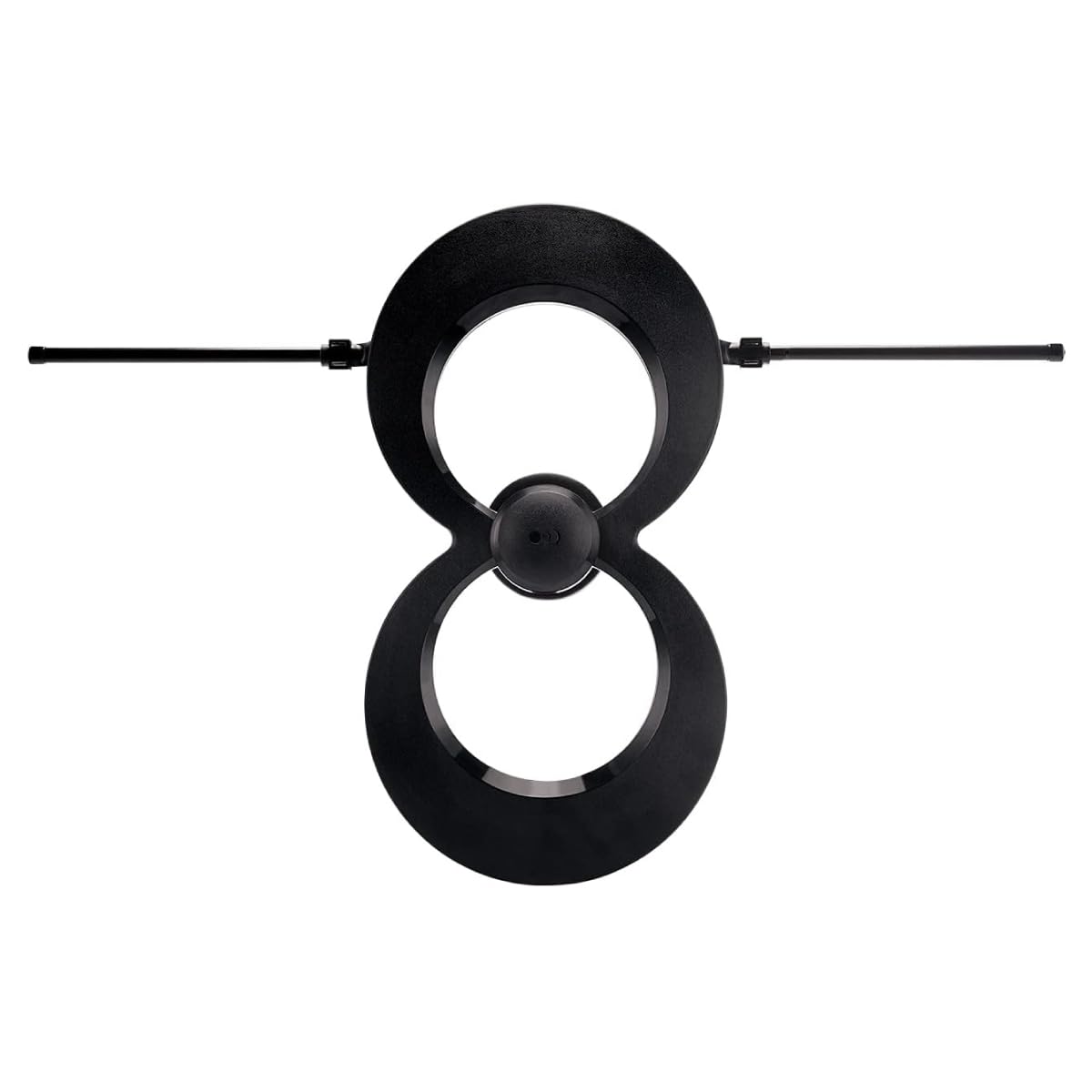
A double-loop with a 65-degree beam that catches clusters front and back without needing a razor aim.
The ClearStream MAX-V is what you buy when your towers are clustered loosely in two directions — say, half the affiliates north and half south. Its double-loop shape uses multi-directional UHF and Hi-VHF elements with a 65-degree beam angle, so it holds reception from the front and the back of the antenna at once. It is rated to 60 miles, and it takes up a compact 17.4″ H x 27″ W x 3.5″ D, with a steel wall bracket in the box for a low-profile wall mount.
Channel count is what people talk about most with this one. It routinely pulls over 100 channels including major networks, and it works where other antennas have already failed — a genuine advantage in tricky spots. Assembly is quick, on the order of 10 minutes with minimal parts, and it does look tidy on a wall. It is listed as compatible with NEXTGEN TV, 4K, 8K UHD and Full HD 1080p with no internet connection needed.
Here is the honest limit: VHF reception splits opinions on this model. Some installations get strong VHF signals across the board, others find VHF stations marginal — a real-world outcome that depends on your local broadcast mix. Every market is different, so check your own station map before committing. It also does not provide cable-only channels, which is true of every over-the-air antenna but worth saying plainly.
Reasons to choose it
- 65-degree beam angle catches towers front and back without precise aiming.
- Pulls over 100 channels in many markets, including where other antennas struggled.
- Roughly 10-minute assembly with a wall bracket and mounting hardware included.
- NEXTGEN TV, 4K and 8K ready.
Reasons to hesitate
- VHF performance is inconsistent across markets — a station-map check is essential.
- Coax cable is not in the box.
- 60 miles is mid-pack for this tier — not a fringe-reception tool.
Reach for it when: your towers come from two compass directions and you want a compact, low-profile wall mount.
Look elsewhere if: your must-have channels are VHF and distant — a uni-directional long-boom model will serve you better.
8. Five Star Outdoor HDTV Antenna

The everything-in-the-box option — antenna, J-pole, mounting bracket and a splitter for four TVs.
Five Star’s value is in what arrives on the porch. The package includes the antenna, mounting bracket, J-pole and a TV splitter, so multi-set homes can run up to four televisions without buying extra pieces. It is a multi-directional design with extended elements, rated to 200 miles on paper, and it handles both VHF and UHF plus 1080p and 4K, with ATSC 3.0 readiness listed too. Physical build runs 46″L x 28″W x 25″H.
Shoppers say it pulling in dozens of channels — over 30 is normal, up to 82 in good spots — with crisp picture and no more costly cable bill. Installation gets strong marks too: the assembly is easy, and the included kit means fewer trips to the hardware store. For tightening up a multi-TV setup, that splitter is a real convenience.
Now the size-honest version. That 200-mile claim does not hold for everyone — some owners pick up three stations about 40 miles out, and others find VHF reception poor and that the antenna stops short of the advertised distance. Treat range claims here as best-case marketing and size your expectations to your actual tower distance. Reception quality is the aspect most likely to leave you wanting more if you are far out.
Where it delivers: a full install kit plus splitter, easy assembly, and 30+ channels for buyers inside useful range.
Where it disappoints: the mileage claim runs ahead of reality in some markets, especially for distant VHF.
Match it to: a home splitting one antenna across up to four TVs where everything arriving in one box saves real time.
Be cautious if: you are at the edge of signal range — the marketing range is generous.
9. Antennas Direct Element Uni-Directional Outdoor Antenna

Focused, precise reception for clustered towers — the uni-directional specialist at the top of the field.
Your broadcast towers all sit in one tight band on the horizon, so the Element is built for you. It is uni-directional by design — it concentrates reception in one arc rather than spraying it around — and it is pitched a step ahead of conventional Yagi designs. Peak gain is listed at Hi-VHF 6.7 dBi and UHF 9.2 dBi across Hi-VHF 174 to 216 MHz and UHF 470 to 608 MHz, which is the kind of figure you aim at the right compass bearing rather than bolt up and hope.
You get fold-out elements, all-weather mounting hardware, and a design that installs on an existing outdoor mast or in an attic. The 2.6-pound unit is compact enough to tuck into a suburban or rural attic, and the fold-out shape speeds installation. Signal reception is the aspect that earns it its slot — it is a genuine VHF performer in a category where VHF usually gets neglected, and in one test it measured a 7% gain in VHF signal strength after the swap.
Be realistic about the ceiling. It is rated to 60 miles, which is modest for a dedicated long-boom directional, and its real payoff only shows up when towers sit in one direction. Aim it wrong and the focus works against you. It is a specialist’s tool: precise, well built, and worth the effort if your station map clusters, but a poor fit for scattered towers.
The case for it: true uni-directional focus with 6.7 dBi VHF and 9.2 dBi UHF gain, built to pull VHF that other antennas neglect.
The case against: 60-mile range and a narrow balance mean it needs a properly aimed install on a clustered market.
Choose this if: you can see all your towers in one compass direction and want a precise, compact pull in the attic.
Choose a multi-directional instead if: your stations are scattered — this one will lose focus.
Know the Specs
The spec sheet matters, but only three numbers actually change what you watch. Here is what each one means in plain terms.
Gain in dBi
Gain in dBi (decibels relative to an isotropic radiator — a measure of how much an antenna focuses signal versus a perfect point source) tells you how strongly the antenna pulls in weak stations. A higher number means a stronger, more focused pull on weak stations — but also a narrower balance that demands accurate aiming. Look at VHF and UHF figures separately, because some antennas are strong on one band and weak on the other.
Front-to-back ratio
The front-to-back ratio (in dB) measures how well the antenna shuts out signal arriving from behind it. A higher figure means fewer reflections and less ghosting or pixelation, which is why directional long-boom models tend to hold a steadier picture than short omni types in tricky terrain.
Frequency range
Frequency range is the span of broadcast channels the antenna can pull in. VHF typically sits around 170–230 MHz, UHF around 470–860 MHz (some antennas top out lower, near 608 or 790 MHz). If a station is outside the listed band, no amount of aiming will bring it in — check your market’s station list first.
Rated range
Rated range is the maker’s best-case distance to broadcast towers, usually measured with a clean path and no obstacles. Trees, hills, siding material and roof pitch all eat into that number. Treat the printed mileage as a ceiling and choose a model with headroom over your actual tower distance.
Common Questions
Do I need an amplified antenna or a passive one?
Will an outdoor TV antenna pick up both VHF and UHF stations?
Can I install a TV antenna in my attic instead of the roof?
How far from the broadcast towers can I realistically be?
Does an outdoor antenna still work during a storm?
Is an ATSC 3.0 or NEXTGEN TV compatible antenna a requirement?
How many TVs can I run off one outdoor antenna?
Directional or omnidirectional — what is the real difference for my house?
Do I need to run a channel scan after installing?
The Bottom Line
For most households dealing with distant towers and unpredictable signal, the antenna worth saving for is the Televes DAT BOSS Mix LR 149884. Its band-by-band TForce amplification (38 dBi VHF, 46 dBi UHF) and integrated LTE/5G filtering solve the problem that trips up every simpler amplified model — weak stations lost to overload. A near-five-star average across hundreds of owner ratings backs the pick.
If you want the safest possible install in an attic and a proven 30+ channel history, the RCA Compact Outdoor Yagi is where most buyers will happily land. And for RV owners or anyone whose stations come from all directions, the Channel Master Omni+ 50 removes the aiming job entirely. Buy one of these three, run a channel scan, and cancel the cable box.
How we choose
We do not accept paid placement. Every pick is matched to a real buyer and a real use-case; we do not hands-on test units.
Sources
Specifications: manufacturer listings and product documentation. Review insights: verified customer reviews, as of November 2026. Pricing: not shown on this page (it changes often); check the current price via the retailer link.
As an Amazon Associate, Tactical Gear Guy earns from qualifying purchases. This does not affect which products we feature.