Specs are compiled from manufacturer listings and verified buyer reviews and can change over time — please confirm the key details on the product page before buying.
If you only paddle lakes, almost any inflatable will do. Rivers are different — moving water pushes back, so you need a hull that self-bails (drains water that splashes in), tracks straight, and shrugs off a rock scrape. The short answer: the Sea Eagle SE370 Pro is the safest all-round river buy for most people, the AIRE Tributary Spud is the boat for a solo paddler who wants something that folds into a duffel, and the Sea Eagle 420X is the one to get if you plan to run Class IV rapids (advanced whitewater) with camping gear stacked behind you.
This guide is built by comparing the manufacturers’ published specifications and the patterns across verified customer reviews, so you get each pick’s real strengths and trade-offs instead of marketing spin.
Rivers reward hull shape over the biggest number on the box, and this breakdown matches each boat to the water you actually paddle. Below you will find the honest differences between the leading options for the best inflatable river kayak.
Top Picks

How To Choose The Best Inflatable River Kayak
A river kayak is judged by what happens when the water gets pushy. A lake boat can be flat, wide, and simple. A river boat must shed water, hold a line in current, and survive contact with rock. Those three jobs drive every choice below.
Self-Bailing Drain Valves
Self-bailing valves are open holes in the floor you can close for calm water and open for rapids. With them open, water that splashes in drains straight back out instead of pooling around your legs. Without them, you sit in a bathtub and lose stability fast. Count and placement matter more than the marketing badge.
Floor Rigidity and PSI
The floor is what your weight pushes against. A drop-stitch floor uses thousands of internal threads to lock two fabric sheets into a firm panel, and it is rated in PSI — pounds per square inch, the air pressure it holds. More pressure generally means a stiffer floor under your feet. A soft, low-pressure floor rolls up smaller but flexes with every stroke.
Rocker and Tracking
Rocker is the upward curve at the bow and stern. More curve lets the boat ride over waves and turn faster. Less curve tracks straighter on a long flat stretch. Most river boats split the difference, and a removable rear skeg (a small fin under the stern) adds straight-line tracking you can pull off for shallow, rocky runs.
Capacity and Seating
Capacity is the total weight the hull carries, paddlers plus gear. Two adults plus a cooler and dry bags add up faster than most people expect. Check the stated weight limit, then leave a margin. Seat height and back support decide how you feel after three hours, not the first ten minutes.
Side-by-Side Comparison
| Model | Best For | Capacity | Weight | Water Rating | Amazon |
|---|---|---|---|---|---|
| Sea Eagle SE370 Pro★ Best Overall | All-round river and lake use | 3-person rated | 33 pounds | Class III whitewater | Amazon |
| S AFSTAR 2-Person CanoeBest Value Tandem | Budget tandem with room for gear | 507 lbs | 39 pounds | Whitewatering | Amazon |
| AIRE Tributary Spud | Solo paddler, packable | 1-person | 21.5 lbs | — | Amazon |
| BEYOND MARINA Explorer | Couples on long days | 507 lb | 38.5 lb hull | Rough waves and fast currents | Amazon |
| Sea Eagle 380x Explorer | Whitewater plus flatwater touring | 750 lbs | 40 pounds | Class IV whitewater | Amazon |
Detailed Reviews
1. Sea Eagle SE370 Pro Package Inflatable Sport Kayak
Our pick — 4.0+★ from 1,500+ verified ratings; the strongest balance of quality and price.
Rated for Class III whitewater, packed with paddles, seats and a pump — a complete kit that gets you on the water with nothing else to buy.
The headline here is the water rating: Sea Eagle builds this hull for Class III whitewater, which means it is designed for rapids with moderate waves and a bit of maneuvering required. That is a step beyond the calm-lake inflatables most buyers start with. You also get the whole kit in the box — two deluxe seats, two four-part paddles with aluminum shafts, a foot pump, two skegs and a storage bag.
It weighs 33 pounds and the company says it packs into a space small enough for the smallest car trunk. For river trips where you drive to the put-in and carry the boat a few hundred yards, that matters more than any spec on a chart. The seats sit you 5 inches off the floor and are 14 inches wide, 21 inches deep and 19 inches tall — enough back support for a long downstream push rather than a floating lounge chair.
Build quality is the strongest theme in owner reviews, with inflation speed a close second. Owners routinely get it float-ready in a matter of minutes and roll it back into the bag without a wrestling match. The honest catch is stability — this is the one point where opinion splits. Some find it surprisingly hard to tip; others feel it is less planted in chop than a wider hull. The SE370 is 34 inches wide, and the wider tandem boats in this guide give you more of a barge-like feel.
What earns the top spot
- Class III whitewater rating for real moving-water use
- Complete kit: 2 seats, 2 paddles, foot pump, 2 skegs, bag
- 33 pounds and it fits in a small trunk
- Seats hold you 5 inches off the floor with tall back support
- Open-and-close drain valves make emptying it quick
Where it asks something of you
- Stability draws split opinions — the narrowest feel among the tandems here at 34 inches wide
- Durability is rated positive overall but a share of owners note wear over time
Go with this if: you want one boat that handles a river run and a lazy lake day without buying a second hull.
Think twice if: you want maximum width and a planted feel under two full-grown adults.
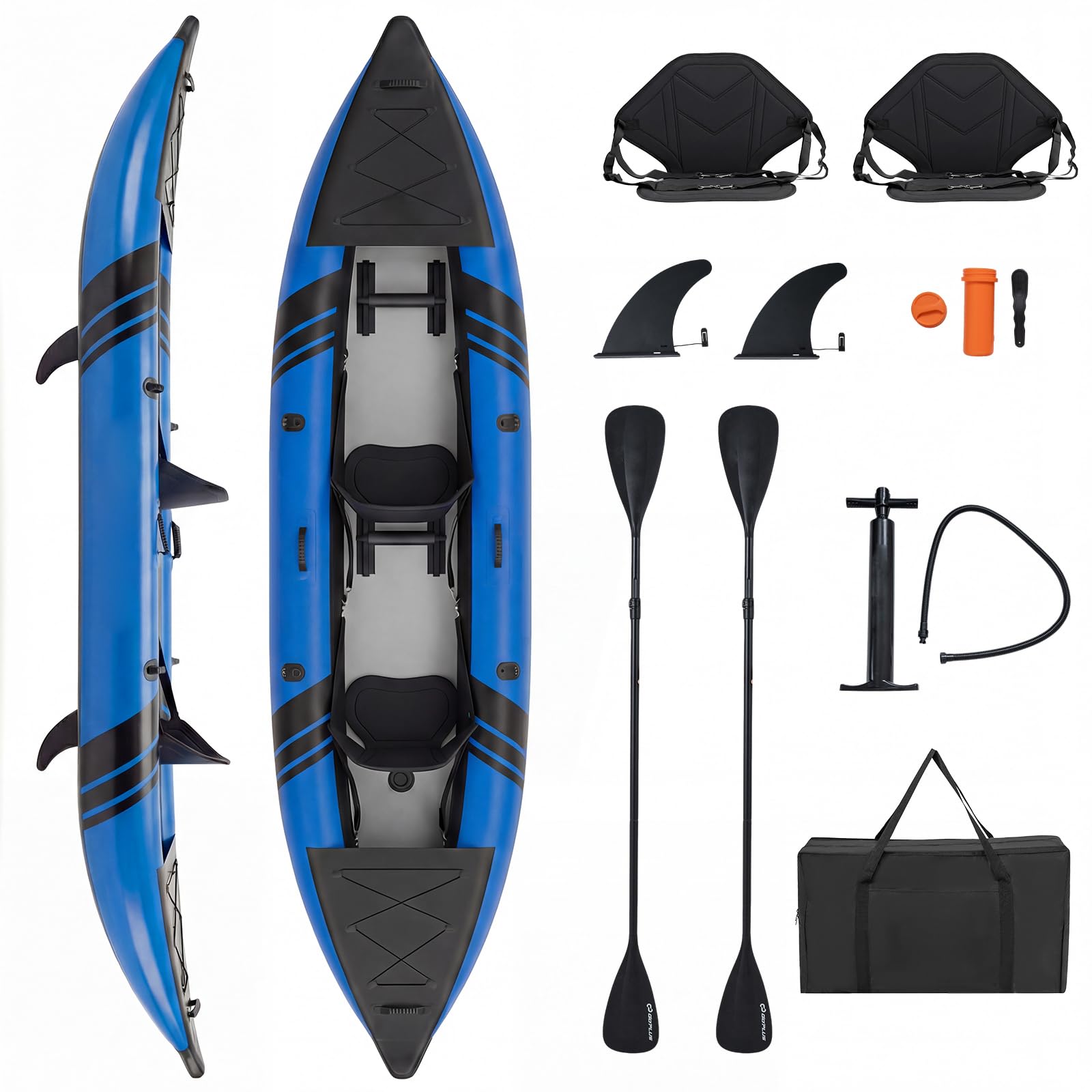
2. AFSTAR Inflatable Kayak 2 Person
Twelve and a half feet of PVC with a stiff drop-stitch floor, and it still folds into a trunk.
Stretch this one out and the first thing you notice is length: 12.5 feet. That is a full foot and a half longer than the AIRE Spud, and the extra hull translates into more room for a cooler, dry bags and a fishing rod. The capacity backs that up at 507 lbs, matching the BEYOND MARINA figure exactly, so two adults plus gear is a realistic load rather than a hopeful one.
The floor is drop-stitch, meaning it is built from two fabric sheets tied together by thousands of internal threads so it inflates into a firm panel. Under your feet that reads as support when you push off a rock or shift your weight to turn. Safstar also fits three air chambers and says you can have all of them inflated within 8 minutes, with a screw-in paddle setup that skips the fiddly assembly.
Two removable direction fins give you a choice for river work — run the rear fin alone in complex water so you do not snag, or both fins in clear water for straighter tracking. There are paddle holders on both sides so your hands are free to grab a drink, and three-level adjustable footrests brace your legs when you row. The trade-off with a boat this long and this broad is bulk: at 39 pounds it is 6 pounds heavier than the Sea Eagle SE370, and it runs 37 inches wide against the BEYOND MARINA’s 32. Storage is generous with elastic cord at both ends and zipper pockets behind the seats.
Room to spare: the 12.5 ft hull and 507 lb limit make this the practical tandem for two adults who pack like they mean it.
One thing to plan for: the 90-day warranty is short for river use, so inspect seams early and register the purchase.
Worth reaching for when: gear volume matters and you want a long, stable platform on a budget.
Leave it on the shelf if: you paddle alone — a 12.5 ft tandem is a lot of boat to turn by yourself.
3. Inflatable Kayak Tributary Spud by AIRE
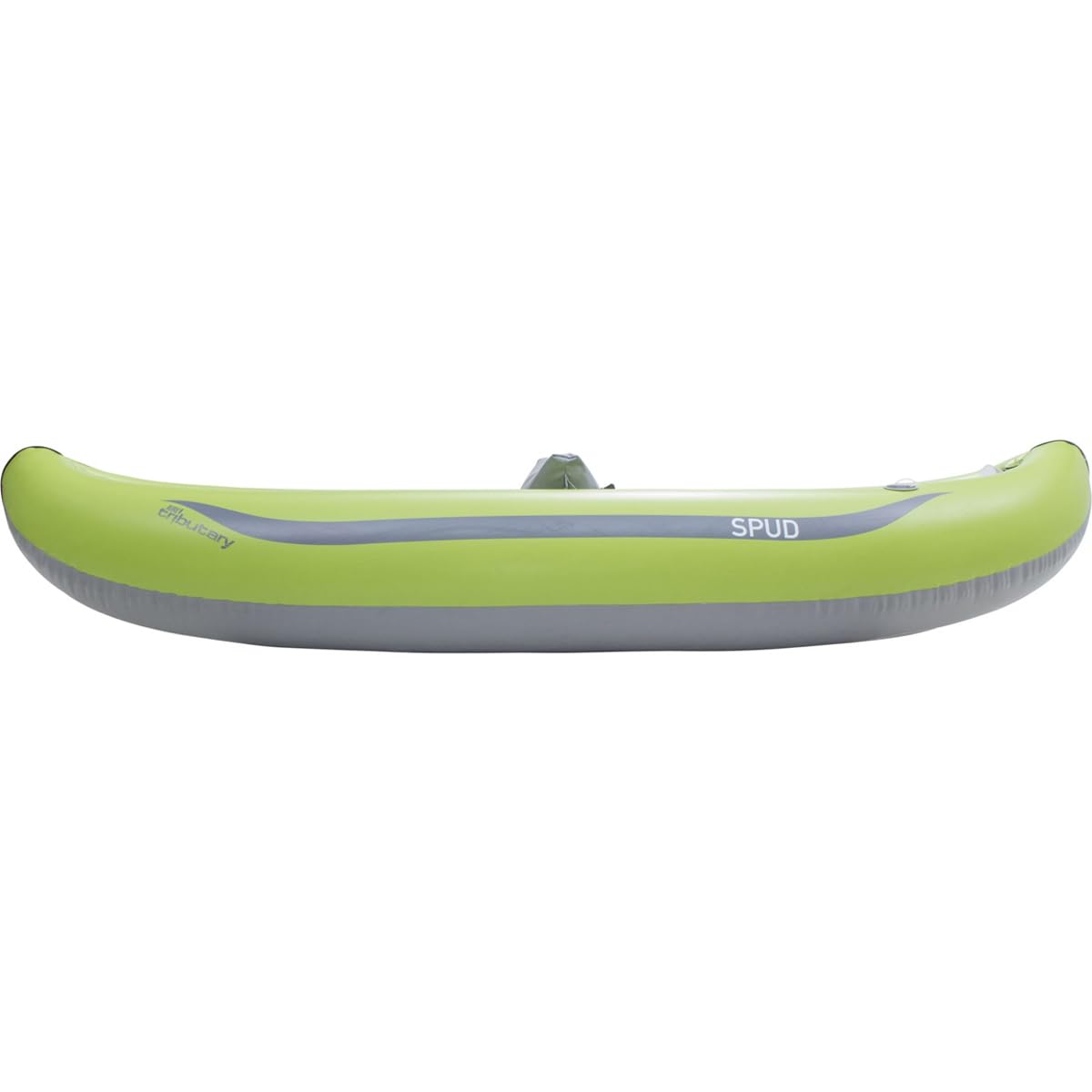
A one-person packraft-style hull at 21.5 pounds — light enough to hike in, tough enough for rocks.
Where the tandems here carry two or three people, this AIRE seats exactly one, and the comparison is stark — the BEYOND MARINA is a two-person boat against this single-seater. A solo hull is narrower, quicker to turn in a current, and far less boat to wrestle when the wind picks up.
The build is the selling feature. AIRE uses vinyl AIREcells with welded seam construction and double-zipper access, and the base fabric is a 1000-denier material at 23 oz per square yard. That 1000-denier cloth is heavy-duty fabric built to slide over gravel and rock without tearing. Air retention comes from radio-frequency welded seams rather than glue, which is the more durable way to join vinyl on a boat that flexes constantly.
At 21.5 pounds it is the lightest kayak on this list by a wide margin — the Sea Eagle SE370 is 33 pounds for comparison. Dimensions run 7 ft. 2 in. long and 35.5 in. wide, short enough that it turns on a dime but still buoyant enough to float you and a day pack. You get an adjustable inflatable seat, six sets of cargo loops for lashing gear, and a repair kit in the box. The honest limit: it is a solo boat, so a couple needs two of them, and the shorter length means it will not track as straight across a big lake as the longer hulls here.
Built for: the solo paddler who wants a boat they can carry under one arm and store in a closet.
Not the one for: a pair who wants to paddle together — you would need two hulls.
4. BEYOND MARINA Inflatable Kayak 1/2/3 Person Full Drop Stitch

A 19.7-inch hull — about 4 inches deeper than the S AFSTAR — to keep rough water on the outside.
The number that defines this boat is hull depth: 19.7 inches, which the maker says is 50% deeper than other brand kayaks. Against the S AFSTAR at 16 inches, that extra 3.7 inches of freeboard matters when a wave rolls in — more wall between you and the river. Full drop-stitch construction extends that logic to the side chambers, not just the floor, so the whole hull inflates into a rigid shape rather than a floppy tube.
Inside, it seats two with a 507 lb capacity and measures 13.77 feet by 32 inches wide. You get two adjustable EVA padded seats, two aluminum paddles with ergonomic grips, two adjustable footrests, a high-pressure hand pump, two quick-release fins, a storage bag and a repair kit. The company says a dual-action pump gets it inflated in under 5 minutes.
Here is the fair caveat. Stability is the mixed point on this hull — some find it super stable and heavy-duty, while others say it is tricky to handle. Depth helps in waves but a 32-inch width is narrower than the S AFSTAR’s 37 inches, and that shows up in how planted it feels at rest. Weight is the other split point: some call it light, some call it heavy, and the hull alone is 38.5 lb before you add seats and paddles. What buyers do agree on is build quality and how easy it is to inflate and deflate.
Why it stays on the shortlist
- 19.7″ hull depth for more freeboard in moving water
- Full drop-stitch build, floor and side chambers both rigid
- Under 5 minutes to inflate with the included dual-action pump
- Complete package with seats, paddles, fins, pump and bag
What to weigh before you buy
- Stability splits opinion — 32 inches wide is narrower than the wider tandem options
- Weight draws mixed reactions, and the 38.5 lb hull figure excludes accessories
Pick this one if: you paddle choppy water and want more hull wall between you and the spray.
Reconsider if: you want a wide, planted feel at rest — the 37-inch S AFSTAR gives you more of that.
5. Sea Eagle 380x Explorer Inflatable Tandem Kayak
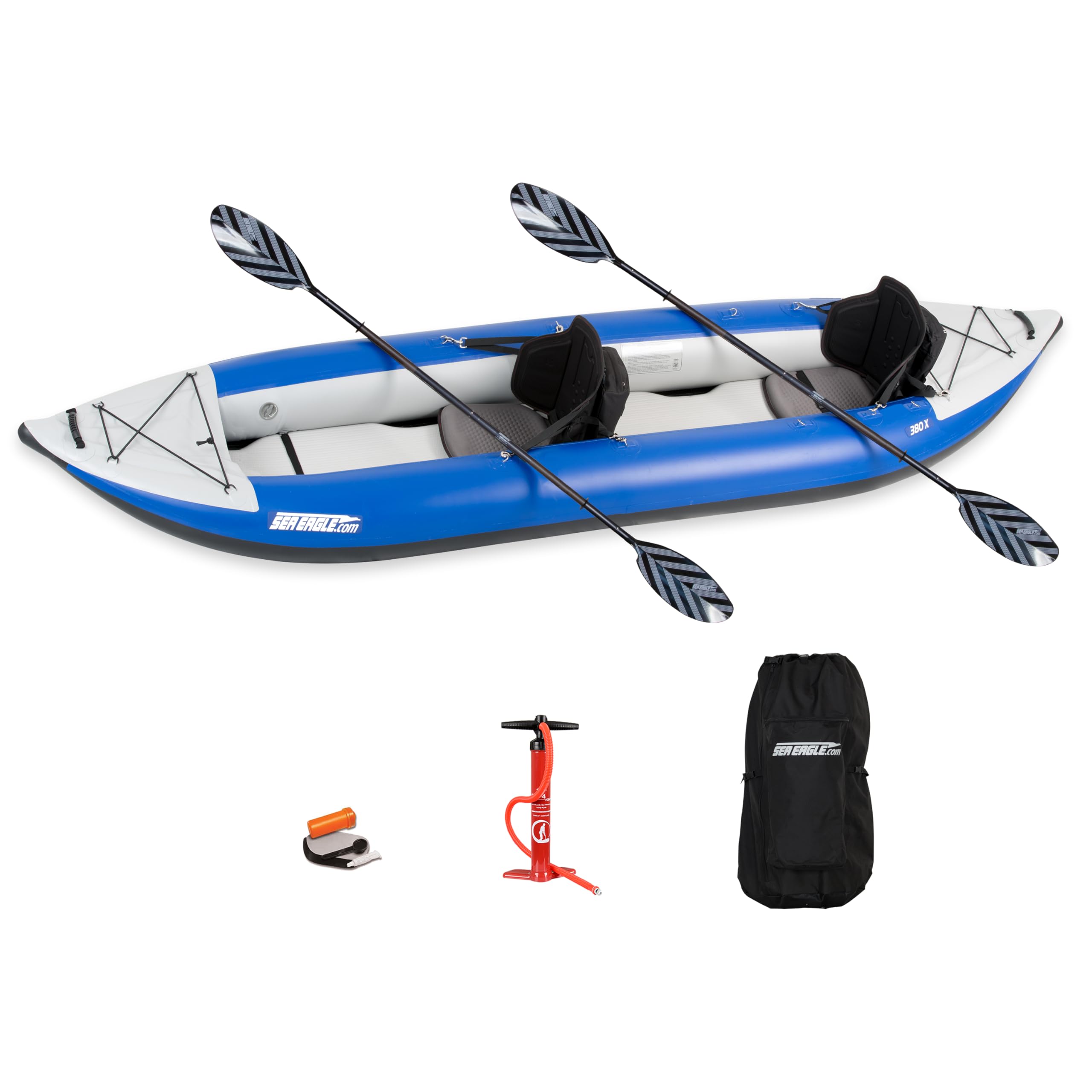
Sixteen drain valves you can open mid-rapid, plus a 10 PSI floor that turns the hull stiff.
Class IV whitewater is serious moving water — big drops, technical lines, water coming over the bow. Sea Eagle rates the 380x to that level, and the mechanism is the 16 rapid self-bailing drain valves. Open them and river water drains straight out of the floor; close them and you have a dry ride for flatwater touring. No bailing bucket, no sponge routine.
The floor is a removable high-pressure drop-stitch panel that inflates to 10 PSI, which is high for an inflatable floor. At that pressure it behaves closer to a hard-shell platform than a soft air mattress, and you feel it when you plant a foot to turn. The hull is 1000-denier reinforced PVC with quadruple-overlapped glued seams, built to bounce off rocks, logs and river debris rather than absorb the hit.
Capacity is the other headline: 750 lbs for two to three adults. Against the S AFSTAR at 507 lbs, this boat carries 243 lbs more, which is the difference between “two of us and a cooler” and “two of us, a cooler, and a full expedition load.” Paddling straight is handled by a removable swept-back rear skeg (a fin you can drop for open water). The catch: a boat this capable is not nimble — maneuverability is the split opinion on this model, with some finding it quick on lakes and others working harder to turn it at first.
The river case: 16 self-bailing valves and a Class IV rating put this in a different league from the flatwater-first picks above.
The real trade: turning a 150-inch hull takes deliberate strokes — plan your lines a little earlier than you would in a shorter boat.
The right call for: paddlers who want one hull that handles rapids and a calm lake tour on the same weekend.
Not ideal if: you mostly play in tight, technical riffles where quick turns beat straight tracking.
Know the Specs
Self-Bailing Valves
These are openable drains in the floor that let river water empty itself out of the boat while you keep paddling. Open them on rapids, close them on calm water for a drier, warmer ride. Boats with 16 valves drain faster than hulls with a couple of holes, which matters when a wave breaks over the side.
Drop-Stitch Floor PSI
The floor’s rigidity is measured in PSI, or pounds per square inch of air pressure. A 10 PSI drop-stitch floor feels closer to a hard panel underfoot, so you lose less energy with each stroke and can shift weight to steer. Softer floors roll up smaller and cost less, but flex more in current.
Weight Capacity
This is the total load the hull is built to carry — paddlers plus gear. Two adults plus a cooler and dry bags add up quickly, so leave headroom. A 507 lb boat suits two people; a 750 or 855 lb hull is for gear-heavy or three-up trips.
Hull Width and Depth
Width across the beam and hull depth together decide how planted the boat feels. A wider hull resists tipping at rest; a deeper hull keeps waves on the outside. Narrow or shallow boats feel quicker to turn but less forgiving in chop.
Common Questions
Can an inflatable kayak actually handle river rapids?
How long does it take to inflate a river kayak?
Is a drop-stitch floor better than a standard inflatable floor?
Do I need a skeg for river paddling?
How much weight can a two-person inflatable kayak hold?
Can one person paddle a two-person inflatable kayak alone?
Will an inflatable kayak puncture on rocks?
How do I store an inflatable kayak between trips?
What is the difference between Class III and Class IV whitewater ratings?
Do these kayaks come with paddles and a pump?
The Bottom Line
The best inflatable river kayak for most people is the Sea Eagle SE370 Pro — a Class III rating, a complete paddle-and-pump kit in the box, and 33 pounds you can lift alone. It is the crowd favorite here, sitting at 4.0+ stars across 1,500+ owners, who consistently report fast inflation, compact packing and durable construction. If you want maximum room for gear on a long tandem day, the longer S AFSTAR gives you 12.5 feet and 507 lbs of capacity. And for serious whitewater with expedition loads, the Sea Eagle 420X and its 855 lb limit is the boat built for the job.
How we choose
We do not accept paid placement. Every pick is matched to a real buyer and a real use-case; we do not hands-on test units.
Sources
Specifications: manufacturer listings and product documentation. Review insights: verified customer reviews, as of November 2026. Pricing: not shown on this page (it changes often); check the current price via the retailer link.
As an Amazon Associate, Tactical Gear Guy earns from qualifying purchases. This does not affect which products we feature.