Specs are compiled from manufacturer listings and verified buyer reviews and can change over time — please confirm the key details on the product page before buying.
An outdoor electrical cabinet has one job: keep rain, dust, and rust away from the wiring that runs your well pump, pool timer, or garage subpanel. Get that wrong and you are re-terminating corroded connections in January. The nine enclosures here all carry a real weather rating, and they split cleanly into two types. Some are breaker load centers with buses and spaces built in. Others are empty junction boxes you fill with your own gear. Decide which one you actually need first, because that single choice narrows this list faster than any spec.
This guide is built by comparing the manufacturers’ published specifications and the patterns across verified customer reviews, so you get each pick’s real strengths and trade-offs instead of marketing spin.
You will see which enclosure survives a coastal winter, which one swallows a Starlink router, and where a welded seam beats a folded one. The short version: pick a NEMA rating that matches your exposure and check the internal depth before anything else — the right enclosure for an Outdoor Electrical Cabinet is one you measure before you order.
Top Picks


How To Choose The Best Outdoor Electrical Cabinet
Start with the load, not the box. A cabinet that holds breakers needs bus bars, spaces, and a main rating. A cabinet that holds a router, a PoE switch, or a pump controller needs nothing but space, a backplate, and a way to get cable in. Mixing those two up is the most common mistake in this category, and it costs a return every time.
Match the NEMA or IP rating to your exposure
NEMA 3R means the enclosure sheds rain and sleet but is not built for hosedown or dust. NEMA 4X adds corrosion resistance and protection from splashing water and hose-directed spray, which matters near a pool or on a coast. IP66 is the international equivalent for protection against dust and powerful water jets. If your cabinet sits under an eave and only sees blowing rain, a NEMA 3R load center is enough. If it faces full weather or lives near salt water, go with 4X or a 304 stainless body.
Measure the internal depth, not the outside
The advertised figure is the outside dimension. Once you add a mounting plate, a breaker, cable glands, and the bend radius of a thick conductor, usable space shrinks fast. Manufacturers that publish an internal dimension drawing are telling you something useful. Order the next size up when your gear is close to the limit, and leave room for cable to curve rather than kink against the door.
Look at the door hardware and the gasket
A cabinet is only as weatherproof as its seal. A one-piece molded gasket holds better than a foam strip that compresses unevenly. A reinforced hinge keeps the door aligned so the gasket stays evenly squeezed along the full length. Stainless hardware survives coastal air where plated steel pits. And a keyed latch keeps curious hands out of live conductors. If you plan to open the cabinet often for maintenance, a hinged door with a cam lock is far easier to live with than screws.
Decide between welded steel, stainless, and plastic
Powder-coated cold-rolled steel is the value choice and holds its shape well. 304 stainless costs more but resists rust and salt corrosion without a coating to scratch. ABS and PC/ABS plastic never rusts, never needs grounding, and is light enough to hang on a fence post alone. Each has a place, and the right call depends on how harsh your site is and how heavy a box you are willing to lift onto a ladder.
Side-by-Side Comparison
| Model | Best For | Weather Rating | Capacity | Material | Amazon |
|---|---|---|---|---|---|
| Siemens W0816ML1125CU★ Best Overall | Whole-property breaker panel | Outdoor load center | 125 A, 8 space / 16 circuit | Copper bus, steel body | Amazon |
| Siemens W0204ML1060UCompact Pick | Small subpanel feeds | Outdoor enclosure | 60 A, 4 circuits | Plastic | Amazon |
| CXCESNS 16x12x8 NEMA 4XBest Steel Build | Well pumps and timers | NEMA 4X / IP66 | 16″ x 12″ x 8″ | Welded cold-rolled steel | Amazon |
| Joinfworld Outdoor WiFi Enclosure | Routers and PoE gear | NEMA 4 | 15.7″ x 11.8″ x 7.1″ | ABS with stainless latches | Amazon |
| ANIMACYN Waterproof ABS Box | Ventilated gear housing | IP65 | 15.7″ x 11.8″ x 7.1″ | ABS plastic | Amazon |
| QILIPSU UL 94 V-0 Box | Fire-sensitive installs | IP66 | 16.4″ x 12.4″ x 7.1″ | PC/ABS alloy | Amazon |
| VEVOR NEMA Steel Enclosure | Big multi-device jobs | NEMA 4X / IP66 | 24″ x 24″ x 8″ | Welded alloy steel | Amazon |
| Yeaborn 304 Stainless Box | Coastal and industrial sites | IP65 | 16″ x 12″ x 8″ | 304 stainless steel | Amazon |
| Square D HOM816M100PRB | 100 A outdoor service | NEMA 3R | 100 A, 8 space / 16 circuit | Tin-plated aluminum bus | Amazon |
Detailed Reviews
1. Siemens W0816ML1125CU 125 Amp Outdoor Load Center
Our pick — 4.5+★ from 500+ verified ratings; the strongest balance of quality and price.
Sixteen breaker slots fed by a 125 amp main — this is a full outdoor service panel, not a hobby box.
Running a shop, a detached garage, or a well house off its own outdoor panel? The 125 amp main and 16-circuit capacity on this Siemens are the numbers that decide it. You get eight spaces that expand to sixteen circuits with tandem breakers, so a whole outbuilding’s lighting, receptacles, and a 240-volt tool circuit all land in one cabinet. The 13 lb steel body with a copper bus is built to be mounted and left alone, and the made-in-USA build lines up with the reputation these panels carry.
Set it beside its smaller sibling, the Siemens 60 amp enclosure, and the gap is hard to miss. Sixteen circuits against four. A 125 A main against 60 A. At 15.5″L x 13.0″W x 5.3″H this one is the far larger cabinet, and it is the only one on this list that will feed a real subpanel load without running out of spaces. If you are wiring a single pump circuit, the 60 amp unit is plenty; if you are bringing a building to life, this is the cabinet you want.
Owners rate it 4.5+ stars across 500+ reviews, and what wins them over is plain build quality. It arrives square, the door seats flat, and it does exactly what the listing says. The honest catch is size feedback, which splits both ways: a few buyers are surprised at how much wall it occupies once it is up. That is a fit note, not a defect. Measure your intended mounting spot and plan conduit routes before it goes on the wall.
What earns it first place
- 125 amp main with 8 spaces expanding to 16 circuits
- Copper bus and a 13 lb steel body that stays square
- Built in the United States by a panel brand electricians know
Where it asks you to plan
- A large footprint — confirm wall space before ordering
- Overkill if you only need one or two breaker circuits
Reach for this if: you are feeding a detached building and need real circuit headroom.
Look elsewhere if: a single pump or timer circuit is your whole job.
2. Siemens W0204ML1060U Circuit Breaker Enclosure
Four circuits, a 60 amp main, and a plastic body light enough to hang one-handed.
For a hot tub, an outdoor receptacle run, or a small pump disconnect, this is the sensible size. It handles 120/240 volt single-phase service across four circuits with two 1″ spaces, and it weighs 4.3 lb, so you are not fighting a steel cabinet onto a ladder. A single-phase, three-wire layout covers the common residential cases without giving you unused capacity you paid for.
The enclosure itself is straightforward: 7″L x 5″W x 3-1/16″D and plastic, so it never rusts and never needs bonding. It goes up fast and the wiring is uncomplicated. Owners consistently describe it as well-built and as-described, and it works without fuss.
Here is where you need to slow down. The inside is tight. A GFCI breaker is a snug fit, which is the most-repeated fit complaint on this cabinet, and there is no ground bar included — you supply your own. Neither is a flaw in the enclosure, but both change your parts list before you start. Buy the ground bar with the box, and confirm your breaker type clears the cover before you mount it.
The tight-fit reality: four circuits in a plastic shell this small means internal clearance is the spec that matters, not the outside dimensions. Check your breaker depth first.
Add to the cart: a separate ground bar and the correct breaker clips, because neither comes in the box.
Suits: a small outdoor disconnect or a two-to-four circuit branch run.
Skip it for: any job where you know you will add circuits later — there is no room to grow.
3. CXCESNS Outdoor Electrical Box 16x12x8 NEMA 4X IP66
One-piece welded steel with a keyed cam lock and a backplate that lifts out for wiring.
Full-sun exposure on a fence line or a pool pad is where this cabinet makes its case. The body is 1.5 mm (0.059 in) welded cold-rolled steel, polished and powder coated so it resists rust and stays square. A square body is not a cosmetic point — it means the door seals flat instead of bowing and letting water past the gasket. The one-piece molded gasket and precision door lip are rated IP66 for powerful water jets and NEMA 4X for corrosion resistance, indoors and out.
Compared with the Joinfworld plastic enclosure, this is the sturdier option at the same general footprint: 8″D x 12″W x 16″H versus 7.1″D x 15.7″W x 7.1″H, so you get real depth for cable bends and a steel shell that will not flex. The galvanized backplate lifts out so you can mount breakers, contactors, or timers, then drops back in. Four pre-drilled holes on the back take it to a wall, and the bottom plate fits conduit and cable glands.
Two things to know before you mount it. First, you must install the included bottom sealing plate before outdoor use, or rain can find the cable opening. Second, the advertised size is the outside; buyers report the actual opening comes in smaller than the label implies, so measure your equipment before ordering. The locking cam and the latch are the recurring gripe — they work, but treat them gently rather than forcing the door.
Why owners rate the build
- 1.5 mm welded steel that resists bowing and keeps the gasket flat
- IP66 and NEMA 4X, with a molded gasket and keyed cam lock plus two keys
- Removable galvanized plate makes breaker and timer installs simpler
What you must handle
- Install the bottom sealing plate or rain enters through the cable opening
- Opening measures smaller than the outer label — size up if your gear is close
- Latch and lock need a gentle hand
Best fit: a fixed outdoor install that sees direct weather and needs real internal depth.
Not for: a quick hanging job where a 3.9 kg steel box is more weight than you want on a post.
4. Joinfworld Outdoor WiFi Enclosure 15.7×11.8×7.1
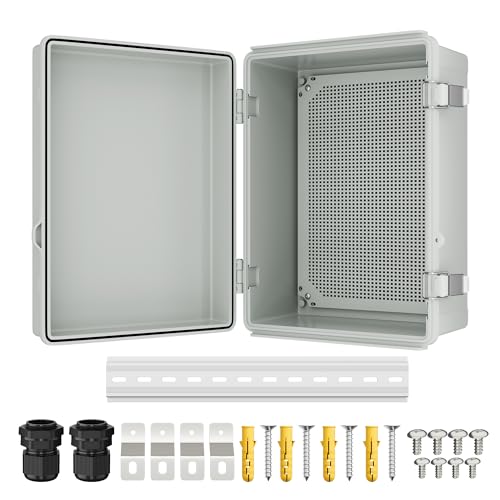
A plastic cabinet built around a DIN rail — the one detail networking gear actually needs.
If you are putting a PoE switch, a router, or a media converter outside, this is the shape you want. An aluminum DIN rail runs inside so components snap on the way they do in a proper rack, and the ABS body with 304 stainless latches will not rust in coastal air. The 15.7″ x 11.8″ x 7.1″ footprint carries a grid plate and screws, and two NPT1/2″ cable glands come in the box to seal your drilled holes.
Water resistance is where this earning its place: the body is rated NEMA 4 and is described as water-tight, and that seal against driving rain is what makes an outdoor network install viable. It also fits a wide list of jobs, from Starlink gear to pump controllers to irrigation timers. Plastic means no bonding and light handling on a ladder.
One thing to plan around. The closure draws mixed notes — some report a tight seal, while a few mention the mesh shields not snapping in firmly. It is a small detail, but if a perfectly flush cover bothers you, inspect it on arrival and seat the shields before you mount it. There is also no keyed lock, so treat it as a weather shield rather than a security cabinet.
What the rail buys you: a finished-looking network box, not a tangle zip-tied to a backplate.
Check the covers: seat the mesh shields while the box is on the bench, not after it is on the wall.
Made for: outdoor routers, PoE switches, and controllers that want DIN mounting.
Think twice if: you need a lockable, tamper-resistant cabinet — this one has no key.
5. ANIMACYN Waterproof ABS Outdoor Junction Box
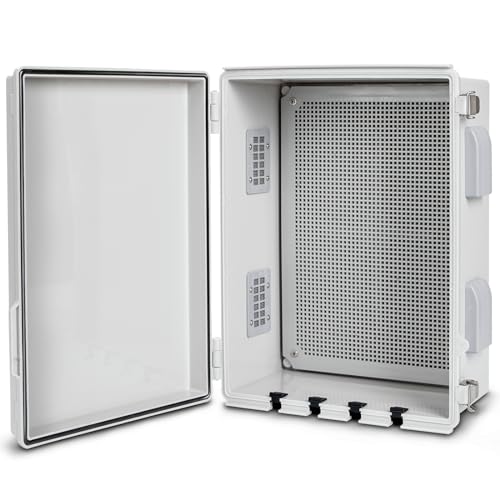
Rain hood vents on both sides keep continuously running gear from cooking itself.
Routers, solar controllers, and media adapters put out heat, and a sealed plastic box turns into an oven by August. This ANIMACYN cabinet addresses that directly with vented rain hood lugs on both sides for air circulation and heat dissipation, offset so rain does not run in. Sealing gaskets and sturdy metal latches handle the water side, and it still meets IP65 for dust and water-jet protection.
Wiring it is the easy part. Pre-installed rubber cable glands take different wire gauges, so Ethernet, power cords, and irrigation tubing feed through without cutting the housing or drilling holes. A pre-drilled mounting plate hangs it on a wall or ceiling, and the hinged cover opens wide for maintenance — a real benefit over screw-down lids when you need to check a controller in the rain.
Built from ABS, it will not rust or corrode, and buyers are consistently happy with the weatherproofing and the roomy interior. What stands out is how easy it is to live with: mounting is quick, the size gives you space to route cable, and it does what it says. The one edge is that ABS is not a security material and it offers less impact resistance than steel — keep a running router indoors and this is not your cabinet.
Why it earns a ventilation slot
- Rain hood ventilation lugs on both sides for heat dissipation
- Pre-installed rubber cable glands take multiple wire gauges
- Roomy interior with a hinged cover that opens for service
Where it stops
- ABS body offers less impact resistance than steel
- Not a lockable security enclosure
Pick this one for: a running router, solar controller, or media converter that needs airflow.
Look past it if: you are protecting a device that needs tamper resistance or metal impact protection.
6. QILIPSU UL 94 V-0 Waterproof Outdoor Electrical Box
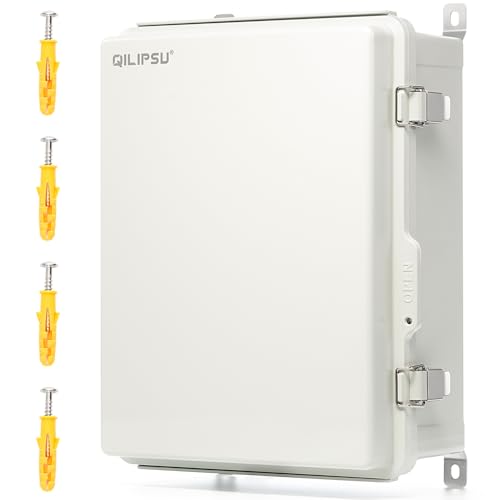
Built from flame-retardant PC/ABS that self-extinguishes within 10 seconds once the flame is removed.
For anyone who takes wiring safety seriously, this is the cabinet with the most specific fire story. The body uses UL 94 V-0 rated flame-retardant PC/ABS material that has passed a 960°C glow-wire test. That means the plastic itself resists ignition earlier than ordinary ABS, and it stops burning quickly if a fault produces heat. Your phone’s QR reader will not care, but the inspector who signs off on the install often will.
Water protection is IP66, rated for water and dust indoors and out, and the included solid mounting plate makes equipment installs simple. The 16.4″ x 12.4″ x 7.1″ cabinet is easy to drill for cable entries, so you can lay out lighting, PoE, cameras, or Starlink gear the way your site needs. Wall and pole mounting are both supported, which opens up a fence post or a mast when a wall is not handy.
The size is the number to read carefully. The outside is 16.4″ x 12.4″ x 7.1″ (415 x 315 x 180 mm), and internal space is smaller — the maker points you to a dimension drawing, and you should use it. A cabinet this roomy swallows coiled cable and a switch, which is what owners like about it, but you have to allow for connectors and cable bends. The seal is also on the snug side, so if the cover is hard to open at first, that is the gasket seating, not a broken latch.
Where the safety spec earns its place: a UL 94 V-0 body with a 960°C glow-wire pass is a concrete difference you can point to, not marketing.
Measure inside: plan around the internal, not the outer, dimensions.
Right for: careful installs near lighting, PoE, or anything where you want flame-retardant material.
Overkill for: a low-voltage gadget box that never sees a live fault.
7. VEVOR NEMA 4X Steel Enclosure, 24 x 24 x 8″

A 24-inch welded steel cabinet that swallows multiple controllers at once.
When the job is bigger than a single device, this VEVOR is the roomiest on the list at 24″W x 24″H x 8″D. At 41.8 lb of 1.5 mm cold-rolled steel, it is built to hang on a wall and stay square. It complies with NEMA 4X and IP66 for water and dust, and the high-strength hinged cover is designed to keep the door from being damaged or bent out of shape. A detachable galvanized backplate slides out so you can install components flat, then bolt it back inside.
The details are thought through too: four wall-mounted holes on the back fix it fast, grounding screws are pre-installed, the bottom is set up for threading conduit, and the cutouts are smooth so they do not chew cable. The high-quality lock core adds a level of security the plastic cabinets cannot match. Buyers describe it as a cabinet that surpasses expectations, and the 1.5 mm welded steel is the reason.
What you should know going in is the lock. The mechanism on this enclosure draws criticism — the key does not always stay put, and some find the lock not as secure as the shell suggests. It is a latch, not a safe. If security is the driving requirement, add a padlock hasp or plan around it. And with a box this heavy, have a second person for the lift.
What justifies the size
- 24″ x 24″ x 8″ internal depth for multiple controllers
- NEMA 4X and IP66 with welded 1.5 mm steel
- Detachable galvanized backplate and pre-installed grounding screws
The trade-offs
- Lock core is criticized — the key does not reliably stay in place
- 41.8 lb is a two-person wall lift
- Far more cabinet than a single small device needs
Best for: a wall of equipment — pumps, a panel, and controllers in one enclosure.
Think about: adding a padlock hasp if the cargo inside is valuable.
8. Yeaborn 304 Stainless Steel Electrical Box 16 x 12 x 8

Polished 304 stainless with a double-slope roof — the coastal box that will not rust through.
Salt air eats painted steel for breakfast, which is why stainless matters here. This 16″ H x 12″ W x 8″ D box is built from 304 stainless steel with a polished surface, so it resists rust and rain corrosion without a coating to scratch through. The double-slope rainproof top sheds water rather than pooling it, and heat dissipation holes on the top and sides give running components somewhere to breathe. A one-time-forming foamed thickened sealing strip handles the water intrusion.
Strong hinges keep the door from bending out of shape under pressure, and the waterproof lock is designed to keep out rain and dust. It is set up for outdoor sites — factories, courtyards, exterior walls, pole mounting — and weighs 9.4 lb, so it is manageable without a crane. The design gets consistent praise; it looks the part on a nice facade.
This is the pick where the honest picture matters most. The build quality on this cabinet is genuinely debated, with some finding it well-built and a few describing it as lighter-made than expected. The locking mechanism is the more consistent complaint — the latch with key has been reported as not working right. And IP65 protects against dust and water jets, but it is not the same claim as the NEMA 4X on the steel box above. Buy it for the 304 stainless that shrugs off salt, not for the latch. Check the lock works and the door seats on arrival, then return if it does not.
Why stainless wins the coast: no paint, no rust-through, no yearly touch-up.
Test the lock first: open and close the latch a few times before it goes on the wall.
Built for: salt-air sites and buildings where a rusted box would be an eyesore.
Look elsewhere if: a reliable keyed lock is a must-have rather than a nice-to-have.
9. Square D Homeline 100 Amp Outdoor Main Breaker Box
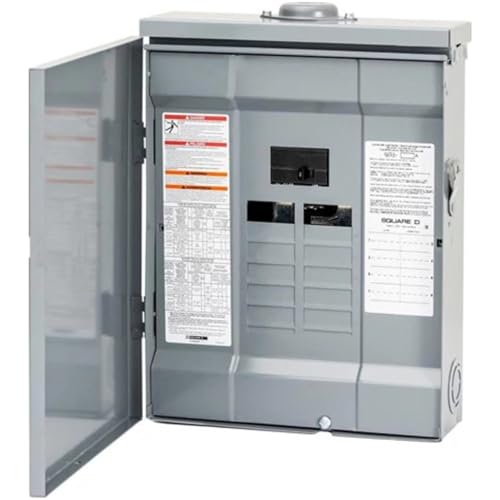
A 100 amp Homeline panel with plug-on neutral — fewer pigtails and a faster tie-in.
For a residential or light commercial outdoor service, this Square D brings a two-pole plug-on neutral main breaker rated 100A at 120/240 VAC single phase. The PoN design lets the neutral land directly on the bar under the breaker, so you skip the trailing neutral pigtail — a small thing that saves time on every circuit. The tin-plated aluminum bus and welded sheet steel enclosure with a baked enamel gray finish are built for outdoor mounting in a NEMA 3R enclosure.
Inside you get 8 spaces that expand to 16 circuits with tandem breakers, distributed neutral bars to keep wiring tidy, and box lugs that accept 6 AWG to 1 AWG copper or 6 AWG to 2/0 AWG aluminum. It is UL Listed and carries a 22 kA breaking capacity, so it has real fault-clearing headroom. The 14.75″L x 4.52″W x 18.92″H cabinet mounts on a surface with its included cover.
It is a smaller panel than the Siemens 125 amp above — 100 A and 16 circuits versus 125 A and 16 — so it is the right call when 100 amps covers the load and you want plug-on neutral without extra pigtails. Buyers rate it on quality and function, and it does the job it is listed for. NEMA 3R means rain and sleet are handled, but hose spray is not — keep it under cover if your site gets pressure-washed.
The PoN advantage: landing the neutral on the bar instead of a pigtail is a real convenience during install.
Weather note: NEMA 3R is rain and sleet, not hose-directed spray.
Fits: a 100 amp outdoor service feeding a home or small shop.
Move up if: your load calculation pushes past 100 amps — the Siemens 125 A has more headroom.
Know the Specs
NEMA vs IP ratings
NEMA is the North American rating and IP is the international one, and they overlap but are not identical. NEMA 3R means the enclosure sheds rain and sleet for outdoor use, but it is not rated for hose spray or dust. NEMA 4X adds corrosion resistance and protection from splashing water and hose-directed spray, which is what you need near a pool or a coast. IP66 covers dust-tight protection against powerful water jets, which is why many cabinets carry both. Match the rating to what your cabinet actually faces — an eave-protected install and an exposed fence line are not the same job.
Load centers vs empty junction boxes
A load center is a panel: it has a main breaker rating, bus bars, and breaker spaces, and it distributes power to circuits. An empty junction box has no bus and no breakers — it just houses equipment such as a router, a timer, or a controller. The two are not interchangeable. A 125 A load center will not hold a Starlink router any better than a plastic box will protect a breaker panel. Decide what is going inside before you shop, because that choice eliminates half the list on its own.
Common Questions
What does NEMA 3R mean on an outdoor breaker box?
Can I put a router inside an outdoor electrical cabinet?
Will a GFCI breaker fit in the Siemens 60 amp enclosure?
Is a load center better than an empty junction box?
Does the metal cabinet need to be grounded?
How much clearance should I leave for cable bends inside the box?
Which box survives salt air without rusting?
Can I mount one of these on a pole instead of a wall?
What does UL 94 V-0 tell me about a plastic cabinet?
Do I need to seal the bottom cable opening before rain hits?
The Bottom Line
For most people wiring a building to code and wanting real circuit headroom, the outdoor electrical cabinet winner is the Siemens W0816ML1125CU because its 125 amp main and 16 circuits feed a whole outbuilding in one welded steel box. If you are housing a router or a PoE switch rather than breakers, grab the Joinfworld Outdoor WiFi Enclosure for its DIN rail and stainless latches. And for a coastal site where rust is the real enemy, the Yeaborn 304 Stainless box is the one to reach for — just check the latch works before it goes on the wall.
How we choose
We do not accept paid placement. Every pick is matched to a real buyer and a real use-case; we do not hands-on test units.
Sources
Specifications: manufacturer listings and product documentation. Review insights: verified customer reviews, as of November 2026. Pricing: not shown on this page (it changes often); check the current price via the retailer link.
As an Amazon Associate, Tactical Gear Guy earns from qualifying purchases. This does not affect which products we feature.