Specs are compiled from manufacturer listings and verified buyer reviews and can change over time — please confirm the key details on the product page before buying.
Buying a press tool is simpler than the listings make it look: match the jaw sizes you actually crimp to the tool that carries them, then decide between a light one-hand unit and a 32KN sledge (32 kilonewtons of squeezing force). Get that wrong and you own an expensive paperweight. Get it right and a copper joint that used to take a torch, flux, and a fire watch takes one squeeze and a few seconds.
This guide is built by comparing the manufacturers’ published specifications and the patterns across verified customer reviews, so you get each pick’s real strengths and trade-offs instead of marketing spin.
You will see jaw ranges in inches, press force in kN (kilonewtons, a measure of squeezing force), and weights in pounds, each tied to a real job-site consequence. The right pick depends on your pipe sizes and how long you hold the tool overhead, which is exactly what the propress plumbing tool roundup below sorts out for you, pick by pick and jaw by jaw.
Top Picks

How To Choose The Best ProPress Plumbing Tool
A press tool is only as useful as the jaws bolted to it. Before you look at force ratings or battery counts, write down the pipe sizes you crimp in a normal week. Then buy the kit that covers them without making you order extra jaws.
Start with jaw range, not horsepower
Jaw sizes are listed in inches and match the fittings they press. A 1/2″ to 1″ kit covers most residential copper and PEX work. A 1/2″ to 2″ kit opens up commercial mains, but those larger jaws also add bulk and weight to the head of the tool.
Match the press force to the pipe you crimp
Press force is measured in kN — kilonewtons, the squeezing power the tool delivers to the fitting. A 24 kN tool presses up to 1 1/4″ copper pipe. A 32 kN tool is built for the heavier end of the range and for carbon or stainless steel jobs.
Weigh the tool against how you work
Weight in pounds is not a spec-sheet vanity number. Holding a tool above your head in a joist bay for an afternoon turns a few pounds into a different job entirely. A one-hand mini press and a full-size kit are separated by real pounds, and you feel every one of them by the last fitting.
Check your battery platform
Some press tools run on a maker’s own battery, and one model here accepts a common 18V platform battery. If your van already carries one brand of cordless tool, a tool that accepts those batteries saves you a charger and a spare battery slot in the case.
Side-by-Side Comparison
| Model | Best For | Jaw Range | Press Force | Tool Weight | Amazon |
|---|---|---|---|---|---|
| Milwaukee 2473-22 M12 Force Logic★ Best Overall | Tight-space residential work | 1/2″ – 1″ | — | 3.8 lb | Amazon |
| Growlush 18V Pro Press Tool KitBest Versatility | One kit across copper and PEX | 1/2″ – 1″ copper, 3/8″–1″ PEX | 32KN | 8 lb | Amazon |
| HHEWLEE Mini Copper Press ToolOne-Hand Pick | One-hand overhead pressing | 1/2″, 3/4″, 1″ | 32KN | 5.7 lb | Amazon |
| SWANSOFT SWPR-1550B | High-volume press runs | 1/2″ – 1-1/4″ | 32KN | 7 lb | Amazon |
| ZUPPER Compact Press Tool Kit | Fast cycles in tight spaces | 1/2″ – 1-1/4″ | 24 kN | — | Amazon |
| Milwaukee M18 Short Throw Press | Heavy repeated pressing | — | — | 23.6 lb | Amazon |
| VEVOR Press Tool | Large-diameter copper runs | 1/2″ – 2″ | 32KN | 54.2 lb | Amazon |
| RIDGID RP 115 Mini Press Tool | Overhead work in tight spots | 1/2″ – 3/4″ | — | 13.9 lb | Amazon |
| DEWALT DCE200M2K | Job documentation and reporting | 1/2″ – 4″ | — | 57 lb | Amazon |
| RIDGID RP 350 ProPress Kit | Full commercial range | 1/2″ – 2″ | — | 7.1 lb | Amazon |
Detailed Reviews
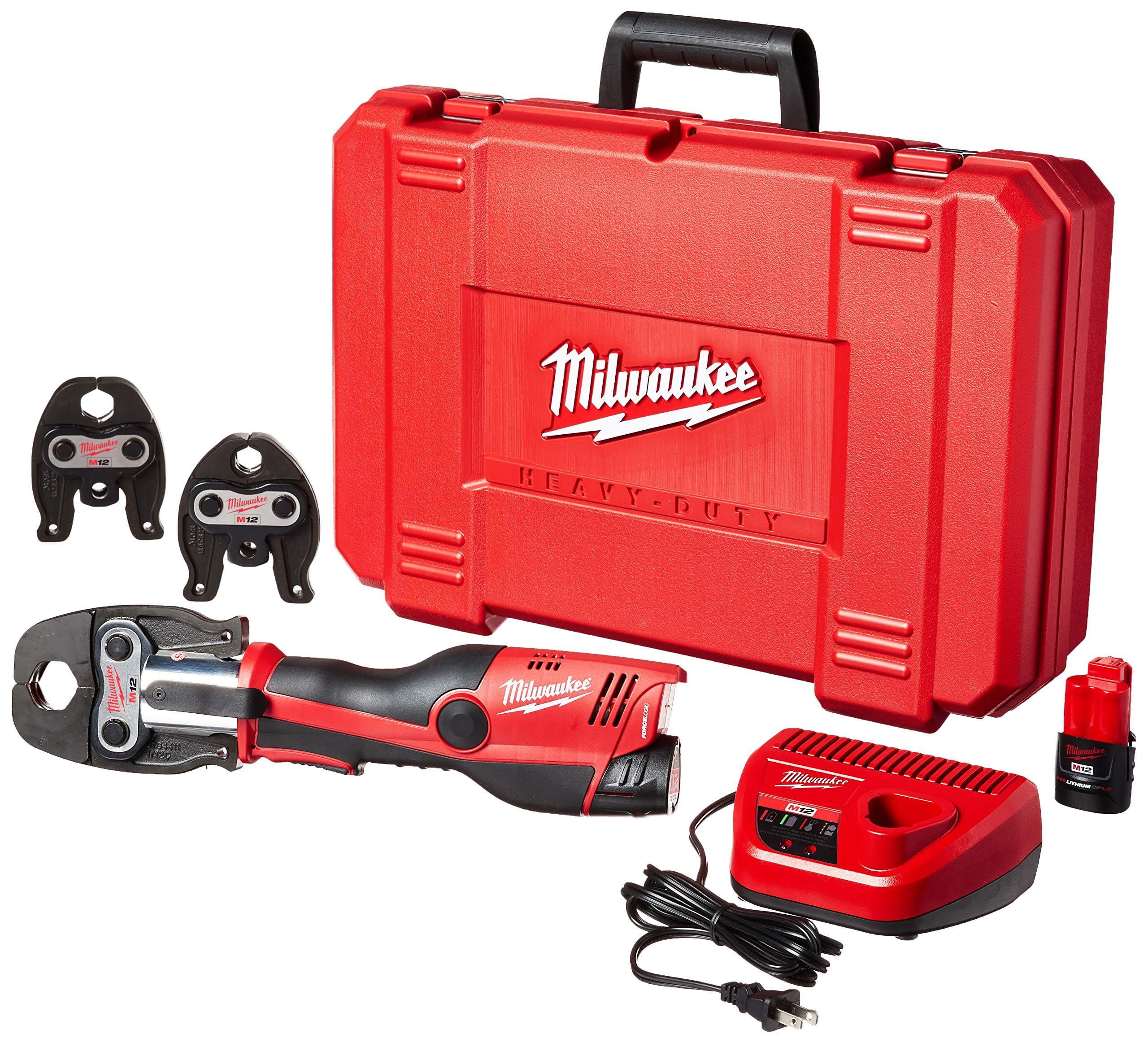
1. Milwaukee 2473-22 M12 Force Logic Press tool 1/2″ – 1″ Kit
Our pick — 4.5+★ from 400+ verified ratings; the strongest balance of quality and price.
The 3.8-pound press tool that ends the torch-and-fire-watch routine on residential copper.
Milwaukee’s 2473-22 is the pick here because it puts the crimping force where you need it and almost none of the weight. At 3.8 pounds it is 4.2 pounds lighter than the Growlush 18V kit, so a full afternoon of fittings overhead in a joist bay does not turn your shoulder into the bottleneck. The kit covers the 1/2″ to 1″ fittings that fill most residential copper work, and the locking jaw pliers in the box mean the jaw locks in place before you squeeze. Cordless operation runs off the M12 lithium-ion platform, and the charger brings the battery back in 30 minutes, so a swap plus a short break gets you running again.
Build quality is the most-praised trait in owner feedback, and the sentiment behind it is overwhelmingly positive. Durability and clean, consistent crimps come up again and again. Ease of use is the next thing you hear: one-hand operation and a jaw that lines up without a fight. Time savings follow close behind, because a press cycle replaces solder, flux, and the wait for the joint to cool. The tool is backed by a 5-year tool warranty.
The catch is that the M12 kit stops at 1″. If your work hits 1 1/4″ or larger, this tool cannot follow you there and you will need a bigger kit. Milwaukee lists the number of batteries as 5 AAA, which reads oddly against the M12 lithium-ion spec in the same listing — confirm the actual battery package with the seller before you check out. As for the crowd: this is the one pick here with 4.5+ stars across 400+ ratings, and the sentiment holds up across all of them.
What earns the top spot
- 3.8 lb body keeps overhead work comfortable through a long day
- 1/2″ to 1″ jaws cover the fittings most residential jobs call for
- 30-minute battery charge means minimal downtime between swaps
- 5-year tool warranty backs the crimping head
Where it stops
- Jaw range tops out at 1″, so 1 1/4″ and up is out of reach
- The battery listing text conflicts with the lithium-ion spec — verify before buying
Make this your daily driver: fit it if your pipe work lives in the 1/2″ to 1″ range and you value a light tool you can carry all day.
Go bigger if: your jobs regularly hit 1 1/4″ fittings, because this kit has no jaw to match.
2. Growlush 18V Pro Press Tool for Copper & PEX Pipes Kit
Eleven die sets in one case, covering copper, PEX rings, and stainless sleeves from 3/8″ to 1″.
Most kits here make you pick a lane. This Growlush setup hands you a 1/2″, 3/4″, and 1″ copper jaw set alongside ASTM F1807 PEX ring dies in 3/8″, 1/2″, 5/8″, 3/4″, and 1″, plus ASTM F877 stainless press sleeve dies in 1/2″, 3/4″, and 1″. If your van runs mixed work — a copper repair in the morning and a PEX repipe after lunch — that coverage is the whole pitch. The 32KN force (about 3.2 tons) is delivered from an 18V lithium-ion battery, and the kit arrives with two batteries and a charger, so one can charge while the other presses.
The slim, compact crimp head is built for the places that slow you down: under-sink cabinets, tight basement corners, and odd angles where a full-size head has to come off the fitting. Reliability is the most-praised trait in owner feedback, and owners keep coming back to it. Build quality and solid crimps follow close behind. It is simple to run, and the value read is positive across the board. Growlush also builds in a reinforced jaw and hydraulic system made to handle 10,000+ cycles, and backs the tool with an 18-month support window.
The honest trade-off is weight and where the head fits. At 8 pounds it is 4.2 pounds heavier than the Milwaukee M12 above, so a long run of overhead crimps will wear on you faster. Owners also flag that it does not fit everywhere — the head angle gets you into a lot of tight spots, but a few cramped connections stay out of reach. The 12″ x 3″ body profile is compact for a kit this loaded, though still bulkier than a dedicated mini press.
Coverage is the draw: copper, PEX, and stainless dies in one box is a genuinely rare combo, and it means you stop swapping tools between pipe types.
Weight is the tax: 8 pounds and a head that will not squeeze into absolutely every corner — the trade for all those die sets.
Reach for this if: your jobs mix copper and PEX and you want one case to cover the whole lot.
Think twice if: every fitting you press is overhead, because those 8 pounds add up fast.
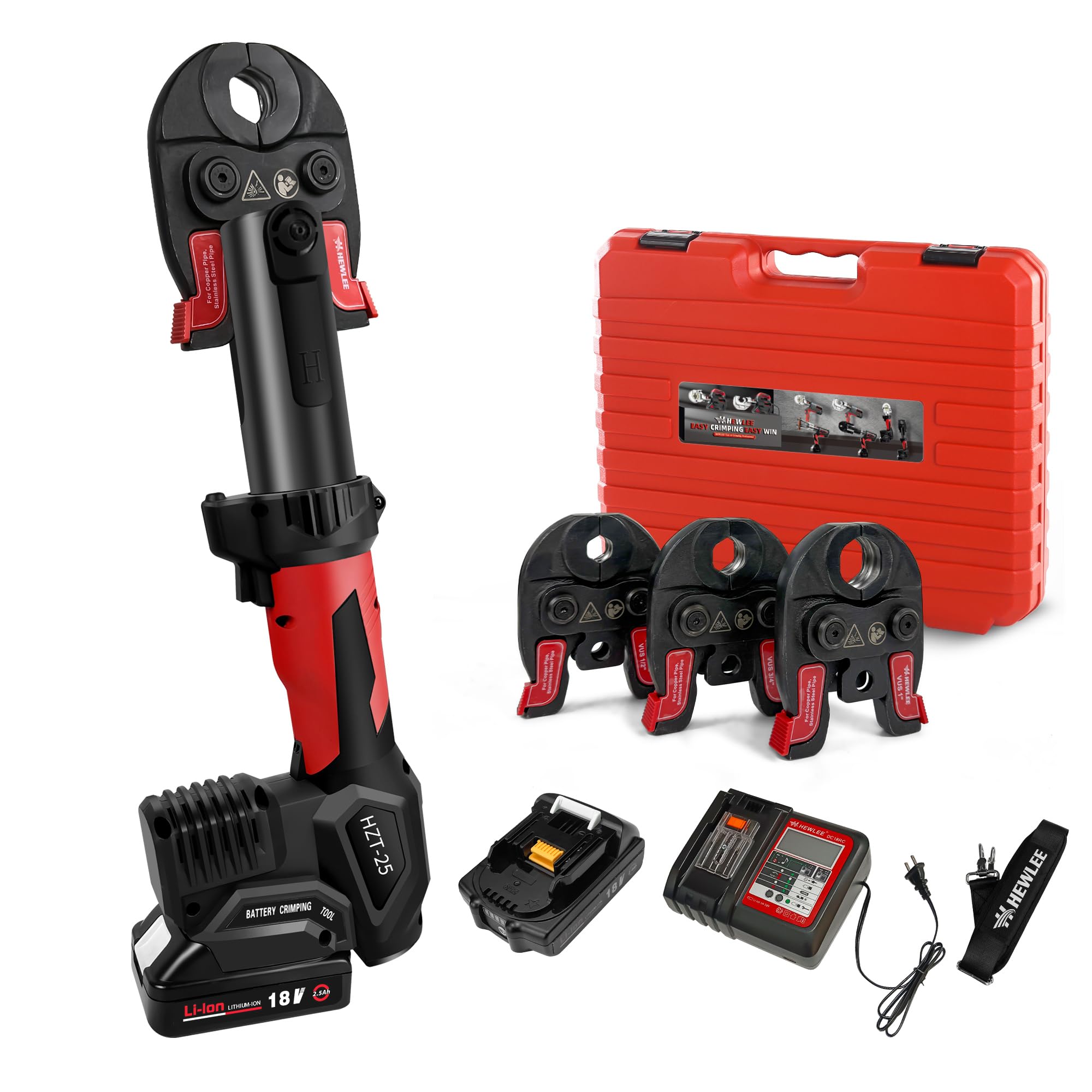
3. HHEWLEE Mini Copper Press Tool
An upright mini press you can finish a crimp with using one hand — and check on a small screen.
The net weight is the headline: 5.7 pounds for the bare crimper, 9.7 pounds once the jaws and battery are on. That is light enough to balance in one hand while you hold a fitting square with the other, which is the difference between a clean press and a re-do in a cramped cabinet. The pure copper motor pushes 32KN of crimping force and finishes a press in 3-6 seconds, with automatic pressure release after each cycle to take the load off the motor. Two 18V 2.5Ah lithium-ion batteries ship in the kit and recharge within an hour.
Quality is the most-praised trait in owner feedback, and it is almost uniformly positive. Functionality is right behind it — owners say it just does the job. Value reads clean across the board. Battery life gets its own nod, with owners noting the cells outlast what they expected from a competitor, and the dual-battery kit means you always have a spare charged. The OLED screen earns its place on a dark job: it shows power level and usage count without you guessing. A 350° rotating head, 360° swiveling jaws, and built-in LED lights handle awkward angles and low-light work.
Here is the honest part. The weight note cuts both ways — 20 owners mention it, and most of them call the tool heavy once the jaw and battery are mounted. That is the 9.7 pound loaded figure talking. The kit also tops out at 1″, so it is not your commercial main-liner. One quirk to note before you start: the charger takes about 20 seconds to recognize the battery, and charging begins once the screen shows 3.0Ah.
Why it fits overhead work: 5.7 pounds net, one-hand operation, and a swiveling head mean you are not fighting the tool while your other hand steadies the pipe.
The loaded-weight reality: 9.7 pounds with jaw and battery aboard is what your arm feels on a long run, so plan for it.
The one-hander that earns its keep: best for service plumbers doing bathroom and kitchen drops who need to press with a free hand.
Not your commercial rig: if your fittings run past 1″, this kit has no jaw for you.
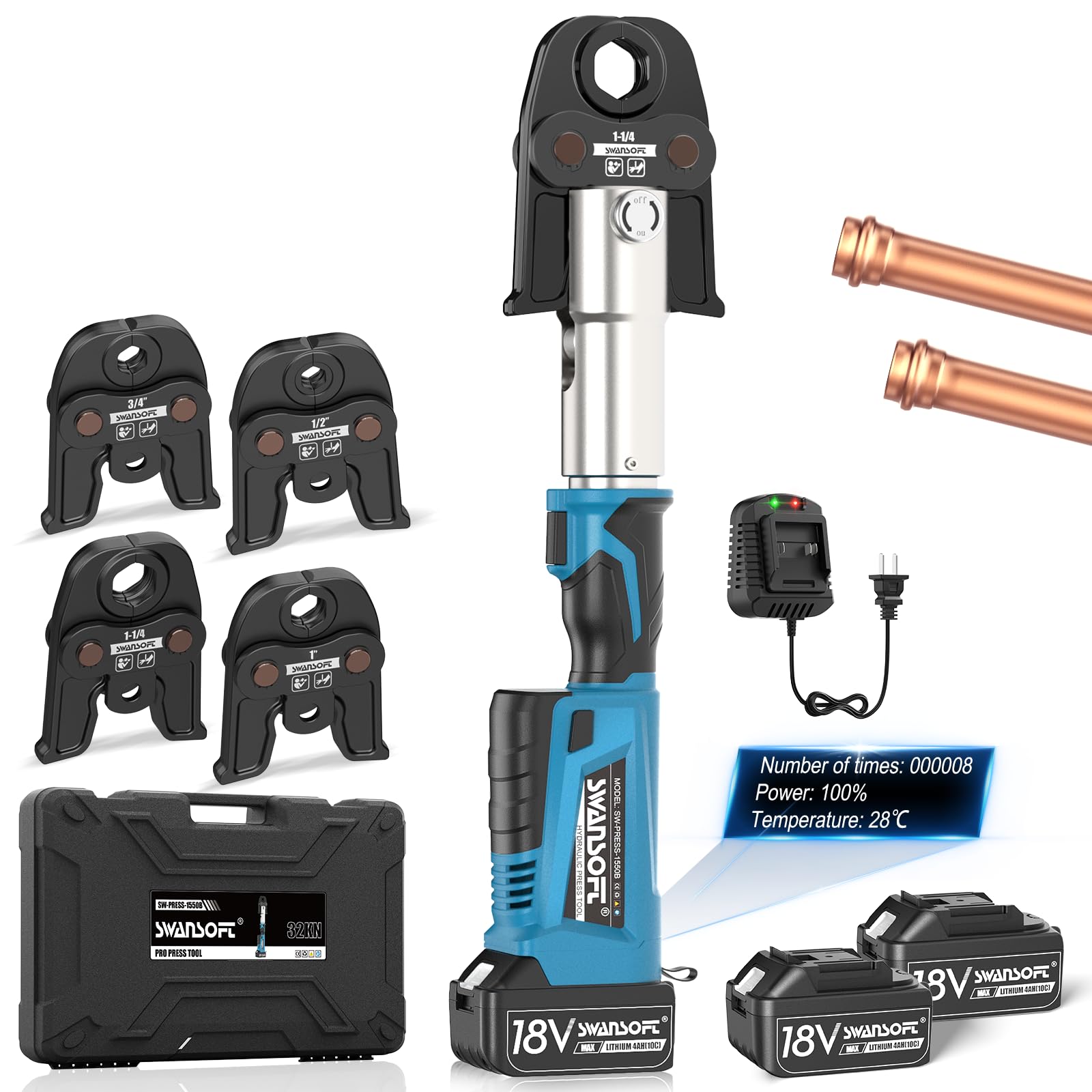
4. SWANSOFT 32KN Pro Press Copper Crimper, SWPR-1550B
A four-jaw copper press built around full force from the first second and a long battery shift.
The press cycle here runs 3-6 seconds, and the 32KN of force is available from the first second — no warm-up, no ramp. That speed is the sell for anyone billing by the job: the maker puts it at 50% faster than standard tools, and SWANSOFT’s own figure for complete crimps is 100+ per hour. Four US-standard jaws cover 1/2″, 3/4″, 1″, and 1 1/4″ copper, and the aerospace 7075-T6 aluminum body is built to take job-site knocks. Two 4000mAh 18V lithium-ion batteries deliver 300+ presses per charge, with hot-swap so you can change a battery mid-run instead of calling lunch.
Owners praise its quality and performance above all else. The maker’s jaw claim is 50,000+ presses from the dual-stage hardened jaws, and the O-ring seal is pressure-tested for zero bursts or drips. Value reads well for what you get. Tech support is available around the clock and the warranty runs 1 year on the system including batteries. One honest note from the listings: if the transfer pins stop working effectively, press the pressure-relief button for 7-8 seconds after powering on and test with a jaw — that is the reset, and it saves a call.
Durability is a split picture. Some owners find it rugged; others report broken clamps or damaged pipes in use, and several owners complain it is heavy. Treat that as a fit note: this tool suits someone who handles equipment carefully and values speed over a featherweight feel — not a rental-fleet beater. Compared with the ZUPPER below, the SWANSOFT’s 3-6 second cycle and 32KN force sit above the ZUPPER’s roughly 2-second cycle and 24 kN, so the SWANSOFT trades a touch of cycle speed for more force on the heavier pipes.
The speed play: pick this if you run volume — 100+ crimps an hour is the point of the 32KN and the dual 4Ah batteries.
Handle with care: the jaw clamp wants a careful operator, and the tool is heavy enough that a full day of overhead work will tell you about it.
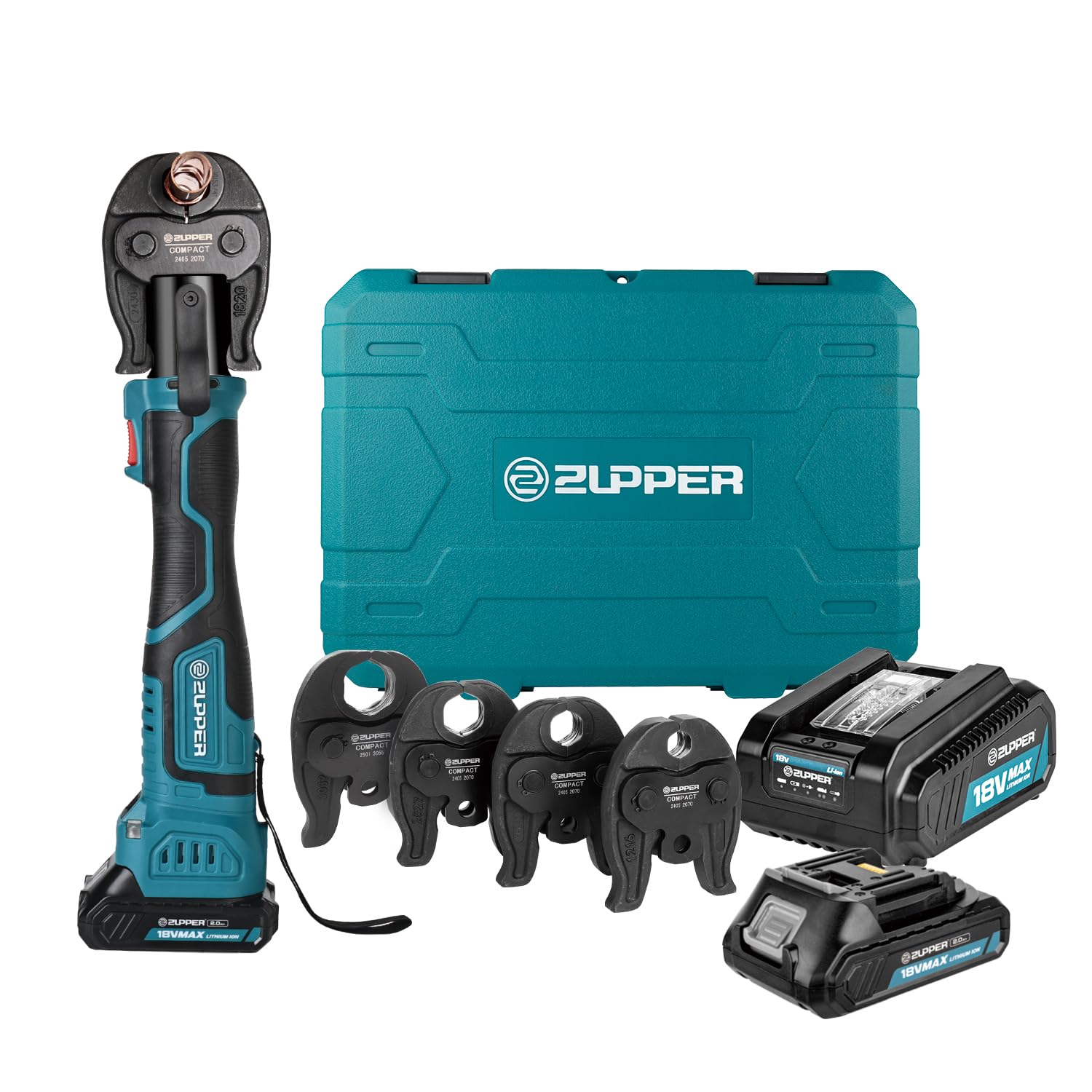
5. ZUPPER Compact Press Tool Kit
An around-2-second cycle from a brushless motor, with a head that swivels 180° into awkward corners.
Cycle speed is the star here. Each press takes only around 2 seconds per cycle, driven by a screw-drive mechanism and a brushless motor that also stretches motor life. The 24 kN of force (about 5,400 lbs) presses up to 1 1/4″ copper, 1″ carbon steel, 1 1/4″ stainless steel, and 1 1/2″ PEX pipe — wide enough for most service work. Four VUS jaws cover 1/2″, 3/4″, 1″, and 1 1/4″. A full charge is rated for around 400 press cycles, and the OLED display shows battery level, pressing times, fault codes, and maintenance notes so you are not guessing.
Functionality is the most-praised trait in owner feedback, and every mention of it is positive. Performance and value come next, with owners noting it gets the work done without fuss and the pressing motion saves real time. The 180° rotating head and compact body make overhead and tight spaces easier, and the tool is compatible with ZUPPER’s jaws, rings, and actuators plus US brands’ Compact Series equivalents. Bonus for a mixed van: it accepts Makita 18V batteries, so you may not need the included charger at all.
Battery life is the split. The display-driven battery reading is more accurate than a bare level light, but experience on runtime varies — some buyers report great performance, others find it lacking. Treat the 400-cycle figure as the ceiling on a fresh battery and keep the second battery close. The other thing: if you need to press fittings outside the VUS copper range, you buy the corresponding jaws separately.
Why speed matters here: a 2-second cycle at 24 kN means you spend your time positioning fittings, not waiting on the tool — that is time back in your day.
The honest trade: battery runtime is the one variable that splits owners, so plan the second battery into your workflow.
For the quick-handed: service plumbers who press a lot of small fittings and want the cycle to disappear under their hands.
Look elsewhere if: you need to press carbon or stainless beyond the listed sizes without buying more jaws.
6. Milwaukee Electric – M18 Short Throw Press

A short-throw M18 press for the crew that already runs Milwaukee batteries.
If you already own Milwaukee M18 gear, this is the press tool that slots into your existing charger-and-battery rotation. The short-throw design means a shorter jaw travel than a full-size tool, which helps when the fitting is in a spot where you cannot swing a long handle. It runs on a single lithium-ion battery and ships as a kit with the case. The tool comes in at 23.6 pounds as listed, so this is a two-hands-on-it tool rather than a one-hand mini press.
Owners say it does exactly what the box promises, and several call it a standout on the job. Ease of use and value both lean positive. Beyond that, the listed data is thin, so treat the M18 platform match as the main reason to pick it over the lighter M12 above.
Here is the honest fit note: 23.6 pounds is not a one-hander, and this tool is best suited to a shop or van that already runs M18 batteries. Buy it for the platform and the short jaw stroke; do not buy it expecting a compact tool you can wave around in a ceiling. If you want a lighter Milwaukee press, the M12 at the top of this list is the tool for that job.
Why crews pick it
- M18 battery platform match for vans already running Milwaukee cordless
- Short-throw jaw travel suits fittings where a long handle will not fit
- Single lithium-ion battery keeps the kit simple
What to know going in
- 23.6 pounds as listed — heavy for overhead work compared with a mini press
- Thin listing data on jaw sizes and force, so confirm coverage before ordering
Built for the Milwaukee van: the obvious pick if your batteries, charger, and tools are already M18.
Too heavy for one hand: for a light tool you can run overhead solo, the M12 kit above is the better answer.
7. VEVOR Press Tool 18V
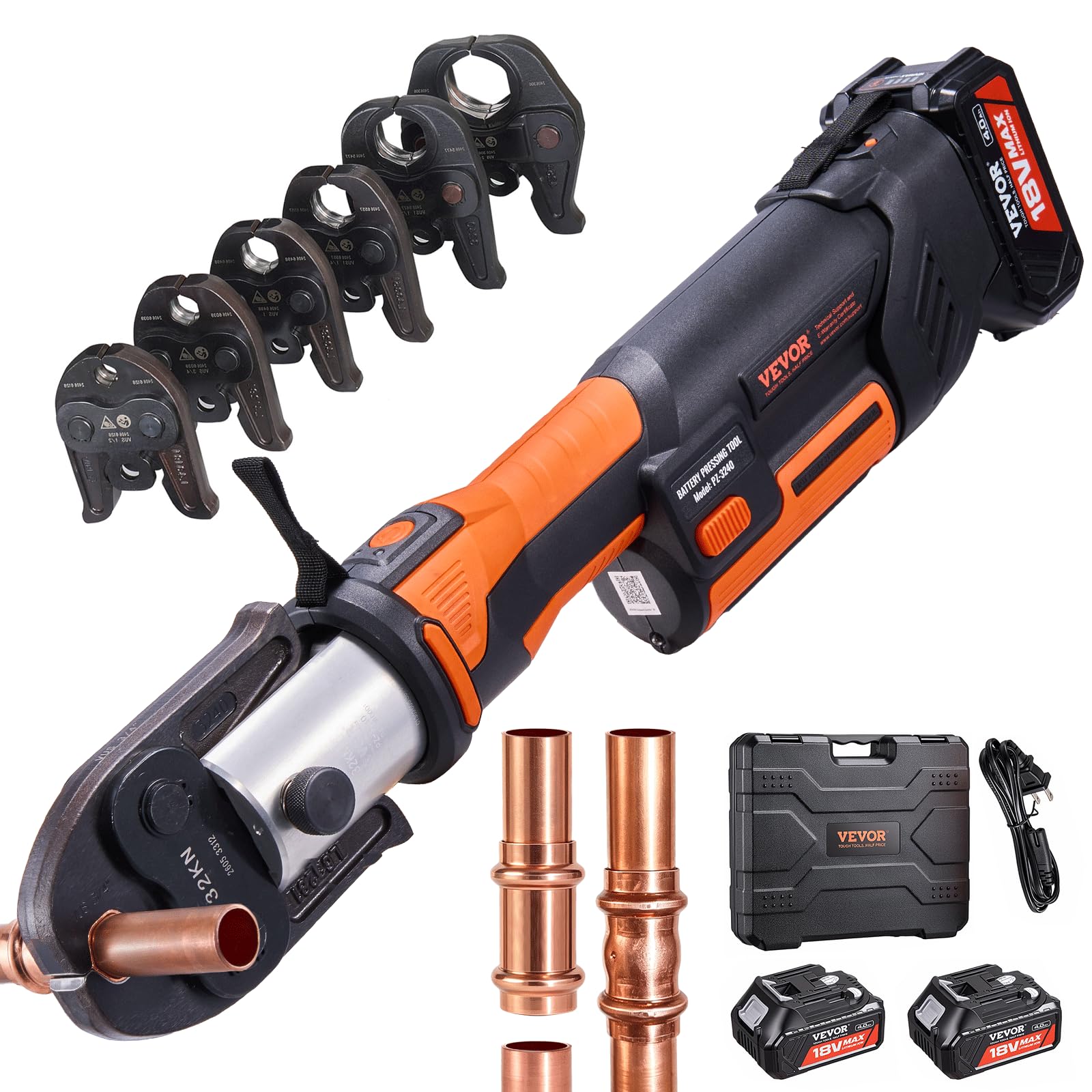
Six jaws from 1/2″ up to 2″ — the widest pipe coverage in this roundup.
If your work reaches into larger mains, this is the kit that covers them. Six VUS jaws span 1/2″, 3/4″, 1″, 1 1/4″, 1 1/2″, and 2″ copper — a range the M12 and the mini presses above simply cannot touch. A brushless motor pushes 32KN of force through each jaw, and the maker lists 350 crimps per charge from two 18V 4.0Ah lithium-ion batteries with a fast charger. A 360° rotating head and slim body help in confined spaces, and a carrying case keeps the jaws and batteries organized for transport.
Quality is the thing that wins people over — it is the aspect mentioned far more than any other in owner feedback, and the read leans heavily positive. Value comes next, and owners describe it as the best bang for the buck in the range. Functionality and ease of use both score clean. The six-jaw coverage is the reason most people buy it, and it handles both residential and industrial pipe work up to that 2″ ceiling.
Two honest caveats. The tool is heavy — owners flag the weight, and it will slow a long overhead run. And durability is a mixed picture: some owners find it tough, others report it breaking after 100 presses, so treat it as a tool that rewards careful handling and a steady pressure-relief routine rather than job-site abuse. If your jaw range needs to stop at 1 1/4″, the ZUPPER above covers it at a lighter build; if you truly need the 2″ reach, this is the kit that delivers it.
The jaw-range answer: pick it if your pipe work regularly reaches 1 1/2″ and 2″ and you need one kit to cover them all.
Know your limits: heavy in the hand and best handled carefully — a 2″ jaw is not the tool you want to drop.
8. RIDGID RP 115 Mini Press Tool Kit with 1/2″ to 3/4″ Jaws
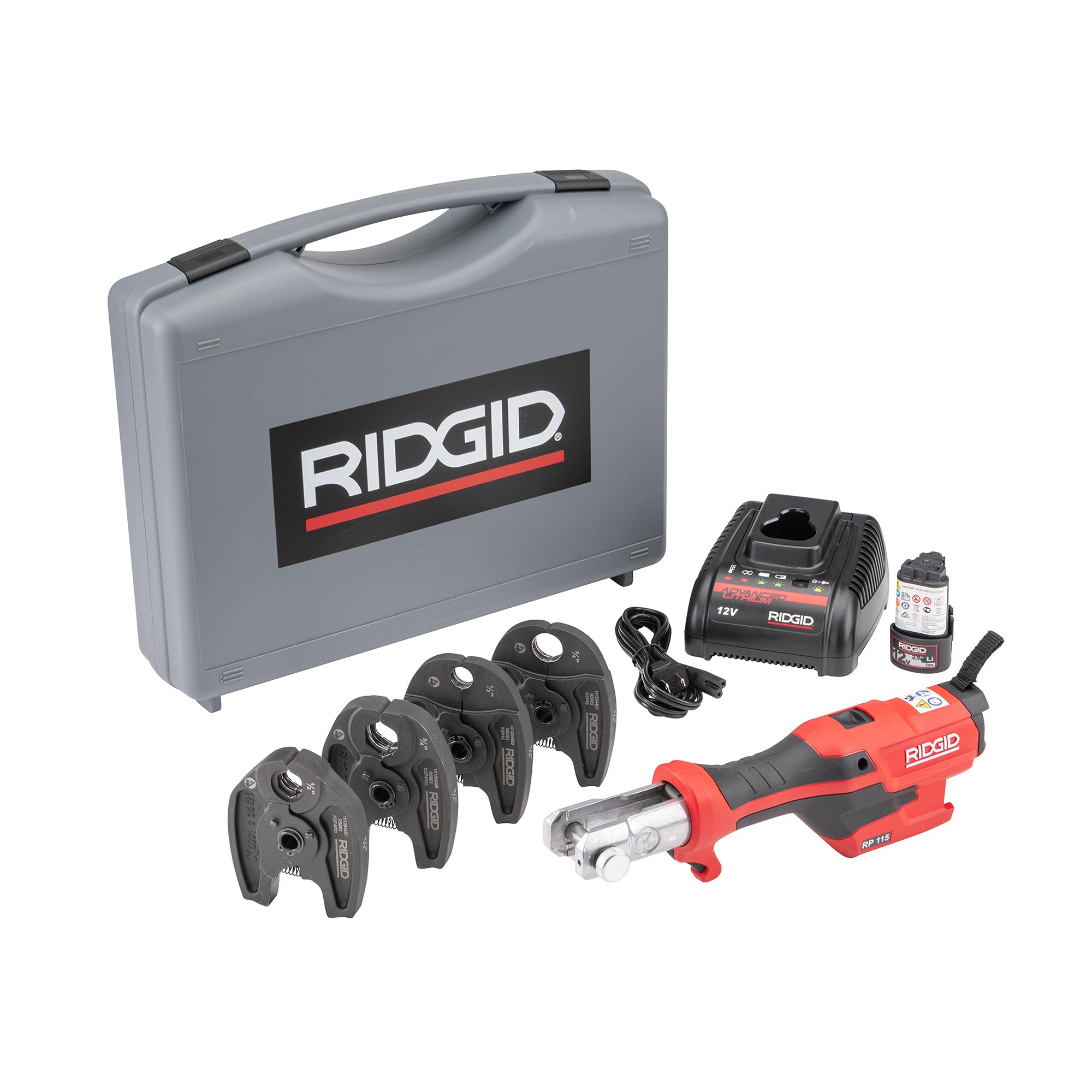
A 210-degree swivel head and a SlimGrip handle built for pipe runs you have to reach at odd angles.
The RP 115 is a one-handed hydraulic mini press with a 210-degree head swivel — enough rotation to reach a fitting from a different angle than the pipe allows you to stand. The SlimGrip handle and tune trigger were shaped to keep the tool balanced in your hand, which matters when you are working a fitting under a sink or behind a wall. The kit includes 1/2″ and 3/4″ ProPress mini jaws, matching 1/2″ and 3/4″ PureFlow jaws for PEX work, a 12V lithium-ion battery, a 12V charger, and a rugged case.
Versatility is the thing that wins people over — it is the aspect mentioned far more than any other in owner feedback, and it is unanimous. The ProPress and PureFlow jaws in the same kit mean you can move between copper and PEX without swapping whole tool bodies. Functionality and value both score positive. RIDGID backs the tool with a lifetime warranty against defects in workmanship and material.
Two things to accept going in. The jaw range stops at 3/4″, so any 1″ or larger fitting is beyond this kit. And the listed weight is 13.9 pounds, which sits heavy for a tool billed as a mini press — check how it feels in your hand before a long overhead run. It is a specialist’s tool for reach and one-hand operation, not a general-range kit.
Where it shines: the 210° swivel head plus ProPress and PureFlow jaws make it a do-two-things tool for tight residential work.
The honest limit: 3/4″ max jaw size and a 13.9 pound listed weight mean it will not replace a full-range tool.
For the reach-limited job: pick it when the fitting is in a spot that makes you want a different angle, not a different tool.
Not for larger mains: 1″ and 2″ fittings need a bigger kit.
9. DEWALT 20V MAX Pipe Press Tool Kit DCE200M2K

The press tool that files a report of every crimp you make, from 1/2″ up to 4″.
Most press tools press and quit. This DEWALT kit keeps a record. Crimp Connect reporting technology gives you a detailed report of the work you did, and the on-board diagnostics show battery life, whether the last crimp was successful, when service is needed, and the operating temperature range. For a crew that documents installations for inspection or warranty, that is the reason to pick it over the rest. The pressing capacity spans 1/2″ to 4″ for copper, PEX, stainless steel, and carbon steel, and the kit ships with five 1/2″-2″ crimping heads, two 20V MAX lithium-ion batteries, a charger, a shoulder strap, and a kit box.
Quality earns the positive read here. The forward and reverse triggers make it easier to reposition the head for the next fitting without fighting the tool. The 3-year limited warranty covers the tool, and the textured pistol grip adds control on a heavy tool.
The honest fit note is durability — experience splits, with some owners reporting that the tool broke during use. Pair that with a listed weight of 57 pounds, and this is clearly a two-hands, shop-oriented kit for wide-range commercial work, not a service-call tool you carry up a ladder. If you need documentation and the full 1/2″ to 4″ range, it is here; if you want a light residential press, one of the mini kits above is the better call.
The documentation angle: Crimp Connect reports and on-board diagnostics are the reason to buy this over a plain press — the tool proves the job.
Weight and durability to weigh: 57 pounds listed and a mixed durability read mean commercial-shop use, not a ladder tool.
For the documentation-hungry crew: buy it if inspection and job records matter as much as the press itself.
Not a light residential press: at 57 pounds listed it wants two hands and a plan.
10. RIDGID RP 350 ProPress Pressing Tool Kit

ProPress jaws from 1/2″ to 2″, a brushless motor rated past 100,000 cycles, and Bluetooth on board.
This is the full-range kit for a shop that presses everything. Four ProPress jaws ship in the box covering 1/2″, 3/4″, 1″, and 1 1/4″, with 1 1/2″ and 2″ jaws available in RIDGID’s Standard Series to take you to the top of the range. The brushless motor is rated for over 100,000 press cycles with no scheduled maintenance, so the tool is built to be the last press you buy for a long time. An 18V battery, charger, and rugged case complete the kit. The head swivels 360 degrees for tight spaces, and bright LED lighting handles dark areas.
Bluetooth connectivity pairs the tool with a phone for tool information, and the color-coded light indicators make operation simple at a glance. What makes this the flagship is the breadth: one tool, all the Standard Series jaws, rings, actuators, and attachments — a flexibility the smaller kits above cannot match. At 7.1 pounds it is heavy enough to feel in the hand but light enough to work with one hand on a fitting.
Two things keep it from being the pick for everyone. The jaw range starts at 1/2″ and the 1 1/2″ and 2″ jaws are sold outside this kit, so confirm your largest fitting before you buy. And the listed battery count reads two lithium-ion cells while the included-components list names one 18V 2.5Ah battery, so verify the exact battery package with the seller. Fit this to the shop that presses from residential up through 2″ mains and wants one platform to do it all.
The one-tool shop solution: choose it if your work spans 1/2″ copper up through 2″ mains and you want a single platform with the Standard Series jaw lineup.
Confirm the battery kit: the listing names one battery in one place and two in another, so settle that before ordering.
Know the Specs
Press force in kN (kilonewtons)
<
Press force is the squeezing power the tool delivers to a fitting, measured in kilonewtons — one kN is roughly 225 pounds of force. More kN means the tool can press larger-diameter pipe and harder materials. A 24 kN tool (about 5,400 lbs) presses up to 1 1/4″ copper. A 32KN tool (about 3.2 tons) is built for the heavier end of the range and for carbon or stainless steel work. Match the force to your pipe sizes rather than buying the biggest number on the page — a 32KN tool in a 1/2″-only van is force you never use.
Jaw range and die compatibility
The jaw is the shaped steel head that crimps the fitting, and its size in inches must match the pipe you press. A 1/2″ to 1″ kit covers most residential copper and PEX. A 1/2″ to 2″ kit opens up commercial mains. Some kits name standard families — ProPress for copper, ASTM F1807 for PEX rings, ASTM F877 for stainless press sleeves — and those names tell you which fitting system the dies fit. Buy only the jaw range you crimp, and confirm any Standard Series or Compact Series compatibility before you order extra jaws.
Tool weight and how you hold it
Weight in pounds decides whether you can press with one hand or need two. A load like 3.8 pounds lets a press sit in one hand while the other steadies the fitting. At 8 pounds and up you are leaning on the tool, and overhead runs in a joist bay get old fast. Read the weight as a working number, not a spec-sheet boast — the best tool for a service call is not always the heaviest one on the shelf.
Battery platform and runtime
Press tools run on rechargeable lithium-ion batteries, and the platform matters as much as the runtime. If your van already carries one brand of cordless tool, a press that accepts those batteries saves a charger and a spare slot in the case — the ZUPPER kit, for example, accepts Makita 18V batteries. Runtime figures like 140, 350, or 400 presses per charge are ceilings on a fresh cell, so keep a second battery in the kit and plan swaps around the job.
Common Questions
What is the difference between a ProPress tool and a regular crimping tool?
Will a 24 kN press tool handle 1 1/4″ copper pipe?
Do I need a different jaw for copper and for PEX?
Can I use a press tool on stainless steel pipe?
How many presses can I get from one battery charge?
Is a heavier press tool better than a light one?
What does Bluetooth on a press tool actually do?
Do I have to press the pressure-relief button, and when?
Will a press tool accept my existing cordless batteries?
What jaw sizes should a residential plumber start with?
The Bottom Line
For most working plumbers, the propress plumbing tool winner is the Milwaukee 2473-22 M12 Force Logic because it combines a 3.8-pound body with 1/2″ to 1″ jaws and a 30-minute battery charge — a tool you can carry overhead all day and still trust on the fitting. If you want one case that covers copper, PEX, and stainless, grab the Growlush 18V kit with its eleven die sets. And for full commercial mains up to 2″, the VEVOR Press Tool is the one to reach for.
The crowd favorite and the sensible place to start is still the M12 — at 4.5+ stars across 400+ ratings it is the strongest-supported pick in this roundup, and it earns that read on weight and build quality rather than marketing. Buy the jaw range you actually crimp, keep a second battery charged, and the press tool turns a torch job into a few seconds of squeeze.
How we choose
We do not accept paid placement. Every pick is matched to a real buyer and a real use-case; we do not hands-on test units.
Sources
Specifications: manufacturer listings and product documentation. Review insights: verified customer reviews, as of November 2026. Pricing: not shown on this page (it changes often); check the current price via the retailer link.
As an Amazon Associate, Tactical Gear Guy earns from qualifying purchases. This does not affect which products we feature.