Specs are compiled from manufacturer listings and verified buyer reviews and can change over time — please confirm the key details on the product page before buying.
If you are shopping for a welding blocker wall, the real question is not which curtain looks toughest in the photo — it is which frame stays upright once you actually start burning rod. A screen that sways or flaps on its frame is worse than none, because you stop trusting it and start working around it. The five picks below cover the spread: a tinted shade-eight screen built on rigid square steel, two larger multi-panel enclosures on casters, and a couple of mobile options that roll where the job takes them.
This guide is built by comparing the manufacturers’ published specifications and the patterns across verified customer reviews, so you get each pick’s real strengths and trade-offs instead of marketing spin.
You will see what each frame is made of, how many wheels it rolls on, what flame rating it carries, and where the weak points show up in real workshops. By the end you should know exactly which size and frame style fits your bay or driveway. Here is the honest breakdown of every welding blocker wall worth putting your name behind.
Top Picks


How To Choose The Best Welding Blocker Wall
The screen is a sheet of flame-resistant vinyl on a tube frame. So your buying decision depends on three things: how much area you need to cover, how the frame is built, and whether it moves. Get those three right and the price tier matters far less than you would think.
Size and panel count first
A single 6 x 8 ft panel gives you one flat wall of protection. A three-panel setup lets you wrap a corner or box in a work area, which matters when sparks fly in more than one direction. Measure the bay before you buy — a screen that is too small forces you to clamp extra curtains on, and a screen that is too wide will not fit between your bench and the door.
Frame construction is the real durability test
Rigid square steel tubing with powder-coat finishing holds its shape far better than thin round tube. If the curtain tears, you replace a curtain. If the frame racks or the casters snap, the whole unit is scrap. Look at the tubing shape and the wheel count — more casters spread the load, and lockable ones let you park the screen and work against it without it creeping.
Flame rating and UV level
Flame-resistant vinyl is the standard material, but not every screen states which standard it meets. The Revco screen below is listed against CPAI-84 and CSFM, and the VEVOR curtains cite a six-level UV rating. That UV number is what keeps the arc glare from reaching your skin and eyes, so it is worth checking before you assume any yellow curtain will do.
Mobility versus stability
Swivel casters let one person move a heavy frame across a shop, which is the whole point of a rolling screen. The trade-off is that a taller, wider frame on four casters is less planted than a shorter one, so lock the brakes before you strike an arc near it.
Side-by-Side Comparison
| Model | Best For | Curtain Size | Frame Style | Wheels | Amazon |
|---|---|---|---|---|---|
| Saf-Vu Shade 8 Welding Screen with Frame★ Best Overall | Tinted arc-flash protection on a fixed frame | 6′ x 8′ | Rigid square steel tubing | — | Amazon |
| VEVOR 6′ x 6′ Welding Curtain ScreenBest Value | Rolling single-panel shield for tight bays | 6′ x 6′ | Metal frame, 4 swivel wheels | 4 (2 lockable) | Amazon |
| VEVOR 3-Panel Screen, 12 Swivel Casters | Wrapping a corner without extra clamps | 3 panels, 6′ x 6′ | Metal frame, 12 swivel casters | 12 (6 lockable) | Amazon |
| JustSmart 3 Panel 6×6 FT Vinyl Welding Screen | Building a custom enclosure from single panels | 3 panels, 6′ x 6′ | Segmented square tube, 4 swivel casters | 4 (2 lockable) | Amazon |
Detailed Reviews
1. Saf-Vu Shade 8 Welding Screen with Frame, 6′ x 8′
Our pick — 4.5+★ from 50+ verified ratings; the strongest balance of quality and price.
Shade-eight tint on a rigid steel frame — the screen that kills the flash instead of just hiding it.
The reason this one holds the top spot is the curtain itself. It is made from flame-resistant tinted vinyl in Shade 8, which is a dark welding-lens grade of tint rather than the light yellow sheet you see on most enclosures. That tint is what stops the bright arc flash from bouncing across the shop and reaching anyone standing behind or beside the screen. For a helper holding parts or a neighbor watching from the door, that difference is the whole point of buying a blocker wall.
The frame is rigid square steel tubing with a powder-coat finish, and the curtain attaches with a quick frame attachment system rather than a pile of zip ties. Square tubing resists racking — the sideways wobble that turns a tall screen into a hazard — better than thin round tube, and the powder coat keeps rust off the joints in a damp garage. It is listed against CPAI-84 and CSFM flame-resistance requirements, so the flame rating is stated rather than implied. On size, the 6 x 8 ft curtain covers more vertical wall than the 6 x 6 ft VEVOR screen below, and it does it without the 50.7 pounds of steel the biggest VEVOR 3-panel carries.
What you are buying here is a stationary defensive screen, not a mobile one. There are no casters in the spec, so once it is set up it stays put until you move it by hand. That suits a fixed welding bay where the work comes to the screen. It is less suited to a job site where you rebuild the enclosure every morning. The other note is that this is a single flat panel, so it protects one face of your work area; if you need to wrap a corner, the multi-panel VEVOR options do that job.
Where it earns its keep
- Shade 8 tinted vinyl blocks arc flash for people standing behind the screen, not just the welder
- Rigid square steel tubing with powder-coat finishing holds its shape in a damp shop
- Flame resistance is stated against CPAI-84 and CSFM, so the rating is documented
- Quick frame attachment system makes curtain changes a tool-free job
What to plan around
- No casters in the spec — this screen is moved by hand, not rolled
- One flat 6 x 8 ft panel guards a single face of the work area
- A shade-8 curtain is dark to look through, so ambient light in the bay drops behind it
Reach for this if: you weld in a fixed bay and want the strongest arc-flash barrier in the lineup without dragging a 50-pound frame around.
Look elsewhere if: your enclosure has to travel between sites — the caster-equipped VEVOR screens are built for that.
2. VEVOR Welding Screen with Frame, 6′ x 6′, 4 Swivel Wheels
A 15.3-pound rolling shield that one person can reposition between welds.
If your bay has to double as something else, start here. This screen hangs a 6 x 6 ft flame-resistant vinyl curtain on a metal frame and rolls on four 360-degree swivel wheels, two with brakes. At 15.3 pounds it is light enough to push one-handed. It is the lightest frame in this group by a wide margin — the 3-panel 6 x 8 ft VEVOR tips the scale at 50.7 pounds, and this one moves with a nudge.
What wins people over is that it rolls out, blocks the arc, and rolls back without fuss. The curtain carries a six-level UV protection rating, so it cuts the radiation and glare that reach your skin and eyes on the wrong side of the arc. The vinyl is flame-resistant and described as waterproof, and the frame is built to resist tipping. Metal grommets are included for hanging, along with 24 cable ties in the box. The maker notes the curtain is semi-transparent and that photos may not match the real color exactly, which is worth knowing before you judge the yellow from the listing.
Here is the honest trade-off, and it is the one that shows up again and again in owner feedback: the frame is not built like a shop fixture. Assembly and overall quality draw split opinions — some find it simple to put together and solid enough, others find it cheap for the category. Treat it as a light rolling screen you set up and handle gently rather than one you lean stock against, and it earns its keep. That is a fair call at the entry tier, and it is why this stays the value pick rather than the overall one.
Where it fits best: a home garage or small shop where the screen rolls out for a job and rolls back against the wall after. The 6 x 6 ft coverage and four wheels make that routine easy.
The honest limit: the frame is the weak link in the long run. If your work involves bumping the screen, dragging it over rough concrete, or leaning stock against it, budget for a sturdier frame.
Pick this one when: budget and mobility are the two things you care about most, and the screen only needs to stand between the arc and the rest of the room.
Think twice if: you need a screen that doubles as a wall you can work against — the lighter frame will not enjoy that.
3. VEVOR 3-Panel Welding Screen 6 x 6 ft with 12 Swivel Casters

Three panels and twelve casters — it wraps the work area instead of guarding one side.
A flat screen only blocks what is directly behind it. This VEVOR takes three 6 x 6 ft panels and puts them on a shared frame with twelve 360-degree rotation wheels, six of them lockable. That is three times the wheel count of the single-panel VEVOR above. The extra casters matter on a 46.5-pound frame — the load spreads out, so the screen rolls straight instead of digging a corner into the floor.
The enclosure is what sells it. Three panels let you form a corner or a three-sided box around the bench, which is the shape that actually keeps sparks and UV flash off the rest of the shop. The vinyl is flame-resistant with the same six-level UV protection rating as the single-panel screen, and it comes with 72 cable ties and a manual. Owners talk about how easy it goes together, and the value read is the strongest in this lineup — the price-to-what-you-get ratio is exactly where this screen lands best.
The recurring gripe is durability, and it lands mostly on how light the panel frames feel once assembled. It is not a welded industrial cage; it is a movable divider. Roll it into position, lock the six brakes, and leave it there for the job. If you expect to collapse and rebuild it every day, the joints will not love the routine.
Built for three-sided coverage
- Three 6 x 6 ft panels form a corner or box around the bench
- Twelve swivel casters, six with brakes, move a 46.5-pound frame without wrestling it
- Six-level UV protection on flame-resistant vinyl
- 72 cable ties included, and assembly is the easy part
Where it needs care
- The panel frames feel light once assembled — this is a divider, not a cage
- 46.5 pounds plus three panels means it wants floor space and a plan
- Daily collapse and rebuild will work the joints harder than it should
The right call for: a shop where the work happens in one spot and you want a box around it that rolls out of the way between jobs.
Not the one for: a tight bay with no room to swing three panels — the single-panel VEVOR rolls into spaces this cannot.
4. JustSmart 3 Panel 6×6 FT Vinyl Welding Screen with Frame
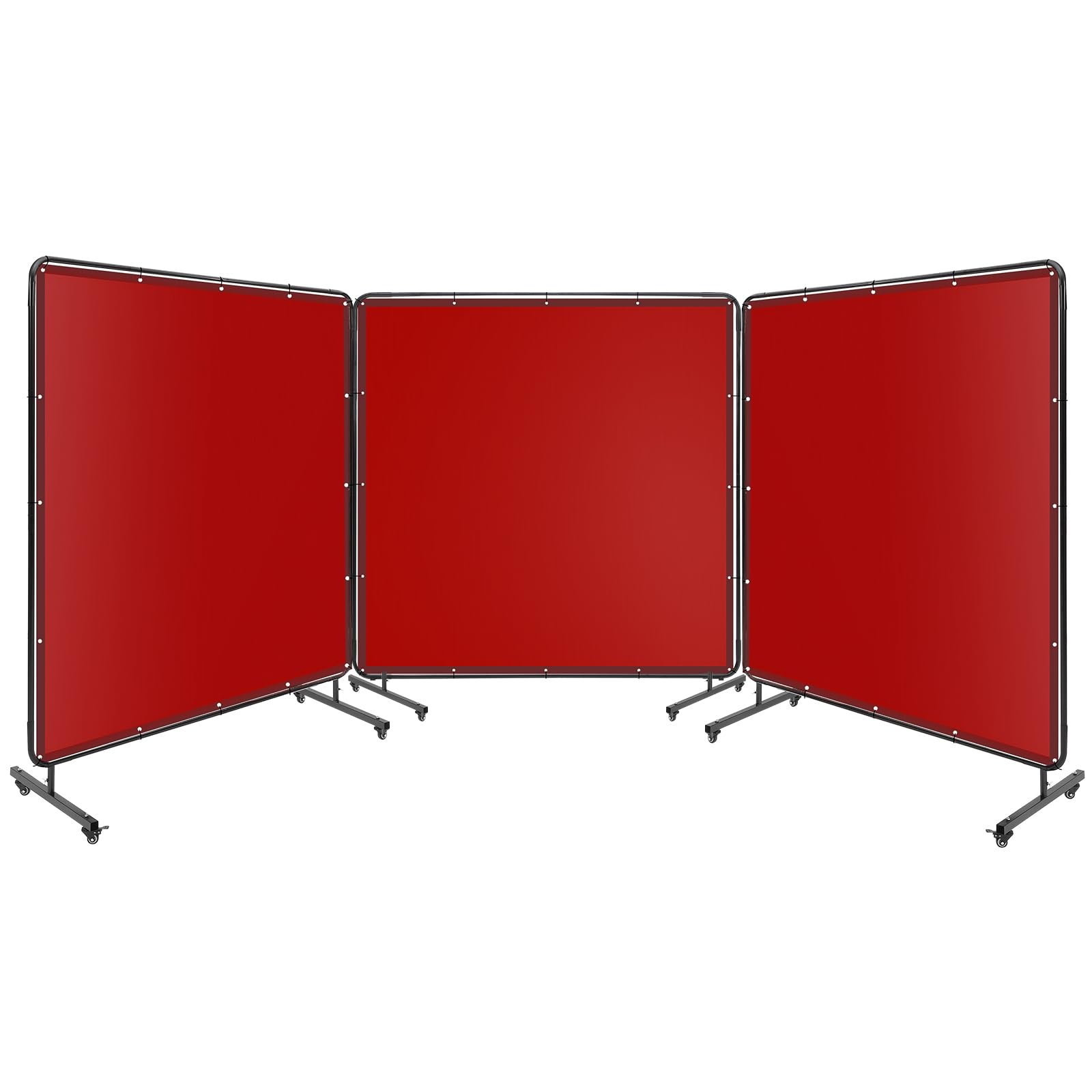
Segmented tubes that click together — build the enclosure you need, not the one in the box.
This is the pick for someone who wants to decide their own layout. The frame uses segmented steel tubes joined by press-in pins, so you assemble the panels and then hang the vinyl with zip ties. You can run individual panels, or connect several to form a multi-panel enclosure or an inline divider. That modularity is the reason to look here — no other screen in this group is described as letting you break it down to single panels so easily.
The curtain is 0.02 in / 0.4 mm thick vinyl measuring 6 x 6 ft, with Level-6 UV protection and flame retardancy. The vinyl is described as the time-proven industry standard with acceptable transparency and reflectivity — it blocks the arc without turning the bay into a cave. The square tube frame sits on four 360-degree swivel casters, two with brakes, so it moves and locks like the bigger VEVOR units. At 48.5 pounds, the 3-panel assembly has real presence once it is up.
Where this one asks for patience is the pin-together frame. Segmented tubes that press together are fast to assemble but they are not the same as one welded cage, and this is the lowest-rated screen in the lineup at 3.5+ stars over 10+ ratings. That is a small sample, so read it as a sign to set expectations rather than a verdict. Stated for what it is — a modular vinyl screen on a pin-together square tube frame — it does the job. Stated as a heavy-duty permanent partition, it will disappoint. Pick it for the layout freedom, not for the beef.
Best for: the welder who wants to reconfigure the enclosure around each job and does not mind assembling tubes to get there.
Skip if: you want one welded frame you never take apart — the Saf-Vu or the 6 x 6 ft VEVOR are the fixed and rolling alternatives.
Know the Specs
Flame-Resistant Vinyl and the CPAI-84 Rating
The curtain is the part that catches the sparks, so its flame rating is the spec that matters most. Flame-resistant vinyl is treated so it resists ignition rather than feeding a fire. When a screen states it meets CPAI-84 and CSFM requirements, that means the vinyl has been listed against recognized flame-resistance standards — worth checking, because not every curtain on the shelf names one. The tint level is separate: shade-8 tint, like the Saf-Vu uses, is a dark welding-grade tint that cuts arc flash for anyone standing behind the screen.
UV Protection Level and Caster Count
A six-level UV protection rating describes how much of the arc’s ultraviolet radiation the vinyl blocks before it reaches skin and eyes. The arc throws more UV than visible light, so this is the number that protects the helper, not just the welder. Caster count is the other spec to weigh: four wheels move a light screen like the 15.3-pound VEVOR 6 x 6 ft, while twelve wheels spread the load on a 50.7-pound frame. Lockable brakes are the difference between a screen you can work against and one that creeps.
Common Questions
Will a welding screen protect someone standing behind me while I weld?
What does shade-8 tint mean on a welding screen?
Do I need a single-panel screen or a three-panel enclosure?
How many casters should a rolling welding screen have?
Is the flame-resistant vinyl the same as fireproof?
Can I cut a large three-panel screen down to fit a smaller bay?
Do I need to worry about UV radiation through the gaps between panels?
How long should a flame-resistant welding curtain last?
Will these screens stand up in a windy outdoor job site?
Can I hang a welding curtain from the ceiling instead of using a frame?
The Bottom Line
For most people shopping for a welding blocker wall, the right buy is the Saf-Vu Shade 8 Welding Screen with Frame. It is a shade-8 tinted curtain on rigid square steel, listed against CPAI-84 and CSFM flame requirements, and built to stand in one place and block arc flash properly.
If you need the screen to roll, the VEVOR 6′ x 6′ curtain on four swivel wheels is your move: 15.3 pounds, easy to reposition, and the lightest frame in the group. And for a shop that wants a three-sided box around the bench with room to spare, the VEVOR 3-panel 6 x 6 ft enclosure with twelve casters is the one to reach for.
The one nudge worth making: pick by the shape of your bay, not by the size of the curtain. A screen sized to the bay gets set up every time, and one you have to wrestle into place stops getting used. Matching the panel count and footprint to your bay matters more than any spec on this page.
How we choose
We do not accept paid placement. Every pick is matched to a real buyer and a real use-case; we do not hands-on test units.
Sources
Specifications: manufacturer listings and product documentation. Review insights: verified customer reviews, as of November 2026. Pricing: not shown on this page (it changes often); check the current price via the retailer link.
As an Amazon Associate, Tactical Gear Guy earns from qualifying purchases. This does not affect which products we feature.