Specs are compiled from manufacturer listings and verified buyer reviews and can change over time — please confirm the key details on the product page before buying.
If your steering wheel groans every time you turn the wheel, a cracked or leaking fluid tank is often the reason — and swapping it takes less time than diagnosing it. The right pick depends on fitment: the tank must match your car’s year, model, and hose port layout exactly. Get it wrong and the hoses won’t clamp on or the ports face the wrong side. Get it right and the steering whine fades within a short drive.
This guide is built by comparing the manufacturers’ published specifications and the patterns across verified customer reviews, so you get each pick’s real strengths and trade-offs instead of marketing spin.
What follows separates vehicles that use a plastic factory bottle from those running an aluminum upgrade, so you can tell which one belongs under your hood before you order. Below is a practical shortlist of the best Power Steering Reservoir for a real repair job.
Top Picks

How To Choose The Best Power Steering Reservoir
The tank itself is a simple container, so almost every buying mistake here is a fitment mistake. A reservoir that bolts up but swaps the inlet and outlet sides will fight you every time you turn the wheel. A tank with the wrong cap threading will seep fluid onto your belt.
Start With Your VIN, Not the Photo
Use the garage tool on the listing and enter your make, model, and trim level. Trim level matters more than most buyers expect, because a hybrid or a different engine family often runs a different bottle. If the listing names specific years, match your car’s year range exactly before you order.
Plastic Replacement or Aluminum Upgrade
A plastic tank is the factory-style route — it drops in, uses the original hoses, and asks nothing of you. An aluminum tank is the enthusiast route: it replaces the plastic bottle with a metal canister and heavier walls. If your car is a daily driver with no fluid-push problems, plastic is the calmer choice.
Barb Fittings Decide Hose Fit
Barb fittings are the ribbed spigots your hoses slide over and clamp down. A listing that specifies them, like the 5/8″ and 3/8″ sizes on the aluminum tanks here, tells you whether your stock hoses clamp straight on. A listing that leaves them unspecified is a listing you should message the seller about first.
Where the Inlet and Outlet Sit
Two tanks can look identical in the product photo with the fluid ports mirrored. Read the listing carefully and check which side the hose connections sit on. The most frustrating outcomes here are reservoirs that mount fine but feed the pump from the wrong side.
Side-by-Side Comparison
| Model | Best For | Material | Fitment Scope | Weight | Amazon |
|---|---|---|---|---|---|
| Dorman 603-934 Power Steering Reservoir★ Best Overall | Most buyers wanting a quiet, drop-in fix | Not listed | Select Chrysler / Dodge models | 12.8 ounces | Amazon |
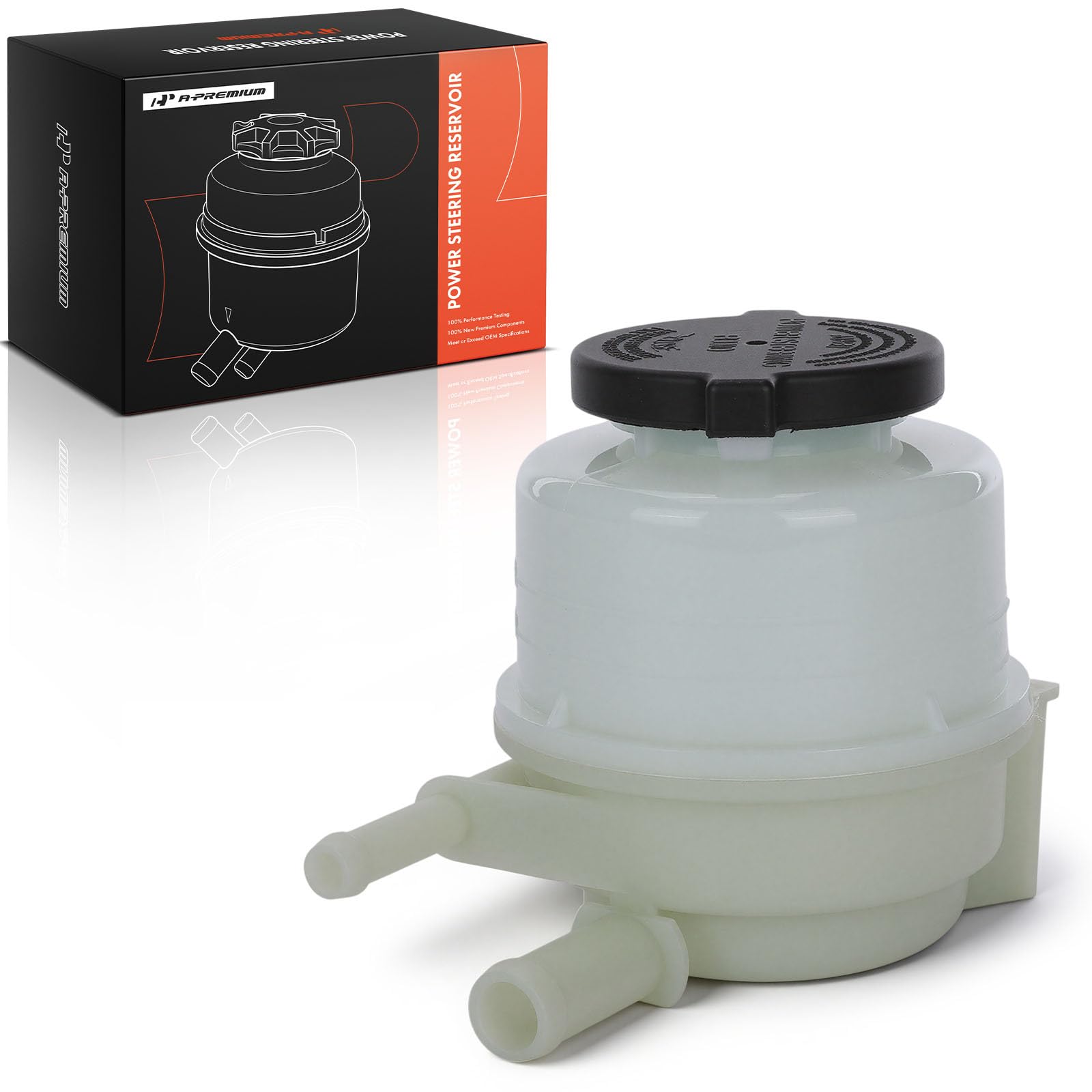
| A-Premium Power Steering Reservoir/Tank with CapToyota Fit Specialist | Toyota and Lexus owners on a tight fit | Solid plastic | Toyota Avalon, Camry, Solara; Lexus ES300, ES330, ES350 | 12 ounces | Amazon |
| Universal Aluminum Fuel Cell Surge Tank | High-RPM and track use | Aluminum | Universal, fits Honda, Nissan, Opel, Subaru pumps | 1.3 pounds | Amazon |
| Power Steering Reservoir Bottle Tank for Mercedes | Mercedes C-Class and GLK owners | Not listed | Mercedes-Benz C230, C280, C300, C350, E350, CLK350, GLK350 | 1.12 pounds | Amazon |
| Auto Dynasty Aluminum Tank Compatible with Ford Mustang 1999-2004 | Mustang owners upgrading the plastic bottle | Aluminum | Ford Mustang 1999-2004 | 1.5 LBS | Amazon |
| Car Power Steering Reservoir Aluminium Alloy | Commodore and HSV owners | Aluminium alloy | Commodore V6 V8, VS VT VX VY VE HSV LS1 | 1.1 pounds | Amazon |
| DNA Motoring TANK-PS-001 Power Steering Reservoir | Builders who want a machined metal look | Aluminum | Vehicle specific | 0.65 kg | Amazon |
Detailed Reviews
1. Dorman 603-934 Power Steering Reservoir
Our pick — 4.5+★ from 700+ verified ratings; the strongest balance of quality and price.
A complete reservoir-and-cap assembly that quiets the groan without a separate lid to source.
The repair you are after is the squeal going away, and this Dorman is the pick most buyers report delivers it. It lands at 4.5+ stars across 700+ ratings, and buyers single out the molding quality more than any other trait. It ships as a complete assembly with the reservoir and its cap together, so you are not hunting for a separate lid that threads on wrong.
For a part this simple, the fit is the whole job. This one is listed as fitting select Chrysler and Dodge models, and it slots in as a direct replacement that the maker says functions like original equipment. Weight sits at 12.8 ounces. Compare that to the A-Premium at 12 ounces and there is barely a difference in hand — but the Dorman carries the lighter 6.75 x 5.75 x 6.5 inches footprint against the 6.5 x 3.54 x 4 inches surge tank, which matters when you are threading it into a tight engine bay corner.
The most repeated review theme is the noise disappearing: cars that squeaked before the swap go quiet, and the pump runs without the low whine. Installation is described as quick and simple rather than a wrestling match. Dorman backs it with a limited lifetime warranty and says it is on-vehicle tested for fit and service life. The honest catch is the fitment scope — this is not a universal bottle, and if your car is not a listed Chrysler or Dodge application, you need a different pick.
What Makes It The Pick
- Complete assembly with cap included, so nothing extra to source
- Direct-replacement design that fits and functions like original equipment
- Quiets steering squeal and pump whine after the swap
- Limited lifetime warranty from the manufacturer
- On-vehicle tested for fit and long service life
Where It Stops Short
- Fitment is limited to select Chrysler and Dodge models, not universal
- Plastic-style replacement rather than an aluminum upgrade
Go with this one: you drive a listed Chrysler or Dodge and want the whine fixed in one afternoon with no fabrication.
Change course: your car is not in the fitment list or you specifically want a metal tank under the hood.
2. A-Premium Power Steering Reservoir/Tank with Cap
Built for a narrow slice of Toyota and Lexus bays — and honest about exactly which ones.
If you own a Camry, Avalon, Solara, or one of the Lexus ES models in the fitment list, this is the shape your engine bay was molded around. The listing names its years and models precisely: Avalon 2005-2012, Camry 2002-2011 with the 2007 model excluding the hybrid, Solara 2004-2008, plus ES300, ES330 and ES350 coverage. That level of specificity is exactly what you want on a reservoir, because the fluid ports have to land where your hoses already are.
The tank is solid plastic, and the maker says it tolerates high temperature and high pressure without deforming — the two conditions that kill a tired factory bottle in the first place. It weighs 12 ounces, so it is light in the hand and easy to maneuver into place. The cross-reference list is long, covering OEM numbers including 603-670 and 4436006030 through 40603670, which gives you a way to cross-check against your own part number before ordering.
Owner experience here centers on two things: it fits, and it functions. Those are the only two jobs this part has, and both come back positive in the feedback. A-Premium also stands behind it with a one-year unlimited-mileage guarantee, which is meaningful if you drive a lot. The trade-off is the same one every vehicle-specific tank carries — stray outside the listed Toyota and Lexus applications and this is the wrong part for you.
Fit is the entire pitch: this tank is only worth buying if your car is on the list, and the list is unusually detailed with year and model ranges spelled out.
Worth noting: the one-year unlimited-mileage guarantee is a real backstop for a high-mileage daily driver, and 12 ounces keeps the install light work.
Right for you: a Toyota or Lexus owner who wants a factory-shape plastic bottle with a clear year range to match against.
Look elsewhere: your car falls outside those listed applications, or you want an aluminum replacement instead of plastic.
3. Universal Aluminum Fuel Cell Surge Tank
For the car that pushes fluid out of the cap after a hard run, not a grocery-getter.
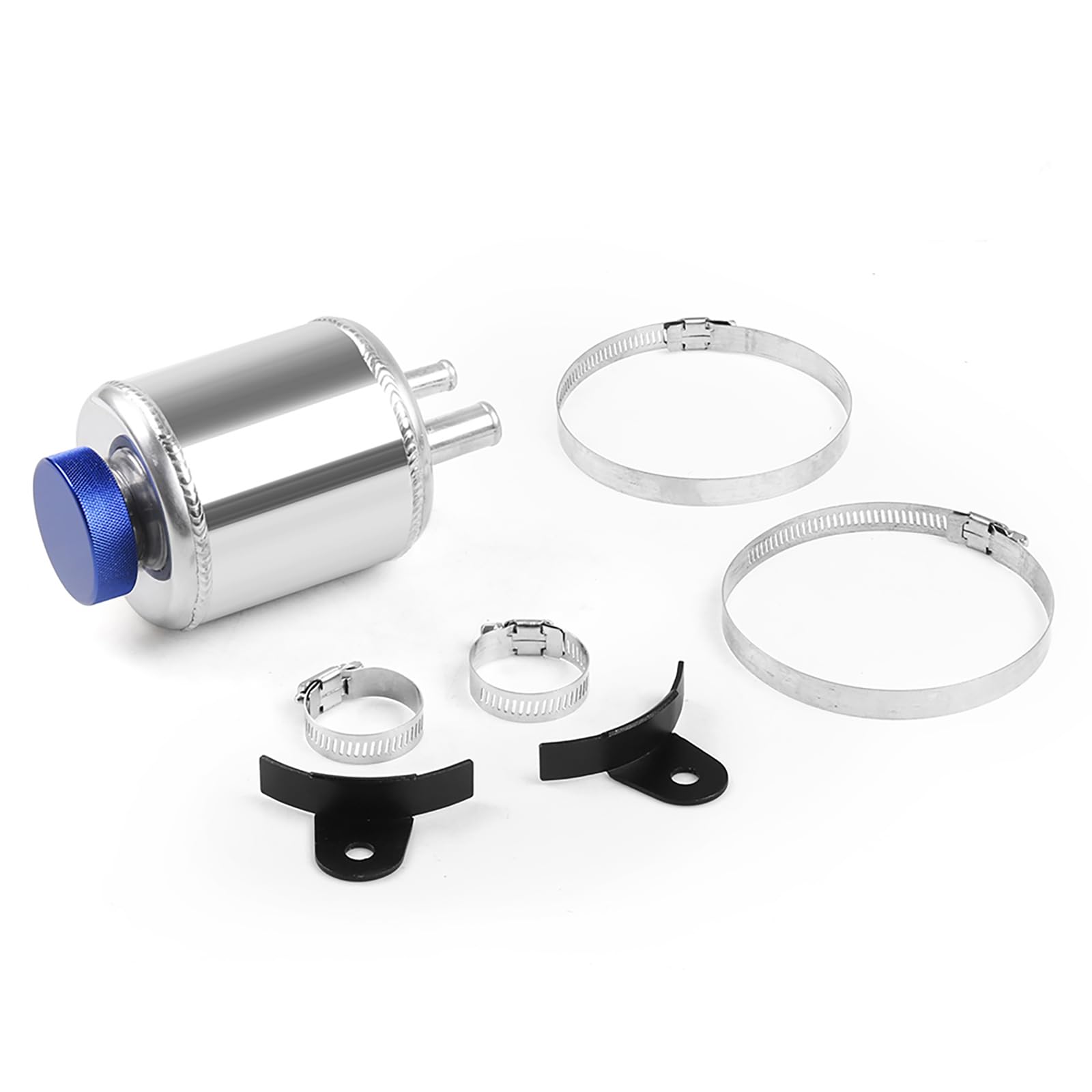
This one solves a problem most drivers never have. When the pump spins at high RPM — circuit driving, sport driving, hard sustained revs — the fluid cavitates, meaning air bubbles form and expand through the system. That raises the level inside the tank, the bubbles heat up, and fluid gushes out past the cap. This surge tank is designed to trap those bubbles and cut the overheating that causes them.
It is made of aluminum with a polished exterior finish, and it comes as a kit: one reservoir, two clamps, and two mounting brackets. The whole package weighs 1.3 pounds, which is heavier than the 1.1 pounds of the alloy Keenso tank but still light enough to hang off a bracket without strain. Its footprint is a compact 6.5 x 3.54 x 4 inches, so it tucks into space a bulky factory bottle would not.
Fitment is listed as universal, with the maker naming Honda, Nissan, Opel, and Subaru power steering pumps as applications. That is a broad claim, so treat it as a starting point rather than a guarantee — you will want to check your hose sizes and mounting points before committing. The warranty runs three months, which is short, so this is a part for someone comfortable doing their own plumbing rather than a plug-and-play repair.
Who it is engineered for: a driver whose power steering fluid is being pushed out under sustained high-RPM use and who wants the cavitation problem addressed at the canister.
The real constraint: universal fitment plus a three-month warranty means this rewards a buyer who verifies hose and bracket compatibility first.
Buy it when: you run the car hard enough to see fluid escape and want an aluminum canister with clamps and brackets in the box.
Hold off: you want a factory-shape drop-in for a stock daily driver with no fluid-push symptoms.
4. Power Steering Reservoir Bottle Tank for Mercedes
A single-marque bottle that knows precisely which C-Class and GLK it belongs to.
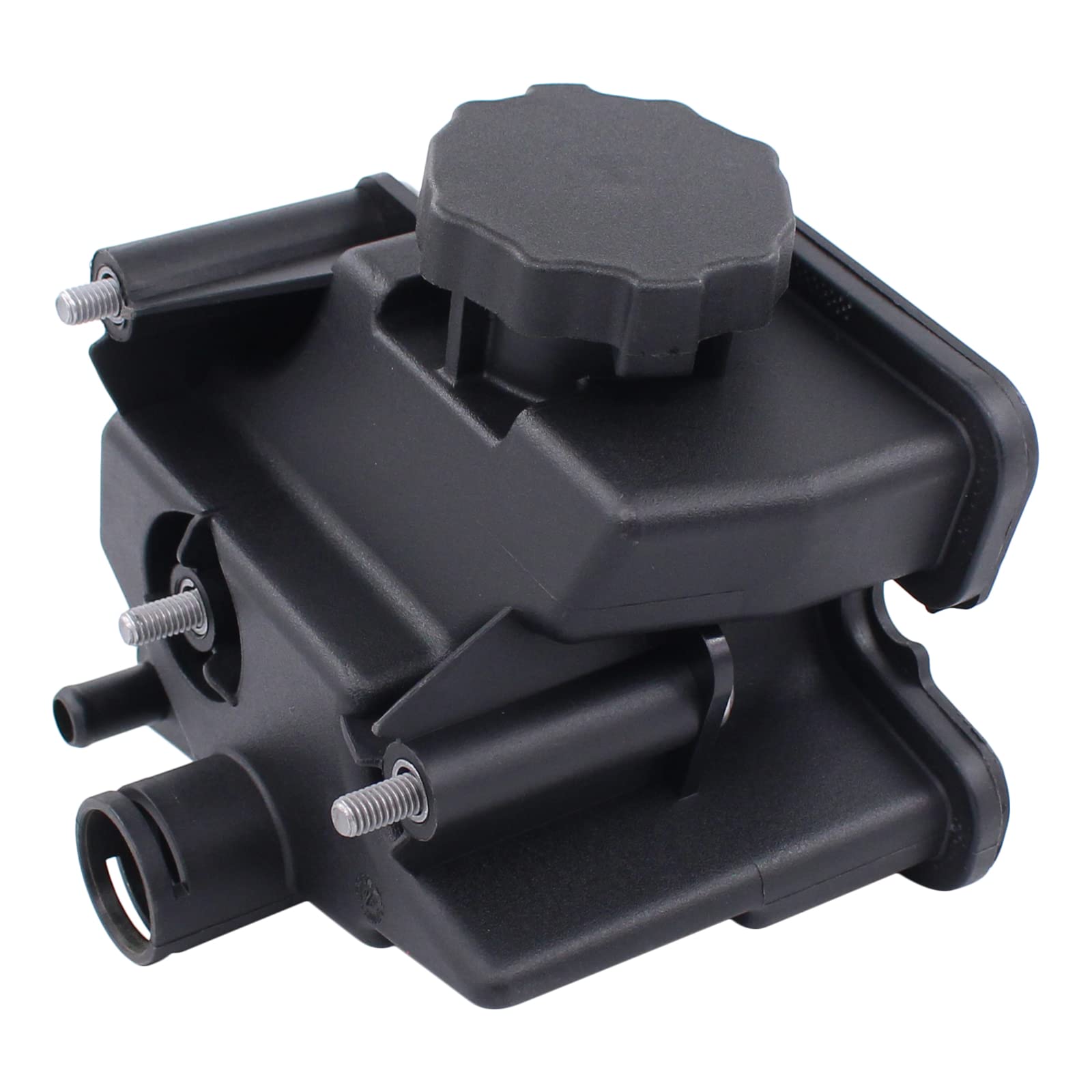
Mercedes owners get a straighter answer here than most. The listing names C230 2007, C280 2006-2007, C300 2008-2012, C350 and E350 2007-2011, CLK350 2007-2009, and GLK350 2010-2012. If your car is in that list, this is a bottle shaped for your engine bay and nothing needs adapting.
Weight is 1.12 pounds, so it is a solid-feeling unit rather than a featherweight shell. The model number is L0004602383, which doubles as the manufacturer part number — handy if you want to cross-check it against the part on your car before you order. The package measures 7.13 x 5.59 x 5.51 inches, giving you a sense of the box it arrives in and the room you need on the bench.
Where this one asks something of you is research. There is no fluid capacity, no material call-out, and no cap detail spelled out in the listing, so the smart move is confirming your exact model year matches before checkout. It is a plain, specific replacement rather than an upgrade, and for a worn factory bottle on a listed Mercedes that is exactly the right role.
The case for it: the fitment list is unambiguous across C-Class, E-Class, CLK and GLK models, so a matching owner can order with confidence.
What to check first: the listing skips material and capacity details, so verify your model year against the ranges before you commit.
Made for you: you drive one of the listed Mercedes models and want a straight replacement bottle without guesswork.
Think twice: your chassis is not on the list, or you want documented material and capacity specs before ordering.
5. Auto Dynasty Power Steering Reservoir Tank

Swaps the plastic bottle for metal on a 1999-2004 Mustang, with hoses that clamp straight on.
The number worth knowing here is the wall thickness:.1 inch of aluminum. That is the figure the DNA Motoring tank matches at.100 inch, so the two metal options sit at the same gauge. The difference is the target car — this Auto Dynasty canister is built for the Ford Mustang 1999-2004, and it is a direct replacement for the factory plastic tank with no drilling or modification.
Barb fittings are listed at 5/8 inch and 3/8 inch, which tells you your stock Mustang hoses should clamp over the spigots without adapters. The canister measures 3-1/4 inch wide by 3-1/4 inch deep by 5-1/4 inch high, and it weighs 1.5 LBS. That is heavier than the 1.3 pounds Dyno Racing surge tank and lighter than the alloy Keenso at 1.1 pounds — a middleweight that still feels substantial in the hand.
One detail in the listing deserves a careful read: it notes you need to use factory-size fittings. In plain terms, the tank takes the standard hose sizes your car already runs, so there is no custom plumbing to sort out. The finish is natural aluminum rather than polished, which is a quieter look under the hood.
Reasons It Earns A Slot
- .1 inch aluminum walls for strength over the factory plastic tank
- 5/8 inch and 3/8 inch barb fittings match factory hose sizes
- Direct replacement with no drilling or modification required
- Compact 3-1/4 x 3-1/4 x 5-1/4 inch canister fits the stock location
What To Weigh First
- Fitment is locked to the 1999-2004 Mustang only
- At 1.5 LBS it is the heavier of the metal tanks here
The match: you own a 1999-2004 Mustang and want to trade the plastic bottle for an aluminum canister that bolts straight in.
Not your part: you drive anything outside that Mustang window or want a polished finish rather than natural aluminum.
6. Car Power Steering Reservoir Aluminium Alloy

An alloy bottle aimed squarely at the Commodore crowd, VS through VE and HSV LS1.
This one is a fitment answer before it is anything else. The listing names Commodore V6 and V8 applications across VS, VT, VX, VY, VE, plus HSV LS1 — a very specific slice of the Australian performance world. If that is your garage, this tank was shaped for it, and the maker says it directly replaces the broken or worn original.
The material is aluminium alloy, finished to resist rust and wear, and the whole thing weighs 1.1 pounds. That makes it the joint-lightest of the aluminum tanks alongside the Dyno Racing surge tank, and 0.4 pounds below the 1.5 LBS Auto Dynasty. It arrives in a package measuring 11.22 x 6.38 x 4.8 inches, so the box is fairly long and note if you are collecting at a locker.
The maker says it installs without instructions and needs no drilling or cutting, while still recommending professional installation. Read that honestly: it means the part is designed to bolt up, but if you are not confident under the hood, a shop is the safer call. For a Commodore owner with basic tools, this is a straightforward swap.
The value read: an alloy, rust-resistant bottle for the Commodore and HSV family, at 1.1 pounds and with no drilling needed for the install.
Plan around this: the maker recommends professional installation, so budget for a shop visit if you are not comfortable doing the swap yourself.
Choose it if: you run a Commodore VS through VE or an HSV LS1 and want an aluminum replacement bottle made for that engine bay.
Keep looking: your car is not a Commodore or HSV application, since this listing is tightly scoped to those models.
7. DNA Motoring TANK-PS-001 Power Steering Reservoir

Beautiful welds and.100 inch walls — as long as the ports land on the right sides for your car.
The look is the hook here. The finish and the weld quality are what people notice first, and the welds in particular come in for consistent praise — clean, tight metalwork on a part that sits right in the engine bay. The canister measures 3-1/4 inch wide by 3-1/4 inch deep by 5-1/4 inch high, the same profile as the Auto Dynasty tank, and it carries.100 inch thick aluminum walls.
Barb fittings are listed at 5/8 inch and 3/8 inch, so hose sizing follows the same standard as the other metal options. It weighs 0.65 kg. The maker positions it as a heavy-duty replacement for the factory plastic tank, made for enhanced strength and durability.
This is where honesty matters most. The feedback on this tank splits down the middle. Build quality draws both fans and critics, durability is the rougher category with reports of rusted caps and chipping chrome, and the fitment and connections threads lean negative — specifically, the inlet and outlet on the bottom sitting on the wrong sides for some buyers and the fittings reversed. Treat this as a part for a builder who will test-fit and possibly rework the connections, not a drop-in for a factory bay. The upside is that where it goes on cleanly, the welded metal canister looks the part.
The Good Metal
- Clean welded construction with.100 inch thick aluminum walls
- 5/8 inch and 3/8 inch barb fittings match standard hose sizes
- Same 3-1/4 x 3-1/4 x 5-1/4 inch canister profile as the Auto Dynasty
- Replaces the factory plastic tank with a heavier-duty metal unit
The Honest Friction
- Fitment is the weak point — the inlet and outlet sit reversed for some cars
- Caps have been reported to rust and chrome to chip
- Fit and connections feedback leans negative, so test-fit before bolting down
For the builder: you want a welded aluminum canister with great-looking metalwork and can test-fit and adjust the hose ports if needed.
Pause here: you want a guaranteed stock-location fit, since the port orientation and hardware finish are the recurring friction points.
Know the Specs
Barb Fittings (Hose Spigots)
A barb fitting is the ribbed metal spigot your power steering hose slides over and clamps down. The sizes on these tanks — 5/8 inch and 3/8 inch — tell you whether your factory hoses will clamp straight on or need adapters. When a listing skips the barb sizes, ask the seller before you buy, because a mismatched spigot means a leak that starts the moment you fill the tank.
Wall Thickness in Metal Tanks
Wall thickness, written in inches, is the gauge of the aluminum the canister is made from. Two of the metal tanks here list.1 inch and.100 inch, which is the same gauge written two ways. Thicker walls resist dents and heat better than thin sheet, which matters on a part bolted next to an exhaust manifold and exposed to constant vibration.
Plastic vs Aluminum
The factory bottle is typically plastic, which is light and flexible but ages with heat cycles. Aluminum swaps that for metal walls and heavier construction. Plastic stays the calmer choice for a stock daily driver; aluminum suits a car pushed harder or an owner who wants a metal canister under the hood.
Surge Tanks and Cavitation
Cavitation is what happens when the pump spins fast enough to form air bubbles in the fluid. Those bubbles expand through the system and raise the level in the tank until fluid escapes. A surge tank is a canister designed to trap and separate those bubbles, reducing the overflow on a car that sees sustained high RPM.
Weight and Fitment
Tank weight runs from 12 ounces for the plastic A-Premium unit up to 1.5 LBS on the Auto Dynasty aluminum tank. Weight itself does not decide the job; what matters is whether the tank bolts into your stock location and the hoses reach. Always match the year, model and trim against the listing before ordering.
The Cap and Seal
The cap does more work than it looks like it does: it seals pressure and stops fluid sloshing out under cornering. Some tanks ship with the cap included, some do not. A cap that threads on wrong or rusts shut is a real nuisance, so check whether the cap comes in the box and how it is described.
Common Questions
Will an aluminum power steering reservoir fit my stock car?
How do I know which size barb fitting my hoses need?
Does replacing the reservoir stop the steering whine?
What is a power steering surge tank and do I need one?
Can I install a power steering reservoir myself?
Do I need to bleed the power steering system after swapping the tank?
Why would the inlet and outlet be on the wrong sides?
Is a plastic or aluminum reservoir better for a daily driver?
Does the reservoir come with a cap?
How long should a replacement reservoir last?
The Bottom Line
For most people chasing a squealing or leaking power steering tank, the power steering reservoir that fits the widest list of everyday cars and fixes the noise without fuss is the Dorman 603-934 — it comes as a complete assembly with the cap, and it is the crowd favorite at 4.5+ stars across 700+ owners. If your car is a Toyota or Lexus, grab the A-Premium tank for a shape made to fit your bay. And for a Mustang owner who wants metal walls and stock-size hose barbs, the Auto Dynasty aluminum tank is the one to reach for.
How we choose
We do not accept paid placement. Every pick is matched to a real buyer and a real use-case; we do not hands-on test units.
Sources
Specifications: manufacturer listings and product documentation. Review insights: verified customer reviews, as of November 2026. Pricing: not shown on this page (it changes often); check the current price via the retailer link.
As an Amazon Associate, Tactical Gear Guy earns from qualifying purchases. This does not affect which products we feature.