Specs are compiled from manufacturer listings and verified buyer reviews and can change over time — please confirm the key details on the product page before buying.
Your power bill keeps climbing and nothing in your house changed. The cause is usually one hidden load you cannot see — a water heater, an old fridge, a space heater left running. A house electric meter you install yourself gives you the actual number instead of a guess. The picks below cover every job this category handles: a drop-in meter for a rental unit, a DIN rail unit for a sub-panel, a WiFi clamp meter that talks to your phone, and a full circuit-level monitor for a solar home.
This guide is built by comparing the manufacturers’ published specifications and the patterns across verified customer reviews, so you get each pick’s real strengths and trade-offs instead of marketing spin.
Meters split into three families, and knowing which family you need saves you from buying the wrong one. A socket-base utility meter replaces or supplements the meter already in your panel. A DIN rail meter is a small block you snap onto a rail inside a sub-panel. A clamp meter wraps around the main wires without cutting them at all. Which family fits your wiring decides everything else, so read that part before you shop for any house electric meter.
Top Picks


How To Choose The Best House Electric Meter
The first decision is not brand or features — it is the socket. Walk out to your panel and look at what is already there. If you see a round or rectangular meter plugged into a 4-jaw base, you need a form 2S socket meter. If you see a metal rail with small blocks clipped onto it, you need a DIN rail meter. If your main service cables are exposed and you would rather not cut them, a clamp-on monitor is the answer. Buying the wrong family means the meter will not physically fit, no matter how good the specs are.
Match the current rating to what you will actually run
Every meter here carries a maximum current figure in amps (A), which is the ceiling on how much electricity can flow through it. A 200A rating suits a whole house service. A 100A rating suits most single-family sub-panels. A 63A rating suits a single large circuit or a small apartment. Running a welder or an electric furnace through a meter rated well below that load is where meters fail.
Decide if you need data on a screen or on your phone
A basic kWh meter shows a running total on an LCD and stops there. A smart meter adds WiFi, an app, and often scheduling and alerts. The trade-off is real: the smart versions need a stable 2.4GHz network, and several rely on a cloud service. If you want your readings to stay on your own network, look at the models with local API support instead.
Check the voltage configuration before anything else
A 120/240V three-wire system (two hot wires plus a neutral) is the standard US residential setup, and most picks here are built for it. A few are strictly three-wire and will not work in a two-wire circuit. Read that line in the listing twice — it is the single most common reason a meter gets returned.
Side-by-Side Comparison
| Model | Best For | Max Current | Wiring | Data Output | Amazon |
|---|---|---|---|---|---|
| EKM Universal Single Phase kWh Meter★ Best Overall | Whole-house or sub-panel metering with a wired data feed | 100 A | 2 or 3-wire, 120V to 120/240V | LCD plus pulse output | Amazon |
| BAOMAIN Single-Phase 3-Wire DIN Rail MeterBest Value | Snap-in sub-metering inside a DIN rail panel | 100 A | 3-wire only, 110V/220V | LCD plus passive pulse output | Amazon |
| eMylo 63A WiFi Energy MeterMost Connected | Remote switching and leakage alerts on one circuit | 63 A | Single-phase, AC 80-400V | LCD plus 2.4GHz WiFi app | Amazon |
| Meterly Centron SSEM CL200 | Replacing an existing 4-jaw utility meter | CL200 | 240V, 4 terminal, form 2S | LCD register plus test LED | Amazon |
| Aituzero Digital Electric Sub Meter | Landlords splitting usage across tenants | 200 A | 3-wire, 120/240V, ANSI form 2S | LCD plus pulse and Modbus | Amazon |
| DAE DEM730P Submeter | Cloud billing reports for property managers | 50 A | 1P3W, 120/240V | RS485 plus LCD | Amazon |
| Aeotec ZW095 Home Energy Meter Gen5 | Z-Wave smart home whole-home tracking | 200 A per clamp | 2-phase mains, 120V | Z-Wave Plus wireless | Amazon |
| EKM Pass-Through Single Phase Meter | Clean in-line installs without a socket base | 100 A | 2 or 3-wire, 120V to 120/240V | LCD plus pulse output | Amazon |
| Meross Smart Home Energy Monitor | Circuit-level and solar monitoring | 200 A main, 60A branch | Single, split-phase, 3-phase Wye | App, Home Assistant, local API | Amazon |
Detailed Reviews
1. Universal Single Phase kWh Meter 100A
Our pick — 4.5+★ from 150+ verified ratings; the strongest balance of quality and price.
One meter that wires into almost any US panel and hands you the numbers two ways at once.
This is the meter to buy when you are not fully sure what your panel will accept. It handles single-phase 120/240V three-wire (two hots plus a neutral), 120V or 208-240V two-wire with one hot and a neutral, and 120V or 208-240V two-wire with two hots. Those three configurations cover the wiring almost every US home and garage already has. You wire it once and you stop worrying about compatibility.
You can wire thin control lines and thick service conductors into the same terminal block without adapters, because the terminal takes wire from 22 AWG up to 1 AWG at a 13.5mm diameter. The current ceiling is 100A. You read the running total on the LCD, or you pipe the same data out through the pulse output to a logger or controller. That second path matters if you plan to build usage reports without standing at the panel.
What wins people over here is build quality, and the second most discussed strength is plain functionality — including units that kept working after a year of constant use. Installation gets a smaller but genuinely mixed response, and the sense from the negative side is wiring confusion rather than a defective unit. If you are comfortable in a panel, this goes in cleanly. If you are not, budget for an electrician and it becomes a non-issue. At 4.5+ stars across 150+ ratings, it is the strongest-rated pick here with the broadest wiring support, though the Aituzero model carries more ratings overall.
Where it earns its place
- Three wiring configurations in one body — 3-wire 120/240V, 2-wire with neutral, and 2-wire with two hots
- 100A maximum current with a 13.5mm wire diameter range spanning 22 AWG to 1 AWG
- Two ways to read it: the on-board LCD, or the pulse output feeding a remote logger
- Build quality is the most praised trait, with long-term operation called out specifically
Where it asks more of you
- Wiring is the part that trips people up — set aside time or hire help
- No WiFi or app, so remote viewing means running your own pulse wiring
- The largest footprint of the group at 4.75 x 4 x 3 inches, against 2.87 x 2.95 x 3.46 inches on the BAOMAIN
Reach for this if: you want one meter that covers whole-house or sub-panel duty and can feed a data logger, and you are comfortable terminating wire in a panel.
Hand it to an electrician if: you want the readings on your phone — there is no radio inside this one, so remote access means hardwiring the pulse line yourself.
2. BAOMAIN Single-Phase 3-Wire DIN Rail kWh Meter
A meter the size of a deck of cards that snaps onto a rail and disappears into your panel.
If your sub-panel already has a 35mm DIN rail — the standard metal strip that small breakers and relays clip onto — this drops straight in. The housing measures 2.87 x 2.95 x 3.46 inches, which makes it the most compact meter on this list and near the tightest fit you can get in a crowded box. Compare that with the 4.75 x 4 x 3 inches of the EKM Universal above and you see the space difference immediately.
On accuracy, it carries a Class 1.0 rating, a formal accuracy grade for energy meters, and a starting current of 40mA, meaning it will register even a very small standby draw rather than sitting at zero overnight. The current range is 10(100)A with a 100A ceiling and operation at 60Hz ±10%. The rated accuracy and the 100A ceiling are what make this credible for real sub-metering rather than casual monitoring.
The catch is genuine and worth reading twice. This is a three-wire meter only — L1, L2 and N with the neutral bypassing the unit. It will not work in a two-wire L-N circuit at all. It also has no WiFi and no app, so what you get is an LCD readout with a 6+1-digit register counting to 999,999.9 kWh plus a passive pulse output at 800imp/kWh. The flame-retardant PC housing, a rated range from -25°C to 70°C and a 4000V/25mA withstand voltage round out the spec sheet for anyone mounting this somewhere unheated.
The honest read: a compact, formally graded submeter with a wide pulse output and a housing rated for a cold garage — for 4.0+ stars across 90-odd ratings, that is a fair trade for giving up app connectivity.
Where it bites: three-wire only, and no radio inside. Confirm your circuit is L1-L2-N before ordering, because two-wire panels are out of luck.
Right call for: a DIN rail panel that needs a small, accurately graded block with a pulse line to a logger.
Wrong call for: two-wire circuits, or anyone who wants to see usage in an app — there is no WiFi here.
3. eMylo 63A WiFi Energy Meter
The meter that does not just count kilowatt-hours — it switches the circuit off when something goes wrong.
Most meters in this category sit and watch. This one acts. You set current, voltage and leakage thresholds in the Smart Life or Tuya app, and when a threshold is crossed the meter disconnects the connected circuit on its own. You can also set how long it waits before cutting power, which lets you ride out a brief surge instead of tripping on every flicker.
The electrical range is wide: AC 80-400V input and a 63A current ceiling, a narrower amp ceiling than the 100A EKM Universal above but a much wider voltage window. It logs voltage, current, power, energy and leakage current, and keeps daily, monthly and annual cumulative totals — with the annual figure resetting after a year. Voltage measurement holds within 1% of range. Because it connects over 2.4GHz WiFi, you can toggle the circuit remotely and ask Alexa or Google Home to do it for you.
Owners value reliability most, with the device holding steady over long stretches, and functionality is the next most-discussed strength. The honest limits: it needs a stable internet connection for remote control, it will not join a 5GHz network, and there is no hard-wired pulse output for a logger. This is a circuit-level device, so do not plan to push a whole-house service through it. At 4.0+ stars across 200+ ratings, the leakage protection is what separates it from every other pick here.
What it actually adds
- Adjustable leakage, voltage and current thresholds that cut the circuit automatically
- Scheduling and run-time control from the app, plus Alexa and Google Home voice commands
- Tracks five separate readings including leakage current, with daily to annual totals
- Voltage accuracy within 1% of range
Known constraints
- 63A ceiling — well under what a whole-house service needs
- 2.4GHz WiFi only, and remote control depends on an internet link
- Annual data resets after one year, so long-term trend keeping is on you
Buy it for: one circuit you want to monitor and be able to kill remotely — a water heater, a workshop feed, a garage sub-panel.
Look past it for: whole-house metering or any spot where you want readings to keep flowing with the internet down.
4. Meterly Centron SSEM CL200 KWH Meter
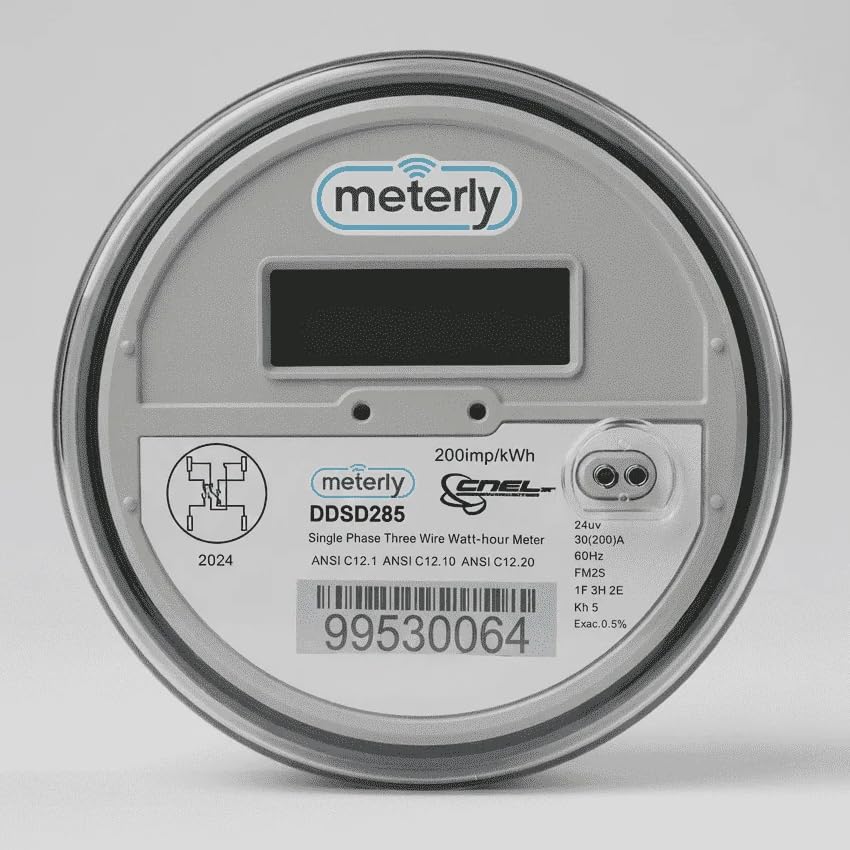
Swap the meter already in your socket base and keep everything else exactly as it was.
This is a form 2S solid-state meter built to sit in the same four-terminal 240V socket base a utility meter uses. There is no rail to mount and no bracket to fabricate — you pull the old unit and this one seats in its place. The CL200 marking is the service class, the rating utilities use for a standard 200A residential service. If you are adding metering to an RV pedestal or a rental property that already has a socket, this is the shortest path.
You can watch the test LED blink as power flows and know the meter is live and counting. The build is a polycarbonate cover over an electronic LCD register. It has been tested for ANSI C12 compliance, the US standard for electricity metering accuracy, and it arrives zeroed — which is exactly what you want for a fresh sub-metering job, since the register starts clean at your install date. The unit weighs 2.53 pounds.
What this meter does not give you is a data port. There is no pulse output, no Modbus, no WiFi and no app — just the LCD and the test LED. That is fine for reading a monthly total by eye, but it is a real limitation if you plan to automate billing or feed a monitoring system. It is also strictly a socket-base device, so it will not help if your panel has no 4-jaw base to plug into. At 4.0+ stars across 170+ ratings, it earns its keep through simplicity rather than features.
Why the swap wins: form 2S fit, ANSI C12 tested, zeroed register and a pulsing test LED — everything a straightforward replacement needs, nothing more.
The trade you accept: no data output of any kind. If you want the numbers in software, this is the wrong family of meter.
Made for: replacing or adding a meter in an existing 4-jaw socket base at a home or RV pedestal.
Not made for: DIN rail panels, pulse logging, or any setup where you want usage data where you can keep it.
5. Digital Electric Sub Meters 120/240V
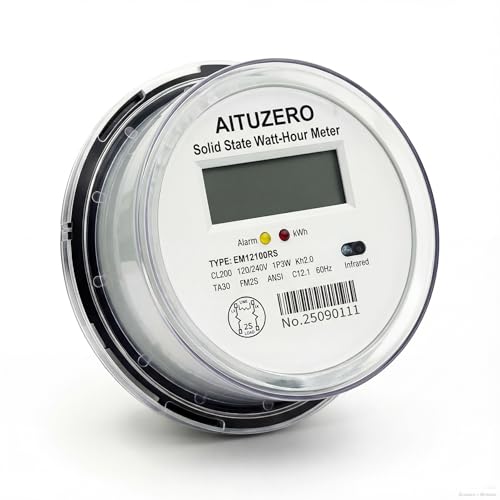
Built for the person who has to explain the bill to a tenant at the end of the month.
Start with the current figure, because it is the highest on this list: a 200A maximum alternating current rating, well above the 100A EKM Universal and the 63A eMylo. That ceiling is what lets it sit on a whole house service or a heavy workshop feed without being the weak link. It installs into a standard ANSI form 2S 4-jaw socket base and accepts 120/240V single-phase three-wire — the ordinary US residential arrangement.
The feature set goes past simple counting. It emits a pulse output and speaks Modbus, a common industrial communication protocol that lets a controller or monitoring tool pull readings directly from the meter. It also stores data in EEPROM memory, a chip that holds its contents when power drops, so a blackout does not wipe your usage history. An infrared port lets a technician read or adjust settings without opening the panel, and the LCD auto-cycles through voltage, current and power so you can flip through the readings in place.
Where it earns its keep is the scenario in its own name: splitting usage across tenants, RV pads and workshop circuits so costs get allocated fairly instead of argued over. The reverse-flow LED is a quiet bonus for solar owners, since it shows instantly when power is flowing backward through the meter. The one honest caveat is that all this capability assumes you are working inside a proper box or panel — the sealed housing protects the circuitry, but it is not a standalone outdoor enclosure on its own. At 4.5+ stars across 70+ ratings, it holds the highest score of any pick here.
The reason to pick it: You get 200A capacity, Modbus output and EEPROM storage in a form 2S body — the highest-rated meter in this guide at 4.5+ stars.
What to plan around: it needs a proper box or panel around it, and Modbus wiring only pays off if you own the tooling to read it.
Best fit: landlords, RV parks and workshop owners who need accurate kWh split across multiple users.
Think twice if: you just want a number on a screen — this meter’s strengths sit in Modbus integration and tenant billing, not in simple readout.
6. DAE DEM730P Electric kWh Submeter

The submeter that arrives ready to plug into a cloud reporting system for a whole building.
If you manage several units and want the kWh numbers to land in an app without building your own logger, this is the one designed for that job. Paired with the DAE CC2030 gateway, this meter sends its energy data over Ethernet to a cloud server. From a PC, phone or tablet you pull real-time data, monthly kWh and tenant billing reports, including time-of-use billing. The company’s own framing is that you wire it per the diagram and go — no IT person required.
The electrical side is deliberately modest: 1P3W, meaning two hot wires and one neutral, at 120/240V with a 50A rating and an internal current transformer. That 50A figure is the lowest here and it is the number to respect — this meter suits a single apartment, a suite or a defined circuit, not a whole-house service. It conforms to the IEC61036 standard for energy meters. Calibration certificates are available from the manufacturer.
Two practical notes before you order. First, this is an indoor unit — the manufacturer offers a separate watertight enclosure for outdoor mounting, and you will want it for a pedestal. Second, if your meter sits far from your router, the company sells a gateway plus RF converter pair that links the two wirelessly, which solves the cable run problem in an existing building. At 4.5+ stars across 60+ ratings, it is a specialist tool aimed squarely at landlords who bill tenants.
For the multi-unit owner: RS485 metering with a clear path to cloud billing reports, time-of-use included, at a 50A ceiling.
For the single-family homeowner: overkill. A 50A rating will not carry a whole house, and the cloud reporting value only exists when you have tenants to bill.
Choose it when: you run rental units or a property with multiple tenants and want meter data flowing into billing reports automatically.
Skip it when: you are metering a whole house or mounting outdoors — 50A is a small-service ceiling and the enclosure is sold separately.
7. Aeotec ZW095 Home Energy Meter Gen5

Two clamps, up to 200 amps each, and readings that land in your Z-Wave hub instead of an LCD.
This is a clamp-on unit, not a wired-in meter. Two clamps wrap the mains and each meters up to 200 amps at 120 volts, so the electrical capacity is generous — far beyond the 63A eMylo or the 50A DAE. The monitor connects to mains power on a two-phase system inside your electrical box, and the manufacturer states a professional electrician may be required for installation. Aeotec claims 99% measurement accuracy and rates the Z-Wave wireless range at up to 492 feet.
The real draw is the Z-Wave Plus radio. It pairs with certified Z-Wave gateways including SmartThings, Home Assistant, Vera, Home Seer, Indigo 7 and a list of others, and Z-Wave Plus adds faster response and encryption over plain Z-Wave. If your smart home already runs on Z-Wave, this slots into the dashboard you already check instead of adding another app. The unit weighs 1.3 pounds and mounts to a wall.
Here is the honest part, and it matters more here than anywhere else on this list. Reliability and compatibility are the two most-discussed topics and both come back mixed — some units run for years, others report trouble after about a year, and pairing can be smooth with Home Assistant or fiddly with SmartThings. Power measurement is the weakest recurring theme, with the meter displaying watts and kWh but not measuring voltage independently. At 3.5+ stars across 200+ ratings, it is the lowest score here — buy it specifically because your hub is Z-Wave, not for general-purpose metering.
What it does best
- Two clamps, each rated to 200A at 120V, with no service interruption to install the sensing
- Native Z-Wave Plus with a long gateway compatibility list including SmartThings and Home Assistant
- Wireless range rated up to 492 feet
- Aeotec claims 99% measurement accuracy
What buyers run into
- Long-term reliability is the biggest split in feedback — some units last, some falter around a year
- Pairing difficulty varies by hub, with SmartThings the more troublesome in reports
- No independent voltage reading — watts and kWh only
Worth it if: your smart home already runs on Z-Wave and you want whole-home consumption on the dashboard you already use.
Pass if: you need a rock-solid standalone meter — this one lives or dies by its hub pairing.
8. Single Phase kWh Meter Pass-Through 100A

The same 100-amp metering job as the top pick, in a smaller body with wire running straight through.
Take the wiring flexibility of the EKM Universal and shrink the housing. This unit measures 3.94 x 3.44 x 2.55 inches against the 4.75 x 4 x 3 inches of the meter above — a meaningfully smaller block to find room for inside a tight panel. It covers the same ground: 120/240V three-wire with two hots and a neutral, 120V or 208-240V two-wire with one hot and a neutral, and 120V or 208-240V two-wire with two hots.
The current ceiling matches at 100A, with the same 13.5mm wire diameter that spans 22 AWG to 1 AWG. The pass-through design means the load conductors route through the meter body rather than terminating into a socket, which keeps the wiring neat and lets you mount it where a socket base will not fit. You read totals on the LCD or pull the same data through the pulse output. It is rated as an ammeter and wattmeter.
The limitation worth naming: two or three-wire flexibility is broad, but this is not a socket-base meter and it is not a WiFi meter. If your panel has an existing 4-jaw base, the Meterly or the Aituzero is the correct shape. If you want usage on your phone, none of the EKM family will do it — the pulse output expects a third-party logger. At 4.0+ stars across 60+ ratings, it is the pick for someone who has looked at both EKM units and needs the smaller footprint.
The narrow advantage: 100A capacity and full two-or-three-wire flexibility packed into a 3.94 x 3.44 x 2.55 inch body.
The thing to accept: no socket base fit and no wireless of any kind — it is a hardwired, hardwired-only meter.
Pick this when: panel space is tight and you still need 100A metering across mixed two or three-wire circuits.
Choose differently when: you have an existing form 2S socket, or you want readings without running pulse cable.
9. Meross Smart Home Energy Monitor
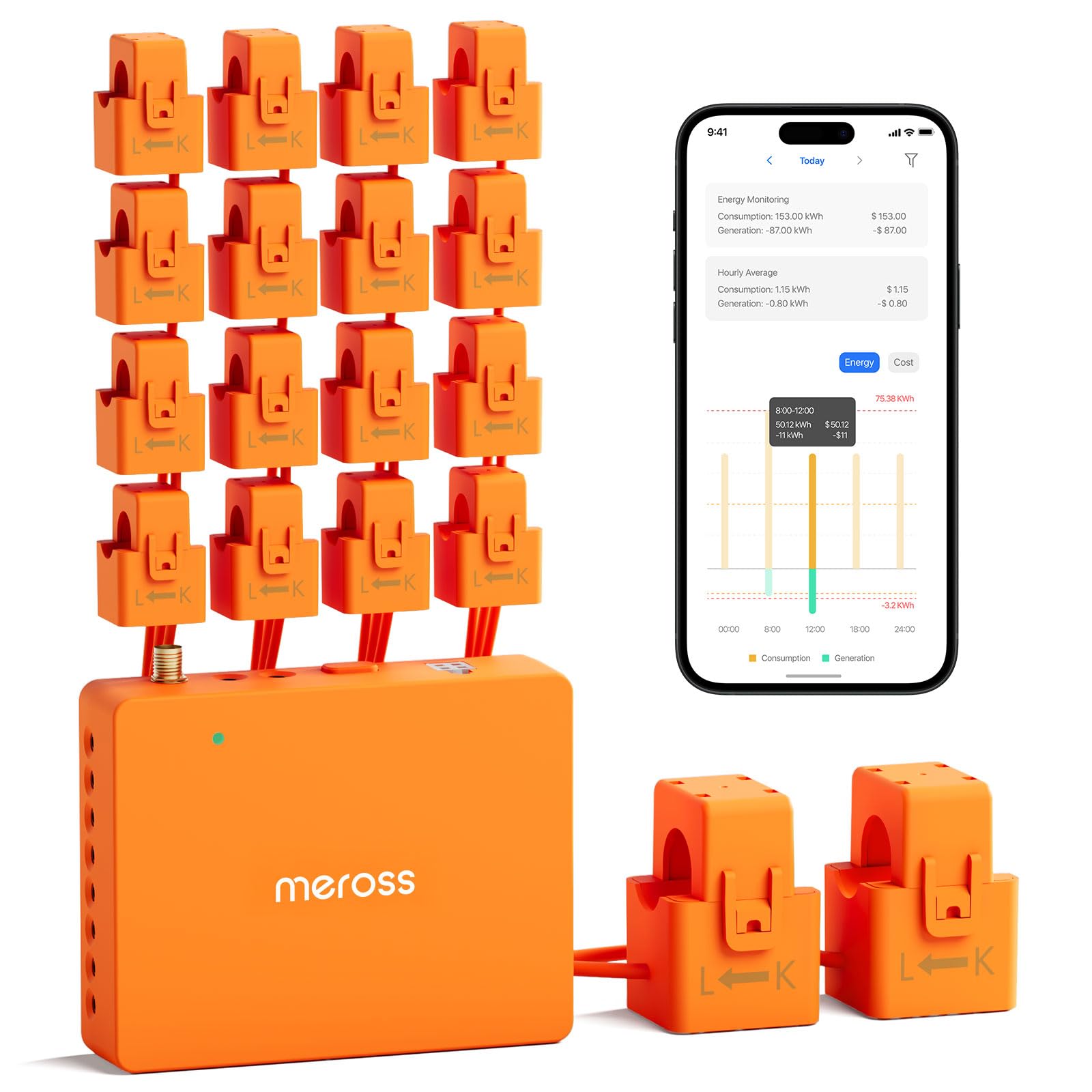
Wraps the mains and sixteen branch circuits, so you can see which breaker the money is going to.
Every other meter here tells you how much the house used. This one tells you where. It covers 2 main circuits up to 200A plus 16 branch circuits up to 60A each, using clamp-on current transformers, the ring sensors that read current without cutting the wire. The clamp design installs in minutes, and you can invert a CT reading in the app rather than physically flipping the sensor — a small detail that saves a frustrating second trip to the panel.
It tracks power, voltage, current and power factor within ±2% accuracy and charts consumption from minute to year. It stores up to 5 years of data and exports hourly reports. On the smart-home side it works with Home Assistant, and importantly all data stays local — no cloud, no subscription, with Open API and web control available. It is ETL-certified, compliant with the UL 61010 testing standard, and carries a 2-year warranty.
The solar angle is what separates it from a plain monitor. Connected to Home Assistant, it detects surplus solar production and can trigger EV chargers, water heaters and other high-use appliances to run on that free power instead of the grid. Setup is the honest trade-off: some buyers find the software easy to configure and others report a complicated installation, and a handful hit connectivity trouble. None of it sinks the product, but plan to spend a focused afternoon on the app. At 4.0+ stars across 180+ ratings, it is the most capable monitor here — just note that saving is a result of acting on what you find, not something built into the box.
The capability case
- 2 main circuits to 200A plus 16 branch circuits to 60A each
- ±2% accuracy on power, voltage, current and power factor, with charts by minute through year and up to 5 years of stored data
- All data local, no subscription, Home Assistant and Open API support
- ETL-certified, UL 61010 compliant, backed by a 2-year warranty
What to plan for
- Setup spans app configuration and hardware clamping — budget real time for the first one
- Connectivity is the recurring weak spot in feedback
- Real savings depend on you changing how you run the house
Go for it if: you want to know which appliance is eating the bill, or you have solar and want to use the surplus yourself.
Hold off if: you only need one whole-house total — the branch-level capacity here is more than that job asks for.
Know the Specs
Maximum current in amps
This is the ceiling on how much electricity can flow through the meter, and it is the number to match to your load. A 200A rating suits a whole-house service and heavy equipment like welders or HVAC. A 100A rating covers most sub-panels and single-family circuits. A 63A rating suits one large circuit or a small apartment. A 50A rating is for a single suite or a defined circuit. Pushing a load past the ceiling is where meters fail or heat up, so pick a rating above what you will actually run.
Wiring configuration and socket type
Meters come in three physical families and they are not interchangeable. A form 2S socket meter seats into a standard 4-jaw base the way a utility meter does. A DIN rail meter clips onto a 35mm rail inside a sub-panel. A pass-through meter routes the conductors through its own body. Wiring then splits into two-wire (one hot plus a neutral) and three-wire (two hots plus a neutral, which is standard US residential 120/240V). Some meters handle all three configurations and some are strictly three-wire — check that line before you buy.
Accuracy class and percentage figures
Accuracy tells you how close the meter’s count is to the truth. A Class 1.0 rating is a formal grade for energy meters. A stated ±2% accuracy means the reading stays within two percent of the real value. A 99% accuracy claim works the other way — it means one percent of variance is possible. For splitting a bill between tenants, accuracy matters a lot. For spotting a power-hungry appliance, even a looser meter will point you at the right suspect.
Data output: pulse, Modbus, RS485 and WiFi
A meter without an output is a screen you walk over to read. The outputs change what is possible. Pulse output sends a signal that a logger counts. Modbus and RS485 are industrial protocols that let a controller pull real readings from the meter. WiFi and Z-Wave connect the unit to an app or smart home hub. Local API support means the data stays on your own network with no subscription. Decide first if you need automation, then choose the output that delivers it.
Common Questions
Can I install a house electric meter myself or do I need an electrician?
Will a form 2S meter fit my existing utility socket?
What does CL200 mean on an electric meter?
Do these meters work with solar panels feeding power back to the grid?
Can a submeter split electricity costs between tenants legally?
Do I need WiFi on a house electric meter?
What is the difference between a 63A and a 100A meter?
Can a clamp-on monitor read my whole house without cutting any wires?
What happens to my meter readings during a power outage?
Does a smart energy monitor actually lower my electricity bill?
The Bottom Line
The strongest all-round pick for a house electric meter is the EKM Universal Single Phase kWh Meter, because it accepts three different wiring configurations, carries a 100A ceiling, and gives you both an LCD and a pulse output. It is the meter that fits the most panels without a second thought. The honest footnote is that the Aituzero landlord submeter holds a higher 4.5+ star score and more ratings — but the EKM’s broader wiring support makes it the safer default when you have not opened the panel yet.
If your job is splitting usage across tenants, reach for the Aituzero Digital Electric Sub Meter and its 200A ceiling plus Modbus output. For a single circuit you want to switch off remotely, the eMylo 63A WiFi Energy Meter adds leakage protection nothing else here offers. And if the real question is which appliance is eating the bill, the Meross Smart Home Energy Monitor answers it circuit by circuit with 16 branch channels and local-only data.
One nudge before you close this tab: meter feedback is lopsided where it counts. The EKM Universal and the Aituzero both sit 4.0+ stars with steady long-term reports, while the Z-Wave clamp unit sits lower on reliability and pairing. Decide your socket family first, then buy the meter your panel actually accepts — that single check prevents nearly every return in this category.
How we choose
We do not accept paid placement. Every pick is matched to a real buyer and a real use-case; we do not hands-on test units.
Sources
Specifications: manufacturer listings and product documentation. Review insights: verified customer reviews, as of November 2026. Pricing: not shown on this page (it changes often); check the current price via the retailer link.
As an Amazon Associate, Tactical Gear Guy earns from qualifying purchases. This does not affect which products we feature.