Specs are compiled from manufacturer listings and verified buyer reviews and can change over time — please confirm the key details on the product page before buying.
You want one kayak you can carry alone, inflate at the water’s edge, and paddle without fighting the hull all afternoon. The short answer: buy for weight capacity and hull shape before anything else, because a one-person inflatable that fits you badly is a wet, wobbly day out. The picks below cover every budget and every kind of water, from a calm lake to moving current.
This guide is built by comparing the manufacturers’ published specifications and the patterns across verified customer reviews, so you get each pick’s real strengths and trade-offs instead of marketing spin.
Capacity, packed weight and tracking decide most of it, so the numbers below are the ones that actually change your day on the water. Here is the honest shortlist of the 1 person inflatable kayak options worth your time and money.
Top Picks

How To Choose The Best 1 Person Inflatable Kayak
Most first-time buyers shop by length and colour. The two numbers that actually decide whether you enjoy the boat are weight capacity (how much paddler plus gear it floats safely) and packed weight (whether you can get it from the car to the water without help). Get capacity and packed weight right and the rest — colour, seat padding, included accessories — is preference.
Weight capacity: your real ceiling, not a suggestion
Capacity tells you how much total load the kayak floats comfortably — you, your paddle, a dry bag and a cooler. A solo boat rated around 220 lbs is fine for a lighter paddler with minimal gear. If you are a bigger person, carry fishing kit, or paddle with a dog aboard, look at a hull rated higher, such as one near 331 lbs or 300 lbs. Going over capacity does not just slow you down; it sinks the hull deeper and makes every stroke heavier.
Hull shape and floor: where tracking comes from
A drop-stitch floor is a floor made of two fabric layers held apart by thousands of internal threads, so it inflates to a firm, board-like panel. That stiffness is what lets you push with your legs and hold a straight line. A plain inflated floor is softer and lighter but flexes under you. Fins and skegs — the small blades under the stern — are the other half of tracking: they resist sideways drift so the nose stays pointed where you aim it.
Packed weight and folded size decide how often you go
A solo inflatable that weighs around 20 to 26 lbs is genuinely one-person car-to-water carry. Once you pass 40 lbs, you start wanting a second pair of hands or a cart. Check the folded size against your trunk and your hall closet too, because a boat that lives in the garage instead of the car does not get used.
What kind of water you plan to paddle
A calm lake or slow river asks little of the hull. Open water and current ask for rigidity, a defined nose and good tracking. Whitewater asks for self-bailing — drain valves that let splashed water run straight out instead of pooling at your feet. Match the hull to the water you actually paddle: a wide flat-water boat for lakes, a self-bailing hull with fins for current.
Side-by-Side Comparison
| Model | Best For | Inflated Size | Weight Capacity | Kayak Weight | Amazon |
|---|---|---|---|---|---|
| Aqua Marina Steam★ Best Overall | Rivers and open water | — | — | 25.4 lbs | Amazon |
| Intex Challenger K1Budget Champion | Lakes on a tight budget | 9 ft x 2.6 ft x 1.1 ft | 220 lbs | 26 lbs | Amazon |
| Bestway Koracle X1Best for Anglers | Solo fishing trips | 9 ft 4 in x 36 in | 331 lbs | — | Amazon |
| Bestway Cove Champion | Casual flat-water paddling | 9 ft x 32 in | 220 lbs | — | Amazon |
| Sevylor QuickPak | Travel and small storage | — | — | 20.3 lbs | Amazon |
| Advanced Elements Lagoon1 | Beginners wanting stability | 100 in x 34 in | — | 23 lbs | Amazon |
| Advanced Elements StraitEdge | Heavier paddlers, rough water | 116 in x 35 in | 300 lbs | 47 lbs | Amazon |
| Catalyst Outdoors Keystone 210 | Hiking to remote water | 86 in x 37 in | 265 lbs | 5.5 lbs | Amazon |
| TIDETREK Touring Kayak | Two pumps, full kit included | 10 ft x 41 in x 15 in | 220 lbs | 29.1 lbs | Amazon |
Detailed Reviews
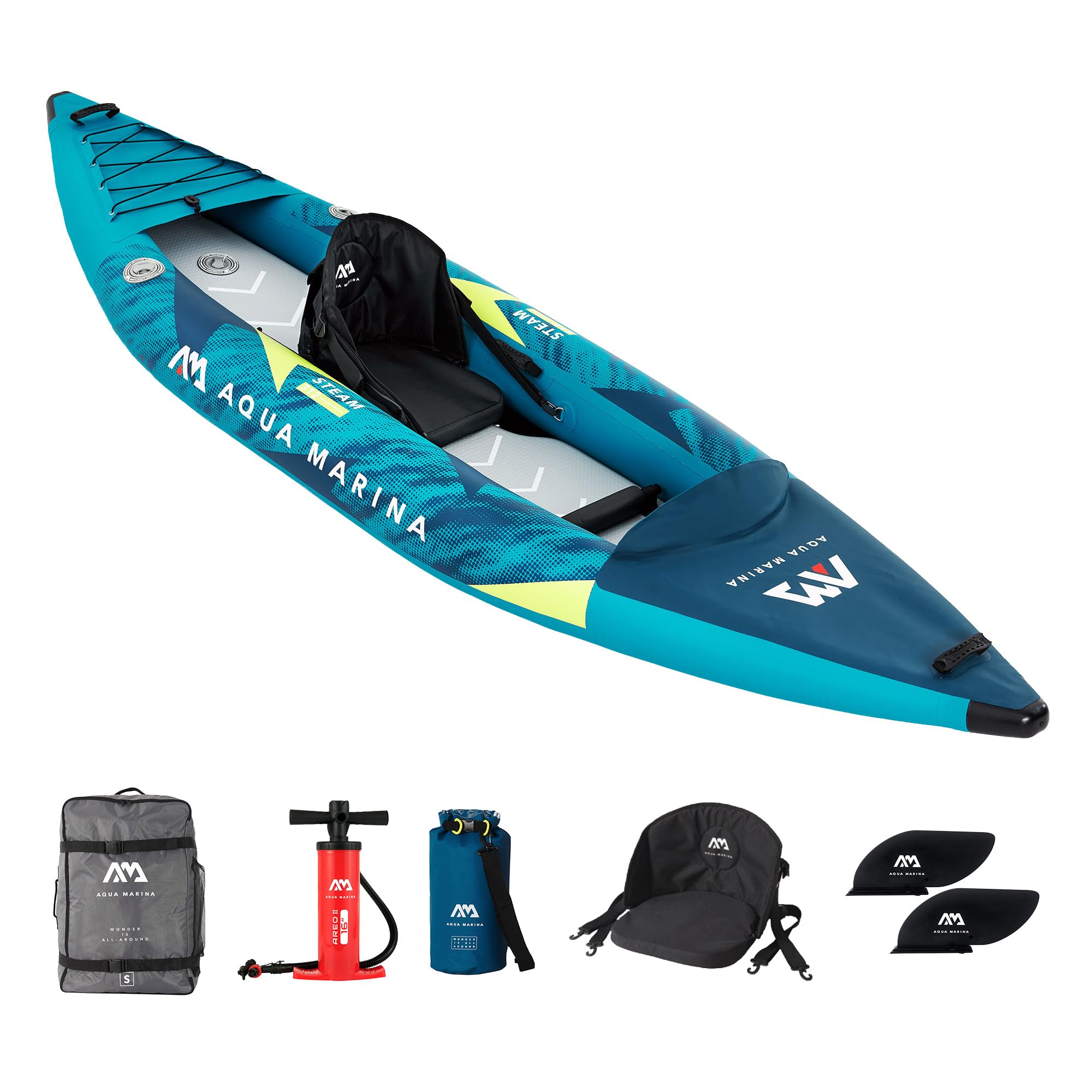
1. Aqua Marina Steam Inflatable Touring Kayak
Our pick — 4.5+★ from 200+ verified ratings; the strongest balance of quality and price.
The one solo boat here built to take a splash without you bailing it out by hand.
If you plan to paddle moving water instead of a flat lake, the Steam is the pick built for it. The maker rates it for class III whitewater (rivers with moderate, choppy rapids), and the self-bailing design is why: open the drain valves and water that splashes over the side drains straight out through the hull instead of pooling around your legs. That is the difference between pushing through a riffle (a shallow stretch of rough water) and stopping at the bank to empty the boat by hand.
Underneath you sits a drop-stitch floor — two fabric skins tied together by internal threads so it pumps up firm, almost like a board — and that stiffness gives you something to brace your feet against on every stroke. Twin center fins then keep the nose pointed where you aim it, so you spend your energy going forward instead of correcting drift. At 25.4 lbs it is light enough to carry in one hand from the car, and it folds into the included backpack, so you no longer need a roof rack.
The kit is unusually complete for a solo boat: a high-backrest seat, two fins, a gauged hand pump (one with a pressure dial so you stop guessing), a 10L dry bag and the backpack all come in the box. The catch is what it is not: this is a performance hull, not a beginner’s barge. The streamlined shape and drop-stitch floor that make it track and respond also make it a little less forgiving while you learn, and it asks more of your balance than a wide, soft-floored lake boat. If you are brand new and want maximum stability on calm water, a wider lake boat suits you better.
Where it earns its place
- Self-bailing drain valves clear splashed water without you stopping to empty the boat
- Drop-stitch floor and dual center fins give it the straight-line tracking of a much stiffer hull
- 25.4 lbs with an included backpack means solo car-to-water carries are realistic
- Seat, fins, gauged pump, 10L dry bag and bag all included — nothing to buy on top
What to weigh before you buy
- The responsive hull asks more balance of a total beginner than a wide flat-water boat
- Built for rivers and open water rather than lazy, shallow lake drifting
- Premium-tier spend for a solo kayak
Made for: paddlers who want one boat that handles rivers and open water and still folds into a backpack.
Think twice if: you are a first-timer who only ever paddles flat, calm water and wants maximum stability from day one.
2. INTEX 68305EP Challenger K1 Inflatable Kayak Set
The easiest yes in the category: a complete solo kayak for lake days without a second thought.
This is the boat that gets people onto the water at all. It inflates to 9 feet by 2.6 feet by 1.1 feet and floats up to 220 lbs, which suits a solo paddler with a day bag on a lake or a mild river. A removable skeg — a small fin under the stern — slots in when you want help holding a straight line and comes out when you want to turn quicker. At 26 lbs it goes in the car boot and comes out again without a struggle.
What wins people over is simply how little friction there is between deciding to paddle and actually paddling. Owner consensus circles the same handful of things: it pumps up and deflates quickly, it packs down small, and setup and teardown take minutes rather than an afternoon. The cockpit is roomy enough to stretch your legs, and the seat is removable and adjustable so you can position it where you want it. For a first solo kayak, that ease is worth more than any spec sheet line.
Here is the honest trade-off, and it is the one thing to size properly: durability is the recurring split in owner experience. Plenty of boats hold up season after season without a puncture; some develop seam or floor issues after use. That is a fair caveat on any PVC inflatable at this tier, and it means storing it dry, avoiding dragging it over gravel, and keeping the repair patch handy. Pick it for calm water and reasonable care, and you get a lot of paddling for the outlay.
The value read: a full solo kayak set at entry-level spend, with a skeg for tracking and a cockpit roomy enough for taller paddlers to stretch out.
The fair warning: treat the PVC hull kindly — dry storage and no gravel drags — because long-term durability is the one area where experiences genuinely divide.
Reach for this if: you want a proven, easy-inflating solo lake kayak and are happy to look after a PVC hull.
Look elsewhere if: you plan to run rivers with rocks, where a stiffer, higher-capacity hull is the safer money.
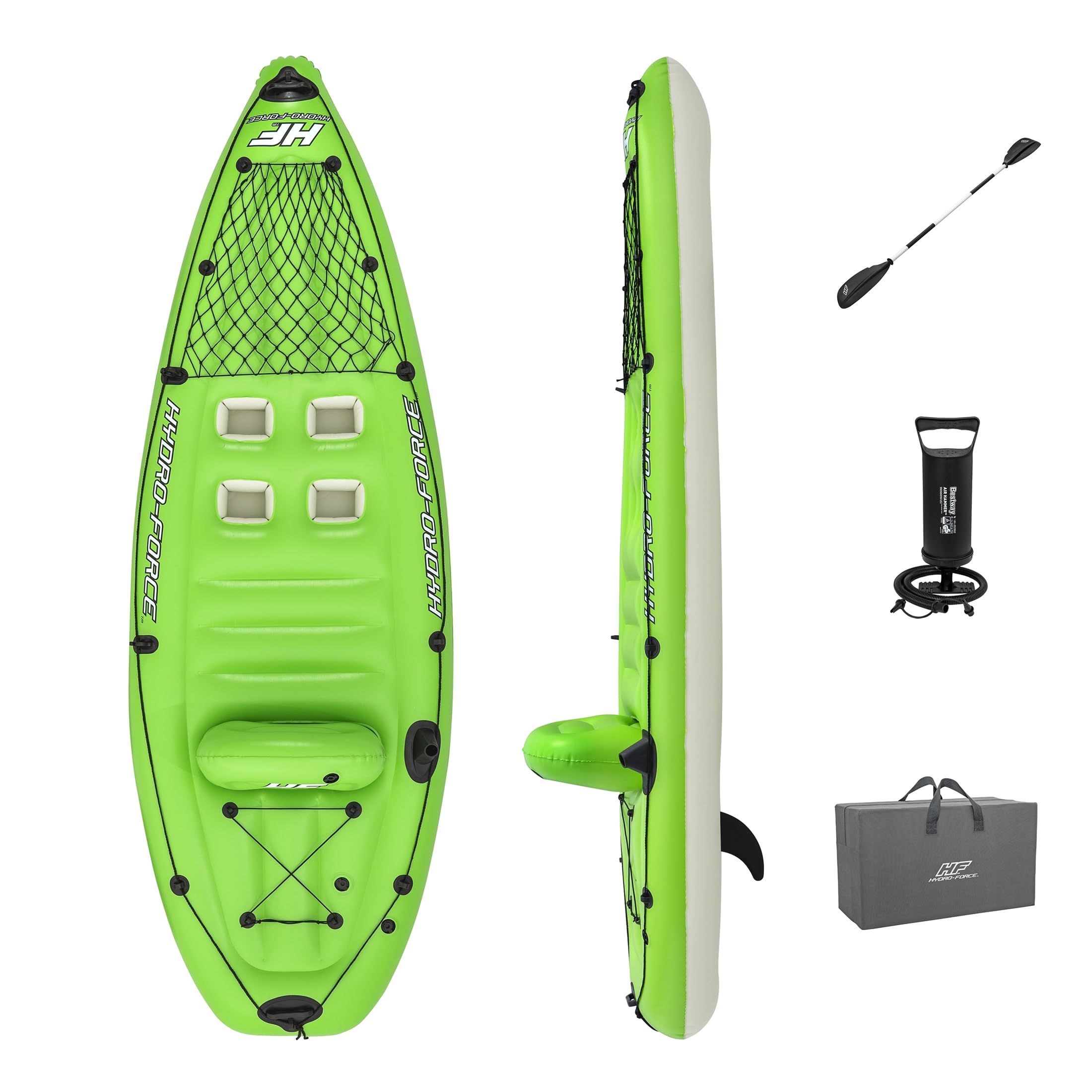
3. Bestway Hydro-Force Koracle X1 Inflatable Fishing Kayak Set
A solo boat that carries more weight than almost anything else on this list — and a rod holder built in.
Start with the number that matters for a fishing kayak: it floats up to 331 lbs. That is far more headroom than the Bestway Cove Champion’s 220 lbs, and it is the difference between a boat that stays high and dry with you, a tackle box and a cooler aboard and one that sits low and sluggish. At 9 ft 4 in by 36 in inflated, it is a stable, wide platform to cast from without feeling like you are about to tip.
The layout is the real story. There is a net up front and elastic cords at the back to lash down your essentials, oar clasps to park the paddle while both hands are busy with a line, and a built-in rod holder so you can leave a bait in the water and relax. Four footrests mean the boat adjusts to your height rather than the other way around, and the built-in inflatable backrest gives you something to lean into over a long session. Two removable fins in different sizes let you tune directional support to the water you are on.
The Inflata-Shield material is the maker’s name for a hull skin built to resist punctures, limit stretching and add grip, which is the trait you want when fishing near stumps and banks. The set includes the kayak, a 91 in aluminum paddle, a single-action hand pump, both fins, a carry bag and a repair patch. One practical note: a single-action pump moves air on the downstroke only, so expect to put in a little more effort than a dual-action pump would ask.
Why anglers should care: 331 lbs of capacity plus a rod holder, net, storage cords and paddle clasps make it a purpose-built fishing platform, not a lake toy with a rod added.
The one chore: the included single-action pump is slower going than a dual-action model — inflate at home or bring a better pump.
Pick this one if: you want to fish from a solo inflatable and carry real gear without sinking the hull.
Not your boat if: you only need a quick paddle toy and would rather not spend mid-range money on fishing features.
4. Bestway Hydro Force Inflatable Kayak Set with Paddles

A firm inflated floor and a cockpit that taller paddlers can actually stretch out in.
At 9 ft by 32 in inflated with a 220 lbs capacity, this is the Bestway built for straightforward flat-water paddling. What separates it from a plain lake boat is the firm and rigid inflated floor — it gives you a solid surface underfoot in a way a soft single-skin floor does not, which makes pushing through each stroke feel more planted. A 91 in aluminum paddle comes in the set, so you are not shopping for one separately.
Owners consistently describe it as roomy enough for people of all heights, which is a real point in a one-person boat where legroom often gets sacrificed. The cockpit adds an inflatable seat and backrest, a wraparound grab rope for hauling it to the water, and a storage cord and net for a dry bag. Everything packs into the included carry bag along with the pump, two fins and a repair patch.
The honest notes come down to setup and inflation. How easy it assembles is genuinely split — some get it together quickly, others find the instructions thin and the first go slower than expected. Inflation is likewise mixed, with some finding it quick and a few reporting a slow or stubborn fill. Practise at home once before your first trip and both of those stop mattering. Treat the bag and hull with a little care as well, since a few owners found the bag the first thing to give out.
What it gets right
- Firm, rigid inflated floor gives you a planted feel underfoot
- Cockpit is roomy enough that taller paddlers fit comfortably
- Full set with paddle, pump, fins, bag and patch in one buy
Where it can frustrate
- Instructions are thin — do a practice inflate at home first
- The carry bag is the weak link for a few owners
Fits you if: you are taller or want a firm floor underfoot for calm lake days.
Keep looking if: you paddle moving water and want self-bailing or serious tracking fins.
5. Sevylor QuickPak Inflatable Kayak
The trunk-friendly one: a kayak that folds into its own backpack and lives in a small car.
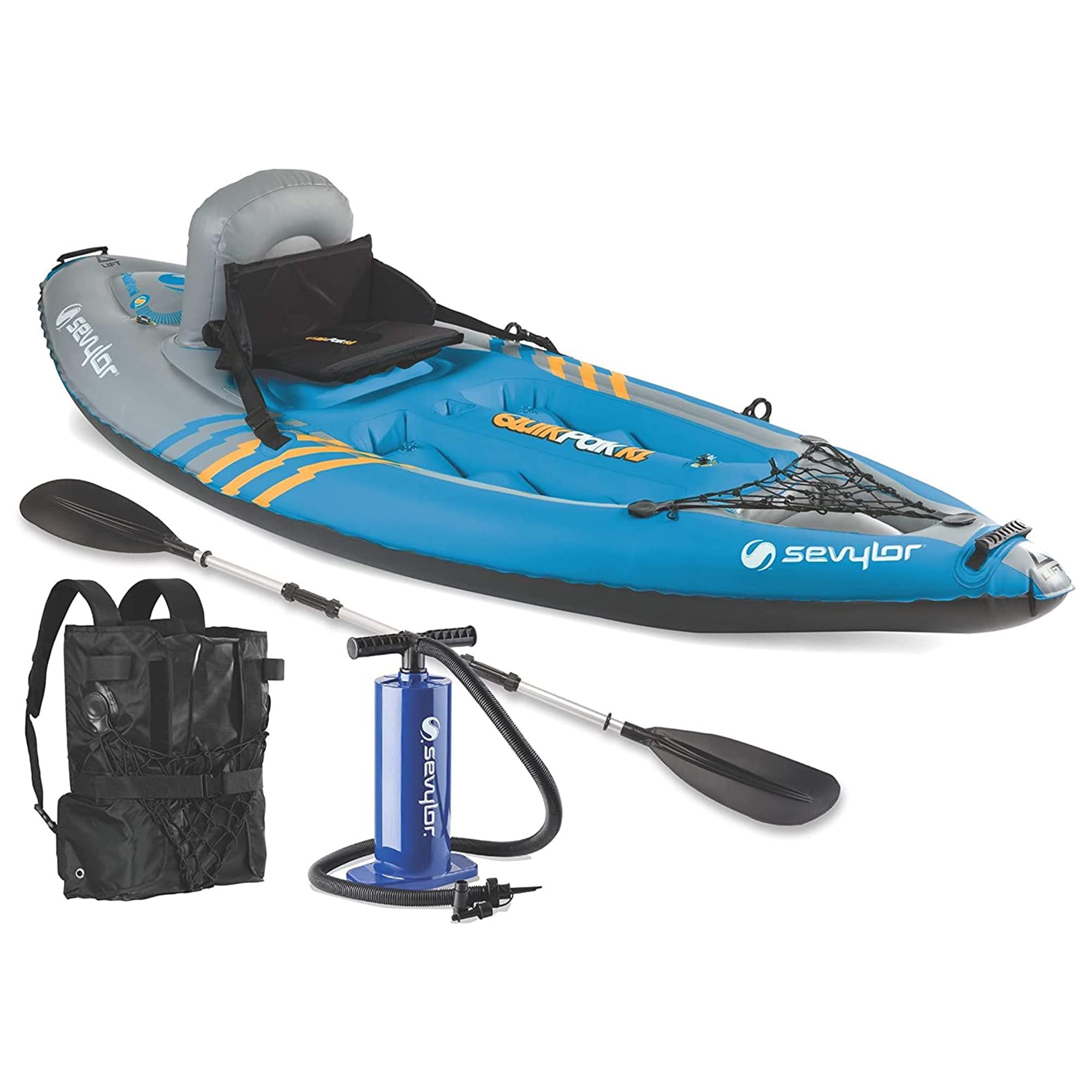
Weighing 20.3 lbs, the QuickPak is the lightest traditional inflatable here and the one most likely to actually come with you. It packs away into its own backpack system, which then doubles as the seat — so there is no separate bag to lose, and it fits in a trunk with room to spare. That backpack-and-seat combo is the whole pitch, and it suits anyone short on storage or hauling the boat to the beach on foot.
The construction details are aimed at relaxed lake use: 21-gauge PVC (a thick, tough plastic) is rugged enough for flat water, a tarpaulin bottom adds protection against punctures, and multiple air chambers mean that if one section is holed, another keeps the boat floating. Double Lock valves use two locking points for easier inflation and deflation, the backrest lets you lean back, and a multi-position footrest helps you find a comfortable leg angle. A bungee-secured storage area keeps your gear in place.
Two honest limits belong in the same breath. Stability and tracking get split feedback — some find it super stable and easy to steer, others describe it as flimsy and note it does not track straight like a hard-body kayak. That is the trade of a 20.3 lbs packable hull: a calm-water cruiser rather than a touring boat. Keep it on lakes and slow water and it does exactly what it promises.
What sells it: 20.3 lbs and a backpack that turns into the seat — genuinely easy to store and carry to the water.
Where it stays honest: multiple chambers give you a safety margin, but the light hull is a calm-water boat, not a river tracker.
Worth it for: apartment dwellers and travellers who need a kayak that stores small and carries light.
Skip if: you want hard-body tracking and open-water stiffness.
6. Advanced Elements Lagoon1 Inflatable Kayak
A wide, steady 34-inch beam that keeps a new paddler upright while they find their rhythm.
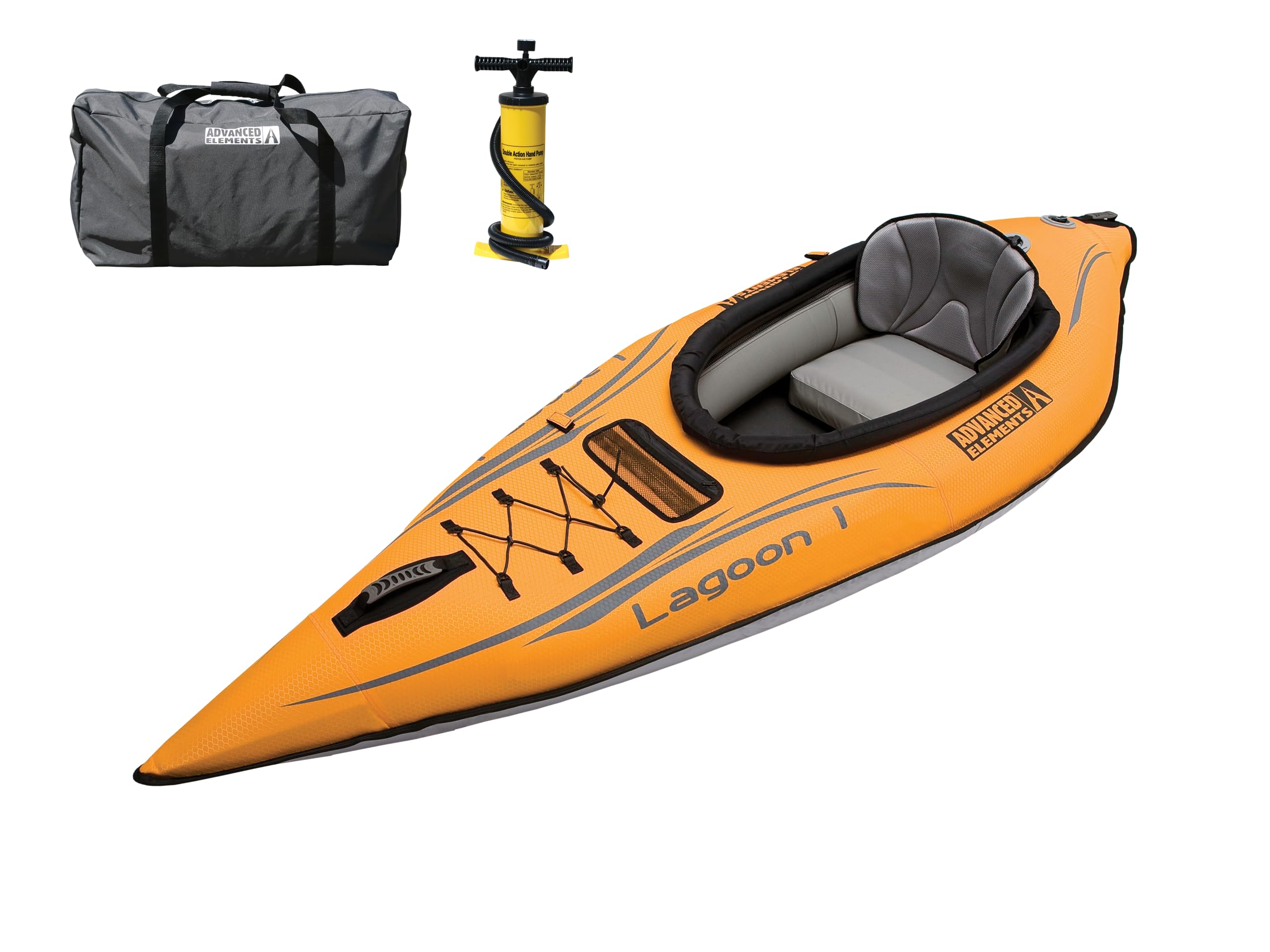
Twenty-three pounds is the number that makes the Lagoon1 easy to live with — light enough to carry solo, and it folds down to 29″ x 18″ x 5″, small enough for a hall closet or the back of a hatchback. But the spec that really shapes the ride is the beam (the boat’s width): 34 inches wide is what gives it the steady feel that makes it a friendly first kayak. A tracking fin underneath works with the hull shape to hold a straight line so you are not constantly correcting.
Durability here comes from rugged materials and multiple air chambers, which is the right setup for a boat that will get bumped around on lake banks. The seat is adjustable and padded with ample legroom for longer paddling stretches, and integrated deck lacing gives you a place to tie down a dry bag within easy reach. It ships with a pump included.
Here is the part a buyer should weigh properly: this is a newer listing, so there is far less owner history to lean on than the long-running boats in this guide. The published design points — wide beam, tracking fin, multiple chambers, adjustable padded seat — are sound for a beginner, but you are buying on the specs and the maker’s reputation rather than on years of accumulated owner experience.
The beginner logic: 34 inches of beam plus a tracking fin and multiple air chambers add up to a forgiving, steady ride for a new paddler.
The thing to know: it is a newer product with a short track record, so you are trusting the spec sheet more than a long review history.
Best call for: first-time paddlers who value a wide, stable hull and easy storage above speed.
Wrong boat for: experienced paddlers chasing a stiff, fast touring hull.
7. Advanced Elements StraitEdge Inflatable Kayak
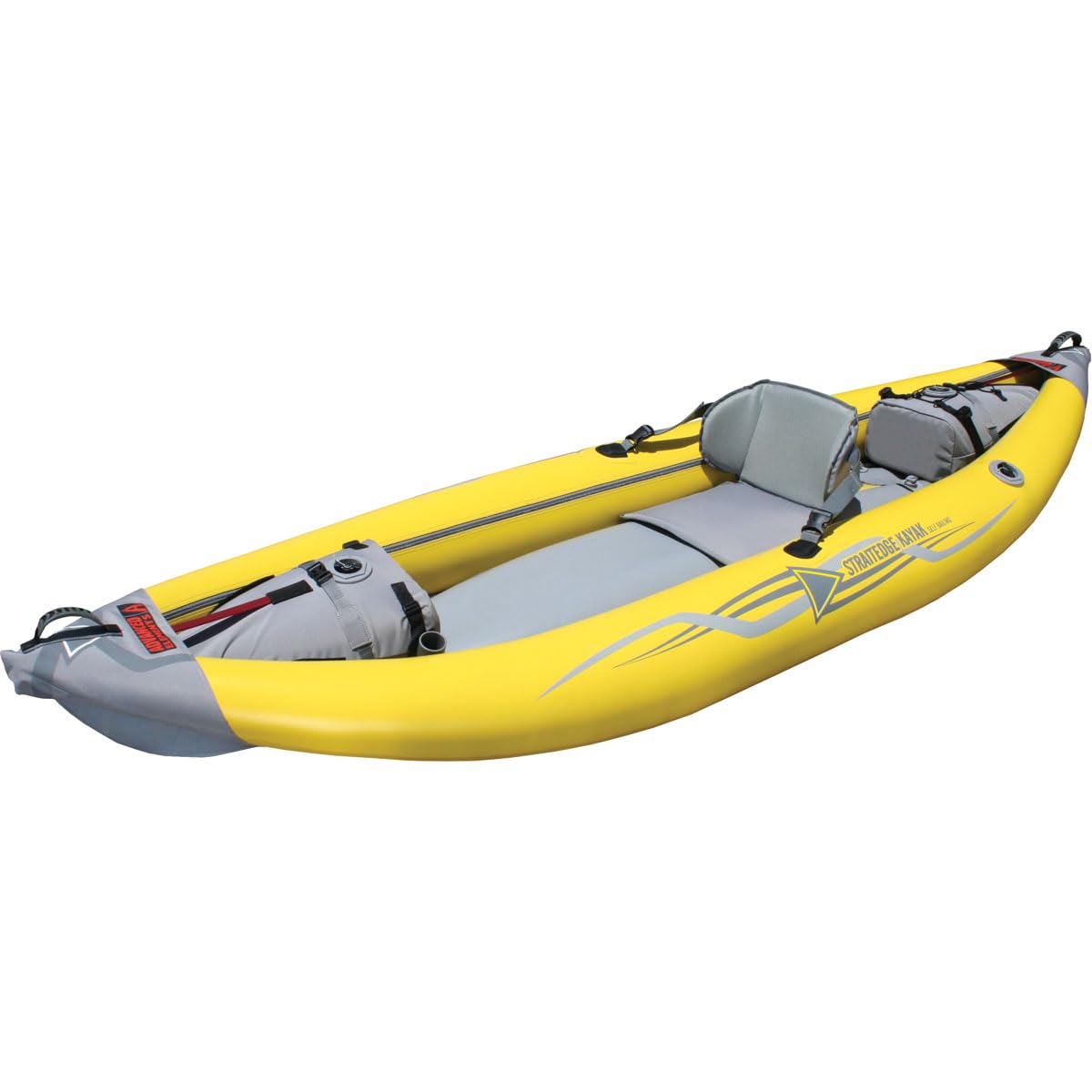
Heavy-duty PVC tarpaulin and a 300-lb rating for paddlers a lighter boat cannot float well.
At 116 in by 35 in inflated with a rating for a single rider up to 300 lbs, the StraitEdge is built for a bigger paddler or a paddler carrying serious gear. The hull is PVC tarpaulin with RF-welded seams — seams joined by radio-frequency welding rather than glue — which is the construction the maker leans on for puncture and abrasion resistance. That makes it a long-haul boat rather than a weekend novelty.
It arrives pre-assembled at the factory: unfold, inflate, attach the seat, and you are on the water. The included folding seat with high support and adjustable padding is meant to keep you comfortable through hours of paddling. It all folds down to 30″ x 17″ x 10″ and stows in the included carry duffel, so it travels well for a boat this substantial.
The catch is the 47 lbs packed weight — by a wide margin the heaviest solo kayak here, and more than double the Intex Challenger K1’s 26 lbs. Owner feedback also flags that the space is narrow and does not leave much room for gear, which is worth knowing if you like to bring a lot aboard. Buy it if you want 300 lbs of capacity and RF-welded PVC tarpaulin and will trade light-and-easy carry for both.
The case for it
- 300 lbs capacity suits a heavier single paddler or one hauling kit
- RF-welded PVC tarpaulin seams built for punctures and abrasion
- Arrives pre-assembled — unfold, inflate, attach the seat and go
The cost of the beef
- 47 lbs packed weight makes it a two-hands-or-a-cart carry
- Wide hull but narrow interior — limited room for gear
Choose it when: capacity and welded durability matter more than light carry weight.
Steer clear if: you need to carry the kayak far on your own or pack a lot of kit.
8. Catalyst Outdoors Keystone 210 Packraft
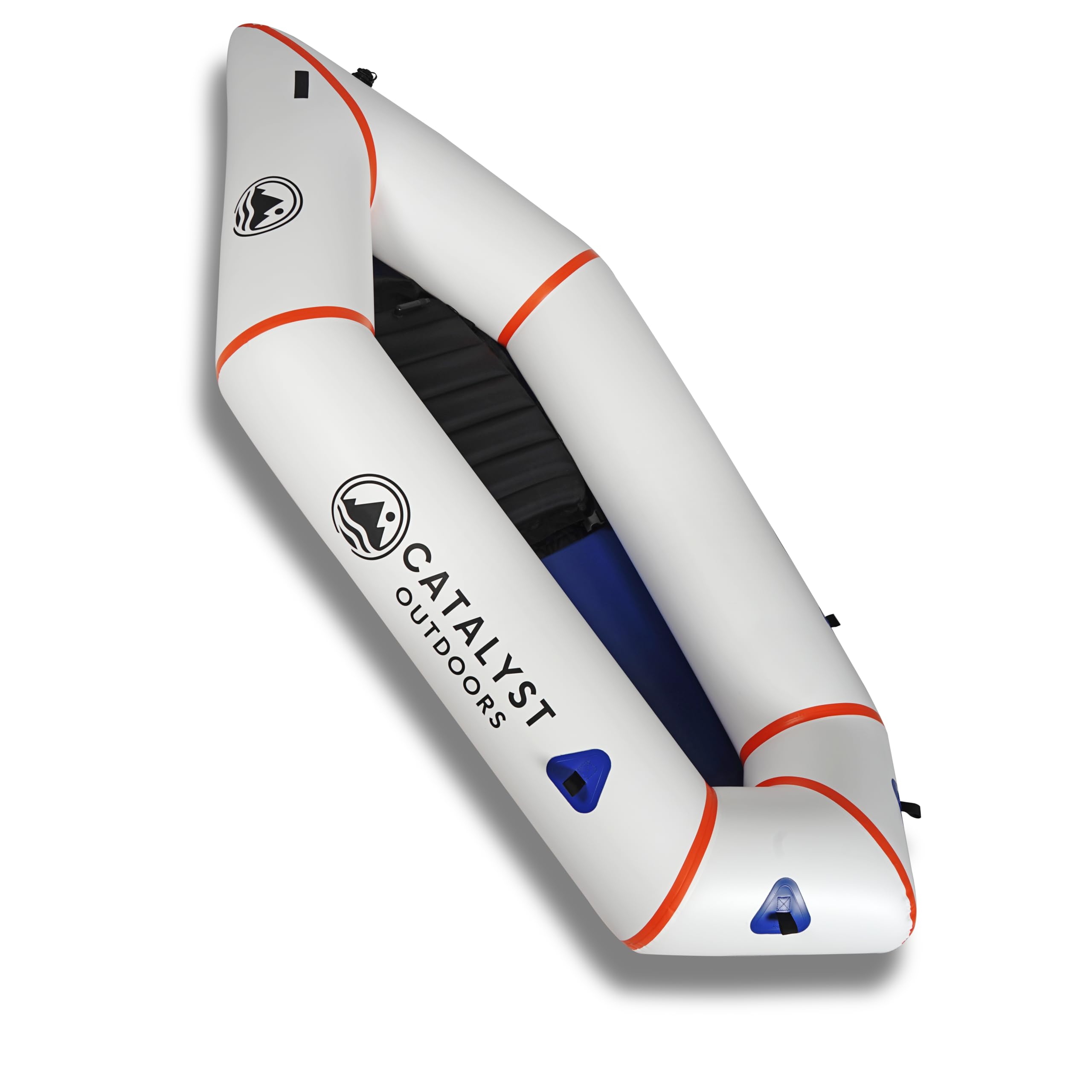
Five and a half pounds of boat you can hike into water no trailer could ever reach.
Nothing else here comes close on weight: 5.5 lbs, which is roughly a quarter of the Intex Challenger K1’s 26 pounds. That is because this is a packraft, not a rigid-floor kayak — a single-person boat meant to go in a hiking pack and come out at a remote alpine lake or river. It fits users up to 6 ft 6 in and carries up to 265 lbs, so it is genuinely usable rather than a gimmick.
The hull is a 70D TPU tube with a 210D TPU floor. TPU is a tough, flexible plastic that resists abrasion and punctures, which is the trade behind the low weight: you get a compact, foldable boat that stands up to rough ground without the bulk of a PVC kayak. It folds to a fraction of a traditional inflatable’s volume and ships with a clever 4-in-1 accessory — an inflation bag that also serves as the seat, a dry sack and a carrying case — plus a patch kit. Note that a paddle and life vest are not included.
The inflation story is the one thing to plan for. You get the inflation bag, but the maker notes an optional Giga Pump, sold separately, fills it in about two minutes — so budget for that if you want fast setup. And because it is a packraft, it is a light, agile ride rather than a stiff touring hull; that is the point, but it is not the boat for someone who wants kayak-like tracking.
Where it shines: 5.5 lbs, a 265-lb capacity and a 4-in-1 inflation bag/seat/dry sack/case make it the go-anywhere solo option.
The fine print: paddle and life vest are not included, and fast inflation needs the optional Giga Pump.
Made for: hikers and minimalist travellers who want to reach water a kayak cannot.
Not for you if: you expect kayak-style rigidity and are set on using a full kayak paddle from the start.
9. TIDETREK Inflatable Touring Kayak
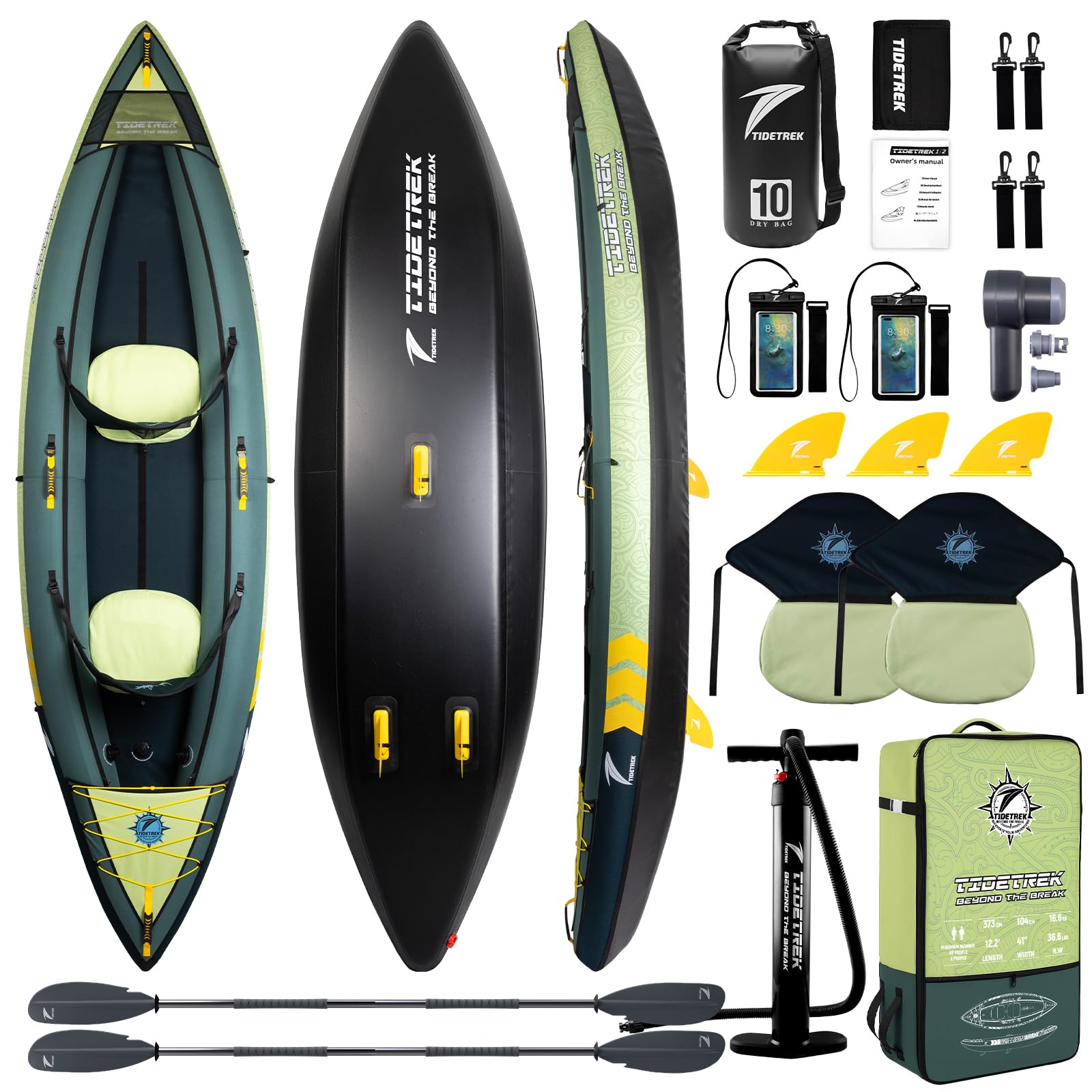
Two pumps, three fins and a full accessory kit in a touring hull built to hold its shape.
The construction story here is a puncture-resistant PVC bladder wrapped in a 600D waterproof polyester cover with high-elastic PVC backing, plus a 4 inch drop-stitch floor. That drop-stitch panel is the key: it holds a firm, board-like shape and, per the maker, stops air from transferring between chambers — a known weak point on ordinary multi-chamber PVC floors. The result is a hull that keeps its form on open water instead of squirming under you.
Tracking comes from a triple-fin setup — one center fin plus two rear fins — which the maker says improves straight tracking and glide so the boat does not drift off course. The 1-person version weighs 29.1 lbs, is rated to 220 lbs, and measures 10 ft by 41 in by 15 in inflated. The included kit is generous: a heavy-duty waterproof backpack with chest and waist straps, a lightweight paddle with a non-slip grip, a dual-action high-pressure hand pump, a compact low-pressure electric pump, a 10L dry bag, a phone bag, three removable fins and the seat.
Two obvious buying notes. First, the listing covers 1- and 2-person versions and shows tandem dimensions of 12 ft 3 in and 36.6 lbs, so confirm you are selecting the solo configuration at checkout. Second, it is a newer product with limited owner history, so you are trusting the published spec and the 1-year hull and accessory warranty rather than a deep review record.
The spec that matters: a 4 inch drop-stitch floor designed to stop cross-chamber air loss and hold a firm shape, backed by a triple-fin tracking setup.
Watch the listing: solo and tandem sizes are sold under one listing, so double-check the 1-person option when you order.
Right for you if: you want a touring-style hull with a complete kit and both electric and hand pumps.
Maybe not if: you prefer to buy on a long track record rather than a newer listing.
Know the Specs
Weight Capacity (lbs)
Capacity is the total load the kayak floats comfortably — you, paddle, gear and any cooler. A 220 lbs rating is fine for a lighter paddler going minimal. Bigger paddlers or fishing kit push toward a 300 lbs or 331 lbs hull. Paddling over capacity sinks the boat and makes every stroke harder.
Inflated Floor Type
A drop-stitch floor is two fabric layers held apart by internal threads so it pumps up firm. That stiffness gives you a surface to brace against and holds the hull’s shape. A plain inflated floor is softer and lighter but flexes underfoot — better for relaxed flat water than for sustained paddling.
Tracking Fins and Skegs
Fins and skegs are the small blades under the stern that resist sideways drift. More or larger fins track straighter for touring and open water. Removable fins let you pull them out for shallow launches or tight turns. A solo boat without any fin tends to wander and needs constant correction.
Packed Weight and Folded Size
This is what decides whether the kayak leaves your garage. A 20 to 26 lbs solo boat carries easily from car to water. Around 47 lbs you want a cart or a second pair of hands. Check the folded size against your trunk and closet — a boat that stores small gets used more.
Common Questions
How much weight can a 1-person inflatable kayak hold?
Do I need a roof rack to carry an inflatable kayak?
What is a drop-stitch floor and why does it matter?
Can I use a 1-person inflatable kayak on a river or in whitewater?
How long does it take to inflate and deflate an inflatable kayak?
Are inflatable kayaks durable enough to last multiple seasons?
Do inflatable kayaks come with a paddle and pump included?
How do fins or a skeg affect how a solo kayak tracks?
What is a packraft and how is it different from an inflatable kayak?
Can a taller or heavier paddler use a 1-person inflatable kayak comfortably?
The Bottom Line
For most paddlers, the 1 person inflatable kayak winner is the Aqua Marina Steam, because it is the only solo boat here built for rivers as well as lakes — self-bailing drains, a drop-stitch floor and dual center fins in a 25.4 lbs package that folds into a backpack. If you want to fish from your kayak, grab the Bestway Koracle X1 and its 331 lbs capacity and built-in rod holder. For a first boat on calm water without stretching the wallet, the Intex Challenger K1 is the easy, proven starting point.
How we choose
We do not accept paid placement. Every pick is matched to a real buyer and a real use-case; we do not hands-on test units.
Sources
Specifications: manufacturer listings and product documentation. Review insights: verified customer reviews, as of November 2026. Pricing: not shown on this page (it changes often); check the current price via the retailer link.
As an Amazon Associate, Tactical Gear Guy earns from qualifying purchases. This does not affect which products we feature.