Specs are compiled from manufacturer listings and verified buyer reviews and can change over time — please confirm the key details on the product page before buying.
You paid for a paddle board, then discovered the real warm-up is twenty minutes of leaning on a hand pump in the parking lot before you even touch the water. A battery-powered pump that stops by itself at your target pressure fixes that. This list covers nine pumps that reach genuine SUP pressure, with the honest trade-offs spelled out.
This guide is built by comparing the manufacturers’ published specifications and the patterns across verified customer reviews, so you get each pick’s real strengths and trade-offs instead of marketing spin.
One thing to know before you scroll: every pick here reaches at least 18 PSI, so all of them clear the 15 PSI-and-up SUP inflation standard. Either way, a full rundown of the stand up paddle board electric pump market is what you’ll find here.
Top Picks


How To Choose The Best Stand Up Paddle Board Electric Pump
The one mistake nearly every first-time buyer makes is shopping on first-stage airflow alone. Raw liters-per-minute (a measure of how much air the pump moves in a minute) tells you how fast the boring part goes — filling the empty board. It says nothing about the part that actually hurts. The last few PSI, from about 8 up to your board’s target, are where a cheap motor strains, heats up, and gives up early.
Look at both stages, not one number
A dual-stage pump runs two different jobs in sequence. Stage one shoves a big volume of air at high speed — the 400 L/min, 430 L/min and similar figures you see on these listings. Stage two slows down to push hard against rising pressure, which is where pumps like the AIRBANK drop to 120 L/min and the Peakspeak to 100 L/min. The second number is the one that gets you from 12 to 18 PSI without a stall. If a listing only brags about the first stage, treat the second as unknown.
The real specs to check on the box
Target pressure comes first — a pump needs a max rating at or above what your board asks for. A digital gauge with a small error margin (±0.2 PSI on one pick here, ±0.1 PSI on another) is worth more than it sounds, because overfilling stresses the rail seams. Battery capacity decides board count, not speed: a 13500mAh pack and a 96.2Wh pack can both finish a single board, but they do not agree on how many boards they’ll do in a row.
Weight and the walk to the beach
A 2.5 lb pump rides in a backpack without a thought. A 4.4 lb pump is a different decision if you have a full dry bag, a leash, and a paddle to carry in the same trip. Check whether the pump you want ships with a storage bag or strap — several here do, several do not.
Side-by-Side Comparison
| Model | Best For | Max Pressure | Airflow (stage 1) | Weight | Amazon |
|---|---|---|---|---|---|
| AIRBANK Whale Shark Pro★ Best Overall | All-round best | 18 psi | 400 L/min | 4.4 lb | Amazon |
| Mojimdo 20PSI Smart PumpPreset Simplicity | Preset simplicity | 20 psi | 100 L/min | 2.02 kg | Amazon |
| Peakspeak Electric PumpLight Travel Pick | Light travel pick | 20 psi | 400 L/min | 2.5 lb | Amazon |
| anoutway Jungle D15PRO | Fine pressure control | 20 psi | 400 L/min | 1.14 kg | Amazon |
| TOPUMP TPS260 | Fast top-up charging | 20 psi | 350 L/min | 1.26 kg | Amazon |
| Aurethryon 13500mAh Pump | Group outings | 20 psi | 360 L/min | 2.8 lb | Amazon |
| Seawolf 99.9Wh Pump | Whole-crew days | 20 psi | 100 L/min | 2.58 kg | Amazon |
| AIRBANK Pulse Pro | Packable premium | 20 psi | — | 900 g | Amazon |
| OutdoorMaster Shark 3 | Fastest fill | 20 psi | — | 3.64 kg | Amazon |
Detailed Reviews
1. AIRBANK Whale Shark Pro
Our pick — 4.5+★ from 200+ verified ratings; the strongest balance of quality and price.
Two motors, one job: getting you off the sand and onto the water in eight minutes.
The Whale Shark Pro is a two-stage pump built around a 96.2Wh lithium-ion battery and a pair of motors. The first gear pushes air at 430L/min to fill the empty board fast, then the second gear drops to 120L/min to pressurize it properly — that is 8 minutes from 0 to 15 psi and 10 minutes from 0 to 18 psi, with the pump cutting out on its own at your target. The maximum pressure rating is 18 psi, so it will not go past that number even if your board asks for more.
Where this pump separates itself is measurement. The digital differential barometer keeps the reading error within ±0.2 PSI on the 1.4″ LED display, against the ±1 PSI error the maker says most pumps in this class carry. In real terms, you can inflate to the exact pressure printed on your board’s rail and walk away trusting the number, rather than guessing whether you have overdone it. Seven nozzles cover paddle boards, kayaks, pool inflatables, kite wings and air mattresses, and a dedicated storage bay keeps the hose coiled and out of the way.
The honest catch is pack weight and battery confidence. At 4.4 pounds it is a real item in your bag — the Peakspeak below does the same high-pressure job at 2.5 pounds, so if you walk far, that 1.9-pound gap is something you’ll feel. The maker claims one charge inflates 7 boards (10.6 ft) to 12 PSI or 5 boards to 15 PSI, with a 2.5-hour full charge, but owner reports on battery life are mixed. Reliability readings hold steady when it works, but there are enough reports of a unit that stops accepting a full charge to make a genuine charger and a dry, sand-free storage habit worth taking seriously.
What earns it the top slot
- Two-stage motor: 8 minutes to 15 psi and 10 minutes to 18 psi, with auto shut-off at the target.
- ±0.2 PSI gauge accuracy against the ±1 PSI the maker attributes to most class rivals.
- Onboard hose storage and seven nozzles cover boards, kayaks, kite wings and mattresses.
- The area that draws the most praise is raw performance; reliability runs a close second.
Where it asks for your attention
- 4.4 pounds is the heaviest thing on this list after the OutdoorMaster.
- Charging consistency is the recurring soft spot; charge with the original cable and keep sand out.
- 18 psi ceiling means high-pressure race boards are out of reach.
Paddle solo and want certainty: this is the pump to buy if you value an accurate gauge and auto shut-off over trimming every ounce.
Then again: if your board’s rails carry a higher PSI target than 18, the pump simply cannot follow you there.
2. Mojimdo 20PSI Pump
The pump that tells you what PSI to use, so you never have to remember.
Five presets do the thinking here: SUP Mode at 12PSI, Tent Mode at 4.5PSI, Pool Float Mode at 1PSI, a Deflation Mode accurate to ±0.5PSI, and a Custom Mode you can set anywhere from 1 to 20 PSI. If you own more than one inflatable — and most paddlers do — that kills the mental arithmetic. Press the SUP button, come back to a board that is already at pressure. The pump starts at 400L/min for the volume fill and shifts to 100L/min precision mode once it hits 80% of your target, then shuts off at the exact setting.
What makes it worth carrying is the backup power path. The internal battery is rated for 7-10 full SUP inflations, and when it runs dry the included 12V car adapter takes over. The kit is unusually complete for a mid-range unit — a 118″ long 12V car and home adapter cable, a 43″ hose, six universal nozzles and a travel bag, in a 2.9 lb body.
Dial your expectations on speed for big boards. This is not the fastest inflator on the list, and the buyer pattern reflects that split: easy operation and pack-up earn the most consistent praise, while air time and battery endurance draw a wider spread of experience. It handles one board smoothly; a group day asks more of it than one charge usually gives.
Best reason to pick it: the preset buttons and the 12V cord together mean a flat battery never ends your session — a combination none of the other picks offer at this size.
One caution to carry: 2.9 lb is comfortable in a bag, but the battery does not stretch to a whole family’s boards on its own.
Reach for this if: you want push-button simplicity plus a car-cable safety net for inflating whatever is in the trunk.
Look elsewhere if: a single battery needs to cover three boards back to back with no vehicle nearby.
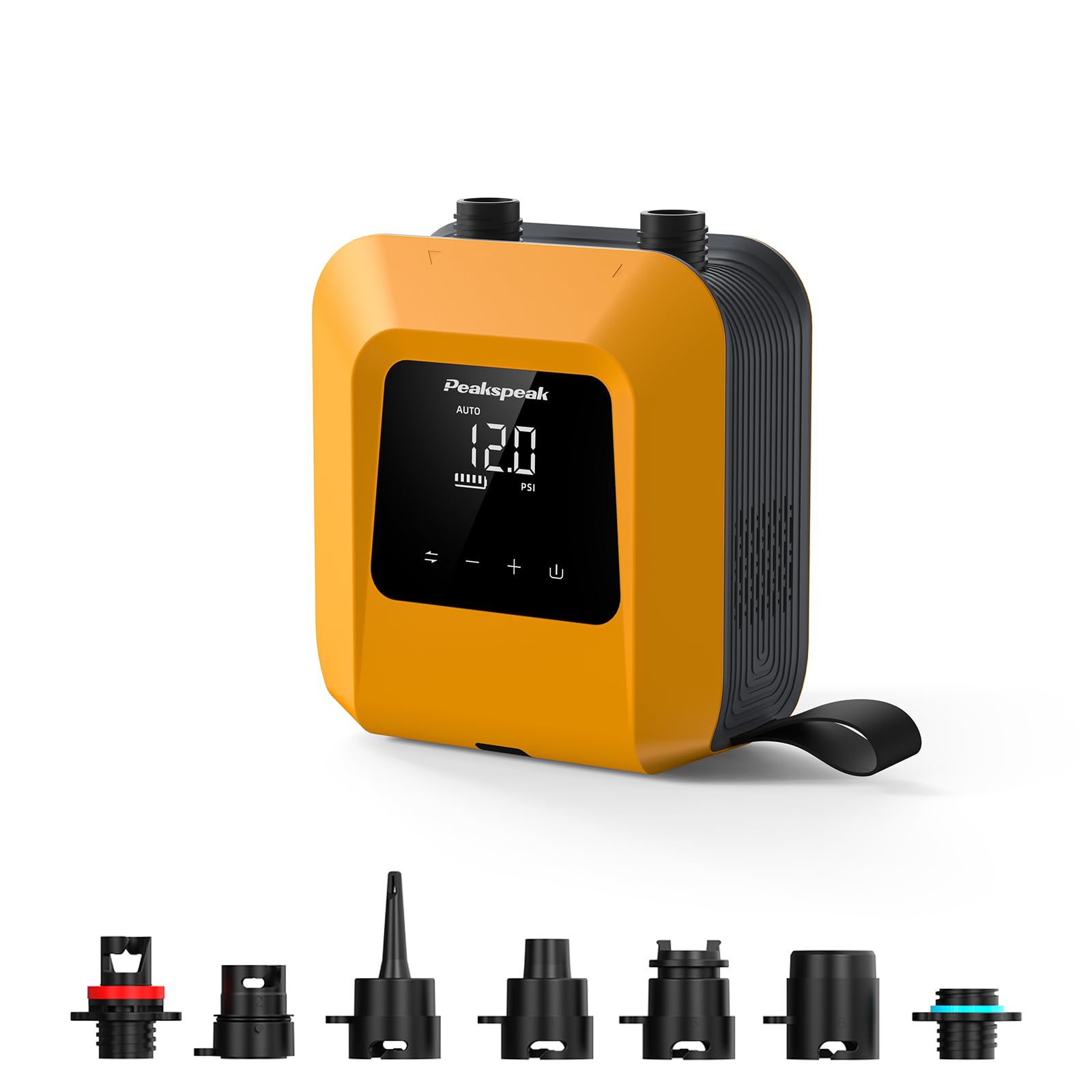
3. Peakspeak Paddle Board Pump
At 2.5 pounds it disappears into a daypack — and still hits 12 PSI in under six minutes.
The weight is the headline. At 2.5 pounds, this is the trimmer half of a direct comparison with the AIRBANK Whale Shark Pro — 4.4 pounds on the same scale — and it is also a smaller package all round, at 7.4″L x 3.4″W x 6.7″H against the AIRBANK’s 12.6″L x 7.7″W x 4.9″H. That matters if your walk to the water involves a trail, a bus, or a bike. It fills a 12 PSI board in under six minutes on the first stage’s 400 L/min, then steps down to 100 L/min for the pressure work, with a 20 PSI ceiling and auto-stop at your set pressure.
What wins people over here is straightforward functionality and build feel — the pump just works, launch after launch, and inflates and deflates without a fuss. A 39-inch hose gives you more slack at the valve than most of the compact picks, which is a small thing that stops mattering only after you have fought a short hose on a windy beach. The 4×2600mAh battery is rated for up to three 10.6 ft boards to 12 PSI, or two to 15 PSI.
Two things to plan around. The battery and the board count are where experience splits — some crews finish two and a half boards on a charge, others barely two — so bank on two boards if you’re heading out with company, and treat the third as a bonus. Noise is the other one: it is not the quietest pump on this list when the second stage is working hard.
The armchair math: you give up 1.9 pounds of pump compared with the AIRBANK and gain a bag that closes easily. For a solo paddler who carries their own gear, that trade is the right one.
Built for: solo paddlers and anyone hauling kit on foot or by bike.
Think twice if: you routinely inflate three or four boards in one go and cannot reach a socket between trips.
4. anoutway Jungle Pump

The 20 psi ceiling that the Whale Shark Pro cannot reach, in a body you can sling in a backpack.
If your board wants more than 18 psi, this is where the search should land. The Jungle is rated to 20 psi — two psi above the AIRBANK Whale Shark Pro’s 18 psi cap — which puts it in the territory of stiffer, higher-pressure touring boards. It gets there with a three-setting motor: 400L/min for the fast volume fill and 80L/min when it needs to push hard, dropping a 10.6′ board to 12 PSI in 7.5 minutes and 15 PSI in 9.5 minutes, then cutting off automatically.
An automatic cooling system is what lets it hold that 20 psi without cooking the motor mid-inflation, and the digital display lets you set the target and watch the pressure climb in real time. It weighs 2.5 lbs in a 9.05 x 6.3 x 3.35 inch frame, which is small enough to ride in a daypack next to a towel. Reliability is the strongest signal in the owner data — the pump handles SUPs, docks, dog ramps, air mattresses and boats up to 12.5 feet, and it is the most consistently endorsed trait, with reported build quality close behind.
Pressure control is where the experience varies, though. Check the hose connection is snug before you press start — it is the cheapest fix in the book and it solves most of those cases. Noise and battery also split opinion; the pump runs best on a topped-up charge rather than a half-empty one.
Right call for: high-pressure board owners who need the full 20 psi and a pump that survives back-to-back inflation.
The trade-off: the same 2.5 lb body as the Peakspeak, but the pressure-control inconsistency asks you to double-check your hose fit before every session.
5. TOPUMP Electric Paddle Board Pump TPS260, 20PSI Rechargeable

A 2.5-hour refill from a Type-C cable is the feature that makes the TPS260 worth its spot.
Two and a half hours to a full charge over QC3.0 fast charging is the number that changes how you use a pump. Plug it into a car USB port or a power bank while you drive to the launch, and it arrives topped up rather than half-alive. The pump itself weighs 2.78 lbs (1.26 kg) in a 7.05 x 6.10 x 3.23 inch body, with a built-in nylon strap handle and a storage pouch, so it carries like a lunchbox. One note: the charger plug is not in the box, so you’ll use your own USB wall adapter.
Inflation runs through a two-stage motor — 12 PSI in 7.5 minutes, 15 PSI on a 10.6-foot board in 9.5 minutes, up to a 20 PSI maximum — with a high-precision LED display for live pressure and an active cooling system that keeps it steady through continuous work. The 350 L/min first-stage figure is the lowest on this list, but the second stage does the heavy lifting near your target anyway. Seven nozzles cover boards, beds, kayaks, boats, tents and swimming rings, and a two-year manufacturer warranty sits behind it.
Where it gets interesting is use-case range. The pump’s most loyal following is kiteboarders, who inflate small, high-pressure bladders and value the compact body and the quick pressure read. Paddle boarders get the same reliable service. The battery is the split — some owners charge it, use it, and never think about it; others have a unit that stops taking a charge.
Standout spec: QC3.0 charging at 2.5 hours to full is the shortest listed refill time in this group, and with no plug in the box you should pair it with the charger you already trust.
Second read: the 350 L/min stage-one figure trails the 400 L/min picks, so a big board takes a touch longer to fill.
Suits: kiteboarders and paddlers who charge from a car or power bank and want the shortest refill window.
skip it if: you need the pump to arrive with a wall charger included — you’ll supply your own.
6. Aurethryon 13500mAh Pump
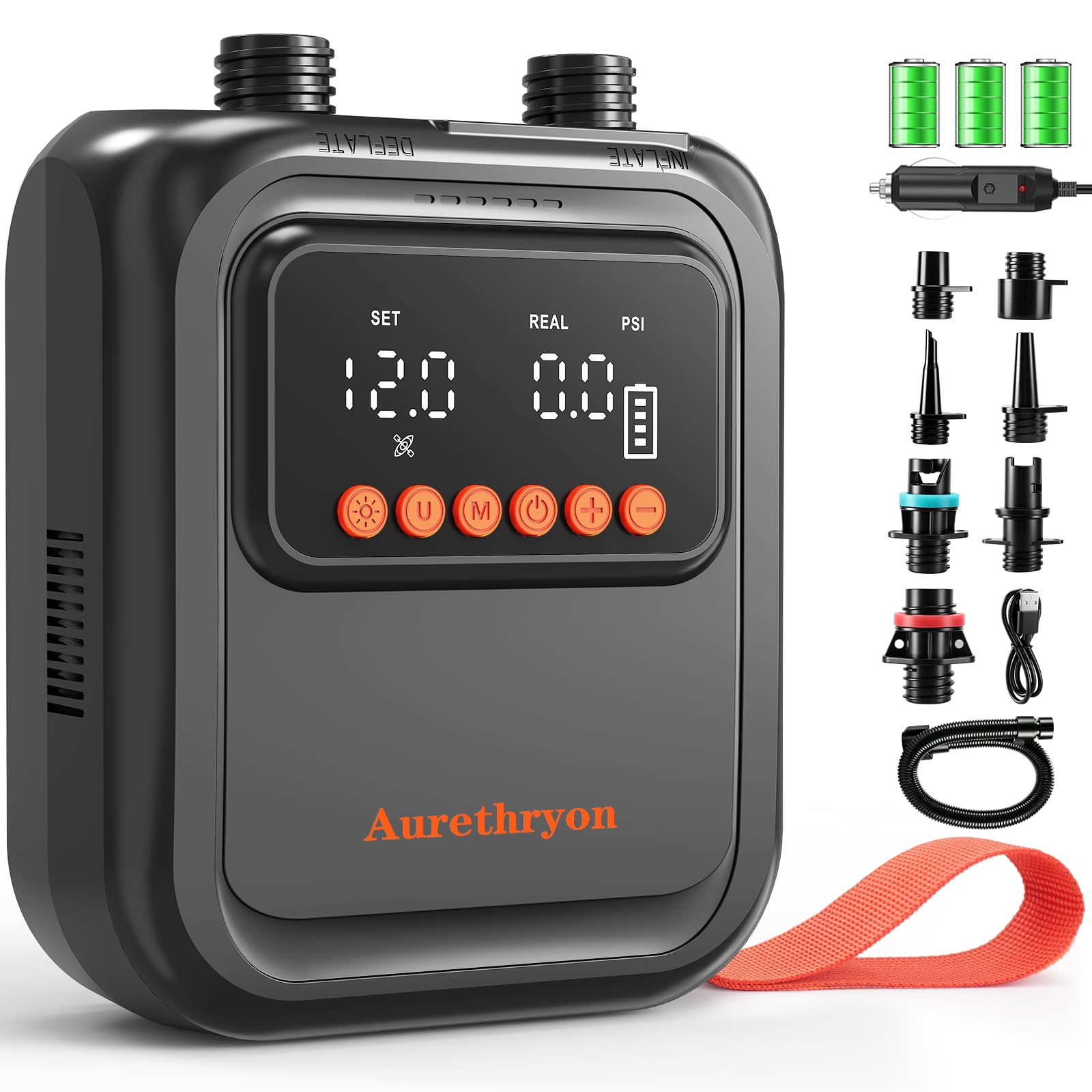
A 13500mAh pack rated for four to six boards in a row — this is the crew-day pump.
Four to six paddle boards on one charge is the claim, and that is the spec that should drive your decision here. The 13500mAh lithium-ion battery is charged over USB-C, with a 12V DC car connector as a second power path, so a family trip or a club outing has a genuine answer for a flat battery. The pump itself weighs 2.8 lbs in a compact 0.07ft³ body, and it comes with a storage bag and nylon handle for the trip to the water.
Filling is quick, too — an 11-foot board reaches 15 PSI in about 8 minutes, with a 360 L/min first stage and a second stage that presses up to the 20 PSI maximum. Ignore the maker’s 260% faster-inflation figure and plan around the 8-minute fill to 15 PSI on an 11-foot board. Auto shut-off triggers within ±0.1PSI of your target, and an active cooling system with a high-speed axial fan and heat-dissipation ducts is there to stop overheating on hot summer days. You also get a 90-hour LED camping light and a deflation function that empties a board in about 2 minutes.
The battery and speed are where the owner experience divides. The portability wins cleanly — nobody argues about carrying it — but some outings finish well short of the top board count, and inflation pace feels quick to some and merely adequate to others. Charge it fully the night before a group day and the gap mostly disappears. An occasional fan-noise gripe shows up, but it runs under 83dB by the maker’s own figure, which is a conversation-level hum rather than a shout.
What people actually celebrate: ease of setup and pack-up, plus how the thing carries — the portability note is 100% positive in the owner data, which is the cleanest signal on this whole list.
For the family van: pick this if two boards or more leave the house at once and a USB-C cable is your charging default.
A fair caveat: the higher board counts are best-case numbers on a full pack, so overnight charging is non-negotiable.
7. Seawolf Electric Paddle Board Pump, 12 Boards/Charge, 99.9Wh
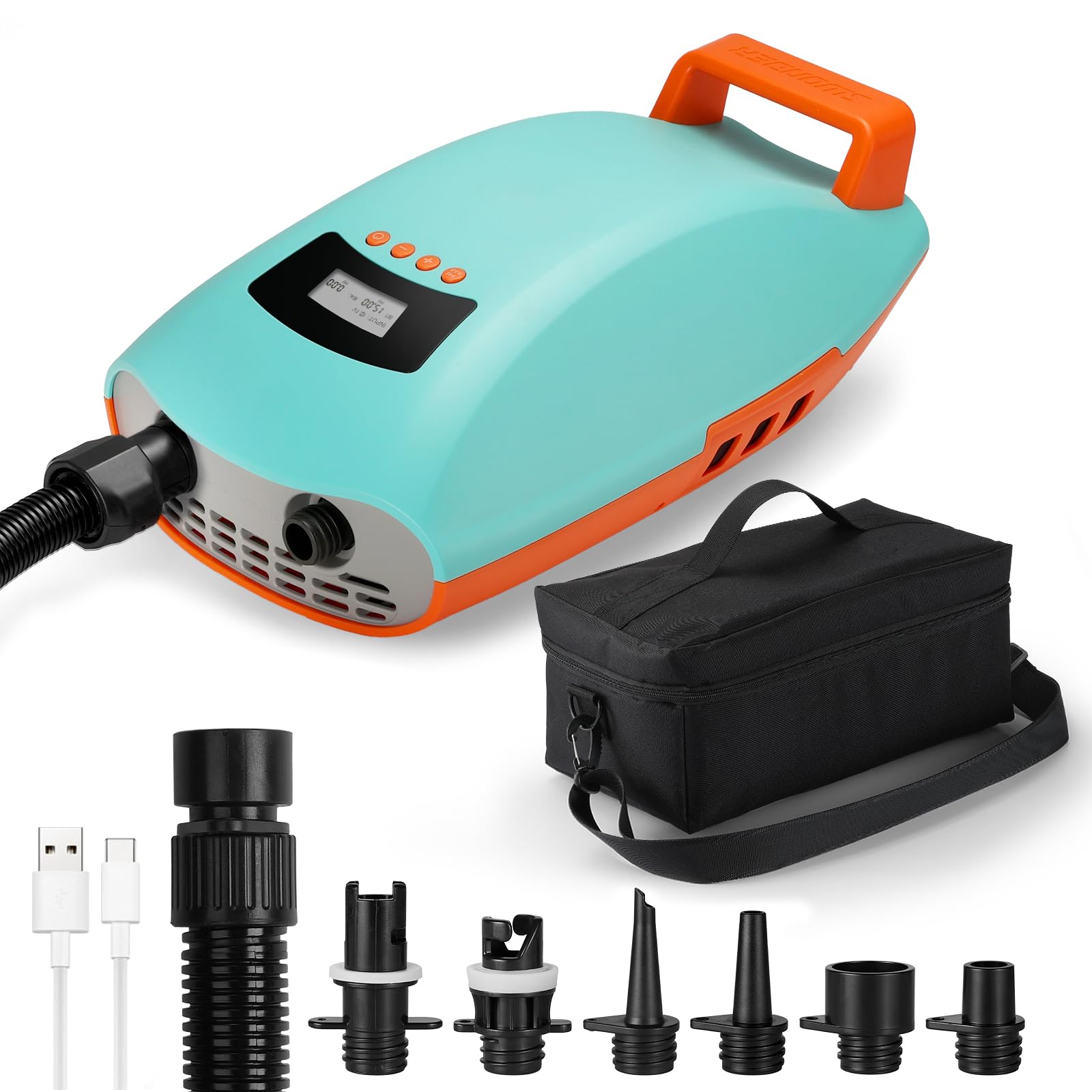
Twelve boards on a single charge, built for the parent who is tired of pumping while the kids swim.
A 99.9Wh rechargeable battery rated for up to 12 paddle boards per charge is the number that sets this apart from every other pump here. If you run a rental stand, coach a club, or simply own four boards and a raft, that endurance is the whole point. A dual-cylinder high-pressure motor backs it up — the maker claims 4 minutes to 12 PSI on a 10.6-ft board — and an active cooling system is engineered to keep the speed and power steady from board one through board twelve.
The rest of the package is straightforward. Set your PSI, press start, walk away — the precision sensor monitors pressure in real time and cuts the pump off at the target, so there’s no babysitting and no over-inflation. Six nozzles of different sizes cover paddle boards, kayaks, towable tubes, rafts and air mattresses. A USB Type-C connector handles charging. At 2.58 kg it is one of the heavier units, and you’ll want to plan for that in how you move it between the car and the water.
Where you should temper expectations is long-term reliability and noise. The auto shut-off is the feature people depend on, and when it works it works cleanly; a small share of users see a pump that quits after a season, so the maker’s warranty is worth registering on day one. Noise is the more consistent note — this is a big-motor pump and it sounds like one, especially under load. Neither undercuts the strength of the battery story, but on a shared campsite, expect a few heads to turn.
Why a group would commit
- 99.9Wh battery rated for 12 boards per charge — the most board-endurance on this list.
- Dual-cylinder motor with active cooling for back-to-back inflation without a cooldown pause.
- One-button start with auto shut-off at target pressure.
- Six nozzles cover the whole crew’s gear in one kit.
What to know before you commit
- 2.58 kg is a heavier carry than most compact picks.
- Noise is the repeated theme; this is not a quiet pump.
- Reliability is not unanimous — a small share stop working after a season, so register the warranty.
Best for group logistics: rental operators, coaches, and big families who inflate a dozen boards a weekend.
Consider instead if: you’re a solo paddler — the battery capacity is overkill and you’ll pay for it in weight and volume.
8. AIRBANK Pulse Pro
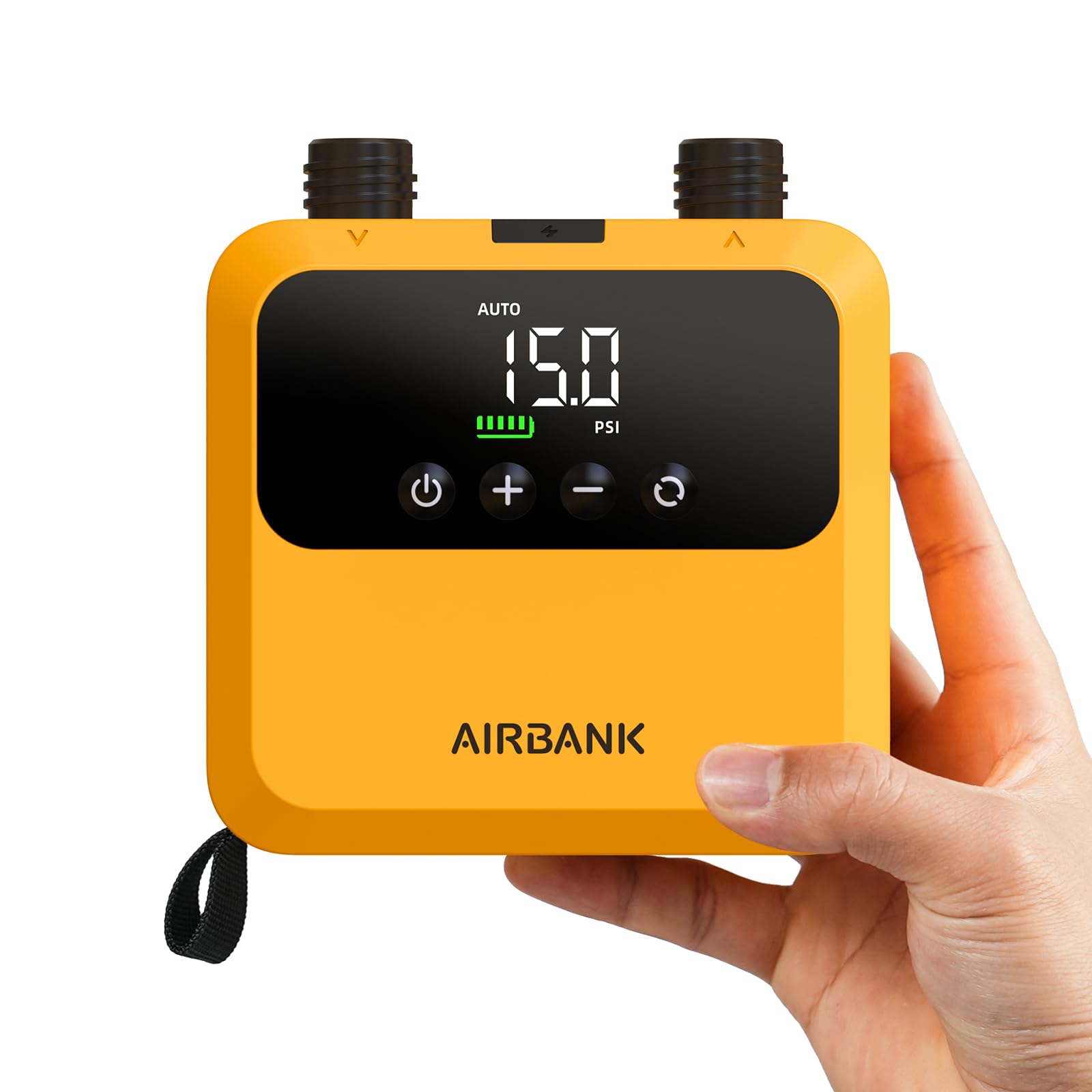
A 900-gram pump with a brushless motor spinning at 80000r/min — small body, serious hardware.
The Pulse Pro’s 900 g body hides a brushless motor rated for 80000r/min, which is the piece of engineering that makes the rest possible. Brushless motors last longer and run more efficiently than the brushed kind, and here the payoff is a 10.6 ft board inflated to 12 PSI in 6 minutes from a dual-stage design. The maximum is 20 psi, so high-pressure boards are covered, and the 4500mAh battery runs the whole thing without a cable.
The feature you won’t find on most of the others is auto-stop deflation. When you’re packing up, the Pulse Pro stops itself — you don’t stand there holding the power button and counting, and you don’t risk the pump running long after the air is gone. It ships with a waterproof bag as well as nozzles, cable, hose and manual, which is a small detail that matters in a wet beach bag. Owners praise the compact size, quick inflation and battery endurance in nearly equal measure, and the “wish I’d bought it sooner” sentiment runs through the value comments.
The trade-off is the weight figure. At 900 g the body is the lightest here, but the 133Wh battery listed in the title and the 4500mAh pack named in the description don’t tell the same story, and neither matches the 2 lb claim on the box. Treat the battery spec with some scepticism until you have your own answer. Noise is the other split — it’s not silent, but it’s not the loudest here either.
The case for the premium: brushless motor, auto-stop deflation, a waterproof bag, and a 900 g body you won’t resent carrying.
Worth a second look: the 133Wh and 4500mAh battery figures contradict each other, so ask the seller which pack you’re actually getting before you commit.
Ideal owner: the paddler who wants top-tier components in a genuinely pocket-sized body and will pay for refinement.
Not for you if: you need to know the exact battery capacity before you buy — that spec is inconsistent on the listing.
9. OutdoorMaster Shark 3 Paddle Board Pump Electric 74Wh
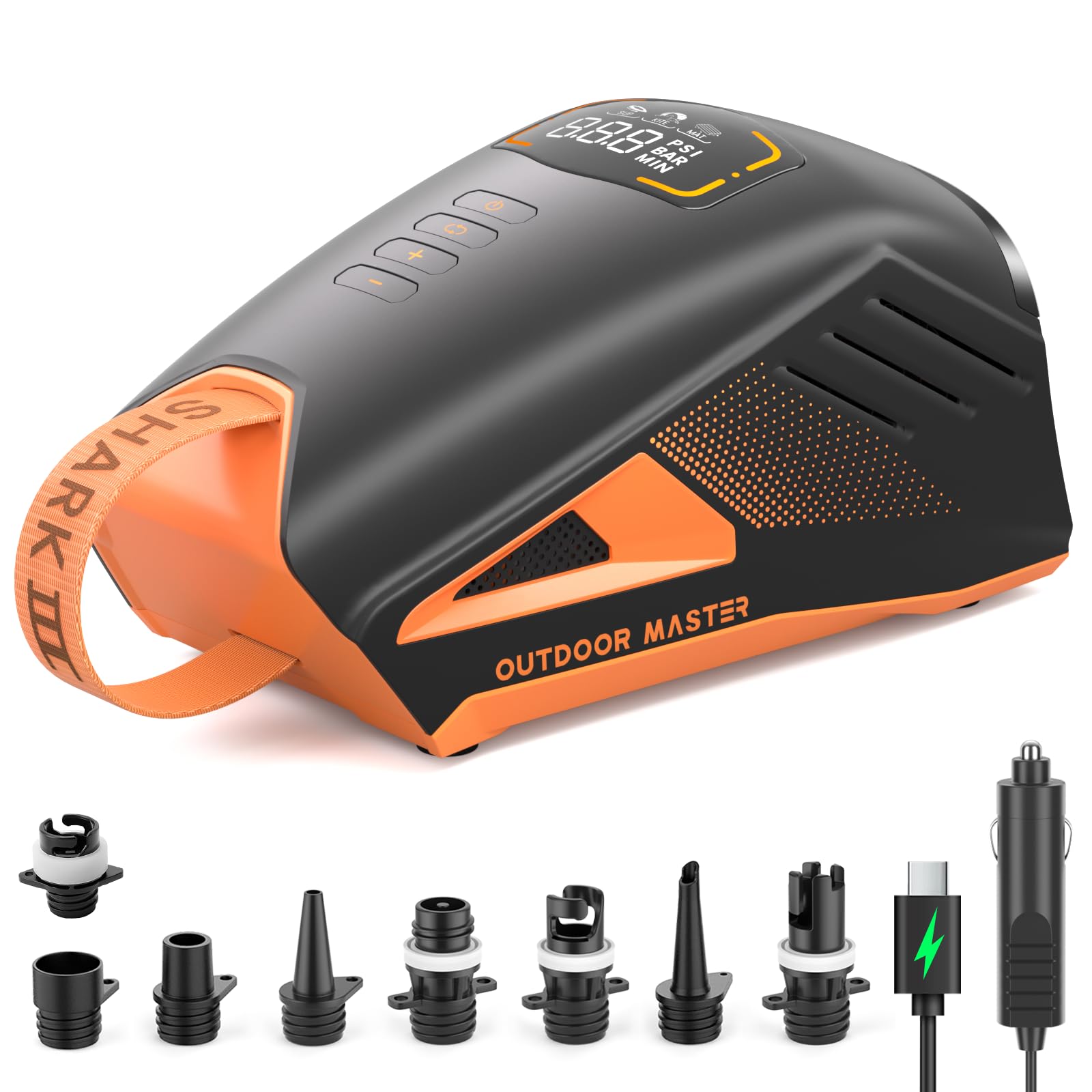
Three minutes fifty to a 15 PSI board — the fastest claimed fill on the list.
Speed is the Shark 3’s whole identity. A 10.6-foot board reaches 15 PSI in 3’50”, and it deflates in 1’20” — both the fastest figures in this group. The 74Wh battery is rated to inflate and deflate four boards on a full charge, and a built-in cooling system is there to prevent overheating or an unexpected shutdown when you’re far from the car in summer heat. It weighs 3.2kg with a handle for the walk.
The second charging path is what makes the Shark 3 different. It takes 45W Type-C fast charging to full in 1H 40Min, and when the battery runs out you connect it to a car’s 12V/15.8V DC port — fully compatible with Tesla and other vehicles, which is a rare and specific claim that speaks to the EV paddling crowd. In a tight spot, it doubles as an emergency power bank to charge a phone. The 20 PSI maximum and auto shut-off are set on a digital display, with eight nozzles to fit boards, beds, kayaks, kites, boats, arches, pools and tents.
Two things are worth knowing going in. First, noise: the maker states up to 88dB during high-pressure inflation, which is genuinely loud, and it climbs as pressure builds. Second, the charging performance is where the experience is uneven — a small share of users report the battery failing to charge within the first couple of uses. That makes it worth buying from a listing that stands behind the product, and worth a quick top-up test before your first big trip.
The fast-fill case
- 3’50” to 15 PSI and 1’20” to deflate — fastest in this group.
- 45W Type-C gets you full in 1H 40Min; 12V/15.8V DC input is Tesla-compatible.
- Dual use as an emergency phone charger.
- Eight nozzles and a handle for the walk to the water.
Count the cost
- Up to 88dB during high-pressure inflation, per the maker.
- Charging reliability is the recurring weak spot.
- 3.2kg puts it in the heavier pack-and-carry class.
- 74Wh battery gives you four boards, not the twelve of the Seawolf.
Your pick when speed leads: EV drivers and anyone who wants to be on the water within minutes of parking.
Hedged note: given the charging reports, register the warranty the day it arrives and run a full charge cycle before you rely on it.
Know the Specs
Max PSI and your board’s target
PSI stands for pounds per square inch — the measure of how hard the air presses against the inside of your board. Every inflatable SUP has a target printed on the rail, usually between 12 and 18 for a standard model, higher for stiff touring boards. A pump’s maximum pressure rating must meet or exceed that target; anything less and you will end up with a soft board. Note the gap here: pumps with an 18 psi ceiling cannot fill a board that asks for 20.
Two-stage airflow explained
L/min (liters per minute) is how much air the pump moves. A first stage at 400 L/min fills an empty board quickly, but it cannot build real pressure. The second stage slows down — 80 or 100 L/min on the pumps here — to push hard against the rising resistance. That’s why a listing with a big first-stage number and no second-stage figure is incomplete. The second stage is what gets you from a limp shell to a board you can actually stand on.
Battery capacity and how many boards
mAh (milliampere-hours) and Wh (watt-hours) both describe how much energy a battery holds. The higher the number, the more boards you can inflate before needing a socket. A 13500mAh or 99.9Wh pack carries more energy than a 4500mAh one, but the board count also depends on your target pressure — filling to 15 PSI uses more than filling to 12. Always check the maker’s stated board count at the pressure you actually use.
Gauge accuracy and auto shut-off
A gauge’s error margin tells you how far off the reading might be. A pump rated at ±0.2 PSI is more accurate than one at ±1 PSI, meaning you can trust the number on the display. Auto shut-off stops the pump the moment your target is reached, so you can walk away and not worry about over-inflation — which is the mechanical stress that shortens a board’s life.
Common Questions
Will any of these pumps fit my paddle board’s valve?
How many boards can I inflate on a single charge?
Can these pumps over-inflate my board?
Will a battery-powered pump work if it runs out at the beach?
Is an 18 PSI pump enough, or do I need 20?
How loud are these pumps in use?
Do I need to add a charger or is one in the box?
Do these pumps deflate, or only inflate?
How heavy are these pumps to carry to the water?
Can I use one of these pumps for kayaks, air mattresses or pool floats too?
How long does the hose need to be at the beach?
The Bottom Line
The stand up paddle board electric pump that earns the top spot is the AIRBANK Whale Shark Pro, because it pairs an accurate ±0.2 PSI gauge with a two-stage motor that reaches 15 psi in 8 minutes and shuts off on its own — the spec that matters most on a windy launch. If group logistics are your problem, the Seawolf is rated for 12 boards per charge, which is a different class of endurance entirely. And if you walk to the water carrying everything yourself, the Peakspeak at 2.5 pounds is the one to reach for — no other pump here balances that low a weight with a 400 L/min first stage.
One last nudge worth acting on: the Whale Shark Pro’s charge record and the OutdoorMaster’s charging performance are both uneven enough that a full top-up the night before, plus a registered warranty, is the cheapest insurance you can buy. Everything else about both pumps is built to work hard.
How we choose
We do not accept paid placement. Every pick is matched to a real buyer and a real use-case; we do not hands-on test units.
Sources
Specifications: manufacturer listings and product documentation. Review insights: verified customer reviews, as of November 2026. Pricing: not shown on this page (it changes often); check the current price via the retailer link.
As an Amazon Associate, Tactical Gear Guy earns from qualifying purchases. This does not affect which products we feature.