Specs are compiled from manufacturer listings and verified buyer reviews and can change over time — please confirm the key details on the product page before buying.
You want to know which machine actually catches a fake bill before it costs you real money — and which ones are slow, fussy, or jam on creased notes. That answer depends on one thing: how much cash crosses your counter each day. A busy register needs a counter that verifies on the move, while a small shop or market stall is better served by a compact checker that reads a single bill in a second. Below, you get nine real machines sorted by what they genuinely do well, with the trade-offs spelled out plainly.
This guide is built by comparing the manufacturers’ published specifications and the patterns across verified customer reviews, so you get each pick’s real strengths and trade-offs instead of marketing spin.
Some units count and verify in the same pass, others only check one bill at a time, and a few fold both jobs into a tiny footprint you can set beside the till. Below are the nine worth your attention, sorted so you can find the right money detector machine for your counter in one read.
Top Picks

How To Choose The Best Money Detector Machine
The first fork in the road is simple: do you need a machine that counts a whole stack, or one that checks one bill at a time? A counter feeds a pile through rollers, tallies the notes, and runs its sensors on every bill as it passes. A detector reads a single note against a light panel or sensor, which suits a register where bills arrive one at a time. Knowing which job you actually have stops you buying speed you will never use.
Counting speed and stack size
Speed is quoted in bills per minute, and it only matters during a rush. If you count once at closing, a machine rated at 1,000 bills per minute clears a day’s takings in a couple of minutes. Hopper capacity is the other half of the story — a larger hopper means fewer reloads mid-count, while a smaller one has you feeding the machine in smaller batches.
What the detection letters actually mean
Every detector letters its checks, and each letter is a different physical test. UV (ultraviolet) looks for the glowing security strip and fibers. MG (magnetic) reads the magnetic ink printed on genuine notes. IR (infrared) and MT (magnetic thread) catch washed or reprinted bills. DD (dimensional), DBL (double-feed) and HLF (half-note) flags catch two bills stuck together or a torn note. More letters means more separate tests before a bill passes.
Where you will use it
A back office with steady power wants a plug-in counter with an external display so staff and customers can read the total. A market stall or a pop-up needs a rechargeable unit you can run on a battery. And a cramped register lane needs a footprint small enough to sit beside the till rather than take over the counter.
Side-by-Side Comparison
| Model | Best For | Type | Speed / Checks | Weight | Amazon |
|---|---|---|---|---|---|
| PONNOR Money Counter Machine (Value Count)★ Best Overall | Busy tills that count and verify in one pass | Stack counter + detector | 1,200 notes/min, UV/MG/IR/MT/DD | 8.5 pounds | Amazon |
| Flash Test Counterfeit Bill DetectorMost Compact | A tiny always-ready checker beside the register | Single-bill detector | 3 tests in under 1 second, watermark/ink/UV | 4 ounces | Amazon |
| MUNBYN IMC51 Money CounterBest Value Count | USD-only shops building value stacks | Stack counter + detector | 1,100 bills/min, UV/MG/IR/MT | 9.02 pounds | Amazon |
| AL1000 Money Counter Machine | Retail floors needing a big readable display | Stack counter + detector | 1,300 notes/min, UV/MG/IR/DD/DBL/HLF/CHN | 10.32 pounds | Amazon |
| AccuBANKER LED430 Detector | Bars, nightclubs and ID plus card checks | Single-bill detector | 6 detection systems, UV/MG/IR/size | 1.21 pounds | Amazon |
| MUNBYN IMC20 Money Counter | Front counters that want plug-and-play counting | Stack counter + detector | 1,000 bills/min, IR/MG/UV | — | Amazon |
| PONNOR AL-135T Bill Detector | Market stalls needing cordless multi-currency reads | Single-bill detector | 10 authentication checks, 3″ TFT screen | 1.91 pounds | Amazon |
| AccuBANKER D450 Detector | Quick one-bill pass or fail at the drawer | Single-bill detector | 5 checks, under 1 second | 1.1 pounds | Amazon |
| Cassida Quattro Detector | High-volume desks that need all-orientation scanning | Single-bill detector | 6 sensors, 4-way feed, rechargeable | 2.1 pounds | Amazon |
Detailed Reviews
1. PONNOR Money Counter Machine with Value Count
Our pick — 4.5+★ from 350+ verified ratings; the strongest balance of quality and price.
A 1,200-note-per-minute counter that flags a fake before the stack finishes moving.
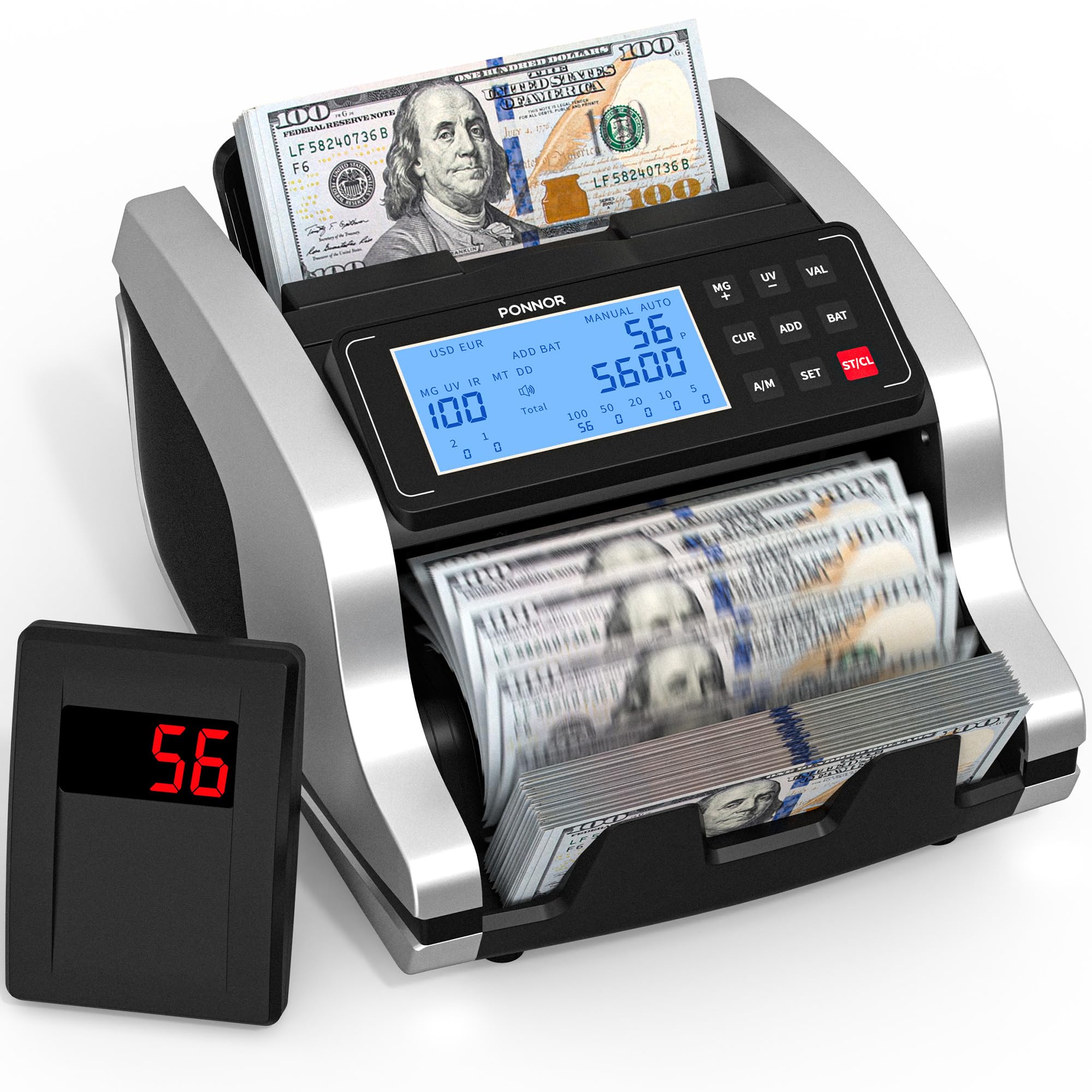
If your drawer fills up fast, this is the machine that keeps pace. It feeds bills through at 1,200 notes per minute — roughly twenty notes every second, so a full closing count clears before your coffee goes cold. Five separate sensors run on every bill as it passes: UV for the glowing security strip, MG for magnetic ink, IR and MT for thread and reprinted notes, and DD for two bills stuck together.
The catch that matters at the till is the total-value mode. In ADD mode you pick a denomination first, then the machine tallies both the number of notes and their cash value — but it cannot total a mixed bunch of banknotes. You have to sort by denomination and feed each stack one at a time, which is a real extra step on a drawer full of fives, tens and twenties. There is also a silent setting: hold the ST/CL button, cycle the rear switch, and the machine drops below 60 dB, quiet enough that a neighboring counter barely hears it.
Weighing in at 8.5 pounds, it sits about 1.8 pounds lighter than the AL1000 below — easier to move between counters when you need to. The plug is American standard at 110V and works in the US only; anywhere else you need a voltage converter. Owners praise its functionality above all, with value for money a close second. Fine, reliable counting is exactly what a cash-heavy business asks for.
value count plus batch stop
- 1,200 notes per minute clears a day’s takings in minutes
- Five detection checks — UV, MG, IR, MT and DD — catch fakes and double-feeds
- Silent mode drops noise below 60 dB for shared counters
- ADD mode totals both note count and cash value
bulky desktop footprint
- Value mode cannot total mixed denominations — you sort first
- 110V US plug only; other regions need a converter
- Bills must be loaded the right way up or it reports an error
counting volume users: a shop or office where the drawer fills daily and speed plus counterfeit cover both matter.
space is tight: your cash arrives as a mixed pile of denominations you would rather not sort before counting.
2. Flash Test Counterfeit Bill Detector
Smaller than a smartphone, and it verifies a bill in under a second.
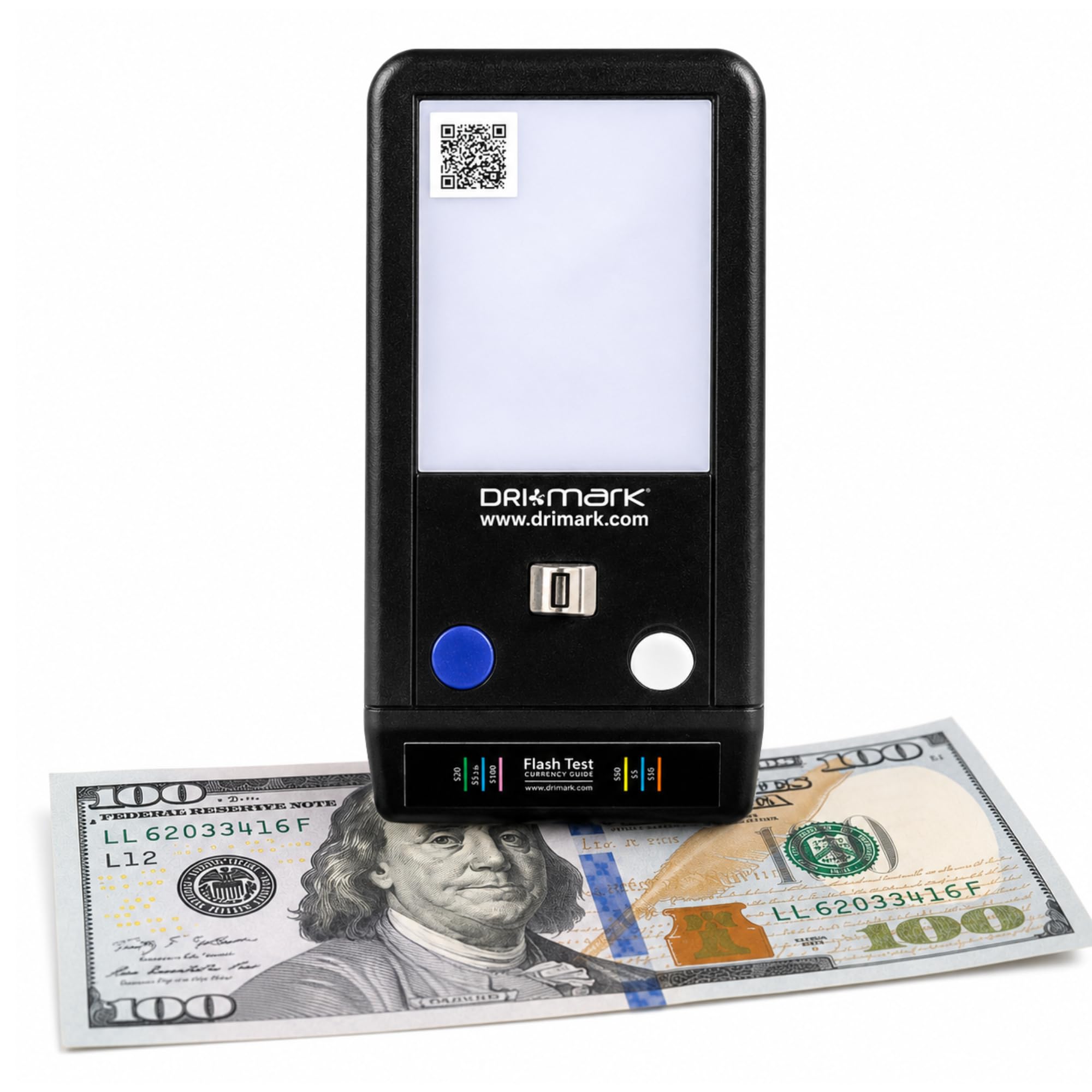
Retail registers with no spare counter space get the most out of this one. It measures 4.5 x 2.8 x 0.7 inches — for scale, the MUNBYN IMC51 counter is 11.1 x 9.41 x 5.71 inches, so this slips into roughly a fraction of that footprint and lives right beside the till. Three checks run in sequence: hold the bill over the lighted panel to see the watermark, pass the front over the sensor for the ink test, then hold it under the UV light to read the security strip. You can also use the UV light to check state IDs.
There are no batteries and no bulbs to replace — it runs off the included AC plug or a USB cord, and an automatic sensor switch lets you work it one-handed. That last detail matters when one hand is already holding a bill. It is built for high-traffic lanes with few registers, the exact setup where a slow check backs up a line.
The honest limit: this reads one bill at a time, so it is a gatekeeper rather than a bulk counter. On creased or worn notes the ink and watermark tests still work, but you are doing the checking by hand, bill by bill. Buyers mention build quality most often, with reliability a close second. If your register sees a steady trickle rather than a flood, that fit is right on.
quick UV and magnetic check: 4.5+ stars with a heavy stack of owners behind it, and the pattern is clear — it does its job without fuss, needs no upkeep, and fits where a full counter never would.
spotting fake bills: a small shop, bar, or market stall checking bills as they arrive.
need full counting: bulk counting a whole day’s takings — that needs a roller counter.
3. MUNBYN IMC51 Money Counter Machine Count Value
Built for USD shops that want the note count and the cash total on one screen.
This is a USD-only counter that tallies value as well as notes. In Value Mode it counts the worth of a stack, and paired with Add mode it sums the value across several stacks of different denominations. The one rule: you must separate bills by denomination first and feed each stack on its own, because the machine will not count mixed bills. If your deposits are already sorted, that is no hardship at all.
The Batch mode is the sleeper feature. Set a target number and the machine stops after counting that many bills, so you can build straps of a set size without recounting. Run it with Add and Batch together and it totals the notes while bundling them in one pass. On the detection side, UV, IR, MG and MT work through magnetic, infrared, UV, dimensional, thickness, security-line, variable-ink, spectrum and fluorescence techniques — a thorough net.
Speed runs at 1,100 bills per minute, and the roller setup is tuned for old, creased notes, which is where a lot of counters stumble. Some owners do report jams when handling crumbled bills, and accuracy draws mixed notes — so the honest read is that crisp bills glide through while badly battered ones ask for patience. It weighs 9.02 pounds and measures 11.1 x 9.41 x 5.71 inches, a footprint you should confirm fits your counter before buying. It runs on 110V.
mixed cash drawers: you handle USD, sort by denomination, and want note count plus cash total in one pass.
single currency only: you regularly feed badly crinkled bills and want fewer pauses.
4. AL1000 Money Counter Machine with Value Counting

The 1,300-note-per-minute counter for retail floors that need a readable total.
Speed is the headline here: 1,300 notes per minute, the fastest rating on this list and 100 notes a minute quicker than the PONNOR above. The hopper holds 200 banknotes, so you load a fat stack and let it run. It works in COUNT, ADD, BATCH, AUTO and MANUAL modes, which covers everything from a straight tally to fixed-size bundles before a bank run.
The display is the other reason to pick it. A 3.7-inch bright LCD shows the data clearly, and the included external display lets a second person read the total from another angle — useful when a customer is watching the count. Detection runs through UV, MG, IR, DD, DBL, HLF and CHN, so it flags fake, damaged, half and double-fed notes, turning the screen red and sounding an alarm when it catches one.
On value mode, note that it cannot auto-recognize denominations; you set the value manually. A few owners run into miscounts and jams, so it rewards a careful feed and clean bills. Owners say it simply performs, and value for money holds up across the board.
adds value counting mode: 1,300 notes per minute plus a 200-note hopper means fewer reloads on a heavy deposit day.
loud during runs: you set the denomination by hand before value counting, and it wants a tidy feed to stay accurate.
daily till counts: a staffed retail counter where speed and a shared display both earn their keep.
quiet office wanted: you need a light machine to carry between locations.
5. AccuBANKER LED430 Cash and Card Counterfeit Detector

Six separate checks in one unit, and it reads cards and passports as well as cash.
Nightclubs, bars, and stores that verify more than just bills should start here. Six detection systems run on a note: ultraviolet, magnetic ink, magnetic thread watermark, infrared, and size verification, with manual checks letting you confirm security features across all countries’ banknotes. It handles USD, Euro, GBP, Mexico Pesos and Canadian Dollars from the start.
The flexibility goes beyond currency. You can verify credit cards, IDs, passports and other documents from any country for authenticity, which is why it lands in bars, gas stations, restaurants and movie theaters as much as register lanes. The super-bright UV and white LEDs are built to last, the unit is UL Listed, and it carries a 3 Year Warranty. At 1.21 pounds it takes up little counter space.
There is no automated feeding, so it is a manual checking tool — you place each item and read the result. For a bar taking cash and IDs at the door, that is fine; for a back office reconciling a day’s takings, a roller counter is faster. Owners consistently praise its build quality and report accurate results. If your front desk checks cards and bills side by side, this one does both without buying two machines.
retail checkout desks: your business checks cards, IDs and cash in the same spot.
counting is the job: you need to count full stacks — this is a one-item-at-a-time checker.
6. MUNBYN IMC20 Money Counter Machine with Value Count

No setup, one button, and a 200-note hopper that keeps checkout lines moving.
For a front counter that wants counting to just start, this one is built around a single button and no installation. It counts 1,000 bills per minute out of a 200-note hopper, pairing a 150-note stacker so reloads are infrequent during a busy shift. Value, Add and Batch modes cover preselected denominations, stacking multiple totals, and preset bundles before a bank deposit.
Detection covers USD and EUR with IR, MG and UV checks while counting; GBP supports counting only, so keep that in mind if you handle three currencies. It comes with an external LED display so cashiers and customers read the total together. The adjustable thickness dial is a smart touch — turn it for crisp or worn bills and you cut down on feed interruptions from mixed-condition stacks.
The honest caveat that buyers should weigh is accuracy: some buyers report notes that come out miscounted, so verify your first few full counts before trusting the machine blindly on a large sum. Beyond that, owners find it genuinely easy to use and good value for money. If you want straightforward plug-in counting with verification at the checkout counter, this fits cleanly.
small business tills: a cashier lane that just wants to plug in, press one button, and count.
large batch runs: accuracy on every bill is the one thing you refuse to compromise on.
7. PONNOR AL-135T Counterfeit Bill Detector Money Checker
Ten authentication checks, a 3-inch screen, and a battery for stalls with no outlet.
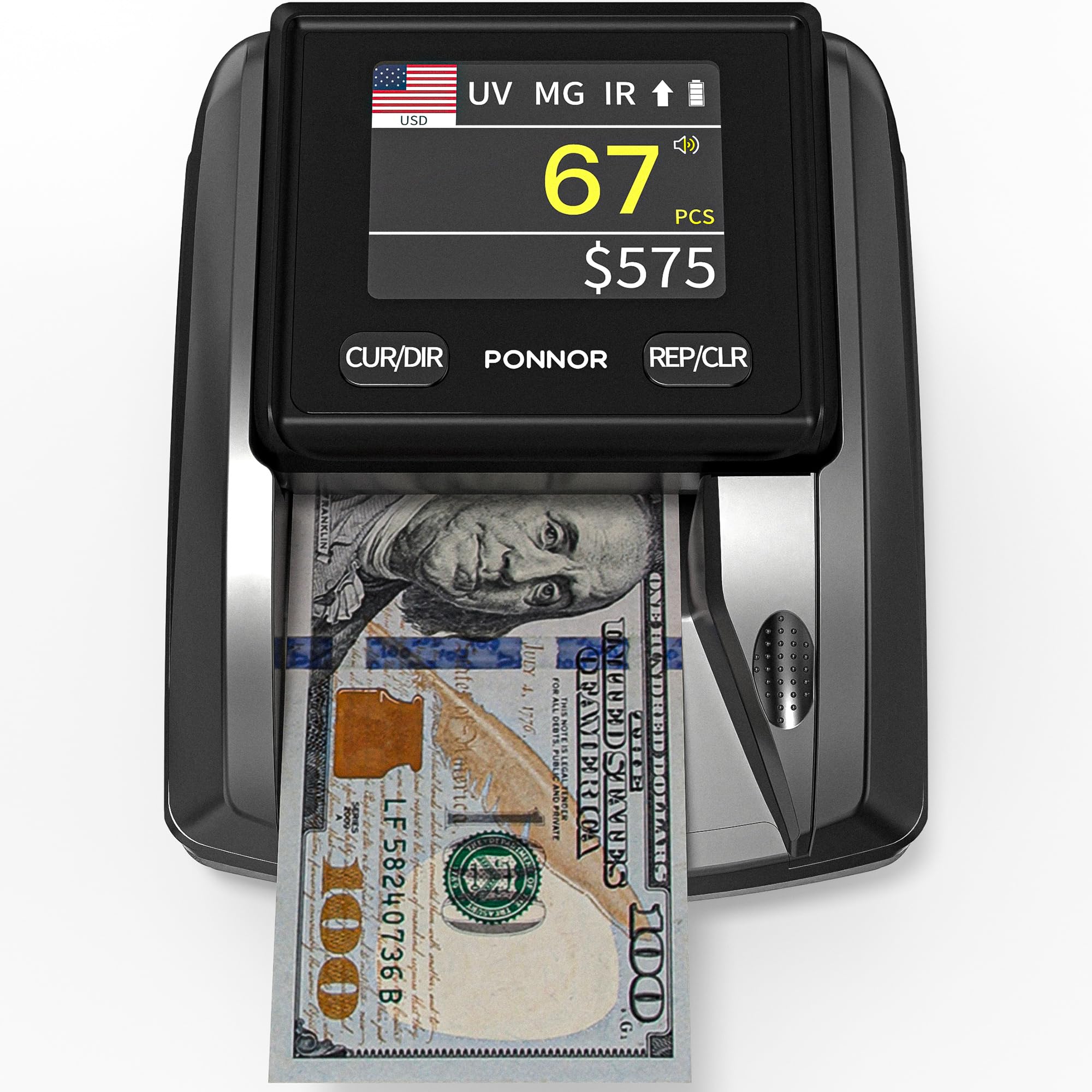
Market stalls and pop-ups that have no power socket in reach are the exact fit here. A built-in 500 mAh rechargeable battery runs the unit cordless, and you can plug it in when a socket is handy. Up to 10 advanced authentication checks run on each bill, and the machine supports four currencies — USD, EUR, CAD and MXN — so cross-border trade or a tourist-heavy stall does not leave you guessing.
Two modes keep the workflow simple: one identifies the denomination and totals up the value, the other is a straight pass-or-fail read for when speed matters more than detail. A 4-way feed lets you insert bills from any of the four sides, and the limiter design is built to stop jams. The 3-inch high-res TFT screen shows the result, and you can choose whether bills exit inward or outward depending on where you stand.
At 1.91 pounds it is light enough to drop in a bag and set up on a folding table. One honest note: there are no written owner reviews for this specific model yet, so the confidence here rests on the printed specs rather than a track record. Compared with the Flash Test above, the screen and battery are genuine upgrades — the Flash Test has neither — but it is also more machine to carry. If you need to verify several currencies on the move, this does the job.
quick single checks: sellers who move between stalls or need multi-currency checks off-grid.
bulk verification: you only ever check US bills at a fixed plug-in counter.
8. AccuBANKER D450 Counterfeit Bill Detector

A five-check single-bill scanner that gives you a clear pass or fail in under a second.
This is the entry point for a business that wants a dedicated bill scanner at the drawer. Five methods run on each note — ultraviolet, magnetic ink, infrared, watermark and size detection — and the result comes back in under a second with audible and visual pass-or-fail notifications. An automatic self-feeding system pulls the bill in, so you are not lining it up by hand every time.
It weighs 1.1 pounds and measures 5 x 5.5 x 2 inches, so it tucks into a small space near the register. There is a 3 Year Warranty behind it. To get an accurate read, place a single bill face-up and line it up with the face mockup on the machine — skip that step and the result can come back wrong.
Here is the honest trade-off you should know about: reliability and accuracy split opinion. Some owners find it works well with most new bills and does not get fooled by fakes, while others find it struggles. Durability is the weakest signal — a few report the unit not lasting long — so treat it as a checking aid that wants careful handling rather than a heavy-duty fixture. Build quality draws strong feedback overall, and setup takes seconds. If you want a simple second set of eyes on incoming bills at the drawer, it does that one job.
simple counterfeit detection: the self-feeder and sub-second result make it fast to check bill after bill, and the five methods cover the main security features.
low volume checks: a drawer that wants an affordable single-bill scanner for incoming notes.
high security needs: mixed reports on reliability and accuracy mean you should confirm it reads your typical bills before depending on it daily.
9. Cassida Quattro Fast Automatic Currency Counterfeit Detector

Insert the bill any of four ways and it still verifies — no lining-up required.
The four-way scan is the reason to pick this one. Most detectors accept a bill in a single orientation, so you flip and rotate until it reads; the Quattro takes the note in any of its four possible orientations and verifies it either way. That alone speeds up a busy desk where bills arrive at all angles. Its patented “M” Algorithm is the maker’s claim to a low false-reject rate.
Six sensors run the check — UV, MG, IR, MT, thickness and size — and the 3.5-inch display reports pass or fail along with the denomination. A report screen breaks down the total value and denomination mix, which helps at the end of a shift. A rechargeable lithium-ion battery means you are not tethered to an outlet, handy for on-site work or a mobile setup. At 2.1 pounds it is the heaviest detector here, but still portable.
The trade-off is genuine and you should hear it. Reliability is the most-discussed topic around this machine and opinion splits — some units run without a hitch, others stop working, and durability draws reports of a unit failing within a couple of months or lasting only three months. Battery life also splits. So this is a capable detector for the all-orientation advantage, but not the machine to buy if a long, trouble-free life is your top priority.
busy cash offices: the four-way feed and multi-sensor checks, if you need speed over a single-bill check.
budget is fixed: mixed long-term reliability reports mean you should weigh the multi-orientation advantage against the chance of a shorter working life.
Know the Specs
Bills per minute and hopper capacity
Bills per minute tells you how fast the machine feeds a stack, and hopper capacity tells you how big a stack it accepts before you reload. Fast speeds matter during a rush; a larger hopper means fewer stops. For a back office counting once at closing, a moderate speed and mid-size hopper keep the routine smooth. For a busy register, higher speed plus a big hopper keeps the line moving. Watch for units that list a note-per-minute figure but not hopper size — the count only tells half the story.
Currency and value-count limits
Value mode let different machines behave very differently. Some counters read only US dollars; others add EUR, CAD or MXN. And when a machine cannot auto-recognize a denomination, you set the value by hand and feed one stack at a time. Also check whether the unit can tally mixed bills — most cannot, so you sort first. If you handle several currencies, confirm every one on your list is supported before you buy.
Common Questions
What is the difference between a money counter and a counterfeit detector?
What do UV, MG, IR, MT and DD stand for?
Can these machines count mixed denominations automatically?
How many bills can the counters hold at once?
Will a machine sold in the US work overseas?
Which machines can check credit cards and IDs as well as cash?
Why do some machines jam on creased or worn bills?
Do I need a battery-powered detector or a plug-in counter?
How fast does a single-bill detector report a result?
What does “value counting” actually mean?
The Bottom Line
For most businesses counting a full day’s cash, the money detector machine winner is the PONNOR Money Counter Machine with Value Count — it clears 1,200 notes per minute with five separate counterfeit checks, and the silent mode keeps a shared counter quiet. It also has the deepest verified owner review base of any counter here, which is why it takes the top spot. If a screen and all-orientation scanning matter more to you, the Cassida Quattro takes a bill any of four ways and adds a rechargeable battery. And if you just need a small check beside the till, the Flash Test Counterfeit Bill Detector runs three tests in under a second with no batteries to replace.
How we choose
We do not accept paid placement. Every pick is matched to a real buyer and a real use-case; we do not hands-on test units.
Sources
Specifications: manufacturer listings and product documentation. Review insights: verified customer reviews, as of November 2026. Pricing: not shown on this page (it changes often); check the current price via the retailer link.
As an Amazon Associate, Tactical Gear Guy earns from qualifying purchases. This does not affect which products we feature.