Specs are compiled from manufacturer listings and verified buyer reviews and can change over time — please confirm the key details on the product page before buying.
If you are sanding a chair leg, a window frame, or the inside of a drawer, the tool you need is one you can steer with one hand into places a full-size sander simply will not fit. That is the whole job of a small sanding tool. This guide separates the palm sanders and detail sanders that genuinely reach into corners from the ones that just look compact in the photos.
This guide is built by comparing the manufacturers’ published specifications and the patterns across verified customer reviews, so you get each pick’s real strengths and trade-offs instead of marketing spin.
The Milwaukee M12 Fuel tops the list: compact, cordless, and light enough to hold steady for long sessions. These are the small sanding tools I would actually put in a toolbox, ranked by what each one does best.
Top Picks


How To Choose The Best Small Sanding Tools
A small sander lives or dies by one question: does it reach where your hand cannot? Everything else — speed, grit, dust collection — is secondary until that is settled. Here is what actually moves the needle.
Match the pad and the tip to the surface
A mouse-style detail sander with a pointed tip gets into an inside corner that a round pad never will. A 5-inch round pad removes more material faster on flat panels but skips right over the tight spots. Think about the last three things you sanded and buy for those, not for a once-a-year job.
Orbit speed tells you how aggressive the cut feels
Sanding speed is measured in orbits per minute — how many tiny circles the pad makes each minute. A faster rate takes material off quicker. The range here spans from a 3,500 rpm palm polisher to a 16,000 OPM detail sander, which tells you how differently these tools behave before you even pick them up.
Cordless means no outlet, but you give up runtime
A corded tool runs as long as you keep working. A cordless sander frees you from hunting for an outlet and from a cord catching on a tire or a bench leg, but you are working on a battery. Neither is better — corded suits long bench sessions, cordless suits quick touch-ups away from a plug.
Dust handling is worth a serious look
Skip dust control and you get sawdust in your eyes, your lungs, and every crevice of the workpiece. A dust box or bag catches most of it, but not all systems perform equally. Buyers often flag uneven dust collection, so check the dust system on each model before you buy.
Side-by-Side Comparison
| Model | Best For | Power Source | Speed (RPM) | Weight | Amazon |
|---|---|---|---|---|---|
| Milwaukee M12 Fuel Orbital Detail Sander★ Best Overall | Precision in tight corners | 12V Lithium-Ion battery | 10 rpm (rotational) | 16 ounces | Amazon |
| 5-inch Air Palm Random Orbital SanderBest for Auto Body | Fiberglass and auto body prep | Air powered | 10,000 rpm | 1 kg | Amazon |
| Prostormer Mouse SanderBest for Small Hands | Small hands and tight spaces | Corded electric | 13,000 rpm | 2.36 pounds | Amazon |
| WORKPRO Detail Electric Sander | Woodworking with sandpaper included | Corded electric | 13,000 rpm | 3.4 pounds | Amazon |
| BLACK+DECKER Detail Sander BDEMS600 | Quick material removal with a finger attachment | Corded electric | 16,000 rpm | — | Amazon |
| Vkndoynt Cordless 3″ Palm Sander | Portable polishing and cleaning | 16.8V 2.0Ah Li-ion battery | 3,500 rpm | 1.65 pounds | Amazon |
| Proxxon PS 13 Pen Sander | Superfine sanding in slots and slots | 12-18V AC adapter | 20,000 rpm | 10.08 ounces | Amazon |
| CRAFTSMAN 20V MAX Cordless Detail Sander | Variable-speed cordless detail work | 20V MAX Lithium Ion battery (tool only) | 12,000 rpm | 1.18 kg | Amazon |
| Vkndoynt Brushless Mini Buffer Polisher | Car detailing and full kit value | 14.4V 2600mAh batteries | 3,000 rpm | 2.02 pounds | Amazon |
Detailed Reviews
1. Milwaukee Electric – M12 Fuel Orbital Detail Sander
Our pick — 4.5+★ from 450+ verified ratings; the strongest balance of quality and price.
The cordless detail sander that reaches the corner without fighting your wrist.
If your projects live in tight corners and half-hidden edges, this is the pick that was built for exactly that. It runs on a 12V Lithium-Ion battery, so there is no cord dragging across your workpiece. At 16 ounces it is light enough to hold steady with one hand while you steer the pad into a joint. The 1.5mm orbit diameter keeps the motion small and controlled rather than throwing the tool around.
What wins people over is the build. Buyers describe it as a genuinely great tool that handles tight corners and small-to-medium projects without fuss. Milwaukee also fits a variable speed trigger with four speed settings, so you can back off near a delicate veneer and push harder on bare stock.
The catch is battery life — that is the one recurring gripe across feedback, and it makes sense for a tool this compact. It is also a bare tool: you are buying into Milwaukee’s M12 battery platform, so you need a compatible battery and charger on hand. The rotational figure listed for this model reads 10 rpm, which is note against the BLACK+DECKER’s 16,000 orbits per minute — different motions for different jobs, not a fair speed comparison on paper.
Why it earns the top slot
- 1.5mm orbit diameter keeps the cut tight and controllable in corners
- 16 ounces is light enough to steer one-handed
- Built-in LED light reaches into shadowed joints
- Four speed settings plus a variable speed trigger
Where it asks something back
- Battery life is the most-cited concern, and it needs a Milwaukee M12 battery and charger you may not own yet
- Listed rotational speed is 10 rpm, so it is not a bulk material remover
Reach for this if: your work is precision sanding in tight corners and you want a cordless tool that handles beautifully.
Think twice if: you do not already run Milwaukee’s M12 batteries, since the tool alone will not run without one.
2. 5-inch Air Palm Random Orbital Sander
A shop-air palm sander that chews through fiberglass and leaves a swirl-free finish.
Air-power is the whole point here. This TOOLPEAK unit runs a 10,000 RPM motor off your compressor and pulls 8 CFM through a 1/4″ inlet, so you trade electricity for a steady stream of compressed air. The 125mm (5-inch) pad takes standard hook-and-loop sandpaper, which means no hunting for a proprietary refill. The dual-action random orbit keeps the pad spinning and orbiting at the same time, and that motion is what prevents the pigtail swirl marks that ruin a paint job.
The buyer pattern for this one is telling. It is picked up for fiberglass, Bondo, and metal finishing, and it handles those with finer grits well. It also suits both wet and dry work, which is unusual for a palm sander. Value is a frequent theme — you are seeing a full orbit motion for an entry-level outlay.
Size is worth knowing before you buy: with a 5-inch disc it is the widest pad on this list, so it covers flat panels quickly but skips right past a tight inside corner. Durability comes up with mixed notes in buyer feedback, so treat it as a shop tool rather than a lifetime tool. And if you do not own a compressor that delivers 8 CFM, this sander will never hit its stride — that is a real prerequisite, not a footnote.
Buyer consensus: buyers report a fantastic tool that performs on fiberglass and Bondo with finer grits, and they rate the value highly.
Honest limitation: buyers split on durability, and a 5-inch pad (the sanding disc size) is the least corner-capable option in this guide without an air compressor behind it.
Who it suits: anyone already set up with a compressor who needs fast flat-panel sanding on fiberglass or metal.
Who should pass: buyers without shop air, since this tool has nothing to power it otherwise.
3. Prostormer Detail Sander, 13000RPM Mouse Sander
A pointed mouse sander that fits smaller grips and tighter gaps than most palm units.
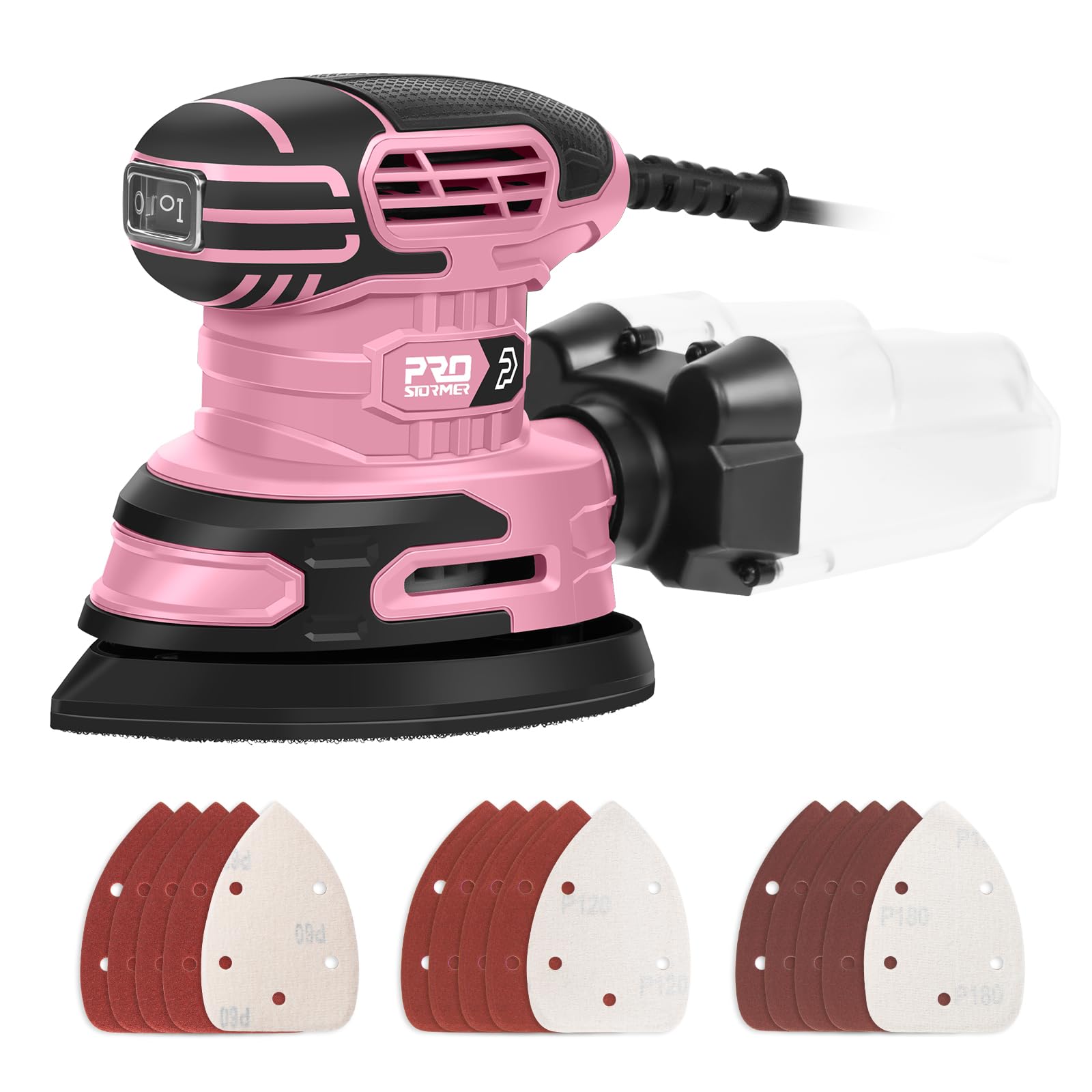
The pointed tip is the reason to look at this one. A mouse-style sanding pad tapers to a point, so it slides into the corner a rounded pad just bounces off. It runs a 1.6A corded motor at 13,000 rpm, which is a fast, aggressive cut for a tool this size. The package throws in 15 pieces of sandpaper at 60, 120, and 180 grits, so you can go from deburring to polishing without a separate trip for paper.
Weight matters here. At 2.36 pounds this is noticeably lighter than the WORKPRO at 3.4 pounds — a lower number is easier to control one-handed for a long stretch. Buyers repeatedly mention that the size works well for small hands, and the compact build lets you reach into places a full-size sander cannot.
Dust control is the fair caveat. The 5-hole system feeds a transparent box so you can watch the fill level, but feedback is split, with some buyers finding dust still spreads. One practical note: push the dust box forward to tighten it after attaching, or it can work loose mid-job. That is a small handling quirk, not a reason to walk away.
The winning detail: functionality is what buyers praise most here — it simply gets the job done.
Set expectation: dust collection is the trade-off, so plan on a little cleanup after each session.
Best fit: detail work on small projects where a pointed tip and a lighter body make the difference.
Look elsewhere if: you need a perfectly sealed dust system on a full refinish.
4. WORKPRO Detail Electric Sander with Dust Bag

Five grits in the box, a 5.5-inch pad, and a soft rubber top that tames the vibration.
You get a whole refinement run in one box: this WORKPRO ships five grits (sandpaper coarseness levels) — P60, P80, P120, P180, and P240 — with three sheets each, where most detail sanders give you two or three. The 1.6Amp motor runs at 13,000 orbits per minute (the speed of the sanding pad), so you remove material fast. The hook-and-loop base (a press-on pad) makes swapping paper a ten-second job. Its 5.5-inch pad is slightly wider than the 5-inch air sander in this guide, giving you a touch more coverage per pass on flat work.
The body is where this one surprises. At 3.4 pounds it is the heaviest pick here, but that mass works with the soft rubber top to soak up vibration and keep the grip comfortable through a long sanding session. The dust box installs easily and is meant to keep the work area clean.
Two honest notes. Dust collection is the divided topic in buyer feedback — some report it catches well, others see it escaping the side vents and find the cup stubborn to remove. Paper life comes up too, with pads wearing quicker than expected under hard use. Neither makes this a bad tool; it makes it a tool for buyers who value grit variety and grip comfort over a sealed dust system.
What lands well
- Five grits included, from P60 to P240, three sheets each
- Soft rubber top reduces vibration and fatigue
- Hook-and-loop pad makes paper changes fast
- 5.5-inch base covers slightly more ground than a 5-inch pad
What to plan around
- At 3.4 pounds it is the heaviest tool in this guide
- Dust can escape the side vents and the cup can be stubborn to remove
Pick this for: woodworking where a full grit range and a comfortable, vibration-tamed grip matter most.
Know before you buy: the dust box is helpful but not airtight, so budget for cleanup around the vents.
5. BLACK+DECKER Detail Sander BDEMS600

Sixteen thousand orbits a minute, plus a finger attachment for the awkward spots.
The BDEMS600 is the fastest tool in this lineup at 16,000 OPM — the most aggressive cut on the list for a small detail sander. That speed comes with a 1.2 Amp motor and a corded design, so there is no battery to swap and no runtime ceiling. The compact body with a three-position grip gives you a way to hold the tool for horizontal, vertical, and overhead work without wrenching your wrist.
The finger attachment is the standout feature. It is a small, narrow pad that lets you reach into hard-to-reach spots a flat pad cannot touch, and the rounded detail pad handles odd angles. For anyone sanding teak patio chairs or refinishing a piece with lots of curves, that extra contact point is the difference between a clean finish and hours of hand sanding.
This one comes with a long, mixed history — the classic trade-off is durability, particularly the finger attachment (the thin sanding tip for tight spots), which owners mention wearing out or breaking. It is the most detailed caveat in this guide, so treat the finger attachment as a wear item. The motor and the grip do their job; the fine tip asks for some care.
Speed focus: 16,000 OPM makes it the fastest cutting small sander here.
Honest edge: the finger attachment is the wear point — reserve it for spots a flat pad genuinely cannot reach.
Choose it when: you want fast corded removal and a finger pad for genuinely awkward angles.
Consider other options if: you need a tool that runs long sessions without parts wearing thin.
6. Vkndoynt Cordless 3″ Palm Sander
A 1.65-pound cordless kit that does sanding, polishing, and cleaning from one battery.
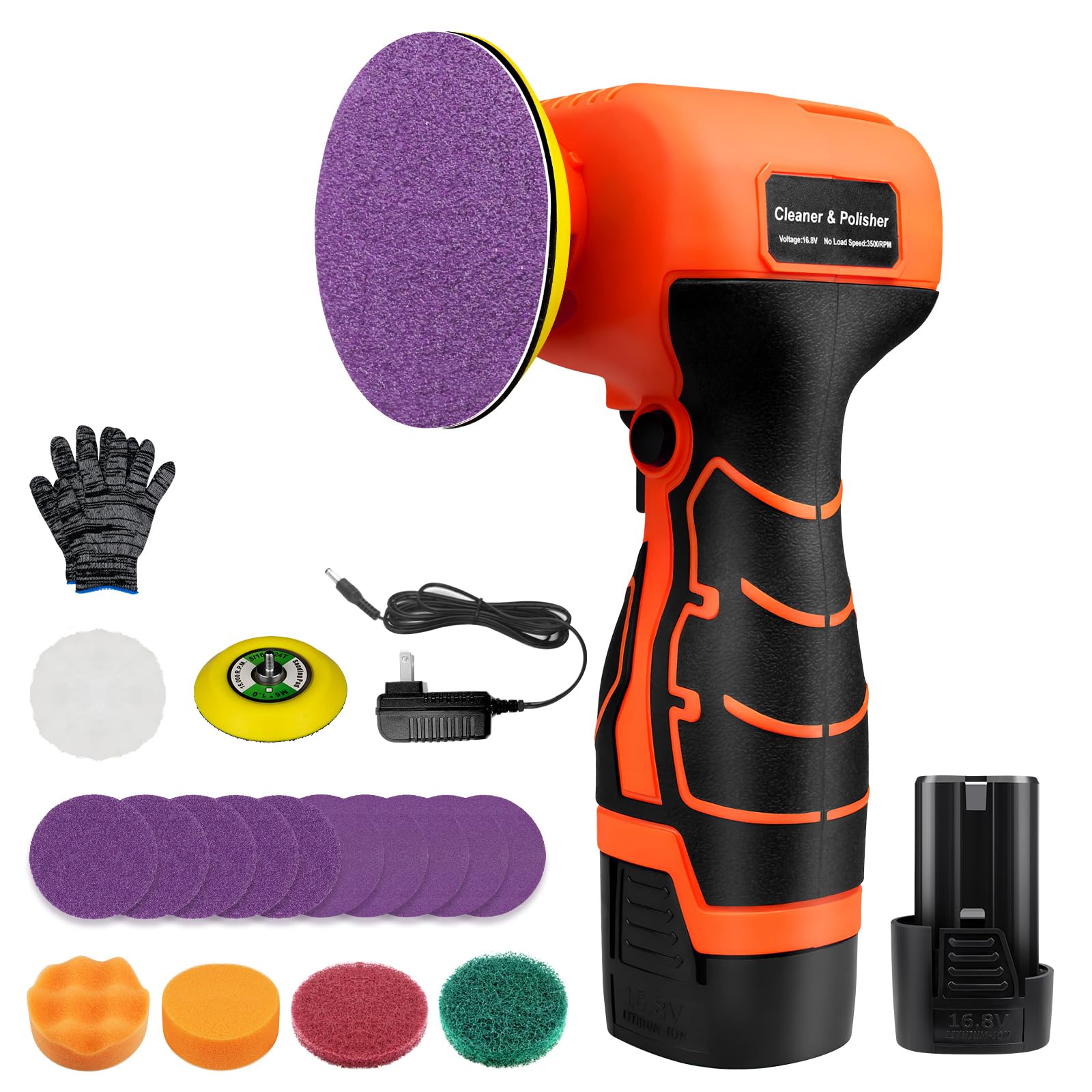
This is the one you hand to someone who wants one small tool to do a bit of everything. It runs a 16.8V 2.0Ah lithium-ion battery and weighs 1.65 pounds with the battery in, so it is light enough to use overhead or one-handed. The 3,500 rpm motor is leisurely compared to the corded detail sanders — that is the trade-off of running on battery. You get a 3-inch backing pad, 10 sandpapers, a wool buffing pad, and three sponge pads, along with a pair of gloves.
Cordless freedom is the whole proposition. No tangled cord catching on a tire or bench leg, and no hunting for an outlet before you start. A lock button lets you run it hands-free for extended polishing or cleaning sessions. Customers note solid power for small jobs and a genuine liking for the compact footprint.
There is one clear limitation: speed control. It runs at a single speed setting, and that is the most-discussed shortfall in buyer feedback. If you want to slow down over a soft surface, this sander will not let you. The add-on cleaning pads aimed at kitchen sinks and marble also require care, since the machine spins fast and can fling spray, so it is worth wearing an apron.
The strong points
- 1.65 pounds with battery included
- Runs on a 2.0Ah lithium-ion pack, with a fast charger included
- Lock button enables hands-free continuous operation
- A full starter kit of pads and papers in one box
Where it limits you
- Single speed setting — no control for delicate surfaces
- 3,500 rpm is slower than corded detail sanders, so expect a gentler cut
Made for: light-duty sanding, polishing, and cleaning where cordless convenience beats maximum speed.
Not the one if: you need to vary speed for soft trim or fine finishing work.
7. Proxxon 28594 PS 13 Corded Pen Sander

A pen-shaped tool that reaches into slots and corners no palm sander can touch.
The PS 13 is a different animal from a palm sander. It is a pen sander — a slim, pen-style tool with 4 angled sanding arms and 4 straight arms, plus sheets of pre-cut adhesive paper at 180, 240, and 400 grit. That grit range tells you the job: it is a superfine finisher for model makers, miniature repair, and slot work, not a stock remover. The 20,000 rpm spindle speed is the highest on this list, but the stroke is tiny by design.
Where it shines is precision. It fits into slots and tight corners that a 3-inch or 5-inch pad cannot reach, and the interchangeable arms let you angle the pad into a channel. Buyers consistently describe it as versatile and precise for small jobs.
The honest caveats are unusual and worth reading closely. Power supply is the most-cited issue — it needs a special adapter, and it is not compatible with standard American plugs, so plan for that before your first session. Sanding speed is mixed in buyer feedback, with some finding it slows over time, and the fine paper wears quickly by nature. This is a specialist’s tool, and it expects a specialist’s patience.
Precision first: pen format plus 8 interchangeable arms gets into slots nothing else on this list reaches.
The real friction: check your adapter situation up front, because a standard US plug will not work.
Built for: model makers and fine-detail work where a superfine 400-grit finish and a pen grip are essential.
Not the right fit if: you want to remove real material or plug into a standard US outlet without an adapter.
8. CRAFTSMAN 20V MAX Cordless Detail Sander (Tool Only)

Variable speed from 9,000 to 12,000 OPM, wrapped in a D-handle built for vertical work.
If you already run the CRAFTSMAN 20V MAX battery system, this detail sander drops straight into your rotation as a tool-only purchase. That is a key distinction: this is the bare tool, so you supply the battery. The payoff is variable speed across a 9,000 to 12,000 OPM band, which lets you dial down for soft trim and open it up for bulk removal. The D-handle grip is genuinely useful for vertical sanding, where a palm grip starts to feel awkward.
The dust system offers two paths: a dust bag or a 1-1/4 inch vacuum connection. That means you can hook it to a shop vacuum for serious dust control rather than relying on a bag alone. A dust-sealed switch keeps dust out of the internals, and the 20V MAX platform shares batteries with other CRAFTSMAN tools.
Two things to weigh. Since it is tool-only, the real investment includes a battery and charger if you are new to the platform. And battery life splits buyer feedback — some find it better than expected, others find it lacking, so plan on a spare pack for extended sessions. Otherwise this is a well-reviewed cordless detail sander that performs cleanly on small items and in fence slats.
Why it holds up
- Variable speed from 9,000 to 12,000 OPM
- Dust bag or 1-1/4 inch vacuum connection for two dust paths
- D-handle grip suits vertical sanding
- Dust-sealed switch for longer tool life
The fine print
- Bare tool only — no battery or charger in the box
- Battery life is a split topic, so bring a spare pack
The right call for: CRAFTSMAN 20V owners who want a cordless detail sander with variable speed and vacuum hookup.
Count the cost first if: you own no CRAFTSMAN batteries, since the tool alone will not run.
9. Vkndoynt Brushless Cordless Polisher (2x2600mAh)
Two speed ranges, two batteries, and 52 accessories — a complete cordless detailing kit.
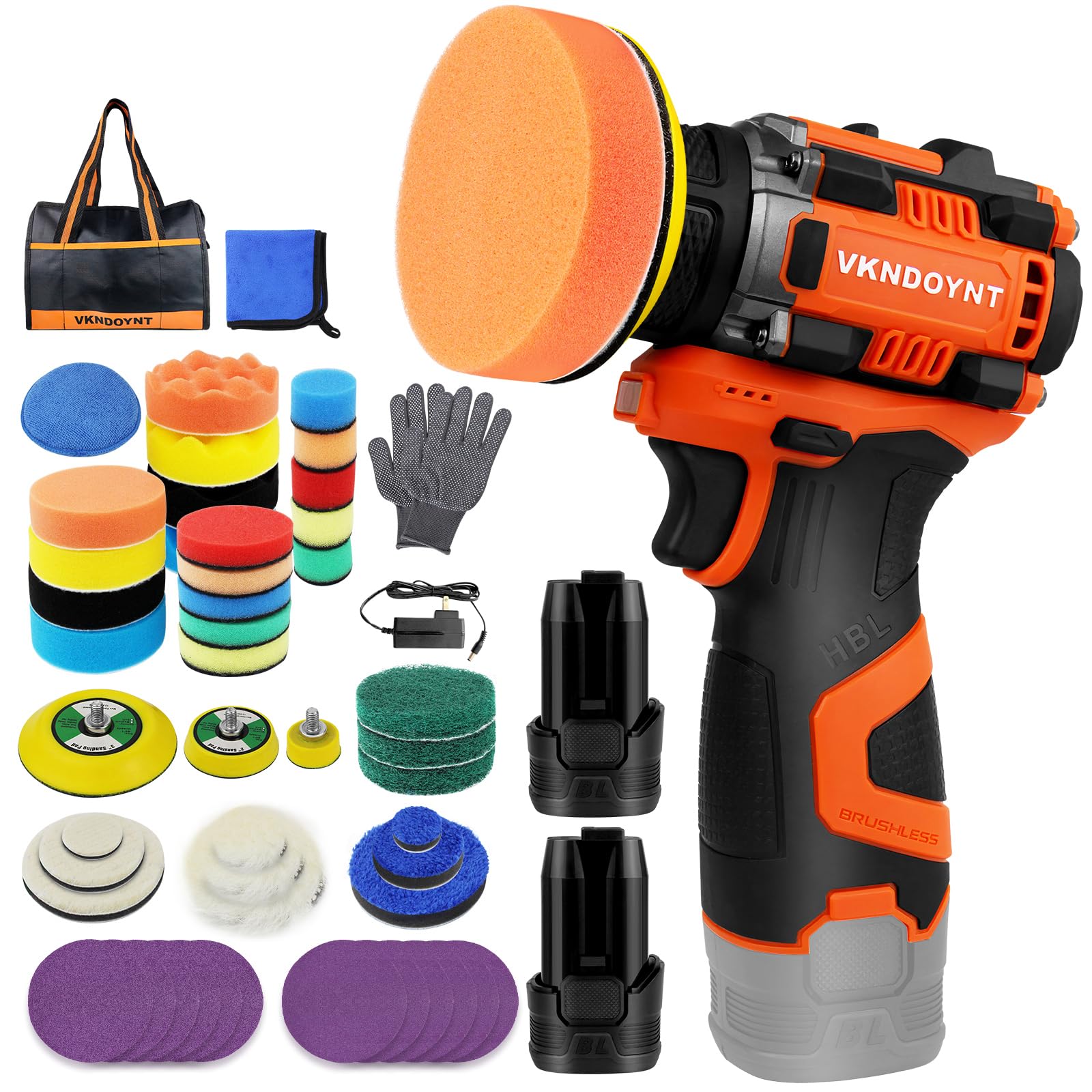
This is the most complete kit in the guide, and the spec sheet is the reason. Two 14.4V, 2600mAh lithium-ion batteries deliver up to 60 minutes of continuous runtime and recharge in 3 hours. The brushless motor delivers more torque and longer tool life than a brushed motor. At 2.02 pounds with battery in place, it stays controllable for extended sessions.
The two-speed control is what makes it versatile. A 0-500 rpm low range handles delicate polishing, waxing, and buffing on soft surfaces. The 0-3000 rpm high range takes over for sanding and material removal. That is genuine two-tool flexibility from one body — a far more useful setup than the single-speed palm sander above it. You also get 3 backing pads in 1″, 2″, and 3″ sizes, so you can match the pad to the panel.
The 52-piece accessory set is where the value lands — sandpapers, wool and sponge pads, microfiber pads, a fiber towel, gloves, and a storage bag, all in one box. On the other side, durability feedback is mixed, so this is a detailing and light-sanding companion rather than a heavy-use professional tool. And the brushless motor’s advantage shows up best on long jobs where a brushed unit would heat up.
Kit value: three pad sizes and 52 accessories cover polishing, waxing, sanding, and cleaning without extra purchases.
The trade-off: durability feedback is split, so treat it as a light-to-medium duty kit.
Best for: car detailing and mixed light-sanding work where a two-speed brushless kit and full accessory set beat a single-purpose tool.
Skip the overload if: you need a tool built for daily heavy sanding rather than detailing.
Know the Specs
Orbits per minute (OPM) and RPM
These two numbers are both “how fast,” but they describe different motions. RPM (revolutions per minute) is the spin rate of a pad or spindle; OPM (orbits per minute) is how many tiny circles an orbital sander’s pad completes. A higher OPM generally takes material off faster, but on a small sander it also makes the tool more eager to walk across the surface. A lower-speed palm polisher at 3,500 rpm is calmer than a 16,000 OPM detail sander, which is exactly why the slower unit suits buffing and the faster unit suits stock removal.
Orbit diameter and pad size
Orbit diameter is the size of the circle the pad makes, measured in millimeters. A small orbit like 1.5mm leaves a finer, more controlled scratch pattern; a larger orbit removes more but can leave deeper marks. Pad diameter works the other way around: a wider pad like 5.5 inches covers more flat surface per pass, but a pointed mouse tip or a pen-sized pad reaches places no round disc can. Match the shape to the job first, then worry about speed.
Common Questions
What is the difference between a detail sander and a palm sander?
Do I need an air compressor for the pneumatic palm sander?
Why does the Proxxon pen sander need a special adapter?
Can I use a cordless polisher as a sander for wood?
What grit sandpaper should I start with on a small sander?
Will a small detail sander fit into an inside corner?
Is a corded sander better than a cordless one for detail work?
How do I keep dust under control with a small sander?
Does a mouse sander work on metal or just wood?
What does brushless motor mean on a small polisher?
The Bottom Line
For most people buying small sanding tools, the winner is the Milwaukee M12 Fuel Orbital Detail Sander — a cordless, 16-ounce tool with a 1.5mm orbit that steers into tight corners instead of fighting your wrist. A 4.5+ star rating across a few hundred owners backs that up; if you want to keep things corded and cover more flat ground, the WORKPRO Detail Electric Sander packs five grits from P60 to P240 into one box. And for auto body or paint prep work on flat panels, the 5-inch Air Palm Random Orbital Sander is the one to reach for — provided you already have shop air behind it.
How we choose
We do not accept paid placement. Every pick is matched to a real buyer and a real use-case; we do not hands-on test units.
Sources
Specifications: manufacturer listings and product documentation. Review insights: verified customer reviews, as of November 2026. Pricing: not shown on this page (it changes often); check the current price via the retailer link.
As an Amazon Associate, Tactical Gear Guy earns from qualifying purchases. This does not affect which products we feature.