Specs are compiled from manufacturer listings and verified buyer reviews and can change over time — please confirm the key details on the product page before buying.
At 10x magnification (ten times life size), a slightly off lens shows you a soft, colour-fringed blur right when you need to read a hallmark or judge a gemstone’s pavilion. So here is the short answer: buy a loupe with a triplet lens (three glass elements bonded into one unit) in a metal body. A triplet in a metal body keeps the view sharp out to the edges. Cheap single-lens magnifiers are why people give up on loupes and blame their eyes.
This guide is built by comparing the manufacturers’ published specifications and the patterns across verified customer reviews, so you get each pick’s real strengths and trade-offs instead of marketing spin.
Below you get nine loupes ranked by how they actually behave in the hand, from triplet pocket kits up to a German-made aplanatic model. Read on for the one lens upgrade that changes everything, including how a sealed triplet fights colour blur that single lenses cannot.
Top Picks

How To Choose The Best 10X Jewelers Loupe
Every 10x loupe claims the same magnification, so the number on the box tells you almost nothing. What separates a good one from a frustrating one is what is inside the barrel and how close you have to hold your eye. Work through these four decisions and the choice narrows fast.
Lens construction: triplet versus single
A triplet lens is three separate glass elements bonded into one block. That stacking is what cancels out the colour fringing and edge softness that a single element cannot avoid. On a diamond’s facets or a coin’s lettering, that difference is the whole point of a 10x loupe. Expect any serious pick here to say “triplet” on the label; if it does not, treat it as a hobby magnifier.
Lens diameter and what it costs you
A bigger lens gives you a wider view and is easier to line up over a stone, but it also needs a steadier hand. The 28 mm Rongon gives the broadest window in this group, while an 18 mm lens keeps the barrel pocket-slim. Pick wide for comfort at a desk, narrow for pocket carry.
What you hold it over, and how long
Jewellers working at a bench can live with a tight eye relief; a coin or stamp collector flipping through an album wants something easier to steady. Check whether a model includes a case and lanyard, because a loose loupe in a pocket is a scratched lens waiting to happen. Built-in LED or UV light helps in dim rooms, but it adds a battery you have to keep fed.
Corrected optics: when the jargon is worth paying for
Achromatic means the lens is corrected so colours focus together instead of smearing at the edges. Aplanatic adds correction for field flatness, so the outer edge stays sharp alongside the centre. If you are grading stones rather than just satisfying curiosity, those corrections are the reason to spend more.
Side-by-Side Comparison
| Model | Best For | Magnification | Lens Size | Body Material | Amazon |
|---|---|---|---|---|---|
| DANOPLUS 20.5mm Triplet Kit★ Best Overall | All-round first loupe | 10x | 20.5 mm | Aluminum | Amazon |
| Toyo Hexagonal 21mm TripletTop Performer | Sharpest everyday optics | 10x | 21 mm | Chrome | Amazon |
| Ade Advanced Optics 10x21TB-AMost Versatile | Field and hobby work | 10x | 21 mm | Leather-wrapped | Amazon |
| DANOPLUS LED/UV 21mm Triplet | Dim rooms and gem grading | 10x | 21 mm | Aluminum | Amazon |
| Quality Optics Hastings 10X | Widest field of view | 10x | — | Plated brass | Amazon |
| Toyo 18mm Triplet | Compact jewellery checks | 10x | 18 mm | Rubber-grip chrome | Amazon |
| GemOro Hastings Triplet | Bench-side appraisal | 10x | — | — | Amazon |
| Rongon 28MM Folding Loupe | Textile and fabric counts | 10x | 28 mm | Zinc alloy | Amazon |
| ZEISS D40 Pocket Magnifier | Precision professional work | 10x | — | Metal | Amazon |
Detailed Reviews
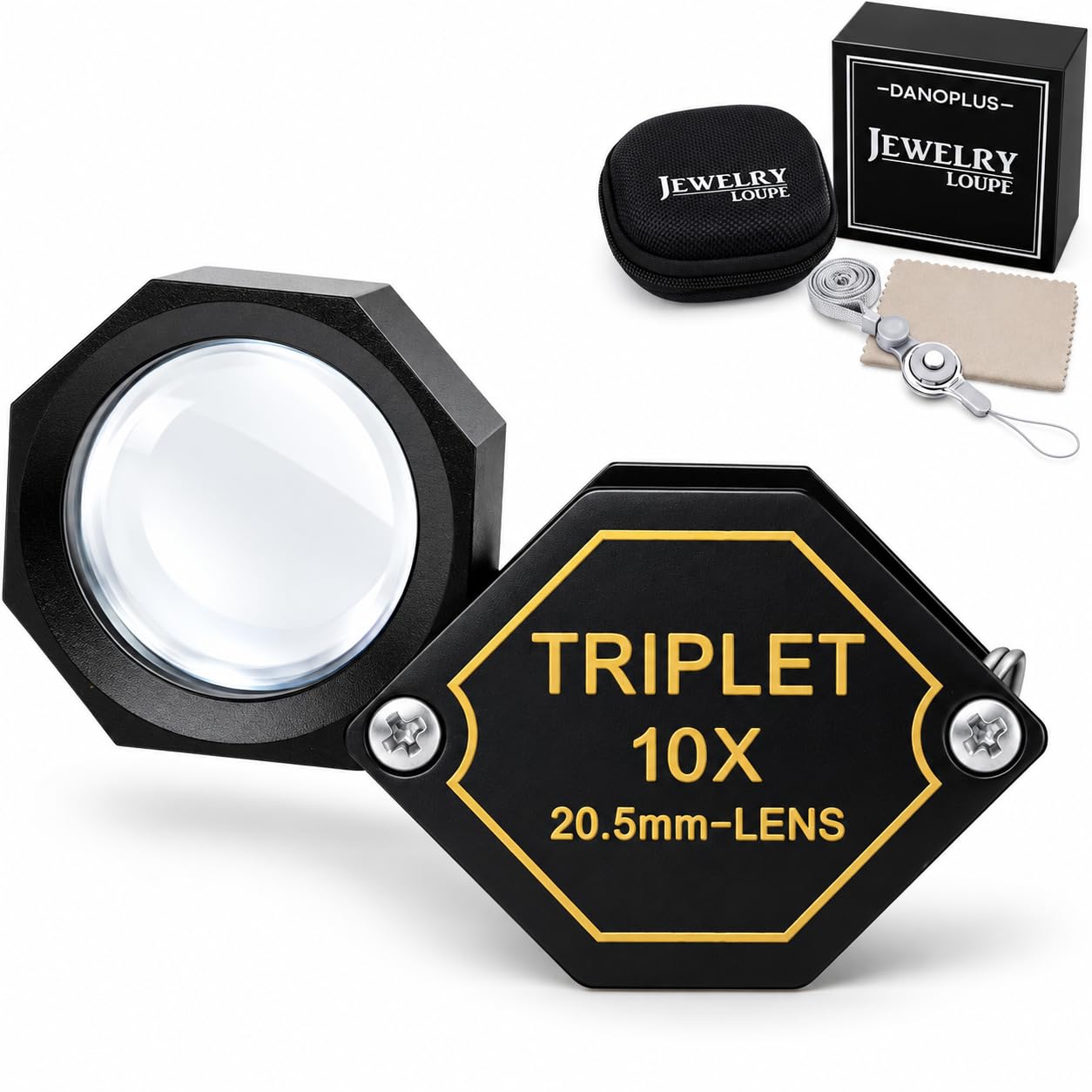
1. 10x Magnifier Jewelry Loupe 20.5mm Triplet Lens
Our pick — 4.5+★ from 600+ verified ratings; the strongest balance of quality and price.
The complete pocket kit that gets a first-time buyer looking at stones properly.
For anyone buying their first real loupe, this DANOPLUS is the one to beat. It puts a 20.5 mm triplet lens inside an aluminum hexagonal body, and it ships ready to use with a protective case, a cleaning cloth and a detachable lanyard. The 10x magnification is fixed, which is exactly what you want for grading — nothing to knock out of adjustment mid-inspection.
The optics are corrected for colour and edge distortion — that is what “achromatic” and “triplet” mean on the spec sheet — so a diamond’s facet junctions read cleanly instead of smearing into a rainbow at the rim. What wins people over is the build: the lens quality is the thing this loupe is known for, and the image stays sharp at the centre where you are actually looking. The included case is a small thing that matters more than you would expect, because a triplet lens left loose in a pocket is a triplet lens you will replace.
Here is the honest caveat. The hinge is the recurring weak point — a small number of these develop a loose feel over time, so treat the fold as a gentle motion rather than a flick. A few people also find the first look-through takes a moment of getting used to, since your eye has to sit close to the barrel. Neither issue changes the recommendation; they just mean you should not hand it to a child to snap open and shut.
What holds up under use
- Triplet achromatic glass keeps colour fringing out of the edge of the view.
- Aluminum hexagonal body — the flat sides stop it rolling off a workbench.
- 20.5 mm lens is wide enough to line up comfortably over a ring or a coin.
- Full kit from the start: case, cleaning cloth and detachable lanyard.
Where it asks for care
- The folding hinge is the part to watch; open it gently rather than snapping it.
- Your eye sits close to the lens, so the first few viewings need a moment of settling in.
Reach for this if: you want one loupe that covers jewellery, coins, stamps and watch work without hunting for extras.
Look elsewhere if: you need built-in lighting for dark rooms — this version has none, and the LED variant is the one to pick instead.
2. Toyo Professional Hexagonal 10X Jeweler’s Loupe 21mm
Chrome-bodied bench tool with the smoothest hinge action in this group.
This Toyo earns its spot on one spec: a 21 mm triplet lens that is aplanatic and achromatic (corrected for both colour and a flat, even field). That means the edge stays as sharp as the centre when you scan a full girdle. Edge-to-edge clarity is what this lens is known for, and you see the precision when checking prongs and pavilion facets at working distance. If the shape of the view matters more to you than the extras in the box, this is the sharpest everyday option here.
Against the 18 mm Toyo further down this list, the wider lens is the clear trade. At 21 mm you get more of the stone in the frame at once, and the hexagonal chrome body gives you flat faces to grip so the barrel does not spin in your fingers. Owners also single out the hinge: the opening and closing mechanism feels secure, and the focus point stays where you set it instead of drifting while you work. For a bench loupe that gets picked up and put down all day, that smooth, steady action is worth more than any gadget.
The trade to know: there is no case or lanyard in this package, so budget for a pouch if the loupe leaves the bench — chrome bodies show fingerprints and pick up pocket grit.
Who it clicks with: jewellers and serious collectors who already own a case and just want the cleanest optics they can get at this level.
The strongest lens here: a 21 mm corrected triplet with a hinge that holds its focus, for anyone who values the view over the accessories.
Only if you carry loose: buy a case at the same time — this one arrives without one.
3. Ade Advanced Optics 10x21TB-A Triplet Professional Loupe
A leather-cased triplet built for people who take their loupe outdoors.
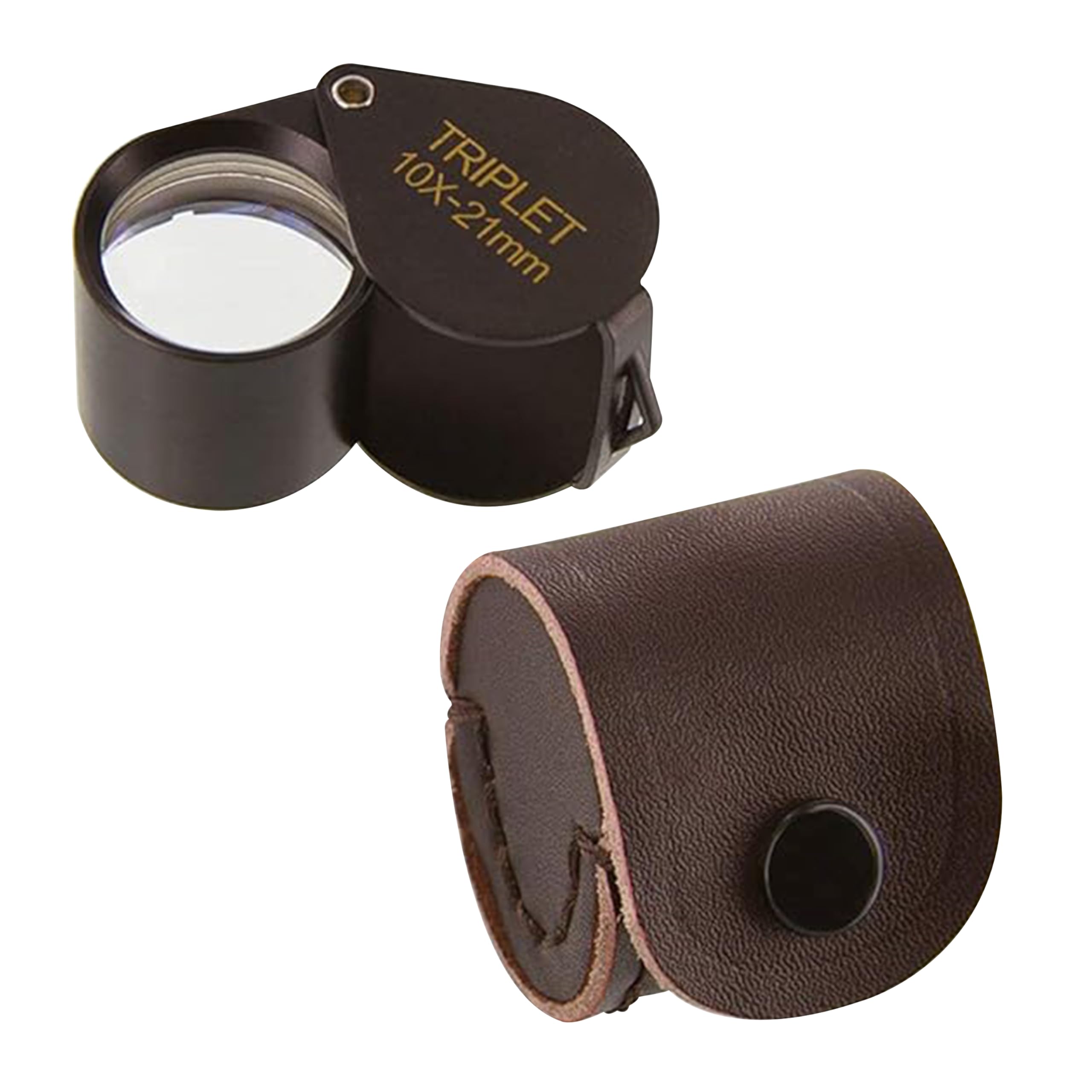
This Ade Advanced Optics is the outlier on this list because it is aimed at more than jewellery. The same 21 mm bonded triplet that reads a hallmark also handles coins, gemstones, trichomes, plant matter, slides and circuit boards — so it is the one to pick if your inspection work wanders across hobbies. Three precision-bonded glass elements give you a crisp, high-definition image with focus that runs to the edges rather than fading out.
Day to day, the leather case with a snap closure is what separates it. It holds the loupe firmly and keeps grit off the glass in a pocket or a field bag, so you can drop it in a jacket and forget it until you need it. For long sessions, the comfortable eye relief (the gap that lets you rest your eye without squinting) matters too. You are not fighting to hold your eye in one exact spot.
The only real complaint is size. A handful of buyers find the compact body too small to grip comfortably, which is a hand-size mismatch rather than a fault. If you have large hands and plan to use it for long stretches, the wider-bodied picks may sit better.
Best reason to buy: the snap-closed leather case turns a delicate optical tool into something genuinely pocketable for field and travel work.
The honest limit: it is a compact barrel, and larger hands may prefer more body to hold onto during long inspections.
Pick this one when: your loupe lives in a bag and travels between coins, minerals and jewellery.
Handle it first if: you have broad fingers — the small body is the one thing that divides opinion.
4. 10x Magnifier Jewelry Loupe LED UV 21mm Triplet Lens

Two lights in one barrel — LED to see by, UV to check what glows.
Buy this one if you grade stones in a room that is not well lit, or if you want to check for treatments and fluorescence under UV. It pairs a 21 mm achromatic triplet with switchable LED and UV illumination in the same aluminum body, so the light comes from the barrel rather than a separate lamp. The lit view is genuinely sharp and clear, and the black frame around the lens cuts reflection back toward the object so you see the stone rather than a glare hotspot.
The weight jump is worth flagging, because it tells you what the lights cost you. This LED model weighs 0.11 kg, and the plain 20.5 mm DANOPLUS higher up weighs 0.03 kg — a substantial difference in the hand, all of it battery and circuitry. Carry it in a pocket and you notice; set it on a bench and you do not. The included case takes the sting out of the extra bulk, keeping the whole unit together in a drawer.
One thing to plan for: this loupe runs on batteries that are not in the box, and they drain quickly with regular use. Buy a strip of spares at the same time and you will not be caught mid-inspection with a dead light.
Why the lights earn their place
- LED and UV illumination in one barrel covers both normal viewing and fluorescence checks.
- 21 mm achromatic triplet keeps the lit image sharp and colour-accurate.
- Black inner frame kills reflected glare so the surface reads clean.
- Protective case included, which suits a heavier tool that lives on a desk.
The running cost to accept
- Battery life is short — keep spares on hand, and note no batteries ship with it.
- The extra 0.11 kg makes it a desk tool rather than a featherweight pocket carry.
Built for: gem grading and dim-room work where the light in the barrel is the difference between seeing and guessing.
Skip the lights if: you work in daylight and want the lightest carry — the unlit version weighs a fraction of this.
5. Quality Optics Hastings 10X Loupe

The one that gives you more of the stone in frame at once.
This Hastings model gives you a wider field of view than most loupes here, which squeeze you into a narrow circle. That wider window is the spec that matters when you read a full hallmark or scan a coin’s rim rather than a single point. The Hastings lens uses the same corrected triplet design, so the wider view does not cost you sharpness. A broad, clear view is what this loupe is known for, and it holds that clarity to the edges.
The body is three-plated brass, tapped with a bezel ring so a bale loop can take a lanyard or chain. That brass shell feels substantial in the hand, and the solid construction is the reason it earns its keep at a bench — no flex, no wobble, no roll. It includes a leatherette pouch and a cleaning cloth, so the kit is complete enough to keep the lens safe without buying anything extra.
If you only look at one ring twice a year, a cheaper kit covers you. If the loupe is a daily working tool, the wider field is a genuine upgrade.
Go for the wide window: a corrected Hastings lens with a field of view that lets you see a whole setting, in a brass body that will not wobble mid-check.
Not for light-pocket carry: the plated brass adds heft, so this is a tool that lives in a benchtop case rather than loose in a pocket.
6. Toyo Professional 10X Jeweler’s Loupe 18mm

A lean chrome triplet that slips into a pocket and stays out of the way.
This Toyo takes the corrected triplet optics of the larger hex model and shrinks them into an 18 mm lens with a rubber-grip handle. It is aimed at the buyer who checks rings and chains on the go and does not want bulk in a pocket. The triplet is aplanatic and colour-corrected — flat field and true colour out to the edge — so the smaller window stays sharp instead of soft at the rim.
The size is the whole conversation. It is trimmed, which makes it easy to carry but means you fit less of an object in the frame than the 21 mm options. Edge-to-edge clarity is the strength here, and inspecting jewellery is what it is built for. It arrives with a 1-year warranty, which is a reassurance most pocket loupes skip.
If you work over a bench with plenty of room, the wider Toyo above gives you more view for a similar outlay. This one’s case is a compact carry, not a generous view.
Where it shines: a corrected 18 mm triplet with a grip that does not slip, in a slim body that disappears into a pocket.
Size versus view: the trim 18 mm lens shows less of an object at once — fine for a stone, tight for a large coin.
Choose it for the carry: a slim, corrected triplet with a rubber grip and a 1-year warranty for on-the-go checks.
Choose wider if you scan: for a whole hallmark or coin face, the 21 mm lens is the more comfortable window.
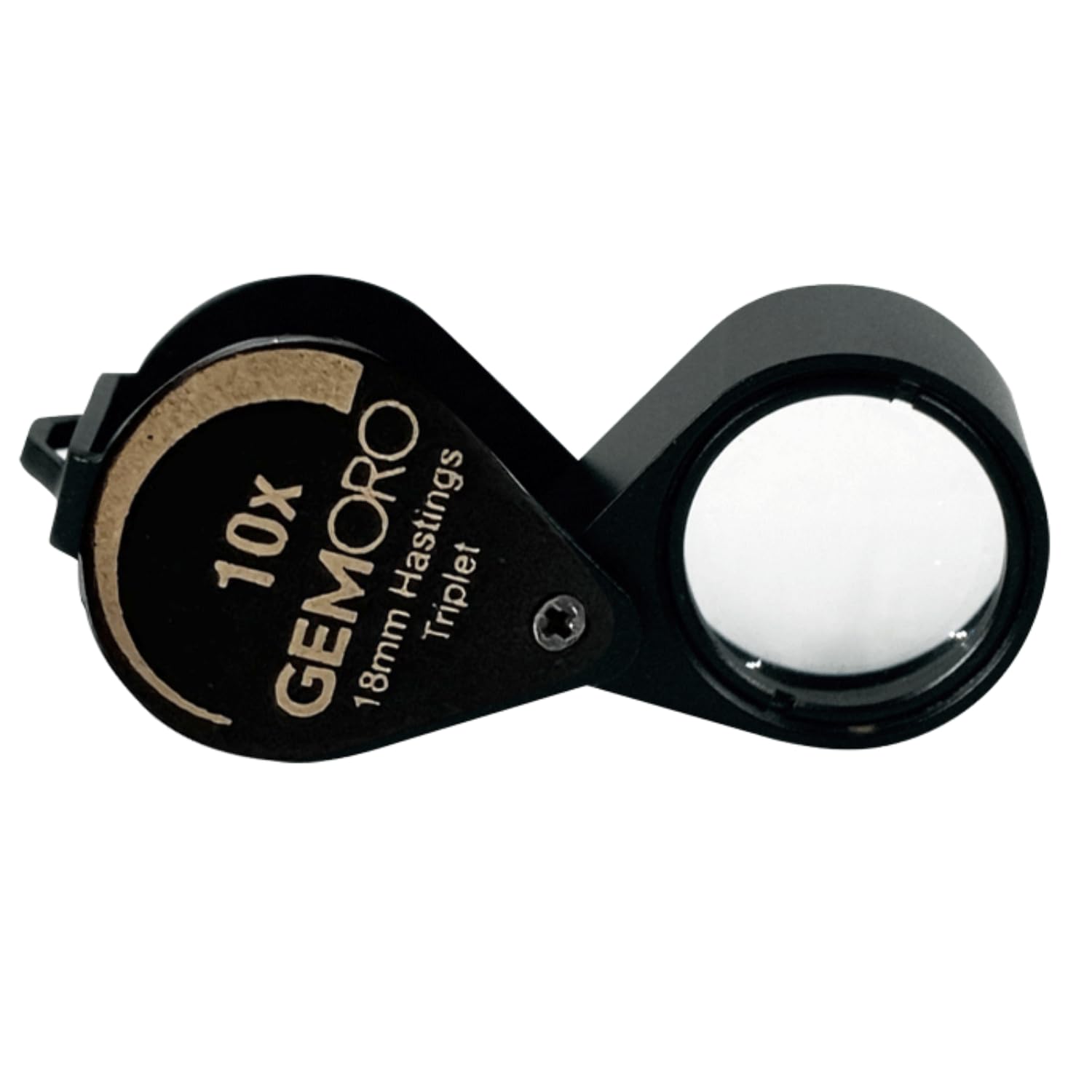
7. GemOro Jewelers Loupe 10x Hastings Triplet Lens
A compact Hastings triplet in the pocket-slim format appraisers tend to favour.
GemOro has been making jewellery tools for years, and this is its take on the classic pocket loupe. It uses a Hastings triplet lens — the corrected three-element design — for a view that is meant to be sharp and free of distortion across the field. The 10x magnification is fixed, so once you get the working distance right, every look at a stone is consistent.
It is built for portability first. The clear, distortion-free viewing is the reason to choose it, and it holds that quality across the frame rather than only at the centre.
The caveat worth knowing is the clarity at the edge. A portion of buyers find the aperture a little tight, so the outer part of the view takes a moment to settle into focus. Moving your eye slightly closer usually fixes it. It is a first-class lens in a small package, not a wide-window tool.
The appraiser’s pocket tool: a Hastings triplet in a compact body for consistent stone grading on the go.
Mind the aperture: expect a tight viewing circle, so line your eye up deliberately rather than glancing through.
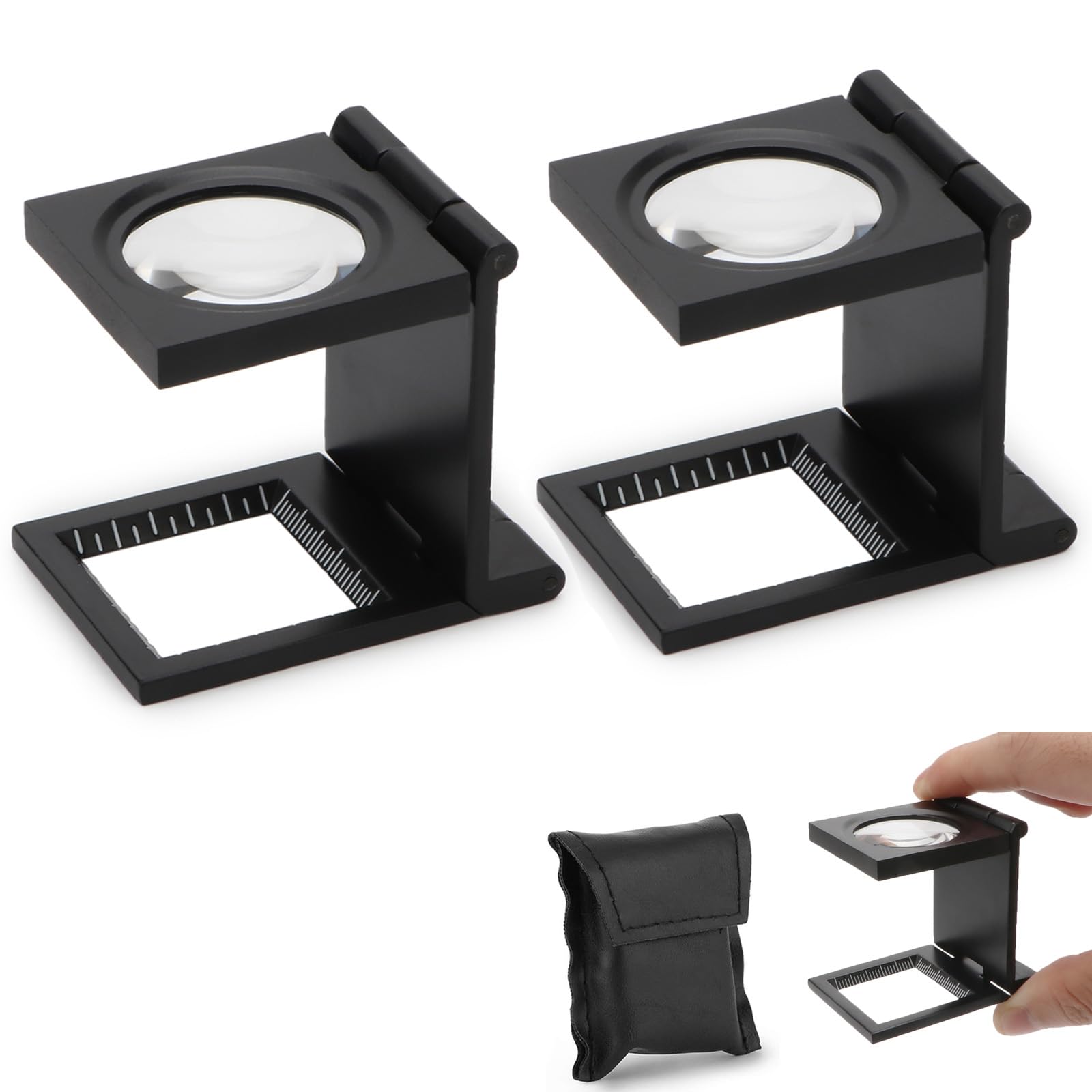
8. Rongon 10X 28MM Pocket Magnifier
The widest lens here, built for counting threads and measuring parts.
The spec that matters on this Rongon is the lens — 28 mm, the widest window on this list, and 18 mm versus 28 mm is a 56% bigger window than the Toyo compact. That buys you room to see a run of stitches or a row of threads at once, which is why it is sold as a linen tester for textiles class and fabric counts. The folding zinc alloy body stands up on its own and carries a scale in both inch and mm units for measuring small parts.
You get a 2-piece pack with a leather pouch, so you can keep one on the desk and one in a bag. Owners find the construction solid and the magnification strong. Focus is what divides opinion: buyers report the lens needs to be held at least 1/4 above the object for proper focus,” and the image can feel badly out of focus until you find that exact working distance. This is a loupe that rewards lining it up before you look.
For measuring and counting work — stitches, threads, tiny machine parts — the wide lens and the scale make it the right tool. For quick handheld jewellery glances, the hunt for the focus point gets in the way.
Made for the tape measure: a 28 mm lens with an inch/mm scale, in a folding body that stands on its own over fabric.
Respect the focus point: it needs holding about a quarter-inch off the object before the image snaps in, so it is a deliberate tool rather than a glance-through.
For weavers and machinists: the 28 mm window and built-in scale make counting and measuring straightforward.
Not the casual loupe: if you want to glance at a ring, the working-distance hunt costs you time.
9. Zeiss Optics D40 10x Pocket Magnifier

German aplanatic optics that stay sharp across the whole field.
This is the loupe you buy when the standard of the view is the only thing that matters. Zeiss builds aplanatic-achromatic optics — corrected for flatness and colour — that deliver 10x magnification across the entire field with no distortion or chromatic aberration. For precision work where you have to recognise the finest detail, that full-field sharpness is the difference between seeing a flaw and missing it. The glass is what this magnifier is known for, and it is the reason it exists.
It is the most expensive pick on this list, and that extra cost is honest — you are paying for corrections and coating that cheaper lenses do not have. The metal body is slim and pocketable, keeping the classic folding format appraisers like. Contrast and clarity are what buyers keep coming back to, particularly the way stones pop against the background under this lens.
The trade-off is the working distance. The focal plane is narrow and the aperture is small, so the lens has to be positioned carefully at close range to find the sharp image. Move a hair outside that band and the view softens fast. It is not a forgiving loupe for the casual user, but for disciplined, close, steady inspection it is the finest optics here.
What the German glass delivers
- Aplanatic-achromatic correction — sharp to the edge with no colour fringing.
- Full 10x magnification across the entire field of view, not just the centre.
- High contrast and incredible clarity for recognising the finest detail.
- Slim metal pocket body keeps precision optics genuinely portable.
The precision tax
- The focal plane is narrow — you must hold it at the right distance to get a sharp image.
- The small aperture and extreme smallness ask for careful, steady positioning.
For the serious inspector: Zeiss aplanatic glass that holds sharpness to the edge, for work where a missed detail costs you.
The discipline it demands: a narrow focal plane and tiny aperture mean it is a loupe for patient, precise use, not quick glances.
Know the Specs
Triplet versus single-element lens
A triplet is three glass elements bonded into one unit. Stacking corrects colour and curvature errors a single element cannot fix. That is why every serious pick here is a triplet: on a diamond or a hallmark, the edge stays readable instead of fuzzing into a rainbow.
Achromatic and aplanatic correction
Achromatic means colours focus together so you do not get fringing. Aplanatic adds correction for a flat field, so the outer edge stays sharp alongside the middle. Both are the specs that justify spending above the entry kits.
Lens diameter and working field
A 28 mm lens shows a wide window; an 18 mm lens keeps the barrel slim. Match the diameter to your task — wide for scanning and counting, narrow for pocket carry and single-stone checks. Bigger glass also asks for a steadier hand.
Working distance and aperture
The working distance is how far the lens sits from the object. A narrow focal plane means you must hold it at an exact gap or the image softens. Expect a corrected, small-aperture loupe to demand deliberate positioning. That is a precision feature, not a flaw.
Common Questions
Is a 10X loupe the right power for checking jewellery?
What does a triplet lens do that a single lens cannot?
Why does my loupe look blurry until I hold it a set distance away?
Do I need LED or UV lights in a jewellers loupe?
What is the difference between achromatic and aplanatic optics?
Can I use a 10X jewellers loupe for coins and stamps?
How should I clean and store a jewellers loupe?
Will a 10X loupe magnify a phone screen or work with a camera?
Does a bigger lens mean better magnification?
Is a pricier jewellers loupe actually sharper?
The Bottom Line
For most people buying a 10x jewelers loupe, the DANOPLUS 20.5 mm triplet kit is the one to grab. It arrives with the case, cloth and lanyard you would otherwise buy separately, and its corrected triplet glass handles jewellery, coins and watches alike. If edge-to-edge sharpness is your priority and you already have a case, the Toyo hexagonal 21 mm triplet is the cleaner lens, with a hinge that holds its focus. Want to check for fluorescence in dim rooms? The LED/UV model adds both lights in one barrel. And for precision work where a missed detail costs you, the Zeiss D40 aplanatic is the finest optics on the list — just be ready for its narrow focal plane.
How we choose
We do not accept paid placement. Every pick is matched to a real buyer and a real use-case; we do not hands-on test units.
Sources
Specifications: manufacturer listings and product documentation. Review insights: verified customer reviews, as of November 2026. Pricing: not shown on this page (it changes often); check the current price via the retailer link.
As an Amazon Associate, Tactical Gear Guy earns from qualifying purchases. This does not affect which products we feature.