Specs are compiled from manufacturer listings and verified buyer reviews and can change over time — please confirm the key details on the product page before buying.
You suspect a leak behind the paint, and the only way to know for sure is to get a number out of the wall itself. A moisture reader for walls does exactly that: it tells you whether the drywall, plaster or masonry is actually damp or already dried out, so you stop guessing before you cut a hole. The short answer on what matters: depth and material settings beat screen size, and pinless meters save your walls from pinholes while pin meters dig deeper into the material.
This guide is built by comparing the manufacturers’ published specifications and the patterns across verified customer reviews, so you get each pick’s real strengths and trade-offs instead of marketing spin.
Below you get nine wall-capable meters sorted by how you will actually use them, from a budget pinless unit that reads through tile to a premium deep-scan model with an alloy probe. Every pick here is measured on the same three things so you can scan the differences fast: detection depth, material modes, and how the reading reaches your eyes. That is the whole game with a moisture reader for walls.
Top Picks


How To Choose The Best Moisture Reader for Walls
Buying for walls is different from buying for firewood. On a wall, you usually cannot see the wet spot, you cannot poke a hole without a repair, and the material under the surface is a mix of drywall paper, gypsum, plaster or block. That shapes everything worth caring about.
Pinless or pin, based on your wall
A pinless meter sends a signal into the material and reads what comes back, so it never marks the surface. That makes it the right call for painted drywall, finished plaster and tile you would rather not repair. A pin-type meter drives two stainless steel pins into the material and reads the moisture between them, which gives a direct contact reading in wood, drywall and carpet — but it leaves two small holes each time.
Detection depth tells you what the meter can reach
Depth is the spec buyers skip and then regret on a soaked wall. A meter that reaches only the surface film of paint will read dry while the gypsum behind it is soaked. Deeper sensing — whether that is a stated depth in millimeters or inches, or a non-invasive signal that reaches behind the surface — is what lets you find moisture that has traveled into the wall cavity.
The material setting changes the number
Wood, drywall, plaster and masonry all hold and conduct moisture differently, so a meter needs a mode for each. If you are checking a wall after a pipe leak, you want a meter with an explicit wall or masonry setting. If you also check firewood or lumber, a meter with softwood and hardwood modes earns its place. Reading a wall in a wood setting gives you a number that means nothing.
How the reading reaches you
You will often be crouched in a basement or reaching behind a washing machine, so backlighting and a clear bar graph matter more than they sound. A 3-color bar (green for dry, yellow for risk, red for wet) plus an audible alert lets you sweep a whole wall quickly and only stop when the tone changes. Large digits and a hold button help you log a reading before it scrolls away.
Side-by-Side Comparison
| Model | Best For | Detection Type | Depth / Range | Material Modes | Amazon |
|---|---|---|---|---|---|
| General Tools MMD4E★ Best Overall | Leak confirmation on drywall | Pin type | 1.5–33% building materials | Wood and building materials | Amazon |
| Proster Rechargeable PinlessDeep Scan Pick | Deep non-destructive wall scans | Pinless | 5–40 mm | Wood, wall, brick, tile, plaster, concrete, mortar | Amazon |
| Mecurate Pinless 4-ModeBest for Wood and Walls | Woodworkers who also check walls | Pinless | 0.1% resolution | Softwood, hardwood, wall, masonry | Amazon |
| Povlen Pinless MT510-Y | Fast drywall sweeps | Pinless | ±4% accuracy | Softwood, hardwood, wall, masonry | Amazon |
| ennoLogic eH710T | Multi-material inspection work | Pin type | As low as 0.1% in some materials | 7 material settings | Amazon |
| General Tools MM8 | Mold-risk checks on finished walls | Pinless | 2″ backlit digits | Drywall, masonry, softwood, hardwood | Amazon |
| Klein Tools ET140 | Jobsite durability | Pinless (EMF) | Up to 3/4-inch deep | Drywall, masonry, hardwood, softwood | Amazon |
| Calculated Industries 7440 | Firewood plus wall checks | Pin type | 5–50% moisture range | Wood, concrete, drywall, plaster, carpet | Amazon |
| Tadeto TE0015 | Reaching awkward wall spots | Pinless | Up to 40 mm | Wood, plaster, tile, cement mortar | Amazon |
Detailed Reviews
1. General Tools MMD4E Moisture Meter
Our pick — 4.5+★ from 15,000+ verified ratings; the strongest balance of quality and price.
The leak-hunter that separates a wet stain from a dried one, with a number instead of a guess.
When you are standing in front of a brown ring on the ceiling, the first question is not “how wet” but “wet or already dried.” This meter answers that directly with two stainless steel pins you press into the drywall or wood, and a range that covers 1.5–33% for building materials such as concrete and drywall, plus 5–50% for wood. That building-materials window is where ceiling stains and bathroom wall patches live.
The design is built for repeated checking rather than a single inspection. Readings show as both tones and on-screen icons, so low, medium and high come through as a beep pattern and a symbol at the same time. The digits stand 0.3″ high on a backlit LCD, which matters when you are reading in a dim basement. A hold button freezes the number, and the protective cap doubles as a calibration checker, so you can confirm the tool is honest before you trust it on a wall.
Here is the trade-off you should know going in. Owners love how it works — the meter’s functionality is the aspect that wins people over most, and ease of use runs even higher on the praise side, so this is a tool you can hand to a first-timer and they will work it out. But the pins are the weak point. As buyers report: The durability receives mixed reviews, with several customers reporting that the pins bend after about 30 uses. Push down hard into drywall and the metal tips can bend, so treat the pins as the wear part and keep the spares in the cap.
What earns its keep
- Reads 1.5–33% building materials and 5–50% wood, covering drywall, concrete and lumber in one tool
- Audio tones plus screen icons give you two ways to catch a wet spot
- 0.3″ digits on a backlit LCD stay readable in a dark basement
- Cap doubles as a calibration checker, and spare 8mm stainless pins are in the box
Where it asks for care
- Pin tips bend when pushed hard into drywall — expect to replace them
- Pin type means two small holes per reading, so it is not for finished surfaces you care about
Reach for this if: you have a stain, a suspicious spot or a spot of damp on a wall and you want a definitive reading and a repair cost you can plan for.
Pass it by if: your walls are finished plaster or tile you cannot mark — the pinless Proster reads the same surfaces without a hole.
2. Proster Rechargeable Moisture Meter
Forty millimeters of reach without a single pinhole makes this the one for finished walls.
If the wall is painted and you would rather not repair it, this is the shallowest-risk way to get a hard answer. The pinless probe reads moisture at a depth from 5 to 40MM, so the reading comes from the material behind the surface film rather than the paint itself. That is the spec that matters when a leak has traveled down inside a bedroom wall: you want the wet gypsum below the paint, not the dry face above.
At 5.3 ounces it is the lighter of the two pinless meters I would shortlist against the Povlen at 5.6 ounces, and both are light enough to hold overhead for a slow ceiling sweep. The 2.4-inch color display shows max and min values at the same time, so you can see the floor and ceiling of a reading without re-measuring. Auto-calibration takes 3 seconds after a press of the MEAS button, and a 3-color LED analogue bar plus audible alarm turns low, mid and high moisture into something you can act on without decoding numbers.
The charging is where it stands apart from every other pick here: a rechargeable battery with a USB cable means no hunting for a 9V at the wrong moment. Set your own alarm level for a suspected leak and the meter will tell you when the wall crosses it. The carrying pouch is included, and the material list — wood, wall, brick, tiles, cardboard, plaster, concrete and mortar — covers nearly any wall assembly you will meet. If you prefer a wider, more detailed screen, the Klein Tools ET140 has its own reverse-contrast display and nine LED bars, but it reads to 3/4-inch deep rather than the 40 mm this one advertises.
Where it wins: the combination of 5–40MM depth, pinless sensing and a rechargeable battery is the most wall-friendly package on this list.
The honest catch: a pinless reading is relative, not a laboratory percentage, so treat it as a wet-versus-dry and trend tool rather than a calibrated lab number.
Suits the wall owner: anyone chasing a leak through paint, plaster, tile or brick where holes are not an option.
Not for the lumber yard: if your main job is seasoning firewood to a precise percentage, a pin meter like the Calculated Industries 7440 reads the wood directly.
3. Mecurate Pinless Moisture Meter, 4 Mode 9 Density Settings
Nine density steps for softwood and four modes for the wall make this a two-job tool.
The reason to pick this one over a plain wall meter is the calibration. Switch between SOFTWOOD, HARDWOOD, WALL and MASONRY modes, and within softwood you get 9 sensitivity settings so different wood species read honestly instead of all landing on the same number. Reading at 0.1% resolution means the display moves in fine steps, which helps when you are watching a wall dry out over a week and want to see the trend move.
On the wall side, it does everything you want from a pinless meter: percentage readings alongside a 3-colored LED bar, so you can read low, mid and high at a glance, plus a backlit LED, visual reference and audible alert for sweeping large surfaces. The non-destructive probe means you can map a whole wall around a suspected leak and never leave a mark. It comes with a carrying bag and 3 AAA batteries, so it works on day one.
For 700+ ratings it holds a 4.0+ rating, which is a solid score for a dual-purpose meter, and the honest limit sits in the manufacturer’s own note: percentages from building-material testing are for reference only and cannot be used to derive exact values. So use the WALL and MASONRY modes to find where moisture is and track whether it is falling — do not treat the number as a lab certificate for a concrete wall. The density settings are also a softwood-only feature, so hardwood users get the mode but not the tuning.
Why it earns a spot
- 9 sensitivity settings inside softwood mode let you match the species you are testing
- Four modes cover wall and masonry alongside wood, so one tool handles both jobs
- 0.1% resolution shows fine movement as a wall dries
- Ships with 3 AAA batteries and a carrying bag
What to weigh first
- Building-material percentages are reference-only, not precise values
- No stated sensing depth, so treat it as a surface-and-shallow scanner
Good fit: the homeowner who checks drywall after a storm and also dries lumber in the garage.
Look elsewhere: if you need a stated depth in millimeters for a thick masonry wall, the Proster’s 40 mm rating is the clearer number.
4. Povlen Pinless Moisture Meter

A drywall scanner that beeps and goes red the moment the wall crosses your set point.
For the person who wants to sweep an entire room after a leak, the combination of a big LCD color display, an analog bar and a beep is the whole feature list. Set the threshold, run the flat sensor along the wall, and the meter turns red and sounds when moisture exceeds it. The advanced sensor technology and smart chip do the reading with high-frequency waves, and a HOLD function records a number with one button so you are not trying to memorize digits while standing on a stool.
Accuracy is listed at ±4%, and the meter offers the same four modes — SOFTWOOD, HARDWOOD, WALL and MASONRY — as the pricier pinless units, covering drywall, wood, concrete, cement and paper. Weight is 5.6 ounces, so it is 0.3 ounces heavier than the Proster but still a light tool to carry up a ladder. In softwood mode it can be adjusted by density grade to match the wood type in front of you.
The body is ABS, which keeps it light, and the 850+ ratings behind its 4.5+ score point to a meter that earns its place on drywall and softwood in particular. The recurring note to weigh: the plastic shell is the wear point, and a few mention damage to the display. Treat it as a homeowner tool that lives in a drawer rather than a jobsite meter that rides loose in a truck. The Klein Tools ET140, by comparison, advertises 2m drop protection for the rougher work.
The value read: ±4% accuracy and four material modes on a non-destructive probe is a lot of wall-reading capability for a mid-range meter.
Fair caution: the ABS body and display want a case or a padded drawer if you plan to haul it around.
Pick it when: you want to walk a wall and let the meter beep at you rather than read numbers off a screen.
Think twice if: you will be throwing it in a truck bed weekly — the Klein has explicit drop protection this one does not advertise.
5. ennoLogic eH710T Moisture Meter with 7 Material Settings
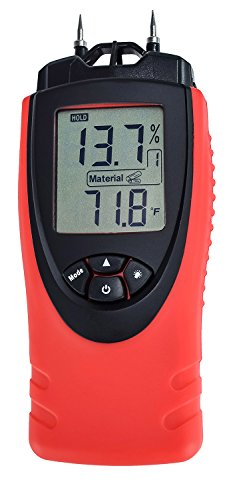
Seven material settings and a 0.1% floor for the inspector who reads cement as often as drywall.
Most wall meters give you four modes. This one gives you seven, covering firewood logs, carpet, sheetrock, cement, gypsum, mortar and bricks — so when you probe a basement wall that is block under plaster, you can pick a setting that matches what the pins are actually touching. The pins are described as sturdy and well-mounted, which matters on this list because bent pins are the recurring complaint on cheaper pin meters.
The range is where it earns attention: it can measure as low as 0.1% in certain building materials and 7% for wood, so a wall that reads barely damp still shows movement instead of sitting at zero. There is an air temperature sensor you can set to Celsius or Fahrenheit, with accuracy of plus or minus 1 degree, and the meter remembers your temperature unit and last material setting after power off. Hold freezes a reading, MAX and MIN display shows the spread across a range, and auto-power off kicks in after 10 minutes.
The display is the thing to get straight before you buy. With 150+ ratings and a 4.0+ score, this is the entry point on the list, and the recurring complaints point the same direction: the screen is small and a few find the settings menu more complicated than they expected. If you are buying for reading a tiny number with reading glasses in a dark crawlspace, the 2″ backlit digits on the General Tools MM8 are friendlier. But for an inspector-style tool that handles many materials at a wide range, the seven settings are the point.
What stands out: seven material settings plus a 0.1% low end covers gypsum, cement, mortar and brick without swapping tools.
The real caveat: the display is small and the menu adds steps, so it rewards patience more than it rewards a quick glance.
Best for the detailed checker: someone who probes several material types in one afternoon and wants a setting for each.
Skip if: you want one button and one big number — the small screen will frustrate you.
6. General Tools MM8 Pinless Moisture Meter

Two-inch-tall digits and a color bar graph built to be read from a crouch in a crawlspace.
Where the MMD4E uses pins, this sibling reads the surface without marking it, using non-marring sensing technology. That makes it the one to grab when the wall is already painted and finished and you only want to know whether the stain under the window is active. Separate settings for drywall, masonry, softwood and hardwood mean the number you see matches the material under the sensor.
The display does the heavy lifting: 2″ (50mm) high backlit white LCD digits, auto-calibrating, a 3-color LED bar graph and an audible alert for accurate detection. That combination is what makes it quick to sweep a ceiling line or a bathroom wall. An out-of-range alarm flags moisture past your threshold, and a low 9V battery alert warns you before the reading goes soft. The ergonomic handle is shaped to sit in the hand while you press the sensor flat against the wall.
For mold prevention, this is the early-warning tool in the line: a quick scan of a leak stain tells you whether the drywall behind it is wet or already dried. The honest wrinkle on this one is the reading itself. With 900+ ratings and a 4.0+ score it holds a strong position, but the accuracy opinions split: some call it among the most accurate devices they have used, while a smaller group found it not very accurate. That split is typical of pinless meters, which read relative moisture rather than a direct contact sample, so use it to find the wet zone and let a pin meter or a moisture test confirm the exact number.
Wins on
- 2″ backlit digits plus a 3-color bar graph are genuinely easy to read
- Non-marring sensor leaves finished drywall untouched
- Separate drywall, masonry, softwood and hardwood settings
- Out-of-range alarm and low-battery alert keep you ahead of a dead reading
Weigh this
- Accuracy gets mixed reports, which is the nature of pinless sensing
- Relative readings only — no direct contact sample like a pin meter gives
Worth grabbing: the homeowner with a finished wall and a suspicious stain who wants a quick wet-or-dry verdict.
Not the one: if you need a hard percentage from inside the gypsum, the MMD4E’s pins get you there.
7. Klein Tools ET140 Pinless Moisture Meter

Built to survive a drop from a ladder and still read the wall behind the paint.
The one spec that puts this meter in a different class is the kit. It comes with 2m drop protection, so it is the pick for someone who works off a ladder or a scaffold and has watched a meter slip before. The detection itself is non-destructive, using an electromagnetic field (a signal that reaches into the material without touching it) up to 3/4-inch deep, on drywall, masonry, hardwood and softwood — and it is calibrated for those four materials only.
The display is a reverse-contrast design with nine LED bars that show the moisture range at a glance rather than asking you to parse a number. Hold, low battery and auto-power off round out the feature set, and it ships with the 9V battery and an instruction manual. Ease of use is the aspect that carries this meter: it is the top-scoring trait on the listing, so the workflow is simple enough to hand to someone who has never used a moisture meter.
Buyers treat it as a jobsite tool that pays for itself on the first leak call. The two honest limits: battery life draws complaints — the included battery often arrives near flat, and it can drain even when powered off, so keep a spare 9V on hand. And the readings can run wet. Users split on accuracy, with some finding it consistent and others reporting it flags more moisture than is really there. That means treat it as a “look here” pointer rather than a final verdict, then confirm with a pin meter.
Where it leads: 2m drop protection and nine LED bars make it the toughest-to-kill and quickest-to-scan meter here.
Keep in mind: carry a spare 9V and expect the numbers to lean wet on some walls.
For the trades: an electrician, plumber or remodeler who needs a wall reading on a jobsite and cannot baby the tool.
For a careful homeowner: the Proster reads deeper at 40 mm and recharges over USB, which suits occasional use better.
8. Calculated Industries 7440 AccuMASTER XT

A pin meter that names the moisture band in plain words instead of making you interpret a number.
The feature that sets this one apart is the labeling. Push the sharp stainless steel pins into wood and the meter tells you whether the moisture content is Low (5-11%), Medium (12-15%) or High (16-50%). For someone splitting firewood or checking a floor board before installing it, that low-to-high band is more useful than a raw percentage, because it answers the question you actually asked: is this ready to burn or ready to cover?
On the wall side, it covers firewood, lumber, brick, concrete, drywall, plaster, floors, walls and carpets. The stainless pins are replaceable, which matters on a pin meter because it means a worn set does not retire the tool. A Hold key freezes readings, icons and audio alerts flag the moisture level, there is automatic shut-off and built-in calibration test pins to check the meter against itself. It runs on an included 9V battery and is rated for operating humidity from 0-95%, so a damp basement does not sideline it.
With 800+ ratings behind a 4.5+ score, the build quality is the part that holds up: the body feels solid when pressing the pins in, and owners describe it as sturdy. The recurring note is about the pins themselves — some report breakage and the probes coming off on occasion, so keep the built-in calibration pins in mind and do not lever the meter sideways while the pins are buried. The screen is large and backlit, but you need to look straight at it; it is not the heads-up sweep tool a color-bar pinless meter is.
The standout: named moisture bands of Low 5-11%, Medium 12-15% and High 16-50% remove the guesswork for firewood and lumber.
The honest limit: pins can break and probes can loosen, so press straight in and do not pry.
Made for: the wood-stove owner and the DIYer checking subfloor and drywall with the same handheld unit.
Better served elsewhere: if finished walls are your only concern, the pinless Proster leaves no holes at all.
9. Tadeto TE0015 Moisture Meter

An extended probe and a screw mount for the wall corners nothing else can reach.
The problem this meter solves is access. The extended handle and probe cover narrow and difficult areas, and a 1/4″ screw hole on the back lets you mount it to an extension pole to reach a high ceiling corner or a tight cavity. Measurement runs at a depth up to 40 mm with a range of 0-100 and a resolution of 0.1, so you get fine-grained readings without the surface being damaged by a pin.
The HD color screen is backlit and readable across a 360° range, and a 3-color bar chart labels the reading as “DRY” in green, “RISK” in yellow and “WET” in red, with optical and acoustic alarms whose range you can set yourself. The 0.1 resolution matters most when you are tracking a wall that is almost dry — the difference between 1.8 and 1.2 is the difference between “wait a day” and “paint it.” Hold, max/min and automatic shut-off are all aboard, and calibration takes 3 seconds after pressing MEAS.
The body is soft TPE rubber, described as more resistant to falls than typical meters, and it sits in the hand during one-handed operation. It weighs 10.6 ounces, making it the heaviest unit here, which is a fair trade for the reach. With 500+ ratings and a 4.0+ score, this is a meter that holds up on the access features, but the manufacturer’s own note is worth reading carefully: calibrate and measure by hand, hold the bottom of the meter and do not push it back and forth, because moisture on your hands can skew the result. It is not suitable for metal measurements.
Why it stands out: the 1/4″ screw mount plus 40 mm depth lets you reach a ceiling or cavity a handheld meter cannot.
What to know: at 10.6 ounces it is the heaviest pick, and hand moisture can affect readings if you slide it around.
Right for this buyer: someone chasing moisture in a high corner, a cramped attic or behind a fixed appliance.
Overkill if: your walls are all at arm’s height — the lighter Proster covers those without the extra heft.
Know the Specs
Detection depth (mm or inches)
Depth is how far the meter’s signal reaches into the material to find moisture. A shallow meter mostly reads the paint or paper face, while a deeper one reaches into the gypsum, plaster or block below. The Proster and Tadeto both state a 40 mm depth; the Klein Tools ET140 states up to 3/4-inch. When you suspect a leak has traveled down inside a wall, deeper sensing is what finds it.
Pin type versus pinless
A pin meter drives two stainless steel pins into the material and reads the moisture between them. It leaves small holes but gives a direct contact reading. A pinless meter uses a sensor pressed flat against the surface and leaves no mark. Which one fits you depends on whether the wall is finished and if you need a hard contact sample or a fast wet-or-dry scan.
The 3-color bar and audible alarm
Many wall meters translate their reading into a color bar — green for dry, yellow for risk, red for wet — and add a beep when the value crosses a level you set. This is what lets you sweep a whole wall at walking pace and stop only where the bar turns. The alarm is the difference between squinting at numbers and finding a wet patch in one pass.
Material modes and density settings
Wood, drywall, plaster and masonry hold moisture differently, so a meter needs a mode for each. The four-mode meters here cover softwood, hardwood, wall and masonry, while the ennoLogic adds seven settings across firewood, carpet, sheetrock, cement, gypsum, mortar and brick. Matching the mode to the material is what turns a screen number into a real moisture reading.
Common Questions
Will a pinless moisture meter read through painted drywall?
What moisture percentage means a wall is wet?
How deep behind the wall can a moisture meter detect?
Pin meter or pinless meter for finding a water leak in a wall?
Can I use a wood moisture meter on drywall and concrete?
Do I need an alarm on a wall moisture reader?
How do I know when a damp wall has dried out?
Why do my moisture meter readings not match what the number should be?
Can I mount a moisture meter to reach high or cramped wall spots?
What kind of battery does a wall moisture meter use?
The Bottom Line
For most people chasing a leak, the strongest pick on this list is the General Tools MMD4E, because it answers the wet-versus-dry question directly with a pair of stainless pins and a range that covers drywall at 1.5–33% and wood at 5–50%. If you want the wall untouched, grab the Proster Pinless — its 5–40MM depth and USB-C recharge make it the cleanest way to scan finished plaster and paint. And for the jobsite and firewood duties, the Klein Tools ET140 with its 2m drop protection is the one to reach for when the tool cannot be babied. The MMD4E also carries a 4.5+ rating across 15,000+ owners, the deepest review base on this list.
How we choose
We do not accept paid placement. Every pick is matched to a real buyer and a real use-case; we do not hands-on test units.
Sources
Specifications: manufacturer listings and product documentation. Review insights: verified customer reviews, as of November 2026. Pricing: not shown on this page (it changes often); check the current price via the retailer link.
As an Amazon Associate, Tactical Gear Guy earns from qualifying purchases. This does not affect which products we feature.