Specs are compiled from manufacturer listings and verified buyer reviews and can change over time — please confirm the key details on the product page before buying.
Buying a microphone for your camera is really about one thing: can people hear your voice clearly without straining? A camera’s built-in mic records everything in the room at once, so your subject sounds distant and the air conditioner sounds close. The fix is a small shotgun or directional mic that mounts on the camera’s shoe and points where you point. This guide sorts eight real options by what each one is actually good at — dialogue, wind, run-and-gun shooting, or phone-only vlogging. One honest note before you read: this list uses flexible, human-like matching for camera mounting, meaning some picks use a camera shoe mount and others are camera-mount compatible. Not every pick is the exact number you typed into the search bar, but the nearest same-type mic serves the same job. Every pick below genuinely mounts to a camera.
This guide is built by comparing the manufacturers’ published specifications and the patterns across verified customer reviews, so you get each pick’s real strengths and trade-offs instead of marketing spin.
You’ll learn which direction pattern actually rejects room noise, why plug-in power beats a battery for some shooters, and what low-cut filtering does for wind. Read to the end and you’ll know exactly which microphone for camera belongs in your bag.
Top Picks


How To Choose The Best Microphone for Camera
Start with the pattern, not the brand. A directional mic picks up mostly what it points at, so your voice sits forward and the room falls back. An omnidirectional mic hears the whole room equally, which is why your camera’s built-in audio sounds hollow in a kitchen. Direction wins almost every time for talking-head and interview work.
Pickup pattern and what it does for you
A super-cardioid pattern (a narrow forward cone with a small rear lobe for rejection) is the standard for on-camera dialogue. The Shure VP83 uses a super cardioid/lobar design to push off-axis sound down. That means a passing truck behind you gets quieter while your subject stays loud. Wide patterns are more forgiving if you move around, but they let in more room.
Power: plug-in vs battery
Plug-in power means the camera feeds the mic through the audio cable, so there is nothing to charge and nothing to forget. The Rode VideoMicro runs on plug-in power with a minimum of 3V and has no battery at all. Battery mics like the RØDE VideoMic Pro+ and the Shure VP83 keep working when your camera’s mic jack cannot supply power, and they add switches and filters. Neither is better — it depends on whether you trust your camera’s power output or want a self-contained rig.
Low-cut filters, gain, and wind protection
A low-cut filter trims low-frequency rumble like wind, footsteps, and HVAC hum before it reaches your recording. The Comica VM20 offers switchable 75 Hz and 150 Hz low-cut settings plus a stepless gain knob. More gain means a hotter signal into the camera, which is useful when your camera’s preamp is weak. A furry wind muff or foam windshield is not optional outdoors — it is the difference between usable audio and a wash of wind noise.
Side-by-Side Comparison
| Model | Best For | Frequency Range | Power Source | Connector | Amazon |
|---|---|---|---|---|---|
| RØDE VideoMic Pro+★ Best Overall | Crew shoots and run-and-gun | 40Hz – 20kHz | LB-1 Li-ion, 2x AA, or Micro USB | 3.5 mm Jack | Amazon |
| Sennheiser MKE 400Top Performer | Monitoring audio on the fly | — | Battery | 3.5 mm TRS and TRRS | Amazon |
| COMICA VM20OLED Power Readout | Long event days with gain control | 15 KHz | 300mAh rechargeable, USB-C | 3.5 mm Jack | Amazon |
| RØDE VideoMic GO II | Camera and phone in one rig | 20Hz – 20kHz | Plug-in power, no battery | 3.5mm TRS, USB-C | Amazon |
| Shure VP83 LensHopper | Long battery life and RF rejection | 50 – 20,000 Hz | 1 AA alkaline | 0.125 inch dual mono | Amazon |
| Sennheiser MKE 200 | Travel-light camera-top audio | 40 Hz to 20 kHz | Plug-in power | 3.5 mm Jack | Amazon |
| Rode VideoMicro | Small rigs and first mics | 100 hz – 20 khz | Plug-in power, min 3V | 3.5 mm Jack | Amazon |
| Deity V-Mic D4 Mini | Phone-only vlogging and interviews | 20 KHz | 1–5V passive from device | 3.5 mm Jack | Amazon |
Detailed Reviews
1. RØDE VideoMic Pro+ Shotgun Microphone
Our pick — 4.5+★ from 800+ verified ratings; the strongest balance of quality and price.
A shotgun mic that powers down when you unplug the camera cable, so a forgotten mic never dies in the bag.
For a one-person crew that shoots fast, this is the least fussy way to get broadcast-clean dialogue. The defining feature is the automatic power function: unplug the cable from the camera and the mic shuts itself down. Plug it back in and it wakes up. That one behavior kills the classic run-and-gun mistake of leaving the mic on in the bag all afternoon.
Power comes three ways — the included RØDE LB-1 lithium-ion rechargeable battery, two AA batteries, or continuous Micro USB. The built-in battery door means a swap takes seconds and the door stays attached, so you are not hunting for a plastic flap in the grass. The metal body survives being knocked around a camera cage.
Sound is where it earns its keep. Its frequency response reaches down to 20 hertz, against 100 hertz on the Rode VideoMicro — that 40Hz–20kHz range means the low end of a voice and the body of a room tone come through instead of sounding thin. What wins people over is the audio itself, with the Rycote Lyre suspension keeping handling noise out of that signal. The honest catch is noise: opinions split on whether the rear-facing capsule picks up too much of the room behind you, so a lively street can bleed into your take.
What earns its spot up top
- Auto on/off tied to the camera cable — no forgotten-mic dead battery
- Three power paths: LB-1 rechargeable, 2x AA, or Micro USB continuous
- Rycote Lyre suspension isolates bumps and handling noise
- Digital switching captures the signal clean at the source, cutting post time
What you should know going in
- The rear lobe picks up off-axis room noise, which splits buyer opinion
- Premium-tier spend — this is the most expensive pick on the list
Reach for this if: you shoot solo, move between setups, and want the mic to manage its own power.
Look elsewhere if: you work mostly in tight reflective rooms where rear pickup becomes a real problem.
2. SENNHEISER MKE 400 Shotgun Microphone
A camera shotgun with a built-in headphone jack and volume control, so you hear the take before you wrap.
Anyone who has driven home with a silent card knows the value of hearing your own audio live. The MKE 400 has an integrated headphone output with volume adjustment, so you can plug in earbuds and confirm the take before you move on. That single jack changes how you shoot more than any spec sheet number.
The rest of the package is built for changing conditions. A built-in low-cut filter trims rumble, and a 3-step sensitivity switch lets you match the mic to a loud room or a quiet one without digging through a camera menu. The super-cardioid shotgun pattern is highly directional, so it favors the person in front of the lens. Interchangeable 3.5 mm TRS and TRRS cables cover both a DSLR or mirrorless body and a phone.
The super-cardioid design is the same idea Sennheiser uses on the smaller MKE 200 below, but here you get the monitoring and switching that the 200 leaves out. What buyers keep praising is the tone — described as professional grade — and the compact size that keeps it out of the way on a small rig. The trade-off is a noise floor: some find it audible in quiet rooms, and the body is not as tank-like as the price implies. Judge it on dialogue in a normal room, not a silent studio.
Why it climbs this high: live headphone monitoring plus a 3-step sensitivity switch makes the MKE 400 the pick for shooters who cannot afford a silent take.
Built for: the solo videographer who wants to hear the audio before wrapping the scene.
Think twice if: your work happens in whisper-quiet rooms where a raised noise floor would show.
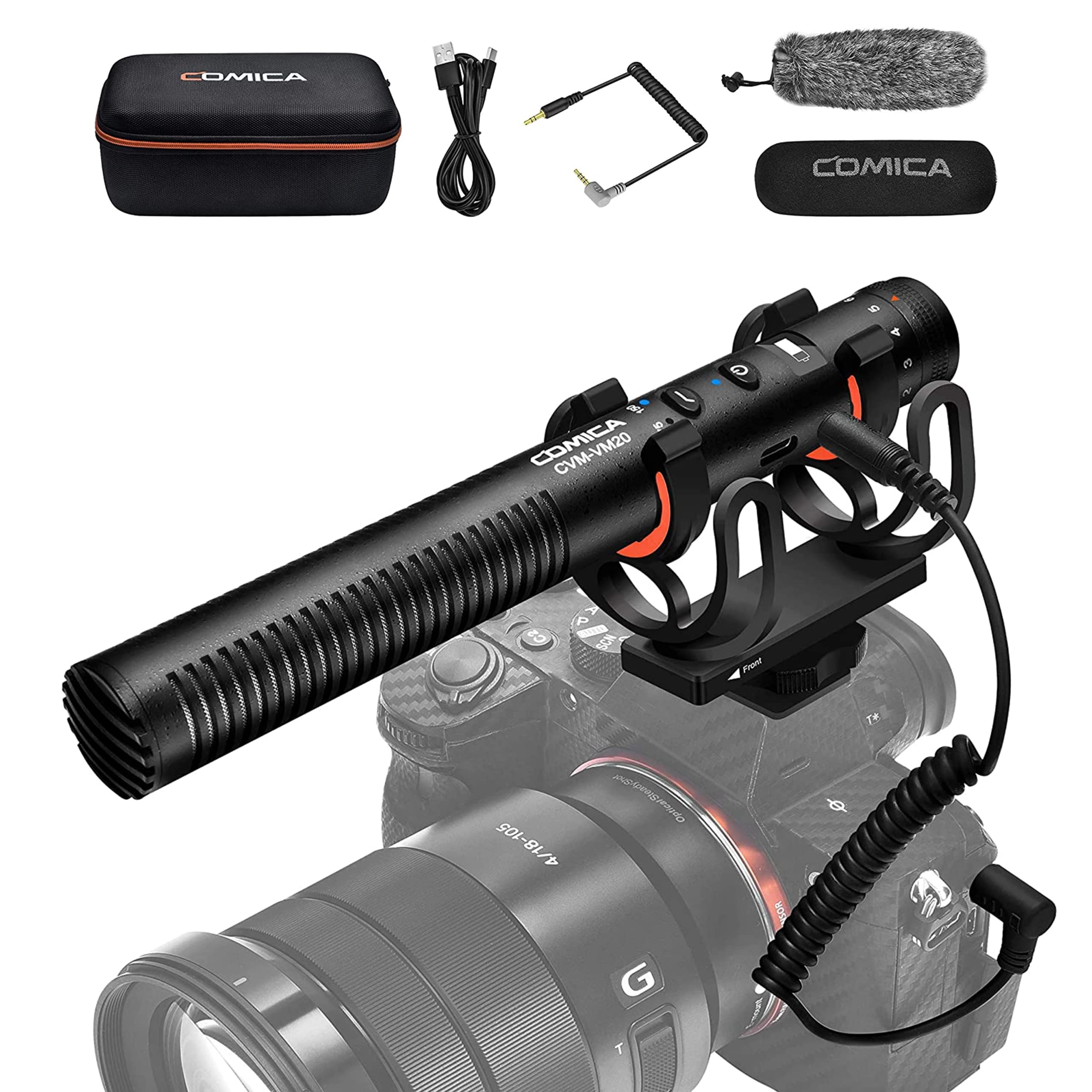
3. COMICA VM20 Shotgun Microphone
A 300mAh rechargeable shotgun with 60 hours of standby and an OLED screen showing live battery status.
Event and wedding shooters live or die by battery anxiety, and the VM20 answers it directly. A built-in 300mAh rechargeable lithium battery runs up to 60 hours on a 3-hour charge, and an OLED screen shows the remaining power in real time. According to Comica, it is the only 3.5mm shotgun mic that can be used while charging, so a USB-C power bank extends a long day instead of ending it.
Control is unusually deep for the tier. A stepless gain knob with ten levels and a sensitivity range of -43dB to -23dB lets you dial the signal to your camera’s preamp. Two low-cut settings — 75 Hz and 150 Hz — trim the hum and rumble that ruin outdoor takes. The full-metal body weighs 84 grams, light enough to sit on a mirrorless rig without pulling the balance forward.
The tone gets high marks, especially for event recording where you cannot re-shoot the moment. A furry wind muff and windscreen ship in the box, and a carrying case keeps the kit together. The fair caveat is consistency: a few units arrive that never power on, and some hear interference from nearby radio sources. Buy from a seller with a clean return path and this is a lot of mic for the tier.
The features that carry long event days
- OLED screen shows live battery status instead of a guess
- Up to 60 hours standby on a 3-hour charge, and it runs while charging over USB-C
- Ten-level stepless gain with -43dB to -23dB sensitivity range
- Switchable 75 Hz / 150 Hz low cut for wind and hum
Where it can slip
- A small share of units arrive dead on the first try
- Occasional radio-frequency interference in crowded venues
The right call for: wedding and event work where a dead battery costs you the moment.
Second-guess it if: you shoot in venues packed with wireless transmitters and need absolute RF silence.
4. RØDE VideoMic GO II Shotgun Microphone

A 57-gram shotgun with 3.5mm TRS for cameras and USB-C for phones, running on plug-in power with no battery.
The GO II is the flexible middle of the road: a 3.5mm TRS output for cameras and a digital USB-C output for phones, tablets, and computers, all in one body. At 57 grams and 5.91 x 1.97 x 2.06 inches, it is notably more compact than the Sennheiser MKE 200 at 9.4 x 4.5 x 2.8 inches, so it disappears on a small gimbal or a phone cage.
No battery and no complicated switches is the whole pitch. The HELIX isolation mount handles knocks, bumps, and handling noise, and a deluxe windshield takes the edge off wind. Hooked to RØDE’s software you can open up a high-pass filter, a high-frequency boost, and a pad — the same kind of tuning the pricier mics ship with as physical switches.
The tone reads slightly bassy, which most vloggers like because it adds weight to a voice without sounding muffled. What buyers come back to is the sound quality for the tier and how easily it connects across devices. The catch is simple: no battery means it leans on the device to feed it power, and the plastic body will not shrug off a hard fall the way a metal one would.
The single best reason to buy: a camera-and-phone audio tool in a 57-gram package with no charging routine.
One trade to accept: the plastic enclosure is built for careful handling, not abuse.
Pick it when: you switch between a mirrorless body and a phone and want identical audio from both.
Leave it if: your rig gets banged around and you need a metal body.
5. Shure VP83 Shotgun Microphone

A super cardioid/lobar shotgun that runs 125 hours on a single AA and rejects off-axis crowd noise.
The VP83 solves two different problems at once. Its 125 hours of battery life from a single AA alkaline means you can run a week of shooting on a battery you can buy at any gas station. And its highly directional super cardioid/lobar pattern rejects off-axis audio, so the crowd to your left stays out of the take while your subject stays in front.
RF immunity is the sleeper feature. Cellular and wireless devices nearby can inject clicks and buzz into a camera’s audio chain, and Shure engineered the VP83 to avoid those artifacts. An integrated Rycote Lyre shock mount, developed with Rycote specifically for this model, isolates vibration and mechanical noise. Frequency response spans 50 to 20,000 Hz with sensitivity at minus 36.5 dbv per pa.
What buyers praise is the tone and how it picks up everything they want, described as better than Rode alternatives in the same role. The build is solid and the adjustable settings let you shape the signal. But the recurring gripe is the output plug, which can break with rough handling — treat the cable connection gently and store it mounted, and this mic runs for years. The value debate is real at this tier, but the audio justifies it for professional work.
Why professionals keep one in the bag
- 125 hours from 1 AA alkaline — no charging routine at all
- Super cardioid/lobar pattern rejects off-axis sound
- RF immunity against cellular and wireless interference
- Rycote Lyre mount built specifically for the VP83
The maintenance you owe it
- The audio plug is the known wear point — handle the cable carefully
- Plus-tier spend that a beginner may not need
Tailor-made for: documentary and on-location shooters who cannot stop to recharge.
Pass if: you want a set-and-stash mic that survives being tossed loosely into a bag.
6. SENNHEISER MKE 200 Microphone
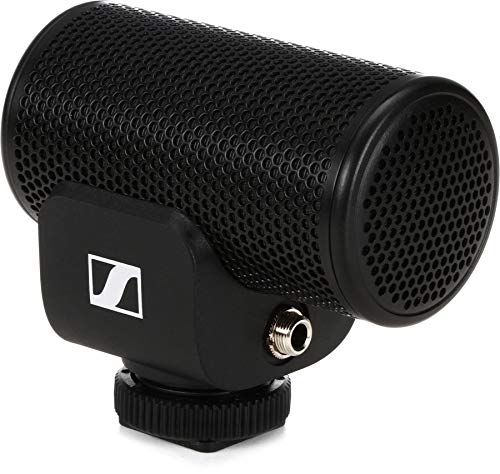
A compact cold-shoe Sennheiser with integrated wind protection and internal suspension, built to stay out of your frame.
If your priority is a small camera-top mic that does not fight your rig, this is the shape you want. An integrated wind protection and internal suspension mount cut handling noise without a separate shock mount cluttering the frame. A standard cold shoe mount means it drops onto nearly any DSLR, mirrorless body, or mobile rig.
Its sensitivity spec of 33 db is the highest on this list, ahead of the Deity V-Mic D4 Mini at 30 db — a hotter signal can matter when your camera’s preamp is weak and you need to push the level up without adding gain in post. Frequency response of 18 KHz tops out lower than the Deity’s 20 KHz, but for voice work that ceiling rarely matters. Interchangeable 3.5mm TRS and TRRS cables cover cameras and phones from the start.
The size and design get near-unanimous praise, and the wind rejection earns its mentions — the integrated protection does real work outdoors. What splits buyers is level: some find the output extremely low into certain cameras, and a few report compatibility hassles with specific bodies or needing adapters for modern phones. Check that your camera supplies plug-in power and this mic behaves.
Its standout quality: 33 db sensitivity in the smallest body here, for camera setups that need a hotter signal.
Suits you if: you want a tidy, low-profile mic for vlogging and travel where weight is the enemy.
Skip the leap if: your camera body is known to feed weak plug-in power — check compatibility first.
7. Rode VideoMicro Microphone

An 80mm, 42-gram all-metal shotgun running on 3V plug-in power, with no battery to charge.
The VideoMicro is the entry point most people should start with. At only 80mm (3′) long and 42gm (1.5oz), it adds almost nothing to the top of a camera, so a small gimbal stays balanced. The all-metal body takes a knock better than the plastic shells around this tier. It runs on plug-in power from the camera at a minimum of 3V, so there is no battery to charge and none to forget.
Its frequency range of 100 hz to 20 khz is the narrowest low end here — against the RØDE VideoMic Pro+ reaching down to 20 hertz — so deep voice rumble is trimmed rather than captured. For dialogue that is a reasonable trade, and the SC2 patch cable, deluxe wind screen, and shoe mount all ship in the box, which keeps the setup cost honest.
Tone and value are what carry this mic: clear speech at a price that undercuts the field by a wide margin, with a footprint that suits vloggers moving around. The shock mount is the known soft spot — it is the piece most likely to give out first — and noise handling splits, since some captures pick up a hiss in quiet settings. Neither flaw ruins the experience, but both are worth knowing before a critical shoot.
The value read: at this size and weight there is almost no reason not to keep a VideoMicro in the bag as a backup mic even after you upgrade.
The one weak joint: the shock mount is the part to treat gently, so store it mounted and keep tension off the Lyre loop.
A smart first buy for: small rigs, vloggers, and anyone who wants clear dialogue without adding weight or a charging routine.
Not the fit if: you shoot in dead-quiet rooms where any hiss would show up on the track.
8. Deity V-Mic D4 Mini Mic

A passive 1–5V shotgun rated for 20mph wind, shipping with a faux fur windshield and TRS/TRRS cables.
Phone-first creatives get a purpose-built tool here. The D4 Mini runs on 1–5V passive power from cameras, phones, and audio recorders, so there is no battery and no charging cable to lose. It ships with a faux fur windshield, a TRS camera cable, a TRRS phone cable, and a shock mount, which means you are ready to shoot the moment it arrives.
Two details stand out for talkers. The 20mph wind rating tells you the windshield is rated for real outdoor work, and automatic extra track assignment kicks in when you plug in a secondary source — useful for recording a second angle without a mixer. The supercardioid pattern focuses on the voice in front of the lens.
Where it needs honesty is consistency. The compact size and the price-to-value ratio are the parts buyers like, and outdoor recordings with focused voice pickup hold up well. But the audio quality itself splits opinions, with some recordings described as unusable in the wrong setup, plus reported compatibility snags on select phone models. Expect to test your exact phone and cable pairing the day it lands, then it does its job.
Who it fits: phone-only vloggers who want a windshield, a shock mount, and both cables bundled from the first box.
The catch worth testing: run a short clip on your exact phone model before a real shoot, because device compatibility varies by handset.
Worth it for: shooting out loud, outdoors, straight from a phone without extra gear.
The reason to hesitate: mixed reports on sound consistency and device pairing mean a quick test run is the smart move.
Know the Specs
Pickup pattern and frequency response
The pattern controls which direction the mic listens to, and the frequency response (the range of pitches it captures, in hertz) controls how full the recording sounds. A super-cardioid pattern narrows the listening cone so off-axis noise drops away. A response that reaches lower captures more of a voice’s weight, while a narrow low end trims rumble. For dialogue, a tight pattern plus a range that covers speech is what you want.
Power and connector compatibility
Plug-in power draws from your camera, so there is no battery chore, but it depends on your camera’s output. Battery mics stay self-contained and add features like low-cut filters. The connector matters just as much: a 3.5mm TRS cable suits most cameras, while a TRRS cable is what phones expect. A mic with both cables, like the Deity D4 Mini, covers more devices without adapters.
Common Questions
Will a shotgun mic work with my phone as well as my camera?
Do I need a battery-powered mic or is plug-in power enough?
What does a low-cut filter actually do for my recording?
How long does the battery last on a camera microphone?
Will my camera’s cold shoe fit any of these mics?
Is a super-cardioid mic better than an omnidirectional one for interviews?
My recordings sound too quiet. What should I check?
Will a camera mic pick up wind noise outdoors?
Do I need a shock mount to stop handling noise?
Can I monitor my audio while I record?
The Bottom Line
The strongest all-around microphone for camera is the RØDE VideoMic Pro+, because its automatic on/off, triple power options, and 40Hz–20kHz range handle fast solo shooting without a charging worry. If hearing the take live matters, the Sennheiser MKE 400 earns the spot with its headphone jack and 3-step sensitivity switch. For event days where a dead battery ends the shoot, the Comica VM20 and its 60-hour standby are the safe play. And if you shoot mainly from a phone, the Deity V-Mic D4 Mini bundles the windshield and cables you need in one box.
The one nudge worth making: match the mic to your power and connector setup first, then to your budget tier. A mic that needs plug-in power on a camera that cannot supply it will frustrate you more than any spec shortfall, and a mic with both TRS and TRRS cables saves you adapters down the road. Start there and every pick on this list does its job.
How we choose
We do not accept paid placement. Every pick is matched to a real buyer and a real use-case; we do not hands-on test units.
Sources
Specifications: manufacturer listings and product documentation. Review insights: verified customer reviews, as of November 2026. Pricing: not shown on this page (it changes often); check the current price via the retailer link.
As an Amazon Associate, Tactical Gear Guy earns from qualifying purchases. This does not affect which products we feature.