Specs are compiled from manufacturer listings and verified buyer reviews and can change over time — please confirm the key details on the product page before buying.
You want a plasma cutter that cuts thick steel without forcing you to stop every few minutes. The CUT60 60Amp Non-Touch Pilot Arc gives you a 60% duty cycle at 60 amps (a duty cycle is the share of a ten-minute window the torch can fire before it needs to cool), so you can cut for six minutes out of every ten. It handles 1/4 inch mild steel without drama. Duty cycle matters more than almost any other number on the box, because it sets how many minutes of every ten you spend cutting instead of waiting on the fan. This guide sorts nine real machines by what they are genuinely good at: thick-plate cutting, portability, easy setup, or simply surviving a hard life on a farm.
This guide is built by comparing the manufacturers’ published specifications and the patterns across verified customer reviews, so you get each pick’s real strengths and trade-offs instead of marketing spin.
You will see how amp rating, pilot arc design, and duty cycle change what a machine can cut and how long it runs before cooling. The best plasma cutter for your bench depends on your power supply, your metal thickness, and how often you cut.
Top Picks


How To Choose The Best Plasma Cutter
Buying a plasma cutter depends on four decisions: how thick your metal is, what power you have in the shop, how long you cut in one session, and how much prep you are willing to do on dirty steel. Get those four right and you avoid a cutter that trips your breaker or stalls halfway through a job. Get them wrong and you end up with a cutter that trips your breaker or stalls halfway through a job.
Match amps and cut capacity to your real metal
Amperage is the current the torch pushes through the arc, and it sets the thickness a machine can slice cleanly. A 60A machine like the CUT60 is rated for a 60% duty cycle at 60 amps, so it holds up on thicker plate than a 50A unit. Buy for the metal you cut on a normal week, not the one-off 4/5 inch plate you might touch once. If your work is mostly 1/4 inch or thinner, a strong 50A to 55A cutter will do the job and cost less.
Duty cycle decides your session length
Duty cycle is the share of a ten-minute window the torch can keep cutting before the internal fan needs to cool it down. A 60% duty cycle means roughly six minutes of continuous cutting out of every ten for most machines here. If you cut long production runs, a higher duty cycle is worth more than extra amps you never use. For quick repair jobs, a lower duty cycle rarely gets in your way.
Pilot arc versus touch start
A non-touch pilot arc lets the torch fire the arc across a gap, so you do not have to scratch the tip on the metal to start. That pays off on rusted, painted, or expanded mesh, where a touch-start torch struggles to light and eats tips fast. The CUT50D uses the older lift-type, non-pilot touch-and-lift start, which is fine for clean drag cuts on clean plate. If your scrap pile is rusty, a pilot arc machine saves you prep time and consumables.
110V or 220V — and what your breaker can take
Most of these machines are dual voltage, but the cut capacity changes with the outlet. The SILATU, for example, cuts 12mm at 40A and 60PSI on 110V, and 20mm at 65A and 70PSI on 220V. The catch is circuit protection: that SILATU needs a breaker rated at 40 amps or higher and a dedicated circuit, or it will trip. Check your panel before you buy, and confirm which voltage your shop can actually feed.
Side-by-Side Comparison
| Model | Best For | Max Amps | Duty Cycle | Voltage | Amazon |
|---|---|---|---|---|---|
| CUT60 60Amp Pilot Arc★ Best Overall | All-around shop work | 60A | 60% at 60A | 110V/220V | Amazon |
| SILATU STC650P 65AThick-Plate Power | Thick plate on 220V | 65A | 60% | 110V/220V | Amazon |
| YESWELDER CUT-55DS PROPrecision Cuts | Clean-cut precision work | 55A | — | 110V/220V | Amazon |
| ARCCAPTAIN 55A CUT55 | Beginners on a budget | 55A | 60% | 120V/240V | Amazon |
| Bestarc BTC500DP 7GEN | App control and rust removal | 50A | — | 110V/220V | Amazon |
| YESWELDER 60A CUT-60DS PRO | Big cuts on a tight budget | 60A | — | 110V/220V | Amazon |
| ARCCAPTAIN iControl CUT55 Pro | App control with premium build | 55A | — | 120V/240V | Amazon |
| PRIMEWELD CUT50D | Portable drag cutting | 50A | — | 110V/220V | Amazon |
| Hypertherm Powermax 30 Air | Cutting away from compressed air | — | — | 120V/240V | Amazon |
Detailed Reviews
1. CUT60 60Amp Non-Touch Pilot Arc PT60 Torch Plasma Cutter
Our pick — 4.5+★ from 450+ verified ratings; the strongest balance of quality and price.
The machine that makes a class cutter feel like a bargain — 60 amps with a real warranty behind it.
This is the pick that fits the person who wants one cutter to handle a shop, a farm, and a trailer build without excuses. The 60% duty cycle at 60 amps means the torch keeps firing through a long stretch of cutting, so you are not standing around waiting for the fan to catch up. That 60% duty cycle at 60 amps is the reason it sits at the top of this list.
You can cut rusted, painted, or expanded metal without grinding a clean spot first, thanks to the blow-back PT60 torch with its Euro central connection (a plug-and-play torch fitting) that gives you a continuous pilot arc (a small spark that stays lit so you can start cutting anywhere). It also runs 110V or 220V with the included adapter, so it moves between a household outlet and a serious shop feed. Compared with the ARCCAPTAIN 55A below, this is a physically larger machine — 20 x 11 x 19 inches versus 7.09 x 5.12 x 2.76 inches — but it brings the higher amp ceiling and the extra warranty year the other one lacks.
The ownership picture matches the spec sheet: quality and functionality are what owners talk about most, and the recurring line is that it cuts 1/4 inch mild steel with barely any effort. As owners put it, it performs alongside the premium-brand machines at a fraction of what those cost. The honest catch sits with the paperwork — the manual draws mixed reviews, with some buyers finding it clear and others calling it genuinely poor. Plan on learning from the torch controls themselves.
Where it earns its keep
- 60% duty cycle at 60 amps keeps you cutting, not cooling, through a full job
- Continuous pilot arc slices rusted, painted, and mesh metal without prep work
- Three-year warranty and USA support back it up
- Dual 110V/220V with the adapter included
What to plan around
- The printed manual is hit or miss — expect to learn on the machine
- A full-size unit, so it wants bench or cart space rather than a backpack
Buy it if: you want one dual-voltage cutter that will tackle thick plate, dirty scrap, and daily fabrication without a second thought.
Think twice if: you need a compact, throw-it-in-the-truck machine — this one is built for a bench.
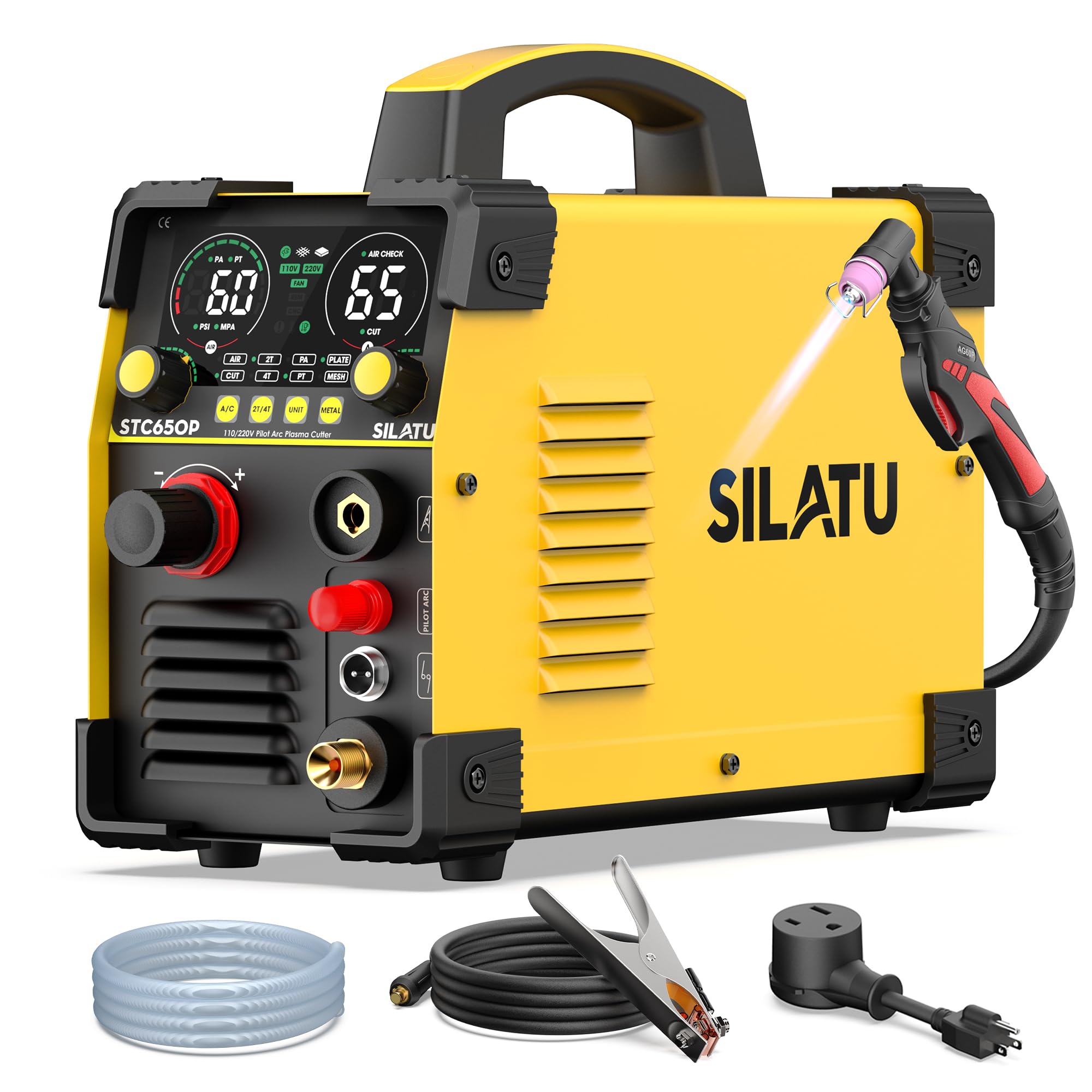
2. SILATU Plasma Cutter, 65A Non-Touch Pilot Arc, 110V/220V
A 65-amp machine that punches through 20mm plate on 220V — and folds into a package you can lift one-handed.
The STC650P is the answer for anyone whose work lives on the thick end of the shelf. On 220V it tops out at 20mm at 65A and 70PSI, and on 110V it still manages 12mm at 40A and 60PSI. Its 60% duty cycle holds that output through a real cutting session. The IGBT inverter inside is the power-conversion hardware that keeps the arc steady, and the 50/60 Hz high-frequency pilot arc means no contact with the plate to start.
Here is the number that makes it stand out next to the CUT60: this thing weighs 13.45 pounds, against 19.41 pounds for the YESWELDER CUT-55DS PRO. That is a 44% jump in weight on the other machine, and for a cutter you haul onto a truck or carry up a ladder, it is the difference you feel at the end of the day. The adjustable PA (pilot arc) setting also prolongs arc maintenance time, which cuts energy use between cuts and slows electrode wear.
The air-side details earn their place too. A built-in air sensor puts live pressure on the front panel, and there is an internal air filter with a quick-connect 1/4 NPT fitting, so you are hooked up and cutting right from the start. The large digital screen shows air pressure, voltage, and current and flashes an error code if something goes wrong. The 2T and 4T modes give you semi-auto and fully automatic trigger control, and the 3-15 second post-time cools the torch between cuts.
The one thing to get right before you buy: this machine demands a circuit breaker rated 40 amps or higher on a dedicated circuit, or it will trip. That is not a quirk to work around — it is a spec you need to match against your panel. If your shop can feed it properly, a 65-amp cutter this portable is a standout.
Why it fits the thick-plate job: 20mm maximum cut at 65A on 220V, 60% duty cycle, and a weight that keeps it carryable at 13.45 pounds.
Set-up reality: the 2T/4T trigger modes and digital error codes make it forgiving once wired to a dedicated 40-amp breaker — but that breaker is not optional.
Reach for this if: you cut heavy plate regularly and your shop already has a dedicated high-amp circuit.
Look elsewhere if: you only have a shared household circuit — the breaker demand will trip it every time.
3. YESWELDER CUT-55DS PRO 55A Plasma Cutter
The clean-cut specialist — an ideal 25/64 inch slice on 220V, with a torch that starts without high-frequency noise.
For metalwork where the edge quality matters more than raw power, this YESWELDER earns its spot. Its ideal clean-cut rating is 25/64 inch at 220V and 5/16 inch at 110V, while the maximum cut reaches 4/5 inch at 220V and 5/8 inch at 110V. The 55A high current is run by MCU intelligent digital control, the microcontroller that keeps the arc parameters steady, so the cut stays deep and clean.
You get less electrical interference for nearby equipment because of the non-high-frequency blow-back start (it starts the arc mechanically instead of with a high-frequency spark) — a real plus if you share a shop with sensitive electronics. The IPT40 torch cuts rough, painted, and rusty surfaces without touching the tip to the metal, which stretches consumable life (the parts that wear out, like tips and electrodes). The 5.6 kW rating tells you this is a serious power draw, so confirm your feed can carry it.
The digital display shows air pressure, voltage, and current, and shows an error code if the machine has a problem. Post-flow is adjustable from 5-20 seconds to cool the head, and the 2T/4T modes cover both accurate short cuts and long continuous runs. IP21 water-rating protection plus over-load and over-heat protection round out the safety side. It weighs 19.41 pounds and comes with a two-year warranty.
Where the caution comes in, honestly, is longevity. Reliability and cutting performance get mixed reactions across the review base — some machines cut great and hold up, while others stop working and struggle on 120 volts. If your work is exact edge quality on 220V power, this is a strong tool; if you need a machine to run hard on 110V all day, weigh the track record.
The case for the 55DS
- 25/64 inch ideal clean cut at 220V for edge quality that needs less cleanup
- Blow-back start runs interference-free near other shop electronics
- IPT40 torch handles rough, painted, and rusty surfaces without touching
- IP21 protection with overload and overheat safeguards; two-year warranty
Before you commit
- Mixed reliability reports — some units stop working; a few struggle on 120V
- 5.6 kW draw wants a supply that can carry it
Best for: fabricators who cut precise clean edges on 220V and want a quiet, interference-free start.
Our caution: if 110V is your only option or you run the torch hard daily, the mixed reliability record is worth weighing.
4. ARCCAPTAIN 55A Plasma Cutter Machine, Non-Touch Pilot Arc
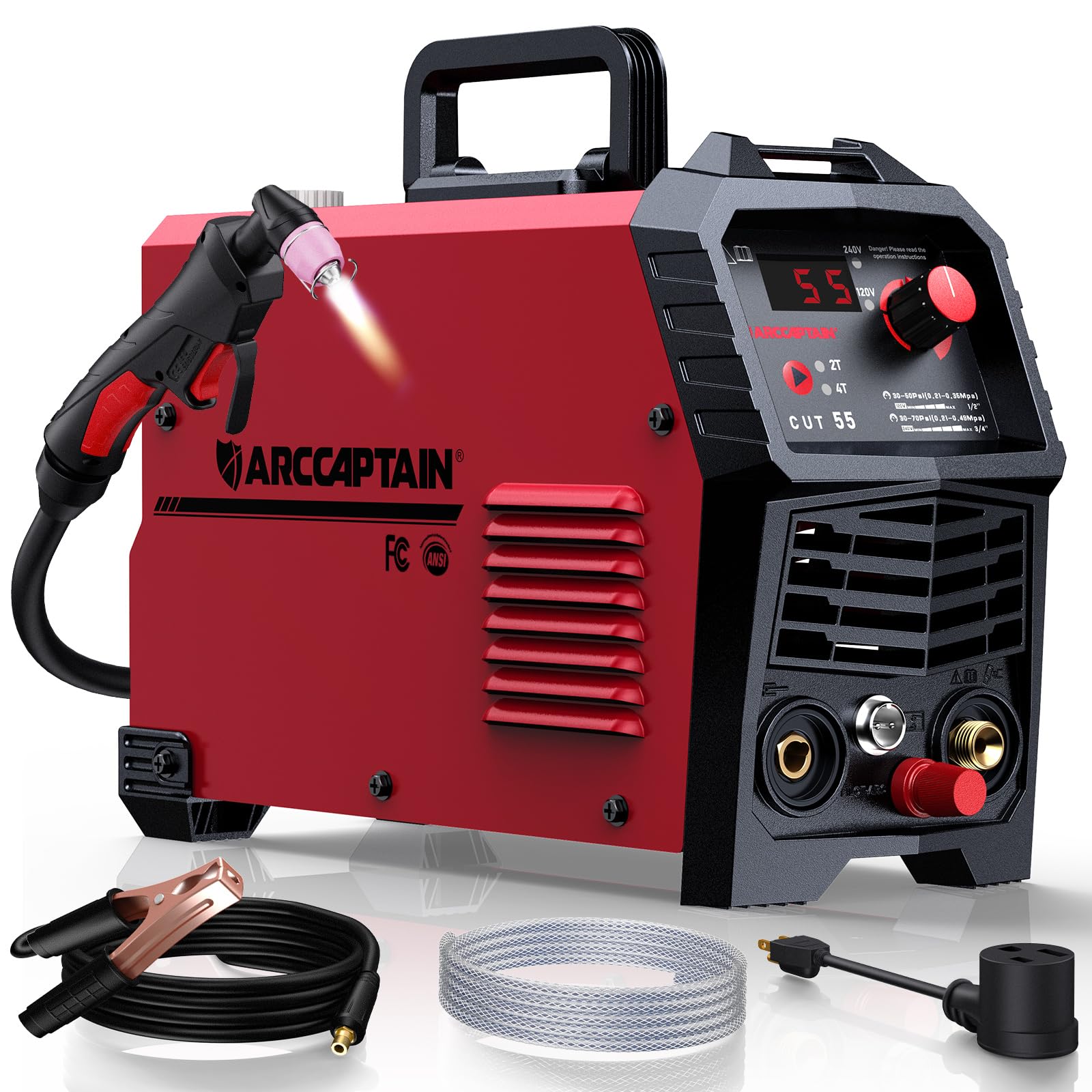
Set the voltage, turn one knob, start cutting — the pre-set defaults take the guesswork out of a first machine.
If you have never run a plasma torch, this ARCCAPTAIN trims the learning curve down to two controls. Air pressure is pre-set at 60 PSI and post-flow time at 5 seconds, so all you choose is 120V or 240V and your current. The 2T/4T function releases your finger during long cuts, and the 60% duty cycle at 55A keeps it working through a session. On 240V it reaches a 3/4 inch maximum cut and a 1/2 inch clean cut, checking in at 55A and 75PSI at the top end.
The non-touch high-frequency pilot arc means the torch head never touches the plate, so it burns through electrode life more slowly and handles metal that is not spotless. If you move between a home garage and a job site, the machine is built for that — it weighs 19.8LB and ships with a shoulder strap. The air filter sits at the rear for quick connection, and the recommended compressor feed is 60PSI at 5.3CFM. Note that the torch is an AG60 unit and you will need a compressor, sold separately.
Owner experience lands where the spec sheet suggests: performance on 240V is where this machine feels strongest, and it earns praise as a budget tool that gets the job done. Setup is the split point — some find it simple, others say it takes more work than expected, and arc stability on dirtier material draws mixed reports. The manual is the roughest edge, with most of its feedback negative. The trade-off here is friendlier defaults but a slower, rougher path on stubborn material.
The beginner’s shortcut: pre-set 60 PSI air and 5-second post-flow mean you only pick a voltage and turn the current knob.
What to know going in: setup and arc stability on dirty steel draw mixed feedback, and the manual is widely called hard to follow.
Pick it if: you want your first plasma cutter to be forgiving, portable, and built around sensible defaults.
Pass if: you cut dirty, inconsistent scrap and need steady arc behavior — this one prefers cleaner metal.
5. Bestarc Plasma Cutter Machine, Pilot Arc, 50A IGBT
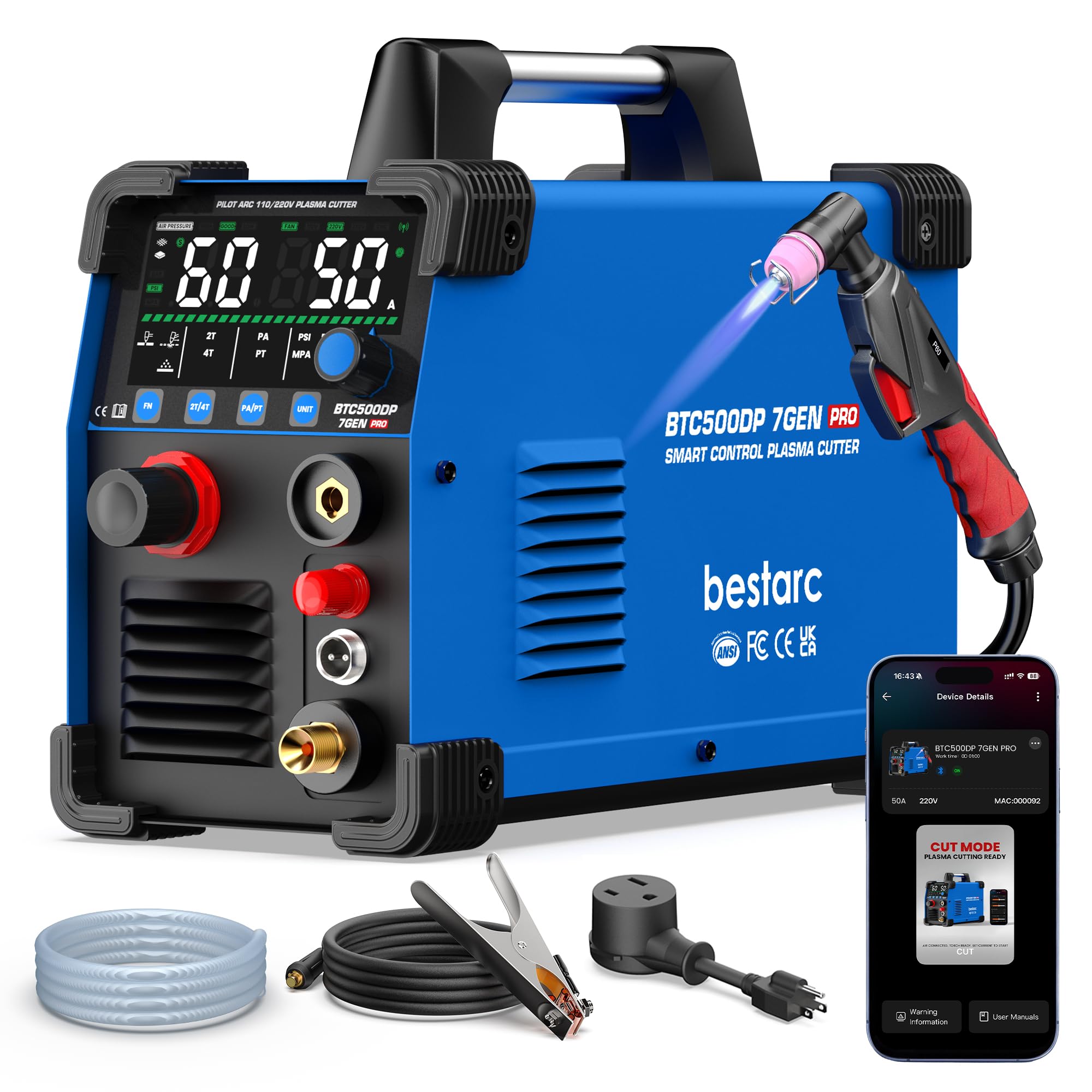
The one you can run from your phone — a 98-foot Bluetooth leash for a 50-amp torch.
Here is a cutter built for the person who is tired of walking back to the machine between cuts. A Bluetooth app controls it from up to 98 ft (30 m) away, letting you adjust current, switch modes, save settings, monitor status, and read error codes from your phone. If you are doing auto body work or fencing where the machine sits across the bay, that remote control is a genuinely useful feature rather than a gimmick.
The cutting side is solid too. Its IGBT inverter runs on 110V or 220V and cuts steel, stainless, aluminum, and copper up to a 2/3 inch maximum thickness. Recommended capacity is 1/2 inch at 35A and 50PSI on 110V, and 2/3 inch at 50A and 65PSI on 220V. The non-touch pilot arc cuts straight through rusted, painted, or coated metal with no prep, and a dedicated rust-removal mode clears the surface first if you want a cleaner result. Adjustable pilot arc time up to 15 seconds supports mesh and expanded metal.
Setup is fast: a built-in air sensor shows live PSI on the front panel, an internal metal filter keeps moisture out of the torch, and a 1/4 inch quick-connect means you are cutting within minutes of unboxing. It weighs 15.2 pounds, so it moves easily between jobs. The honest question here is longevity — durability draws mixed feedback, with some owners saying it holds up while others doubt it under daily use. That is the trade for the lower amp ceiling and the app convenience.
Standout features
- Bluetooth app control from up to 98 ft (30 m) so you skip trips back to the machine
- Rust-removal mode preps surface rust before you cut
- Up to 2/3 inch max cut; 15.2 pounds for easy moving
- Built-in air sensor and metal filter for clean, fast setup
The honest trade-off
- Durability reports are split — some doubt it lasts under daily use
- 50A ceiling is below the 55A-65A machines here for thick plate
The right fit for: portable job-site cutting where remote control and rust handling save real time.
The trade: a 50-amp ceiling and split durability feedback mean it suits lighter production, not heavy daily fabrication.
6. YESWELDER 60A Non-HF Plasma Cutter
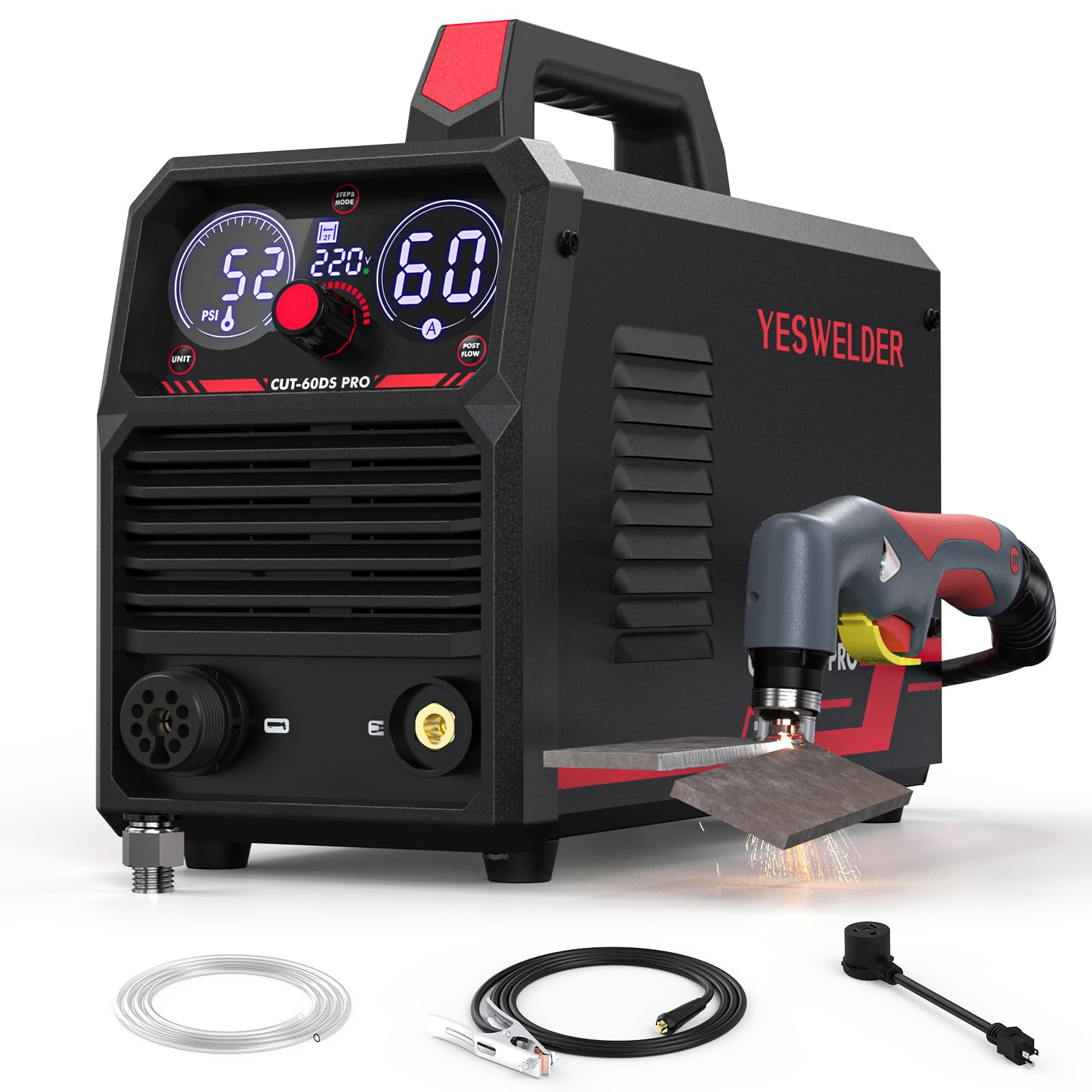
A 60-amp cutter with a 63/64 inch max cut on 220V — plenty of raw stretch if you stay on its good side.
On paper, the CUT-60DS PRO throws a lot at you for a modest machine: a 60A high current, a 5/8 inch ideal clean cut at 220V, and a 63/64 inch maximum cut at 220V. On 110V it drops to a 5/16 inch clean cut and a 1/2 inch maximum. MCU intelligent digital control keeps the cut deep and precise, and the IPT40 non-touch pilot arc torch cuts rough, painted, and rusty metal without surface prep.
The blow-back non-high-frequency start keeps the ignition interference-free, which is a plus if you run it near other electrical gear. The digital display shows air pressure, voltage, and current in real time and flags an error code when there is a fault. Post-flow adjusts from 5-20 seconds to cool the torch head, and the 2T/4T modes give you both short-precision and long-continuous control. IP21 water rating and over-load and over-heat protection safeguard the machine. It is also ETL certified.
You should think carefully about the reliability record. There are plenty of strong cut-quality reports, but build quality and reliability draw the wrong kind of attention — complaints range from tripped breakers and intermittent operation to broken pin connectors and trashed torch threads. This is a machine that suits a buyer who wants a big 60-amp cut at a modest outlay and is willing to treat it with care; it is not the pick for someone who needs a daily production tool to run for years. If you cut heavy material on 220V and keep an eye on your breaker, it delivers on capability.
What it gives you: 60A and a 63/64 inch max cut on 220V, plus non-touch pilot arc and digital monitoring that track the pricier machines.
What gives pause: build quality and reliability reports are the weak point, with breaker trips and connector issues showing up.
Suited to: hobbyists and farm users who want maximum amps and cut depth on a modest budget and will handle the tool with care.
Not for: buyers who need a daily-driver machine with a spotless long-term reliability record.
7. ARCCAPTAIN iControl CUT55 Pro Plasma Cutter

Cuts up to 20mm, runs the cooling for you, and takes orders from your phone — a full-featured shop machine.
The CUT55 Pro is aimed at the fabricator who wants a smarter, better-cushioned machine and does not mind paying for the build. Its MCU technology upgrade digitizes control of current and voltage for steadier cuts, giving a quality 12mm (1/2 inch) cut and a 20mm (3/4 inch) maximum. The high-frequency non-touch pilot arc handles dirt, rust, and coatings without contact, and the 3-year warranty is among the longest on this list.
You can control and monitor the machine from up to 10 meters away, so you can adjust parameters, choose cutting processes, save settings, and pull up FAQs from your phone — the app side mirrors the Bestarc’s remote idea but with different reach numbers. Where it pulls clearly ahead is the smart cooling system. The auto post-blow sets the cooling time by current — 5 seconds at 20-34A, 8 seconds at 35-45A, and 10 seconds at 46-55A — so there is no manual adjusting. The manufacturer states the advanced cooling system cuts noise, improves cooling efficiency, and extends machine life.
Setup is meant to be quick: a pre-installed air regulator and filter are ready in about a minute, and the filter pressure regulator pulls water, oil, and impurities out of the air feed. ANSI-certified protections cover overcurrent, overvoltage, overload, and overheat. The sticking point is durability — the fitting-quality and cutting-performance side is well liked, but there are scattered reports of blown fuses, fried electronics, and parts broken on arrival. It weighs 19.41 pounds and arrives with a 10FT torch, air hose, and earth clamp.
Reasons to favor it
- 20mm (3/4 inch) max cut with a quality 12mm cut for cleaner edges
- Smart cooling auto-sets post-blow time by amps — no manual dialing
- App control up to 10 meters plus a 3-year warranty
- Pre-installed regulator and filter pull water and oil from the air supply
Keep in mind
- Durability feedback includes blown fuses and broken-on-arrival parts
- App range is 10 meters, so it is a shop convenience, not a long-leash remote
Worth it for: shop workers who want automated cooling, app monitoring, and a 3-year warranty on a 3/4 inch capable machine.
Weigh carefully if: durability reports give you pause — a few units showed up damaged or failed early.
8. PRIMEWELD CUT50D 50A Air Inverter Plasma Cutter

A drag-cutting workhorse you can carry between shop, job site, and home — touch, lift, and go.
The CUT50D is for the person who moves around and wants a cutter they can throw in the truck. It cuts up to 1/2 inch plate on 50 amps, and its MOSFET inverter design keeps it light at 23 pounds. At 23 pounds with a 13-foot torch hose, it goes to the truck, the job site, or the far end of the shop.
Where it differs from the pilot-arc machines above is its start method. The CUT50D uses a high-frequency, non-pilot touch-and-lift arc — you touch the torch to the metal, light the arc, then drag across the surface. That drag technique is actually a benefit for long straight cuts where you want speed and a steady hand. It runs dual 110V/220V with a 35-45 amp input range, 20-50 amp output range, and 60% efficiency. It ships with an AG60 torch, a 13-foot torch hose, air regulator, ground clamp, air hose, and a 240V-to-120V adapter pigtail, so you cut from the start.
Owners tend to describe exactly what the spec sheet promises: it cuts half-inch steel with no problem, and it earns its keep as a time-saver on repair jobs. Quality and functionality are where the praise concentrates. The catch is the paperwork — the manual is consistently called out as the weak point — and durability reports are split, with some machines still going strong and others falling apart or tripping the breaker on 120V. Drag-start needs a touch on the plate, so it is less forgiving than a pilot arc on rusted or painted metal.
What sells it: 1/2 inch cut capacity, a touch-and-lift drag start that suits fast straight cuts, and 23 pounds with a full accessory kit in the box.
What it asks: the manual is hard to follow and drag-start wants clean metal, so treat it as a clean-plate tool rather than a scrap-pile one.
Handy for: the mobile welder or home shop that cuts clean plate on the go and values drag-start speed.
Steer past if: your work is all rusty, painted metal — a pilot arc handles that better than a touch-and-lift start.
9. Hypertherm Powermax 30 Air Plasma Cutter
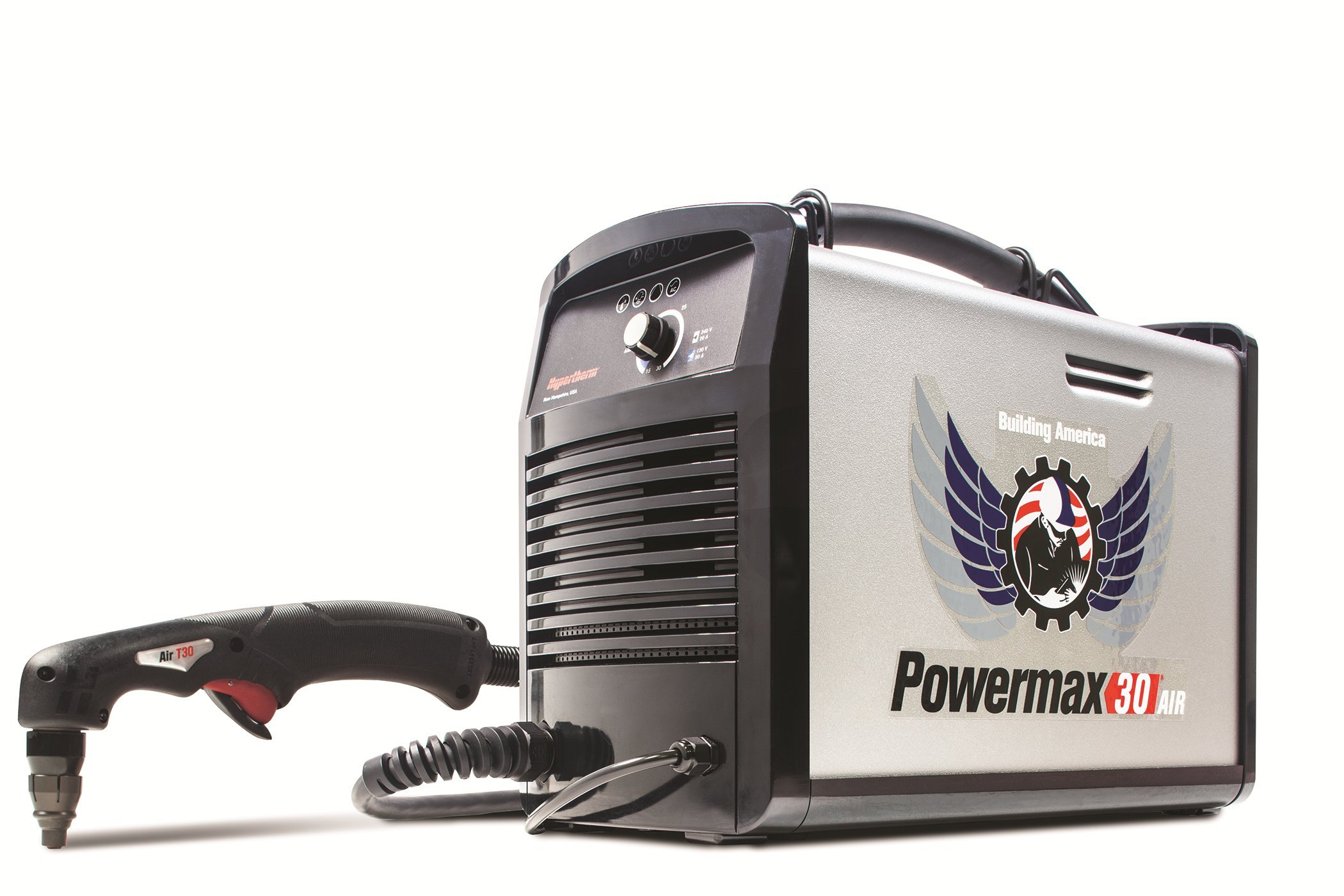
No compressor to drag along — the air is built in, so you cut wherever there is a wall outlet.
This is the answer for the buyer who does not own a compressor and does not want to haul one. The Powermax 30 Air packs an internal compressor and filter inside the machine, so there is no external air supply to source. That alone removes the compressor, the hose run, and the moisture filter most buyers have to sort out first.
It also travels light on setup, because its Auto-Voltage technology plus included plug adapters let you connect to any 120 or 240 V power. The continuous pilot arc means you can cut metal grate or rusted metal without retriggering the torch over and over — a steady arc keeps going as you move along the surface. Its small size and light weight are pointed at exactly this: take the machine to the work, not the work to the machine. It weighs 35 pounds.
The trade is a higher outlay than every other machine here, which buys you the built-in air and the rugged build. Owners consistently find it versatile and portable, and it does what it says. That built-in compressor and 35-pound frame justify the premium for on-site work, remote locations, or a shop with no compressed-air line.
The self-contained win: internal compressor and filter mean no separate air supply and no dragging a tank around — plug into 120 or 240 V and cut.
The premium reality: 35 pounds and a premium outlay put it in a different bracket, for the buyer who values the built-in air over raw amp-per-dollar.
Choose it if: you work without a compressor or need a rugged, self-contained cutter that goes anywhere there is power.
Choose another if: you already have shop air and want the most amps for your outlay — this one sells convenience, not budget power.
Know the Specs
Amps and cut capacity
Amperage is the current pushed through the arc, and it sets how thick a plate the torch can slice. Higher amps generally mean deeper cuts, but the number only helps if you actually cut material that thick. A 50A cutter handles 1/2 inch work well, while a 60A or 65A machine opens up thicker plate — the SILATU, for example, reaches 20mm on 220V. Buy for the metal you cut most weeks, not the ceiling number on the box.
Duty cycle explained
Duty cycle is the share of a ten-minute window the machine can keep firing before it needs a cooldown. A 60% duty cycle at 60 amps, like the CUT60 and SILATU, means roughly six minutes of cutting before the fan pulls the torch back. Long production runs want a higher duty cycle; quick repair jobs rarely bump into it. It is the number that decides whether the torch keeps firing through a long run or forces a cooldown mid-cut.
Pilot arc versus touch start
A pilot arc starts the plasma across a gap so the tip never touches the metal. That lets you cut rusted, painted, or mesh material without grinding a clean spot first, and it saves consumable tips over time. A touch-and-lift, non-pilot start like the CUT50D needs a brief touch on the plate, which is fine for clean drag cuts but fussier on scrap. Choose pilot arc if your metal is dirty; choose touch start if you want simplicity on clean plate.
Dual voltage and your breaker
Most machines here run on both 110V and 220V, but cut capacity changes with the outlet. The SILATU cuts 12mm at 40A on 110V and 20mm at 65A on 220V. The catch is circuit protection — some machines demand a dedicated circuit with a breaker at 40 amps or higher, or they trip. Check your panel and confirm which voltage you can feed before you buy.
Common Questions
Will a plasma cutter run on a normal household 110V outlet?
What does duty cycle mean on a plasma cutter and why does it matter?
Do I need an air compressor to run these plasma cutters?
What is a non-touch pilot arc and is it worth having?
What thickness of steel can a 50A versus a 60A plasma cutter cut?
Can I cut aluminum or stainless steel with these machines?
Why does my plasma cutter trip the breaker and how do I stop it?
How long should the post-flow cooling time be?
Is a plasma cutter better than a cutting torch for rusty metal?
Do these plasma cutters come with everything I need in the box?
The Bottom Line
For most people, the best plasma cutter winner is the CUT60 60Amp Pilot Arc because its 60% duty cycle at 60 amps and continuous pilot arc handle thick plate and rusty scrap in one machine, backed by a three-year warranty and USA support. If you cut heavy 20mm plate on 220V and want a machine you can still lift, grab the SILATU 65A; just feed it the dedicated 40-amp breaker it asks for. And if you do not own a compressor and need to cut anywhere there is an outlet, the Hypertherm Powermax 30 Air is the one to reach for, with its air supply built in.
One practical nudge before you decide: the CUT60 earns its top spot on a 60% duty cycle at 60 amps, and the Bestarc BTC500DP backs its app-control convenience with a 2/3 inch max cut on 220V. Match the machine to your power and your plate, and you will be cutting the same afternoon.
How we choose
We do not accept paid placement. Every pick is matched to a real buyer and a real use-case; we do not hands-on test units.
Sources
Specifications: manufacturer listings and product documentation. Review insights: verified customer reviews, as of November 2026. Pricing: not shown on this page (it changes often); check the current price via the retailer link.
As an Amazon Associate, Tactical Gear Guy earns from qualifying purchases. This does not affect which products we feature.