Specs are compiled from manufacturer listings and verified buyer reviews and can change over time — please confirm the key details on the product page before buying.
You want a big picture and sound that wraps around your head, and you do not need a separate speaker kit cluttering your living room to get it. The three TVs below build a multi-channel surround effect right into the chassis, so dialogue still comes from the middle and effects pan across your walls without a single extra box. The catch: built-in surround only works when the set has up-firing drivers, and of these three, only the Hisense quotes a full 4.1.2 array.
This guide is built by comparing the manufacturers’ published specifications and the patterns across verified customer reviews, so you get each pick’s real strengths and trade-offs instead of marketing spin.
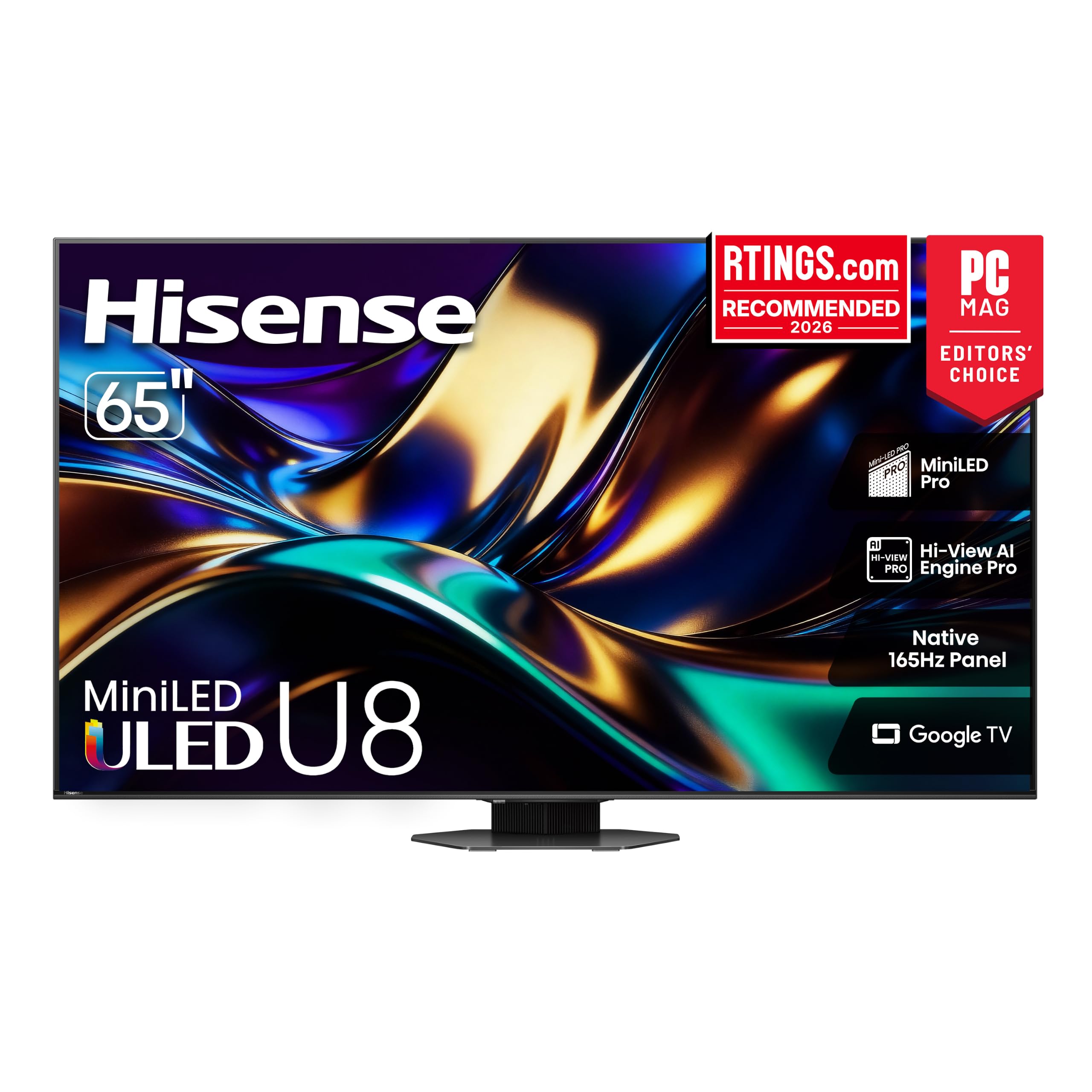
You want surround sound without adding a soundbar, and the Hisense U8 is the set most buyers land on: 4.0+ stars across 800+ ratings. Its 4.1.2 channel Dolby Atmos setup (four ear-level speakers, one subwoofer, two height speakers) fires sound upward as well as sideways, so you hear rain overhead in a movie. The differences between these sets matter before you commit to a wall mount and a soundbar-free room. This breakdown of the best tv with surround sound system shows which panel earns its place.
Top Picks
How To Choose The Best TV with Surround Sound System
Most people assume surround sound means a receiver, five speakers, and a subwoofer snaking cable around the skirting board. That era is over for a lot of rooms. A modern set can fire audio up at your ceiling and out to the sides from drivers hidden in the frame, and that is exactly what “multi-channel surround” means on a spec sheet.
The confusion starts with the label. “Dolby Atmos” on its own tells you the TV can decode the format — not that it has the speakers to play it back with height. You have to look at the channel count.
Read the channel number, not just the badge
A channel count like 4.1.2 means five separate speaker feeds doing specific jobs: left, right, left-surround, right-surround, and a subwoofer for bass, plus two up-firing drivers that bounce sound off the ceiling. Plain stereo is 2.0 — two speakers, no bass unit, no height. When you see a set quote a full multi-channel layout with an upward-firing pair, that is the one that actually produces the “helicopter overhead” sensation during a film.
Match the panel to your room’s light
Two technologies dominate this list. OLED panels light every pixel individually, so a dark scene shows true black with no glow bleeding around the edges. Mini-LED panels use clusters of tiny backlights behind the screen, which lets them push far brighter highlights — useful if your living room gets a lot of daylight. Neither is wrong; they simply suit different rooms.
Do not overlook refresh rate for sport and games
Refresh rate is how many times per second the screen redraws the picture, measured in hertz. A native 165Hz panel keeps fast pans across a football pitch smooth, and variable refresh rate (VRR) lets the screen match the frame output of a console so you do not get torn lines. If you watch a lot of live sport or play games, put this near the top of your list.
Side-by-Side Comparison
| Model | Best For | Surround Audio | Refresh Rate | Panel Type | Amazon |
|---|---|---|---|---|---|
| Hisense 65″ U8 Series ULED Mini-LED (65U8QG)★ Best Overall | Built-in surround on a bright screen | 4.1.2 channel with Dolby Atmos | Native 165Hz, VRR 48–165Hz | Mini-LED ULED / QLED | Amazon |
| LG 65 inch Class OLED AI B6 | Film lovers wanting perfect black | Dolby Atmos with WOW Orchestra | Up to 120Hz | OLED (self-lit pixels) | Amazon |
| LG 65 inch Class OLED evo AI C6 | Fast-moving sport and gaming | Dolby Atmos with WOW Orchestra | Up to 165Hz | OLED evo (self-lit pixels) | Amazon |
Detailed Reviews
1. Hisense 65″ U8 Series ULED Mini-LED 4K UHD Smart Google TV
Our pick — 4.0+★ from 800+ verified ratings; the strongest balance of quality and price.
The one set here that fires sound at your ceiling and out to both sides from inside the frame.
Here is the number that decides the surround question for this whole list: 4.1.2. That means left and right mains, left and right surround channels, a built-in subwoofer for low bass, and two up-firing drivers angled at the ceiling. So when the ball is passed across the field, the commentary stays anchored at centre while the crowd noise spreads around the room and the referee’s whistle seems to come from above you. No soundbar, no rear satellites, no cable runs.
The picture hardware backs up the audio rather than trailing it. Up to 5000 nits of peak brightness means the panel can drive extremely bright highlights — handy for a daytime living room where a dimmer screen would wash out. Mini-LED backlighting with Full Array Local Dimming keeps those bright areas tight against deep blacks, and Anti-Reflection Pro adds a coating in the liquid crystal layer to tame glare from a window or a lamp. The native 165Hz panel with VRR from 48Hz to 165Hz is the same headline figure the top LG here matches, and it sits comfortably ahead of the B6’s 120Hz for fast pans.
What owners praise most is the build and picture together, by a clear margin over every other quality comment. Colors land rich and contrast reads deep, with several owners comparing the blacks to OLED. Setup is quick, and the Google TV side keeps streaming tidy. The one thing to go in with eyes open on is long-term reliability: a share of buyers report the set eventually failing to power on. That is the trade-off, and it is the reason to buy from a seller with a straightforward return window and to register the warranty the day it arrives.
Where it pulls ahead
- The only 4.1.2 channel layout in this group — two up-firing drivers plus a genuine built-in subwoofer for Atmos height.
- Up to 5000 nits peak brightness with up to 5600 local dimming zones keeps a sunlit room readable.
- Native 165Hz with VRR down to 48Hz and AMD FreeSync Premium Pro for consoles.
What to plan around
- A portion of owners mention the TV periodically quitting and refusing to power on — treat the warranty as part of the purchase.
- Its base is 15.7 inches deep, so measure your stand before it arrives.
Reach for this if: you want the most complete built-in surround experience without adding a soundbar, and your room gets bright during the day.
Look elsewhere if: you need rock-solid long-term reliability above all else and would rather not deal with a possible power fault down the road.
2. LG 65 inch Class OLED AI B6 4K Smart TV 2026

Over 8.3 million pixels that switch themselves off — so a night scene is genuinely black.
If your viewing happens after dark with the curtains drawn, the B6’s approach is the one to understand. Every one of its over 8.3 million pixels lights itself independently, which means a black sky has no backlight glowing behind it. Space films and moody dramas show true black with no grey halo creeping around a bright object. Dolby Atmos and Dolby Vision both come loaded, so the surround mix decodes properly and the soundtrack spreads around the room.
On the audio front it carries Dolby Atmos and WOW Orchestra, which lets the TV speakers work together with a compatible LG sound system rather than fighting it. That is the smart path if you eventually add an LG soundbar. Compare it to the Hisense and the honest difference is height: the B6 decodes Atmos but does not list the upward-firing driver array the Hisense quotes, so overhead effects are less pronounced straight from the start. What you gain instead is that flawless black level and OLED’s near-perfect viewing angles. Its annual energy draw is 225 kilowatt hours per year, the lowest of the three here.
Gamers are well served too — a 0.1ms response time with up to 120Hz, NVIDIA G-Sync and AMD FreeSync Premium. OLED Care runs background routines to help protect the panel over time. The a8 AI Processor Gen3 handles upscaling and tone mapping automatically. The B6 holds the same 4.0+ star standing as the Hisense, though from a far smaller pool of owners, so treat its early reputation as promising rather than proven. It is the film-first pick, not the brightest-room pick.
Who it fits: a dark, dedicated movie room where contrast matters more than raw brightness, and where you may add a speaker system later via WOW Orchestra.
What you give up: in a sunlit room the OLED panel cannot match the Hisense’s peak output, and the built-in overhead effect is less dramatic without those up-firing drivers.
Pick this for the blacks: film buffs who want every shadow rendered true and will happily dim the room to get it.
Think twice if: your TV lives in a bright, glass-fronted living room or you want the strongest built-in height effect without extra speakers.
3. LG 65 inch Class OLED evo AI C6 4K Smart TV 2026

OLED black levels, then a 165Hz panel bolted on for people who watch the ball, not the replay.
The C6 is the set you buy when smooth motion is non-negotiable. Its refresh rate tops out at 165Hz against the B6’s 120Hz, and that extra headroom matters during a fast counter-attack or a racing game where every frame counts. VRR stretches up to 165Hz too, with NVIDIA G-Sync and AMD FreeSync Premium on board. A 0.1ms response time means the picture keeps pace with your controller instead of trailing behind it.
Behind the glass it is still OLED — over 8.3 million self-lit pixels with Perfect Black and Perfect Color — but the evo panel adds a Brightness Booster driven by the a11 AI Processor Gen 3. That processor claims 5.6x greater AI neural processing, 50% faster operation, and 70% improved graphics compared to the LG a9 AI Processor Gen8, which is the maker’s own comparison, not a lab result. In practice that means a brighter OLED that holds detail in a sunlit scene better than a standard OLED panel.
It decodes Dolby Atmos, Dolby Vision and Filmmaker Mode, and WOW Orchestra lets it team with an LG sound system. Its stand base is wider than the Hisense’s — 18.5 inches versus 15.7 inches — so check the depth of your media unit before you commit. It also draws more power year-round at 286 kilowatt hours per year against the B6’s 225. Review coverage on the C6 is still thin, with only a small early pool of owners behind its 4.0+ star figure, so it is the pick on raw spec and motion handling rather than a deep track record.
The case for the evo panel
- Up to 165Hz refresh and VRR to 165Hz — the fastest motion handling in this group.
- Brightness Booster on OLED delivers a punchier picture than a standard OLED panel.
- 0.1ms response time plus G-Sync and FreeSync Premium for console and PC gaming.
Small print worth knowing
- Atmos decoding is here, but no up-firing driver array is listed — overhead effects are subtler than the Hisense’s 4.1.2 setup.
- An 18.5-inch base demands a deeper stand, and annual draw is the highest of the three.
Built for: sports fans and gamers who would trade a little built-in height for the smoothest panel on the list.
Not your set if: your priority is maximum surround immersion from the TV alone rather than a speaker add-on later.
Know the Specs
Channel Layout and Up-Firing Drivers
The channel number tells you how many separate speaker feeds the TV runs. The format is typically mains, then a bass count, then height. A 4.1.2 layout means four main and surround speakers, one subwoofer channel, and two up-firing drivers, so effects are sent bouncing off your ceiling. A plain Stereo or Surround label without those height channels decodes the format but cannot place sound overhead.
Peak Brightness and Local Dimming
Nits measure how intense a screen’s light output is at its brightest — a higher figure fights back against daylight in the room. Mini-LED sets group their backlights into zones and dim individual clusters to deepen shadows; the Hisense quotes up to 5600 of them. OLED works differently: each pixel produces its own light, so black is simply the pixel switched off.
Refresh Rate and VRR
Refresh rate is redraws per second in hertz — 120Hz redraws 120 times, 165Hz redraws 165. Variable refresh rate (VRR) lets the screen adjust on the fly to match a console’s output and cut screen tearing. A 0.1ms response time describes how quickly a pixel changes colour, which keeps fast action from smearing.
OLED Versus Mini-LED for Sound Rooms
OLED gives near-perfect black and wide viewing angles but generally caps lower on raw brightness. Mini-LED pushes brighter highlights and shrugs off window glare, at the cost of very faint haloing around bright objects on a dark field. In a surround-sound setup, a darker room flatters OLED and a brighter one flatters Mini-LED.
Common Questions
Do I still need a soundbar if the TV has Dolby Atmos built in?
What does the.2 mean in a 4.1.2 channel setup?
Is OLED or Mini-LED better for a bright living room?
Will these TVs pass surround sound through to an external speaker system?
How many hertz do I need for watching live sport?
Do I need a wall mount or can I use the stand for a 65-inch TV?
What is Filmmaker Mode and should I leave it on?
Is a 165Hz TV worth it over a 120Hz one for a games console?
How long should a modern 4K TV last?
The Bottom Line
For most rooms, the tv with surround sound system that makes the strongest case is the Hisense 65″ U8 Series. Its 4.1.2 channel Dolby Atmos layout (four ear-level speakers, one subwoofer, two height speakers) is the only one here that fires sound at the ceiling and out to the sides with a real subwoofer. The panel is bright enough to survive daylight, so you can watch a daytime game without drawing the curtains. If your viewing skews to dark-room cinema and you crave perfect black, the LG B6 is the film-first choice. And for sport and gaming where motion is everything, reach for the LG C6 and its 165Hz panel (it refreshes the screen 165 times a second, so fast pans stay smooth).
How we choose
We do not accept paid placement. Every pick is matched to a real buyer and a real use-case; we do not hands-on test units.
Sources
Specifications: manufacturer listings and product documentation. Review insights: verified customer reviews, as of November 2026. Pricing: not shown on this page (it changes often); check the current price via the retailer link.
As an Amazon Associate, Tactical Gear Guy earns from qualifying purchases. This does not affect which products we feature.