Specs are compiled from manufacturer listings and verified buyer reviews and can change over time — please confirm the key details on the product page before buying.
Here’s the short answer before you read anything else: the WiiM Amp is the system most people should buy. It powers the passive speakers you already own — 60 watts per channel into 8 ohms, 120 watts into 4 ohms — and it streams over Wi-Fi, takes your TV through HDMI ARC, and corrects for your room acoustics. It also holds 4.5+ stars across 2,300+ owner reviews. If you want a big-name receiver with a built-in phono stage for vinyl, or a full 7-channel surround brain for movie night, the picks further down cover those jobs just as specifically.
This guide is built by comparing the manufacturers’ published specifications and the patterns across verified customer reviews, so you get each pick’s real strengths and trade-offs instead of marketing spin.
Choosing wrong here usually means one of two things: you buy a surround receiver for a two-speaker music setup and pay for channels you never use, or you buy a stereo amplifier and then realize it can’t take your TV’s HDMI signal. This guide sorts every pick by what it actually powers and what it actually accepts, so you buy once. Below you’ll find a plain-English walkthrough of the system for speakers options that earn their spot.
Top Picks


How To Choose The Best System for Speakers
An amplifier is the engine sitting between your music and your speakers. Your speakers are “passive,” which means they have no power of their own — they need an amplifier to push them. Get the pairing right and a modest pair of bookshelf speakers plays louder and cleaner than its size suggests. Get it wrong and you either run out of clean volume or you cook the speakers with a weak amp pushed too hard. The five things below decide almost everything.
Match wattage at 8 ohms and 4 ohms, not just one number
Speakers are rated by resistance in ohms, and lower resistance is a harder load to drive. An amp that lists 60 W per channel at 8 ohms and 120 W per channel at 4 ohms is telling you it doubles its output into a tougher load — that is the mark of a solid power supply. Compare the 8-ohm figure first, since most bookshelf and floor-standing speakers are rated near there. Then check the 4-ohm figure if you plan on harder-to-drive speakers.
Decide whether your TV needs to run through it
If your speakers need to handle movie night, look for an HDMI ARC port on the amp so one cable carries the TV’s sound back to it. ARC lets one HDMI cable carry the TV’s sound back into the amp, and your TV remote usually controls the volume. HDMI eARC is the newer version with more bandwidth for high-resolution surround formats. No ARC? An optical (Toslink) input will still carry stereo TV audio, but you lose the single-remote convenience and some formats. Several picks here also ask you to set your TV’s audio output to Stereo PCM when using ARC — that is normal for stereo amplifiers.
Check for a phono stage if vinyl is part of the plan
A turntable puts out a very faint signal that needs extra boost and equalization before an amplifier can use it. That boost circuit is the phono stage. If you own a turntable without a built-in preamp, you need an amplifier with a phono input, or a separate preamp box. If your turntable already has a built-in preamp, any line-level RCA input works. Some amps here have dedicated phono boards; others don’t, and that is the single fastest way to rule a pick in or out.
Know how many channels you actually need
A 2-channel receiver drives a left and right speaker. That is all a music system needs, and it puts every dollar of amplification into those two channels. A 7.2-channel AV receiver drives seven speakers plus two subwoofers and decodes Dolby Atmos and DTS:X for height effects overhead. If your room has one listening chair and two speakers, the extra channels sit unused. If you want a ceiling-mounted movie experience, you need them.
Look at streaming and room correction before you fall for cosmetics
Streaming built into the amp means your phone is a remote, not a source — you send Spotify, TIDAL or AirPlay straight to the amp over Wi-Fi, no extra box. Room correction goes a step further: a microphone or automatic process measures how your room colors the sound, then applies correction. A bare-walled room with a hard floor benefits far more from room correction than from another 20 watts.
Side-by-Side Comparison
| Model | Best For | Power Output | Channels | TV / HDMI Input | Amazon |
|---|---|---|---|---|---|
| WiiM Amp★ Best Overall | Most people upgrading passive speakers | 60 W @ 8Ω / 120 W @ 4Ω | 2 | HDMI ARC | Amazon |
| Yamaha R-S202BLTwo-Room Value | Two rooms, two pairs of speakers | — | 2 | — | Amazon |
| Onkyo TX-8470Vinyl and Streaming | Vinyl plus streaming in one box | Over 100 W per channel | 2 | HDMI | Amazon |
| WiiM Amp Ultra | Two pairs of speakers, one streamer | 100 W | 2 | HDMI ARC | Amazon |
| Onkyo TX-8470 | Users wanting phono, Roon and hi-res | Over 100 W per channel | 2 | HDMI | Amazon |
| Denon PMA-600NE | Pure analog music listening | 70 W @ 4Ω | 2 | — | Amazon |
| Denon AVR-X1800H | 7.2 home theater | 80 W x 7 | 7.2 | 3x 8K inputs (8K/60Hz & 4K/120Hz) | Amazon |
| Yamaha R-N600A | Hi-res streaming plus phono | — | 2 | Optical | Amazon |
| Marantz Model M1 | Compact high-end streaming amp | 100 W per channel | 2 | HDMI eARC | Amazon |
| Yamaha RX-A2A | 8K gaming and Atmos in one room | — | 7.2 | 7-in/1-out HDMI, eARC | Amazon |
Detailed Reviews
1. WiiM Amp Streaming Amplifier
Our pick — 4.5+★ from 2,000+ verified ratings; the strongest balance of quality and price.
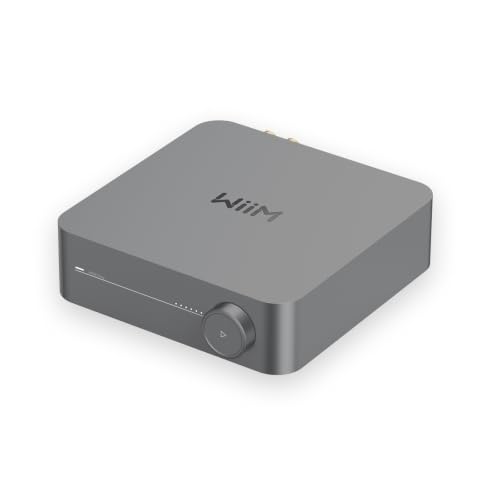
A small grey box that turns the speakers you already own into a streaming system.
WiiM solves the exact problem every passive-speaker owner hits: you love your speakers, but they have no brain. This amplifier delivers 60 W per channel at 8 ohms or 120 W per channel at 4 ohms, so it drives bookshelf, floor-standing or in-wall speakers — the “architectural” speakers that sit flush in a wall — with real headroom. At 4.1 pounds it is light enough to tuck onto a shelf or into a cabinet without needing a dedicated rack. Compare that to the Onkyo TX-8470 at 10 pounds, and you can see how much of the traditional receiver bulk this design sheds.
The streaming side is where this pick pulls away from a plain receiver. It handles AirPlay 2, Google Cast, Spotify Connect, TIDAL Connect and Amazon Music Casting, plus over 20 music services through the WiiM Home app. Supported lossless files stream up to 24-bit/192 kHz over Wi-Fi or Ethernet — “24-bit/192 kHz” just means it can carry studio-grade files without trimming detail, so a high-res track plays as intended instead of being squashed. HDMI ARC lets one cable bring your TV’s sound through the same pair of speakers, and a Sub Out port adds a powered subwoofer for a 2.1 setup. If you know your room is boomy in the corners, RoomFit room correction measures the space and evens it out, and you can save separate EQ settings for each input.
The honest catch is connectivity, and it’s the one mixed spot in an otherwise clean record. Wi-Fi and Bluetooth work flawlessly for most owners, but a share of them hit pairing or network drops — worth knowing if your router sits at the far end of the house. Also note this unit is an AirPlay receiver only: it can accept an AirPlay stream, but it cannot send one onward to other AirPlay speakers. The 60 W at 8 ohms is generous for most bookshelf speakers, though a very inefficient floor-standing pair in a big room may want more.
What owners keep coming back to
- Streaming, DAC and amplification live in one 4.1-pound box instead of three separate components.
- RoomFit correction plus per-input EQ means each source gets its own tuning.
- HDMI ARC pulls TV audio straight through your stereo speakers with no extra soundbar.
- Lossless playback up to 24-bit/192 kHz keeps high-res files intact.
Worth checking before you order
- No AirPlay transmission — it receives AirPlay but cannot push it to other speakers.
- Network and Bluetooth drops are the recurring complaint.
- 60 W at 8 ohms may feel tight with very inefficient floor-standing speakers in a large room.
Right for you: anyone with passive speakers who wants streaming, TV sound and room correction from one compact unit instead of a rack of boxes.
Think twice: if you need to send AirPlay onward to other speakers, or your router lives at the opposite end of the house.
2. YAMAHA R-S202BL Stereo Receiver
Two pairs of speakers, one receiver, and Bluetooth that holds across the house.
The feature that decides this one is the speaker selector. It switches between two separate sets of speaker terminals — one pair in the living room, one out on the patio, or a set of bookshelf speakers plus a set of in-walls. For a buyer wiring a second zone without a second amplifier, that is the whole ballgame. FM/AM preset tuning for 40 stations is also still aboard, which matters if radio is part of your routine and nothing else here offers it. A brushed aluminum finish keeps the front panel looking like proper hi-fi rather than a widget.
Bluetooth is where the Yamaha earns its keep day to day. It holds a strong connection well past 50 feet, so your phone can stay in your pocket while you move between rooms. The frequency response is rated 10Hz–100kHz, which spans far wider than you can hear — the practical point is that nothing in the audible range gets clipped at the edges. An auto power standby function dims the unit into low-power mode when you forget to switch it off, and there is a headphone terminal for late-night listening without waking anyone.
Durability is the question you should ask before buying, and it’s the most-discussed negative in this unit’s record. While build quality and sound gather plenty of praise, a cluster of buyers report units failing within a month or stopping after several months, and a smaller set mention the receiver occasionally turning itself off during play. Sized against its overall reputation, most owners are clearly happy — but this is the pick where an extended warranty is genuinely worth considering rather than an upsell.
The two-zone argument: if your goal is running two pairs of passive speakers from one box with Bluetooth in the middle, this is the cheapest route to that in this list, and it does the job with a clean front panel.
The reliability question: the durability record here is the weakest of any pick on this page. That doesn’t make it a bad receiver, but it does mean you should buy it expecting the Yamaha warranty to matter.
Reach for this if: you are powering two zones of passive speakers and want Bluetooth on a budget.
Look elsewhere if: you need your TV’s sound routed through the speakers — this receiver has no HDMI input.
3. Onkyo TX-8470 Stereo Receiver
A record-player receiver that happens to stream — or a streamer that happens to spin vinyl.
Tucked inside the Onkyo is a separate phono circuit with an isolated MM/MC board — MM and MC are the two flavors of moving-coil and moving-magnet cartridge your turntable might use, and a dedicated board keeps that faint signal away from the noisy digital circuits. That is the reason this pick exists. If you inherited a turntable and a stack of records, this box lets you plug in the RCA cables and go, with no extra preamp purchase. Over 100 W per channel drives most speakers with room to spare, and it’s honest about being a two-channel design: every watt goes into left and right rather than being diluted across seven channels.
Streaming is built in and covers Roon, Tidal, Deezer and Apple/Google voice assistants without an add-on bridge. HDMI is on the back panel for TV sound, and the gold-plated speaker terminals and audio-grade capacitors are the sort of internal detail that signals care in the analog stage. It sits at 10 pounds on the shelf, heavier than the WiiM Amp’s 4.1 pounds, and that mass reflects a traditional receiver chassis rather than anything about sound quality on its own.
The catch is the software and the manual. Setup splits buyers right down the middle — some find it easy to follow, others call it frustrating, and the documentation gets a direct hit for being thin. Several report Bluetooth and Wi-Fi connection trouble. The volume control is the odd one out: several note it needs to be turned well up before you hear anything meaningful, so the dial position reads louder than it sounds. None of these are reasons to skip the receiver if vinyl is your priority, but plan on setting aside an evening rather than ten minutes.
Where it wins
- Dedicated MM/MC phono board means a turntable plugs straight in with no extra preamp.
- Over 100 W per channel, with every watt put into two channels.
- Roon Ready plus Tidal and Deezer built in, no external streamer needed.
Where it strains
- Setup and documentation are the weak links — plan on self-teaching.
- Wi-Fi and Bluetooth drops are the recurring connectivity complaint.
- Volume dial needs a lot of travel before the sound arrives.
Made for: vinyl-first listeners who also want modern streaming in the same chassis.
Skip the rush: if you want a receiver that sets up in ten minutes without a manual, this one will test your patience.
4. WiiM Amp Ultra Streaming Amplifier
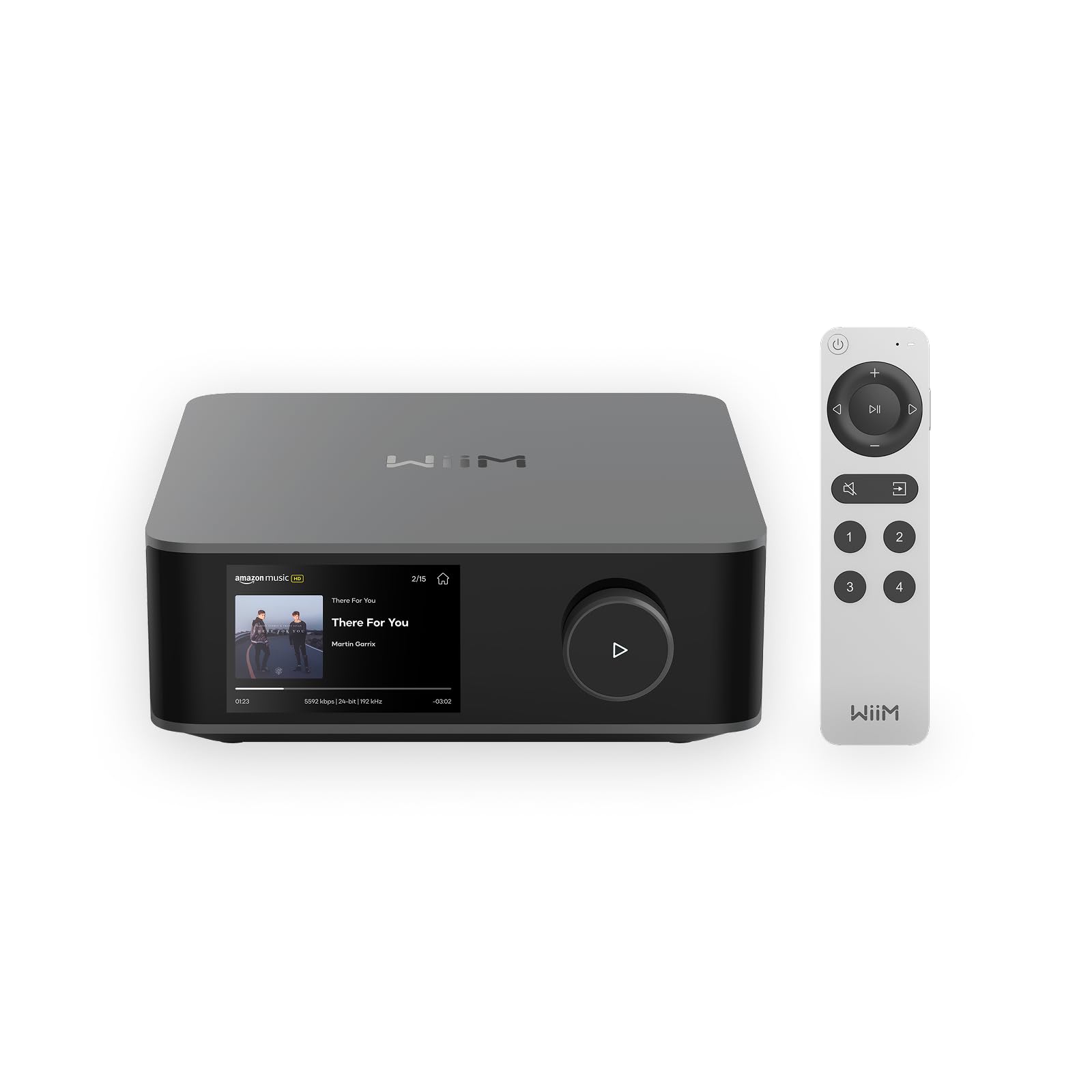
The WiiM for people who ran out of clean power and want a screen on the front.
Where the standard WiiM Amp gives you 60 W per channel at 8 ohms, this Ultra version runs 100 W and powers up to four speakers. That means a pair in the front room and a pair in the kitchen, all from one box. Distortion is rated at -106 dB THD+N — put plainly, THD+N is the tiny amount of unwanted noise and garbling the amplifier adds to your music, and a figure this low means it stays out of the way even when you turn it up.
An ESS SABRE DAC (the chip that converts digital files into an analog signal your speakers can use) works with dual TI TPA3255 amplifier chips and PFFB feedback, which is a circuit that keeps the amp behaving the same regardless of what speakers you hang off it. Wi-Fi 6 and Bluetooth 5.3 with LE Audio handle the wireless side, and HDMI ARC brings the TV in. A 3.5-inch glass-covered touchscreen on the front shows album art and settings so you can adjust without reaching for your phone.
The recurring issue is the one thing WiiM did not carry over: AirPlay. This model is incompatible with AirPlay and cannot function as an AirPlay receiver at all, so if your household is built around iPhones and HomePod pairing, choose the standard WiiM Amp above instead. Owners otherwise describe a clean, loud, low-distortion sound and an app that works well — but that AirPlay gap is the detail that decides the pick for Apple households.
Power and headroom: 100 W and -106 dB THD+N is the most power and the lowest distortion figure in this list, and it drives four speakers without an extra amp.
The AirPlay gap: no AirPlay reception whatsoever. If an iPhone is your main source, this is the wrong WiiM — the standard Amp is the one to buy.
Sound-first pick: buy this if clean watts, a front touchscreen and four-speaker coverage matter more than AirPlay.
Not your pick: if your sources are Apple devices streaming over AirPlay, the standard WiiM Amp is the correct choice.
5. Denon PMA-600NE Bluetooth Stereo Amplifier

A switch that turns the digital half of the amp off — and that is the point.
Denon’s Analog Mode is the single most interesting thing about this integrated amplifier. A switch lets you power down the digital circuits — including Bluetooth — so the amplifier works as a pure analog path from your source to your speakers. That matters if you own a good CD player or turntable and want nothing digital in the chain adding noise. It is a 2-channel integrated amp rated 70 W at 4 ohms, built around Denon’s Advanced High Current push-pull circuit, and the vibration-resistant chassis keeps the internals from rattling along with the bass.
The inputs are generous for a music-first amp: two optical, one coaxial and one phono, all RCA-based, so a CD player, a Blu-ray player and a turntable all find a home. A built-in DAC handles the digital connections — this is the converter chip that turns a digital optical or coax signal into analog sound your amplifier can use. Bluetooth pairing comes from your phone straight to the amp’s own receiver. The controls and input flexibility are the reason this pick earns a spot: you can wire four sources without a switch box, which the Yamaha R-S202BL cannot offer because it relies on Bluetooth and no optical input at all.
Bass control and musical nuance are where this Denon gets its praise — tight, detailed low end and clean output rather than boom. The trade-offs are practical ones. Bluetooth is onboard but there is no streaming service built in and no HDMI, so your TV can only come in through optical. The DAC is good, but it is not the dedicated high-res ESS chip the WiiM and Yamaha R-N600A carry. Nobody is buying this amp for its smart-home tricks, and that is fine — it is a music amplifier that happens to accept a phone over Bluetooth.
Why analog matters: the Analog Mode switch takes the digital noise floor out of the signal path entirely, which is something no streaming-first amp in this list does.
What you give up: no HDMI, no streaming services, and Bluetooth only for wireless input. A great music amp, not a TV amp.
Pick this if: your sources are a turntable, a CD player and a phone, and you want the digital side of the amp out of the way.
Pass on it if: you need your TV’s HDMI sound or built-in streaming apps in the same box.
6. Denon AVR-X1800H 7.2 Channel AV Stereo Receiver

Seven channels, three 8K inputs and Atmos rain from above — the movie-room engine.
This one was built for the room with a TV at one end and speakers around the other. Seven channels of amplification at 80 W each drive a 7.2 or 5.2.2 layout — the “5.2.2” notation just means five main speakers, two subwoofers and two height speakers overhead. Dolby Atmos and DTS:X are the surround formats that place sound in three dimensions, so a helicopter passes over your head rather than just panning left to right. Add DTS Virtual:X and Height Virtualization and you can create the sense of overhead effects even without ceiling speakers.
The HDMI section is current and fast: three dedicated 8K inputs plus one output with 8K/60Hz and 4K/120Hz pass-through and support for Dolby Vision, HDR10+ and HLG. That “4K/120Hz” matters if you own a new console — it carries a high-refresh-rate 4K picture without dropping frames. A color-coded rear panel and on-screen setup guide handle the “which cable goes where” part, and HEOS multi-room streaming pushes Spotify, Tidal and Amazon Music HD into other rooms over Wi-Fi, AirPlay 2 or Bluetooth. Owners consistently praise its sound quality as the reason it stays in their racks.
Two things to weigh before buying. The setup guide is good, but the HEOS software system is the weak spot — several report it stopping or malfunctioning, and setup success splits almost evenly. And this is a 7-channel AV receiver doing 80 W per channel: fine for a modest-to-medium room, but a large open floor plan with hard-to-drive floor-standing speakers will want the far more expensive RX-A2A below. For a small-to-medium room, it hits the mark.
What it brings to the movie room
- Three dedicated 8K inputs and 4K/120Hz pass-through for modern consoles and TVs.
- Dolby Atmos and DTS:X with Height Virtualization, so you can add overhead effects without ceiling speakers.
- HEOS multi-room streaming to other rooms over Wi-Fi, AirPlay 2 or Bluetooth.
What to keep an eye on
- HEOS software bugs are the most common complaint — setup can test your patience.
- 80 W per channel suits a small-to-medium room, not a large open plan.
- Compatibility with some devices and HDMI 2.1 cables has been hit-and-miss for a fraction of owners.
Right choice for: a small-to-medium home theater where Dolby Atmos, 8K pass-through and multi-room HEOS all earn their keep.
Think bigger: if your room is large or your speakers are hard to drive, the RX-A2A is the upgrade to plan for.
7. YAMAHA R-N600A Network Receiver

A quiet black box that handles DSD files, a turntable and your TV in one chassis.
For the buyer with an archive of high-resolution music, this is the one. A front USB port and network connection let the R-N600A play DSD 11.2 MHz and 384 kHz files natively — DSD and 384 kHz are ultra-high-resolution formats that most streaming amps won’t touch, so a wall of downloaded DSD files plays without conversion or compromise. The ESS SABRE ES9010K2M DAC is the chip that does the converting, and its signal-to-noise performance is the reason owners describe the sound as crisp.
Physically this is a full-size receiver — 21.6 pounds — not a compact streamer. It has a dedicated phono input for a turntable, an optical input for TV sound, and there are enough inputs across RCA and optical to wire several sources at once. Tone controls are basic bass and treble, which is fine for a music-first receiver. At only 100+ reviews this is a niche pick, but the feedback is consistent and remarkably positive, with the easy setup and the app getting their own specific call-outs.
The caveat is connectivity, the one mixed area. Some owners mention Bluetooth pairing trouble and network drops, so the streaming experience can be less bulletproof than the WiiM’s when the router is awkward. Also know that the TV connection is optical, not HDMI — your TV’s volume will not follow the receiver’s remote the way it would on an HDMI ARC setup. Given how the sound is regarded, those are practical limits rather than dealbreakers, but they belong on your checklist.
For the file collector: DSD 11.2 MHz native playback and 384 kHz support beat what any other two-channel pick here offers, and the phono input means vinyl lives next to it.
The connection limit: no HDMI, only optical for TV, and Bluetooth pairing is the recurring gripe. Treat it as a music receiver first.
For you if: you own high-resolution files (DSD or 384 kHz) and a turntable, and want both handled properly by one receiver.
Not for you if: HDMI ARC and bulletproof wireless streaming are must-haves.
8. Marantz Model M1 Wireless Streaming Amplifier
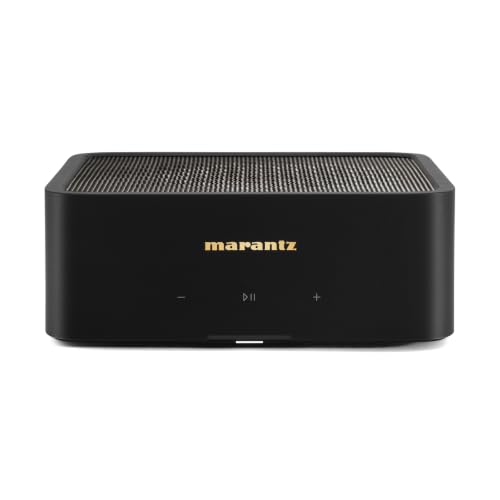
The high-end nameplate in a footprint small enough to disappear on a shelf.
Marantz builds this one at its Shirakawa Audio Works facility in Japan, and the Model M1 works 100 W per channel of low-distortion amplification into a pair of passive speakers. A dedicated subwoofer output lets you build a full 2.1 system, so the low end can come from a powered sub while the amp concentrates on the speakers. Marantz Musical Digital Filtering — MMDF — is the brand’s own oversampling process designed to preserve warmth and detail in a digital recording, and it is the sort of internal tuning you cannot add later.
HEOS is the streaming backbone, handling high-resolution files up to 24-bit/192 kHz PCM and DSD over your network, streamed services or a USB drive, with AirPlay 2, Spotify Connect and Bluetooth supported alongside. HDMI eARC and onboard Dolby Digital+ decoding pull the TV in and let you control volume from your existing TV remote. The chassis is small enough to fit a shelf that would never take a full-size receiver, and the dimmable front panel keeps it from glowing at you during a movie.
What you are paying for is refinement and a name with a design legacy, not raw feature count. There is no built-in phono stage, so a turntable needs its own preamp. Streaming is solid but the HEOS app experience is not the star here. And with a smaller owner base than the WiiM or Onkyo, you’ll find less community troubleshooting if something does go sideways. If high-end build and compact size are the priority, those are fair trade-offs to accept.
Where the money goes: Marantz’s own tuning, MMDF filtering and a compact metal chassis built at a dedicated Japanese facility — that is the premium.
Where it stops short: no phono stage, and a smaller pool of owners to learn from. Add a preamp for vinyl.
Buy this if: you want a compact, premium-built streaming amp with eARC for the TV and 100 W per side for the speakers.
Keep looking if: you need a phono input or the widest community support around the app.
9. Yamaha RX-A2A AVENTAGE 7.2-Channel AV Receiver

The AVENTAGE flagship: seven channels of 8K-ready home cinema in a 25.4-pound chassis.
AVENTAGE is Yamaha’s top-tier line, and the RX-A2A is the version with a genuine premium build. Seven-in, one-out HDMI with eARC and HDCP 2.3, all inputs supporting 4K60 and three supporting 8K60B and 4K120AB — that is the current highest-bandwidth connection standard, so a new console and a new TV both get their full resolution and frame rate. Dolby Vision, HDR10+, HLG and BT.2020 handle the color side, and ALLM and VRR cut input lag and screen tearing for gaming. At 25.4 pounds it is the heaviest pick here, and that mass reflects a stiffer chassis than the Denon AVR-X1800H at 80 W per channel.
The room calibration is this receiver’s signature. Surround:AI listens in real time and reshuffles effects to keep dialogue and motion clear. Zone 2 lets you send a second set of speakers elsewhere. MusicCast, AirPlay 2, Spotify Connect and Roon Tested streaming cover the source side, and a phono input accepts a turntable directly.
Two issues hang over this one, and they’re real enough to mention plainly. Network connectivity and app behavior are the most-criticized parts, with a number of owners reporting connection drops or grayed-out functions. Setup splits the room: some find it easy, others call the configuration very complicated. And with eARC on the back, HDMI switching has occasionally been reported as finicky. For a movie room where the hardware sits behind a cabinet and rarely changes, that is an acceptable set of quirks — as long as you’re patient the first evening.
What earns it top billing
- Three 8K60B and 4K120AB HDMI inputs for the newest consoles and displays.
- YPAO R.S.C. multipoint room calibration tunes sound to more than one seat.
- Zone 2 support, phono input and MusicCast multi-room streaming.
What you should brace for
- Network and app connectivity issues are the recurring complaint.
- Configuration is described as complicated by part of the owner base.
- HDMI switching has been reported finicky by a fraction of users.
Choose this if: you’re building a room that needs 8K pass-through, Atmos, and multipoint calibration across several seats.
Look to the Denon instead if: you want Atmos and 8K without the app headaches, and can live with less calibration depth.
Know the Specs
Wattage per channel at 8 and 4 ohms
Wattage tells you how much power the amplifier can push into your speakers before it runs out of steam and distorts. The important part is the ohm rating next to it. Ohms measure resistance, and 4 ohms is a harder load than 8 ohms, so an amp that doubles its power from 60 W at 8 ohms to 120 W at 4 ohms has a strong power supply. Compare watts at the same ohm rating across picks — 60 W at 8 ohms is not the same as 100 W at 8 ohms, and neither tells you how it behaves at 4 ohms.
HDMI ARC, eARC and optical inputs
ARC stands for Audio Return Channel, and it carries the TV’s sound back down the same HDMI cable it uses for video, so one cable replaces an extra sound cable. eARC is the newer version with more bandwidth, which is what lets it carry high-resolution surround formats. Optical, the square Toslink connector, also carries TV audio but usually stops at standard stereo or compressed surround. If you plan to use your stereo speakers as your TV’s soundbar, HDMI ARC or eARC is the input you are looking for.
Phono stages and turntables
A phono stage is the circuit that boosts a turntable’s tiny signal and reorganizes it before it reaches the amplifier. Without one, a turntable into a regular RCA input sounds thin and faint. Check whether your turntable has a built-in preamp first — many modern ones do, and then you can ignore this spec. If yours doesn’t, look for a receiver that lists a phono input. Moving-magnet (MM) and moving-coil (MC) are the two cartridge types, and a phono board marked for both handles either.
DACs, bit depth and sample rate
A DAC is the chip that converts a digital file — a stream, a downloaded track, a TV’s digital audio — into analog sound your speakers can produce. The numbers attached to it describe how accurately it tracks the original. “24-bit” is the resolution of each sample, and “192 kHz” is how many samples are taken per second. Higher numbers matter only if your source files actually come in those formats; a standard CD-quality stream will not improve because the DAC can handle more. DSD is a different high-resolution format that some DACs decode natively and others convert first.
Common Questions
Will a streaming amplifier work with the passive speakers I already own?
What is the difference between a stereo receiver and an AV receiver?
Can my TV audio go through these speakers without a soundbar?
Do I need a phono preamp to plug in a turntable?
What is room correction and do I actually need it?
Is 60 W per channel enough to drive floor-standing speakers?
Does a streaming amplifier need to be plugged into Ethernet?
Will AirPlay work on every one of these picks?
Can I add a subwoofer to a two-channel stereo amp?
How much power do I lose by choosing a compact streamer over a full-size receiver?
The Bottom Line
For most people, the system for speakers winner is the WiiM Amp because it covers streaming, TV sound, room correction and a subwoofer port in a 4.1-pound box — and it’s the highest-rated pick in the list. If you want vinyl plus streaming in the same chassis, the Onkyo TX-8470 gives you a dedicated phono board and over 100 W per channel. And for a home theater room with a TV at the center, the Yamaha RX-A2A brings 8K pass-through and YPAO calibration to every seat.
How we choose
We do not accept paid placement. Every pick is matched to a real buyer and a real use-case; we do not hands-on test units.
Sources
Specifications: manufacturer listings and product documentation. Review insights: verified customer reviews, as of November 2026. Pricing: not shown on this page (it changes often); check the current price via the retailer link.
As an Amazon Associate, Tactical Gear Guy earns from qualifying purchases. This does not affect which products we feature.