Specs are compiled from manufacturer listings and verified buyer reviews and can change over time — please confirm the key details on the product page before buying.
If your baking keeps drifting and your portion sizes keep creeping, the fix is usually the scale, not the recipe. A kitchen weight scale that reads in fine increments and holds that reading steady is the difference between repeatable results and guesswork. Below are the eight models worth your counter space, sorted by what each one actually does well.
This guide is built by comparing the manufacturers’ published specifications and the patterns across verified customer reviews, so you get each pick’s real strengths and trade-offs instead of marketing spin.
A scale only helps if you trust the number on the screen. That means knowing the increments, the capacity, and how each one handles a bowl on top. Here is how to weigh ingredients with confidence, and what a genuinely accurate kitchen weight scale should look like on your counter.
Top Picks

How To Choose The Best Kitchen Weight Scale
The single most useful thing you can do before buying is read the increment, not the capacity. A scale that reads in 1 g steps will round your 2.4 g of yeast to 2 g. A scale that reads in 0.1 g steps keeps that number intact, which is why bakers care so much about it.
Increments decide your recipe accuracy
Most budget kitchen scales split into two camps: fine-increment models that read to 0.1 g under a certain weight, and everyday models that read in flat 1 g steps. If you bake sourdough, weigh coffee, or portion out yeast, the finer increment matters more than a big weight ceiling. If you mostly weigh flour and chicken breasts, 1 g increments are plenty and you can spend your attention elsewhere.
Capacity versus counter footprint
A scale with an 11 lb ceiling handles a full mixing bowl with dough in it. A scale with a smaller capacity will tap out mid-recipe, and you will be weighing in batches. Check the weighing surface size too — a 6.5 × 6.1-inch platform sits a large bowl comfortably, while a compact pad will crowd it. Slim profiles store in a drawer; thicker models live on the counter permanently.
What the tare button really saves you
Tare is the button that resets the display to zero with a container already on the pad. It lets you weigh flour, then zero out, then weigh sugar into the same bowl without doing subtraction in your head. Every pick below has it. What varies is whether you get one-touch operation or a two-button sequence, and whether the buttons give you any feedback when you press them.
Side-by-Side Comparison
| Model | Best For | Readout Increment | Max Capacity | Unit Weight | Amazon |
|---|---|---|---|---|---|
| Ozeri Pronto★ Best Overall | Everyday all-rounder | 0.1 g below 1000 g; 0.5 g up to 6000 g | 6000 g | 12 ounces | Amazon |
| Greater Goods SlimSlimmest Profile | Slim drawer storage | 1 g | 11 lb (5 kg) | 7.04 ounces | Amazon |
| Vitafit VT703Ratio Mode Standout | Percentage ratio mode | 0.1 g | 11 lb (5 kg) | — | Amazon |
| Taylor Glass Top | Wipe-clean glass surface | 0.1 oz / 1 g | 11 lb (5000 g) | 1.6 ounces | Amazon |
| Etekcity Nutrition | App-based nutrition tracking | — | — | 12.83 ounces | Amazon |
| Escali Primo | Color options and sealed controls | 1 g | — | 11.52 ounces | Amazon |
| OXO Good Grips | Tempered glass on a budget | — | 11 lb (5 kg) | 1.4 pounds | Amazon |
| KitchenTour Dual | Dual platforms for tiny doses | 1 g / 0.01 g | 15000 g / 500 g | 0.8 kg | Amazon |
Detailed Reviews
1. Ozeri Pronto Kitchen and Food Scale
Our pick — 4.5+★ from 93,500+ verified ratings; the strongest balance of quality and price.
Two different increments in one pad, so tiny yeast doses and full dough bowls both read right.
The Ozeri Pronto is the pick that handles the widest spread of jobs without you thinking about it. It reads in 0.1 g steps below 1000 g, then switches to 0.5 g steps up to 6000 g. In plain terms: a pinch of yeast gets a fine reading, and a full bowl of dough still fits on the platform. That two-tier increment is why it tops this list.
Six units are on tap — oz, ml, g, lb, lb:oz, and kg — so a recipe written in metric or imperial converts without you opening a browser tab. The Unit and Tare buttons sit deliberately off the weighing platform, and they click and beep when you press them.
It is the crowd favorite at 4.5+ stars across 93,000+ ratings, and owners describe it as sleek with a top that reads like stainless steel. The catch is the platform material: it is polycarbonate, not metal, so treat the top as plastic and wipe it rather than scrub it. It arrives with two AAA batteries and an auto-off you can program between 2 and 5 minutes, which is an unusually wide window for this class.
What earns the top spot
- Variable Grading: 0.1 g below 1000 g, 0.5 g up to 6000 g — fine where it counts, coarse where it does not
- Six units including lb:oz and ml, so most recipe formats are covered on arrival
- Buttons separated from the pad, which cuts accidental presses and display flicker
- Programmable 2-to-5-minute auto-off, a wider range than most scales offer
Where it asks for care
- Weighing surface is polycarbonate, not metal — no scrubbing and no soaking
- At 12 ounces it is heavier than the Greater Goods scale below, which sits at 7.04 ounces
- Battery access needs the compartment opened, so keep spares in the drawer
Go for this if: you want one scale that covers yeast-level doses and full-dough-bowl weights without a second purchase.
Look at the KitchenTour instead: if your small doses are below 1 g on a routine basis and you need the finer pad.
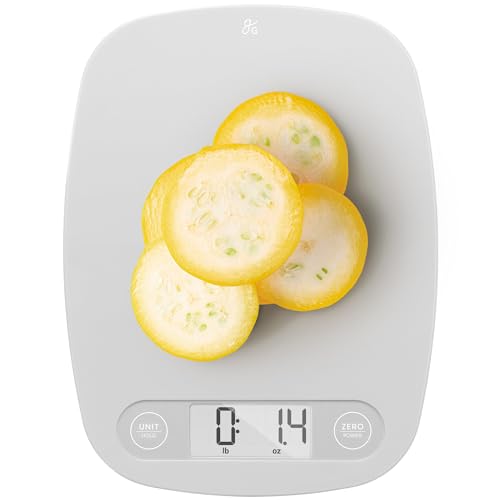
2. Greater Goods Food Scale, 0.5″ Slim Design
Half an inch tall, so it disappears into the drawer and only shows up for the job.
The scale that stays on the counter gets used, and the one that lives in a drawer gets used too — as long as it fits. At 0.5 inches thick and 7.04 ounces, this Greater Goods model slots into a utensil drawer without a fight. That is 70% less weight than the Ozeri pick above at 12 ounces, and you feel it every time you pull it out.
The working range runs from 2 g up to 11 lb, which covers a spice measure and a full bread dough. Four sensors split the load across the platform, so a bowl set down off-center still gets a consistent reading. The 6.5 × 6.1-inch surface holds a mixing bowl with room around the edge. Units switch with a single tap between lb:oz, g, fl.oz, and ml — and the HOLD function freezes the reading on screen for up to 5 minutes, which is the difference between writing down a number and trying to remember it.
The BPA-free surface wipes clean, and it comes with a CR2032 battery already installed. The recurring gripe is battery life — some units turn up with a weak or dead cell, so test it the day it lands rather than the day you need it. The 5-year warranty from a St. Louis-based team is the reassuring counterweight to that battery gripe.
Best for a tight drawer: the 0.5-inch profile and four-sensor reading make this the easiest scale in the roundup to store and the hardest to bump out of calibration on an uneven set-down.
Reach for it if: counter space is your real constraint and you want the scale out of sight between bakes.
Skip the drawer plan if: you weigh in 0.1 g steps — this reads in flat 1 g increments, so fine-dose work belongs on the Ozeri or Vitafit.
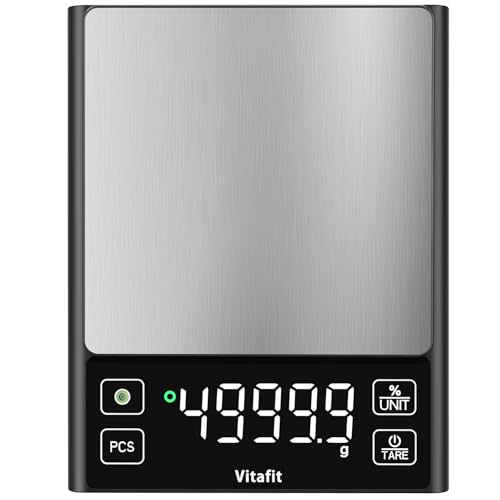
3. Vitafit 11lb Digital Food Scale, 0.1g Accuracy
This one does baker’s math for you and shows the second ingredient as a percentage.
If you work from ratios rather than fixed recipes, the percentage mode is the reason to pick this Vitafit. Set the scale to percentage, weigh your base at 100 g, then add your second ingredient and the display reads it back as a percentage of the base. The stated range runs from 0.1% to 1000%. For bread and coffee that removes the mental arithmetic entirely, and you keep the recipe balanced instead of recalculating on paper.
The rest of the spec sheet is aimed at repeatability. It reads to 0.1 g across an 11 lb (5 kg) capacity, which is a finer step than the Greater Goods model above manages at 1 g. A level bubble on the body tells you the scale is sitting flat, and a green signal confirms a stable reading before you write the number down. The load sensor is a single aluminum unit, and the platform is LFGB approved stainless steel with a 5.24 × 5.24-inch surface.
Readability is handled by a 3.2 × 1.3-inch LED that stays legible with or without room light, and the panel supports seven units. Owners consistently praise the build quality for the price and the sleek, minimal look. Two things to plan around: the factory has been making scales since 2001, but this specific model is new enough that the track record is short, and the membrane buttons need a firm, deliberate press rather than a tap.
The percentage play: a dedicated ratio mode plus a level bubble is a rare combination at this tier, and it makes repeatable bread and coffee far less fiddly.
One honest caveat: a thin review history means you are trusting the spec sheet more than a long owner record — reasonable here, but worth knowing.
This is your scale if: you think in baker’s percentages and want the math done on the display.
Look elsewhere if: you want a decade of owner history behind the model — the Escali Primo below has the longer track record.
4. Taylor Digital Kitchen Food Scale, Black Glass Top
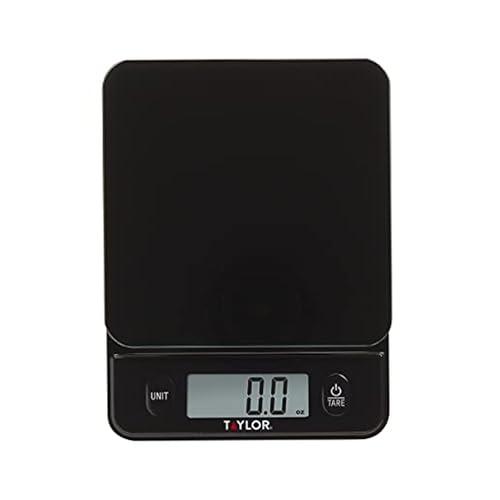
A back-painted glass top with no button grooves for flour to hide in.
Flour gets everywhere, and the places it hides are the seams. The Taylor solves that with a back-painted black tempered glass platform and smooth touch-control buttons — no grooves, no ridges. A damp cloth takes care of it, and the surface resists stains and buildup rather than absorbing them. If you bake weekly and hate scrubbing a textured pad, this is the one that stays presentable.
The measurements run to 11 lb in 0.1 oz steps and 5000 g in 1 g steps, with a 0.75-inch readout that you can read from a standing position at the counter. Four units toggle instantly — grams, ounces, pounds, kilograms — so a metric recipe and a cup-based one both work. One-touch tare zeroes out your bowl so you can layer ingredients without any subtraction. Two AAA batteries are in the box, and auto shut-off protects them between sessions.
Owners praise its versatility and ease of use, and many call it the best scale they have owned. The honest limit is the stepping: 1 g increments mean fine yeast and coffee doses get rounded, so if you weigh small quantities often, the Vitafit or KitchenTour pads suit you better. The glass also wants a wipe rather than a soak, and the touch buttons rely on a clean, dry fingertip.
The cleaning argument: a glass top with flush touch controls removes the single biggest maintenance annoyance in this category — there is simply nowhere for dough to set.
Pick this one if: a spotless, wipe-in-seconds surface matters more to you than 0.1 g dosing.
Pass it over if: you routinely weigh below 1 g — that is the one job this pad does not do finely.
5. Etekcity Food Nutrition Scale

The only one here that scans a barcode and logs the meal for you.
Most scales stop at a number. This Etekcity takes the number and runs with it: scan a food barcode and the free VeSync app pulls the nutrition data in automatically. You can build goals around 19 nutrition metrics, daily calorie intake and sugar intake among them. Data syncs with Fitbit and Apple Health, and you can share progress with a coach, a doctor, or a friend. For anyone tracking intake seriously, the scale is the front door to a whole workflow.
The stainless steel build and larger weighing area are the physical upgrade over its predecessor, and customizable units let you strip out the measurements you never use so the display stays clean. It ships with three AAA batteries pre-installed, so it works the moment it comes from the start.
The thing to know before you buy: this is the most feature-loaded scale in the roundup, and it is also the one with the widest spread of owner experience. Steady readings are the common report, but consistency is the variable — treat it as a tracking tool that needs a stable, level counter rather than a bench instrument you can shift around. If you want a scale that just weighs and nothing else, the Ozeri above is the calmer choice. If you want the meal logged, this is the only one here that does it.
Where the smart features pay off
- Barcode scanning feeds the free VeSync app directly, so you skip manual entry
- 19 nutrition metrics available as daily goals in the app
- Syncs with Fitbit and Apple Health, and shares progress with coaches or doctors
- Customizable units let you hide the readouts you never use
What to weigh before buying
- Reading consistency is the recurring note — keep it on a level, unmoved counter
- The app is the point; if you will not use it, you are paying for features you skip
- Needs a phone nearby to get any of the tracking benefit
Made for the tracker: if you log macros or calories daily, the barcode scan plus app sync turns weighing into a two-second habit.
Not for the purist: someone who wants a plain, dependable number on a screen will find all of this in the way.
6. Escali Primo Digital Food Scale

Two buttons, a sealed panel, and a lifetime warranty — the low-drama choice.
Some kitchens do not want features, they want a scale that turns on and gives a number. The Escali Primo is built on exactly two buttons, and both the display and the controls sit sealed under a protective shield. That shield is the whole idea: a splash of batter or a cloud of flour hits the cover, and you wipe it off. Rounded edges mean nothing collects in a corner.
It reads in 1 g increments with a stated readout accuracy of 1 g, and it measures in grams and pounds. Tare resets to zero so you can weigh multiple items in one bowl, and auto shut-off kicks in after four minutes of inactivity to protect the battery. At 11.52 ounces it sits between the Greater Goods and the Ozeri on the counter, and it comes in a wide spread of colors — the Tarragon Green here is one of several.
Owners rate the size highest, calling it perfect for a home kitchen, and the recurring accuracy note is that weight measurements come out more precise than volume ones. The catch is minimal — 1 g increments round off tiny doses, so this is a flour-and-protein scale, not a yeast scale. The lifetime warranty is the real headline for anyone who has had a cheap scale die on them.
Buy it for the durability terms: a sealed control panel and a lifetime warranty on a scale in this tier is a straightforwardly good deal.
Know the step size: 1 g is the floor here, so small-dose baking is a job for a finer pad.
Fits the family kitchen: splash-prone counters, mixed cooking, and anyone who wants to pick a color that matches the room.
Wrong tool for: coffee dialing and micro-dosing, where the 1 g step hides the difference that matters.
7. OXO Good Grips 11lb/5kg Everyday Glass Food Scale

A low-profile glass pad with a backlit display that stays readable in dim kitchens.
The OXO is the one you leave out because it looks like it belongs there. A low-profile tempered glass platform resists stains and wipes clean, and the compact footprint sits easily on a crowded counter. Unit switching covers oz, lb, g, kg, and ml from a single button, and the zero function tares out a bowl without lifting it. Four AAA batteries come in the box.
The large digital numbers cut down on squinting, and the backlit display is the practical win when you are weighing at night with the overhead lights down. It handles up to 11 lb, so a big batch of dough is within range. Ease of use is where this design earns its keep — nothing about the interface makes you read a manual.
Where I would set expectations: the accuracy conversation here splits by unit. Owners find the ounce readings dependable, but gram-level work draws more criticism for not being tight enough for fine measurement. Button feel also draws divided opinion, with a lack of tactile feedback coming up. So this is a solid everyday pad for larger quantities, and a weaker choice if gram-level precision is your whole reason for buying.
The design case: sleek is not just a look here — a flush glass pad with a backlit readout genuinely reduces friction in daily use.
The honest limit: gram-level precision is the weak spot, so treat this as an ounce-and-pounds scale that happens to do both.
Best suited to: a kitchen where the scale stays on display and the weighing is mostly bowls, batches, and portions.
Think twice if: your recipes are gram-critical — the Ozeri covers that job with more confidence.
8. KitchenTour Dual Platform Digital Kitchen Food Scale
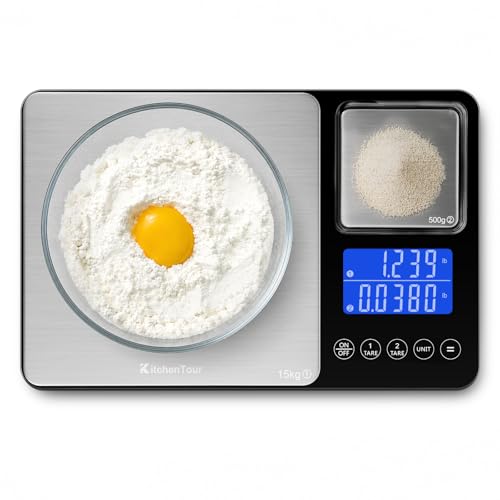
Two pads on one body — a big one for dough, a small one for 0.01 g doses.
This is the answer to a split personality problem. Most kitchens need a scale that handles a full dough batch and a scale that resolves 0.01 g for yeast or coffee bloom, and most scales make you choose. The KitchenTour puts two independent platforms on one body: the large pad takes up to 15000 g in 1 g increments, and the small precision pad takes up to 500 g in 0.01 g increments. Same counter space, both jobs.
The summation function is what makes the two pads work as a system rather than two separate tools. It combines the weights from both platforms into one total, so you can load ingredients across the pads and get a single number without a second bowl or a calculator. One-click tare works independently on each pad, deducting the container weight as you go. Seven units cover g, kg, lb, oz, lb:oz, ml, and milk ml — the last one being a genuinely useful nod to anyone measuring milk by volume.
Build is food-grade stainless steel and shatter-resistant glass, so it wipes clean and does not rust. The backlit LCD holds a clear reading in dim light, and a 3.5-minute auto shut-off stretches battery life. Owners call it highly reliable and the accuracy spot-on on both pads, and the dual-platform design is the reason most of them bought it. The 10.9 × 7.09-inch footprint is the trade-off; it needs a real spot on the counter rather than a drawer slot.
Why two pads earn their space
- Large pad to 15000 g in 1 g steps; small pad to 500 g in 0.01 g steps
- Weight summation combines both platforms into one running total
- Independent one-click tare on each pad, so no bowl swapping
- Seven units including milk ml for volume-based liquid recipes
What you give up
- At 0.8 kg it is the heaviest pick here, so it lives on the counter
- The 10.9 × 7.09-inch body needs real counter real estate
- Two pads mean two surfaces to keep clean after a flour-heavy bake
The dual-purpose answer: one purchase covers bread batches and micro-doses, which nothing else in this roundup does on a single body.
The space cost: if your counter is already tight, this is a permanent resident rather than a drawer item.
Know the Specs
Increment and Readout Accuracy
Increment is the smallest step the display will show — a 1 g increment rounds everything to whole grams, while a 0.1 g increment keeps one decimal place. If you bake with instant yeast, dial in coffee, or portion spices, a finer increment is the spec that matters most. The Vitafit lists a readout accuracy of 0.05 g, and the KitchenTour resolves down to 0.01 g on its small pad. Coarser scales are perfectly fine for flour, meat, and meal prep portions.
Capacity and Platform Size
Capacity is the ceiling before the scale stops reading, and platform size is how much bowl actually fits on it. The KitchenTour’s large pad reaches 15000 g, while the Greater Goods and Vitafit both top out at 11 lb (5 kg). A dual-platform design gives you both a wide batch pad and a fine small pad. Check the surface dimensions too — a 6.5 × 6.1-inch platform holds a mixing bowl comfortably, whereas a compact pad will crowd it and invite spills.
Common Questions
Does a kitchen weight scale need to sit on a level surface?
What is the difference between 0.1 g and 1 g increments in practice?
How does the tare button work when I am weighing multiple ingredients?
Will a glass-top scale crack if I set a heavy mixing bowl on it?
Why does my scale turn off while I am still weighing?
Is a dual-platform scale worth it over a single pad?
What does the percentage mode on the Vitafit actually do?
Can a kitchen scale help with calorie and nutrition tracking?
How should I clean a kitchen weight scale without damaging it?
Do these scales come with batteries included?
The Bottom Line
For most kitchens, the kitchen weight scale that gets the job done is the Ozeri Pronto, because its two-tier increment reads fine yeast doses and full dough bowls on the same pad without you changing a setting. If you work from ratios, the Vitafit shows your second ingredient as a percentage and pairs it with a level bubble. And if you need both a batch pad and a 0.01 g precision pad in one body, the KitchenTour Dual is the only pick that covers both jobs. Start with the one whose increment matches how precisely you actually cook.
How we choose
We do not accept paid placement. Every pick is matched to a real buyer and a real use-case; we do not hands-on test units.
Sources
Specifications: manufacturer listings and product documentation. Review insights: verified customer reviews, as of November 2026. Pricing: not shown on this page (it changes often); check the current price via the retailer link.
As an Amazon Associate, Tactical Gear Guy earns from qualifying purchases. This does not affect which products we feature.