Specs are compiled from manufacturer listings and verified buyer reviews and can change over time — please confirm the key details on the product page before buying.
If you want the short answer: buy a maintainer that drops into float mode on its own and then stays plugged in for months. Float mode is what separates a maintainer that saves your battery from a trickle charger that quietly cooks it. A low power battery charger is not a fast charger — it is a small, slow, patient box that tops a battery up and then holds it there at a safe voltage. Get float mode right and a mower, motorcycle or boat battery that used to die every spring simply starts. Get it wrong and you come back to a swollen, ruined battery. This guide sorts the nine options that genuinely do the slow-charge job, ranked by how well they hold a battery over long storage.
This guide is built by comparing the manufacturers’ published specifications and the patterns across verified customer reviews, so you get each pick’s real strengths and trade-offs instead of marketing spin.
The real skill is matching amperage to battery size, checking 6V/12V coverage, and confirming float mode and safety shut-offs before you plug anything in. Below you’ll find out how to choose a low power battery charger that protects your battery instead of draining it.
Top Picks


How To Choose The Best Low Power Battery Charger
The wrong assumption beginners carry into this category is that more amps equals better. It does not. A big fast charger pushed onto a small powersport battery is exactly how you boil off electrolyte and shorten the battery’s life. Low power exists for a reason: a slow, gentle climb to full charge is what a stored battery actually wants. Your job is to pick a unit that matches the battery’s size and has float mode, then trust it to sit connected without supervision.
Match amperage to battery size
Amperage is the rate at which the charger pushes current into the battery. A 750mA (milliamp) unit — that is three-quarters of one amp — suits a small motorcycle or mower battery perfectly. A 2A (amp) unit is twice that rate and better for a car-sized battery. Buy too small and a large battery takes forever. Buy too big for a tiny battery and you risk overcharging damage, even on a “smart” charger.
Insist on automatic float maintenance
Float mode is the trick that makes long-term storage safe: once the battery hits full charge, the charger lowers itself to a holding voltage and just watches. Anything without this step is really a trickle charger that never stops pouring in current. Look for the words “float mode,” “maintenance mode,” or “maintainer” and you know the unit can be left connected indefinitely.
Check the voltage range your battery needs
6V batteries (older motorcycles, some mowers) and 12V batteries (most cars, ATVs, boats) are not interchangeable. A dual-voltage charger that reads both automatically covers more of your garage, so one box can serve the mower and the truck without a second purchase.
Treat safety shut-offs as non-negotiable
Reverse polarity protection stops a charger from frying itself if you clamp the wrong terminal. Spark-proof circuitry means no flash when you connect the leads near a battery that is venting gas. A built-in timer caps how long the charger will push current before backing off. These features cost nothing extra on a good unit and save you a battery if you have ever rushed a hook-up.
Side-by-Side Comparison
| Model | Best For | Amperage | Voltage Range | Notable Feature | Amazon |
|---|---|---|---|---|---|
| Battery Tender Junior 12V, 750mA★ Best Overall | Long-term motorcycle storage | 750mA | 12V | 4-step program with float mode | Amazon |
| TPE Battery Charger Automatic 6V/12V 1.5ABest Dual-Voltage | Dual-voltage garage use | 1.5A | 6V / 12V | 72-hour safety timer | Amazon |
| Suuwer 2A 12V Smart ChargerTop Performer | Faster top-ups for larger batteries | 2A | 12V | 12-foot DC cord, temperature compensation | Amazon |
| MOTOPOWER MP00205C 2-Pack | Two batteries at once | 800mA | 12V | Built-in desulfation, 24-hour timer | Amazon |
| LOKITHOR BC2 | Adjustable current control | 2A / 1A / 750mA | 6V / 12V | 10-stage charging with forced mode | Amazon |
| Mroinge 1A 12V 2-Pack | Motorcycle and mower upkeep | 1A | 12V | 4-step float program, 12-foot cord | Amazon |
| NOCO GENIUS1 1A | Compact all-in-one with desulfator | 1A | 6V / 12V | Force mode down to zero volts | Amazon |
| CRAFTSMAN CMXCESM259 1.5A | Wall-mount workbench charging | 1.5A | 6V / 12V | Reconditioning / desulfation mode | Amazon |
| NOCO GENIUS2 2A | Big batteries that need more punch | 2A | 6V / 12V | Force mode, mounting bracket included | Amazon |
Detailed Reviews
1. Battery Tender Junior 12V, 750mA Charger and Maintainer
Our pick — 4.5+★ from 50,000+ verified ratings; the strongest balance of quality and price.
The patient 750mA bottle-top that lets a stored motorcycle battery sit all winter without going flat.
Here is the one number that tells the story: 750mA. That is three-quarters of an amp, a gentle trickle that climbs a small battery to full charge slowly, then stops pushing hard. Once it hits full, the Battery Tender Junior drops into float mode — a low holding voltage that keeps the battery topped up without overcharging. For anyone parking a motorcycle, ATV or mower between rides, that is exactly what you want. The 4-step program (Initialization, Bulk Charge, Absorption Mode, Float Mode) walks the battery through each stage automatically, so you plug it in and forget about it.
The 12-foot output cord reaches from a garage outlet to a parked bike without an extension cord. The unit ships with a fused-ring terminal harness for batteries tucked under a seat, plus alligator clip cables for quick hook-ups. Spark-proof circuitry means no flash on connection, and automatic reversed hook-up detection catches a wrong clamp before it damages anything. At just 3.3 x 1.3 x 2.4 inches and 1 lb (charger only), it tucks onto a shelf when not in use. A 5-year warranty and lifetime customer support back the whole thing.
The quality of the build wins people over more than anything else. Two-colour LED status lights tell you whether the battery is charging or holding, and adaptive charging ramps back up if voltage drops under load. Frame it this way: this is the crowd favorite — 4.5+ stars across 50,000+ owners — and the durability is why.
Where the Junior earns its keep
- 750mA trickle rate is gentle on small powersport batteries
- Automatic float mode holds a battery safely for months of storage
- Fused-ring harness plus alligator clips cover hard-to-reach installs
- Reversed hook-up detection and spark-proof circuitry protect the charger
What to weigh before you buy
- 12V only — a 6V battery needs a different unit
- 0.75A reaches full charge slowly on a large car battery
- Some owners note the leads run short on big vehicles
Reach for this if: you store a 12V motorcycle, ATV, mower or boat battery for months at a time and want it to start first try.
Look elsewhere if: you own a 6V battery or need to top up a big car battery fast — the 750mA rate is built for maintenance, not speed.
2. TPE Battery Charger Automatic 6V 12V 1.5A
One compact box that reads both 6V and 12V batteries and caps itself at a 72-hour safety timer.
The 1.5A rate is the first thing to understand — that is one-and-a-half amps, fast enough to bring a car battery up in a reasonable window but still gentle. What makes the TPE unit useful is the voltage range: it handles 6V and 12V batteries without you flipping a switch. It charges batteries up to 40AH and maintains up to 60AH, so a motorcycle, mower, boat and SUV can all share one unit. That range is why it takes this spot over the single-voltage Battery Tender above.
The safety story is built around a 72-hour timer. Anytime the charger is running, that clock is ticking, and if the battery voltage reaches the right level within 72 hours it switches to float mode automatically. That protects a borderline battery from sitting under charge too long. An MCU chip (a small control processor inside the unit) manages a five-step program and adds overvoltage, overcurrent, short-circuit, reverse-connection and overheat protection. At 9.9 ounces, it is the lightest unit here — versus 12.48 ounces for the Suuwer — so a glovebox or toolbox pocket swallows it easily.
Owners lean on it as a Harley and sealed toy-vehicle trickle charger, and the plug-and-play operation is what they single out. The honest catch: battery life sits in the mixed column, with some saying it keeps batteries full and others reporting it ruined a battery after 6 months of use. Treat it as a fair-weather maintainer for the batteries you will check on regularly.
What buyers value most: reliability is what customers praise most — 71 buyers mention it — and the 12V motorcycle/ATV crowd reports it works as a straightforward trickle charger.
The real caveat: the 72-hour cap is your safety net, but it does not guarantee a long battery life — some units have underperformed for owners over time.
Who it suits: garages with a mix of 6V and 12V batteries who want one small charger to handle both.
Where it stops short: if your batteries sit untouched for months, a float-forever maintainer is the safer bet.
3. Suuwer 2A 12V Smart Battery Charger & Maintainer
Twice the push of the Battery Tender at 2A, with a 12-foot cord to reach a parked trailer.
The 2A output makes this the more forceful pick in the mid-range — double the trickle rate of the Tender Junior’s 0.75A. That suits a larger battery that sits flat overnight and needs a faster recovery before morning. Temperature compensation adjusts the charge voltage to the ambient temperature, which matters when a garage swings from summer heat to winter cold. It handles lithium LiFePO4 as well as lead-acid, flooded, AGM and gel, so it covers a wider spread of battery chemistry than the single-chemistry units.
You get more slack to work with here: the Suuwer reaches further than the LOKITHOR above, with a 12-foot DC cord versus the LOKITHOR’s 55-inch DC cable. That extra length lets you park the charger on a bench while the clamps stay on the battery. Big SAE clips and O-ring terminals make motorcycle and car hook-ups quick. The multi-level protection suite covers reverse polarity (clamps on the wrong terminal), short circuit, overcurrent and overvoltage, so a mistake at the clamp does not fry the unit. A two-colour LED shows state of charge at a glance — flashing red means a hook-up or low-power issue, solid red means charging, flashing green means nearly full, solid green means float maintenance (a gentle top-up that keeps a stored battery alive). The whole thing is backed by a 2-year warranty.
It is reliable on AGM batteries, and that is the strongest thing owners say about it — reliability gets the most discussion, and for good reason. The mixed part is battery life: some report it holds a charge all winter, others say it never charged at all. Build quality draws a few flimsy-wire notes, and one or two wish the cable ran longer. Weigh those against a 4.5 overall read and it is plainly a solid middle option.
Best for larger batteries: the 2A rate and temperature compensation suit a car or truck battery in a garage that sees temperature swings.
The trade-off: 12V only, so a 6V mower battery is out — and the flimsy-wire notes mean you should route the cord carefully.
Pick it when: you want faster recovery than a pure trickle and a long cord to reach a parked vehicle.
Think twice if: you need 6V coverage or truly flat-rate durability — check the mixed battery-life reports against your own expectations.
4. MOTOPOWER MP00205C Battery Charger 2-Pack
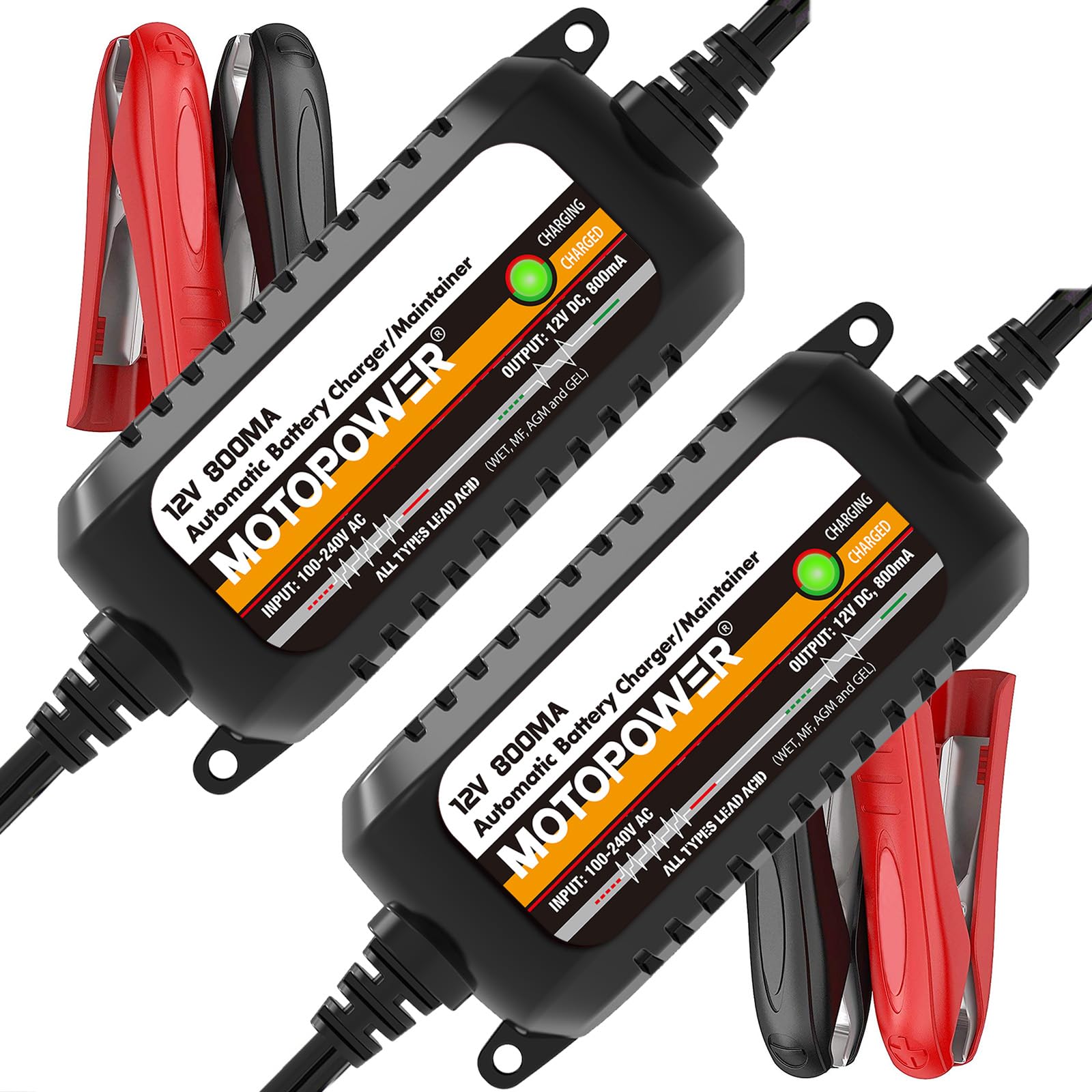
Two maintainers in one box, each with a built-in desulfator that works while you sleep.
Buying a pair changes the maths. The 800mA rate sits between a trickle and a fast charge — enough for a car battery, gentle on a small one. The clever part is the desulfation: it uses pulse current to break down the sulfate buildup that steals capacity from an older battery, and it runs automatically during charging. There is no manual mode to select. Plug in, clamp on, walk away. A 24-hour timer terminates the charge once voltage climbs above 14V and rolls into maintaining mode.
On the numbers, the MOTOPOWER charges up to 14.4V and then holds the battery at 13.6V for long-term maintenance. That holding voltage is deliberately below the boil-off threshold, which keeps a stored battery topped up without gassing. It is ETL safety standard listed, spark-proof on connection, and draws zero output in standby — so attaching it to a battery does not drain the battery back. Overcharge, short circuit and reverse polarity protection round out the safety list.
Buyers report these work well and keep batteries maintained, and the pair approach means you can leave one on the mower and one on the boat without unplugging anything. The units are compact enough to mount on a wall or shelf, and at 800mA they will not stress a small battery if left connected. If you have two stored vehicles that both need a recharge hack through the off-season, this is the simplest way to cover both at once.
The standout feature: automatic desulfation — a maintenance job most owners never do by hand, handled while the charger tops the battery up.
The catch: 12V only, so 6V batteries are left out — and the timer means a deeply drained battery needs a second pass to reach full.
Reach for this if: you have two stored 12V batteries and want both maintained with one order.
Look elsewhere if: you need 6V support or want a single unit to carry between vehicles.
5. LOKITHOR BC2 6V/12V Car Battery Charger
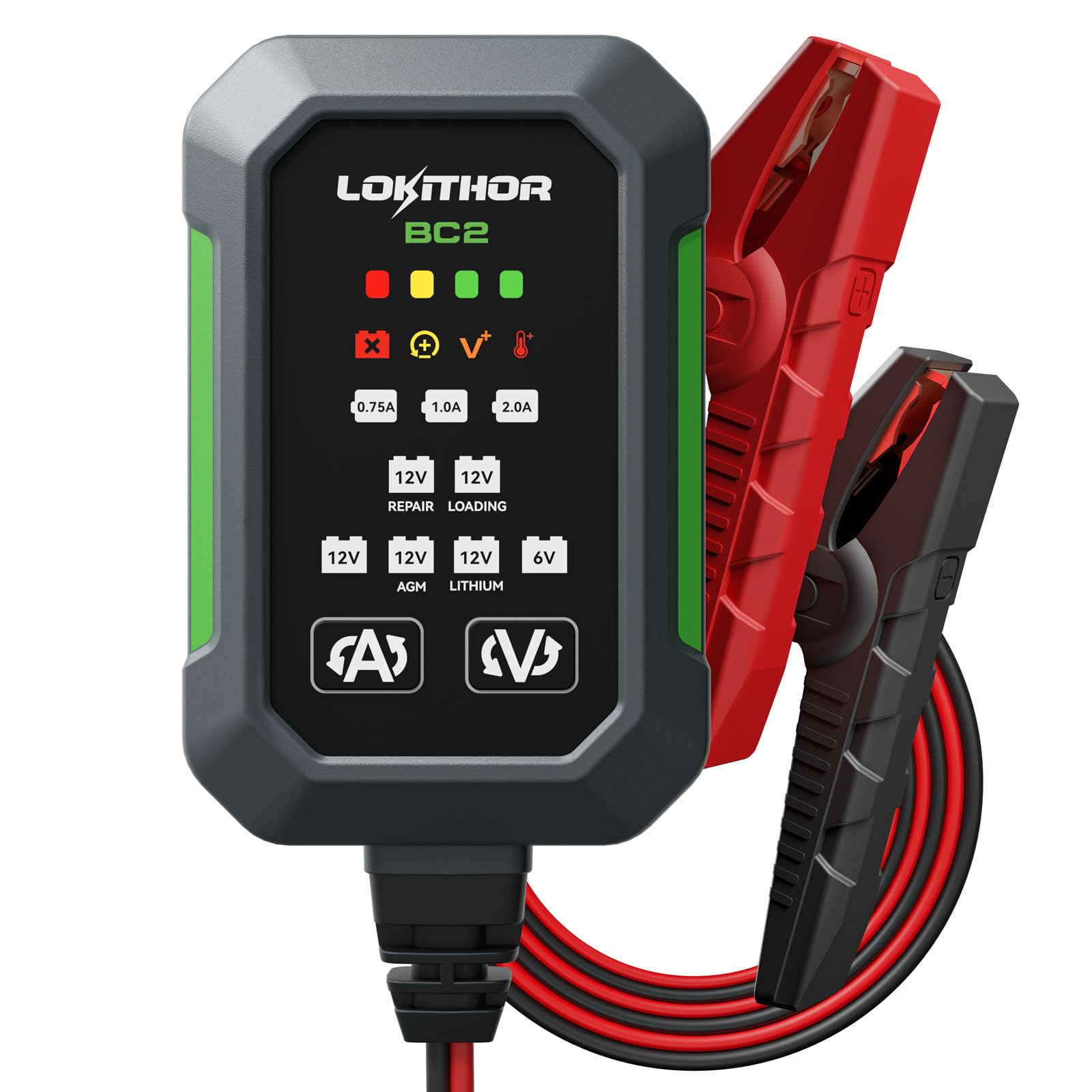
Three selectable current settings and a forced mode for a battery so dead it will not read at all.
This is the pick for someone who wants to dial the charge themselves. The LOKITHOR BC2 lets you choose 2A for a fast top-up, 1A for routine maintenance, or 750mA for a small battery that needs the gentlest possible push. That three-way adjustability is rare in this list — most rivals lock you to a single rate. It handles both 6V and 12V lead-acid (AGM, GEL, SLA, VRLA, Flooded) and LiFePO4, so chemistry and voltage are covered too.
The forced mode is the headline for neglected batteries. If a battery is so deeply drained it reads below the normal detection threshold, you can run forced mode for 5 minutes to wake it, then switch back to a normal program. The 10-stage charging algorithm reads real-time condition and adjusts power delivery from diagnostics through to float maintenance. On top of that, dual-frequency pulse repair tackles sulfate layers with high and low-frequency pulses to try to restore lost capacity.
The protection suite is thorough — spark-proof, short circuit, reverse polarity, overcharge, overcurrent and overheat. The 55-inch DC cable plus 21.7-inch clamp cables give flexible reach, and the integrated M8 eyelet terminals let you mount a permanent connection on a motorcycle or classic car. Owners like it better than a big-name rival, and the compact body and ease of use come up often. The one caveat: the forced mode is a rescue tool, not a routine setting — you must drop back to a normal program after five minutes or risk stressing the battery.
Why it earns the adjustable label: three current settings let one charger serve a tiny powersport battery and a larger car battery without compromise.
The catch: forced mode is powerful and must be time-limited to five minutes — forget to switch back and you defeat the purpose.
Best for: tinkerers who want to match current to each battery by hand and can rescue a dead battery.
skip it if: you want a set-and-forget unit — the manual mode selection is the opposite of one-touch.
6. Mroinge 1A 12V Smart Battery Charger & Maintainer (2-Pack)

A pair of 1A maintainers for the price of a single mid-range unit, built for mowers and bikes.
The number to hold onto is 1A — a full amp, steady, and well matched to a lawnmower or motorcycle battery. It runs a 4-step program (Initialization, Bulk Charge, Absorption Mode, Float Mode), so it climbs to full and then holds, exactly the behaviour that protects a stored battery. Compatible with flooded, GEL, AGM, VRLA, deep-cycle and maintenance-free 12V batteries. The 12-foot DC cord gives reach from an outlet to a parked vehicle without an extension.
The safety list holds its own against pricier picks: spark-proof connection, reverse polarity protection, overcharge protection, short-circuit protection and over-temperature protection. A built-in two-colour LED shows the charging stage, so you can see at a glance whether the battery is climbing or holding. FCC specification standard and a 2-year warranty add a layer of confidence. Two units in the box means the mower and the bike can each get their own charger and never fight over one outlet.
Reliability is what owners point to most, with the consistent refrain that it works great with no issues. Quality and value get similar nods. The main gripe worth knowing about is wiring that some owners found thinner than they would like — handle the leads with a little care and it serves you fine. If you want a spare trickle charger without overthinking the spec sheet, this pair delivers the basics cleanly.
The case for two: you get two 1A maintainers and never have to unplug one vehicle to charge another.
The catch: thinner wiring means treat the leads kindly, and the 1A rate is slow for a big car battery.
Go for it if: you have two 12V mowers or bikes and want cheap, steady maintenance for both.
Pass if: you need to quickly recharge a large car battery — this rate is for upkeep, not recovery.
7. NOCO GENIUS1 1A 6/12V Smart Battery Charger

The all-in-one 1A charger that can wake a battery down to zero volts with force mode.
The GENIUS1 earns its spot on recovery: it will detect and charge a battery from as low as 1 volt, and force mode pushes a completely dead battery back from zero. That is the job the mid-range units in this list cannot do. It runs on 1A of output and works as a charger, maintainer and desulfator (a mode that breaks down the buildup that shortens battery life) in one box. An integrated thermal sensor adjusts charge based on ambient temperature, so a hot garage does not risk overcharging and a cold one does not undercharge. It handles 6V and 12V lead-acid (AGM, Gel, SLA, VRLA) and LiFePO4 alike.
Precision pulse charging detects and reverses sulfation and acid stratification, the two things that steal life from an aging battery. The 110-inch DC cable with integrated eyelet terminals gives plenty of reach, and a 3-year warranty covers the unit. It is smaller and more powerful than its predecessor, per the maker, and designed in the USA. The all-in-one framing means you do not need a separate desulfator box on the shelf.
What people appreciate most is functionality — it does the job, and the ease of setup means minutes, not a manual, before you are charging. The flip side is that reliability is genuinely mixed in the broader feedback: some units run for years, others report a charger that stopped working after a month or died within a year. Charging speed splits the same way, with some finding it quick and others slow. The honest read is that it is a capable all-rounder whose longevity varies, and the 1A rate means a large battery will not rush.
What the GENIUS brand brings: force mode recovers dead batteries down to zero, and pulse charging handles desulfation automatically.
The real trade-off: reliability is split across owner feedback — a capable unit whose lifespan varies — so buy it for the recovery feature, not an open-ended guarantee of longevity.
Best for: anyone with a neglected or deeply drained battery that needs revival, across 6V and 12V.
Think twice if: you need guaranteed long-term reliability — the feedback is genuinely mixed on that front.
8. CRAFTSMAN CMXCESM259 1.5A Car Battery Charger & Maintainer

A wall-mountable 1.5A charger you can bolt beside the workbench and leave there for good.
The 1.5A output sits in the useful middle ground — stronger than a 1A trickle, gentler than a fast charger. What makes the CRAFTSMAN different is the mounting design: it is built to attach permanently to a wall or workbench outside your main work area, so it lives on the wall and you bring the battery to it. A 6-foot power cord and 5-foot booster cables give the reach to hang it wherever there is an outlet. It handles 6V and 12V batteries, standard, AGM, gel and deep-cycle, and works on gas and diesel vehicles.
Beyond charging and maintaining, it reconditions. A desulfation mode works to extend battery life and improve performance on a tired battery — a feature you would otherwise have to buy as a separate unit. Reverse polarity protection guards the battery and vehicle if you mis-clamp. The package includes quick-connect battery clamps and ring connectors, so you can hard-wire a permanent connection. Both the 1.5-amp rate and the maintainer function draw steady, honest feedback from owners.
Owners appreciate the quality of the build and note it charges fully overnight, working fast when it settles in. Ease of use gets consistent nods — the controls never confuse. On value, opinions genuinely split, with the cost-to-feature ratio the point of debate. The size at 7.68 x 7.68 x 2.24 inches and 1.5 lb makes it a substantial unit, so check the wall space before committing. If the permanent-mount idea appeals, this is the one box that does it.
The standout spec: reconditioning mode plus wall-mountable design — a charger, maintainer and desulfator you can bolt down once.
The trade-off: it must be plugged in to run, so it is not a portable option — fine for a bench, no help at the side of the road.
Reach for this if: you want a charger permanently mounted by the workbench to feed batteries on rotation.
Look elsewhere if: you need portability — the AC-powered design ties it to an outlet.
9. NOCO GENIUS2 2A 6/12V Smart Battery Charger

Twice the current of the GENIUS1, for a big battery that needs a real recovery push.
The GENIUS2 doubles the output of the GENIUS1 to 2A, which is the number that matters if you are charging a full-size car battery rather than a motorcycle one. It carries the same all-in-one design — charger, maintainer, trickle charger and desulfator — and covers 6V and 12V lead-acid and LiFePO4. An integrated thermal sensor adjusts the charge by ambient temperature, protecting against overcharge in heat and undercharge in cold. Force mode revives a battery from zero volts, just like the smaller model.
This one comes with a mounting bracket, two truss-head screws and a Velcro strap, so you can fix it to a wall and leave a permanent connection. The 72-inch AC cable plus 80-inch DC cable with clamps and eyelet terminals reach most parking spots. Precision pulse charging handles sulfation and acid stratification, and the 3-year warranty covers it. Compared with the GENIUS1, you are buying more current and a mount as standard, not a different charging philosophy.
Quality and functionality get the most approval — it does its job well, and people find it easy to set up. The mixed side is battery life and reliability: some report it keeps a battery at full charge and brings it back, others note it stopped working after two months. Charging speed splits too, with overnight being a common reality from low to full.
Why the 2A matters: double the GENIUS1’s current carries a full-size car battery back up in a reasonable window.
The catch: reliability and charging speed are mixed in the feedback, and it still takes overnight for a big recovery.
Pick it when: you have a larger car battery, want the mounting bracket included, and value force-mode recovery.
Think twice if: a small powersport battery is the target — the GENIUS1’s 1A is gentler on it.
Know the Specs
Amperage (mA and A)
Amperage is the rate at which the charger feeds current into the battery. A milliamp (mA) is one-thousandth of an amp, so 750mA equals three-quarters of an amp. Low numbers suit small batteries and high ones suit larger batteries; matching the two protects the battery and gives you a reasonable charge time.
Float Mode
Float mode is the resting state a smart charger enters after the battery reaches full charge. It holds the battery at a slightly lower maintenance voltage instead of pushing more current, so you can leave it connected for months without overcharging or boiling off electrolyte.
Voltage Range (6V vs 12V)
Battery voltage is what the charger must match. 6V batteries appear in some older motorcycles and mowers, while 12V covers most cars, ATVs and boats. A charger that reads both automatically can serve your whole garage without a second unit.
Desulfation
Desulfation is the process of breaking down sulfate buildup on a battery’s plates, which is what robs an old battery of its capacity. Pulse-based desulfators do this while charging, sometimes automatically, which is why a maintainer with a desulfator is worth considering for batteries you want to keep longer.
Common Questions
Can I leave a low power battery charger connected all the time?
Will a 1A or 750mA charger charge a completely dead car battery?
What is the difference between a trickle charger and a maintainer?
Can I use a 12V charger on a 6V battery?
How long does a low power charger take to bring a battery back?
Is a low power charger safe to leave in a cold garage?
Do I need a desulfator built in, or can I buy one separately?
Will a low power charger overcharge my battery if I forget to unplug it?
Can one charger handle both my motorcycle and my car?
What safety features should a low power charger have?
The Bottom Line
For most people, the low power battery charger to buy is the Battery Tender Junior 12V, 750mA — it has the track record, the float-mode habit that keeps a stored battery alive, and the fused-ring harness that makes a permanent hook-up painless. If you need to cover 6V and 12V in the same garage, the TPE Automatic 6V/12V 1.5A is the smarter single-box pick. And for a big car battery that needs a real recovery push with force mode behind it, the NOCO GENIUS2 2A is the one to reach for. Whichever you choose, match the amperage to your battery and confirm float mode before you plug in — that is the whole trick to this category.
How we choose
We do not accept paid placement. Every pick is matched to a real buyer and a real use-case; we do not hands-on test units.
Sources
Specifications: manufacturer listings and product documentation. Review insights: verified customer reviews, as of November 2026. Pricing: not shown on this page (it changes often); check the current price via the retailer link.
As an Amazon Associate, Tactical Gear Guy earns from qualifying purchases. This does not affect which products we feature.