Specs are compiled from manufacturer listings and verified buyer reviews and can change over time — please confirm the key details on the product page before buying.
The honest answer up front: a gas-powered T-post driver is worth owning only if you are pounding posts in volume and want to stop swinging a manual slide hammer into hard ground. For a handful of fence posts, rent one or borrow one. On a season of fence lines, orchard supports, or sign runs, it pays back in saved swing time. This guide walks you through nine real gasoline-powered drivers, from a lightweight 30 lb pick to a Honda-powered commercial unit, and tells you which one fits which dirt.
This guide is built by comparing the manufacturers’ published specifications and the patterns across verified customer reviews, so you get each pick’s real strengths and trade-offs instead of marketing spin.
A gas post driver is not a regular drill, and the wrong one will fight you all day on rocky ground. Here is how to read the numbers before you buy a single machine. The smartest way to pick a gas-powered T-post driver is to match soil, post size, and engine type before you buy.
Top Picks


How To Choose The Best Gas-Powered T-Post Driver
Buying a gas post driver starts with one question: what is under your boots? A machine that sings in soft loam can bog down in clay, gravel, or roots and feel like a wasted purchase. Match the driver to the dirt first, then worry about the badge on the engine.
2-Stroke vs 4-Stroke: The Daily Habit Test
A 2-stroke engine runs on a mix of gasoline and 2-stroke oil, usually at a set ratio you blend yourself before every fill. That extra step is the trade-off for a simpler, lighter motor. A 4-stroke engine runs on straight gas with oil kept separate in its own sump, which is easier for most people but usually adds a few pounds.
Read the Beats Per Minute and Impact Energy
Beats per minute, or BPM, is how many times the hammer head strikes per minute, and impact energy in joules tells you how hard each strike lands. Higher BPM drives faster in soft ground, while more joules helps in stubborn soil. A driver rated 1,500 to 2,000 BPM is the common working range for fence work.
Sleeves Decide What You Can Drive
Adapter sleeves, sometimes called collars or heads, center the post under the hammer so it goes in straight. Match the sleeve size to your actual post diameter, because a loose sleeve lets the post wander and a tight one will not seat at all. Many drivers ship with two to four sleeves, so check the sizes in the box before you buy.
Side-by-Side Comparison
| Model | Best For | Engine / Displacement | Strike Rate | Weight | Amazon |
|---|---|---|---|---|---|
| Titan PGD3875★ Best Overall | All-around ranch use | 1.3 HP 4-stroke | 700–1,350 BPM | 50 lbs | Amazon |
| JACKCHEN 52cc 2-StrokeTop Performer | Soft-soil volume piling | 52cc 2-stroke / 1900W | 6,500 RPM | 42 lbs | Amazon |
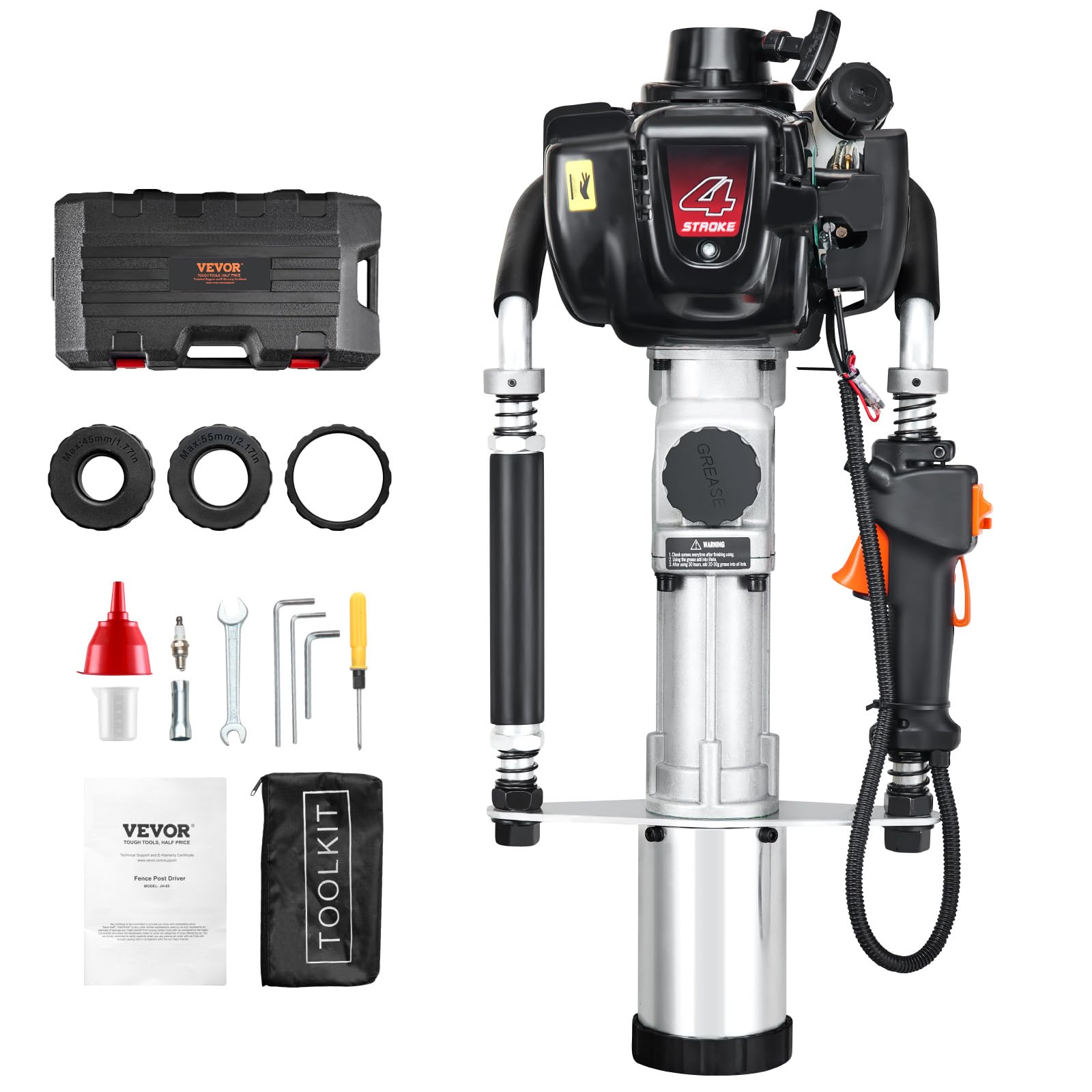
| VEVOR 4-Stroke 1000WMost Versatile | Three head sizes in one box | 37.77cc 4-stroke / 1000W | 1,500–2,000 BPM | 45.6 lbs | Amazon |
| XtremepowerUS 52cc | Budget 2-stroke power | 52cc 2-stroke / 1500W | 700–1,350 BPM | 40.8 lbs | Amazon |
| XtremepowerUS 38cc | Easy-start 4-stroke | 38cc 4-stroke / 1.3 HP | 6,500 rpm | 67 lbs | Amazon |
| Skidril G15D | Light-ish 4-stroke with case | 4-stroke / 1.5 hp | — | 42 lbs | Amazon |
| Titan PGD2875 | Portable hobby farm work | 1.3 HP 4-stroke | 1,500–2,000 BPM | 30 lbs | Amazon |
| Titan PGD1032 | Fast no-mix driving | 140FA 4-stroke | 1,200–1,600 BPM | 34.5 lbs | Amazon |
| Titan PGD3200X | Commercial Honda power | Honda GX35 1.3 HP 4-stroke | 1,850 BPM | 62.8 lbs | Amazon |
Detailed Reviews
1. Titan PGD3875 Gas-Powered Post Driver
Our pick — 4.0+★ from 200+ verified ratings; the strongest balance of quality and price.
The 50 lb workhorse that trades a little back strain for a sure, cord-free drive.
Pick this one if you want a self-contained driver with no hoses, no compressor, and no cord to trip over. The Titan PGD3875 carries its own 1.3 HP 4-stroke engine, which means you fill it with plain gas and pull the recoil cord, and it runs 700 to 1,350 beats per minute. It runs anywhere, with no outlet or cord needed. The crowd favorite here sits at 4.0+ stars from 200+ owners, and the consensus is blunt: it drives.
What wins people over is the build quality — the single most praised thing about this driver by a wide margin. Owners describe the thing in beast terms, and functionality runs second, so most of the box opens and the machine simply does what it is told. The four adapter collars (1″, 2″, 3″, and 4″) mean it handles T-posts, pipes, rods, and stakes up to 3 7/8″ diameter without you buying extra heads. Ergonomic handles and an integrated stop switch keep the operation comfortable over a long run.
Here is the honest catch: this is a light-duty machine, and Titan says so right in the listing. The 50 lb weight is the most-criticized thing about it — you feel every pound when you carry it across a field — and durability splits down the middle, with some owners calling it heavy-duty and others reporting a break during use. Starting is also a coin flip for some, with a share of buyers finding the pull hard. If you are running a commercial crew every day, look up the list. If you are fencing your own land, this is the pick. At this price, a driver that works like a champ most of the time is worth owning.
What earns it the top spot
- 1.3 HP 4-stroke engine runs on straight gas with no oil mixing.
- 700–1,350 BPM drives fast in soft to medium ground.
- Four adapter collars cover 1″, 2″, 3″, and 4″ posts and pipes up to 3 7/8″ diameter.
- Self-contained design with no hoses or cords.
The trade-offs you feel
- 50 lbs is heavy to carry all day.
- Explicitly light-duty, not built for commercial crews.
- Starting can be stubborn for some owners.
Reach for this if: you want a dependable all-around driver for your own ranch or homestead and value a four-collar kit over raw muscle.
Think twice if: you are billing commercial hours — the maker caps this at light-duty use.
2. JACKCHEN 52cc Gas T Post Driver, 1900W 2-Stroke
The 1900W two-stroke that punches above its price tag and lightens the labor load.
Start with the power number, because that is the whole story here. This 52cc 2-stroke driver runs at 1900W, and its closest comparison on this list, the VEVOR 4-stroke, runs at 1000W. That is a 1.9x gap in rated wattage, and in practical terms it means this machine has more raw punch to give when a post needs a hard, fast series of blows. The impact frequency hits 6,500 RPM with 55 joules of impact energy, which is the kind of spec you feel in the ground rather than read on a box.
What buyers rave about is the reliability — it tops the list of things owners talk about, and by a wide margin. The tool runs smoothly, saves labor, and there is a whole thread of owners who wish they had bought it years ago. Ease of use ranks second, with the rubber-plastic sponge handle soaking up recoil and cooling vents keeping the engine happy through a long run. You get two sleeve sizes (Ф55 and Ф70), a proportional oil pot, a funnel, and a full tool bag, which is a lot of kit for an entry-level machine.
The catch is the fuel routine and the weight. This is a 2-stroke, so you blend gas and 2-stroke oil at a 25:1 ratio before every fill, and the maker recommends a name-brand 2-stroke oil for the mix. At 42 lbs it is also heavy to lift, which is the most-criticized thing about it. The main shaft has cracked in two on a unit or two, so treat it gently and do not try to drive in rocky soil — this is a soft-soil machine. Not suitable for rocky ground, and the maker says so.
Where the value lands: this is the pick for anyone piling a lot of posts in soft soil on a budget, because 1900W of 2-stroke power and a full accessory kit beats what most entry-level buyers expect. Just accept the 25:1 mix and a heavy lift.
The right fit is: volume fencers in soft ground who want maximum rated power per dollar and do not mind a two-stroke mix.
Leave it on the shelf if: your soil is rocky or you want a pull-start-and-go four-stroke with zero fuel blending.
3. VEVOR Gas-Powered T Post Driver, 4-Stroke 1000W
Three driving heads in one box, but a spec sheet that promises more than the reviews deliver.
The reason to look here is the heads: this VEVOR ships with three post-driving heads at 45, 55, and 88 mm, so you can swap between post sizes without buying extra sleeves. The 37.77cc 4-stroke engine runs on straight gas and delivers 1,500 to 2,000 BPM with an impact energy of 35J. That 37.7cc displacement falls roughly 38% short of the 52cc XtremepowerUS, so if raw displacement is your measuring stick, this is the smaller motor.
Performance is where this one gets talked about most, and the talk is honestly split. Half the buyers report it working better than expected, and half report concrete failures, including a machine that will not drive posts at all. Quality lands on the negative side of the ledger, with more owners describing it as the worst driver they have used than praising it. Durability skews the same way — the recurring note is that it is not strong enough for hard, repeated work.
The spec sheet also carries a clear warning that is easy to miss: the maker says to avoid sandy, rocky soils and areas with tree roots, because those obstacles can stop the post from installing properly. That is a real limit, not marketing hedging. Read it as a soft-to-medium-soil machine, and if your ground is rocky, budget your expectations accordingly.
A fair read: buy it for the three-head kit and the 4-stroke no-mix convenience, and treat it as a light-to-medium-duty driver for clean soil. If you need a machine that shrugs off roots and rocks, this is not the pick.
Best matched to: a homeowner with mixed post sizes and clean soil who wants three heads in one purchase and no fuel mixing.
Not the one for: rocky, rooty, or sandy ground where the maker explicitly warns against use.
4. XtremepowerUS 52cc Gas Fence Post Driver
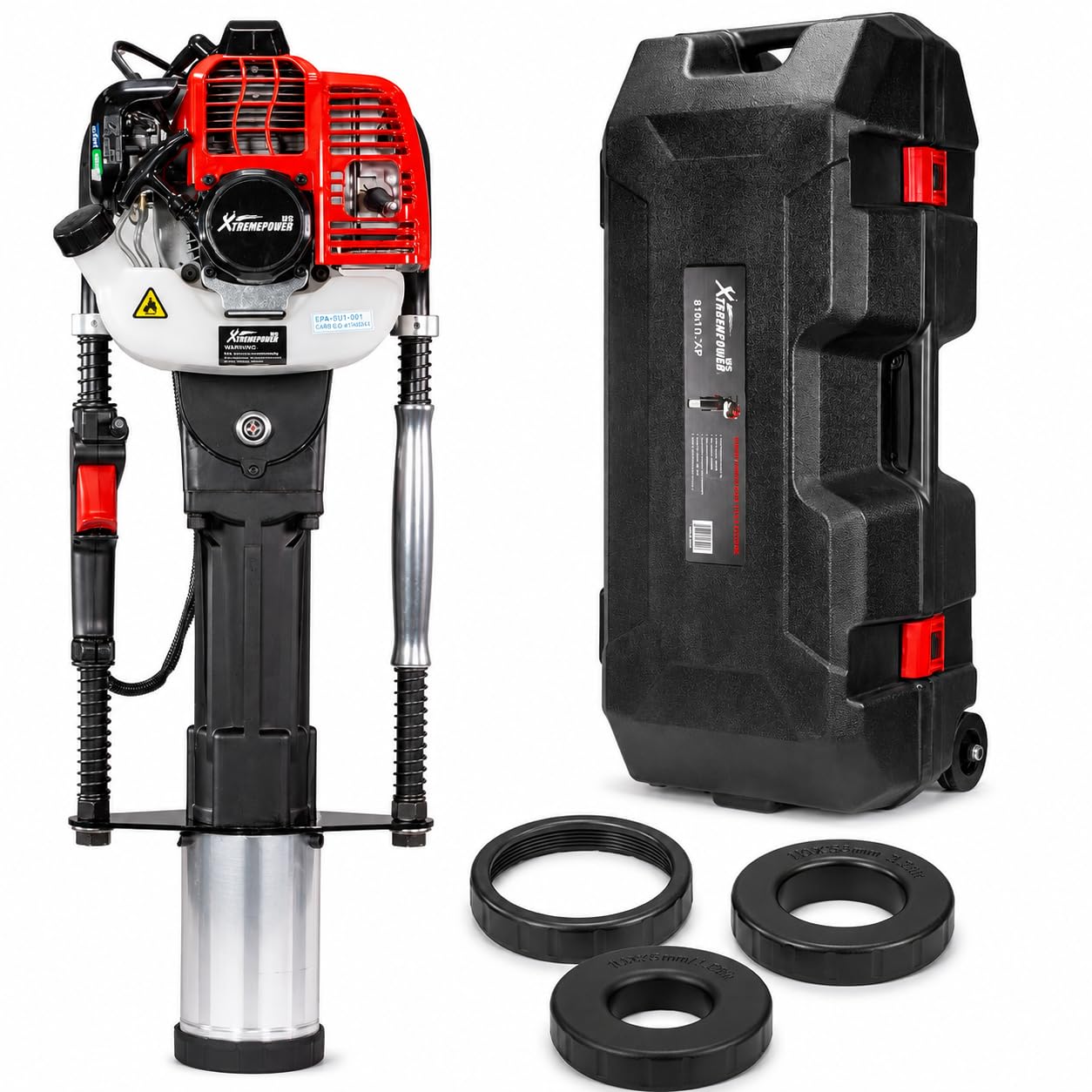
Fifty-two cubes of two-stroke muscle in the lightest package on this list, with a durability question mark.
The headline is the displacement: 52cc in an engine that weighs only 40.8 pounds. It also runs a 1500W 2-stroke motor at 700 to 1,350 BPM with a 9,000 r/min top speed, and the internal vibration damper is designed to take the sting out of the recoil. For a machine at the entry end of the price scale, that is a lot of iron.
The reviews tell a split story, so go in with your eyes open. Reliability and quality are the two most-discussed topics, and both land on the mixed side, with roughly half the owners reporting a machine that runs great and half reporting it will not do the job. Durability is the harder read — the recurring complaint is bolts coming loose and parts breaking quickly. The instructions are also thin, and a share of owners found the machine heavy and tricky to operate at first.
What you get in the box is genuinely helpful: a carrying case, a user manual, and an EPA-certified design that means it meets the emissions standard. The wide application list covers farm fences, sign posts, ground rods, and stakes. If you are a first-time buyer who wants 52cc of power without paying for a premium name, this is the budget route. Just plan on checking bolts and treating the machine kindly, because the build is where the corners were cut.
Why budget buyers look here
- 52cc 2-stroke engine and 40.8 lbs — the lightest heavy-displacement pick here.
- 700–1,350 BPM with 9,000 r/min top speed.
- Ships with a carrying case and manual.
- EPA-certified two-stroke design.
Where it asks patience
- Reliability and quality read mixed across owners.
- Bolts loosening and parts breaking is the durability note.
- Thin instructions and a learning curve for first-timers.
The entry route: a first machine for a homesteader who wants 52cc of power in a light 40.8 lb body and can live with a hands-on maintenance habit.
The honest limit: mixed reliability means this is not the pick if you cannot afford downtime mid-fence.
5. XtremepowerUS 38cc Gas Powered Fence Post Driver

A 4-stroke with a rolling case and three piling head sizes, tuned for T-posts and ground rods.
This one is built around a 38cc 4-stroke engine, so you get straight gas with no 25:1 mixing, and the maker rates it at 1.3 HP with a 5,500 r/min max torque and 6,500 rpm max power. The head sizes are the reason it sits in the T-post lane: 20mm-49mm, 50mm-69mm, and 70mm-100mm covers standard T-posts, ground rods, signposts, and landscaping stakes. It ships in a wheeled carrying case, which matters when you are rolling a 67 lb machine across a field instead of carrying it.
Ease of use is the one thing everyone agrees on here — it is the clean positive in the review data. The dual handles are designed with vibration reduction, and the finger throttle and integrated switch controls are meant to keep the machine steady during extended use. Reliability and build quality split down the middle, though, with some owners reporting it runs fantastically and others reporting it will not start at all. Durability leans negative, so this is a machine to maintain rather than abuse.
At 67 lbs this is the heaviest driver on the list, and that is not a small thing. The wheels help, but you will still feel the weight on uneven ground. Consider it a comfortable, easy-to-control option for medium-scale projects where you can roll it to the post rather than haul it. If T-posts are your main job and you want wheels under the machine, this is the one.
The plain verdict: a sensible T-post driver for homeowners and small farms who value a rolling case and easy control over raw brawn — as long as you have a place to store it and a flat path to roll it.
Reach for this if: you are setting T-posts and ground rods and want a wheeled, easy-starting 4-stroke in the box.
Reconsider if: you need to carry the machine uphill — at 67 lbs it is the heaviest one here.
6. Skidril 4 Stroke Light Impact Post Driver G15D
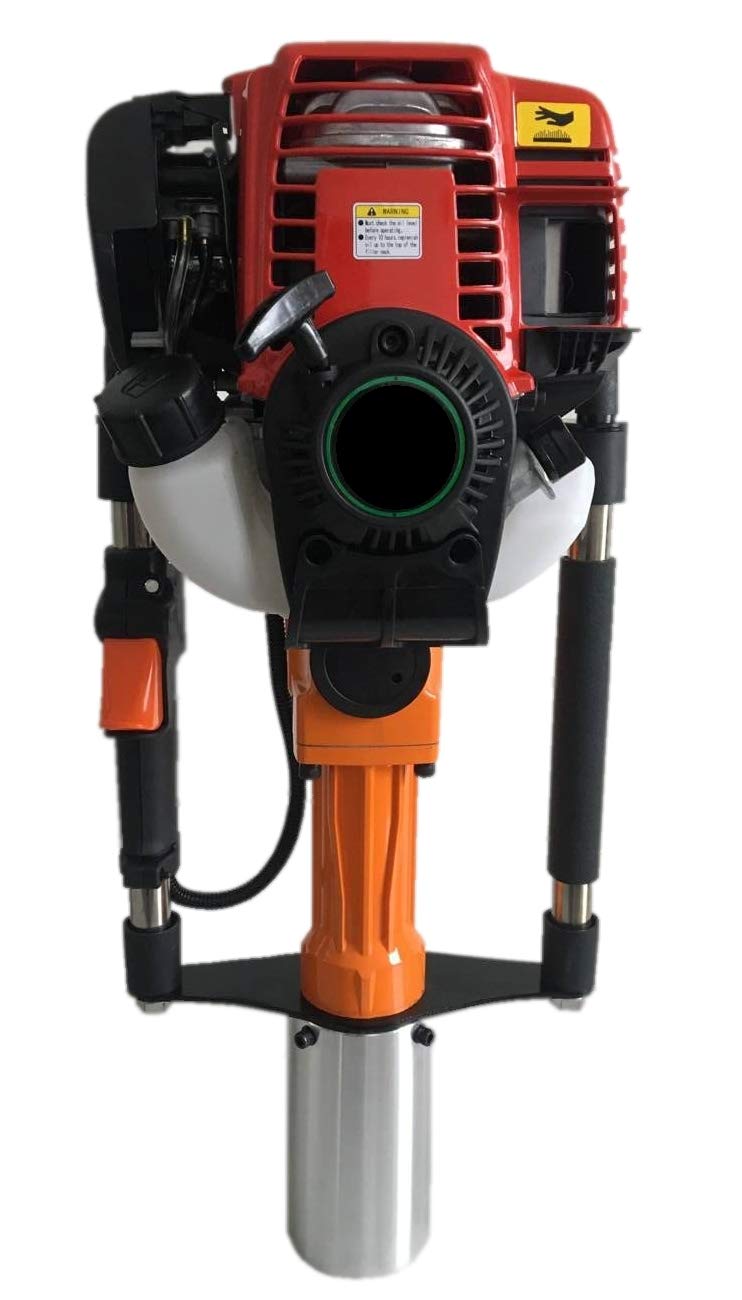
The aluminum-bodied four-stroke that ships with a case and inserts for three post sizes.
For a 42 lb machine, this Skidril packs a 1.5 hp 4-stroke engine and comes in a protective case with insert sets for T-posts, 2″ posts, and 3″ posts. The aluminum build keeps it portable, and the 3-inch max chuck size means it accepts the three insert sizes in the kit. Skidril rates this 4.0+ stars across two dozen or so buyers, and the listing makes a limited life warranty and a complete case-and-inserts package part of the pitch.
The 1.5 hp engine is the largest horsepower rating among the lighter machines on this list, which is a real point in its favor for medium posts. The aluminum body is the reason it stays at 42 lbs, so it handles easier than the 62.8 lb Honda-powered Titan at the top of the price range.
The catch is the track record: there is very little review history to lean on, so you are buying on the spec sheet and the brand’s limited life warranty rather than on a deep pile of owner stories. For a light-impact three-insert machine, that is a reasonable bet, but it is a bet. If you want the most-proven pick, go with the higher-volume Titan at the top of the list. If you want a lightweight four-stroke with T-post and 2″/3″ inserts straight out of the case, this earns a look.
The fit: a light-duty buyer who wants a case-complete 1.5 hp four-stroke with inserts for T-posts, 2″, and 3″ posts.
Hold off if: you want a deep, proven owner track record before you spend.
7. PGD2875 Titan Gas Powered Post Driver

The carrying-weight champ — a 30 lb driver that punches from 1,500 to 2,000 times a minute.
The number that matters here is 30 lbs. That is the lightest driver on this entire list, a full 20 pounds lighter than the 50 lb Titan PGD3875, and it is the one spec that makes this a hobby-farm machine rather than a job-site workhorse. The 1.3 hp 4-stroke engine runs straight gas and pushes 1,500 to 2,000 BPM, and the box includes four adapter collars at 1″, 1.77″, 2″, and 3″ so the driver fits nearly any post in that range.
Performance is the thing owners praise most, and speed is a close second among the topics that come up. The consensus is that it performs better than expected and always starts right up. The 3-inch capacity means it takes up to 3″ posts, and the steel body holds up to typical light-duty abuse. For the hobby farmer or residential user, which the maker names outright, this is a balanced machine.
What you should know before you buy: starting is the split point. Some owners find it easy to start, and others find it very hard to start, so your experience may hinge on your method. Drivability is the harder read — it performs well in ideal conditions but struggles in hard ground, gravel, and rocky soil. The durability record also has a break-after-use note, so keep up with the maintenance and do not ask it to chew through rock. If you are fencing your own property and want the lightest carry possible, this earns its spot.
What makes the featherweight worth it
- 30 lbs — the lightest driver in this lineup.
- 1.3 HP 4-stroke with 1,500–2,000 BPM.
- Four collars (1″, 1.77″, 2″, 3″) cover most posts.
- Steel body with a proven performance record.
Where it stops short
- Struggles in hard ground, gravel, and rocky soil.
- Starting can be hit-or-miss.
- Light-duty build with a break-after-use note in the history.
The right fit: a hobby farmer who wants the lightest carry and four collar sizes for a mix of post diameters.
Not for you if: your soil is rocky or you need commercial-grade duty cycle.
8. Titan PGD1032 Gas Powered Post Driver

A 34.5 lb no-mix four-stroke that owners say sinks a post in half a minute.
If the fuel routine is what keeps you from going two-stroke, this is the answer. The PGD1032 runs a 140FA 4-stroke engine on straight gas with no fuel mixing, and it delivers 1,200 to 1,600 BPM at 34.5 lbs. That is lighter than the 50 lb PGD3875 and lighter than the 45.6 lb VEVOR, so it carries kindly between posts. The engine is designed for smooth operation and reduced user fatigue, which matters over a full fence line.
What people talk about most is reliability, with quality running second, and the consensus is that it works like a champ. The speed story is where it shines: owners mention driving a post in 30 seconds, which turns a fence line into a short afternoon rather than a weekend. The all-steel adapter sleeves come in 1″, 1.75″, and 2.5″ sizes and keep the post centered for a straighter drive. It is, as the maker puts it, a portable driver for remote locations, farms, or home projects.
The honest limit is capacity and weight. The 2.5″ top sleeve means it is built for T-posts, pipes, rods, and wooden stakes rather than big-diameter posts, and at 34.5 lbs it is still a machine you carry rather than roll. It is also a newer model without the years of owner data behind the PGD3875. For the ranch or farm running T-posts in volume, the speed alone is worth the look.
Why ranchers notice it: the combination of a no-mix four-stroke, 34.5 lbs, and a 30-second post is a rare mix on this list. If speed and simplicity are your top two priorities, this one is hard to argue with.
Reach for this if: you want no-mix fuel, fast post driving, and T-post-plus-stake sleeves in a 34.5 lb package.
Look elsewhere if: you need large-diameter post capacity beyond the 2.5″ top sleeve.
9. Titan PGD3200X with Honda GX35 Engine
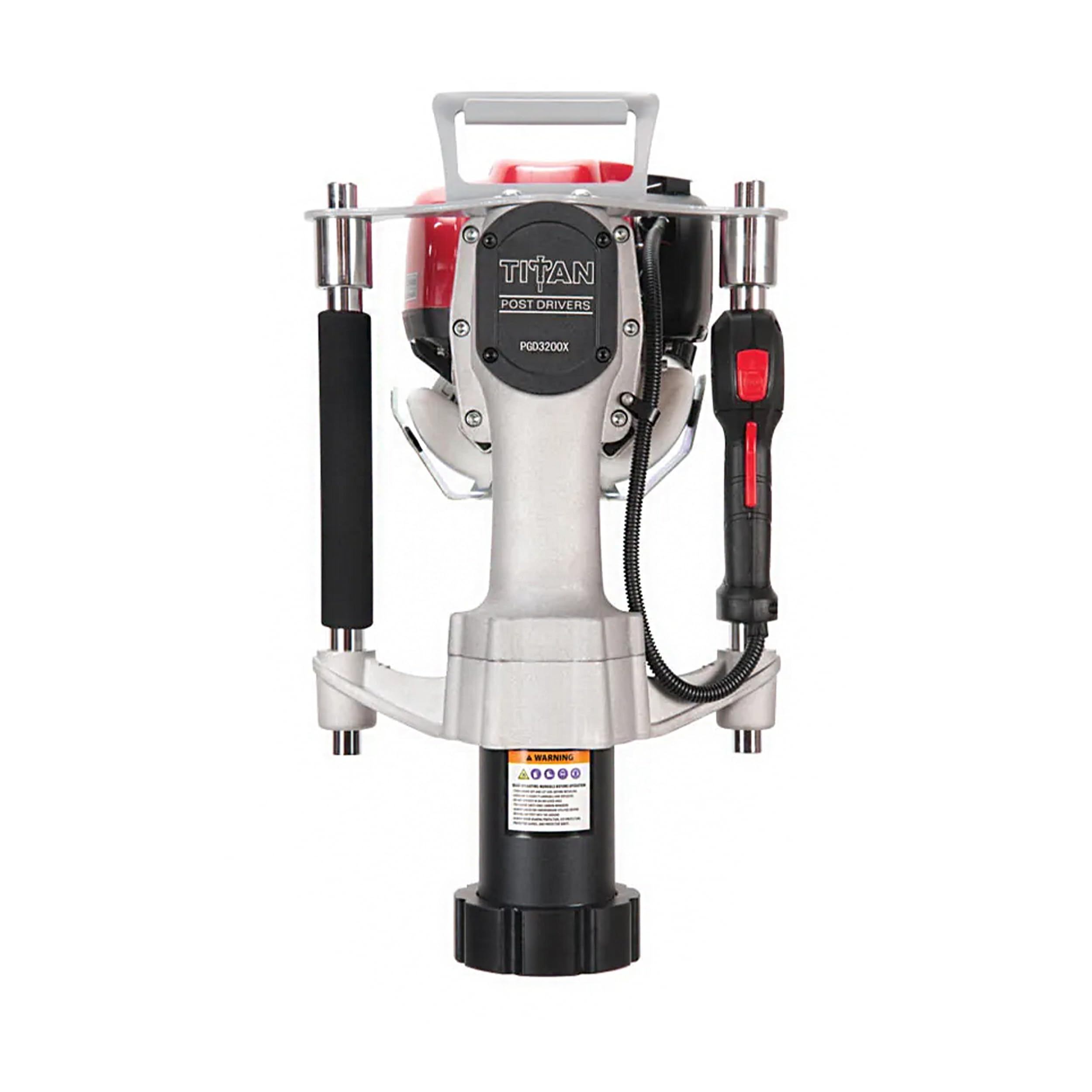
Honda power, 1,850 BPM, and a 3-1/8 inch barrel — the commercial option for crews that bill by the post.
This is the only driver on the list running a Honda GX35 engine, and that is the whole reason people pay for it. The 1.3 HP 4-stroke Honda delivers up to 1,850 BPM, which is the highest strike rate among the Titan drivers here. The heavy-duty threaded steel barrel accepts posts up to 3-1/8 inches in diameter, and the box includes a 2-1/2 inch industrial-grade poly adapter sleeve. That makes it a machine that handles big posts, composite posts, and rebar, not just standard T-posts.
The build details are aimed at a working crew. Internal dampening springs, sealed bearings, and Viton O-rings are all designed to cut vibration while keeping performance steady through repetitive driving. The whole thing is self-contained with no hoses, compressors, or external power, and it ships with a rugged case, engine oil, extra lubricant, and a service tool kit. The 4.0+ star reading here comes from a small pool of buyers, so treat the rating as a promising early signal rather than a long-proven record.
Here is the trade-off: at 62.8 lbs this is one of the heaviest machines on the list, and the top-of-range price means it only makes sense if you are running a fence business or a large ranch. There is also very little review history to go on, which is the trade you make for a newer commercial-grade unit. But if you are setting large posts for a utility crew or a fencing contractor, the Honda badge and 1,850 BPM are worth the extra muscle.
The commercial case: for a crew that drives large posts day in and day out, the Honda GX35 engine, 1,850 BPM, and 3-1/8″ barrel are a serious tool. Budget the 62.8 lbs and a lean review history into the decision.
The right buyer: fencing contractors and utility crews who need commercial Honda reliability and large-post capacity.
The caveat: 62.8 lbs and a thin review base make this a considered purchase, not an impulse one.
Know the Specs
2-Stroke vs 4-Stroke Engines
A 2-stroke runs on a gas-and-oil mix you blend at a set ratio before filling, which is an extra step but keeps the motor light. A 4-stroke runs on straight gas with oil in its own sump, which is easier to live with but usually adds weight. The choice depends on whether you will tolerate mixing fuel at every fill.
Beats Per Minute and Impact Energy
BPM counts the hammer strikes per minute, and impact energy in joules tells you how hard each strike hits. Higher BPM means faster driving in soft ground, while more joules helps in stubborn soil. Look for a driver in the 1,200 to 2,000 BPM range for most fence work.
Adapter Sleeves and Post Capacity
Sleeves center the post under the hammer so it drives straight. Buy the sleeve sizes that match your actual posts, and check the box contents before purchase. A collar that is too loose lets the post wander; one that is too tight will not seat at all.
Soil Type and Real-World Limits
Most gas drivers perform best in soft to medium soil and struggle in rock, clay, or roots. Several makers explicitly warn against rocky and sandy ground. Match the driver to the dirt first, because no spec sheet beats a boulder.
Common Questions
Can a gas post driver handle rocky soil?
Do I need to mix oil with the gas for a 2-stroke driver?
What size posts can a gas T-post driver handle?
How heavy is a gas post driver, and does weight matter?
Is a 2-stroke or 4-stroke better for fence posts?
How many posts per hour can a gas driver set?
Can a gas post driver drive ground rods and rebar?
How hard is it to start a gas post driver?
What is the lightest gas-powered T-post driver in this lineup?
Do I need a rolling case or a carry case?
The Bottom Line
If you want a dependable all-around machine for your own land, the Titan PGD3875 is the best gas-powered T-post driver for most buyers, because its four collars, 1.3 HP 4-stroke engine, and self-contained build cover the widest range of posts without a serious weight penalty. If raw rated power per dollar matters more than convenience, the JACKCHEN 52cc delivers 1900W against a 1000W competitor and a full accessory kit. And if you need commercial Honda power for large posts, the Titan PGD3200X with its GX35 engine and 1,850 BPM is the one to reach for.
The real advice: match the driver to your soil and your post size first, then decide on a 2-stroke or 4-stroke fuel routine. A driver matched to your ground and post size will serve you for years.
How we choose
We do not accept paid placement. Every pick is matched to a real buyer and a real use-case; we do not hands-on test units.
Sources
Specifications: manufacturer listings and product documentation. Review insights: verified customer reviews, as of November 2026. Pricing: not shown on this page (it changes often); check the current price via the retailer link.
As an Amazon Associate, Tactical Gear Guy earns from qualifying purchases. This does not affect which products we feature.