Specs are compiled from manufacturer listings and verified buyer reviews and can change over time — please confirm the key details on the product page before buying.
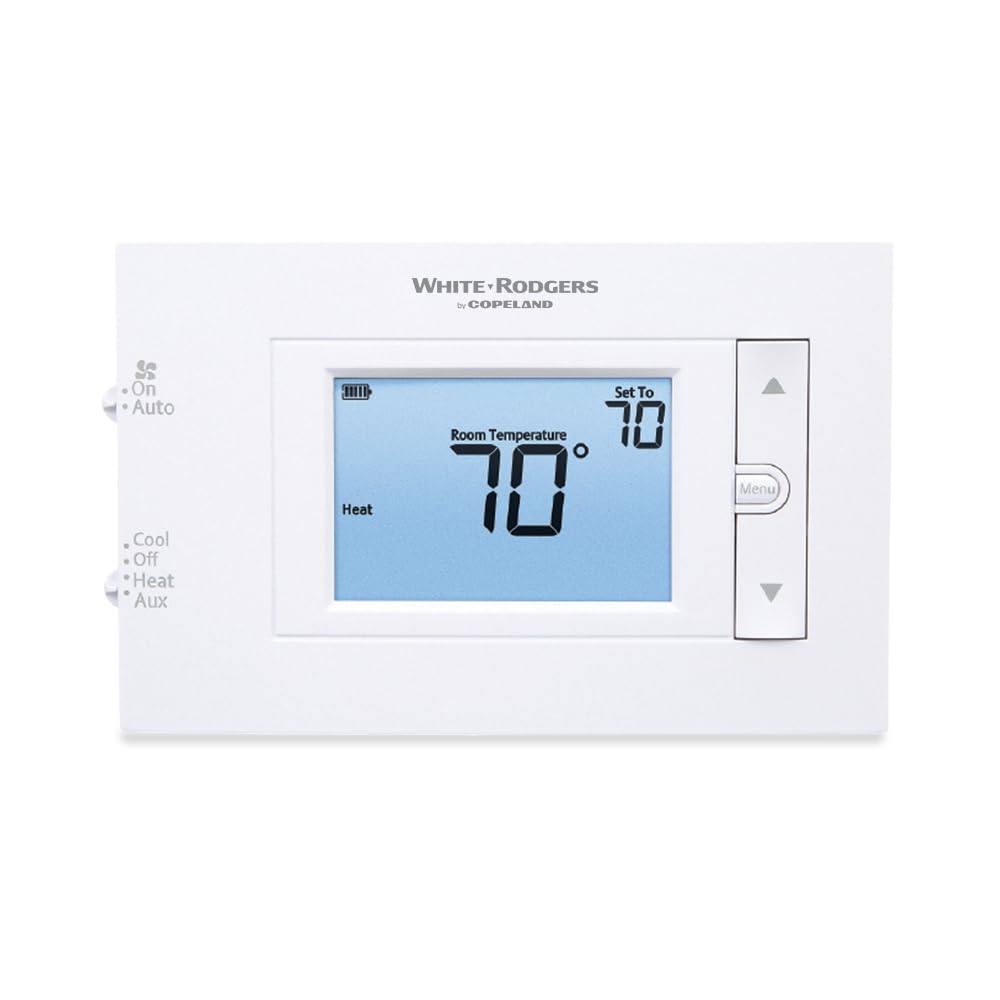
If you are tired of walking up to the hallway wall and squinting to see whether the heat is set to 68 or 70, the fix is a thermostat built around a genuinely large number display. The nine units below all put oversized digits front and center, and they range from simple non-programmable boxes that just show the temperature to programmable models you can schedule around your week. The one to reach for first is the White-Rodgers 1F83H-21NP, a heat-pump-ready unit with a big backlit readout that stays legible in a dark hallway.
This guide is built by comparing the manufacturers’ published specifications and the patterns across verified customer reviews, so you get each pick’s real strengths and trade-offs instead of marketing spin.
Readability is the whole point here, but wiring compatibility runs a close second, and getting that wrong is the most common reason a thermostat goes back in the box. Below you will find how to check your system type, what each display really shows, and how to match a big-digit unit to your existing wires. The right thermostat with big numbers turns a daily squint into a single glance from across the hall.
Top Picks

How To Choose The Best Thermostat with Big Numbers
Before you compare screens, check what is actually inside your walls. A thermostat is only useful if its terminals match your system’s wiring, so compatibility comes first and readability comes second. Get those two right and the rest is preference.
Match the thermostat to your system type
A thermostat only works if its terminal labels match the wires coming out of your wall. A conventional single-stage system uses one heating wire and one cooling wire, and most basic big-digit thermostats handle that without trouble. A heat pump adds a reversing valve wire (the wire that switches the pump between heating and cooling), so you need a model that explicitly lists heat pump support — the White-Rodgers 1F83H-21NP and its programmable sibling both name heat pump compatibility, while several of the simpler units do not. Multi-stage systems with two heat and two cool stages need a thermostat rated for those extra terminals, like the Honeywell TH5220D1029 or the Coiiwsei STN7155.
Read the “not compatible” list as carefully as the compatible one. Line-voltage baseboard heat, mini-split systems, and 12V RV setups run on different power and will not work with the low-voltage units here. If you have electric baseboard heaters, stop and look for a line-voltage thermostat instead.
Decide if you want programming at all
A non-programmable thermostat holds one setpoint until you change it. That is fine for people with a steady routine, and it removes an entire menu system from the interface, which keeps the display clean and the big numbers front and center. Programmable units add 7-day or 5/1/1 scheduling so you can drop the temperature while you are at work and bring it back before you get home.
The trade-off is menu depth. More flexibility usually means more button presses to reach the screen you want, and if reading the numbers is your main goal, a simpler unit can genuinely be the better fit.
Look at the real display, not the marketing word
“Large display” is measured in square inches on some spec sheets and left vague on others. The PRO1 IAQ T805 lists an 8 square inch display, the PRO1 T701 lists 4 square inches, and the White-Rodgers EMERSON 80 Series lists a 4.5 inch display. Those are the numbers worth comparing, because a bigger active area means taller digits you can read from further away. A backlight matters just as much — it is the difference between reading the screen in a dim hallway and having to switch on the overhead light first.
Side-by-Side Comparison
| Model | Best For | Programming | System Support | Notable Spec | Amazon |
|---|---|---|---|---|---|
| White-Rodgers 1F83H-21NP★ Best Overall | Heat pump owners who want simple control | Non-programmable | Heat pump, dual fuel | Large backlit LCD | Amazon |
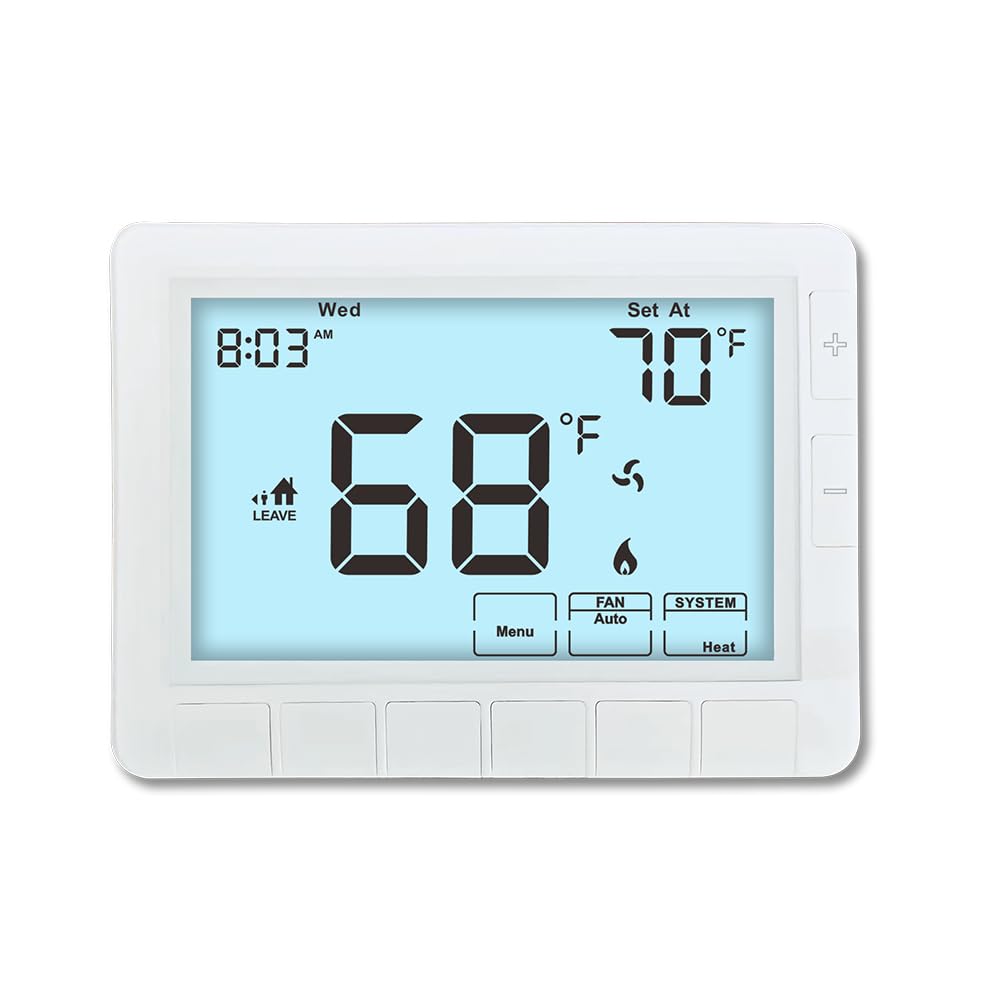
| LUX TX9600TSBest Scheduler | Full-week scheduling with big digits | 7-day programmable | Heating and cooling | Large touchscreen, 8.8 oz | Amazon |
| Coiiwsei STN7105Budget Single-Stage | Conventional single-stage on a budget | 7-day, 5/1/1 | Conventional single-stage | Extra large LCD, 6.72 oz | Amazon |
| Coiiwsei STN7155 | Multi-stage and heat pump systems | 7-day, 5/1/1 | Multi-stage, heat pump with aux | Extra large LCD, 6.72 oz | Amazon |
| PRO1 T701 | One-glance reading with a bright backlight | Non-programmable | Conventional 1 heat/1 cool | 4 sq. in. display, 9.92 oz | Amazon |
| White-Rodgers EMERSON 80 Series | Scheduling plus a very big screen | 7-day / 5-1-1 / off | Heat pump, dual fuel 2 heat/1 cool | 4.5 in. display, 8 oz | Amazon |
| PRO1 IAQ T805 | The biggest readout on the list | 7-day, 5/1/1, or non-programmable | Single stage 1 heat/1 cool | 8 sq. in. display | Amazon |
| Honeywell TH5220D1029 | Two-stage systems that need a clear screen | Non-programmable | 2 heat / 2 cool | Large backlit digital display | Amazon |
Detailed Reviews
1. White-Rodgers 80 Series 1F83H-21NP
Our pick — 4.5+★ from 250+ verified ratings; the strongest balance of quality and price.
The heat-pump thermostat that stays readable when the hallway is dark.
You get a big backlit LCD where the numbers are the first thing your eye lands on, which is the whole reason to buy it. The screen stays clear in low lighting, so a midnight check of the setpoint does not require turning on a lamp. It handles heat pump systems including dual fuel control, and it does that without an outdoor sensor, which removes a wire run most people would rather not deal with.
Installation is where this one earns its keep. It ships with a built-in level (a bubble gauge on the unit) so you can get the housing straight on the wall on the first try, and the setup menu walks you through configuration in a set sequence rather than branching all over the place. Behind the screen you get keypad lockout for households where curious hands find the buttons, plus adjustable heat and cool temperature limits so nobody can nudge the setpoint beyond a range you set. The footprint is a standard one at 6.3″D x 6″W x 4.25″H, which matters most if you are covering an existing hole from an older unit — compared with the Coiiwsei STN7105 at 1.02″D x 4.72″W x 3.54″H, this one sits considerably deeper on the wall.
What wins people over is straightforward function — it holds the setpoint without drifting and needs no menu work. Precision is the recurring theme in the feedback, with owners noting it stays right on the set temperature rather than drifting. The honest caveat is that this is a non-programmable unit: there is no schedule, no setback while you are at work, no app. That is a feature for some and a limitation for others, and if you want a weekly schedule you should look at the LUX or the EMERSON 80 Series instead. White-Rodgers backs it with a 3-year manufacturer warranty, and 5-year limited coverage if a professional installs it.
Where it holds up
- Big backlit numbers you can read in a dark hallway without switching on a light
- Built-in level makes a straight, first-try wall mount much easier
- Heat pump and dual fuel support with no outdoor sensor required
- Keypad lockout and adjustable temperature limits keep the setpoint where you put it
Where it stops short
- No scheduling at all — you set it and leave it
- Deeper body than the compact Coiiwsei units, so it stands off the wall more
Reach for this if: you have a heat pump and want one clear, readable setpoint with no menus to navigate.
Look elsewhere if: an energy-saving weekly schedule is on your list — this unit has no programming.
2. LUX TX9600TS Programmable 7-Day Touchscreen
Seven days of separate scheduling behind a touchscreen with letters big enough to read in the dark.
The display here is the reason it belongs on this list. The digits and letters are sized for a glance from across the room, and the backlight keeps them visible in low light, so you are not leaning in with your phone flashlight. It is a 7-day programmable unit, which means each day of the week can carry its own schedule instead of forcing you into a weekday block you have to fight on Saturdays.
Setup is more approachable than the feature list suggests. Owners consistently describe the programming as intuitive and the wiring as simple, with the whole job landing around a fifteen-minute project for people already comfortable at a breaker panel. The touchscreen replaces mechanical buttons, which removes the worn-button failure that eventually kills older units. At 8.8 ounces and 1.13″D x 5.38″W x 3.38″H, it is a slim panel that sits close to the wall compared with a deeper box like the White-Rodgers 1F83H-21NP at 6.3″D.
The one piece of honest friction is temperature control, which is the most divided topic in the feedback — plenty of buyers report it holds the setpoint and balances heat well across the house, while others find the reading drifts and that the unit generates a little of its own heat. A small offset is common on wall-mounted thermostats and usually correctable through the calibration setting (a menu option that corrects the displayed reading), but it is worth watching in the first week. What is not in question is the build: quality is the single most-discussed topic in the reviews and the overwhelming majority of it is positive, with owners describing it as the best thermostat they have used.
What the schedule buys you: programming earns the most praise after quality and functionality itself — owners talk about setting a different program for every day and letting the house cool while they are out.
The calibration question: if the room feels off from the number on screen, adjust the temperature offset before you assume the unit is faulty.
Suits you if: you want a full week of scheduling on a screen you can actually read without glasses.
Think twice if: you want a plain setpoint box with no menus — this one is built around programming.
3. Coiiwsei STN7105 Auto Changeover Thermostat
A slim extra-large LCD for conventional systems, as long as you check the compatibility list first.
The point of this one is the screen: an extra-large backlit LCD with clear digits and simple button controls underneath. It is also the slimmest unit in this group at 1.02″D x 4.72″W x 3.54″H and 6.72 ounces, so it sits flush against the wall and looks tidy in a hallway. Programming is a 7-day, 5/1/1 layout with straightforward menus, and it arrives with a factory pre-set energy-efficiency program so you are not starting from a blank schedule.
Where it asks you to do homework is compatibility. It covers forced air gas, oil or electric, electric furnace, hot water steam or gravity radiant heat, heat-only systems, heat pump without auxiliary or emergency heat, millivolt, 24V gas fireplaces, floor or wall furnaces, and cool-only systems. It does not cover heat pumps with auxiliary or emergency heat, dual fuel or hybrid setups, electric baseboard heat at 110-240 volts, line voltage, convectors, radiant-ceiling heat, mini splits, or 12V RV systems. Cross off your system type before you order and you avoid the most common return reason.
The auto changeover feature is the one thing to go in with your eyes open about — it is the single most negative topic in the feedback, and the switch between heating and cooling is not reliable. Treat it as a manual-mode thermostat that happens to have the feature rather than the reason to buy. Installation itself is straightforward, with large terminal blocks and a universal sub-base that owners describe getting done inside half an hour. The maker backs it with over 20 years of manufacturing experience and round-the-clock customer service.
Pick it when: you have a conventional single-stage system and the big screen is the feature you care about most.
Set it manually if: you were counting on automatic heat-to-cool switching — that part is the weak link.
4. Coiiwsei STN7155 Multi-Stage Heat Pump Thermostat
The multi-stage sibling that keeps the big screen and adds the terminals a two-stage system needs.
Physically this is the same shell as the STN7105 — 1.02″D x 4.72″W x 3.54″H and 6.72 ounces, with the same extra-large backlit LCD and push-button controls. What changes is what is behind the terminals. This version supports heat pump multi-stage and conventional multi-stage systems, including heat pumps with auxiliary or emergency heat. The narrower STN7105 above explicitly excludes auxiliary and emergency heat, so if your system has that wire, this is the one of the pair that covers it.
It still steers clear of the same hard limits: two-transformer systems, dual fuel or hybrid heating, electric baseboard at 110-240 volts, line voltage, convectors, radiant-ceiling heat, mini splits, and 12V RV setups are all off the table. Installation runs about 30 minutes with the large terminal blocks and universal sub-base, and the 7-day, 5/1/1 programming menus come pre-set with a factory energy-efficiency program you can adjust.
Functionality is the strongest part of the feedback — it works, and owners find it simple to operate. The auto changeover thread is more divided, with some reporting it does not switch as intended, and the programmability comments split the same way. The pragmatic read: wire it to your stages, set your schedule, and run it in the mode you want rather than leaning on automatic switching. Separate heating and cooling swing adjustments let you tune cycle rate for each mode, which is a genuinely useful control on a multi-stage system. There is a low battery indicator too, so a dying pair of batteries announces itself before the screen goes dark.
The reason to pick this over its sibling: auxiliary and emergency heat support — the STN7105 does not list it, and this one does.
What to watch: the automatic heat-cool switchover is the least reliable feature on the unit, so plan to switch modes yourself.
Best fit for: a heat pump or multi-stage system where the big-digit display is the priority and the wiring list checks out.
Wrong choice for: dual fuel, line voltage, or mini-split setups, which the manufacturer lists as incompatible.
5. PRO1 T701 Single Stage Non-Programmable
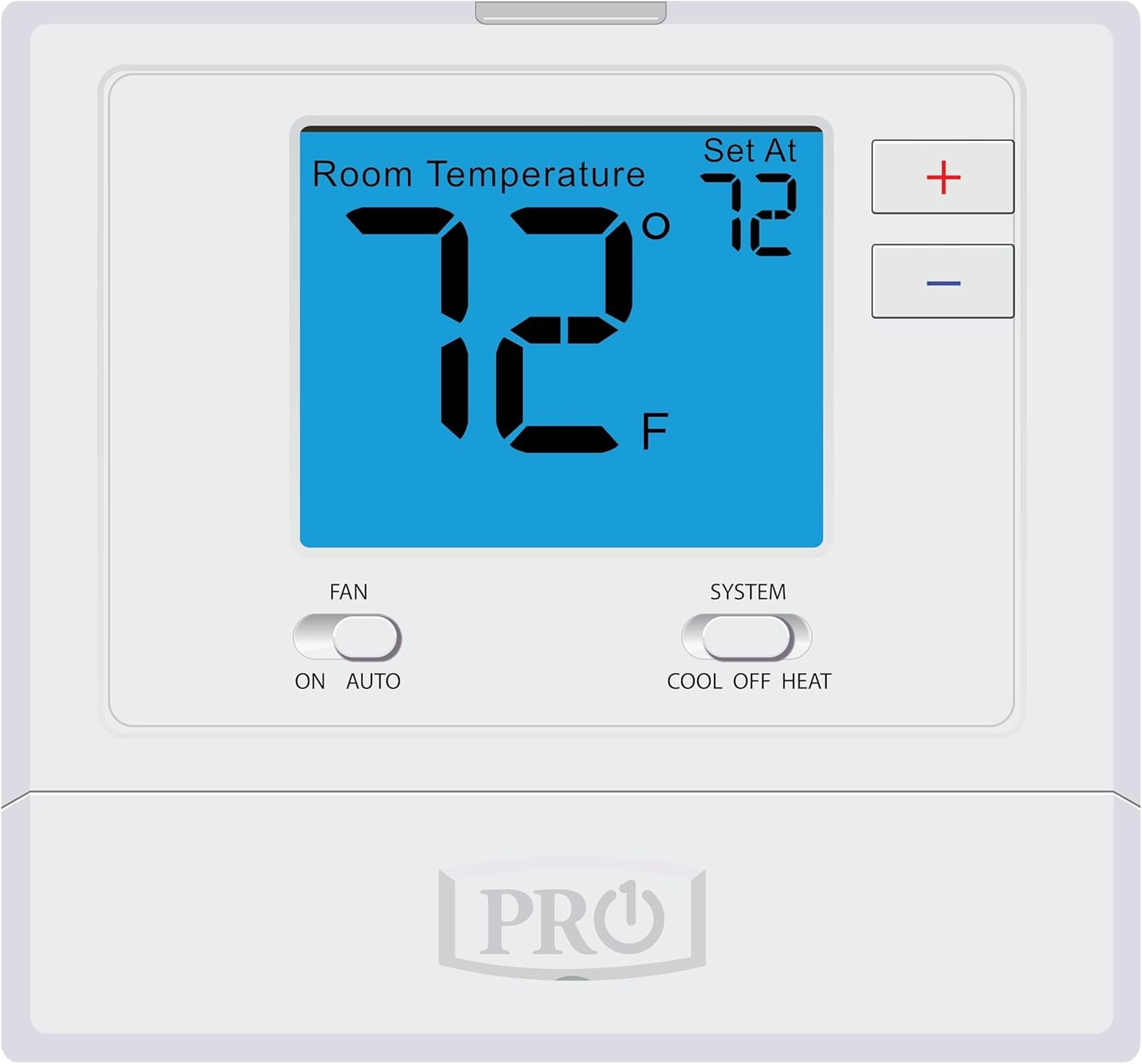
A four-square-inch blue-backlit screen with buttons that glow after the lights go out.
Compact, legible, and built for conventional gas or electric systems, this one earns its place on the backlight alone. The 4 sq. in. display carries a blue backlight, and the buttons themselves glow in the dark, which is the detail that separates it from a plain LCD — you can find and press the right button at night without hunting. At 9.92 ounces it is the heaviest unit in this group, well above the Coiiwsei STN7105 at 6.72 ounces, though that weight sits on a slim 1.1″D x 4.7″W x 4.4″H body.
Configuration is more flexible than a non-programmable label implies. You choose battery or 24V power, and there are separate swing adjustments for heating and cooling so you can set how far the temperature drifts before the system kicks back in. It also includes a 5-minute compressor delay, which protects the compressor from short cycling, plus room temperature calibration if the reading does not match a thermometer across the room. Installation uses color-coded terminal blocks on a universal sub-base, with mounting options for a flat wall surface or a junction box.
The quality consensus here is clean — customers find it excellent across the board, with no meaningful complaints in the feedback. That is the profile of a non-programmable unit: one setpoint, no menus, no schedule to maintain. What it will not do is save you energy on a schedule, because there is no programming at all. For a garage, a rental unit, or a house where someone is always home, that trade is a fair one.
The small detail that matters daily: a glow-in-the-dark button plus a blue backlight means nighttime adjustments happen without turning anything else on.
The limit: no schedule and no setback, so you get one setpoint and no energy-saving automation.
Good match for: conventional single-stage setups where a bright, dark-friendly screen is worth more than a weekly schedule.
Not for you if: your system is a heat pump, multi-stage, or line voltage — this one is built for 1 heat/1 cool conventional only.
6. White-Rodgers EMERSON 80 Series Programmable Heat Pump
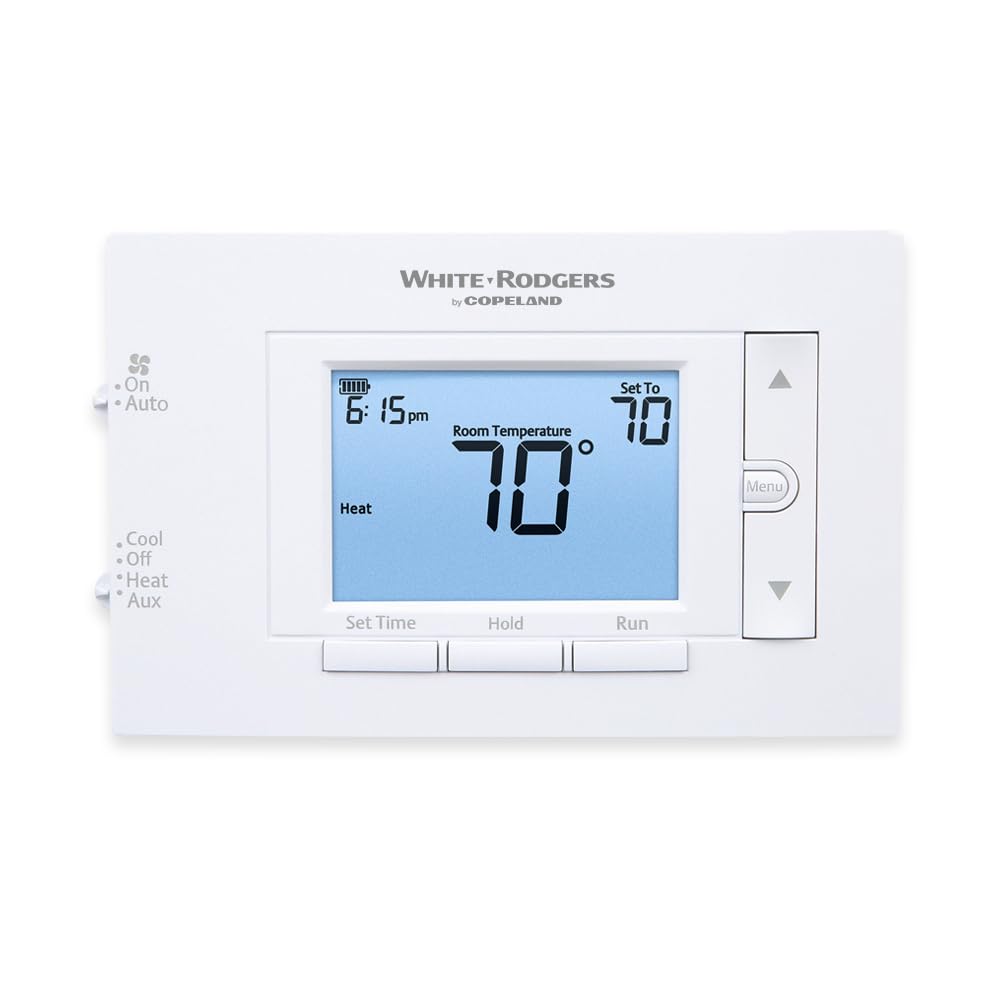
Four and a half inches of readable display behind a scheduling menu you can actually turn off.
This is the thermostat for someone who wants a genuinely large screen and the option to schedule, without being locked into either. The 4.5 inch display stays easy to read in low lighting, and the backlight button lets you bring it up on demand rather than glow all night. Programming is selectable — 7-day, 5/1/1, or off entirely — so you can run a full weekly schedule or switch to plain manual control and never touch a menu again.
System support is where it separates from the cheaper units. It handles 2 heat/1 cool heat pump setups, and dual fuel comes standard with no sensors needed, which removes the outdoor sensor run that some heat pump thermostats require. It is wired rather than wireless at 6.4″D x 4.4″W x 2″H and 8 ounces, so plan on the usual terminal connections. The built-in level indicator, pluggable terminals, and streamlined configuration menu make the install a shorter job than the feature list suggests.
Quality is the standout in the feedback — nearly all of it positive, with owners describing the unit as meeting their expectations outright. It handles air conditioning, heat pumps, and traditional baseboard hot water heat, and owners say it holds the temperature you ask for. The recurring note is temperature accuracy, where a small number report drift; the calibration menu is the fix, as it usually is. Advanced controls include a keypad lock, temperature limits, and the backlight button. Compared with the PRO1 T701’s 4 sq. in. screen, this one gives you noticeably more display area to read from a distance.
What earns the price
- 4.5 inch display readable in low lighting with a backlight button
- Programming that can be set to 7-day, 5/1/1, or switched off
- Dual fuel standard with no outdoor sensors required
- Built-in level indicator and pluggable terminals shorten the install
Where it asks for patience
- Temperature accuracy draws a few complaints — calibrate in week one
- Wired only, with no app or wireless control
Worth it for: heat pump owners who want a big screen plus the freedom to schedule or not schedule.
Skip if: you need app control or remote access — this one is a wall-mounted wired unit through and through.
7. PRO1 IAQ T805 Programmable Thermostat

Eight square inches of temperature readout — the biggest number display in this entire group.
If big numbers are the only requirement, this unit sets the bar with 8 sq. in. of display. The 8 sq. in. display dwarfs the PRO1 T701’s 4 sq. in. screen and edges past the EMERSON 80 Series at 4.5 inches, which translates into digits you can read from a doorway without stepping closer. It is a single-stage 1 heat/1 cool control, so it is aiming at the conventional systems most homes actually have.
Flexibility is the second story. You can run it as a 7-day schedule, a 5/1/1 schedule, or non-programmable, and it takes power from batteries or a hardwire connection so you are not stuck if there is no C-wire. Installation is reported as extremely easy, and the adjustable swing feature lets you tune how far the temperature moves before the system responds. Longevity shows up in the feedback too — units still running after eight years of service.
Be ready for a menu that rewards patience. Programmability is the split topic here, with some finding the options too complex compared with the simple satisfaction of the big screen, and the display feedback splits on the backlight being awkward to switch off. Those are setup-time frictions, not daily-use failures, and they fade once the schedule is entered. What stays is that headline readout — put simply, you will not find a larger temperature display on this list.
Why it wins on readability: 8 square inches of active display area beats every other unit reviewed here.
What to expect going in: the programming menus are deep, and the backlight control takes a little getting used to.
Choose it for: the single largest readout available on a single-stage thermostat, in a hallway where distance reading matters.
Pass if: you want menu-free operation — the setup asks for some patience.
8. Honeywell TH5220D1029 FocusPro 5000

Two-stage control with a backlit screen that stays readable whether the hallway is bright or dim.
The big, clear backlit digital display on this one adjusts to whatever light you have, which is the entire reason it made this list. It is a non-programmable unit, so it holds one setpoint with no schedule to manage. Where it earns its keep is system depth: it is rated for 2 heat and 2 cooling stages, putting it in the same territory as the Coiiwsei STN7155 and ahead of the single-stage units like the PRO1 T701.
The battery door is the detail that saves a service call. It flips out so you can swap the batteries without pulling the thermostat off the wall or disassembling anything, and the unit is dual-powered so it can run on batteries, hardwired 24-volt power, or both. That flexibility matters when you are replacing an older unit and are not sure whether a C-wire is present. It is built in the United States and the controls are a simple four-button layout for people who do not want a touchscreen.
Functionality carries the feedback comfortably, and ease of use is unanimously described as simple. The two areas that split are temperature readings — some find the unit reports a few degrees warmer than the actual room, which calibration can fix — and the controls, where a few mention buttons getting stuck over time. Readability is a clear positive, which is the whole reason you would pick this one over a cheaper non-programmable box. It is also the most expensive unit here, so the premium is really for stage support and the flip-out battery access.
What the extra stage support gets you
- Handles 2 heat and 2 cooling stages, which single-stage boxes cannot
- Flip-out battery door means no disassembly to change batteries
- Dual-powered on batteries, 24-volt hardwire, or both
- Backlit display readable in both bright and dim rooms
What to know before you order
- No programming at all — one setpoint, always
- A few report temperature drift and stuck buttons over time
Right unit when: you have two heating and two cooling stages and want a clear screen without a schedule to babysit.
Consider another pick if: you want programming — this one holds a single setpoint and nothing more.
Know the Specs
Display size and backlight
Display size is usually listed in square inches or as a screen diagonal in inches, and it is the number that predicts how far back you can stand and still read the temperature. An 8 sq. in. screen like the PRO1 T805 carries taller digits than a 4 sq. in. one like the PRO1 T701. Backlight is the second half of the equation — a large LCD without one goes dark when the ambient light drops, so a dim hallway at night leaves you guessing. Look for both: a listed screen size and an explicit backlight or backlit display claim.
Non-programmable versus programmable
A non-programmable thermostat holds one setpoint until you physically change it. A programmable one runs a schedule — 7-day lets you set every day separately, while 5/1/1 groups weekdays together and gives the weekend its own block. Programming can lower your energy use while you are out, but it also adds menus, and more menus means more button presses between you and the number you want to read. Some units, like the EMERSON 80 Series, let you switch programming off entirely, which is the most flexible arrangement.
System compatibility
Every thermostat lists what it controls, and the “not compatible” list matters as much as the positive one. Conventional single-stage means one heat wire and one cool wire. Heat pump adds a reversing valve wire, and heat pump with auxiliary or emergency heat adds more. Multi-stage means two heat and two cool terminals. Line voltage systems, electric baseboard, mini splits, and 12V RV setups do not work with these low-voltage units at all. Check your existing wire labels against the compatibility list before ordering.
Power source and battery access
Some thermostats run on AA batteries, some on 24-volt hardwired power, and some on either. Battery-only units are the simplest drop-in replacement when you do not have a C-wire, but you become responsible for changing batteries — a low battery indicator warns you before the screen goes blank. Dual-powered units let you choose, which is the safest option when you are not certain what is behind your old thermostat. A flip-out battery door, like the one on the Honeywell TH5220D1029, saves you from pulling the whole unit off the wall.
Common Questions
Will a big-number thermostat work with my heat pump?
Do I need a C-wire for a large-display thermostat?
Is a non-programmable thermostat worse than a programmable one?
How big is the display on these thermostats?
Can I read the display without turning on a light?
Will a thermostat for a two-stage system work on a single-stage system?
Why does my thermostat read a different temperature than a thermometer nearby?
Can these thermostats control electric baseboard heaters?
How long do the batteries last and is there a warning?
Does a bigger screen mean the numbers are actually easier to read at distance?
The Bottom Line
Every unit here has a readable display, so the real decision is whether its terminals match your system wiring. The White-Rodgers 1F83H-21NP is the pick to start with — it pairs a big backlit display with heat pump and dual fuel support (dual fuel means it can run a heat pump and a backup furnace), adds a built-in level for a straight first-try mount, and brings a 3-year manufacturer warranty plus 5-year limited coverage on a professional install. If you want a schedule on top of a readable screen, the White-Rodgers EMERSON 80 Series gives you a 4.5 inch display and programming you can switch off entirely. And if absolute display size is the only thing that matters, the PRO1 IAQ T805 puts 8 square inches on the wall and simply has no rival here.
How we choose
We do not accept paid placement. Every pick is matched to a real buyer and a real use-case; we do not hands-on test units.
Sources
Specifications: manufacturer listings and product documentation. Review insights: verified customer reviews, as of November 2026. Pricing: not shown on this page (it changes often); check the current price via the retailer link.
As an Amazon Associate, Tactical Gear Guy earns from qualifying purchases. This does not affect which products we feature.