Specs are compiled from manufacturer listings and verified buyer reviews and can change over time — please confirm the key details on the product page before buying.
You want cinema sound without turning your living room into a speaker showroom. The good news is that small surround speakers can deliver crisp dialogue and effects that circle behind your head. The catch is that “small” means different things on different listings, and some compact sets ask for an amplifier you may not own. This guide separates the genuinely compact sets from the oversized ones.
This guide is built by comparing the manufacturers’ published specifications and the patterns across verified customer reviews, so you get each pick’s real strengths and trade-offs instead of marketing spin.
Below you will find nine compact speaker sets lined up by what they actually do well, from a premium Polk pair down to tiny swiveling cubes. Read on for the smallest surround sound speakers that fit a real room and a real budget.
Top Picks


How To Choose The Best Smallest Surround Sound Speakers
The first thing to settle is whether you already own an amplifier. Passive speakers make no sound on their own — they need an AV receiver or amplifier to push power into them. If you are coming from a soundbar with no receiver, a passive set means buying another box before you hear a single word of dialogue.
Frequency response tells you what you will actually hear
Look at the top of the frequency response range first. A speaker that reaches 40 KHz (kilohertz, a measure of how high a pitch it can reproduce) is covering the treble end with room to spare, which keeps cymbals and dialogue detail clean. A speaker that tops out at 20 KHz covers the standard range and is perfectly fine for surround duty. Neither number is a guarantee of quality — it tells you the ceiling of what the driver is built to reach.
Driver size and where the cabinet will live
The driver is the round cone that actually moves the air. A 2.5-inch driver (about the width of a soda can) is a true micro speaker — brilliant for wall-mounted surrounds behind a couch, thin on output in a large room. A 3-inch or 4-inch driver gives you more clean volume without much more cabinet. Measure the shelf, wall, or stand you plan to use before you order, because a compact speaker that does not fit is no longer compact.
Mounting hardware decides your room’s sound
Surround speakers work best at or just above ear height. Keyhole slots and threaded inserts on the back let you wall-mount at the right spot; a threaded insert takes a bracket or stand bolt. If the listing says mounting kit included, check what that kit actually holds. Clip-on stands and tape do not hold a cabinet safely.
Side-by-Side Comparison
| Model | Best For | Driver Size | Frequency Response | Power Requirement | Amazon |
|---|---|---|---|---|---|
| Polk Audio Signature Elite ES10★ Best Overall | Whole-room movie nights | 4″ woofer + 1″ tweeter | 40 KHz | 4- and 8-Ohm compatible, needs amplifier | Amazon |
| Polk Audio Blackstone TL1Tight Space Pick | Tight wall placement | 2-1/2″ long-throw driver | — | Passive, needs amplifier | Amazon |
| Saiyin 5.0 (235W)Whole Set Value | Full 5.0 set on a budget | 5.2 cm horn tweeter | 20 KHz | Passive, 235W peak total | Amazon |
| Pure Resonance MC2.5B | Aiming sound at a seat | 2.5″ per cube | — | Passive, wired | Amazon |
| Saiyin 5.0 HiFi | Dialogue clarity | 3″ bookshelf + center | — | Passive, 6 ohm, needs AV receiver | Amazon |
| Monoprice rich Satellite | Atmos height effects | 3″ woofer + 3/4″ tweeter | — | 100W input power | Amazon |
| Micca OoO Slim | Slim shelves and cabinets | Two 3″ square woofers | Bass to 60Hz | Passive, RCA/wired | Amazon |
| Klipsch Flexus SURR 100 | Flexus soundbar owners | 6.75″ driver | — | Individually powered, wall outlet each | Amazon |
| Klipsch R-40SA | Atmos overhead sound | 4″ woofer + 1″ tweeter | — | Wired, needs amplifier | Amazon |
Detailed Reviews
1. Polk Audio Signature Elite ES10 Surround Speakers, Pair
Our pick — 4.5+★ from 900+ verified ratings; the strongest balance of quality and price.
Two compact cabinets that put real bass pressure behind your couch.
This pair is for the movie watcher who wants surround that carries weight, not just a few treble sparkles. The ES10 combines a 1″ Terylene tweeter (the small dome that handles high notes) with a 4″ woofer (the cone that moves the low end) behind a crossover that splits the work between them. You get a lifelike soundstage from a cabinet that still counts as bookshelf-sized.
The spec that earns it the top spot is the frequency response reaching 40 KHz. Compare that with the Saiyin 5.0 set at 20 KHz, and the Polk is built to stretch twice as high into the treble — that gap is what keeps dialogue crisp and cymbals from turning to mush. Polk’s Power Port design is rated 3dB louder in the bass than a conventional ported cabinet, which shows up as a firmer thump during explosions and soundtrack drops. It is an early-hours-of-the-morning kind of bass, not subwoofer bass, but it is more than most compact satellites manage.
Setup is forgiving. The speakers run 4- and 8-Ohm compatible, so they work with most amplifiers and AV receivers, including Dolby Atmos and DTS:X units. Use them as side, rear, or improve surrounds, or set them on stands and fire them directionally from wall inserts and keyhole slots. The matching timbre means they blend with the rest of the Signature Elite line if you add a center or towers later.
What sounds right
- 40 KHz top end — double the reach of the Saiyin 5.0 set at 20 KHz
- Patented Power Port rated 3dB louder in the bass than conventional ported cabinets
- 4- and 8-Ohm compatibility across most receivers and amps
- Wall inserts and keyhole slots for directional mounting
What to know before you buy
- Stands are sold separately, so budget for mounting hardware
- Passive design — nothing plays until an amplifier or receiver drives it
Buy this pair if: your priority is full-range surround with bass you feel, and you already have a receiver ready to power them.
Keep looking if: you want a plug-and-play box or a single speaker rather than a matched pair.
2. Polk Audio Blackstone TL1 Satellite Speaker, Single
The smallest Polk here — a single satellite for spots a bookshelf cannot reach.
Need to fill one awkward corner or match a speaker you already own? The TL1 sells as a single cabinet, where the ES10 gives you a pair. It is genuinely tiny, built around a 2-1/2″ long-throw driver (a small woofer that moves plenty of air for its size) and a 1/2″ silk dome tweeter (the soft-dome part that plays the high notes). The tweeter and mid-bass center sit on the same plane behind a grille that shapes the sound, an arrangement Polk calls Time Lens — in plain terms, it helps the high and low notes arrive together so the vocals stay locked to the screen.
That size limit is honest. Comparing it to the ES10’s 4″ woofer, this 2-1/2″ driver moves far less air, so you are getting surround detail rather than room-shaking volume. The rear aperiodic port (a vent tuned to control airflow) is designed to hand off bass duties to a subwoofer, adding extension without the muddiness a plain port can introduce. Its curved cabinet uses non-parallel walls to cut internal resonance, and the mirror-black finish earns the “looks that kill” reputation Polk advertises. Value is the recurring theme in the reviews, and it holds up: this is a lot of speaker construction for an entry-level price.
Treat mounting as a small homework project. Reviewers who wall-mounted found it easy; a few wanted hardware beyond what came in the box, so measure your bracket before the drill comes out. It runs passive, so your receiver still does the powering.
Small package, real texture: the Time Lens alignment and curved cabinet make it read larger than a 2-1/2″ driver has any right to.
It is one speaker: plan a second unit for a true left-right surround pair.
Reach for it when: you need to fill one tight gap and already run a receiver.
Pass if: you are setting up a fresh pair and want both sides in one order.
3. Saiyin 5.0 Surround Sound Speakers, 235 Watts Peak Power
Five speakers in one box, so your corner placement is decided for you.
This set is the quickest route to a full surround spread. You get four identical 40W-peak passive speakers plus a 75W-peak center, for 235W of total peak power. Put the four compact units in the corners and you have a room-filling layout without hunting down matching singles. A 52MM horn tweeter (a flared guide that spreads the high frequencies) pushes treble outward more widely, so the dialogue reaches the back row. It reads clearly even when the volume is modest.
The MDF cabinets deserve a mention that goes beyond looks. MDF (a dense pressed wood board) holds its shape and seals better than thin plastic, which cuts cabinet rattle and firms up the low end. The grain texture is visible, and the vintage-inspired finish is the sort of thing guests comment on before the movie starts. Each cabinet has a keyhole mount and a threaded insert on the back, and a mounting kit is included.
Here is the part listings bury: this is a passive set. You need an external AV receiver or amplifier to drive it, and speaker wires are not in the box. Plan for both before the set arrives. The frequency response tops out at 20 KHz, which is the standard ceiling for surround speakers — fine for the role, just not the extended range the Polk ES10 pair offers.
The set advantage: one order, five matched speakers, and the center channel comes included rather than sold apart.
The setup tax: receiver and speaker wire are on you, so factor them into the budget.
Worth it if: you are starting a 5.0 setup from scratch and want every speaker in one purchase.
Look elsewhere if: you need a powered, plug-and-play solution.
4. Pure Resonance Audio MC2.5B Speaker Pair

Four tiny cubes you can swivel until the sound lands exactly on your seat.
For a hard-to-aim room, this pair does something most compact speakers cannot. Each stack holds two 2.5″ cubes, so four drivers in total per side, and the array pivots independently left and right. You point the sound instead of repositioning the cabinet. That matters in a narrow living room where one couch sits off-center and the surrounds cannot sit symmetrically.
The 2.5″ drivers carry rubber surrounds with metal grilles over the front. Driver-for-driver, that puts it in the micro class — the Saiyin 5.0 set’s 3″ bookshelf drivers move more air per cabinet. The trade is size and control: these cubes hide in corners and aim where you want them. Owners drawn to them tend to be people who want a compact satellite set that mimics far costlier results, and the value read is squarely positive.
The catches are practical. Brackets are not included, and the listing is explicit about it, so budget for a wall mount before you plan the install. They are passive and wired, so a receiver or amplifier still drives them. And the swivel is the whole point: give yourself a minute to aim each cube at the listening position before you tighten anything.
Best trick in the box: independent pivoting on each cube stack lets you fix a lopsided room without moving furniture.
Two things to buy separately: mounting brackets and a receiver to power them.
Ideal for: awkward rooms and off-center seating where you need the speakers to aim at you.
Not for: anyone who wants brackets in the package.
5. Saiyin 5.0 Home Theater System, HiFi Surround Sound Speakers

Built around a center speaker, because mumbled dialogue is the real home theater villain.
If you have ever sat closer to the TV to hear what a character is saying, this set addresses the actual problem. Four 40W-peak bookshelf speakers come with a 75W-peak center channel, and that center does the hard work of pinning dialogue to the screen. The cabinets use 3″ passive drivers, and this is where it pulls ahead of the MC2.5B cubes: a 3″ driver versus a 2.5″ driver means noticeably more cone area per speaker. In a room where you actually sit back on the couch, that size difference translates to cleaner speech at low volume.
Each driver is full-range, so the center and bookshelf speakers share the same voice, and the classic wood-grain cabinets cut resonance while looking pleasant in a living room. You can mount them on shelves, stands, or the wall, and the number and position of speakers can be adjusted to fit the room.
The compatibility note is essential: this is a passive set rated at 6 ohm (ohms measure electrical resistance). That rating is friendly to most AV receivers, but you still need one, plus speaker wires, since neither is included. On size, the opinions split — some owners want even more compact cabinets. Match it to a room where the speakers have breathing room rather than a plug-in build.
Where it earns its spot
- Dedicated center channel tuned to keep dialogue clear
- 3″ drivers versus the 2.5″ cubes on the MC2.5B — more cone area per speaker
- Handcrafted wood-grain enclosures built to reduce resonance
- Flexible placement on shelves, stands, or walls
Honest limits
- Passive; receiver and speaker wires are not included
- Cabinet size draws mixed reactions — some want smaller
Go with this if: clear speech in movies and shows tops your wish list.
Think twice if: you need the absolute smallest cabinet on your shelf.
6. Monoprice Premium rich Satellite Speakers, Pair

A speaker that bounces sound off the ceiling so you skip the in-ceiling install.
The whole idea here is height, and it is clever. An extra driver fires upward, the ceiling reflects it back down, and you get the sensation of sound arriving from above without cutting a hole in your drywall. It is built to work with Dolby Atmos-enabled receivers and soundtracks. Underneath the trick sits honest hardware: a 3″ polypropylene woofer, a 3/4″ aluminum dome tweeter, 100 watts of input power, and 88 dB sensitivity. That sensitivity number means it does not take much amplifier effort to make it loud.
Mounting is the standout. A universal 1/4″X20 threaded insert takes the same style of bolt as camera gear, which opens up a range of brackets and stands. It is also compatible with a wide spread of receivers, so it slots into existing gear without fuss. The up-firing driver works best with a flat, not-too-high ceiling in front of the listening spot, so check your room before you commit.
One caution before you buy: owner feedback flags durability, with some units reportedly failing quickly. Treat it as a potential-warranty item — Monoprice covers it with a 1-year replacement warranty and a 30-day money-back guarantee. If Atmos height effects are the goal and you accept that risk, the ceiling trick is genuinely fun.
The Atmos shortcut: an upward driver plus ceiling reflection gives you overhead sound with no in-ceiling speakers.
Know the trade: some buyers report short lifespans, so the 1-year replacement warranty is your safety net.
Choose it when: you want overhead Atmos effects without an install and have a receiver ready.
Instead pick: a set with a stronger durability record if longevity matters more than height effects.
7. Micca OoO Bookshelf Speakers Walnut

The slim cabinet that disappears into a media shelf and still reaches real bass.
You get real low-end from a slim box: two 3″ square-frame woofers sit in a ported enclosure (a cabinet with a tuned vent) per cabinet, and the bass reaches a usable 60Hz — low enough that explosions and bass lines land as sound, not a whisper of treble. That low-end extension is why it works as a genuine surround or front pair. A 0.75″ silk dome tweeter handles the highs, and the crossover (the circuit that splits frequencies between drivers) uses a 6dB/octave low-pass on the woofers plus a 12dB/octave high-pass on the tweeter — plain English: each driver is filtered so it only plays the range it handles best.
The shape earns its keep. Lay it horizontally and it becomes a center channel; stand it upright for bookshelf duty; add optional wall brackets and it turns into a surround. In narrow media cabinets the OoO fits where rounder speakers cannot, and reviewers single out the low profile for that reason. Voice-wise, the 3″ square woofers put it in the same size family as the Saiyin 5.0 bookshelf units, but with a slim footprint those are not matched for.
It runs passive and wired, so a receiver or amplifier is still in the picture. The trade-off is simple: this is bass extension through enclosure design, not subwoofer punch, and the top end is tuned for smooth rather than sparkling. For a compact shelf setup, that balance is exactly right.
Specs that pay off
- Two 3″ square woofers per cabinet with bass to 60Hz
- 0.75″ silk dome tweeter with level matching
- Three placements: horizontal center, upright bookshelf, wall surround
- Slim housing that fits narrow cabinets and under monitors
The non-negotiables
- Wall brackets are optional and sold apart
- Passive design — it needs a receiver or amplifier
Made for: tight shelves, media cabinets, and anyone who wants one speaker that flexes between center and surround duty.
Weigh first: if you need wall mounts, add the bracket to the order.
8. Klipsch Flexus SURR 100 Surround Sound Speakers
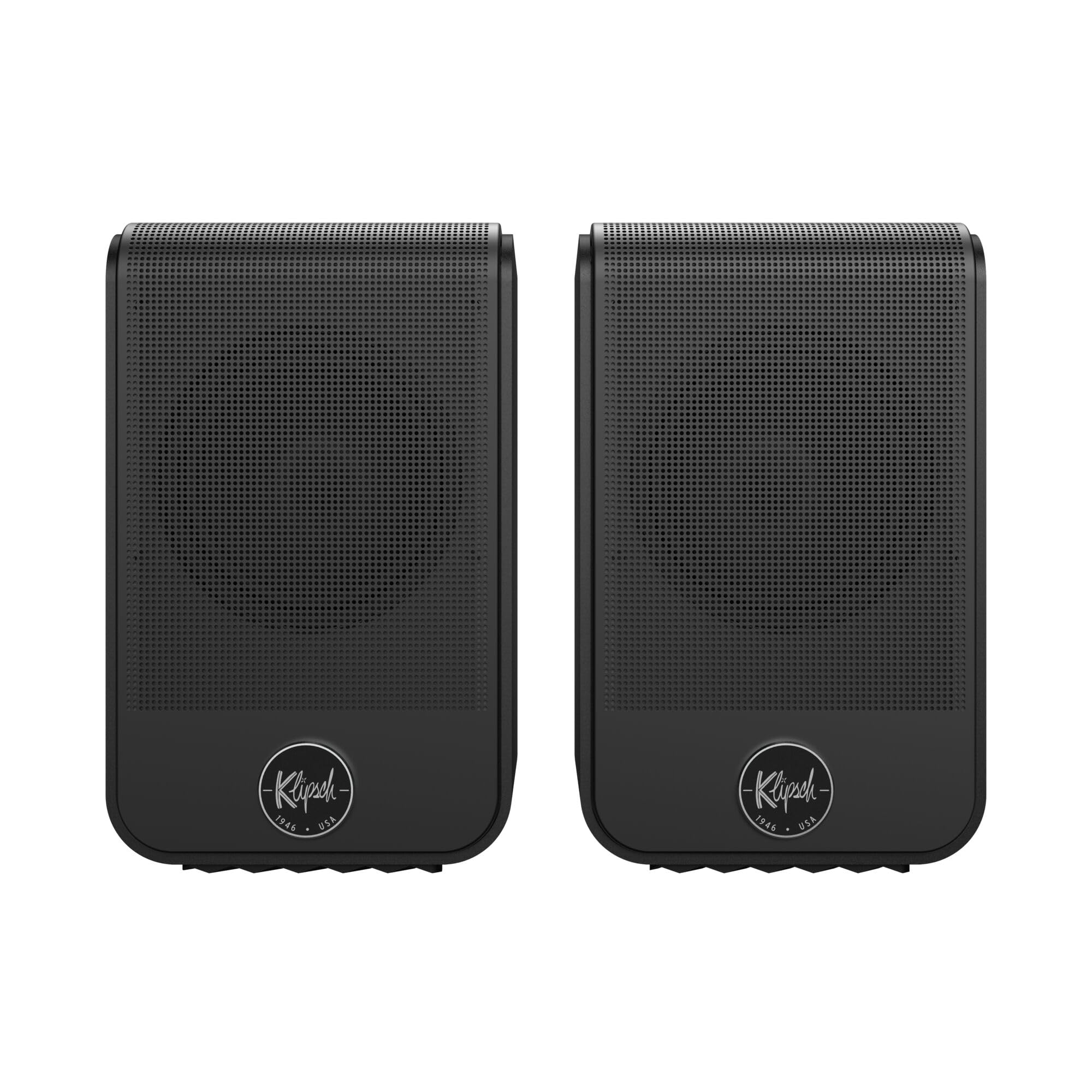
Surround speakers for Flexus soundbar owners — and no one else, by design.
This is the set to consider only if you already run a Klipsch Flexus CORE 100 or CORE 200 soundbar. The listing is direct about it: it works exclusively with those bars. Get past the gate and the appeal is clear. Each surround speaker plugs independently into a wall outlet, so you can skip running speaker cable across the floor. Controls, power, and LED lights sit hidden below the surface so a dark room stays dark.
The Atmos promise is real on paper. The Flexus system places music, movies, and games around and above you, and Klipsch Transport technology keeps multi-channel connections quick. The catch is the sound itself: owner feedback on the volume and output is mixed, with several finding the output disappointing. Klipsch also ran over 1,000 tests on the Flexus line, per its own testing process, which speaks to build consistency rather than loudness in your room. Because it is powered and individually wired, do not expect to pair it with a third-party receiver.
The 6.75″ driver is the largest on this list, and the wall-mountable design keeps placement tidy. But the pairing gate plus a price that several owners question makes this a fit call rather than a broad recommendation.
Clean install: each unit powers straight from a wall outlet, so no speaker wire crosses your floor.
The narrow fit: exclusively Flexus soundbar owners, with mixed reports on volume, so audition against your room’s expectations.
Fits you if: you own a Flexus CORE 100 or CORE 200 and want cable-free surrounds.
Steer clear otherwise: the set will not pair outside the Flexus line.
9. Klipsch R-40SA Speaker Pair

Overhead sound for the listener who treats the ceiling as the last frontier.
Dolby Atmos enabled speakers work by dedicating drivers to the height channels. This pair sits on top of your existing speakers or serves as improve surrounds, giving you a hemisphere of sound rather than a flat wall of it. The 90° x 90° Tractrix horn (a flared guide that controls how the highs spread) aims treble across a wide area, which is why it reads as a more accurate soundstage. That horn control is the recurring praise: the highs come across clean.
Driver hardware backs it up. A 1″ LTS aluminum tweeter runs on Kapton suspension to keep distortion down, while 4″ spun-copper TCP woofers borrow cone angling from Klipsch’s higher series for accuracy. The cabinet is reinforced 3/4″ MDF with a new bracing design, and the textured wood-grain vinyl is made to resist scratches. At 7″ tall, 5.75″ wide, and 12.7″ deep, each cabinet is compact enough for a shelf or atop a tower. It is the pair for a serious Atmos build; the MC2.5B cubes and this share a compact aim, but only this pair brings the horn and bracing.
It is wired and passive, so an amplifier or receiver still drives it, and the price puts it in premium territory. If Atmos is the goal and the budget allows, the build quality is the standout reason to choose it.
Where the money goes: the horn, the aluminum tweeter, and the braced MDF cabinet are all visible, tangible upgrades.
Cost of entry: it is premium-tier, and your receiver must already handle height channels.
Pick it if: you are building a true Atmos setup and the horn-driven soundstage is worth the premium.
Skip if: you want a simple pair to add surround without a height-channel receiver.
Know the Specs
Frequency Response
This tells you the range of pitches a speaker can reproduce. A low number covers bass, a high number covers treble. A top end of 40 KHz means the tweeter is built to reach far up the scale; 20 KHz is the standard ceiling for surround work. Neither number promises great sound, but comparing them across products gives you a clue about how much treble headroom each cabinet has.
Driver Size and Sensitivity
The driver is the moving cone that makes sound. Bigger drivers move more air and give you fuller bass. Sensitivity, measured in dB, tells you how loud a speaker gets from a given amount of amplifier power — 88 dB means it does not need much juice to play loud. Pair a low-sensitivity speaker with a small amplifier and you may run out of volume before you run out of movie.
Impedance and Power
Impedance in ohms measures electrical resistance. A 4- and 8-Ohm compatible speaker works with most receivers. A 6 ohm rating also fits most AV receivers. Some sets are passive and need a receiver or amplifier plus speaker wire; others are individually powered and plug into a wall outlet. Know your setup before you buy.
Dolby Atmos and Height Channels
Atmos places sound above and around you. Some compact speakers have an upward-firing driver that bounces sound off the ceiling; others require an Atmos-enabled receiver. If your receiver handles Atmos, elevation speakers can add that overhead dimension. If not, a standard surround pair still delivers the rear and side immersion.
Common Questions
Do I need an AV receiver for compact surround speakers?
What is the difference between a passive and a powered surround speaker?
Can small speakers really deliver surround sound?
How high should I mount my surround speakers?
Will the Polk ES10 work with my existing receiver?
What does frequency response tell me about a speaker?
Can I use bookshelf speakers as surround speakers?
Which is better for Atmos, upward-firing speakers or elevation speakers?
Are speaker wires included with these surround sets?
How do I match surround speakers to my existing system?
The Bottom Line
Want the best all-around set? The Polk Audio Signature Elite ES10 pair is the one to beat — a 40 KHz top end (highs well past what you can hear), Power Port bass rated 3dB louder than a conventional port, and 4- and 8-Ohm compatibility that fits most receivers. Need dialogue clarity in a compact room? The Saiyin 5.0 Home Theater System brings a dedicated center channel (a speaker built to anchor voices to the screen). Want the absolute slimmest cabinet? The Micca OoO fits media shelves most others cannot touch. And if you already own a Klipsch Flexus soundbar, the Flexus SURR 100 removes the speaker wiring entirely. Any of these small sets will beat a soundbar for true rear immersion — pick by room, receiver, and how much bass you want to feel.
How we choose
We do not accept paid placement. Every pick is matched to a real buyer and a real use-case; we do not hands-on test units.
Sources
Specifications: manufacturer listings and product documentation. Review insights: verified customer reviews, as of November 2026. Pricing: not shown on this page (it changes often); check the current price via the retailer link.
As an Amazon Associate, Tactical Gear Guy earns from qualifying purchases. This does not affect which products we feature.