Specs are compiled from manufacturer listings and verified buyer reviews and can change over time — please confirm the key details on the product page before buying.
You do not need a bigger fan. You need a fan that actually moves cubic feet per minute — CFM, the number that tells you how much air gets pushed through a room. Most store-shelf fans look impressive and move almost nothing. The ones below move real air, and the top pick pushes 5300 CFM through a 20-inch metal frame while still bolting to your garage wall.
This guide is built by comparing the manufacturers’ published specifications and the patterns across verified customer reviews, so you get each pick’s real strengths and trade-offs instead of marketing spin.
Every pick here is a floor or drum fan built to move air, not to decorate. Below you get the airflow numbers, tilt ranges, metal construction, and noise reality of each one. That way you can match a fan to your shop, garage, or barn the first time with the powerful cooling fan that fits.
Top Picks

How To Choose The Best Powerful Cooling Fan
Start with the airflow number, not the fan’s looks. A high-velocity floor fan exists to move a volume of air across a room, and that volume is printed as CFM. Two fans the same size can be hundreds or thousands of CFM apart, and that gap is the entire reason you are shopping.
Read the CFM before anything else
CFM stands for cubic feet per minute — the exact volume of air the fan shifts each minute. A fan rated at 8700 CFM fills a warehouse scale space in a way a 4000 CFM unit cannot. Match the number to the room: a bedroom or home office needs far less than a three-bay garage. If you only remember one spec from this guide, make it this one.
Match the fan body to where it sits
These are floor and drum fans, not desk fans, so placement matters. A drum fan rolls on casters and stands tall in a workshop. A compact floor fan like a 16-inch model tucks into a basement corner. Some units also wall-mount, which frees floor space and puts the airflow exactly at head height in a shop bay.
Decide how much noise you can trade for air
Moving thousands of CFM makes sound — that is physics, not a defect. Every fan in this group has a noise verdict that runs mixed, with the loudest complaints arriving at top speed. The trick is a fan with usable lower speeds, so you get strong airflow without running it flat out all day.
Look at motor type and construction
A brushless DC motor and permanently lubricated motor are built to run long stretches without fuss. All-metal housings, powder-coated finishes, and aluminum or metal blades resist rust and warping in a humid garage. Plastic-bodied fans are lighter to carry, but they do not shrug off years of shop use the same way.
Side-by-Side Comparison
| Model | Best For | Max Airflow | Blade Size | Speeds | Amazon |
|---|---|---|---|---|---|
| HiCFM 20″ 5300 CFM★ Best Overall | Garage and shop with wall-mount option | 5300/5000/4700 CFM | 20 inches | 3 | Amazon |
| Vornado Model 80Crowd Favorite | Whole-room circulation at a low setting | — | 16.15 inches | 5 | Amazon |
| Vornado Model 80XBest Control | Fine-tuned airflow and timer control | — | — | 99 | Amazon |
| Tornado 20″ | Quiet-ish industrial airflow with a long cord | 4750/4200/3800 CFM | 20 inches | 3 | Amazon |
| DEWALT DXF1616 | Compact shop fan that hangs or wall-mounts | 1800/3000/4000 CFM | 14.6 inches | 3 | Amazon |
| VEVOR 24″ Drum Fan | Warehouse scale cooling on casters | 8700 CFM | — | 3 | Amazon |
| iLIVING 20″ Barrel Drum | Stepless quiet control in a garage or shop | 5703 CFM | — | Stepless | Amazon |
| WARMLREC 24″ | Maximum output for very large spaces | 8900 CFM | 24 inches | 3 | Amazon |
Detailed Reviews
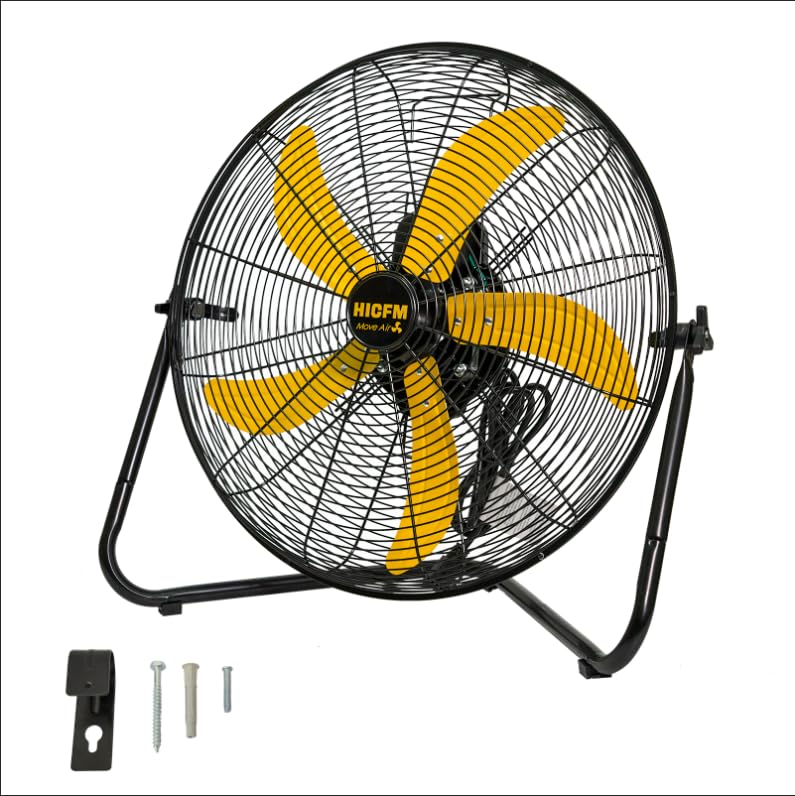
1. HiCFM 20″ 5300 CFM High Velocity Metal Floor Fan
Our pick — 4.5+★ from 250+ verified ratings; the strongest balance of quality and price.
The shop fan that fills a garage with moving air and then bolts to the wall.
Here is the number that should end your search: 5300 CFM on high, with 5000 and 4700 CFM on the two lower speeds. For a 20-inch metal floor fan, that is the strongest flow this group offers below the big drum units — and it beats the Tornado 20-incher’s 4750 CFM top figure. In a garage, that difference shows up as air reaching the far corner instead of dying at the mid-point of the room.
What wins people over is raw performance, with airflow close behind — the fan is bought and reviewed as a work machine, and it performs like one. The aluminum blades and corrosion-resistant metal housing mean the parts that spin and the frame that holds them both shrug off a humid shop. Buyers chasing a match for yellow power tools like the look of this one too, and it is UL Listed to boot. Add the touch controls, the 360° tilt, and the included wall mount bracket and screws, and you have a fan that targets air at a specific bench or bay.
The motor is the standout. It is a brushless DC motor that is permanently lubricated, so you are not topping up oil or nursing it through a season. The 120V/60Hz power rating keeps it on a standard wall outlet. What it is not is silent — the noise verdict is genuinely mixed, with plenty who find it not too loud at all and plenty who call it somewhat loud. Run it on speed two for a shop where you talk over it. The 11.8″D x 23.6″W x 23″H footprint also wants some floor or wall real estate, so measure your bay before you commit.
Why it tops this list
- 5300 CFM of flow — more than the Tornado 20″ at 4750 CFM
- All-metal housing and aluminum blades built for humid shops
- 360° tilt plus a wall mount bracket and screws in the box
- Brushless DC motor that needs no oiling
Where it asks you to compromise
- Top speed splits opinion on noise
- Bigger floor footprint than a compact drum fan
Pick it for: a garage, greenhouse, or workshop that needs serious air aimed at a specific spot — and the option to mount it up high later.
Think twice if: you plan to run it on high in a quiet room all evening.
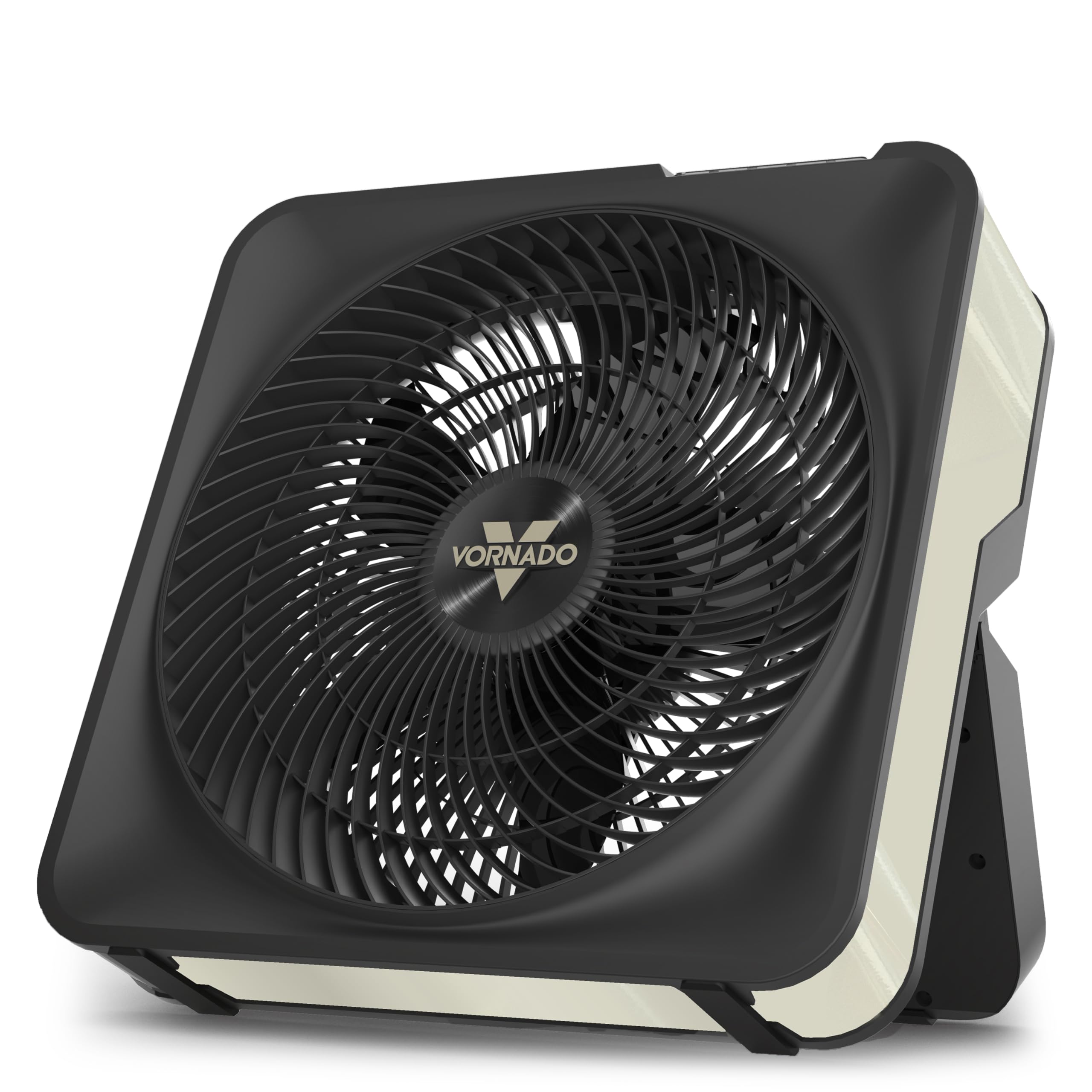
2. Vornado Model 80 High Velocity Box Fan, 20 Inch
The whole-room circulator that drops the temperature reading within minutes.
Five speed settings separate this one from the three-speed crowd, and the lower gears are the point. Buyers report it moves a lot of air and drops the room temperature 2-3 degrees within minutes. That is the whole-room circulation claim doing actual work: it is engineered to distribute air across the space rather than blast one chair.
The dimensions tell you how it fits a room. At 6″D x 20″W x 20.15″H it sits against a wall or backs into a corner without eating floor. Against the Tornado 20-inch floor fan at 23.23″D x 7.09″W x 22.44″H, it is a far shallower body — the gap is roughly 3.9x on depth. The 16.15-inch blade is smaller than the Tornado’s 20 inches, so you trade blade sweep for a tighter housing and five speeds. A removable grille pops off for dusting, which matters on a fan that runs daily in summer.
It is solidly built, balanced, and will not tip over. The Vornado warranty runs up to 5 years, and it is supported from Andover, KS. What you should know before buying: noise divides people sharply, with some finding it quieter than outside traffic and others calling top speed an airplane. That is a fair trade for the airflow, but if you sleep beside it, plan on a middle setting. The 20-inch-wide body is also a wall hog on a narrow shelf.
Five gears, one job: the spread from a light breeze to a powerful gust is what owners prize most — you can cool a room hard or keep it barely turning.
The honest catch: top speed gets loud, so the quiet version of this fan is always a lower setting.
Reach for this if: you want a fan that cools a living room or big bedroom evenly and gives you fine control over how hard it pushes.
Look elsewhere if: you need airflow aimed at one person in a garage bay — a drum fan does that better.
3. Vornado Model 80X High Velocity Box Fan, 20 Inch
Ninety-nine speeds, a digital display, and a timer that lets you dial in the exact breeze.
Ninety-nine. That is the number that defines the Model 80X, and it is not a marketing flourish — it means you can nudge the air up in tiny increments until it is exactly right instead of jumping from too little to too much. A digital display and built-in timer round out the controls, so you can set it and walk away. For a bedroom or home office where a three-speed fan always feels one notch off, this solves the problem.
Buyers rave about the build quality, and the airflow backs it up — it moves a tremendous amount of air and circulates a large room noticeably easier. The built-in kickstand lets you tilt the body to direct flow vertically. A removable grille comes off for cleaning, and the sturdy construction is described as the best some owners have owned. If you have bought fans that felt flimsy after a season, this is the step up.
The DC motor delivers strong output on low power draw, which owners notice on the electric bill. It weighs 11.6 pounds, so it is not a carry-around toy, but it moves on a floor without complaint. The caveat is the same one that dogs every high-velocity box fan: noise. Quiet at mid and low settings is the consensus, but top end draws complaints of being very loud. Treat the top speeds as an occasional tool, not a background hum.
Your pick if: you want the finest airflow control in this group and a timer to shut things down after you drift off.
Your skip if: you need the raw CFM of a garage drum fan — this is a room circulator first.
4. Tornado 20 Inch High Velocity Metal Floor Fan
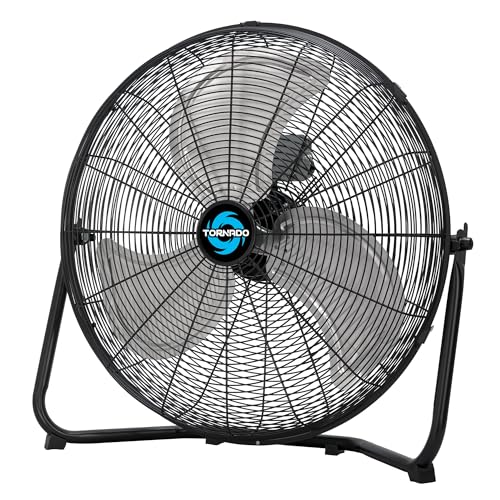
Three speeds, a 120° tilt, and a 6-foot cord that reaches the far outlet.
Three speeds give you 4750, 4200, and 3800 CFM, which is a solid ladder for a 20-inch floor fan — though it gives up ground to the HiCFM above at 5300 CFM. Where it claws back is positioning: the 120° vertical tilt aims air at a specific bench or patio chair, and a built-in carry handle makes moving it from garage to backyard a one-hand job. The 6.0 FT cord is the practical detail owners notice — you are not hunting for an extension cord mid-project.
Airflow is the praise magnet, followed by plain performance — it moves a large amount of air and holds up in shops, and several buyers plan to add a second unit. The aluminum blades and powder-coated steel body resist rust, and the open air over ball bearing motor keeps power consistent. Setup needs no tools, and it is UL Safety Listed. Operating noise is listed at 66 dB on the highest setting, which is a workable figure for a shop or office.
What you should weigh is the body size. At 23.23″D x 7.09″W x 22.44″H it is the deepest frame in this group, so it needs clearance when you tilt the head. The noise verdict still splits — plenty find it not very noisy, plenty call it a bit loud — which is normal at this CFM level. If you need to tuck a fan into a tight corner, a shallower box fan or a compact drum is the smarter call.
What its buyers keep saying: the airflow is what they came for, and the long cord plus carry handle is what keeps them using it.
The trade you accept: a deeply built frame that needs room around it when you tilt the head down.
Built for: a home workshop or covered patio where you want industrial airflow and a cord that actually reaches.
Not built for: a cramped corner — its depth wants breathing room.
5. DEWALT 16-Inch High-Velocity Floor Fan, DXF1616

A 16-inch shop fan that converts from floor unit to hanging or wall mount.
Most fans go one place. This one gives you three: on the floor, hung from a hook, or mounted to a wall, and the 360° rotating head aims airflow wherever you point it. The 3 speeds run 1800, 3000, and 4000 CFM, so this is the smallest blade in the group — 14.6 inches — with output that still clears a two-car garage bay. The 6-foot cord wraps under the control housing for tidy storage when the season ends.
The motor is a 135W high-efficiency 1/5 HP unit with three all-aluminum blades, built for continuous running. That is the spec that matters in a workshop: this is a fan made to stay on. A unique flared drum concentrates the airflow out the front, and the front grille keeps it safe. Buyers come away calling it the best they have purchased, praising the airflow and the surprisingly quiet operation, and many note how easy it is to carry thanks to a lightweight build.
Here is the catch you need to plan around: wall mounting needs two nails, each rated to hold about 11 pounds, and the nails are not included — you provide them, in a diameter of about 0.31-0.47″ (8-12mm). Frame and body are professional-grade engineering plastics, not steel, so this is the least industrial build in the group despite the badge. The 5-year limited warranty offsets a lot of that worry. For a home garage rather than a factory floor, the lighter body is actually the draw.
Best matched to: a home garage, basement, or gym where you want a compact fan you can hang out of the way.
Pass on it if: you want an all-metal drum fan for a factory floor — this one is plastic-bodied and lighter.
6. VEVOR 24 Inch 8700 CFM Drum Fan
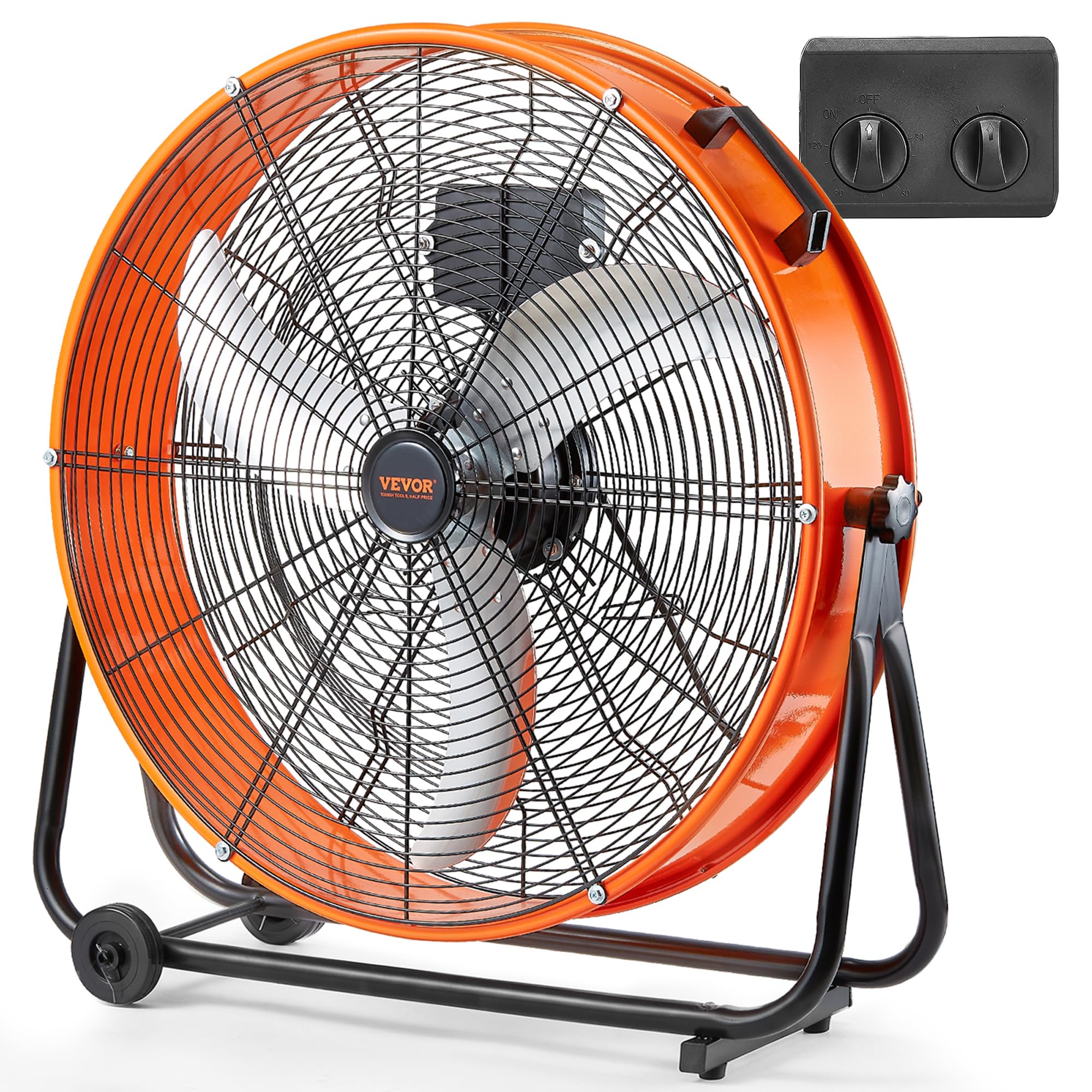
Eighty-seven hundred CFM on casters, rolled wherever the heat is worst.
At 8700 CFM, this fan sits in the top tier of output in this group alongside the WARMLREC below. For a barn, warehouse bay, or open workshop, that is the number that changes the room. A wide handle lets you push it one-handed, and smooth-rolling casters take it from a smooth floor to rough terrain. The high-quality motor and wheeled blades are built to cut vibration and noise while still delivering that volume of air.
Performance is the headline, and garage use is where it earns its keep — owners run it in garage gyms and workshops and find it handles cooling, air exchange, and even dust removal. The 360° rotation lets you aim the barrel where it counts. A three-speed knob keeps control dead simple. Buyers describe it as affordable performance and easy to assemble, which is rare at this output level.
The honest limits are noise and longevity. The noise verdict leans toward loud for more owners than not, which is expected from a drum fan this size — run it on a lower gear when you are working nearby and want to talk. Durability draws mixed opinions, so this is a fan to keep dry and roll carefully rather than toss in a truck bed. If you need quiet more than volume, the iLIVING below is the better fit.
What it does better than most
- 8700 CFM of movement for warehouse scale spaces
- Single-handed wide handle and casters for easy rolling
- Simple three-speed knob control
- Easy to put together from the start
What you accept for the output
- Loud at high speed, as big drum fans are
- Durability verdict is mixed — treat it as an indoor workhorse
Made for: a garage gym, workshop, or barn where you need to push a huge volume of air and roll the fan to where it hurts.
Not the one if: quiet operation is your top priority.
7. iLIVING 20 Inches 5703 CFM Barrel Drum Fan
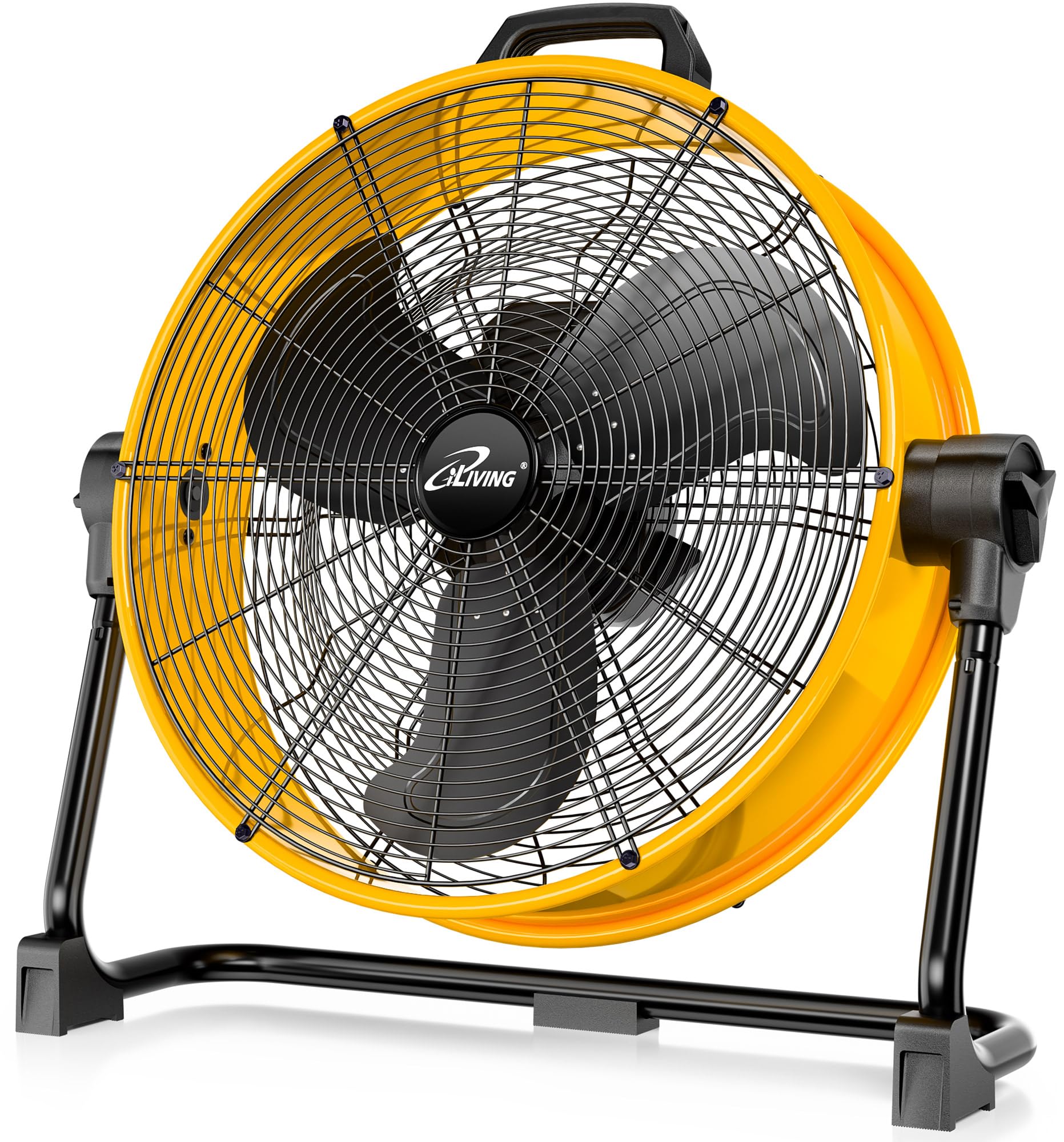
A brushless DC motor that moves 5703 CFM while sipping 95 watts.
This is the fan for the buyer who wants serious airflow without a jet engine. The brushless DC motor draws only 95 watts to move 5703 CFM, so it does the work of a much hungrier AC-motor fan on less power. The real draw, though, is stepless speed adjustment: you turn it to a setting between barely moving and full speed, not a click-stop choice of three. A 360° tilt aims the barrel where you need it.
Airflow is what buyers praise most here, with performance right behind — it moves a ton of air and works well in larger spaces, and the noise verdict is the rare positive one in this category. It is described as quiet on lower settings, which is unusual for a fan this size. The full metal barrel, aluminum blade, and rust-resistant grilles are built for a garage or factory station, and the thermal-protected motor cuts out safely rather than cooking. A 6-foot cord rolls neatly onto the speed housing for storage.
The one wrinkle is ease of use. Owners are split on the tightening handles, with some finding the pivot points difficult to secure and the handles prone to slipping off. It is a small issue on an otherwise solid fan, but worth knowing. It is UL and cUL listed, meets OSHA and UL507 standards, and carries a 1-year limited warranty. It is built for indoor use — covered patios are fine, open rain is not.
Ideal for: a garage or workshop where you want big airflow without drowning out conversation.
Consider another pick if: you plan to tilt and reposition it constantly — the pivot hardware is the fussy part.
8. WARMLREC 24″ Industrial Floor Fan, 8900 CFM

The biggest airflow number here, pushed through 24-inch aluminum blades.
8900 CFM is the top of this group, and 24-inch oversized blades are how it gets there. The maker claims 10% faster wind speeds than standard models — a maker figure, but the 8900 CFM volume is class-leading here. Three speeds handle slow, medium, and high, so you set the room the way you want it. The full 360° tilt spreads that airflow across a wide range for a big greenhouse or warehouse floor.
Performance is where this one is praised most, with airflow right behind — owners find it works better than expected and moves tons of air. Pure copper rotor motors and dual ball bearings power the blades, and the solid aluminum blades and full metal frames are built for continuous indoor and outdoor operating conditions. A sturdy handle and universal wheels let you push or lift it into place.
The honest trade: assembly. Some find it intuitively obvious, others find the instructions lousy and the frame tubes hard to mate — give yourself an evening. Noise is the other split, with plenty finding it very quiet and plenty finding it loud. Durability gets mixed notes too, so run it in a dry space and let it do the work. For a very large building that needs maximum pressure, none of these caveats matter as much as the raw output.
Where it earns its keep: maximum CFM for an extra-large space, with 24-inch blades and a 360° tilt to cover the floor.
The setup tax: frame-tube assembly takes patience, and the instructions leave some owners guessing.
Choose it when: you are cooling a very large warehouse, greenhouse, or barn and nothing short of maximum CFM will do.
Pick something smaller when: you are outfitting one garage bay — this much volume is overkill and louder than you need.
Know the Specs
CFM — the Airflow Number
CFM means cubic feet per minute, the volume of air the fan pushes each minute. Higher CFM fills a larger space. A 4000 CFM fan suits a garage bay; an 8700 CFM drum fan is for a warehouse or barn. Match the number to your room, not to the fan’s looks.
Motor Type — Brushless DC vs AC
A brushless DC motor and a permanently lubricated motor are built for long runs with less upkeep. A DC motor can move strong airflow on lower watts, as the iLIVING does at 95 watts for 5703 CFM. AC motors are common and fine, but tend to draw more power at the same output.
Tilt and Mounting Options
360° tilt lets you aim the airflow up or down across a wide range. A 120° tilt covers a vertical sweep for a bench or patio. Some fans also wall-mount or hang from a hook, which frees floor space and puts airflow at head height in a shop.
Construction and Blades
All-metal housings, aluminum or metal blades, and powder-coated steel resist rust and warping in a humid shop. Plastic-bodied fans are lighter to carry. Drum fans with 24-inch blades move more air than 16-inch floor fans; the trade is size, weight, and noise.
Common Questions
How many CFM do I need to cool a garage?
Is a higher CFM fan always louder?
Can a floor fan be mounted on a wall?
Does a fan actually lower the room temperature?
Brushless DC motor or AC motor — which is better?
How much space does a drum fan take up?
Is a 20-inch fan or a 24-inch fan better for a workshop?
Can these fans be used outdoors?
How long does a high-velocity floor fan last?
What does the wattage tell me about a fan?
The Bottom Line
The crowd favorite here is the HiCFM 20″ 5300 CFM — 4.5+ stars across 200+ owners, the highest score in this group, and it pairs the strongest 20-inch airflow with a wall mount in the box. If you want the finest control and a timer instead of raw volume, the Vornado Model 80X gives you 99 speed settings. And when a warehouse or barn needs maximum CFM on rolling wheels, reach for the WARMLREC 24-inch at 8900 CFM or the VEVOR drum fan at 8700 CFM.
How we choose
We do not accept paid placement. Every pick is matched to a real buyer and a real use-case; we do not hands-on test units.
Sources
Specifications: manufacturer listings and product documentation. Review insights: verified customer reviews, as of November 2026. Pricing: not shown on this page (it changes often); check the current price via the retailer link.
As an Amazon Associate, Tactical Gear Guy earns from qualifying purchases. This does not affect which products we feature.