Specs are compiled from manufacturer listings and verified buyer reviews and can change over time — please confirm the key details on the product page before buying.
You want bass that hits at your desk without a subwoofer eating half your floor. The short answer: pick a 2.1 set (two speakers plus a subwoofer) whose sub fits under or beside your desk, then check its inputs match your gear. This page covers those details, from 50W peak budget sets to premium 3-way systems with light shows.
This guide is built by comparing the manufacturers’ published specifications and the patterns across verified customer reviews, so you get each pick’s real strengths and trade-offs instead of marketing spin.
You’ll see which sets win on bass depth, which win on connection options, and which quietly cut corners on the subwoofer. The breakdown below covers bass depth, inputs, and subwoofer placement so you pick the right set on the first try.
Top Picks

How To Choose The Best PC Speakers with Subwoofer
Start with the bass unit, not the satellites. A 2.1 set splits sound into two small speakers for mids and highs plus a separate box for low frequencies. That subwoofer box is the reason you are shopping 2.1, so where it physically goes matters as much as how loud it gets.
Subwoofer size and your desk footprint
A bigger driver moves more air, which usually means deeper bass. The Logitech Z313 runs a 5.9-inch driver, while the Edifier G1500 MAX runs a 2.5-inch one. That gap is why one set can shake a floor and the other stays tighter and more local. Before you buy, measure the gap under your desk and the space behind your monitor — the subwoofer is the piece that gets in the way.
Peak watts vs RMS watts
Peak power is a short burst figure. RMS is the sustained number you actually hear. An 80W peak rating can lose to a lower-rated set in sustained output if that set is tuned better, so treat peak as a headline, not the whole story. Where a listing gives both, the RMS figure is the one to weigh.
Inputs that match your actual gear
3.5mm AUX works with almost any computer or phone and stays simple. USB-C carries digital audio cleanly from a modern laptop. Optical keeps a TV or console connection digital. Bluetooth adds convenience but can drift out of sync with video on some sets. Look for buttons that switch between inputs without unplugging cables.
Volume control you can reach
A wired control pod, a desktop dial, a remote, or an app all solve the same problem: adjusting volume without leaning behind the monitor. Some sets put a knob on a satellite speaker. Others go fully wireless. Match this to where you sit and how often you tweak levels mid-song.
Side-by-Side Comparison
| Model | Best For | Power (Peak / RMS) | Connectivity | Subwoofer Driver | Amazon |
|---|---|---|---|---|---|
| Logitech Z313★ Best Overall | Bass-heavy music and movies on a budget desk | 50W peak / 25W RMS | 3.5mm AUX | 5.9 in | Amazon |
| FIFINE AmpliGame A22RGB Gamer Pick | Gamers who want RGB sync with audio | AC powered | AUX, Bluetooth, Optical, USB | — | Amazon |
| Bluedee 2.1Clean-Sound Value | Clean DSP-tuned sound with modern inputs | 80W peak | Bluetooth 5.4, USB-A, USB-C, 3.5mm | — | Amazon |
| Edifier G1500 MAX | Compact gaming desk with wooden sub | 30W total RMS | Bluetooth 5.3, USB-A, USB-C, 3.5mm | 4 in (wood) | Amazon |
| Logitech Z407 | Wireless desktop dial and multi-device switching | 80W peak / 40W RMS | Bluetooth, micro USB, 3.5mm | — | Amazon |
| Creative Pebble X Plus | Small desks that still want punch | 15W RMS / 30W peak (60W peak with PD) | USB, Bluetooth 5.3, 3.5mm AUX | Compact sub | Amazon |
| HiVi-Swans M10 Plus | Desktop hi-fi with optical and coaxial inputs | Built-in digital amp | Bluetooth 5.0 (aptX), line, coaxial, optical | 5 in | Amazon |
| Klipsch ProMedia Lumina | Gaming and streaming with app control | Low-profile sub | USB-C, AUX, Bluetooth 5.3 | — | Amazon |
| Harman Kardon SoundSticks 5 | Showpiece desk audio with HDMI ARC | 3-way design | Bluetooth, HDMI ARC | 5.25 in (down-firing) | Amazon |
Detailed Reviews
1. Logitech Z313 2.1 Speaker System
Our pick — 4.0+★ from 16,000+ verified ratings; the strongest balance of quality and price.
A 5.9-inch subwoofer driver that gives a small desk genuine low-end without a big footprint.
The defining number here is the 5.9-inch driver inside the compact subwoofer — larger than the 2.5-inch bass driver in the Edifier G1500 MAX below. In practice that bigger cone is why movies and music carry weight you feel rather than just hear. The satellites and 50W peak (25W RMS) round it out, so vocals and dialogue stay clear while the sub does the heavy lifting.
Setup is about as simple as this category gets: run the satellites into the subwoofer, then plug the 3.5mm cable into your computer. No app, no pairing, no fiddling. The wired control pod sits within arm’s reach and handles power and volume, and it includes a headphone jack so you can switch to private listening without crawling behind the monitor.
This is the most popular set on the list by a wide margin, and sound quality is what wins people over most. Its 4.0+ star average across 16,000+ owners comes from balanced audio and a setup that takes minutes. The honest catch is long-term reliability: a portion of units go quiet or fail within a year, so treat it as a value buy where the sound-for-money math is the whole point. If you want a set to hand down for a decade, spend more; if you want clear sound plus real bass on a modest desk budget, this is the pick.
What keeps it at the top
- 5.9-inch subwoofer driver delivers bass depth a small 2.5-inch unit cannot reach
- Wired control pod puts power, volume, and a headphone jack within reach
- 3.5mm plug works with nearly any computer or laptop with no drivers
- 25W RMS sustained is enough for a room
Where it can let you down
- Reliability is the weak spot — some units fail inside the first year
- No Bluetooth, no USB-C, no optical input
- Volume gets mixed marks at higher settings
Worth grabbing if: you want genuine subwoofer bass for movie nights and music on a desk budget, and you are fine with a wired-only connection.
Spend more if: you need wireless streaming or a set you will not worry about in two years.
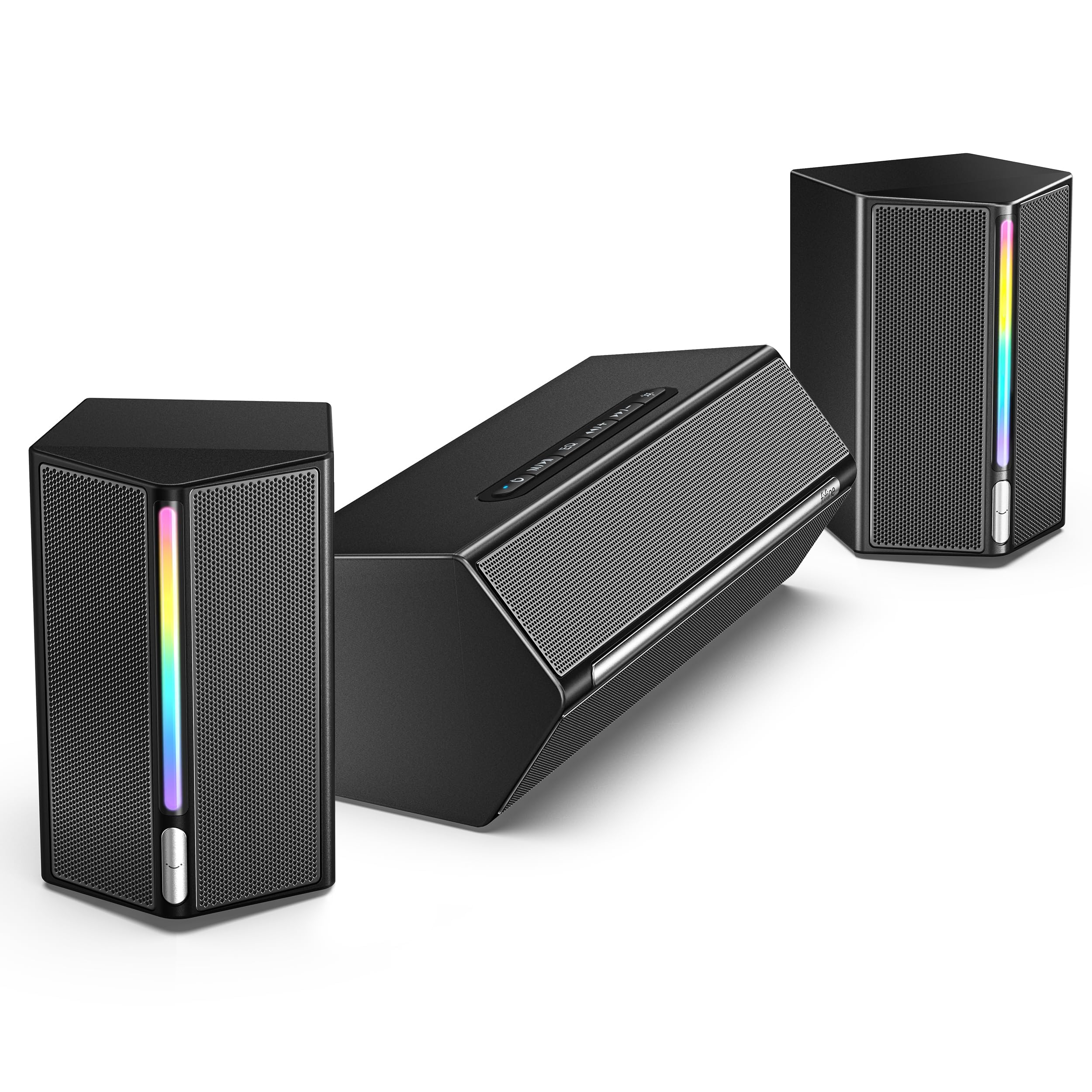
2. FIFINE AmpliGame A22 2.1 Speakers
Eighteen lighting modes that pulse with your game audio, paired with a dedicated subwoofer box.
Ignore the glow for a second and the practical case is the connection list: OTG, optical, AUX, and Bluetooth on one set. That means the same speakers can serve a desktop, a console through a TV, and a phone over wireless. A dedicated subwoofer plus two satellites run the 2.1 channel layout, so explosions get weight and footsteps stay locatable.
The top-mounted buttons make the most sense for how you actually play. Volume, play/pause, track skip, and an EQ button cycling Game, Movie, and Music modes all sit where your hand lands. A long press kills the lighting entirely for a dark room. The RGB sync is the headline feature, and a short press of EQ changes the tuning without opening a single menu.
Here is where honesty helps: the audio itself splits opinion. Some owners find it good; others hear crackle and want deeper bass. Setup and looks land almost universally well. Think of this as the choice for a gamer who wants the lighting show, four ways to connect, and EQ modes on a knob — not as a reference-grade listening set. That framing is fair to a genuinely fun gaming speaker.
The real draw: four inputs (OTG, optical, AUX, Bluetooth) plus 18 lighting modes and an EQ button on the top panel make this among the most flexible desk sets at its tier for gaming setups.
The honest trade-off: sound quality is the most-discussed topic and it splits between good and harsh — deep bass is the recurring ask that goes unmet.
Reach for this if: you want a gaming-looking set with audio-reactive RGB and the most connection options in this group.
Look elsewhere if: pristine vocal clarity and deep low-end matter more to you than the light show.
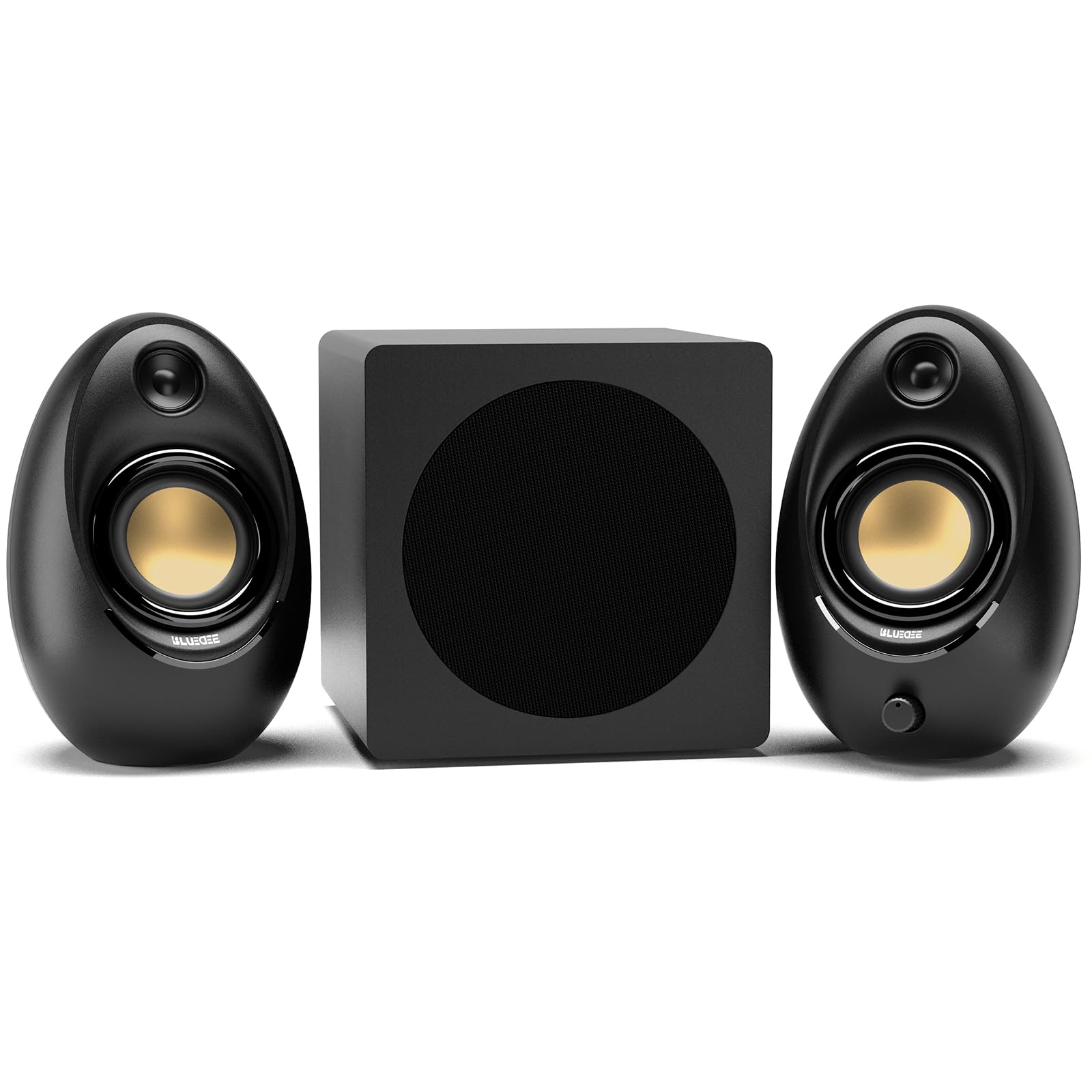
3. Bluedee 2.1 PC Speakers
Built-in DSP tuning that smooths harsh highs, with 80W peak on tap and four ways to plug in.
On the power sheet this one leads the mid-tier group — 80W peak versus the 50W peak on the Logitech Z313 above. More meaningfully, the DSP (digital signal processing, a chip that shapes the sound before it reaches the drivers) is tuned to cut distortion and soften sharp treble. That is a real benefit for an all-day work-from-home desk where harsh highs wear you down by 4 p.m.
The bass side is handled the way this category should handle it: an independent bass unit for low frequencies, keeping the two satellite speakers clear of the boom. That separation is why music and movies get punch without the muddiness that ruins dialogue. On the connection side you get Bluetooth 5.4, USB-A, USB-C, and 3.5mm AUX, and the unit is adapter-powered so it plays as soon as it is plugged in.
One control knob handles volume, play/pause, lighting shifts, and mode switching, which keeps the top of your desk clean. RGB lighting can run dynamic or settle to a soft static glow. Sound quality is the thing buyers praise most here, and value runs second. The only caution note is mixed feedback on Bluetooth mode specifically — wired connections are the safer bet if wireless glitches would annoy you.
Why it earns its place: DSP tuning plus a true independent bass unit plus USB-C and Bluetooth 5.4 cover both sound quality and modern cable-free connections.
Small caveat to know: a few find the volume near the ceiling almost too loud, and Bluetooth mode draws the most mixed comments.
Good match for: a home-office or mixed-use desk where you switch between calls, music, and streaming all day.
Think twice if: you plan to run it almost entirely on Bluetooth and want rock-solid wireless.
4. Edifier G1500 MAX Gaming Speakers
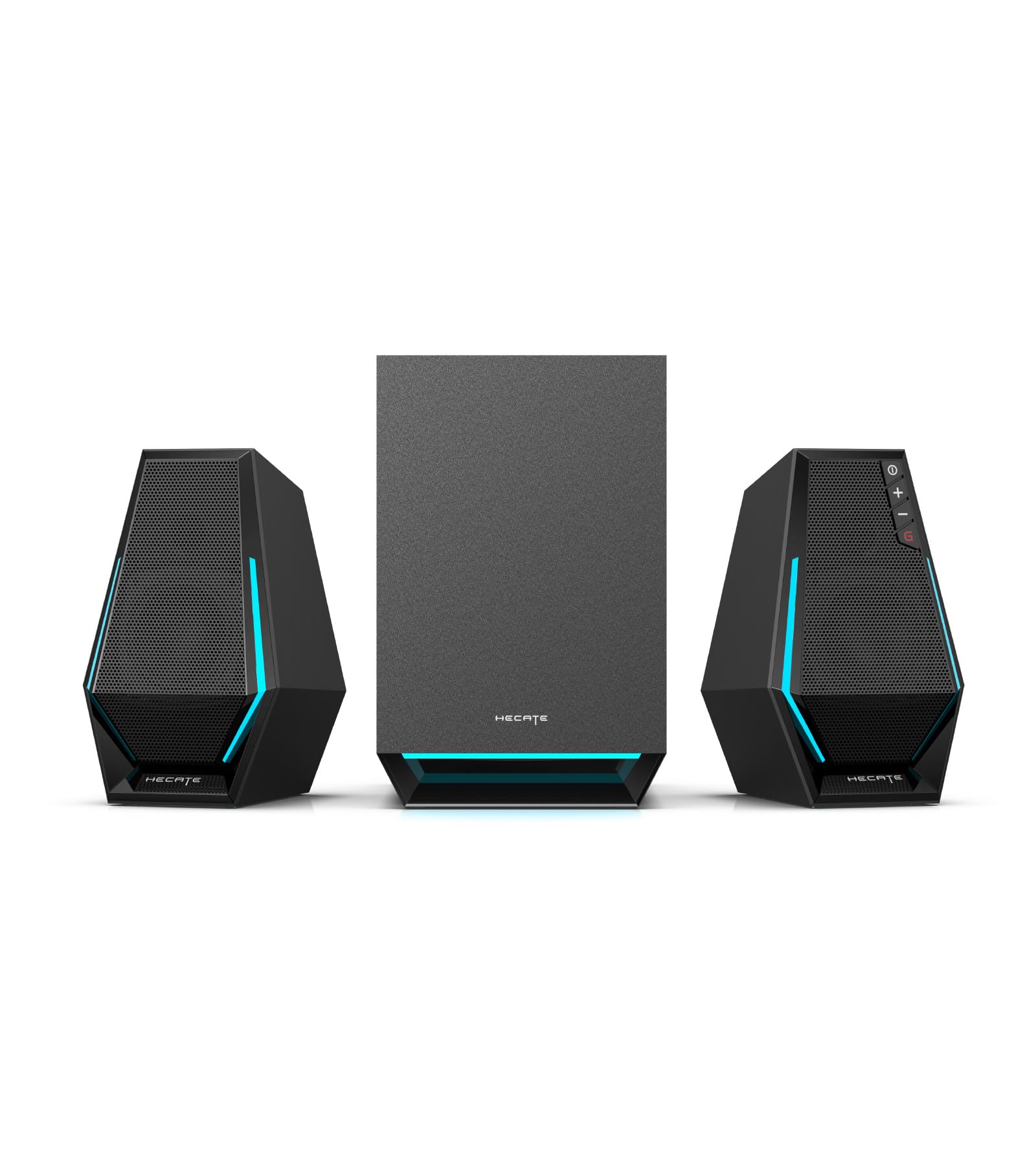
A wooden subwoofer enclosure in a compact body — warmth where plastic boxes sound hollow.
The spec that separates this from the pack is the material: a wooden enclosure subwoofer, which tends to sound tighter than a plain plastic box at the same size. Add a 4-inch subwoofer and 2.5-inch full-range drivers running 30W total RMS (7.5W per satellite plus 15W for the sub), and you get a controlled, punchy low end rather than a one-note thump. Built-in DSP handles the crossover between the two.
Three sound modes sit under one button. Gaming mode sharpens positional cues, Music mode widens stereo separation, and Movie mode pushes the surround effect — all switchable with a press of the multi-function “G” button. Volume, bass, and power controls live on the speakers themselves, so you are not hunting for a remote. Ten preset RGB effects give the cyberpunk look without needing software.
For a smaller desk this is the space-saver’s answer, and buyers consistently rate the sound and the value highly. The one quirk worth flagging: a couple of buyers mention default volume settings that resist adjustment. Compare it to the Z313 and you are trading the bigger 5.9-inch driver for a tidier, wooden-box sub and more inputs — Bluetooth 5.3, USB-C, USB-A, and AUX versus AUX alone.
Standout traits
- Wooden subwoofer enclosure for a tighter, warmer low end
- Three one-button modes (Game, Music, Movie) with on-speaker bass control
- Bluetooth 5.3 plus USB-A, USB-C, and 3.5mm AUX
- Ten preset RGB effects without extra software
Worth a second thought
- The 4-inch wood sub is smaller than the Z313’s 5.9-inch driver
- A few find default volume settings hard to change
Likely the right buy if: your desk is tight and you want a wooden-box sub, three gaming modes, and modern inputs in one neat package.
May disappoint if: you want floor-shaking bass above all — go bigger on the driver.
5. Logitech Z407 Bluetooth Speakers

A puck-shaped dial you spin from across the room, no cable stretched across your desk.
The feature that sets this Logitech apart is the wireless control dial. It works up to 30 m line of sight, so you can tap to pause, spin for volume, and adjust bass from the couch. Under the hood it runs 80W peak / 40W RMS, with a 20-watt ported, down-firing subwoofer adding boom to music, movies, and games.
The satellite speakers are oval and can lay flat or stand upright, so they fit around a monitor instead of imposing on it. Connection is genuinely flexible: up to three devices over Bluetooth, micro USB, and the 3.5 mm input, with buttons to switch between wired and wireless. Digital signal processing keeps the bass deep without smearing the mids.
Two honest notes on a set people clearly like for pure sound. The volume dial draws the most mixed feedback — it is the feature some love and others find fussy — and Bluetooth grips a slice of buyers, mainly around devices refusing to connect. Neither is a reason to pass; it just means wired connection is your most reliable path. For sheer dial-from-the-couch convenience, nothing in this group matches it.
The one thing to know: that 30 m wireless dial is the standout — pause, volume, and bass adjustment without leaving your seat. Sound quality is what owners praise most by a wide margin.
Set your expectations: Bluetooth connections are the recurring sore spot, so keep a 3.5mm or micro USB cable handy.
A strong fit for: the desk where you sit back to watch or listen and want controls in your hand, not on a speaker.
Skip the wireless plan if: you want bulletproof Bluetooth across multiple devices.
6. Creative Pebble X Plus Speakers

Spherical, space-saving satellites with a small subwoofer — punch that stays off a crowded desk.
This set earns its niche by doing a lot with very little footprint. Upgraded 2.75-inch drivers run 15W RMS and 30W peak, and a compact subwoofer handles the low end. The bonus move is the USB-C power path: plug into a 30W or higher USB PD adapter (sold separately) and output climbs to 30W RMS and 60W peak. Same speakers, more headroom, if you have the adapter.
Lighting is unusually rich for the size — up to 16.8m color combinations across six presets. The satellite spheres in matte black keep the desk looking clean, and the small sub tucks away easily. On connections you get USB digital audio, Bluetooth 5.3, and a 3.5 mm AUX input, plus separate headset and mic ports so you can switch to private listening and calls quickly.
Compact size is exactly what buyers appreciate, and the subwoofer wins wide praise for reproducing bass well beyond what the satellites suggest. The recurring question is volume: some find the max level short of what they want. Treat this as a desk-first set — great for near-field listening, team calls, and small rooms — and it delivers an impressive amount of low-end for its size.
Where the value sits: the strong bass from a subwoofer this small is what owners rave about, and the USB-C PD boost to 30W RMS / 60W peak adds headroom if you already own a PD adapter.
The honest caveat: volume at the top end earns mixed notes, and Bluetooth pairing has its quirks — wired USB is the smoothest path.
Made for: a compact or shared desk where every inch counts and you still want a real subwoofer thump.
Not the one if: you need to fill a large room with volume from a single set.
7. HiVi-Swans M10 Plus Speakers

A 5-inch sub reaching below 140Hz, plus optical and coaxial inputs for a TV or turntable desk.
This is the set for someone building a little hi-fi shrine around their monitor. The 5-inch subwoofer digs into low frequencies below 140Hz, and a 20mm soft dome tweeter on an tune magnetic circuit keeps the highs clear. A high-fidelity satellite pair handles the rest. Two amplification chips — one for the sub, one for the satellites — keep each section properly driven.
The back-placed double inverter tube tunes the bass at resonance, lowering wind noise while boosting low-end. Connection options run deep for this category: line, coaxial, and optical inputs mean you can plug in a PC, a TV, a record player, or a gaming monitor without an adapter. Bluetooth 5.0 with aptX handles wireless from a phone, and a remote is included. The Swan logo even changes color to indicate which input is active.
What owners value most here is the sound-to-price balance and build quality, with clean white looks that fit a lighter setup. The bass is the honest catch: some hear it reaching not quite as low as the driver size suggests. Pair that with mixed notes on the satellite-to-sub connection and you have a set that rewards careful setup. Get the wiring right and it is the most audiophile-leaning desktop option in this group.
Strongest card: optical, coaxial, line, and aptX Bluetooth give a single set more ways to serve a PC, TV, and turntable than most rivals here.
Set-up caution: the satellite-to-subwoofer wiring is the weak link for some, and the bass lands shallower than the 5-inch driver implies.
Right for you if: you want one white set to serve your PC plus a TV or record player with proper optical and coaxial inputs.
Look to a bigger sub if: chest-thumping low end is your top priority.
8. Klipsch ProMedia Lumina 2.1 System
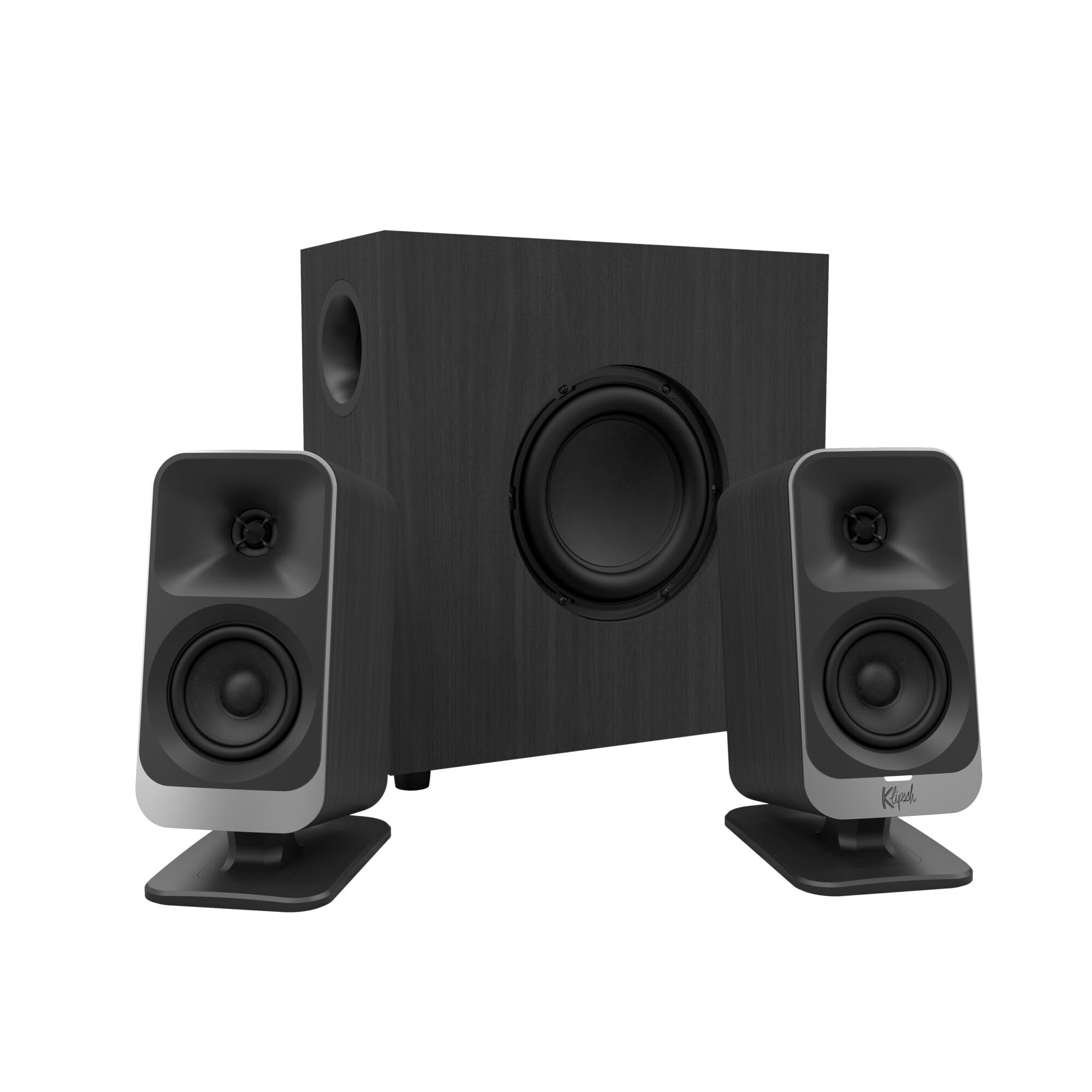
A redesigned desk icon with tiltable stands and a Klipsch app that commands EQ and lighting.
This Lumina version of the ProMedia line adds a fresh cabinet, tiltable stands, and updated controls. The low-profile subwoofer is the headline for space-conscious buyers — it holds its punch while staying tucked away, with an adjustable gain knob and cable-management design to keep the floor clear. Sound quality is what buyers praise most, and it is the reason this set stands on its own.
Control is where it gets modern. The Klipsch Control app, available on the app stores, gives you precision command over EQ, lighting, night mode, and a music-react mode that responds to the audio. Three color options customize the workspace lighting. Inputs run USB-C, AUX, and Bluetooth 5.3, so a modern laptop plugs straight in digitally while a phone can stream wirelessly.
Be honest with yourself about the wireless side. Bluetooth is the mixed spot — several buyers find it unreliable — and a few consider the RGB lighting more decoration than feature. On value and reliability the picture is similarly split. That points to a clear recommendation: run it wired over USB-C for gaming and streaming, use the app for EQ, and treat Bluetooth as a bonus. Do that and the tuned sound delivers.
What stands out
- Low-profile subwoofer with a gain knob and cable management
- Klipsch app controls EQ, lighting, night mode, and music-react mode
- USB-C digital in plus AUX and Bluetooth 5.3
- Tiltable satellite stands for a cleaner monitor setup
Worth knowing up front
- Bluetooth draws mixed reliability reports — plan on USB-C
- RGB lighting strikes some as an afterthought
- Subwoofer performance splits opinion
Best for: a gamer or streamer who wants app-level EQ and lighting control with a space-saving sub.
Pass if: wireless Bluetooth is your main way to play — the USB-C cable is the reliable route here.
9. Harman Kardon SoundSticks 5 Speaker
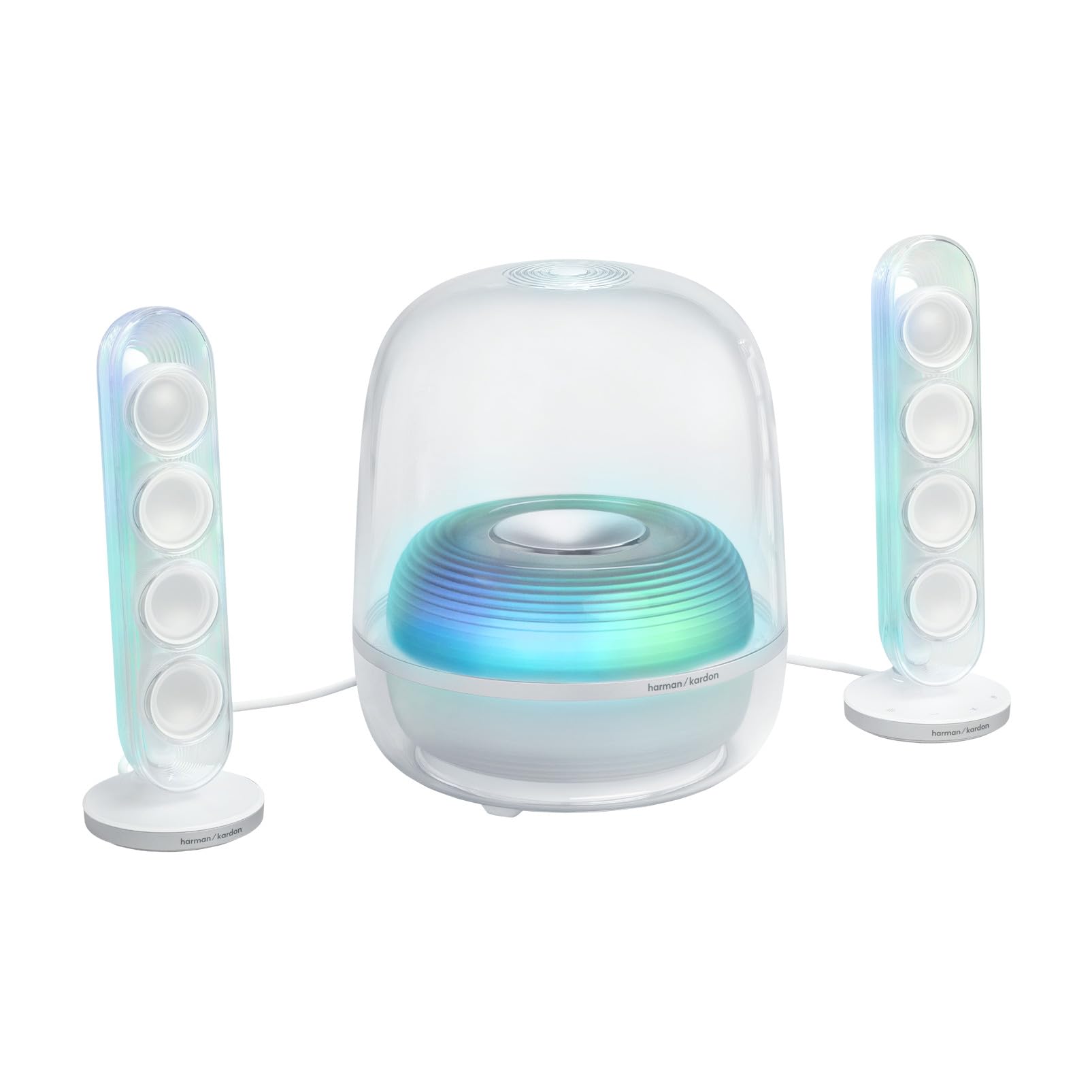
A transparent dome with a light show and a 5.25-inch down-firing sub — desk audio as decor.
This is the set you buy when the speakers should be part of the room, not hidden behind it. A 3-way design splits duties three ways: dual silk dome tweeters for the top, dedicated mid-range drivers for vocals and instruments, and a down-firing 5.25-inch subwoofer for punchy, accurate bass. That separation is why the stereo stage stays detailed at low volume as well as high.
The transparent dome runs a multicolor light show, and the uplifted sub adds a sculptural element to the floor. Connection goes further than most desk sets: Bluetooth streams from up to two devices at once, HDMI ARC pipes TV audio in with a single cable, and Auracast broadcasts to other compatible speakers for a party. The Harman Kardon One app handles setup, EQ, and lightshow personalization.
Bass performance is the trait buyers love most, and the looks follow close behind — this set earns its premium position on both. The gap to keep in mind is Bluetooth stability: the wireless gripes center on dropping connections and pairing quirks with some other speakers. For wired HDMI or a steady Bluetooth link near the source, it holds up beautifully. It is the most style-forward way to put real subwoofer bass on a desk.
What makes it special: the 3-way build with a 5.25-inch down-firing sub and dual silk dome tweeters delivers both detail and punch, and HDMI ARC brings TV audio in cleanly.
Mind the connection: Bluetooth dropping is the recurring complaint, so wired HDMI or a close-range pairing is the way to go.
Buy this if: the speakers are the centerpiece of your desk and you want big sound plus a light show in a transparent, iconic body.
Not for you if: you need rock-solid wireless everywhere or a small footprint.
Know the Specs
Peak Power vs RMS Power
Peak power is the largest burst a set can produce for an instant. RMS (root mean square) is the sustained level it can hold across minutes of playback. A set like the Logitech Z407 lists both — 80W peak and 40W RMS — and the second number is the trustworthy guide to how loud it stays without strain. Treat peak as a headline and RMS as the real measure of staying power.
Why Subwoofer Size Matters
A subwoofer driver is the round cone that pushes air for low frequencies; bigger cones move more air and usually reach lower. The difference between a 5.9-inch driver (Logitech Z313) and a 2.5-inch one (Edifier G1500 MAX) changes how much of the deep bass you feel versus just hear. Even so, enclosure quality counts too — a wooden box can outperform a cheaper plastic one of similar size.
Connectivity: AUX, USB-C, Optical, Bluetooth
3.5mm AUX sends analog audio and works with nearly any device. USB-C carries digital audio, avoiding the hum and buzz analog can pick up. Optical keeps a TV or console signal fully digital. Bluetooth frees you from cables but adds a small delay that can misalign lip-sync on video. The best desk sets offer more than one path and let you switch without unplugging.
DSP, SNR, and Noise Floor
DSP is a processing chip that shapes sound and smooths rough edges before it hits the drivers. Signal-to-noise ratio (SNR) measures how loud the audio is compared to background hiss; the Edifier G1500 MAX lists an SNR of ≥80dB and a noise level of ≤25dB(A), which means a quieter background. A low noise floor matters more than peak volume for long listening sessions.
Common Questions
Do PC speakers with a subwoofer work with a laptop that only has USB-C?
Where should I place the subwoofer under my desk?
Will a 2.1 set sound better than a 2.0 pair for games?
Which connection avoids audio lag when watching video?
Can I connect my TV and my PC to the same speakers?
How much bass can a compact subwoofer really produce?
Do these speakers need a separate amplifier?
What does the Bluetooth version number mean for my PC audio?
Can I use headphones with these speakers?
The Bottom Line
For most people, the best pick among these pc speakers with subwoofer options is the Logitech Z313 — its 5.9-inch subwoofer driver delivers more low-end than anything else at its tier, and the wired control pod keeps volume and a headphone jack within reach for around the price of a nice lunch. If you want cleaner highs and modern inputs, the Bluedee 2.1 with its DSP tuning (digital processing that shapes the sound) and Bluetooth 5.4 covers more ground. And for a compact desk that still wants punch, the Creative Pebble X Plus fits the most sound into the smallest footprint.
How we choose
We do not accept paid placement. Every pick is matched to a real buyer and a real use-case; we do not hands-on test units.
Sources
Specifications: manufacturer listings and product documentation. Review insights: verified customer reviews, as of November 2026. Pricing: not shown on this page (it changes often); check the current price via the retailer link.
As an Amazon Associate, Tactical Gear Guy earns from qualifying purchases. This does not affect which products we feature.