Specs are compiled from manufacturer listings and verified buyer reviews and can change over time — please confirm the key details on the product page before buying.
You want music on the job site, but you also need to stay legal and keep your eyes intact. The trick is finding glasses that pass the ANSI Z87.1 impact standard (the US rating that says a lens will stop flying debris) while hiding a speaker behind your ears. The catch most buyers miss is that the speaker, not the lens, decides whether you can actually hear a call over a saw.
This guide is built by comparing the manufacturers’ published specifications and the patterns across verified customer reviews, so you get each pick’s real strengths and trade-offs instead of marketing spin.
Volume, battery life, and frame durability separate the pairs that survive a season of daily wear from the ones that quit in a month. This roundup breaks down the best safety glasses with speakers so you can hear your calls without blocking out the workshop.
Top Picks

How To Choose The Best Safety Glasses with Speakers
Two things decide whether you will actually wear these every day: the lens rating and how the speaker sits against your head. Get those wrong and you will be back to foam earplugs and a phone buzzing in your pocket.
Start With The ANSI Z87.1 Mark
That code means the lens survived a high-impact test with a dropping weight, so it will stop flying metal or gravel. Every pair here carries it — this is not the place to gamble on a tinted frame with a speaker glued in. If the listing does not state Z87.1, walk away.
Open-Ear Sound Is Not Headphone Sound
These speakers sit outside your ear canal, which keeps you aware of a forklift beeping behind you. The trade-off is volume: open speakers lose to a running saw or grinder in a way sealed earbuds do not. Read the sound-quality feedback carefully — a pair that whispers is useless on a running saw, and low volume is the single most common complaint in this category.
Lens Options: Clear, Tinted, Or Photochromic
Clear lenses suit indoor shops and warehouses. Tinted or photochromic lenses (ones that darken when UV light hits them) suit outdoor crews and road work. If you move between a sunny yard and a dim shed all day, photochromic saves you from swapping pairs.
Side-by-Side Comparison
| Model | Best For | Lens / Protection | Stated Battery | Audio Type | Amazon |
|---|---|---|---|---|---|
| OhO Elite★ Best Overall | Everyday work and walks | ANSI Z87.1, 100% UV400 | Up to 10 hours | Open-ear, voice control | Amazon |
| OHO Pulse SportBest For Driving | Driving and outdoors | ANSI Z87.1, 100% UV400, photochromic | Up to 10 hours | Open-ear, voice control | Amazon |
| Selfing-Focus LED | Low-light and night work | ANSI Z87.1, grey photochromic | 450mAh cell | Open-ear Bluetooth | Amazon |
| Global Vision Jam 1 | Cycling and high-risk sites | ANSI Z87.1, UV400 polycarbonate | — | Open-ear Bluetooth | Amazon |
| 5BC Bluetooth | Warehouse and shop floor | Clear lens, half frame | 220mA cell | Open-ear Bluetooth | Amazon |
Detailed Reviews
1. OhO Elite Open Ear Smart Glasses
The everyday audio spec that walks your dog and takes your calls on one charge.
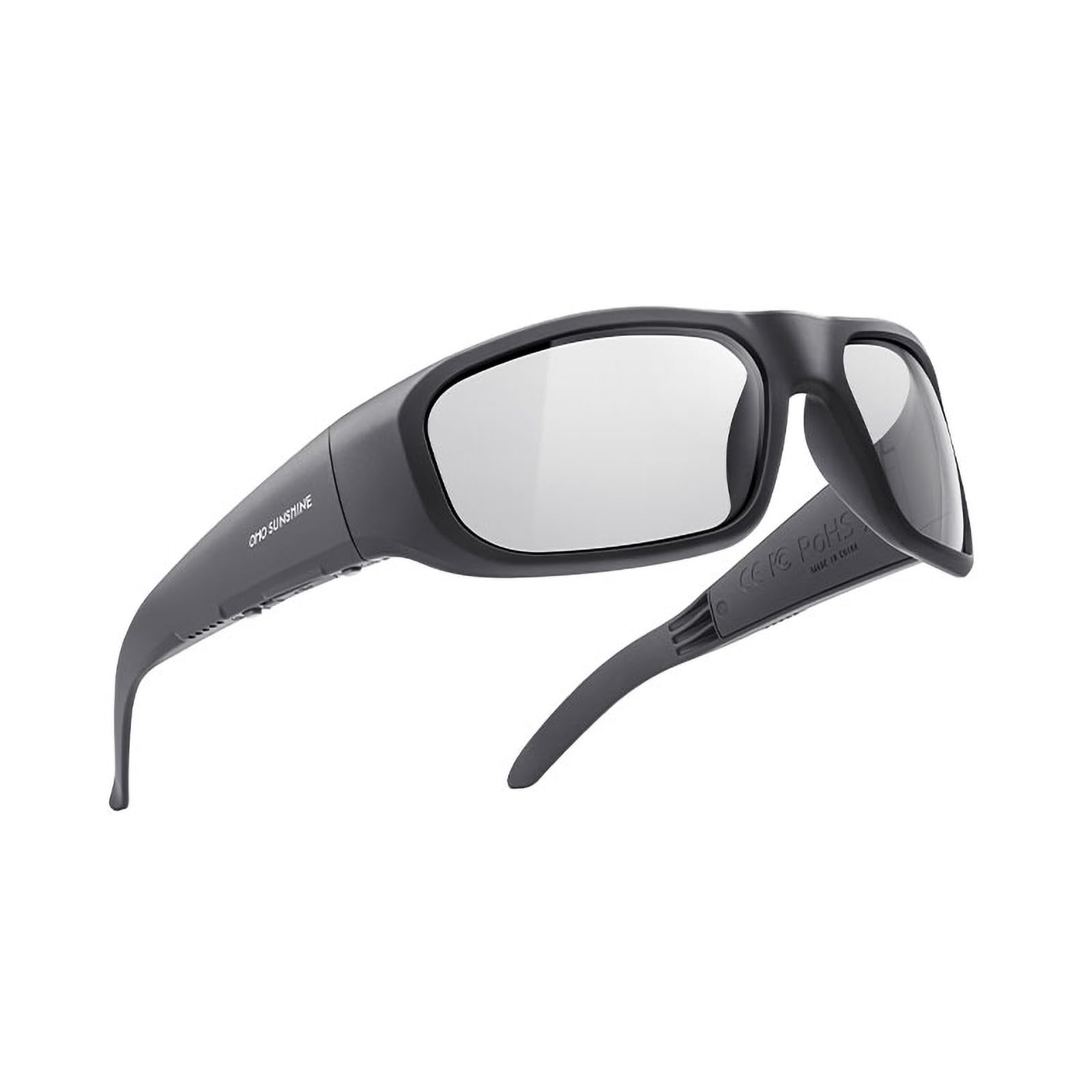
The OhO Elite is the crowd favorite here, and the reason is practical: it promises up to 10 hours of playtime from a 200 mAh lithium polymer cell. That covers a full shift or a long walk without hunting for a cable. The lenses carry the ANSI Z87.1 rating plus 100% UV400 protection, so they block the full UV range while still meeting impact standards.
What wins people over is the build and the price-to-quality read — construction and value are the two things owners talk about most. The open-ear design keeps your ear canal free, so you hear the site around you while the mic handles calls. Voice control through Siri and Google Assistant means you can skip a track with your hands still on the tool.
The honest catch is sound quality and reliability, which split owners. Some report 7-8 hours of real use; a few report a unit that would not hold a charge or stopped turning on. Treat it as a great first pair for lighter jobs rather than a lifetime tool, and you will be happy with it.
What holds up
- Up to 10 hours of audio playtime from a 200 mAh cell
- ANSI Z87.1 lenses with 100% UV400 protection
- Voice control for Siri and Google Assistant
- Water-resistant build for runs and outdoor work
Where it splits the room
- Volume and sound quality draw mixed feedback
- Some units have failed to hold a charge
- Open-ear volume can lose to a loud jobsite
Reach for this if: you want one pair for daily wear, walking, and light job-site calls on a single charge.
Think twice if: you run grinders all day and need earbud-level loudness.
2. OHO Pulse Sport Open‑Ear Smart Glasses
Transition lenses that darken outdoors and lighten in the cab, at just 31 g.
Here is the head-to-head worth knowing: the Pulse Sport weighs 31 g on a TR90 frame (a flexible nylon-plastic blend), and it swaps the fixed tint of the Elite for a photochromic lens that adjusts to light. If you move between a bright yard and a shaded truck cab, that one lens does the job of two pairs. Reach is 11.4 centimeters on the arm, and the frame is a full rectangular wrap with a 20 mm bridge.
Drivers like it because they can take a call through the glasses without pulling over to dig out a phone. The look earns praise too — the mirrored outside against a warm tint inside reads sharp. Note the listing header promises 12 hours while the bullet text says up to 10 hours of playtime; buy it for the roughly-shift-length figure.
Sound and reliability here are the softer spot, with volume complaints showing up. A couple of units have reported a frame splitting or a charge failing after repeated use. It is a stylish commuting pick, not the toughest build on this list.
The trade-off in plain terms: you get the best-looking transition lens of the group, but you give up some loudness and ruggedness compared with the OhO Elite’s sturdier following.
Fit note: the over-ear, full-frame shape suits medium-to-large faces; the 20 mm bridge is snug on narrow noses.
Who it beats: anyone tired of swapping clear and tinted safety specs through the day.
The single caveat: volume against wind noise on a bike or an open cab is not its strength.
3. Selfing-Focus LED Bluetooth Safety Glasses
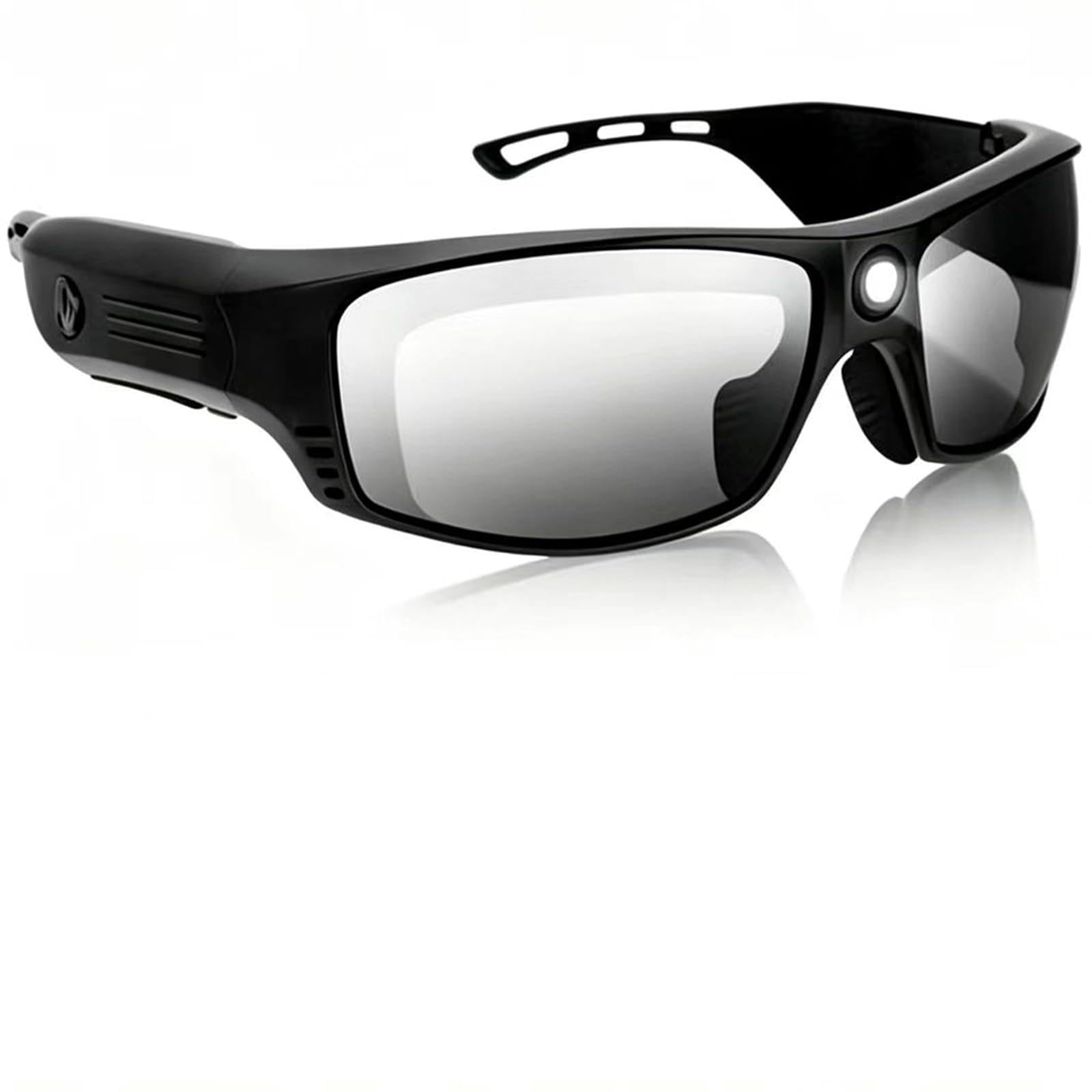
A 1 W white LED on the frame turns your safety glasses into a hands-free work light.
No other pair here lights your work area. This one carries a 1 W white LED with three brightness gears — 50 LM on low, 90 LM in the middle, and 140 LM on high (lumens being the measure of how much visible light it throws). The runtime tracks that: 13 hours on low, 9 hours in the middle, and 5 hours on high, so you pick brightness against how long your shift runs.
The cell inside is a 450 mAh battery, and it charges in about 2 hours at 5V/500MA, then runs on an output of 3.7V/300MA. Grey photochromic lenses darken in the sun, and the whole pair is 48.7 g on a TR90 frame. A polyester lanyard strap is included so it does not slide off when you bend over a task.
Quality and versatility are what buyers respond to — podcasts, music, and calls all get a mention. The honest read is that sound quality and value split people, and the lighting feature draws mixed feelings about how useful the low gear really is. This is a specialist pick for a dim shop or a night shift, not a general daily pair.
- Three LED gears at 50 LM, 90 LM, and 140 LM
- Long low-bright runtime of 13 hours
- Grey photochromic lenses handle sun and shade
- Includes a polyester lanyard strap
Best matched to: electricians and night-shift crews who need light exactly where they are looking.
Worth knowing: the high gear burns the battery in 5 hours, so it is a burst light, not a whole-shift lantern.
4. Global Vision Jam 1 Bluetooth Safety Glasses
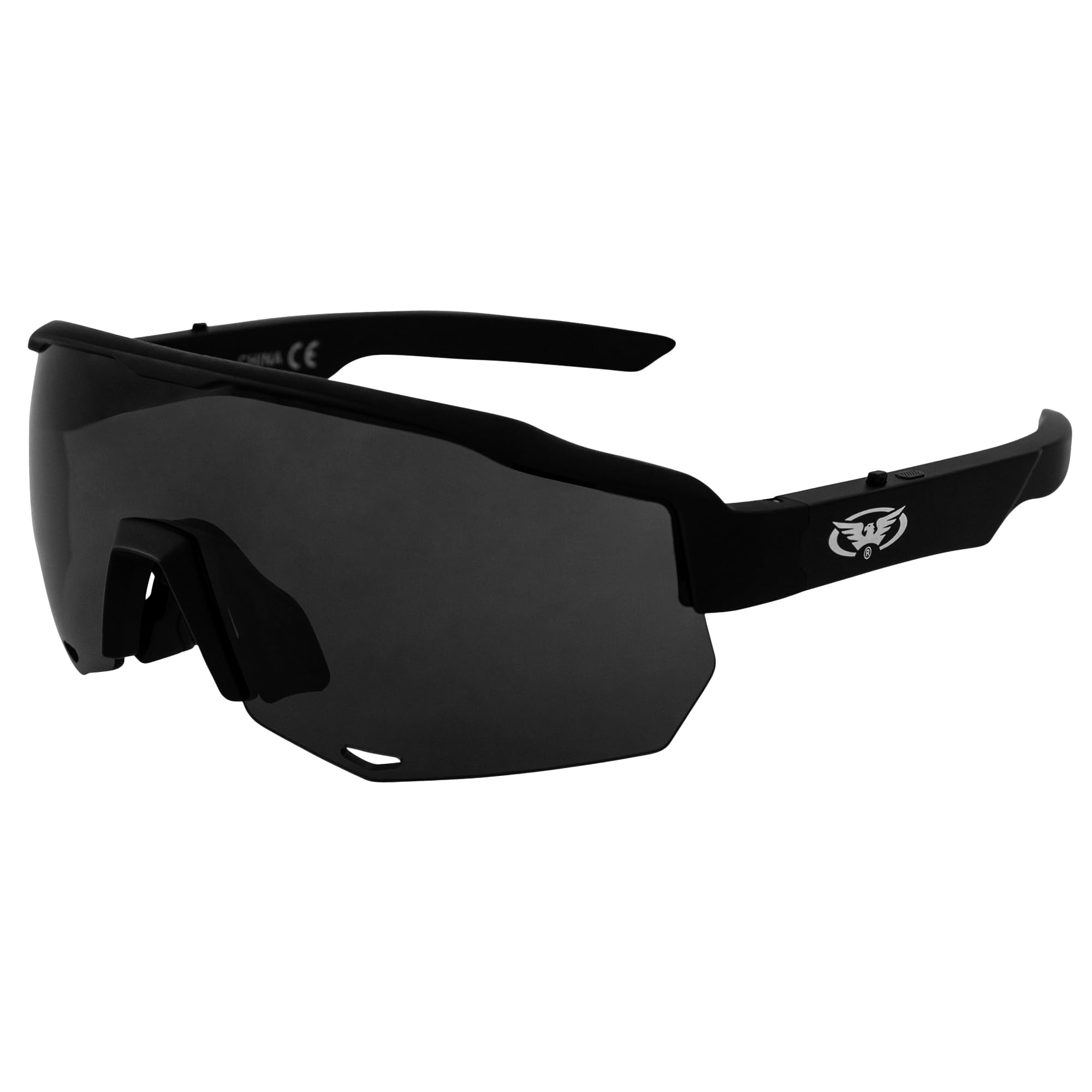
Shatterproof polycarbonate and a wraparound shield built for road grit and wind.
Global Vision leans hard into eye protection, and that is where this pair earns its keep. The lenses are shatterproof UV400 polycarbonate with a scratch-resistant coating, and the wraparound shape gives full peripheral coverage — meaning road spray and gravel hit the lens, not the corner of your eye. It is ANSI Z87.1 rated for both industrial and cycling use, and it ships with a hard case, a cleaning cloth, and a charging cord.
Because the speakers sit outside your ear, you hear traffic behind you instead of being sealed off — the safety argument for open-ear on a bike. The frame is built for all-day wear on the road or a trail.
Sound is the contested part: some users find people around them can hear the audio, while a few report the volume staying low. A few also report the left side cutting out. This is a pick for riders who value the protective lens and the case over maximum loudness.
Where the value sits: full-peripheral shatterproof protection plus a hard case and cord in one package is a serious safety-first bundle for a cyclist.
The catch to weigh: volume is the recurring gripe, so this suits an open road, not a noisy construction floor.
Pick it for: road riding and trail work where peripheral eye cover matters more than booming audio.
Look elsewhere if: you need to clearly hear a call over loud background noise.
5. 5BC Bluetooth Safety Glasses, Clear Lens

A clear half-frame for the warehouse, with a 220mA cell and IPX4 sweat resistance.
If your shift happens indoors under fluorescents, clear lenses beat tinted ones, and that is exactly what this 5BC pair gives you. The frame is a half-frame style with open-ear speakers, hands-free calling, and a water resistance rated IPX4 (splash and sweat resistant, not submersible). The cell is listed at 220mA, so treat it as a shorter-run option than the 10-hour picks above.
The pairing is straightforward: hold the power button for 5 seconds until the red and green lights alternate, then find Vision 5A/5B in your phone’s Bluetooth list and confirm. One step owners skip is turning up the phone volume first — that is the trick to getting usable loudness from these.
Sound quality is the most-discussed thing here, and it is genuinely mixed — some find it fine for a warehouse, others find it too quiet to beat the noise around them. Reliability and durability split owners similarly, with a few reporting a side that quit or a charging port that broke. Buy it as an affordable clear-lens pair for a clean indoor job, not a hard outdoor one.
Smart buy angle: clear half-frame lenses suit indoor shops where tinted glasses are the wrong call, and it pairs fast to any phone.
Honest limit: volume and long-term reliability are the two things buyers argue over, so keep expectations at indoor-shop level.
Suits you when: you work a clean, indoor shop and want clear lenses plus hands-free calls at an entry-level price.
skip it if: you need all-shift audio in a loud factory or hard outdoor duty.
Know the Specs
ANSI Z87.1 Lens Rating
This is the US safety standard that says a lens survived a high-velocity impact test, so it stops flying debris instead of shattering into your eye. It is the single most important line on the box for this category — a speaker in a non-rated frame is not safety gear. Every pick here carries the Z87.1 mark, and UV400 means it also blocks the full range of ultraviolet light.
Battery Capacity In mAh
Milliamp-hours (mAh) measure how much charge a cell holds, which is a rough proxy for how long the audio runs. Bigger numbers usually mean longer playtime, but brightness settings and volume eat into it — the LED model drops runtime sharply on its high gear. Match the stated hours to your shift length rather than chasing the largest number.
Open-Ear Vs Earbud Audio
Open-ear speakers sit outside your ear canal so you stay aware of your surroundings — critical when a forklift or car is behind you. The trade-off is that open speakers fight background noise more than sealed earbuds. On a loud jobsite, volume becomes the deciding factor, which is why it is the most contested spec in this category.
Photochromic Vs Clear Lenses
Photochromic lenses darken when UV light hits them and lighten indoors, so one pair handles sun and shade. Clear lenses are the right call for indoor shops and warehouses where tint would dim your view. If your day mixes bright yard and dim shed, photochromic saves you from carrying two pairs.
Common Questions
Do these safety glasses with speakers actually protect my eyes?
Will the volume be loud enough over a saw or grinder?
How long does the battery last during a shift?
Can I wear these over my prescription glasses?
Are they safe to wear while driving?
Do the lenses fog up on a warm jobsite?
What is the difference between photochromic and tinted lenses here?
Do these work with Siri and Google Assistant?
How do I pair the Bluetooth on the 5BC glasses?
Can I wear these all day for comfort?
The Bottom Line
The pick most people should start with is the OhO Elite — its combination of up to 10 hours of playtime, ANSI Z87.1 lenses, and voice control makes it the most well-rounded daily pair, and it is the crowd favorite of the group. If you move between sun and shade all day, the OHO Pulse Sport and its photochromic lens save you swapping specs. For dim shops and night shifts, the Selfing-Focus LED lights the work with its 140 LM high gear. Commuters and cyclists who want shatterproof coverage plus a hard case should reach for the Global Vision Jam 1, and clean indoor crews get clear lenses on the 5BC. Whichever you choose, confirm the Z87.1 mark first — a speaker is only worth having behind a lens you can trust.
How we choose
We do not accept paid placement. Every pick is matched to a real buyer and a real use-case; we do not hands-on test units.
Sources
Specifications: manufacturer listings and product documentation. Review insights: verified customer reviews, as of November 2026. Pricing: not shown on this page (it changes often); check the current price via the retailer link.
As an Amazon Associate, Tactical Gear Guy earns from qualifying purchases. This does not affect which products we feature.