Specs are compiled from manufacturer listings and verified buyer reviews and can change over time — please confirm the key details on the product page before buying.
If your dog hears you perfectly in the kitchen and turns deaf the second the backyard gate opens, you already know why a training collar is on your mind. The short answer: buy for range and receiver fit first, then worry about how many stimulation levels the handheld offers. A collar with a 4500-foot signal that sits too loose on a narrow neck is worse than a simpler one that stays put. This guide separates the collars that hold a recall at distance from the ones padded with features you will never touch.
This guide is built by comparing the manufacturers’ published specifications and the patterns across verified customer reviews, so you get each pick’s real strengths and trade-offs instead of marketing spin.
The picks below cover every kind of handler, from a puppy owner practicing in the driveway to a hunter running two dogs at a half mile. Each listing pairs the collar’s real numbers with what owners say happens after a few weeks of use, so you can choose a Top Rated Dog Training Collars pick without guessing.
Top Picks

How To Choose The Best Top Rated Dog Training Collars
A training collar is a remote transmitter paired with a receiver that sits on your dog’s neck, and the pairing either works for you every single day or becomes a drawer ornament. The three things that decide which camp you land in are range, receiver fit, and how the buttons feel in your hand while you are also holding a leash.
Match range to how far your dog actually goes
Range is measured in feet, and a collar rated for 4200 or 4500 feet gives you room for off-leash work in a park or open field. A 3000-foot model covers a large backyard comfortably. Buy more range than your training ground needs, because trees, hills, and weather cut into any rated signal. The handheld and receiver must also stay paired through brush and distance.
Check the weight range and neck sizing before anything else
Every collar lists a dog weight range, and that number is your first filter. A 5 to 150 lb range covers nearly any dog you will own, while a 10 to 120 lb range leaves out the smallest puppies. Strap length is the second filter, and you want a strap that tightens down to a puppy’s neck without flopping. Recheck the fit each week, because a loose receiver makes contact inconsistent.
Decide if you need tone, vibration, or static correction
Most collars give you a beep, a vibration, and an adjustable static level, and you can often train entirely on tone and vibration. Many units let you remove the contact prongs or set static to zero for a no-shock setup. If you have a sensitive or older dog, that option matters more than a high static ceiling. Look for a unit that lets you lock or secure the buttons so a pocket bump does not fire a correction.
Side-by-Side Comparison
| Model | Best For | Remote Range | Dog Weight Range | Waterproofing | Amazon |
|---|---|---|---|---|---|
| Garmin Sport PRO★ Best Overall | One-handed field control | — | All breeds | — | Amazon |
| SLOPEHILL 2 Dogs 4200FTBudget Champion | Two-dog households on a budget | 4200 ft | 8 to 140 lbs | IP68 receiver | Amazon |
| HapTop 4500FT 2 DogsTop Performer | Long-range recall training | 4500 ft | 10 to 120 lbs | IPX8 | Amazon |
| PATPET 2 Dogs 3000FT | Extended standby between charges | 3000 ft | 10 to 140 lbs | IPX7 receiver | Amazon |
| BLACKDOG Military 4200ft | Rough terrain and night work | 4200 ft | 5 to 150 lbs | IP67 | Amazon |
| E-Collar ET-300 | Fine-grained low-level control | — | Small to medium | — | Amazon |
| SportDOG SportTrainer 875 | Hunting and field dog work | 1/2 mile | 8 lbs and up | Submersible 25 ft | Amazon |
| Dogtra 280X | Stubborn dogs and precise training | 1/2 mile | 10 lbs and up | Fully waterproof | Amazon |
| Garmin Pro 550 | Multi-dog and upland hunting | 1 mile | All breeds | — | Amazon |
Detailed Reviews
1. Garmin Sport PRO, Handheld Dog Training Device
Our pick — 4.5+★ from 500+ verified ratings; the strongest balance of quality and price.
The handheld you can run blind, by feel, while your other hand holds the leash.
Garmin’s answer to a crowded remote is subtraction: a quick-turn dial that clicks through 10 stimulation levels, plus four training buttons for continuous, momentary, vibration, and tone. You operate the whole thing with one hand and no glance at the screen. That matters when you are mid-walk and the correction has to land the instant your dog breaks. The handheld itself measures 5.7 inches by 5.5 inches and the unit weighs 4.32 ounces, so it rides in a hand or clips on without pulling your jacket sideways.
What earns the four-star-plus reputation here is build and function — the pairing is quick and the signal is steady, whether you are working a single dog or switching between two collars as one setup. Owners of the Pro 550 series report pairing this handheld to their existing collars, which turns a damaged remote into a simple swap instead of a whole-system purchase. The beacon lights are remotely triggered from the handheld and visible up to 100 yards away, and the status light on the unit gives you a quick read without digging through menus.
Longevity is the catch, so size it honestly. For most handlers the battery and casing hold up for years, but a unit that stops holding range is a real risk on any electronic collar with a radio inside. Buy it for the one-hand dial and the training feel, and keep the receipt. Three dogs on one handheld is the practical ceiling.
What the dial gets right
- One-hand, no-look operation with positive clicks between the 10 stimulation levels
- Four dedicated buttons for continuous, momentary, vibration, and tone
- Remote-controlled beacon lights and a visible LED status light
- Works as a replacement handheld with existing Pro 550 collars
Where it asks for care
- Durability is the mixed spot — a rare unit loses range past the warranty window
- A small number of buyers find accessories missing from the box
- Premium-tier spend for a handheld-first system
Built for: the handler who trains one to three dogs on foot and wants corrections to land without looking down.
Think twice if: you need a collar-only replacement or you want the cheapest possible entry into e-collar training.
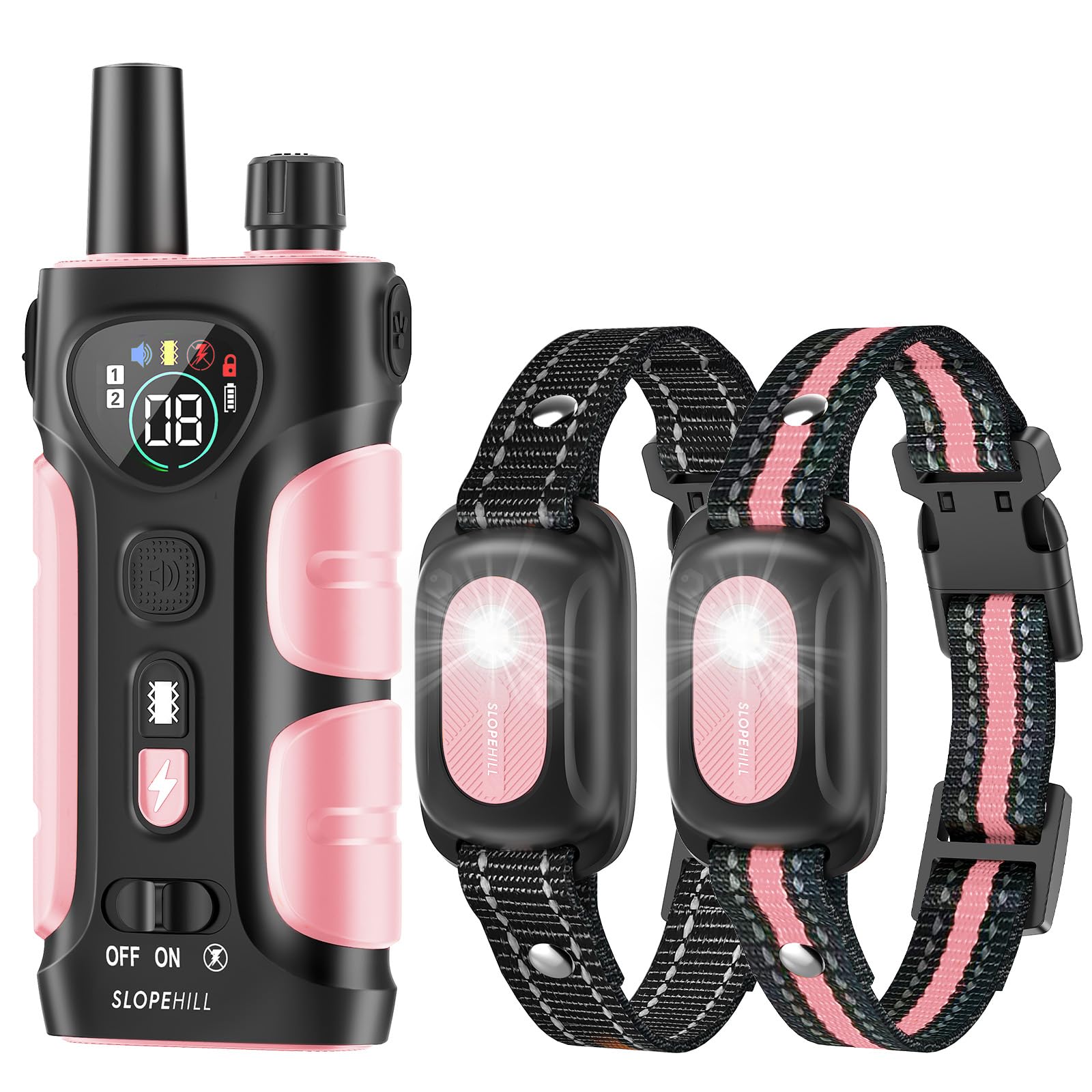
2. SLOPEHILL Dog Shock Collar 2 Dogs (8-140Lbs), 4200FT
Two receivers, 4200 feet of reach, and a price that undercuts nearly every dual-dog kit here.
Two dogs on one remote is what the SLOPEHILL kit gives you for daily training. Its receiver carries an IP68 rating (the highest water-and-dust protection in this group), so it survives a full dunk in the lake, not just a rain shower. The remote itself is not waterproof, so stash it if the sky opens. Range hits 4200 feet, which comfortably covers a park, a farm, or a long driveway. Strap length runs 8 to 26 inches and fits dogs from 8 to 140 lbs, so your 10 lb terrier and your 120 lb lab can share the same household.
Five modes keep the pressure adjustable: beep, vibration, safe shock, a flashlight, and a no-shock option for the days your dog only needs a reminder. Static is adjustable across 0 to 99, and you can pull the metal prongs entirely when you want a pure vibration and beep setup. Two full charges in about 2 hours gets the receiver running 15 to 20 days. The dual-channel remote switches dog to dog with a tap, which is the thing that wins people over on the two-dog kits — no menu diving mid-walk.
The honest trade-off is contact-point and charging-cable durability. A contact prong can snap on an otherwise fine receiver, and one buyer saw a prong break five weeks in. Treat the hardware gently, keep the collar on the loose side of firm, and the electronics inside will serve a long time. This is the kit for the handler who wants two dogs trained without two premium receipts.
Range and water first: 4200 feet of signal plus an IP68 receiver puts the messy outdoor days — lake, mud, pouring rain — inside the design brief.
The modest weak point: individual prongs and cables wear faster than the collar electronics, so order a spare set early and this kit keeps earning its place.
Reach for this if: you keep two dogs and want a water-ready receiver without a premium price.
Look elsewhere if: you need a fully waterproof remote, because this one has to stay dry.
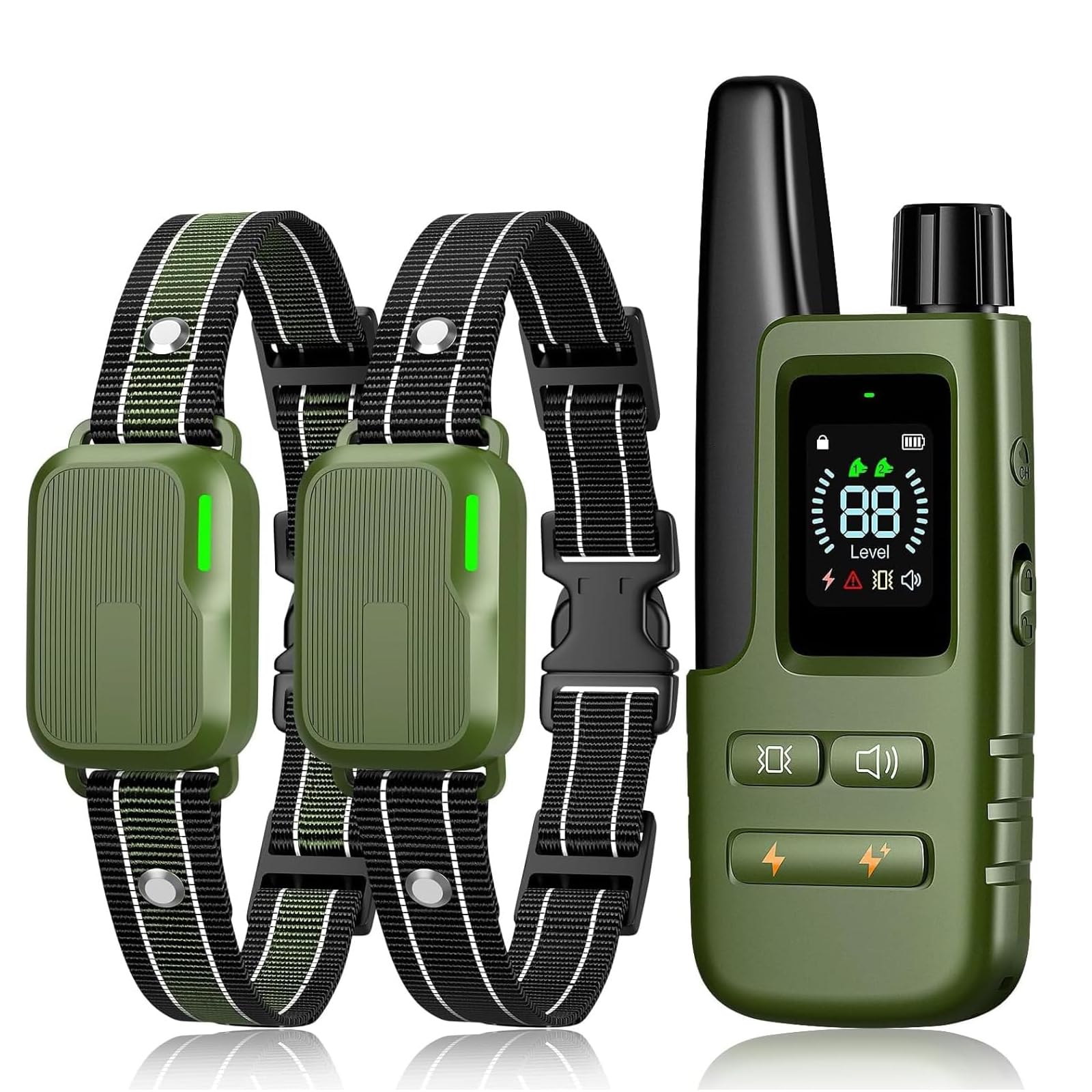
3. HapTop Shock Collar for 2 Dogs, 4500FT
The longest reach in this lineup at 4500 feet, with a signal that stays clean across open ground.
For handlers working a dog in the back forty, the number that counts is 4500 feet — and that is the HapTop’s headline over the PATPET’s 3000 feet, a gap of 1500 feet of usable range. The remote carries two collars with independent channels, so switching between dogs is a button push, not a re-pairing session. Four modes break down as beep (1-8), vibration (1-16), safe static (0-99), and a shock boost that adds a step up for the moments your dog is fully distracted. The system also remembers your last-used settings, so you are not resetting levels every time you switch it on.
Long trips are easier with the HapTop because its receiver holds 35 days on standby, the same 35 days as the SLOPEHILL’s collar, and its remote holds 45 days against the SLOPEHILL’s 45 days — matching parity on the handheld side. Pack without the charger for a month and the collar will still answer. The 3-in-1 USB cable charges all three pieces in 1.5 hours, and the safety lock keeps a bag bump from firing a correction. The IPX8 receiver (protected against water immersion) handles rain, puddles, and a swim. The strap adjusts from 7.8 to 24.4 inches and fits dogs from 10 to 120 lbs.
One thing to plan for: the contact points and the collar fit need regular checks as your dog’s coat shifts with the seasons. This is a no-shock convertible unit — pull the prongs and set static to 0 for puppies and sensitive dogs. Remove the points and it becomes a beep-and-vibration trainer without the static element at all.
The range story: 4500 feet is the furthest reach here, and the built-in memory keeps your training levels intact between sessions.
What to watch: the strap sizing runs down to 7.8 inches, which is snug on the smallest puppies, so measure the neck before you commit.
Your pick if: off-leash distance is the whole reason you are buying, and you want two dogs covered by one long-range remote.
Pass on it if: you only ever train inside a fenced yard and a shorter-range unit would save you the setup fiddling.
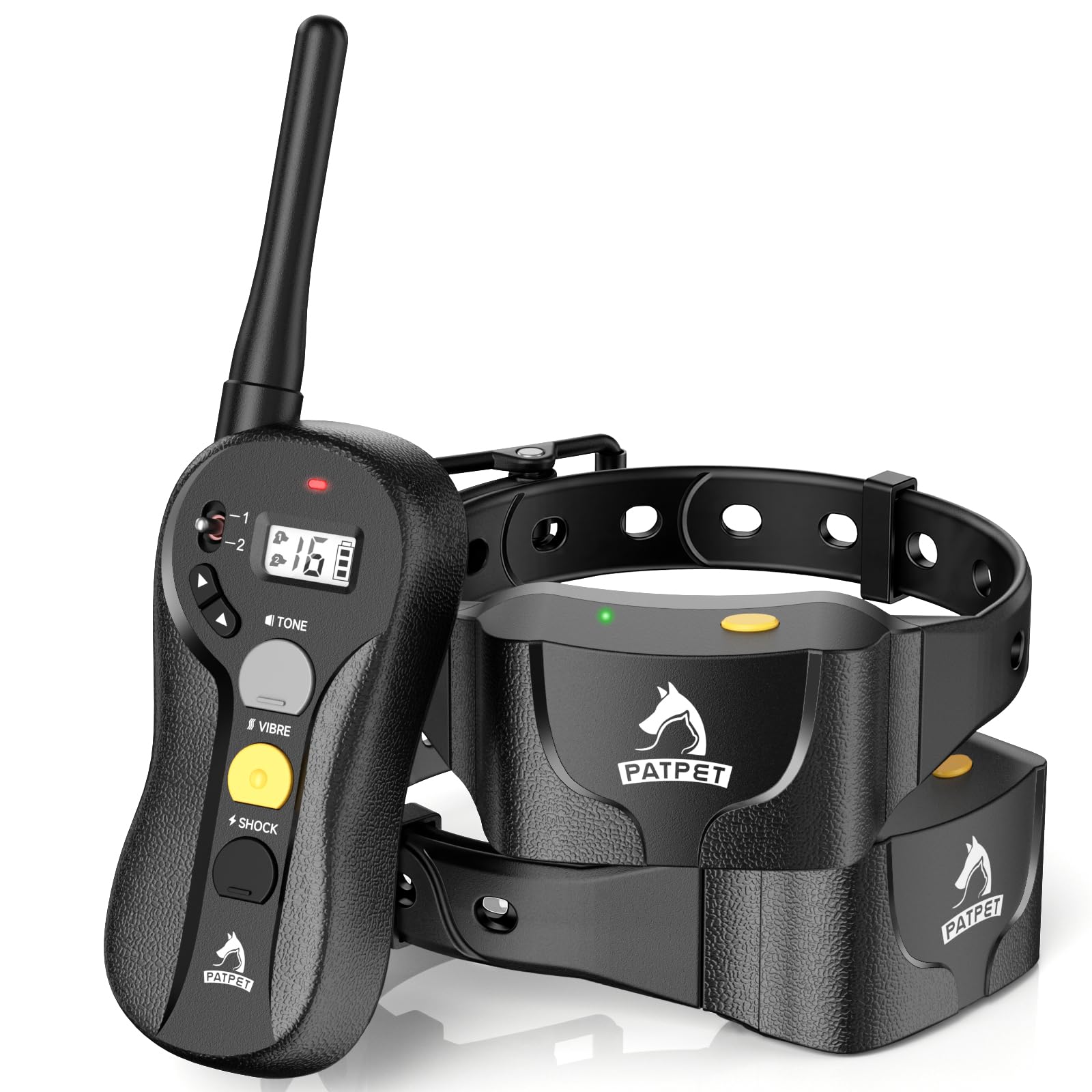
4. PATPET 2 Dogs Training Collar with Remote
A 365-day receiver standby that turns “where’s the charger?” into a problem you solve once a year.
Standby time is a spec most buyers skim past, and it is the PATPET’s strongest card: 365 days on the receiver versus the HapTop’s 35 days, and 100 days on the remote against the HapTop’s 45. The receiver handles IPX7 water — submersible 1 meter deep for 30 minutes — while the remote rates IPX5 rainproof, so a drizzle does not end the session. Range is 3000 feet on a 2-hour charge, which is plenty for a large yard or a park. Both receiver and remote run to 20 days and 10 days of regular use respectively, so the annual battery worry is the receiver’s job, not yours.
Blind operation is the feature that earns the name versatile here: tactile buttons let you find beep, vibration, and the 1-16 static levels by feel alone, so your eyes stay on the dog. One remote pairs with two receivers, and the strap adjusts to cover 10 to 140 lbs with TPU material that stands up to chewing and mud. Three scientific modes — beep, vibration, 16 levels of static — give you a clean progression from gentle reminder to firmer correction.
Durability and battery consistency are the honest caveats. Some units keep their charge for years; a few see a collar stop vibrating or a battery stop holding a charge around the one-year mark. Size your expectations to the field work you do: if your dog is in and out of water daily, the IPX7 protection is doing real work, but the unit is still a consumer device. The 3000-foot range falls well short of the 4500-foot HapTop, so if you work a wide-open field this one asks you to keep your dog closer.
Why the standby wins the day
- 365-day receiver standby and 100-day remote standby cut charging to a rare errand
- IPX7 receiver survives a dunk; IPX5 remote handles rain
- Blind-operation buttons so you train without looking at the remote
- Adjustable TPU strap covers 10 to 140 lbs
What is honestly mixed
- Durability is divided — some owners see years of service, a few see problems inside a year
- 3000-foot range sits well behind the long-range picks
- Battery consistency is not guaranteed across every unit
The right fit: a two-dog household that wants minimal charging hassle and an IPX7 receiver for wet trails.
Not ideal when: your training happens across wide open distance where a longer-range signal is the deciding factor.
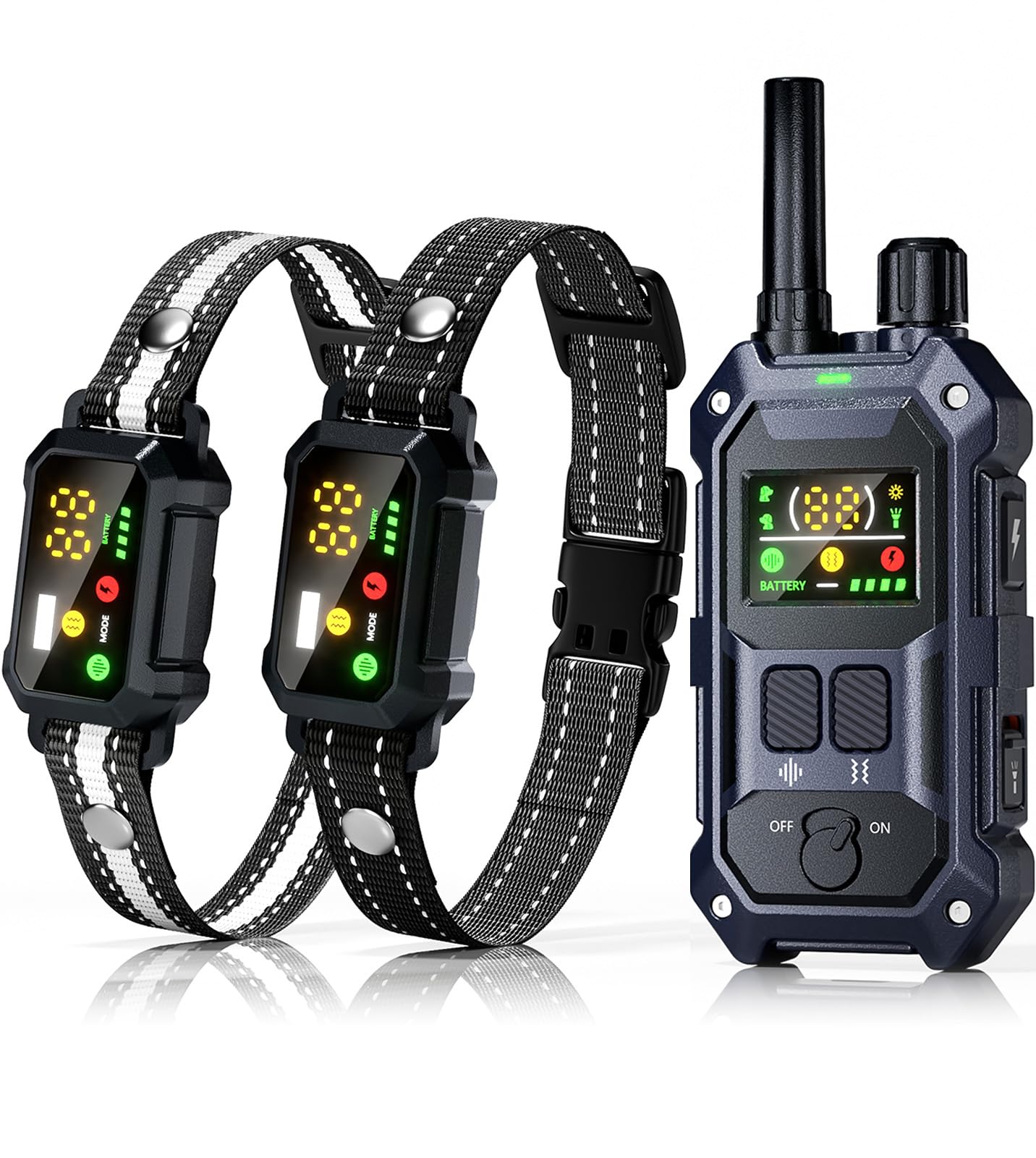
5. BLACKDOG Military Dog Shock Collar 2 Dogs
A reinforced casing rated for 500 lbs of crush force, built for the dog that treats every hike like a wrestling match.
Where the PATPET and SLOPEHILL worry about water, the BLACKDOG worries about impacts. The receiver casing is military-grade reinforced and rated to withstand 500 lbs of crush force and 100K+ bite cycles. The IP67 rating means it survives a 1-meter dunk for 30 minutes — lakes, storms, and a dog that submerges the collar chasing a stick. The 90-day battery life off a single charge runs on 1 hour of daily use, backed by 2-hour USB-C charging. For a weekend of trail work, the collar comes home with charge to spare.
Night work is where this one separates itself. The remote has its own flashlight to scan a dark trail, and the receiver has a strobe you can trigger from the handheld to bring a dog back or find it in the brush. The LCD screen on the remote displays four modes — beep (1-8), vibration (1-16), safe shock (1-99), and strobe — plus battery levels for each. A transparent built-in hex tool lets you pull the prongs without carrying a wrench, opening a no-shock setup for puppies and sensitive dogs. Range hits 4200 feet, and dual-channel control switches dog to dog quickly.
The recurring gripe is the strap that ships with it and the abuse the collar-mounted screen catches on rough ground. Neither is a dealbreaker — the electronics themselves hold up — but a better strap is a reasonable upgrade if you plan to use this hard. The 5 to 150 lb range is the widest in this lineup and the 8 to 25-inch strap covers a lot of neck sizes.
The tough-case case
- Reinforced casing rated for 500 lbs crush force and 100K+ bite cycles
- 90-day battery off a single 2-hour USB-C charge
- Two-way lighting: remote flashlight plus collar strobe for night finding
- Built-in hex tool for tool-free prong removal and no-shock mode
Worth knowing
- The included collar strap gets mixed reviews for comfort
- The collar-mounted screen is exposed to scrapes on rough terrain
- Four-mode screen takes a short while to learn the layout
Suits you if: your dog is tough on gear and your training happens after dark on trails and hills.
Consider a lighter unit if: your dog has a thin coat or you need the smallest, snuggest strap available.
6. E-Collar Educator ET-300 Remote Dog Training Collar

A hundred tiny steps of stimulation, each one small enough that your dog barely notices the first few.
The ET-300 is built for the handler who cares about the difference between level 8 and level 10. Instead of a short dial, it gives you 100 adjustable levels of electronic stimulation with a pulsing or tapping sensation, plus vibration, tone, an adjustable boost from 1 to 60, and an LED tracking light. The receiver is small — about 2 inches long by 1.5 inches wide and 1 inch tall, weighing 2.4 oz — and the yellow Biothane collar suits small to medium dogs. The handheld ships with a manual finger clicker that carries no electronics and does not talk to the receiver, so it marks behavior without touching collar output.
Reliability is the reputation, and the recurring theme across owners is that a dog responds to the tap setting faster and more calmly than to a harsh static jolt. It also rewards a handler willing to learn: the ET-300’s fine steps let you start low and climb slowly, which is why trainers reach for it. Setup means charging both the transmitter and the RX-090 receiver fully and confirming the pairing before the first session — verify the power, verify the collar fit, then train.
Two caveats. The learning curve is steeper than a simple beep-and-buzz unit, and a good instructor makes a real difference. Also, an occasional unit runs hot or fails — a rare heat damage case is on record. Size that as rare, not the pattern. The Biothane collar is not the widest-fitting option here, so check the receiver dimensions against your dog’s neck before ordering.
Why it earns the control label: 100 levels, boost from 1 to 60, and a tapping pulse give you a gentler, more granular training path than a 10-level dial.
Where it demands more from you: there is a real learning curve, and a few units have failed with heat damage, so follow the charge-and-verify routine before every first use.
Best matched to: a committed handler with a small or medium dog who wants the finest correction dial in the lineup.
Wrong fit for: a first-time buyer who wants a three-button collar and a five-minute setup.
7. SportDOG SportTrainer 875 Remote Dog Trainer
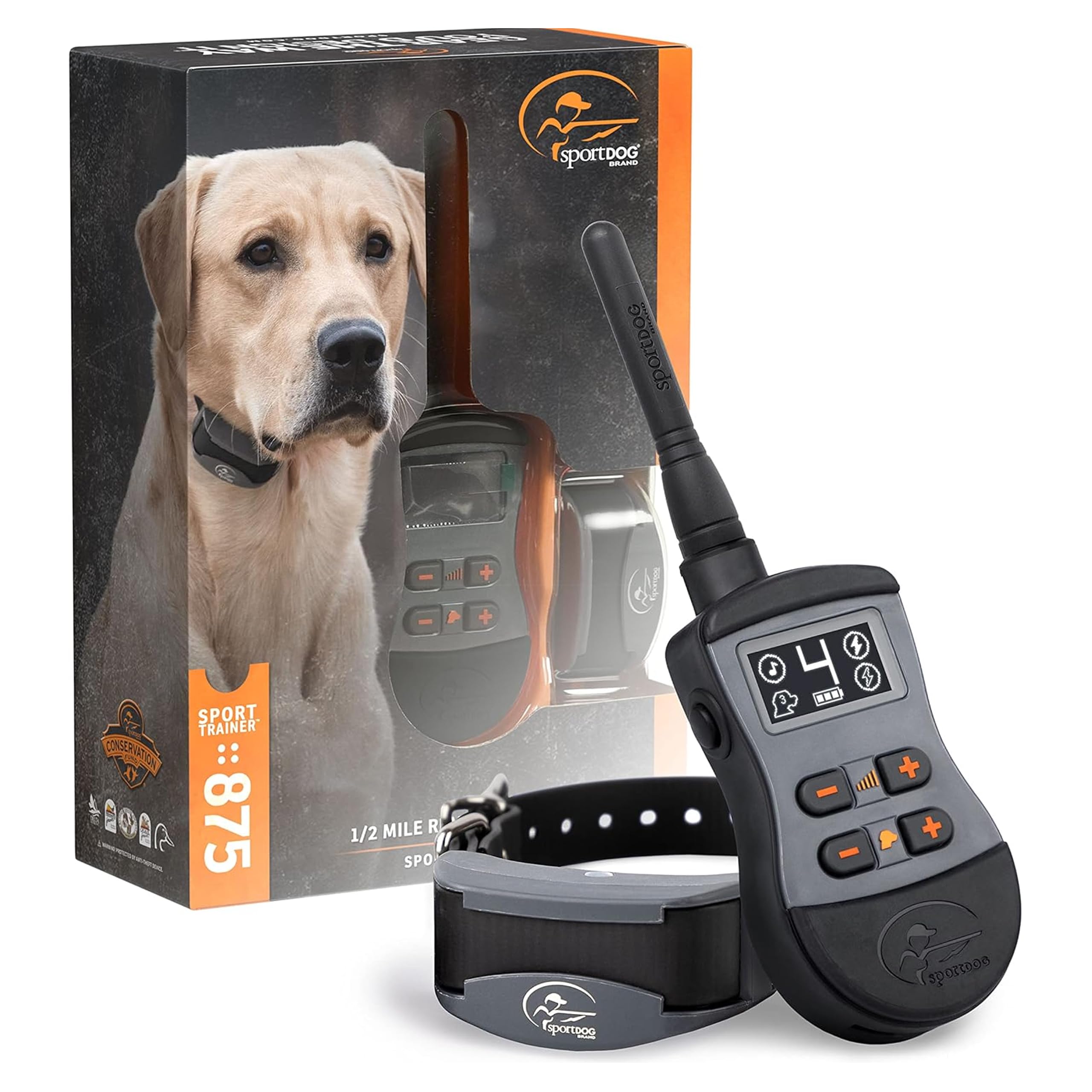
A half-mile signal that works under a quarter-inch of swamp water, made for dogs that hunt.
The 875’s headline is 1/2 mile of range and a receiver that is submersible to 25 feet using DryTek technology — the deepest water rating in this article. That is the kind of number you want on a duck dog that wades through flooded timber. The OLED screen shows selected dog, static level, and battery status at a glance, and the system handles up to 3 dogs with additional Add-A-Dog collars. 10 levels of continuous and momentary static, plus vibration and tone, cover your training progression. The lithium-ion batteries charge in 2 hours and run 50 to 70 hours per charge.
Functionality and build are what the field crowds praise: the system is well made and the programming takes a few minutes to learn, not a weekend. The included kit covers the transmitter, a receiver on a 3/4″ strap, adapter, standard and long contact points, test light tool, lanyard, and quick-start guide. For dogs 8 lbs and up with neck sizes of 5 to 22 inches, it covers the working breeds that dominate field training.
The mixed spot is battery consistency. Some owners see the 50 to 70-hour rating easily; a few find the collar or transmitter stops taking a charge just after the warranty window, and a rare unit eats a charge every day. If you work a dog daily, plan to charge on a schedule and keep an eye on the low-battery indicator. The beeper tone also runs low, so check that you can hear it at distance in wind before you rely on it.
The field-truth strength: a 25-foot water rating and 1/2 mile range give you coverage for flooded cover and wide-open ground.
The trade you accept: long battery life is the norm but charging reliability is where this model occasionally falls short, so budget for a spare charger and a charge routine.
Right for you: a hunter or field trainer working dogs 8 lbs and up that cross water and cover real ground.
Not the one if: your training is confined to a suburban yard and you want a charge schedule you set and forget.
8. Dogtra 280X E-Collar with Remote
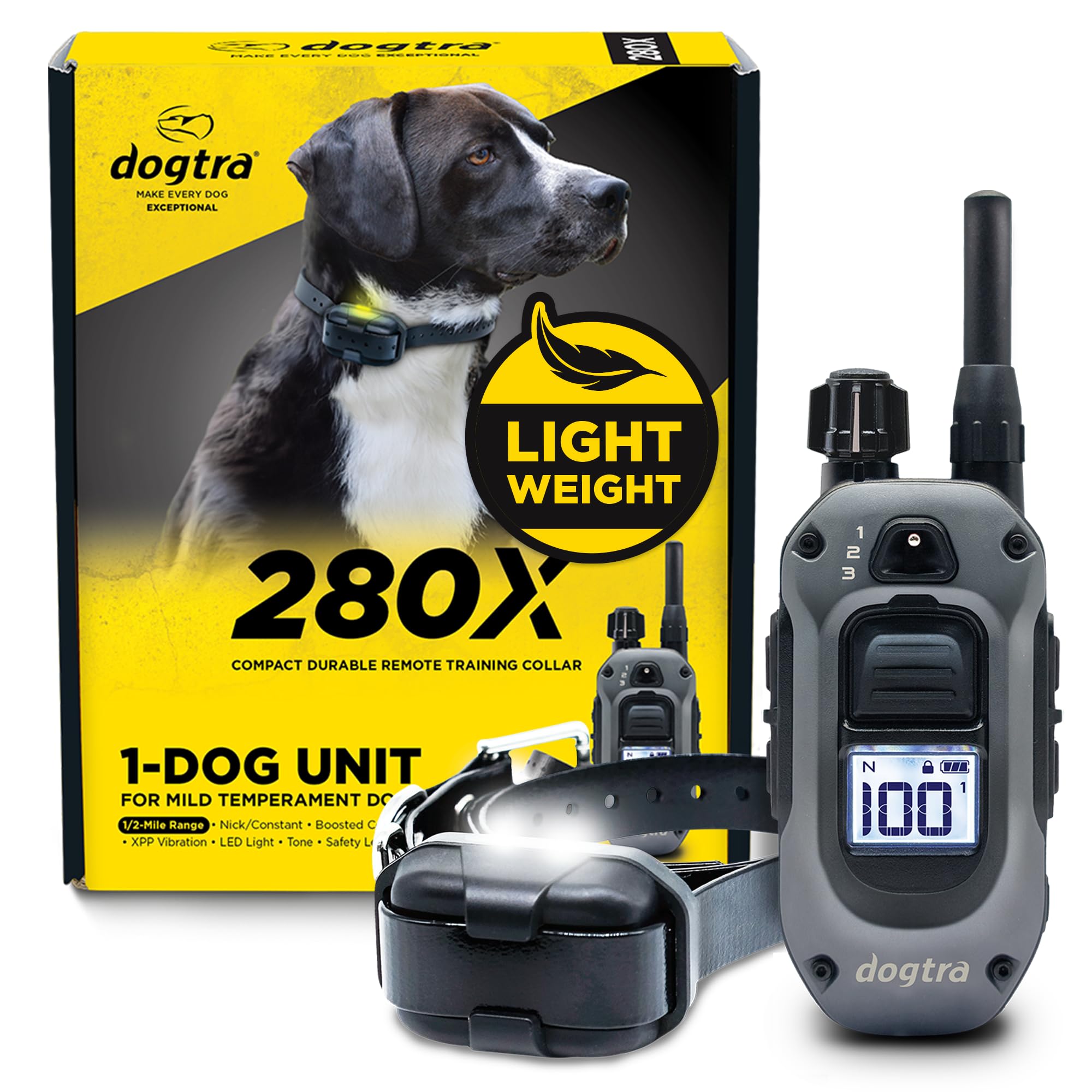
The one button you will actually press sits front and center, so the correction lands and you never break eye contact.
Dogtra’s design principle here is that reaction time beats feature count: a single main button in the center of the remote means you hit the correction the moment your dog thinks about breaking. Behind it sit 100 precise correction levels and a large, easy-to-read screen. Tone, vibration, and BOOST with the level lock and safety lock keep you from accidentally dialing up a correction when you meant a reminder. The receiver takes removable contact points and fits dogs 10 lbs and up. The 1000-lux LED lights your dog at night, and the whole unit is fully waterproof and virtually drop-proof for beach trips and hikes.
The recurring praise is about what happens after a few months: the buttons become muscle memory, the screen stays readable, and dogs respond to the beep and vibrate modes fast enough that many owners rarely touch static. The dual-purpose system works for a single dog just as easily as a pack — a four-dog household reports using it as the tool that focuses attention, and a mixed 30-lb dog responds reliably. The quick-charge splitter cable charges the receiver and the transmitter from one USB-C source.
The honest catch is battery usage: this is a daily-charge unit if you use it daily. The battery holds for days, but the training tool eats power quickly during real use, and a nightly charge is the realistic habit. The Biothane strap is comfortable, but the fit is not the tightest in this group for tiny necks. Where the ET-300 gives you 100 levels on a small, easy-to-lose receiver, the Dogtra keeps the screen and the top button together and scaled for real hands.
The training edge: 100 correction levels plus BOOST and a front-and-center main button put precision and reaction speed in the same hand.
The nightly habit: a daily charge is the realistic routine, so treat the charging cable as part of the collar, not an appliance you plug in occasionally.
A strong match for: a handler of a stubborn breed who wants a screen, a boost, and 100 levels in a familiar layout.
Think twice if: you want a set-and-forget collar — the daily charge cycle learns into your evening.
9. Garmin Pro 550, Dog Training Collar and Handheld

A full mile of range on a 27MHz radio, built for the handler who works dogs across open country.
The Pro 550 is the range king of this lineup: 1 mile on a 27MHz radio, versus the SportDOG 875’s 1/2 mile. It handles up to 3 dogs with additional devices, and 21 levels of continuous and momentary stimulation adjust through a top-mounted selection dial. There is a built-in BarkLimiter with advanced bark correction, plus vibration and the ability to remotely operate an accessory Upland Beeper. The handheld and dog device weigh 7.68 ounces as a set and use a stainless-steel and durable synthetic build. A 2-hour charge gets you days of field use per owner accounts.
The handheld is the part owners love: it clips onto a hunting backpack, runs one-handed with no look, and the collar’s blinking green light stays visible a long way out. The BarkLimiter and the beacon-style status light carry over from the Sport PRO’s design language, so if you already run Garmin gear, this system feels familiar. It also pairs as a remote for existing Pro 550 collars, turning a damaged handheld into a quick replacement rather than a whole new system.
The one flaw worth naming: the remote is more exposed than the collar, and a drop onto hard ground can damage it even though the receiver is built tough. Treat the handheld like a rangefinder, not a truck tool. The 1-mile range and upland-beeper support justify the premium tier for hunters who work open country, but a backyard trainer will never use the reach.
The mile-long signal: 27MHz radio, 21 stimulation levels, and BarkLimiter build make this the tool for open-country and upland work.
The exposed part: the handheld is the piece that fails a hard drop, so a lanyard and a belt clip are not accessories here — they are insurance.
Worth the spend for: the upland hunter who needs a mile of reach, a bark limiter, and up to three dogs on one handheld.
Overkill if: your dog stays within a fenced yard and you will never use the beeper or mile-range features.
Know the Specs
Remote Range And Signal
Range is the maximum distance the handheld can still reach the receiver, quoted in feet or fractions of a mile. A collar at 4200 or 4500 feet gives you room for off-leash work in a park or field. A 1/2-mile system covers hunting distances, and a 1-mile system covers open country. Treat the quoted figure as a clear-line maximum; terrain, trees, and weather will cut into it. The signal reliability matters as much as the top number — a collar that drops pairing mid-session is a liability regardless of its rated reach.
Waterproofing Ratings
An IP rating describes how well a device survives water and dust, and the two numbers after “IP” tell you how much. IP67 means dust-tight and safe in 1 meter of water for 30 minutes. IP68 is a deeper, longer allowance set by the maker, and IPX7 is safe in 1 meter of water for 30 minutes with no dust rating. IPX5 is rain-safe but not for a dunk. Check whether the receiver, the remote, or both carry the rating — many kits waterproof the collar and leave the remote merely rain-resistant.
Stimulation Levels And Boost
Stimulation levels are the adjustable steps of static correction a collar can deliver. A 10-level dial gives you broader jumps between steps; a 100-level system lets you fine-tune with much smaller increments. A boost function jumps you up a preset number of steps temporarily, useful for a single distracted moment. Many units let you remove the contact prongs or set static to zero, converting the collar into a tone-and-vibration trainer for puppies and sensitive dogs.
Battery And Standby Time
Standby is how long a charged collar sits ready without use, and it varies widely — from 35 days on a budget receiver to a full 365 days on another. Continuous-use figures are shorter and more realistic for daily training. Charging time is a separate number worth checking: 1.5 to 2 hours is typical, and a 3-in-1 USB cable can charge both collars and the remote from one source. A low-battery indicator saves you from a dead collar mid-session.
Common Questions
Will a training collar receiver fit my 12-pound dog?
How far can a dog training collar actually reach?
Can I train two dogs with one remote?
Is a shock mode safe if I skip it entirely?
How often will I need to charge a training collar?
What does IPX7 versus IP67 mean on a collar?
Do I need a wider range if my dog wears the collar on hikes?
How do I verify two collars are paired to one remote?
Which collar is best for a stubborn dog?
Will a collar survive a swim in the lake?
The Bottom Line
Correcting a dog one-handed without looking down is what makes the Garmin Sport PRO the top rated dog training collars winner for most handlers. Its quick-turn dial and four training buttons let you do exactly that — and that is the thing that actually decides whether a correction lands. Its 4.5+ star rating and the Pro 550 owners who buy it as a straight replacement handheld both point the same way: handlers keep coming back to it. If you need a second dog covered and a receiver that survives the lake, grab the SLOPEHILL 2 Dogs 4200FT. And for open-country work where a full mile of signal and a built-in bark limiter matter, the Garmin Pro 550 is the one to reach for.
Longest reach in this group belongs to the HapTop at 4500 feet, and its 35-day receiver standby makes the charger a rare errand. The PATPET stretches the receiver to 365 days of standby and adds an IPX7 dunk rating (protected against brief immersion in water). If fine-grained control is your priority, the Dogtra 280X and E-Collar ET-300 each offer 100 levels of adjustment, which is the difference between a broad nudge and a correction you can tune within a single step.
Match the collar to your dog before you read any feature list: start with the weight range and strap sizing, then confirm the waterproofing covers the receiver and the remote, then choose the range that matches how far your dog actually goes. Do those three in order and the feature list stops mattering. One nudge worth taking: the Garmin Sport PRO’s 4.5+ stars are the highest score in this group, and its pairing with existing Pro 550 collars makes it the safest long-term buy if you plan to keep training for years.
How we choose
We do not accept paid placement. Every pick is matched to a real buyer and a real use-case; we do not hands-on test units.
Sources
Specifications: manufacturer listings and product documentation. Review insights: verified customer reviews, as of November 2026. Pricing: not shown on this page (it changes often); check the current price via the retailer link.
As an Amazon Associate, Tactical Gear Guy earns from qualifying purchases. This does not affect which products we feature.