Specs are compiled from manufacturer listings and verified buyer reviews and can change over time — please confirm the key details on the product page before buying.
You already know the feeling: you ease back into a campsite or a fuel lane and the only thing between your bumper and a tree is somebody waving their hands in the mirror. A rear view camera for your RV solves that, but only if you pick the right one. The short answer is that the AUTO-VOX 7.2-inch wireless system is the pick most buyers should start with, because it skips the wiring entirely and still gives you a big, clear picture.
This guide is built by comparing the manufacturers’ published specifications and the patterns across verified customer reviews, so you get each pick’s real strengths and trade-offs instead of marketing spin.
Rigging a camera to the back of a long trailer is a different job than wiring a hatchback, and the details that matter are mount style, signal range, and how long the battery truly holds up. The picks below sort out those differences, and this breakdown of the rear view camera for rv market sticks to the facts each maker publishes.
Top Picks
How To Choose The Best Rear View Camera for RV
The first fork in the road is how the camera talks to the screen. A wired kit runs a video cable from the back of your trailer to the dash, and a wireless kit sends the picture through the air. Wireless is the easier install, but it puts the signal quality on the line every time you drive past a busy interchange.
Mounting: drill or no drill
A magnetic base with a rubber coating sticks to metal surfaces and lifts off when you swap trailers. You get a roughly one-minute setup and no holes in your rig. The catch is that aluminum or fiberglass panels need the included adhesive metal plate, and a magnet this strong needs a clean surface to bite. A screw-in or bracket mount is permanent, which is fine if the camera lives on one trailer forever.
Signal range and channels
Makers publish two range numbers, and they are not the same thing. Open-air range is measured with nothing in the way, and in-vehicle range is what you get with a trailer between the camera and the screen. Trust the in-vehicle figure. If you tow a long fifth wheel or want to watch your tow vehicle, look for a monitor that accepts two, three, or four cameras so you can add views later.
Power: battery, solar, or hardwired
A rechargeable pack in milliamp-hours (mAh — a measure of how much charge the battery holds) decides how many driving days you get before a recharge. A small solar panel tops the pack up on sunny days, but the sun is not a guarantee. If you park in shade or drive every day, plan on pulling the camera off and plugging it into USB now and then.
Weather and night visibility
The IP rating (an ingress-protection number — the second digit ranks resistance to water, with a 9K being the toughest jet-spray level) matters more than any other spec on a trailer camera. Rain and road spray hit that lens at speed. Infrared night vision and a water-repellent lens coating are what keep the picture usable after dark or in a downpour.
Side-by-Side Comparison
| Model | Best For | Monitor | Signal / Mount | Weather & Night | Amazon |
|---|---|---|---|---|---|
| AUTO-VOX 7.2″ Wireless★ Best Overall | Most RV owners | 7.2″ 1080P | Wireless, magnetic | IP69K, IR night vision | Amazon |
| Rohent R4 Dual SystemDual Camera Value | Two-camera coverage | 7″ 1080P | Wired RCA, bracket | IP69K, 80 ft IR | Amazon |
| FEISIKE Magnetic SolarSmoothest Install | Fast no-drill install | 5″ 1080P | Wireless, magnetic | IP69, IR night vision | Amazon |
| Fodkh Wireless 7″ Y08 | Recording on a budget | 7″ 1080P | Wireless, magnetic | Waterproof, IR night vision | Amazon |
| AMTIFO Furrion-Ready | Pre-wired Furrion RVs | 7″ 1080P | Wireless, bracket | IP69, 20 ft IR | Amazon |
| VOONOA VN007 Dual | Two magnetic cameras | 7″ 1080P DVR | Wireless, magnetic | Waterproof, solar | Amazon |
| VOONOA 4-Camera 360° | Full surround view | 7″ 1080P | Wireless, bracket | IP69K, 4 LED night vision | Amazon |
| Haloview BT7 | Long-rig signal reach | 7″ 1080P DVR | Wireless, bracket | Full-color dim-light | Amazon |
| Furrion Vision S+ | Factory Furrion match | 7″ 1080P touch | Wireless, sharkfin | IP65, 140° IR | Amazon |
Detailed Reviews
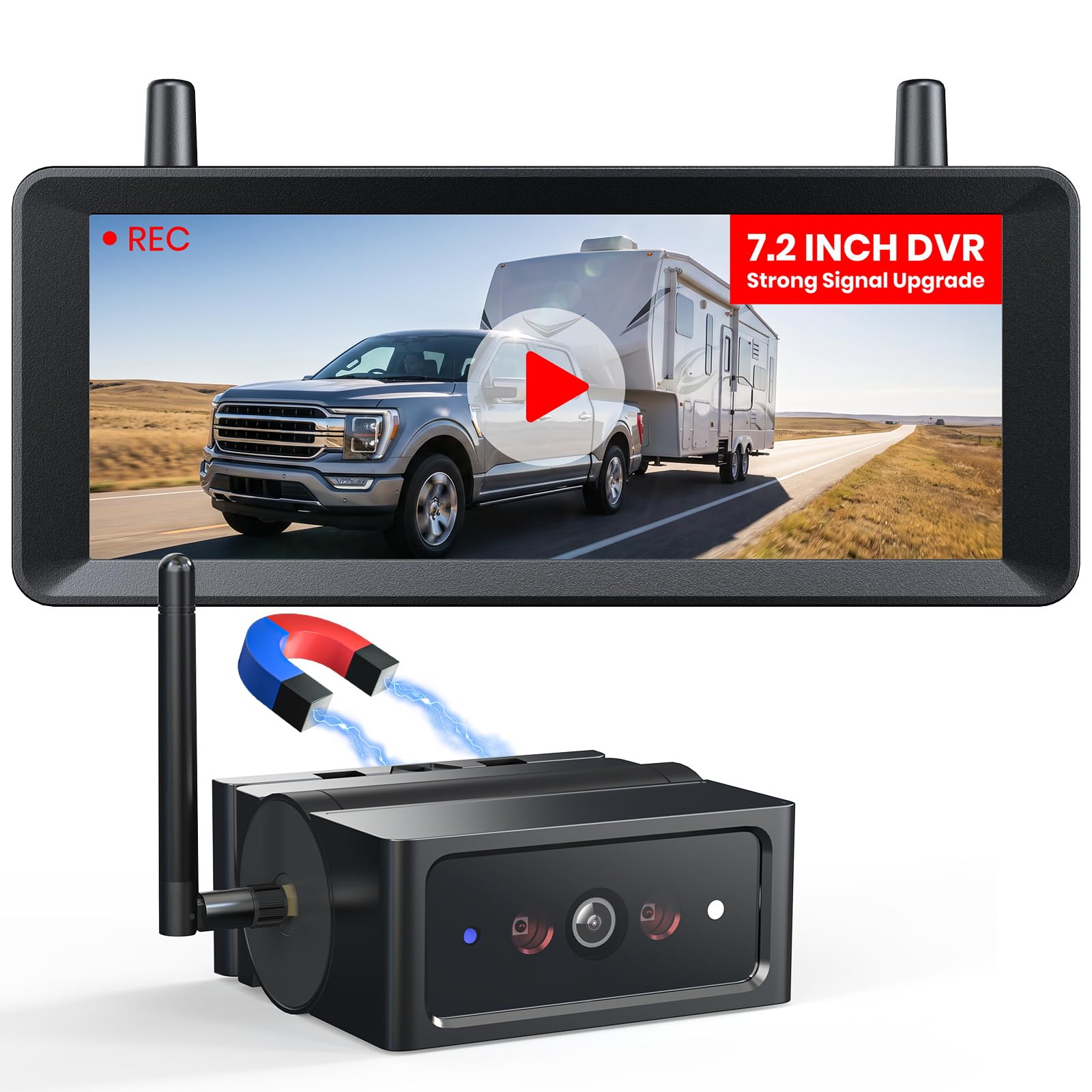
1. AUTO-VOX 7.2 Inch Wireless Backup Camera
Our pick — 4.5+★ from 200+ verified ratings; the strongest balance of quality and price.
A magnetic camera that snaps on in a minute and still holds a steady picture down a long rig.
The 7.2-inch screen is the headline here. That’s the largest monitor in this lineup, and it beats the 5-inch display on the FEISIKE by a clear margin. If you wear glasses on the road or you’re splitting the picture between a rear view and a second camera, that extra panel space is the difference between squinting and actually seeing what’s behind you.
The dual-antenna setup is the other reason this one earns the top slot. Two antennas fight signal drop-off better than one, so your live feed stays put when you pass a busy interchange or a stretch of cell towers. Owners point to that signal quality above everything else, and the 7.2-inch panel delivers sharp 1080P HD footage in full color by day and black-and-white infrared after dark. Backing into a dimly lit campground slot isn’t a guess anymore.
What you won’t deal with is a wiring run. The magnet bites metal surfaces, a rubber coating protects your paint, and an adhesive metal plate covers aluminum and fiberglass trailers. A full charge gives you over 15 hours of camera runtime, and the sleep timer can be set to 120 seconds, 240 seconds, or Never. The camera carries an IP69K rating (the toughest level for water jet spray and dust), and the lens has a water-repellent coating so rain beads off. A built-in DVR records rear footage to a memory card, which helps if you ever need to show exactly what happened behind you.
What makes it the top of this list
- Biggest monitor here at 7.2 inches — easier to read at a glance than the 5-inch FEISIKE
- Dual antennas hold a steadier live feed on a long rig
- Magnetic mount goes on in about a minute, no holes in your trailer
- Over 15 hours of runtime, with a sleep timer you control
- IP69K body plus a water-repellent lens for wet drives
- Built-in DVR saves rear-view footage to a memory card
Where it gives ground
- Runtime runs out faster than the hardwired kits if you drive all day without a recharge
- Mounting on aluminum or fiberglass depends on the included adhesive plate
- The magnetic hold needs a clean metal surface to be reliable
Grab this one if: you tow a trailer or motorhome and want a big screen plus a no-drill install without the wiring job.
Pass if: you drive full days on end and would rather not think about recharging — a wired kit like the Rohent may suit you better.
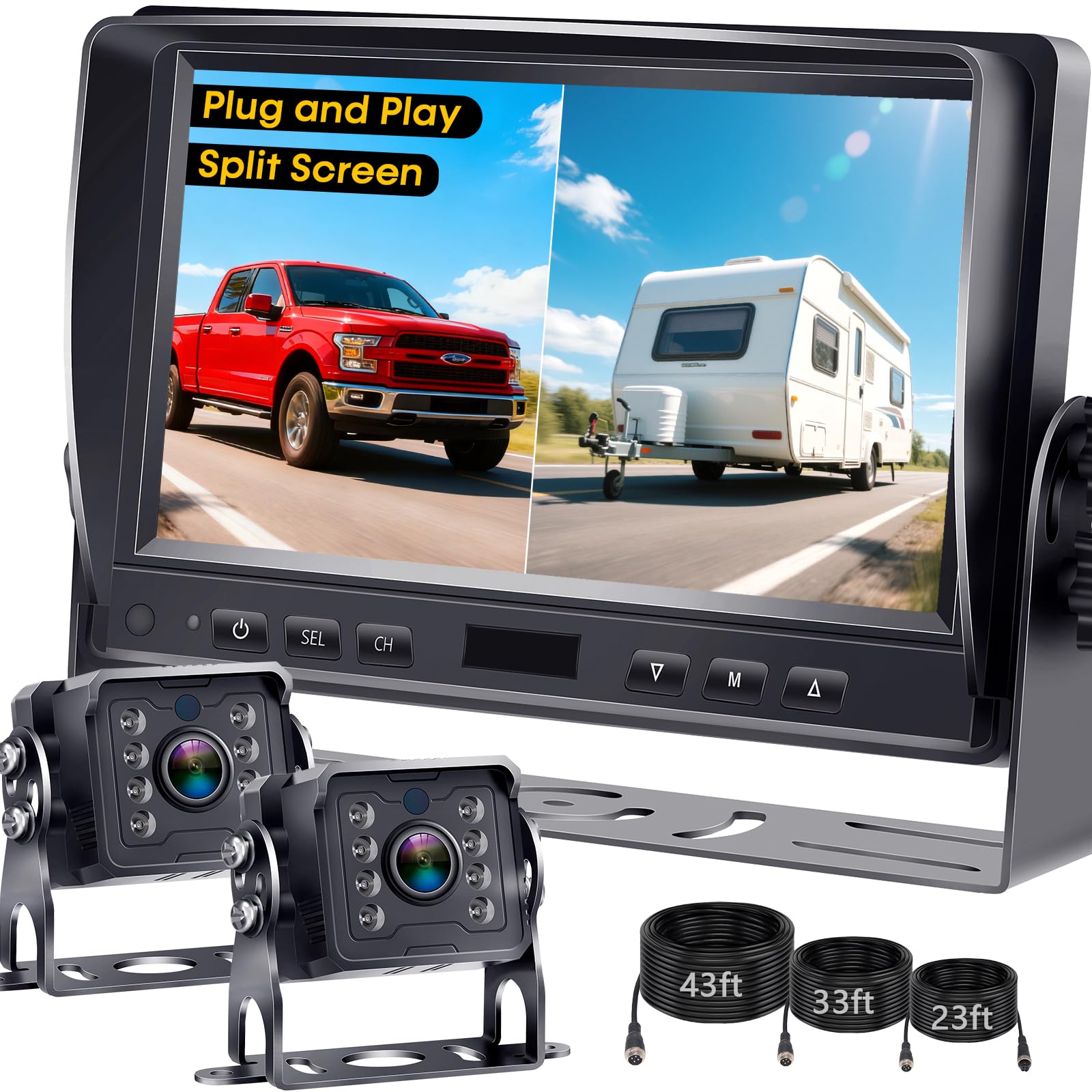
2. Rohent R4 Dual RV Backup Camera System
Two cameras, one screen, and no wireless dropouts — the wired workhorse for serious tow duty.
Here’s the trade this kit makes. It runs a cable from each camera to the monitor, which means real wiring time, but it also means a signal that doesn’t care what’s around you. The kit ships with 23 ft, 33 ft, and 43 ft video cables so you have length to spare, and the result is a rock-steady 1080P feed with no lag or image distortion. Owners praise the build and the functionality most, and the picture on that 7-inch screen stays bright and clear with smooth, lag-free footage.
The pair of cameras are rated IP69K (top-tier protection from water jets and dust), and each one has a 170° field of view. That’s noticeably wider than the Furrion Vision S+ at 140° and the Haloview BT7 at 120°, so you get less guessing at the edges when you swing into a tight site. Night vision reaches up to 80 feet with the built-in IR lights. The kit also ships with a cigarette lighter adapter, a sunshade, and the U-bracket for the monitor, and the makers say you can get it mounted in around 30 minutes over a 12V or 24V circuit.
The rear camera can also be flipped from mirror to normal view by cutting a thin white wire, and you can adjust the parking grid lines to match your rig’s width. The honest gripe worth knowing is the on-screen settings menu, which some owners find runs backwards and takes fiddling to sort out. Wired runs are exactly that — you have cables to route. If you don’t mind spending the time once, you get a signal that never blinks.
The wiring payoff: A wired 1080P link with 170° lenses on both cameras eliminates the signal dropouts that wireless kits fight, and the 7-inch monitor runs off a cigarette lighter adapter or your reverse circuit.
The setup cost: You give up a chunk of installation time and route three cables, and the settings menu takes some patience to navigate.
Worth it if: you want two angles covered at once and you’d rather run a cable than trust a wireless signal.
Think twice if: you want a tool-free install — the magnetic AUTO-VOX skips the cable run entirely.
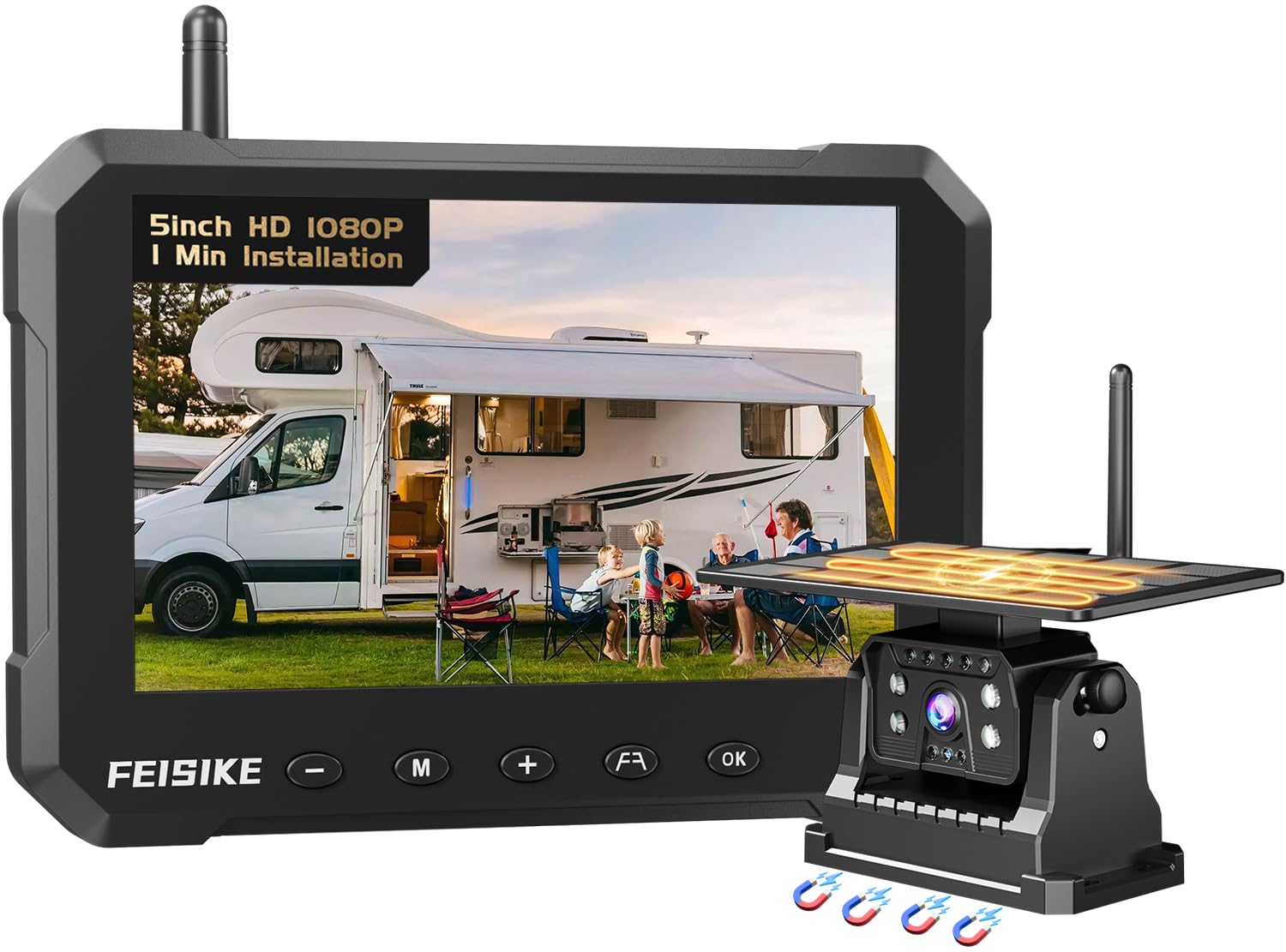
3. FEISIKE Magnetic Solar Wireless Backup Camera
Six magnets and a solar panel make this the closest thing to a clip-on rear camera.
This one wins on the mounting story. Six built-in magnets clamp the camera onto any metal surface, so you can move it between your camper and your work trailer without touching a tool. The 5-inch 1080P screen is the small end of this lineup, and the FEISIKE is 2.2 inches smaller in diagonal than the AUTO-VOX. In exchange, the smaller monitor is easier to tuck out of your windshield sight line.
The rechargeable battery is rated at 9600mAh (a mid-size pack among these picks) and the maker lists 25 hours of use on a full charge, with a 5W solar panel topping it up on cloudy or sunny days. The camera sleeps when the screen is off to stretch that further. The build itself is what wins people over — a metal case with three tightening screws per side gives it a rugged feel that holds up in transit. The 2.4GHz signal runs up to 35 feet on the vehicle and 830 feet in open space, and the IR lights kick on automatically after dark.
Here’s the caveat to weigh. Battery life is the most argued-over part of this camera — some owners run an 8-hour drive in each direction and finish on a full charge thanks to the solar panel, while others lose the charge sooner. The advertised 150° field is also a point of contention, with a few buyers feeling the real view is tighter than the number suggests. Fit it as a workhorse for lighter tow duty and the trade-offs stay small.
Go for it when: you want the fastest possible swap between trailers and a small screen that doesn’t crowd your glass.
Hold off when: you tow for very long stretches or count on a wide sight line — the AUTO-VOX gives you a bigger screen and the Furrion-style kits give you a wider lens.
4. Fodkh Wireless Backup Camera for RV 7-Inch
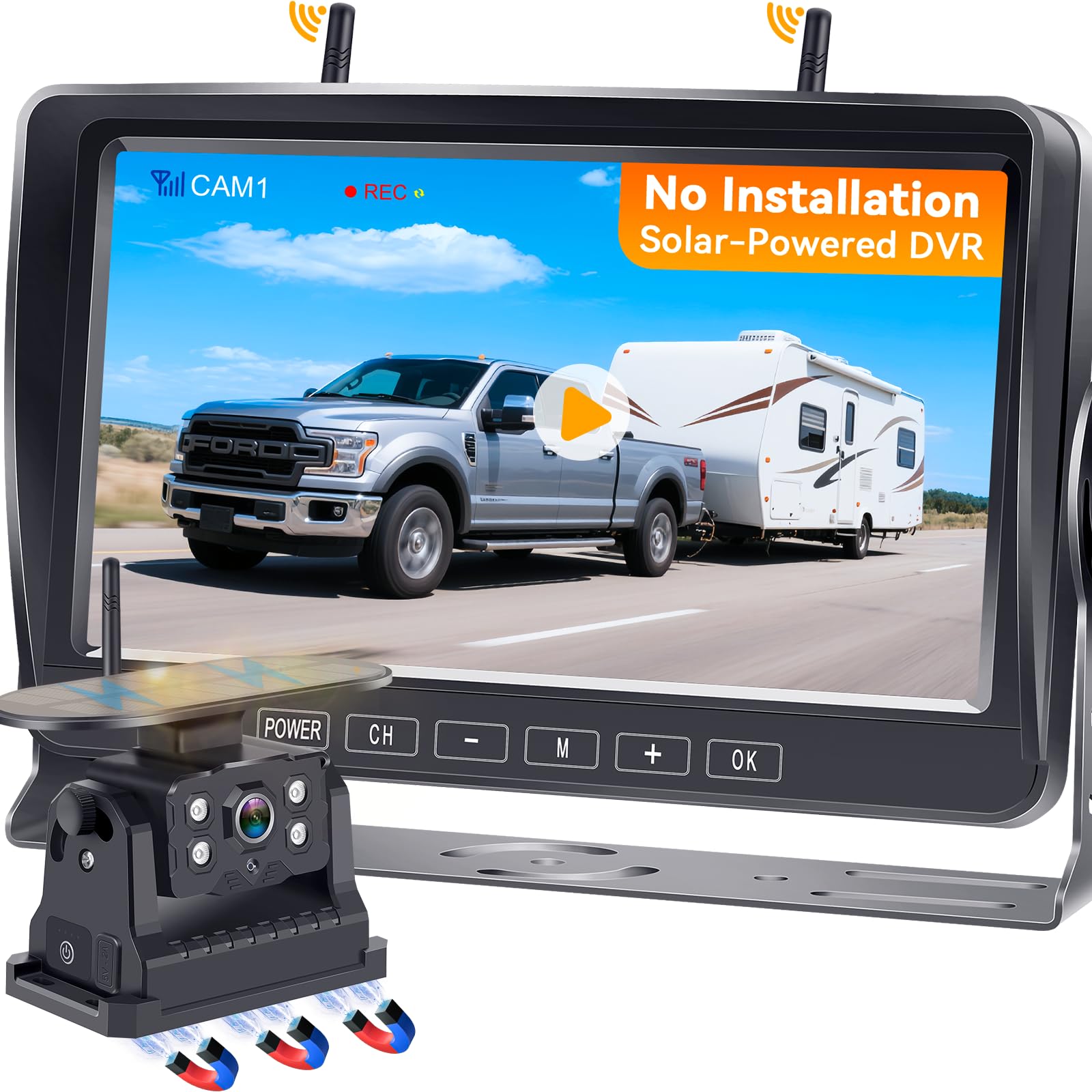
A big battery, a big screen, and a recorder that captures the moment you need evidence.
Fifteen thousand milliamp-hours is a serious pack, and this camera leans on it. The maker lists up to 25 hours per full charge, and the 5W solar panel tops it up from any angle. A powerful neodymium-iron-boron magnet holds the base on in extreme temperatures, with a soft rubber coating guarding your paint, and a USB charger ships in the box for the cloudy stretches.
The 7-inch monitor has loop recording that works like a dash cam, so you capture key footage if an incident happens. That’s a step up from the pure-view kits here, and it matches the recording function on the Haloview BT7. The monitor supports up to two cameras, has touch-sensitive buttons, and comes with a sunshade for bright glare. The lens covers a wide field, and the maker lists a 170° claimed view with infrared night vision for low light. The camera itself adjusts vertically by 90° so you can aim it exactly where you want.
Battery life is where this one asks for planning. The maker lists 25 hours per charge, but owners say daily driving at a few hours a day can outpace the solar top-up and you’ll pull the unit for a USB charge about every few days. That’s the real catch. Everything else — the no-tool install, the clear picture, the recorder — lines up well for the money.
Feature payoff: The 15000mAh pack plus the loop recorder on a 7-inch screen gives you both a live view and a record of what happened, which the smaller-screen kits here skip.
The daily reality: If you drive every day, keep the USB charger handy — the solar panel alone can fall behind.
Best fit for: RV owners who want a recording system on a big screen without paying Furrion-level prices.
Not for you if: you want zero charging chores — the Rohent’s wired link never asks for a recharge.
5. AMTIFO HD 1080P RV Backup Camera Wireless
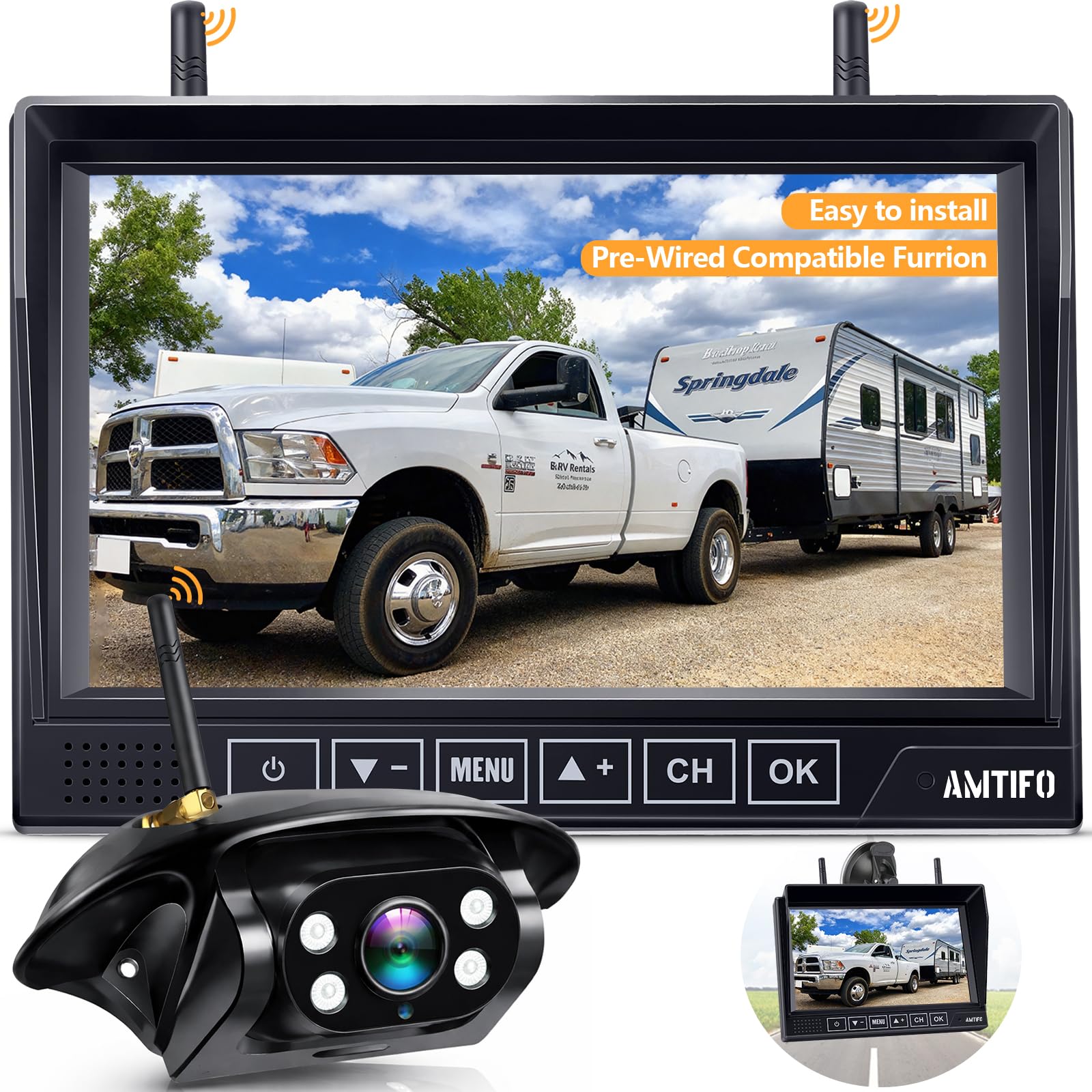
Built to drop straight into a Furrion pre-wired rig and beat the factory system on range.
Many RVs roll off the lot already wired for a Furrion camera, and this kit is the direct substitute. The box includes the Furrion mounting bracket adapter plate and a pigtail wire, so you’re swapping parts rather than drilling holes. That saves the cost of the factory system and the weekend you’d spend installing from scratch. A test cord also ships in the box, so you can confirm the camera works before you climb up to mount it.
The signal specs tell the bigger story. A 2.4GHz wireless link with dual antennas runs up to 825 feet in open air and stays solid on the vehicle up to 320 feet. That range comes close to Haloview’s 984 feet and clears the AUTO-VOX on paper. The 7-inch touch-key monitor accepts up to four cameras, so you can add a license plate cam or a view inside the trailer for your horses or your gear. Night vision reaches about 20 feet, and the 1080P color chip with a wide-angle lens covers your tow vehicle and two lanes of traffic.
You get a metal body that shrugs off rain and dust, thanks to an IP69 rating (the top level for water and dust protection). The maker says the upgraded power board is rated from 35V to 60V, so it can handle a range of RV electrical systems. An SD card recording option works like a dash cam, and you can raise or lower the guide lines to match your site. A 2-year warranty and 30-day money-back guarantee cover it. Before you buy, check the lens angle: the maker lists 130° here, the tightest view in this lineup. That means a sharp picture but a narrower view at the edges than the Rohent’s 170°.
The case for this AMTIFO
- Furrion bracket and pigtail included — plug-and-play on pre-wired rigs
- Up to 825 ft open-air signal and up to 320 ft on the vehicle
- 4-channel monitor lets you add side and interior cams
- All-metal IP69 body with an upgraded power board
- SD card recording plus adjustable guide lines
Where it narrows up
- 130° lens is the tightest here — less edge view than the 170° kits
- Mount needs a screw-in bracket, so no quick swapping between rigs
- Only about 20 ft of IR night vision, shorter than the Rohent’s 80 ft claim
Pick this when: your RV has the Furrion wiring already in place and you want a longer-range connect than the factory unit.
Look elsewhere if: you want a wide sweep at the lens edges or a magnetic mount you can swap.
6. VOONOA VN007 Dual Magnetic Wireless System
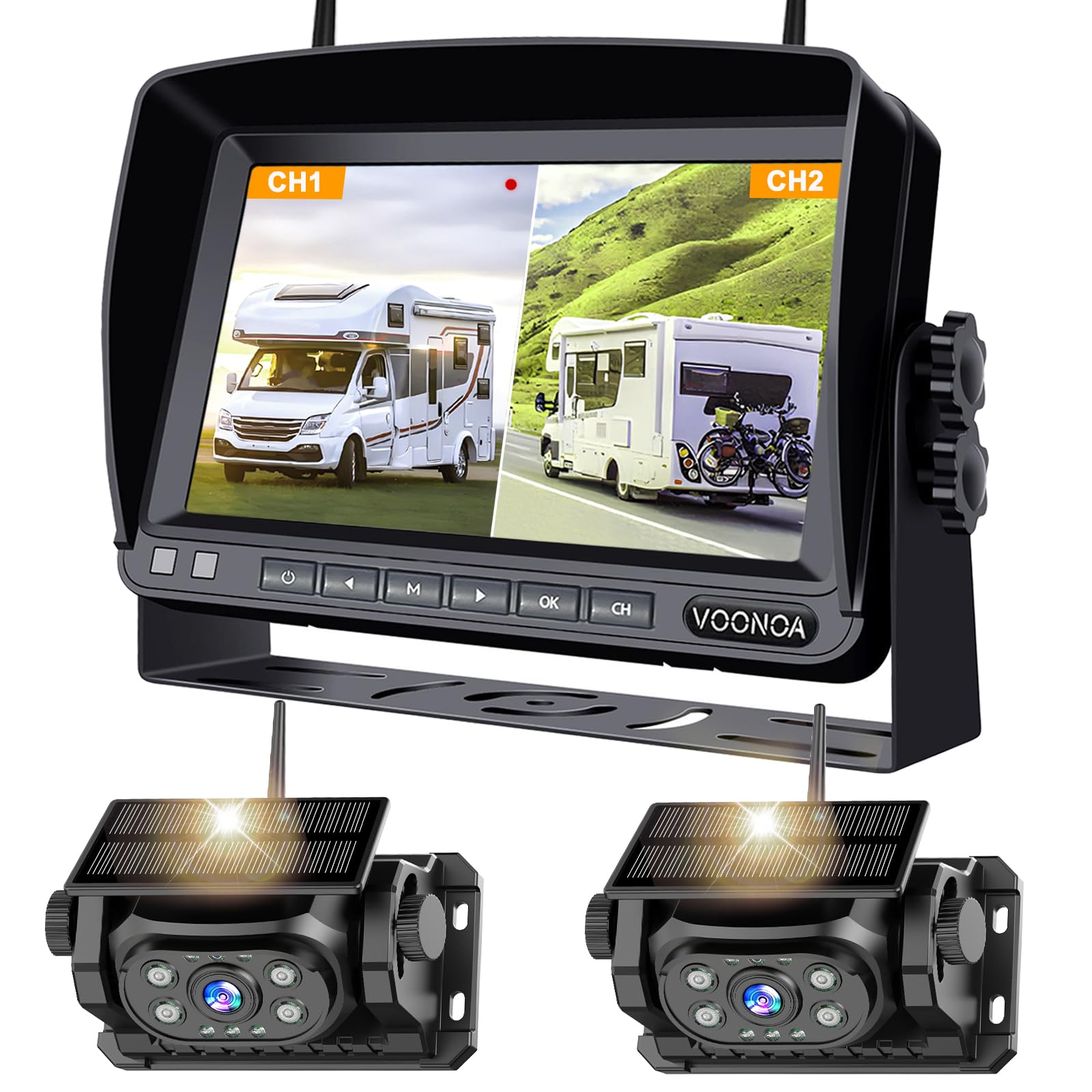
Two magnetic cameras, one seven-inch screen, and a remote that controls both from the cab.
The dual-camera angle is the reason to look here. Two magnetic cameras feed the 7-inch 1080P monitor, letting you watch your rear and a second angle at the same time. The base has six super-strong magnets so you can lift and reposition on the fly. The maker says the roughly three-minute install saves you a pro’s labor, and the 2.4G digital wireless link reaches up to 300 ft.
There’s a clever touch on the controls. Turn the monitor on and the cameras wake up, turn it off and they sleep, so you don’t climb in and out of the cab to fiddle with a switch. Each camera carries a 15000mAh pack rated for over 24 hours per charge, and a fast charger is included for cloudy stretches. The two included cameras give you a rear view and a second angle, with the maker listing a 170° field on the lens. The magnetic strength is a core selling point, and the wireless link works straight away with no pairing stress.
Battery life is the honest sticking point — the most mixed feedback centers on charging, with a few cameras reported to stop holding a charge well before the owner expected. That’s the risk with a rechargeable pack, and it’s worth buying from a seller that stands behind support. Treat this system as the flexible two-camera option rather than the one you leave sitting on a box truck for a year.
Two-angle value: The 2-camera kit covers your rear plus one more spot on a single 7-inch display, and the monitor-on/off remote saves trips to the cab.
The honest trade: Charging reliability is the weak spot here, so buy with the maker’s replacement service in mind.
Reach for this if: you want two views at once and a magnetic install you can move between rigs.
Keep looking if: you want a hardwired system you never have to charge — the Rohent covers that ground.
7. VOONOA 1080P Wireless 4-Camera RV System

Four cameras and a 360° view for the driver who wants eyes on every side at once.
Most RV kits give you one camera. This one gives you four — a front, a rear, and two side cameras feeding a 7-inch monitor so you can see all around your rig. That coverage is the sell here, and the monitor has a three-camera display mode that lets you watch both camper sides and the rear at the same time. The maker rates the view as 360° and lists a 170° real angle on the wide lens. For tight sites and lane changes on a wide rig, that’s a lot more awareness than a single rear cam.
The signal setup is built to handle four feeds. A dual-antenna design with the latest signal chip pushes 1080P video up to 500 feet in open air and 320 feet on the RV. The cameras use a CCD color sensor for clarity and detail, and each one has four big LED lights with light sensors for night vision. The whole system uses all-metal construction with IP69K protection and the maker rates it for temperatures from -4°F to 149°F. A 2-year replacement service covers it.
Here’s the part to plan for. The monitor powers straight from the car charger and the cameras connect wirelessly, but you still wire each of the four cameras to your running, reverse, or turn signal lights for a power source. That’s real wiring time, and it’s a resource-heavy install compared to a magnetic one-camera kit. The upside is the coverage and the reliability, which is what most owners talk about with this system.
Choose this when: you drive a long rig and want a full surround view, not just a rear picture.
Choose differently when: you want a one-minute install — four cameras each need a power wire, so this is a weekend job.
8. Haloview BT7 RV Backup Camera Wireless FHD

The signal reaches farther than any other kit on this list, verified for rigs up to 65 ft.
What sets this camera apart is how far its signal reaches. A line-of-sight wireless connection goes up to 984 feet, and the maker supports installation on vehicles up to 65 feet. If you run a fifth wheel or a long gooseneck, that reach is the difference between a steady picture and a blank screen. The 7-inch LCD monitor records in 1080P at 30fps (full HD, 30 frames per second) and handles up to four wireless camera inputs. With a line-of-sight range this long, you can park the camera at the very back of a long setup and trust it to talk to the dash.
Night vision gets special treatment, too. Powerful sensors deliver full-color video even in dim light, and the fill lights can be switched on or off remotely from the monitor when the light is really low. The monitor has a built-in visor to cut glare, and the 120° wide viewing angle keeps a clear view without fisheye distortion at the edges. It accepts 10-32V wide voltage input, so it works across a range of rigs without a voltage adapter. The DVR records in AVI format and supports 4-channel composite and single-channel recording.
The one place to level-set expectations is the lens. Its 120° field is the second-narrowest in this lineup, so you get a focused rear view rather than a sweeping 170° panorama. If your heart is set on the widest possible angle, the Rohent beats it there, but for pure signal range on a long rig this is the stronger bet. Haloview also offers a Furrion pre-wired adapter, which helps if your RV already has the wiring.
The range win: Up to 984 ft line-of-sight and support for vehicles up to 65 ft make this the long-rig specialist.
The angle trade: 120° is narrow, so you give up edge view for that signal reach.
Matches long trailers: go here for a fifth wheel or a rig near 65 ft where signal reach matters most.
Skip if: a wide, sweeping view is your priority — the AUTO-VOX and Rohent give more lens coverage.
9. Furrion Vision S+ Wireless RV Observation System
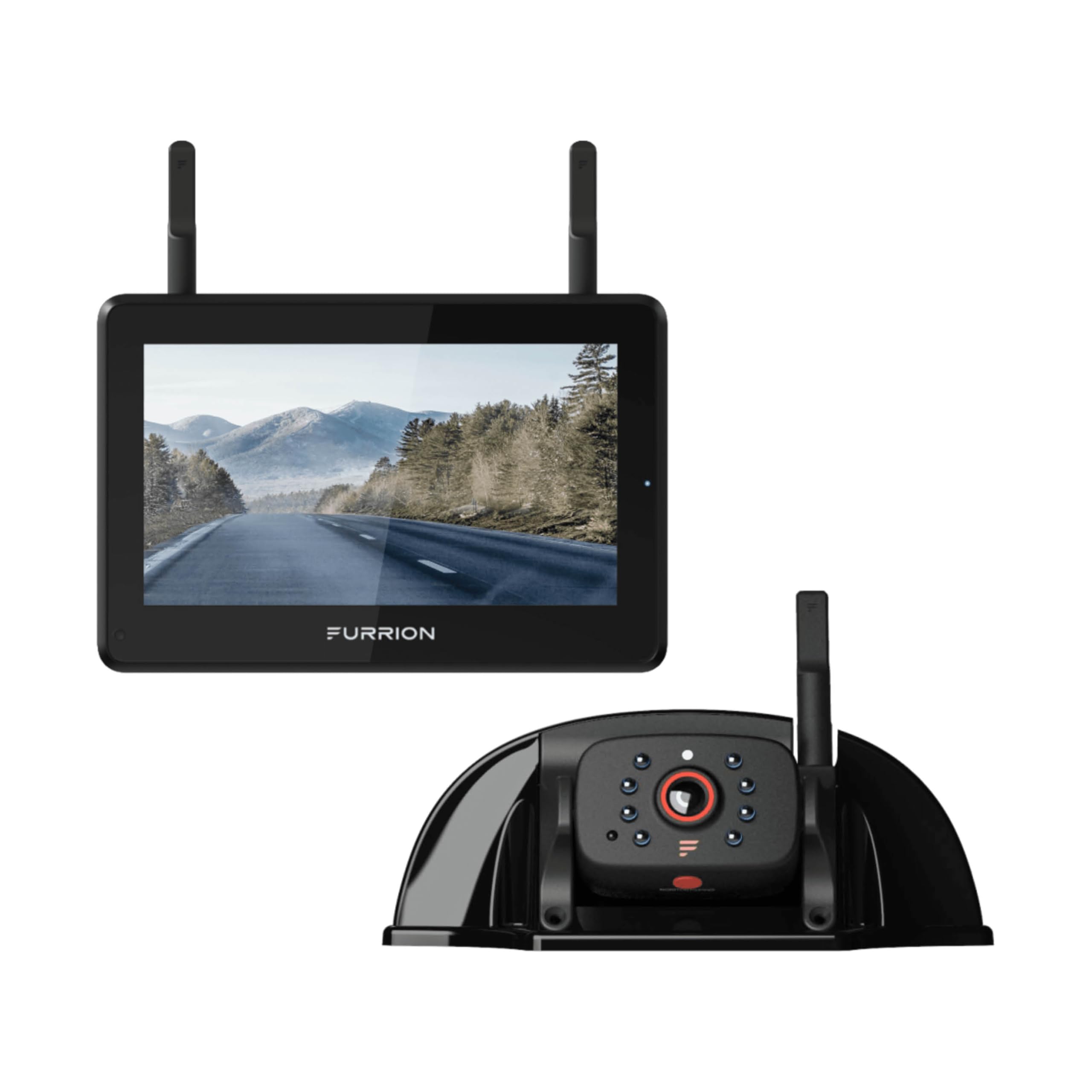
The name-brand system that slips into a Furrion-prepped RV with almost no fuss.
If your motorhome came from the factory with a Furrion sharkfin mount, this is the exact match. Most Furrion-prepped RVs are ready for the Vision S+ system, so the install is close to a swap with no extensive drilling. The sharkfin camera carries a 1080p sensor with a 140° wide view, an IP65 waterproof body (resists water spray but not full submersion), and infrared night vision with smart IR cut filters. The 7-inch touchscreen monitor has an anti-glare coating and park assist marker lines for backing in.
The signal story is built for long rigs. A 2.4GHz proprietary wireless link is tested to up to 100 feet at high speeds and up to 492 feet in open spaces. The monitor displays up to four cameras for full coverage, with windshield and table mounts in the box for easy placement. There’s a security bonus: you can wire the camera to keep watching your rig when you’re parked, and its motion sensor wakes the display when something moves. A built-in microphone means the camera can carry audio, so a helper can talk you through a park.
What you pay for here is factory fit. The connectivity is the most mixed part of the experience, with some owners facing more frequent drops than they want from a name-brand system. The value is the trade — you’re getting a true OEM match and a warranty from a known maker. For a rig that’s already Furrion-prepped, the near-zero-drill install is the draw, and the touchscreen and security features round it out for those who want the brand-name route.
Why to choose the OEM path: A Furrion factory mount fits this unit directly, and the touchscreen, park assist, and motion-wake security mode round out a complete system.
What to accept: Signal drops show up more here than you’d expect for the name, so a rig with a factory-prepped mount is where this makes the most sense.
Ideal for: the RV owner with a Furrion-prepped mount who wants a factory-matched, zero-drill install.
Not the pick if: you want the widest lens or the lowest path to a working picture — the value kits above cover both.
Know the Specs
Monitor size and resolution
A bigger screen means less squinting and easier split-screen viewing if you add a second camera. Seven inches is the common size here, and one pick goes up to 7.2 inches. Resolution, listed as 1080P, tells you the picture is sharp enough to make out details like trailer edges and lane lines. Match the screen to how much you actually look at it — a full-width dash makes bigger easier, and a small windshield tucks a 5-inch panel more easily.
Wireless range, open air versus on the vehicle
Makers list two numbers, and they measure different things. Open-air range is the best case with nothing between the camera and the screen. In-vehicle range is what you get with a trailer in the way, and that is the number to plan around. A kit rated in the hundreds of feet on the vehicle handles a long trailer. A kit rated at 35 feet on the vehicle is fine for a short setup but may strain on a full-length rig.
Battery capacity and solar charging
Capacity in mAh measures how much charge the pack holds. A 9600mAh pack and a 15000mAh pack behave differently across a trip. A small solar panel tops up the charge on sunny days, but it is a supplement, not a replacement for a full recharge. If you drive every day or park in shade, keep the USB charger ready and plan an occasional off-vehicle charge. Hardwired kits skip this whole question by drawing power from the RV.
IP ratings and night vision
The IP rating tells you how well the camera keeps out dust and water. IP65 resists water spray; IP69 and IP69K handle high-pressure jet spray and dust. A camera on the back of a trailer gets hit by rain and road spray, so a high rating is worth paying for. Night vision with infrared LED lights keeps the picture usable after dark, and a water-repellent lens coating keeps droplets from blurring your view in wet weather.
Common Questions
Will a wireless RV backup camera work on a long trailer?
Do I have to drill holes to mount an RV rear camera?
How long does a wireless camera battery last between charges?
Can I add a second camera to my RV monitor later?
What does IP69K mean on a trailer camera?
Is a wired or a wireless RV camera better?
Which RV backup cameras are compatible with Furrion pre-wired RVs?
Do RV backup cameras record video for evidence?
How far can a wireless RV camera see at night?
The Bottom Line
For most rigs, the rear view camera for rv that fits best is the AUTO-VOX 7.2 Wireless. It pairs the biggest screen in the lineup with a magnet mount that installs in about a minute. It also holds the highest owner rating in this lineup at 4.5+ stars across 200+ ratings. If your RV came pre-wired for Furrion, the AMTIFO slots in with the included bracket and gives you that longer in-vehicle signal. And for a long fifth wheel or gooseneck where reach matters most, the Haloview BT7 is the one to reach for. One honest note: the AMTIFO has more ratings — 900+ to 200+ — but the AUTO-VOX holds the higher score, so weigh whether signal range or magnetic flexibility matters more to your tow setup.
How we choose
We do not accept paid placement. Every pick is matched to a real buyer and a real use-case; we do not hands-on test units.
Sources
Specifications: manufacturer listings and product documentation. Review insights: verified customer reviews, as of November 2026. Pricing: not shown on this page (it changes often); check the current price via the retailer link.
As an Amazon Associate, Tactical Gear Guy earns from qualifying purchases. This does not affect which products we feature.