Specs are compiled from manufacturer listings and verified buyer reviews and can change over time — please confirm the key details on the product page before buying.
If your concrete still looks grey and streaked after an hour of waving a wand, the tool is the problem, not your technique. A water broom attachment turns that narrow jet into a wide spinning disc of pressure, so a driveway takes one steady pass instead of a hundred shaky ones. Below are the five Ryobi surface cleaners worth your time, sorted by who they actually suit.
This guide is built by comparing the manufacturers’ published specifications and the patterns across verified customer reviews, so you get each pick’s real strengths and trade-offs instead of marketing spin.
The core thing to understand is that these are attachments, not washers, so the pressure rating on the box has to match the machine you already own. Getting that match right decides whether you clean a patio or just make a wet mess, which is the whole game with the best ryobi water broom.
Top Picks

How To Choose The Best Ryobi Water Broom
Start with your pressure washer, not the attachment. Every one of these cleaners has a pressure ceiling, and running one above that ceiling is how you shorten its life. Know your machine’s PSI and GPM before you shop a single listing.
Match the pressure ceiling to your machine
Gas washers push far more pressure than electric ones, so the two families of cleaner are not interchangeable. A model built for up to 2000 psi belongs on an electric unit. A model rated to 4200 psi is built for gas power, and pairing it with a small electric washer gives you a spinning disc with no real bite.
Decide how wide you want the pass
Cleaning width is the diameter of the spinning spray under the housing, measured in inches. A wider housing covers more ground per pass but needs more pressure behind it to keep the jets spinning. Narrow housings suit tight patios and small electric washers, while wide ones suit open driveways on gas power.
Weigh wheels against the skirt
Casters let the head roll across flat concrete instead of hovering, which takes the strain off your arms on long runs. A skirt or shroud around the housing holds the splash in and helps when you clean a deck before staining. Neither is cosmetic; both change how the job feels by the end.
Side-by-Side Comparison
| Model | Best For | Max Pressure | Cleaning Width | Item Weight | Amazon |
|---|---|---|---|---|---|
| 15 in. 3300 PSI Surface Cleaner for Gas Pressure Washer★ Best Overall | Deck prep and long concrete runs on gas power | 3300 psi | 15 in. | 4 pounds | Amazon |
| Ryobi 12 in. 2000 PSI 1.4 GPM Quick Connect Surface CleanerBest Value | Electric-washer owners cleaning patios and walkways | 2000 psi | 12 in. | 2.4 pounds | Amazon |
| RYOBI 12 in. 2300 PSI Electric Surface Cleaner with Casters | Electric washers on patios and paver driveways | 2300 psi | 12 in. | 4.4 pounds | Amazon |
Detailed Reviews
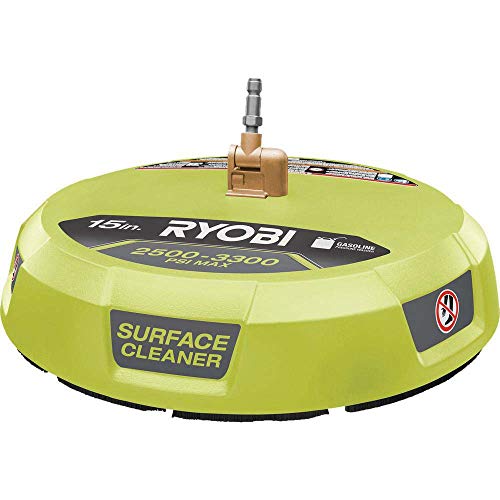
1. 15 in. 3300 PSI Surface Cleaner for Gas Pressure Washer
Our pick — 4.0+★ from 450+ verified ratings; the strongest balance of quality and price.
The gas-powered workhorse that turns a day of wanding into a couple of hours.
This is the pick for anyone with a gas washer and a deck or driveway that has been ignored for years. At 15 inches across, the housing covers a real swath of ground per pass, so you walk in straight lines instead of scrubbing in circles. It weighs 4 pounds, light enough to steer with one hand along a garage apron.
The skirt around the housing is what owners single out for deck work before staining or painting, and the splash control it gives you is the reason. That housing is also what makes this a gas-only tool: it is rated up to 3300 psi, so it is a mismatch for a small electric machine. Functionality draws the most buyer comments of any model here, and the recurring verdict is that it does the job.
Buyers report cutting a 6-8 hour job down to under 2 hours. Compared with the 12-inch electric cleaner further down, you are covering a wider pass and carrying about 1.6 pounds more in the hand, a trade most gas owners happily make.
What it delivers
- 15-inch pass cuts travel time on open concrete
- Rated to 3300 psi for full gas-washer output
- 4-pound body stays controllable on long runs
- Skirt keeps splash down on deck prep work
Where it asks more of you
- Needs a gas washer, not an electric one, to work properly
- A minority of buyers found it lacked bite on tough stains
- Longer wand makes it far easier to control, and that is a separate buy
Go with this if: you own a gas pressure washer and want the most ground covered per hour across a large driveway.
Think twice if: your washer is electric — the pressure ceiling here is well above what a small electric unit delivers.
2. Ryobi 12 in. Surface Cleaner
Barely over two pounds, and the electric-washer pick most driveways actually need.
If your pressure washer plugs into a wall, this is the one to look at first. It caps out at 2000 psi and 1.4 gpm, which is exactly the range a typical electric unit lives in, so nothing is ever over-driven. The 2.4-pound body means one hand does the steering and you are not fighting the head across a patio.
Dual rotating high-pressure jets are the mechanism behind the 12-inch cleaning path, and Ryobi rates that path as cleaning up to 4x faster than a standard nozzle. Owners mention a 55-foot sidewalk cleaned in under 20 minutes and 20 years of patio buildup stripped off. One buyer reports a three-day job finished in a single day.
The honest catch shows up over time rather than on day one. A small group of buyers hit leaking seals after repeated use, and some found the circulating sprayers slowed down once the unit had been running a while. That pattern reads like a tool built for home jobs rather than commercial duty, which matches the 12-inch footprint and the price tier. Treat it as a homeowner’s helper and it earns its place.
Why it earns second spot: the pressure match is right for electric washers, the 12-inch path beats wanding by a wide margin, and the 2.4-pound weight keeps it manageable over a whole driveway.
The fair caveat: seals and sprayer speed have let down a minority of long-term owners, so buy it for regular home upkeep rather than daily professional work.
Right for: electric-washer owners with a driveway, patio, or walkway that needs a fast wide pass.
Not the one for: gas-washer setups, since this tops out well below what those machines push.
3. RYOBI 15 in. Surface Cleaner

Three casters under a 12-inch disc that rolls across a paver patio without snagging.
Paver patios and cement driveways are the target here, and the three caster wheels are what make the difference over uneven joints. It fits electric pressure washers up to 2300 psi and uses a standard 1/4 in. quick connect, so it drops onto most consumer electric wands without an adapter. Ryobi also rates it to clean up to 4X faster than a standard nozzle with its rotating jets laying down a streak-free path.
At 4.4 pounds, this broom is easy to push around, and its size tells you why: at 24″L x 14″W x 12″H it is substantially taller and longer than the 12-inch electric cleaner at 13″L x 13″W x 4″H, because of the caster carriage and frame. You feel that extra bulk when storing it, but the wheels pay it back on the job — the movement across pavers and cement is the quality owners call out most.
Be honest about what you expect from performance. The biggest topic in the review pages is performance in mixed terms, and the fair read is that this is a home-duty tool: one buyer described it as designed for intermittent home use and “not heavy duty by any standards”, and another found the head stopped spinning after a couple of uses. Set against that, the cleaning results and overall quality draw praise — concrete comes cleaner and the job runs about half the time. It holds 4.0+ stars across 70+ ratings. Buy it for seasonal home upkeep on a patio and the math works; expect commercial-grade endurance and it will fall short.
The case for it: casters that roll over pavers, a 12-inch rotating-jet path rated to clean up to 4X faster than a nozzle, and a 2300 psi ceiling that suits consumer electric washers.
Set expectations first: it is a homeowner tool for intermittent use, not a commercial head — the spinning action has been the weak point for a minority of owners.
Get it for: a paver patio or cement driveway where you want the head to roll rather than hover.
Skip the upgrade if: you pressure wash for a living — this is built for home jobs, not daily commercial loads.
Know the Specs
Maximum Pressure (PSI)
PSI stands for pounds per square inch — a measure of how hard the water hits the surface. Each Ryobi cleaner has a ceiling: the highest pressure it is built to run at. Stay at or under it and the jets spin cleanly and the seals last. Push a 2000 psi head onto a much stronger gas machine and you stress the moving parts rather than clean faster. Match the ceiling on the box to the output of the washer you own.
Maximum Flow Rate (GPM)
GPM means gallons per minute — how much water the head needs moving through it. A wider cleaning path needs more flow to keep both rotating jets turning at speed. A 12-inch head on a small electric washer is a natural pairing. An 18-inch head needs a machine that can feed it with volume, which is why the big gas models list the highest flow ratings. Too little flow and the disc stalls it in one spot instead of sweeping.
Cleaning Width and the 4X Claim
Cleaning width is the diameter of the spinning spray under the housing, listed in inches. A wider housing covers more ground per pass but needs more pressure behind it. Ryobi rates several of these heads as cleaning up to 4x faster than a standard nozzle, which reflects the width of the spray circle versus a single jet. Actual speed depends on your washer, the surface, and how dirty the concrete is.
Quick Connect and Caster Wheels
Quick connect is the 1/4 in. push-and-twist coupler that joins the attachment to your pressure washer wand. It lets you swap the head on and off in seconds instead of threading a fitting by hand. Caster wheels are small swivel wheels under the housing that let the head roll across flat surfaces. Together they decide whether a job feels like steering a cart or fighting a hovering plate of water.
Common Questions
Will the 4200 PSI Ryobi surface cleaner work on my small electric pressure washer?
Do I need to buy a longer wand to control a Ryobi water broom?
What is the difference between a water broom and a surface cleaner?
Will a surface cleaner remove oil stains from concrete?
How many passes does a 12-inch versus 15-inch cleaner need?
Can I use these Ryobi attachments on a non-Ryobi pressure washer?
Do the caster wheels make a real difference on a driveway?
What kind of maintenance does a surface cleaner need between uses?
Is a surface cleaner safe to use on wood decks?
How long does a surface cleaner typically last?
The Bottom Line
The clear winner for most gas-washer owners is the 15 in. 3300 PSI Surface Cleaner for Gas Pressure Washer, because a 15-inch path, a 4-pound body, and a skirt that keeps splash down turn a full-day job into a couple of hours. It is the crowd favorite at 4.0+ stars across 400+ ratings, with owners consistently saying it does the job. If your washer is electric, grab the Ryobi 12 in. 2000 PSI Quick Connect Surface Cleaner, which matches electric output and weighs a mere 2.4 pounds. And for the biggest gas machines on the widest driveway, the RYOBI 18 in. 4200 PSI Surface Cleaner covers the most ground per pass and backs it with a 3 YEAR warranty.
How we choose
We do not accept paid placement. Every pick is matched to a real buyer and a real use-case; we do not hands-on test units.
Sources
Specifications: manufacturer listings and product documentation. Review insights: verified customer reviews, as of November 2026. Pricing: not shown on this page (it changes often); check the current price via the retailer link.
As an Amazon Associate, Tactical Gear Guy earns from qualifying purchases. This does not affect which products we feature.