Specs are compiled from manufacturer listings and verified buyer reviews and can change over time — please confirm the key details on the product page before buying.
You paid postage on a box, a padded mailer, and three layers of tape — not on the product inside. That is the exact problem a tare function solves. Press one button with the empty container on the platform, and the scale forgets the packaging so you only pay for what you actually ship. The nine picks below cover both jobs people use a tare weight scale for: postal weighing up to heavy parcel volume, and kitchen portioning down to fractions of a gram.
This guide is built by comparing the manufacturers’ published specifications and the patterns across verified customer reviews, so you get each pick’s real strengths and trade-offs instead of marketing spin.
The short answer: buy by capacity and readout, not by brand name. A 110 lb platform that reads in 2 g increments handles most home resale shipping, while a 440 lb stainless platform earns its place in a busy back room. This page breaks down the tare weight scale options that hold up in daily use.
Top Picks


How To Choose The Best Tare Weight Scale
Most buyers start with the maximum capacity printed in big letters on the box. That is the wrong first question. Your real decision starts with the smallest thing you need to weigh, because the readout increment sets that floor — and a scale that rounds in 0.1 ounce steps simply cannot tell you that two envelopes differ by a few grams.
Start with the increment, not the capacity
The increment is the smallest step the display will show. A postal scale reading in 2 g steps is honest to a couple of grams — fine for a package heading to a carrier counter. A kitchen platform that reads to 0.001 oz is built for yeast, espresso doses, and sourdough starter, where a few grams change the result. Match the increment to your smallest real task, then check that the capacity covers your largest box.
Understand what tare actually deducts
Tare (also labelled ZERO or a “T” key) resets the display to zero with an empty container sitting on the platform. Everything you add afterwards reads as the contents alone. This is how you weigh a mailing tube minus its cap, a mixing bowl minus its own mass, or a shipping carton minus the filler. A scale without a working tare forces you to do subtraction by hand every single time.
Decide where the display needs to sit
If you weigh oversized cartons, a display mounted on a cable — or a wall-mount option — keeps the numbers visible while the box blocks the platform. If you weigh ingredients at counter height, a flat glass or stainless top with a front-facing readout is faster to use. Both designs show up in the picks below, and the difference is purely about which weighing posture you repeat most often.
Check the power setup against your routine
An AC adapter or USB-C charging means the scale is always live for a shipping desk that runs all day. AAA batteries suit a scale that gets pulled out of a drawer twice a week. Several models here run on either, which is the safest setup if you are unsure how often you will use it.
Side-by-Side Comparison
| Model | Best For | Max Capacity | Readout Increment | Tare / Hold | Amazon |
|---|---|---|---|---|---|
| Rollo Digital Postal Scale★ Best Overall | Home resale and small-business shipping | 110 lb | 2 g | Tare + Hold | Amazon |
| Etekcity 22lb Rechargeable Kitchen ScaleBest Value | Meal prep and liquid measuring | 22 lb / 10 kg | 1 g | Tare | Amazon |
| OXO Good Grips Glass Food ScaleCountertop Favorite | Everyday baking on a crowded counter | 11 lb / 5 kg | — | Zero (tare) | Amazon |
| KKZ 440 LB Heavy Duty Postal Scale | Oversized boxes in a warehouse or shop | 440 lb | 11.34 g | Tare + Hold | Amazon |
| MUNBYN 440lb Shipping Scale | High-volume sellers who need decimal accuracy | 440 lb | 1.8 oz | Tare + Hold | Amazon |
| KitchenTour Dual Platform Scale | Baking plus precise small-gram work | 15000 g / 500 g | 1 g / 0.01 g | Tare + Summation | Amazon |
| KUAIVO Dual Platform Food Scale | Sourdough and recipe ratios | 33 lb / 1.1 lb | 0.1 oz / 0.001 oz | Tare + Accumulation | Amazon |
| Amazon Basics Digital Postal Scale | Very heavy items on a portable platform | 660 lb / 300 kg | 2.86 g | Tare | Amazon |
| Fuzion 440LB Shipping Scale | Shop floors and scrap weighing | 440 lb / 200 kg | 10 g | Tare + Hold | Amazon |
Detailed Reviews
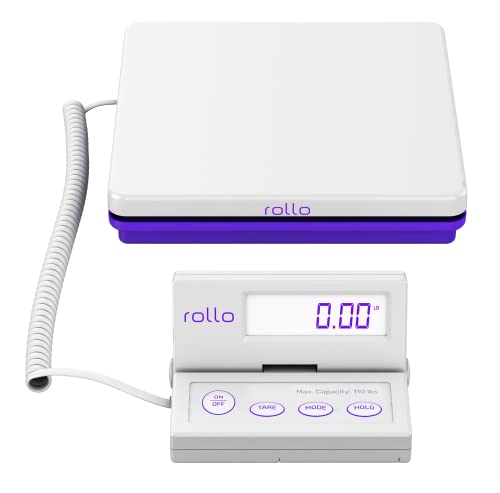
1. Rollo Shipping Scale
Our pick — 4.5+★ from 800+ verified ratings; the strongest balance of quality and price.
The 110 lb desk scale that reads out on a separate panel while a box sits on top.
For anyone listing secondhand gear, shipping handmade goods, or pricing out a stack of parcels, this is the sensible place to land. The platform takes up to 110 lb with a 2 g readout, so a padded envelope and a filled carton both land on the same machine. Four units (g, kg, lb, and lb oz) mean you never convert in your head before typing a shipping label.
The detail that earns the top spot is the separated weight panel on a coiled cable. You can turn a bulky box around, and the numbers stay in front of you instead of hiding behind the carton. That same separation is why the range of owners who ship daily keep this one on the bench. The hold function locks a reading once it settles, so you can set a package down, write the number, and press tare for the next one.
At 3.7 pounds it is noticeably heavier than the 1.4-pound OXO glass scale, but the trade is real capacity: 110 lb against 11 lb, a much wider working range. Power is equally flexible — the included AC adapter runs it all day, or two AAA batteries take it to a table without an outlet. The catch most people hit is the readout floor: 2 g is not fine enough to resolve a single business card, so this is a parcel scale, not a jeweler’s scale.
What earns it the top slot
- Separate display panel on a coiled cable keeps readings visible behind big boxes
- 110 lb capacity with 2 g accuracy covers envelopes through full cartons
- Runs on the included AC adapter or two AAA batteries
- Hold and tare let you lock a weight, write it down, and reset in one press
Where it stops short
- 2 g increments are too coarse for coins, jewelry, or single-page mail
- The heavier body is not a drawer-friendly kitchen scale
- Auto shut-off means a long pause mid-pack resets the display
Pick this one: you ship parcels of varying size and want the readout where your eyes already are.
Pass if: your lightest item weighs a few grams — the display cannot resolve it.
2. Etekcity 22lb Food Kitchen Scale
A counter scale that measures down to 2 g, wipes clean, and never asks for batteries.
Meal preppers and anyone portioning out a week of chicken and rice tend to want two things: speed and a surface they can rinse. This one answers both. A 300mAh rechargeable battery with a USB-C cable in the box means you top it up like a phone, and the IPX6 water-resistant top — a rating that means it shrugs off sprayed water — lets you measure liquid and wipe it down after.
The measuring range is wide for a counter footprint. It handles up to 22 lb / 10 kg at one end and 2 g at the other, with 1 g increments in between. Five units including millilitres for water and milk make it the one kitchen scale here that can follow a recipe written entirely in volume. What wins people over is how small it packs away: 530 g of scale that slides into a drawer, not a shelf. For a category where most buyers never touch the manual, the one-button flow is the whole story.
Honest trade-off: this is a kitchen scale, so 22 lb is its ceiling — it will not weigh a suitcase. Some units drift and need re-zeroing, and a dinner plate on the small platform hides the display. Those are the two recurring fit notes. If you weigh food straight from a bulky bowl, buy a scale with an offset or detached head instead.
Power without cords: 300mAh rechargeable with USB-C in the box — charge it overnight and it is ready for the week’s prep.
The plate problem: the platform is compact, so oversized bowls sit over the readout — portion into a smaller vessel.
Reach for this if: you portion food, weigh liquids, and want to stop buying AAA batteries.
Look elsewhere if: you need a single scale that also handles a 50 lb checked bag.
3. OXO Good Grips 11lb/5kg Glass Food Scale
Glass top, flush buttons, and a zero function — a baking scale you leave out on purpose.
If your counter is already crowded and the scale has to earn its patch of it, the low-profile glass platform here is the argument. It wipes clean of flour and oil in one pass, and the four included AAA batteries mean it works the moment you unbox it. Unit switching runs through oz, lb, g, kg, and ml with a single button, so an American recipe and a metric one both go on the same panel.
The tare lives behind a dedicated ZERO mode, which matters for layered recipes — bowl on, zero, flour in, zero, sugar in, and the bowl never enters the math. Weighing 1.4 pounds, it is lighter than the 3.7-pound Rollo postal scale, and far easier to slide into a cabinet. Tall boxes are not its job; layered dry ingredients on a countertop are.
Where it asks for patience is precision at the low end. It reads fine in ounces but is not accurate enough for gram-level work, so a few grams of yeast is a coin toss. The buttons can feel touchy, and an occasional unit stops responding entirely. For baking by the ounce and coffee by feel, it is a steady companion. For anything measured in single grams, look at a dual-platform kitchen scale instead.
Best fit: bakers who weigh in ounces and want a cleanable surface that stays on the counter.
Not for: gram-precise dosing of yeast, espresso, or supplements.
4. KKZ Shipping Scale

Four sensors, a stainless deck, and a display attached to a retracting cord.
This is the scale you buy when the back room is the real office. Four weight sensors under a stainless steel platform handle up to 440 lb, with accuracy of 0.02 lb between 0 and 44 lb and 0.2 lb from 44 to 440 lb. A 0.1 lb minimum means a light envelope is outside its range — this machine is for cartons, laundry bags, and luggage that has to make a flight.
What separates it from the other 440 lb pick here is how it solves the visibility problem. The display hangs off a 2.8-meter spring line that retracts to 0.55 meters for storage. A large box can cover the entire platform and you still read the number without bending. You can also screw the head to a wall with the included expansion screws. Both power routes are in the box — two AAA batteries or a USB Type-C line — and auto-off after 120 seconds keeps the cells alive.
The readout is the trade: 11.34 g is good for parcels and far too coarse for kitchen work, even though the listing suggests it can double as one. Accuracy draws mixed reports, so calibrate with a known weight before you trust it on a big shipment. In return you get a three-year support commitment and a platform that size has room for oversized cartons.
Built for a working bench
- 440 lb capacity on a stainless platform with four sensors
- Display on a 2.8 m retracting line, or wall-mounted with the included screws
- Backlit LCD readable in a dim warehouse corner
- Runs on AAA batteries or USB Type-C, both included
Read before you buy
- 11.34 g increments rule out light letters and small parts
- 0.1 lb minimum load — a single nightgown may not register
- Calibration matters; check it with a known weight first
Suits: shop owners weighing cartons all day who need the readout up and out of the way.
Choose a different scale if: your items are light, small, or measured in single grams.
5. MUNBYN 440lb Shipping Scale
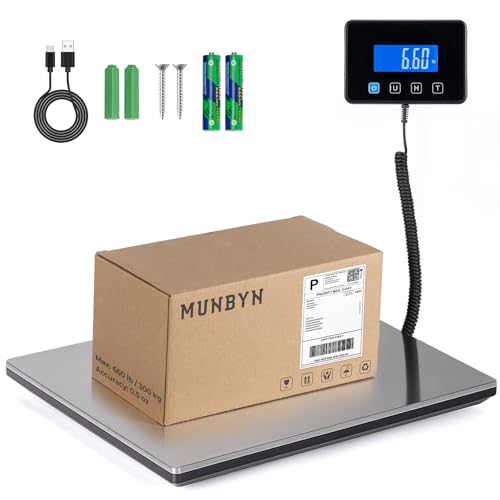
A 440 lb postal scale with a 1.8 oz display so the decimals stop being a guess.
Between the two 440 lb postal scales on this list, this one is the closer readout. MUNBYN pairs that ceiling with a 1.8 oz figure — it is the readout resolution that turns a decimal point into a real number. If you sell on eBay or Etsy and a tenth of a pound swings your shipping tier, that resolution is the whole point. The same 440 lb capacity means it will take a medium-to-large carton without blinking.
Power is where it pulls ahead of most of the field. Two AAA batteries deliver 13 hours of runtime, and the built-in 250mAh rechargeable battery takes USB-C for an 11-hour run — so it goes with you to a market stall and comes home to charge. There is a hold function for locking a weight while you write it down, and the “T” key clears the reading for the next package.
The fit note here is granularity at the light end. It will not register a reading between 0.5 and 1 lb at all — one buyer’s exact complaint. So sweet flat rate envelopes and heavy boxes both sit awkwardly on the same scale. For mixed parcel weights at a steady pace, it is the precision pick here. For tiny items, buy a kitchen scale with 1 g steps and keep this one on the counter.
Shipping math that balances: decimal readings at 1.8 oz, battery and USB-C backup for a table stall, and a price that lands mid-range for a 440 lb machine.
Buy it if: your shipping label price shifts on a fraction of a pound and you want the number in front of you.
skip it if: your parcels will ever be light enough to need sub-ounce detail.
6. KitchenTour Dual Platform Food Scale
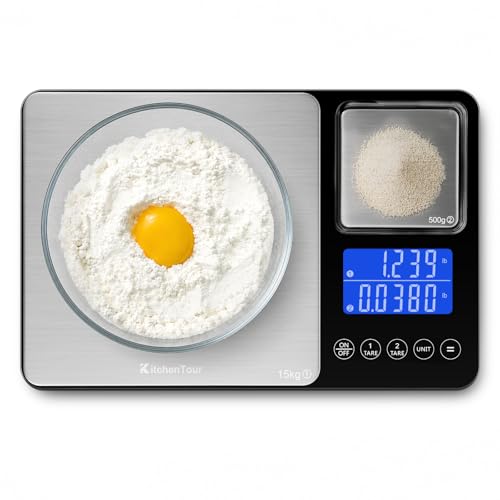
Two weighing pads and a summing feature that adds them together for you.
A single scale forces a compromise: big enough for a mixing bowl, or precise enough for yeast. This design refuses the trade. The large platform takes 15000 g at 1 g steps, while a second pad reads 500 g at 0.01 g — a hundredth of a gram — for the delicate ingredients. Both sit inside a 10.9″ x 7.09″ footprint, so the whole thing slides under a counter rather than living on it.
The summing feature is the one that earns its room. Weigh flour on the big pad, switch to the small one for the salt, and the scale totals both weights for you — no scrap paper, no mental math. Seven units including milk millilitres cover volume recipes too. A backlit LCD stays readable in a dim kitchen, and stainless steel with shatter-resistant glass wipes clean in seconds.
It is light for its size at 0.8 kg, which is great for storage and less reassuring if you expect a brick-solid feel. Auto shut-off at 3.5 minutes of inactivity is short enough that a long recipe pause resets you to zero. Neither is a dealbreaker — they are the price of a small, packable scale. As a precision kitchen tool for baking and coffee, it hits well above its standing in the lineup.
Why bakers reach for it
- Large pad at 15000 g / 1 g plus a precision pad at 500 g / 0.01 g
- Weight summation totals both platforms without manual math
- Seven units, including millilitres for milk
Small print worth knowing
- 3.5-minute auto-off can reset a slow recipe mid-process
- 0.8 kg body feels light rather than substantial
- Two pads mean two surfaces to wipe rather than one
Made for: sourdough bakers and coffee brewers who jump between a heavy bowl and a tiny dose.
Not the pick for: anyone who only ever weighs one bowl at a time.
7. KUAIVO Dual Platform Food Kitchen Scale, 0.001oz/33lbs

Thousandth-ounce precision on one pad, 33 lb of capacity on the other.
Sourdough is a ratio game, and this scale is built to protect the ratio. The large platform takes up to 33 lb at 0.1 oz accuracy, so a full dough batch and a heavy mixing bowl both fit. The small platform handles 1.1 lb at 0.001 oz — precise enough that a pinch of salt shows up as a number. Seven units, including both water and milk millilitres, let a European recipe and a US one share the same panel.
The tare button is the heart of it. Bowl on, press tare, pour the flour, and the container never enters the count. From there, the accumulation function adds the readings from both platforms, so a multi-part recipe totals itself instead of you writing numbers on the back of a bag. A 210-second auto-off stretches further than most, giving you time to line up the next ingredient. The stainless surface is smooth and non-porous, so flour and dough pull off clean.
Durability is the honest question mark. Some units stop working after a short stretch, so treat it as a counter tool, not a knockabout. The small pad is also jumpy, so a steady hand matters for 0.001 oz doses. Everything else lines up: 10.8 x 7 inches of slim stainless steel that stores upright and reads clearly in low light.
Ideal for: bread bakers and home cooks who want gram-level confidence on a slim countertop unit.
Think twice if: the scale will get banged around — it wants gentle handling.
8. Amazon Basics Digital Postal Scale
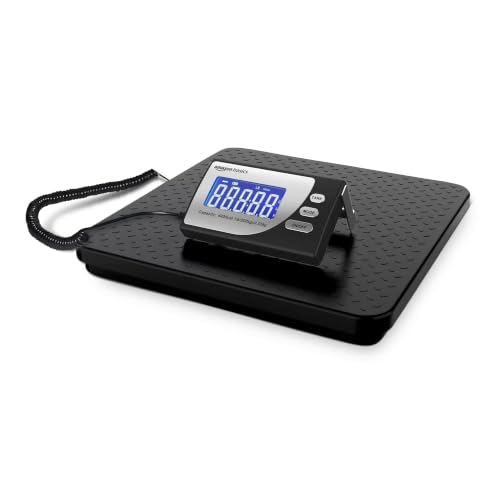
The 660 lb platform that lifts loads the others cannot touch and reads them from two metres away.
Nothing else on this list goes to 660 lb / 300 kg. That capacity is why it turns up in garages and on trailer hitches rather than kitchen counters — one buyer used it for tongue weight on a travel trailer, and others have used it to track their own body weight. The black ABS with an aluminum anti-skid platform is built to take a load and stay put. Readings land in kg, ounces, or pounds, and the tare resets to zero with a container on the deck.
The separated backlit LCD reads from up to 2 m away, which solves the same sight-line problem that the KKZ solves with a cable, just by distance instead. Power comes three ways: two AAA batteries, a USB cable, or the included AC adapter. Plugged in, it stays on instead of shutting down after the 5-minute battery timeout. At 4 pounds, it is light enough to move but heavy enough to feel planted.
Accuracy is where it asks for honesty. The readout is 0.11 lb / 50 g / 2 oz in 0.1 ounce steps, with a 6-ounce minimum — so a small padded mailer is simply below its floor and will not register. That is the same story as any heavy-duty platform, but it makes this a bad fit for light parcel work. For loads measured in tens or hundreds of pounds, it is the one to reach for.
Capacity you cannot ignore: 660 lb / 300 kg with a 2 m detached readout — for loads that need a floor, not a countertop.
The ceiling on small stuff: a 6-ounce minimum and 0.1 oz steps mean envelopes get no reading at all.
Reach for this if: the load is heavy — trailer tongue, luggage stack, body weight, or a big commercial shipment.
Look elsewhere if: your heaviest box weighs less than 6 ounces.
9. Fuzion Shipping Scale
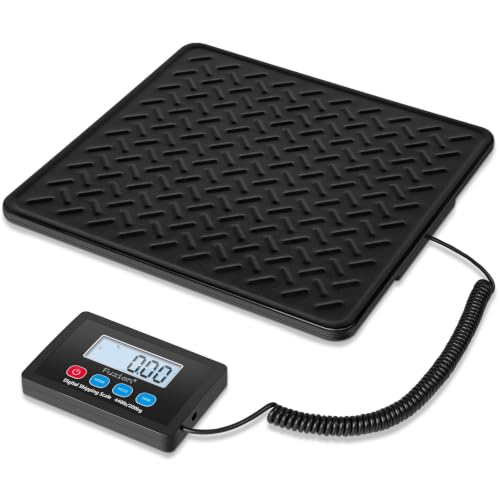
Alloy steel, wall-mount hardware, and a scale built like it belongs on a shop floor.
Scrap metal, pallet parts, and heavy bins take a toll on plastic scales. This one answers with alloy steel construction that resists moisture and corrosion, and a 440 lb / 200 kg capacity with a 40 g minimum readability and a 10 g display resolution. It ships pre-calibrated, and you can re-calibrate it yourself if the readings drift. The separated backlit LCD can be hand-held or screwed to a wall with the drywall anchors included.
Dual power is standard here too: two AAA batteries or an AC adapter, both in the box, and you can adjust or disable the auto-off so it stays awake while you work. The hold function locks a reading, and tare removes container weight so multiples add up cleanly. That makes it practical for a post office counter, a warehouse, or a home business that ships every day — and the Fuzion 2-year warranty plus lifetime support is a real backstop.
Where this one fights itself is consistency. A handful of units drift out of calibration within weeks, which is why the self-calibration option matters. It is also heavier than the MUNBYN at 1.95 kg, and its 10 g resolution is coarser than the 1.8 oz display on that unit. For a rugged scale that weighs scrap, parts, and parcels daily, those are fair trade-offs, not flaws.
Industrial habits built in
- Alloy steel body resists moisture and corrosion
- 440 lb / 200 kg capacity with a 40 g minimum load
- Ships calibrated, and you can recalibrate it yourself
- 2-year warranty with lifetime support
The honest trade-offs
- 10 g resolution is not fine enough for light items
- Drift can appear over time — recalibration is on you
- 1.95 kg makes it a fixed station, not a drawer scale
Worth owning if: you weigh scrap, parts, or heavy parcels in a space where the scale stays put.
Wrong pick if: you need light packages or precise small grams.
Know the Specs
Tare and Zero Function
Tare is the button that tells the scale “forget what is already on me.” Put an empty box or mixing bowl on the platform, press it, and the display resets to zero. Every gram you add after that is the contents alone — the container weight never enters your math. This is the single feature that separates a scale worth owning from a scale that makes you do subtraction on paper. Some models label it ZERO, some a “T” key, and some list a dedicated tare function; all do the same job.
Capacity versus Readout Increment
Two numbers decide what a scale can and cannot do. Capacity is the heaviest load it will take — 110 lb, 440 lb, 660 lb, depending on the model. The increment is the smallest step the display shows, like 2 g, 0.1 oz, or 0.001 oz. A high capacity usually comes with a coarser increment, and that pairing is why one scale cannot serve a jeweler and a warehouse. Match the increment to your lightest item and the capacity to your heaviest, and you have found your machine.
Battery, USB-C, or AC Power
Postal scales that run all day want an AC adapter or USB-C charge, so they are live whenever a package arrives. Kitchen scales lean on AAA batteries for portability. The most flexible models give you both routes in the box — that is the setup to prefer if you are unsure how often you will weigh something. Auto-off saves power but can reset a slow weighing session, so look for a scale that lets you adjust or disable it.
Detached and Backlit Displays
When a carton covers the weighing platform, a display on the base is useless. The answer is a head on a coiled cable, a longer cable run, or a wall-mounted head, so the numbers stay visible from your working position. A backlit LCD matters in a dim back room or garage. See the display as a design decision, not a detail — it changes how often you bend, squint, or move a box just to read a weight.
Common Questions
What does tare mean on a shipping scale?
Can a tare weight scale weigh a package and its box separately?
Do I need a postal scale or a kitchen scale for eBay and Etsy shipping?
How accurate does a parcel scale really need to be?
Can a heavy duty scale also weigh light items?
Why does my scale show a different weight every time I step on or add an item?
Can I run a postal scale on batteries instead of the AC adapter?
What is the difference between 2 g and 0.001 oz accuracy on a scale?
Does a tare weight scale work for weighing luggage before a flight?
How do I clean a glass or stainless steel scale platform?
The Bottom Line
For most sellers, the tare weight scale winner is the Rollo Digital Postal Scale — a 110 lb platform with a 2 g readout and a display on a coiled cord, so large boxes never hide the number. If precision is the priority, grab the MUNBYN 440lb Shipping Scale with its 1.8 oz display. And for sourdough or gram-level cooking, the KitchenTour Dual Platform Scale is the one to reach for, with its 0.01 g precision pad. Buy by increment first, capacity second, and power setup third — and weigh only the goods, never the packaging.
How we choose
We do not accept paid placement. Every pick is matched to a real buyer and a real use-case; we do not hands-on test units.
Sources
Specifications: manufacturer listings and product documentation. Review insights: verified customer reviews, as of November 2026. Pricing: not shown on this page (it changes often); check the current price via the retailer link.
As an Amazon Associate, Tactical Gear Guy earns from qualifying purchases. This does not affect which products we feature.