Specs are compiled from manufacturer listings and verified buyer reviews and can change over time — please confirm the key details on the product page before buying.
If your phone dies on day two of a trip and there is no outlet for miles, the fix is a solar power charger that actually pulls usable current from daylight. The trick is knowing which type you need: a battery bank with a panel built in, or a folding panel you pair with a bank you already own. Below are nine that do the job, sorted by what they are genuinely good at.
This guide is built by comparing the manufacturers’ published specifications and the patterns across verified customer reviews, so you get each pick’s real strengths and trade-offs instead of marketing spin.
Sunlight charges slower than a wall plug, so the best solar power charger for you depends on how you travel. Start with two things: the output port your devices need and how much pack weight you will carry.
Top Picks

How To Choose The Best Solar Power Charger
The first decision is not brand or wattage — it is battery or no battery. A solar power bank carries its own stored charge, so you can fill it in the sun and use it after dark. A folding solar panel has no battery at all. It only makes power while sunlight hits the cells, so you plug a power bank into it and let the bank do the storing.
Built-in battery or bare panel
A bank with a panel is the grab-and-go option: one object, one charge routine, no cable juggling. A bare panel is lighter for its output and lets you bank sunlight into a power station you already trust. If you hike with a power bank anyway, the panel is the smarter weight.
Wattage versus what your phone will take
Panel wattage is the maximum the cells can produce in ideal direct sun. Port wattage is the ceiling your phone or tablet will accept. A 45W panel with a 25W USB-C port tops out at 25W to that phone — the extra headroom goes to other devices or a bank. Match the port to your device first.
Efficiency, waterproofing, and pack weight
Conversion efficiency tells you what slice of the sunlight becomes current — monocrystalline cells in these picks run from 23% into the mid-20s. Higher efficiency means more charge from the same patch of sun. Then check the IP rating: IPX5 shrugs off spray, IP67 and IP68 survive dust and a dunk. Finally, weigh it against your pack.
Side-by-Side Comparison
| Model | Best For | Type | Battery Capacity | Max Output | Amazon |
|---|---|---|---|---|---|
| LuminAID Max 2-in-1★ Best Overall | Light plus a phone top-up | Lantern with power bank | — | 2.1 A port | Amazon |
| BLAVOR 10,000mAhBest For Backpacking | Backpacking with wireless charging | Solar power bank | 10,000 mAh | 20W USB-C | Amazon |
| MINRISE 40,000mAhBiggest Battery | Multi-day outages and group trips | Solar power bank | 40,000 mAh | 20W PD | Amazon |
| BLAVOR 20,000mAh Magnetic | Magnetic snap-on charging on the move | Solar power bank | 20,000 mAh | 20W PD | Amazon |
| SOLUPUP 30W Foldable | Trail charging without a built-in cell | Folding panel | None | 30W | Amazon |
| GEYOTO 45W | Light pack with three ports | Folding panel | None | 45W | Amazon |
| SolarTred 20,000mAh 4-Panel | Week-long trips, five devices at once | Solar power bank | 20,000 mAh | Type-C in/out | Amazon |
| VTOMAN 40W | Hanging on a pack or tent | Folding panel | None | 40W / PD30W | Amazon |
| BigBlue 60W X60 | Power stations and bigger gear | Folding panel | None | 60W | Amazon |
Detailed Reviews
1. LuminAID Max Inflatable Solar Lantern
Our pick — 4.5+★ from 400+ verified ratings; the strongest balance of quality and price.
A lantern that lights the tent and tops up your phone from the same sun.
This is the pick for the camper who wants one object in the pack, not three. It is a solar panel, an inflatable lantern and a backup battery rolled together. Twist it open and it puffs into a 6-inch cube; flatten it and it packs down to 1 inch thick. At under 10 oz it disappears into a daypack, and its 200 lumens of LED output with multiple brightness settings — including a Turbo mode — will light a whole room, not just a tent corner.
The phone side runs through a 5V, 2.1 Amp output port. That is enough for a 75-100% charge on most smartphones, though recharge times vary by phone. What wins people over is the lighting. The soft glow is right for a table or the inside of a tent, and on the low setting it still throws plenty of light. Because it deflates, it takes up very little room in a bag — a small thing that matters on every single trip.
The catch is honest and worth knowing up front. The battery side is mixed in owner experience: plenty of people say it charges well, while others find it will not power their phone even at full. Treat the phone port as an emergency top-up rather than a daily charger, and plan your real charging around the lantern. It is 100% waterproof and dustproof at IP67 and floats when inflated, so rain is not a worry. For the person whose priority is light first and a phone save second, this is the one.
What it gets right
- 200 lumens with several brightness settings and a Turbo mode
- Inflates to a 6-inch cube, packs to 1 inch, under 10 oz
- IP67 rated: waterproof, dustproof and it floats inflated
- Recharges by sun in 16-20 hours or by USB in 1-2 hours
Where it stops short
- The 2.1 A port is a phone top-up, not a full daily charge
- Full solar recharge takes 16-20 hours of direct sun
Reach for this if: you camp, hike or prep for outages and want light plus a phone lifeline in one light package.
Look elsewhere if: your main goal is repeated full phone charges — a dedicated solar bank below does that better.
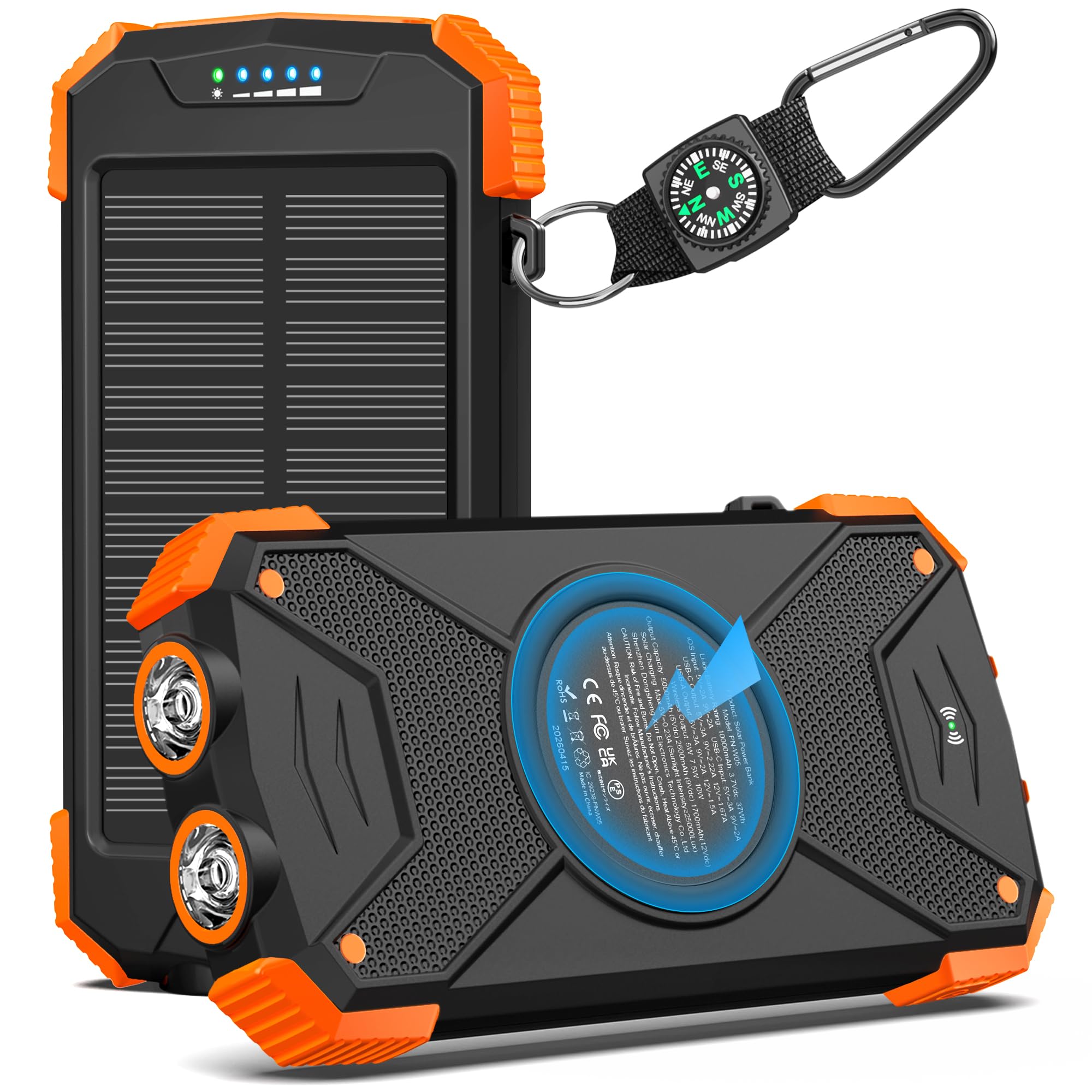
2. BLAVOR Solar Power Bank 10,000mAh
The pocket-sized panel bank that rides a dashboard or a backpack strap.
Here is the size trade-off, stated plainly: the MINRISE pack holds 40,000 mAh while this BLAVOR carries 10,000 mAh — a 4.0x gap in stored capacity. That is not a flaw, it is the point. This is the smallest and lightest option BLAVOR offers, and it is the one you leave on the dash so the sun keeps it topped up. A 20W USB-C output charges an iPhone 15 to 65% in 30 minutes, and its 2.4 A rating is the highest amperage in this group, above the LuminAID’s 2.1 A.
It handles three devices at once, with USB-C, USB-A and wireless all available. The lithium-cobalt cell is rated for 50% more charge cycles than a standard Li-polymer battery. The outer shell is flame-retardant ABS and PC with a waterproof silicone layer and a rubber skin-feel coating, so it feels solid and looks the part. IPX5 means it takes rain spray and dust, and it includes dual super-bright flashlights plus a compass carabiner — small extras that earn their place on a night hike.
Where it asks patience is the solar panel itself. It works as a trickle top-up on a dashboard, but it is not a fast solar charger, and some units reportedly take endlessly to fill even by plug. A full wall charge takes 4 hours, so plan to plug in before you leave. The quality of the build is the thing people rave about, and the flashlights are brighter than expected. For festival weekends and short camping trips where your phone is the main device, it is a sensible companion.
The daily reality: the 10,000 mAh cell and 2.4 A output keep a phone topped through a weekend, while the built-in flashlights and carabiner pull double duty around camp.
The crowd it suits: backpackers and festival goers who want a light bank that trickle-charges on a dash or pack strap.
The trade-off to accept: treat the solar panel as a backup, not your main charger, and plug it in before you head out.
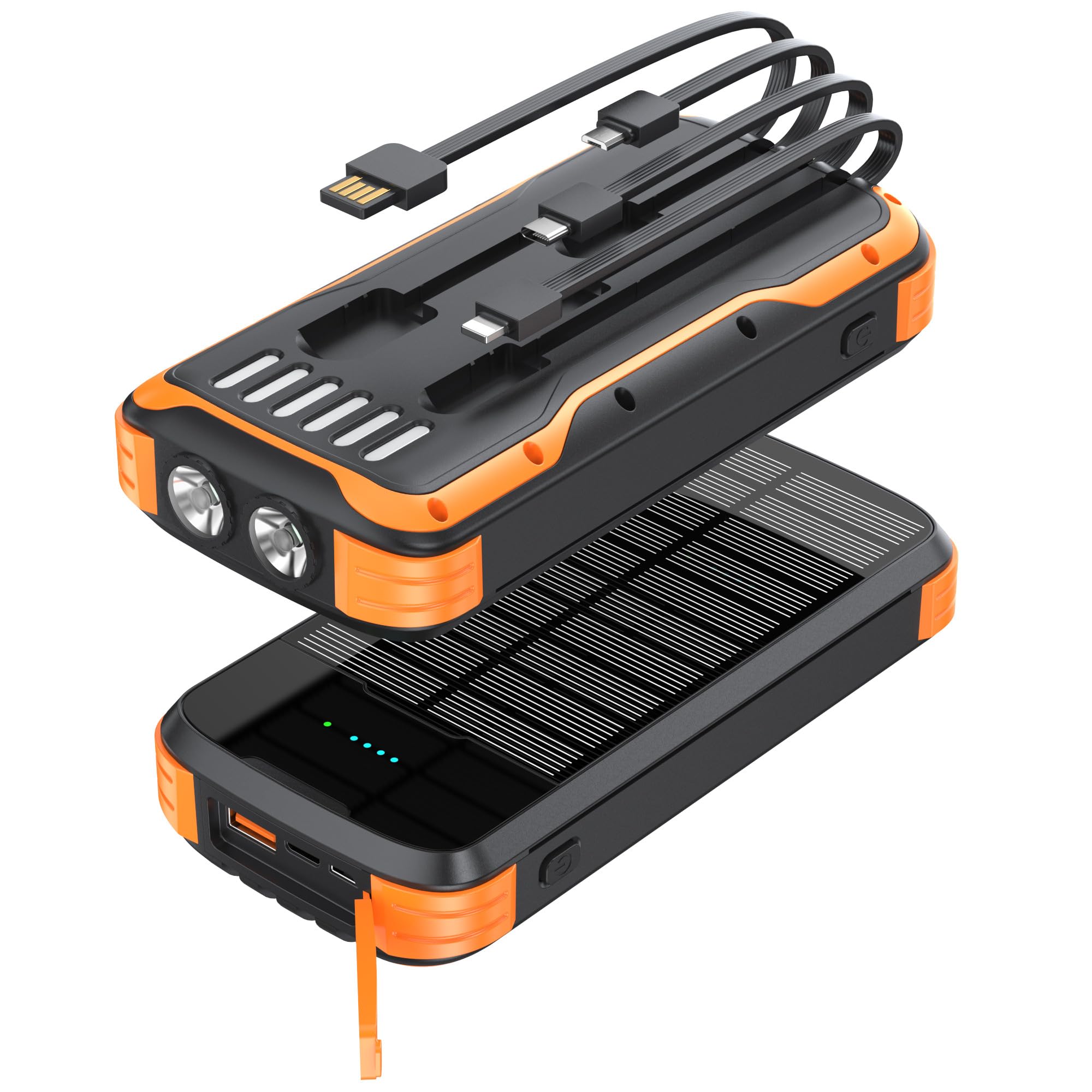
3. Solar Power Bank 40000mAh
Enough stored power to keep a phone fed through a long outage.
The number that decides this one is 40,000 mAh, held in high-density Li-polymer cells. Owners describe it charging a Samsung a half dozen times before it needs a refill. That is the opposite job from the BLAVOR above: where that one is light and quick, this one is a reserve tank. A 20W Type-C output takes an iPhone 15 from 15% to 65% in 30 minutes, and a 6-hour wall charge means you can fill it overnight and forget it.
The cable situation is genuinely clever. Three output cables — Type-C, iOS and Micro USB — are built in, plus one built-in USB-A input cable, so you never dig for a cord. In all it supports 5 output options and 4 input methods, which is more routing flexibility than the folding panels offer. The dual LED flashlights throw up to 165 feet for up to 25 hours, enough to light a dark camp or an outage night. ABS shell, silicone-covered ports and reinforced corners give it a dustproof, waterproof, anti-fall build.
Its honest limit is weight. At 1.1 pounds it is a bag charger, not a pocket one, and carrying it in a purse daily will feel heavy. Solar charging is slow by design and framed as emergency-only — use a 5V/2A or higher adapter for daily fills. Battery longevity is mixed across the long tail, with a couple of units giving out early, which is the kind of risk a large pack of cells always carries. For multi-day trips and outages it is the fix.
Where it earns its spot: four built-in cables and 40,000 mAh mean you can leave the cable bag at home and still keep a group going. The 165-foot flashlight reach is a real bonus at night.
Best matched to: storm-season households, group campers and anyone who wants a big reserve without a separate cable kit.
Consider the weight: at 1.1 pounds, keep it in a bag or emergency kit rather than a daily pocket.
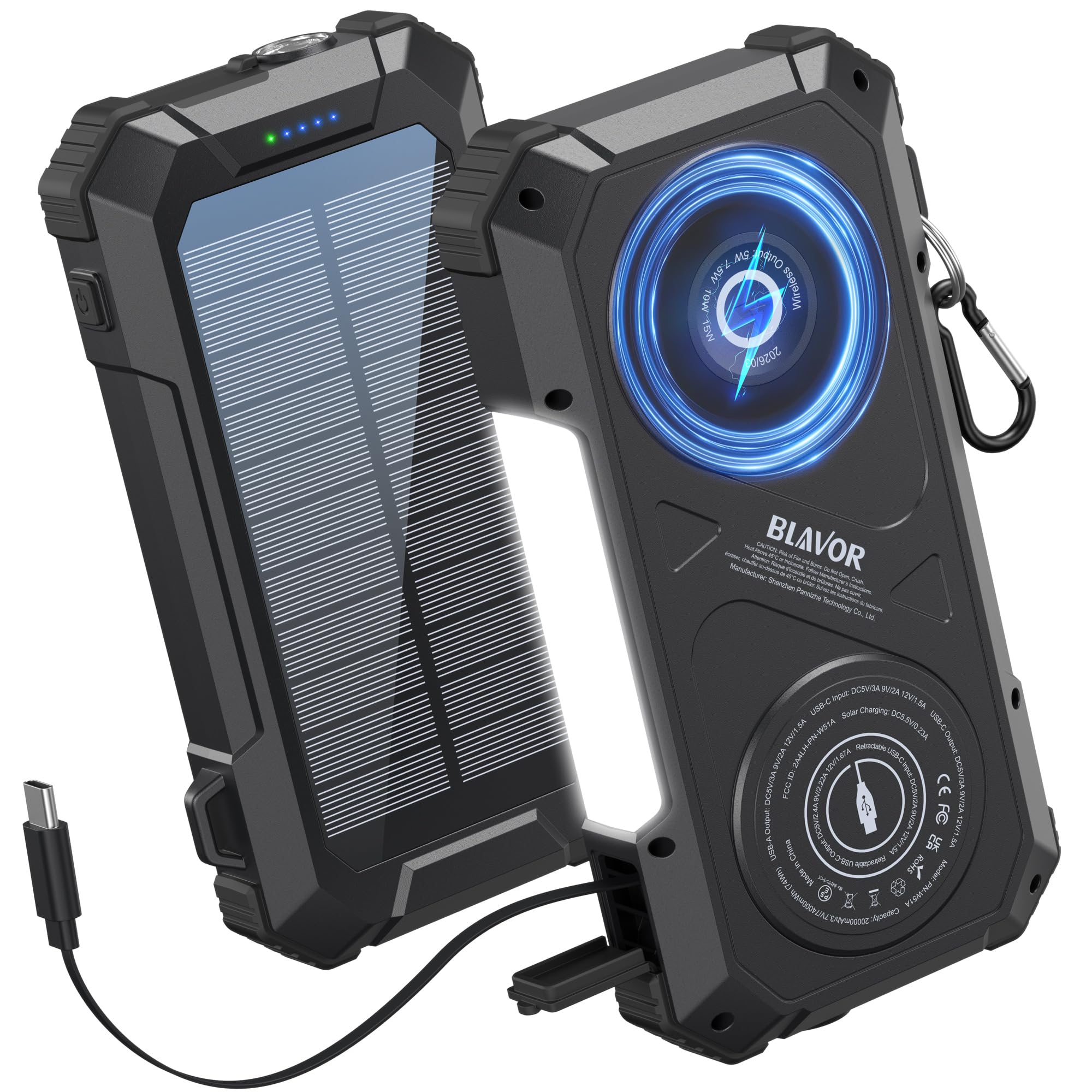
4. BLAVOR Magnetic Solar Power Bank 20000mAh
Snap your phone to it and charge without hunting for a cable.
Magnetic wireless charging is the feature that sets this apart. The panel clicks onto a matching phone and holds it aligned while you walk, so you can charge on a hike without a dangling cord. When you do want a wired connection, a built-in USB-C cable extends to 27.5 inches and retracts when done — it handles 18W input and 20W fast charging, all from one lead.
The 20,000 mAh cell covers roughly four charges on an iPhone 17 or about 3.6 on a Galaxy S24 Ultra, and the 20W PD port fills an iPhone 15 in about 50 minutes. It can feed up to four devices at once, which is why it is the best group-trip pick. Add the three-mode flashlight (steady, SOS and strobe) and the camping lantern with three brightness levels, and you have a light source too. Reinforced rubber corners and a sealed body handle rain, dust and shock.
The honest caveat is reliability, which lands mixed in owner experience — some units work hard for months, a few stop early. Treat the solar panel as a slow trickle and charge by outlet when you can. The magnetic grip is the everyday win, since a phone stays put and charges without a cable. For car camping and cabin trips with multiple people, the flexibility is worth it.
Why it earns its keep
- Magnetic wireless charging holds the phone in place on the move
- Built-in retractable USB-C cable reaches 27.5 inches
- 20,000 mAh and 20W PD: four phone charges in one fill
- Flashlight with SOS and strobe plus a three-level lantern
What to weigh first
- Reliability is mixed over the long run in owner reports
- Magnetic charging works best with a compatible phone or case
Pick it for: trips where several phones need charging at once and cable clutter is the enemy.
Weigh first if: you want guaranteed longevity above all, since a few units fail early.
5. 30W Foldable Solar Panel Charger

A book-sized panel that folds flat and turns daylight into a power bank fill.
This is a bare panel, so read the listing carefully: there is no built-in battery. You plug your own power bank into one of its dual USB-A or USB-C ports and let the bank store the sun. The monocrystalline cells hit 23% efficiency, which the maker says beats same-watt multi-crystalline panels — so your phone or bank tops up faster from the same patch of light. It folds to 7.87 x 10.63 inches and weighs 2.4 lb, so it slides into a backpack.
Setup is flexible. An adjustable stand aims the panel at the sun, and the included carabiners clip it to your bag while you walk. A built-in smart chip delivers steady current so a power bank or tablet does not cut in and out, and it reconnects when the sun returns after shade. IPX5 handles rain spray and dust. The included storage bag shades your phone or bank from direct heat and keeps cables tidy.
Its limit is real and worth planning around. That is normal for a folding panel in real conditions, so pair it with a bank and be content with an overnight fill. The cleanest use is clipping it to your pack in daylight and letting the bank catch the power.
The honest trade: you give up a built-in battery to save weight, and you gain a panel that charges whatever bank you already carry. Pack a power bank or this does nothing.
The fit: hikers and campers who already carry a power bank and want to recharge it on the trail.
The misfit: anyone expecting to plug a phone in mid-hike and charge it, since there is no battery to hold the sun’s work.
6. 45W Solar Panel Charger

A three-port panel that turns a phone into a fast-charger on a sunny ridge.
Consider the port math before the panel math. The 45W of max power is the panel’s ceiling; the 25W PD USB-C port is what your phone sees. Plug a compatible phone in and it can pull up to 25W, which is enough to run phone, tablet and a power bank at the same time across 2 USB-C and 1 USB-A ports. The monocrystalline cells convert up to 26% of sunlight, and IP68 makes it the most weather-proof pure panel here — rain and dust are not a concern.
Weight and size nudge it toward the daypack. At 1.65 pounds and folding to 8.44 x 12.52 x 1.26 inches, it is about the size and weight of an iPad. The panel-only design means you carry a power bank separately, but the payoff is highest efficiency in a panel that small. Its 3-year warranty is the longest of the folding panels here, so a faulty unit is a replacement, not a loss.
The one thing to manage is a unit that arrives faulty — one owner found theirs produced nothing after two days in direct sun and returned it. That is what the warranty covers. In normal use, buyers report the 25W USB-C port delivering full output, charging a Samsung A37 from 50% to 100% in about 30 minutes. Weigh the panel, angle it at the sun, keep the cells clear and it delivers.
What stands out
- 26% conversion efficiency in a panel this small
- IP68 for rain, dust and water immersion
- Three ports with 25W PD on the USB-C
- 3-year warranty, the longest here
What to know first
- No built-in battery, so pair it with your own bank
- A faulty unit is possible and needs a warranty claim
Go here for: a light, rain-proof panel that plugs straight into a phone and charges it fast in direct sun.
Skip it for: overnight charging, because without a battery the sun must be up while you charge.
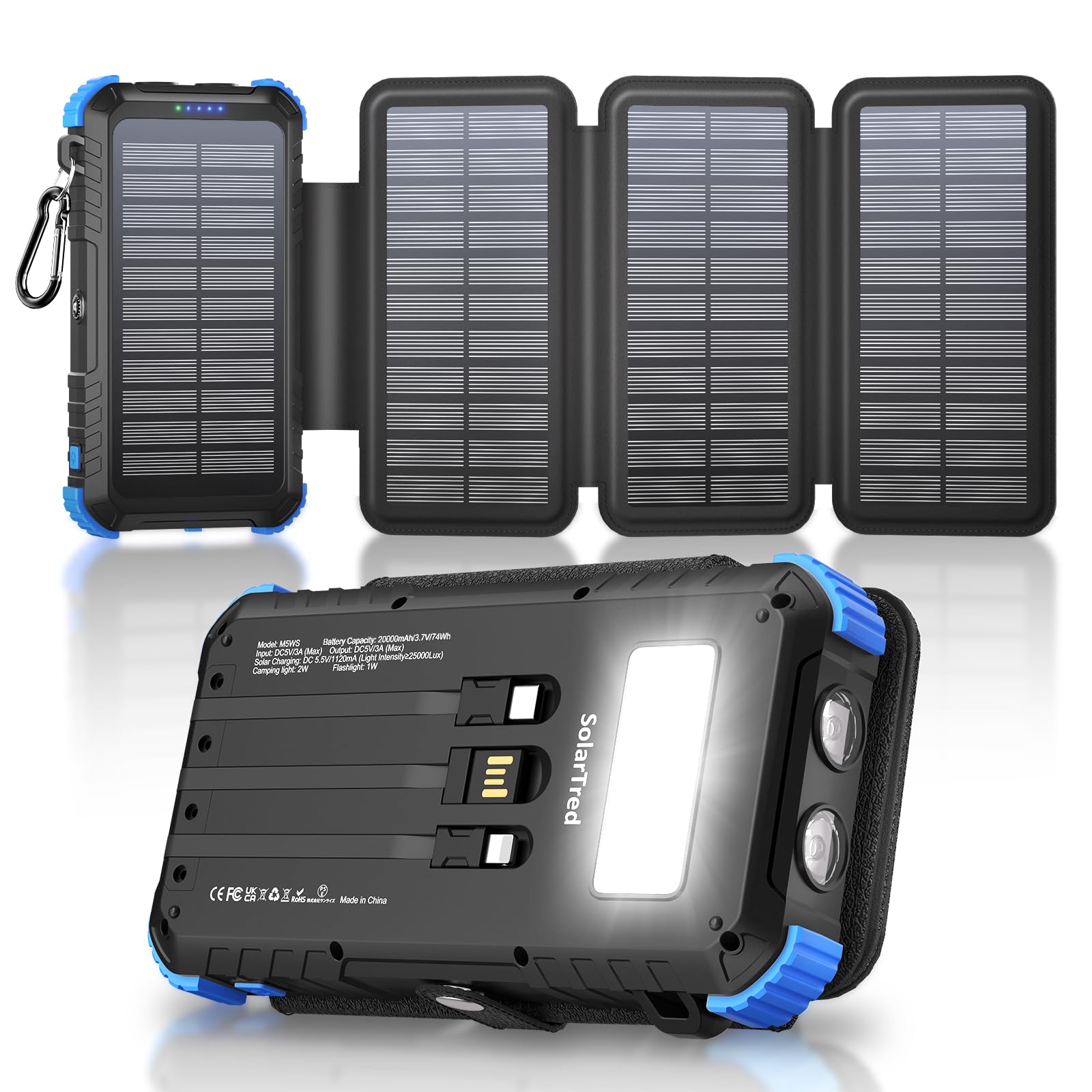
7. Solar Power Bank 20000mAh 4 Panels
Four fold-out panels and five charging ports for the whole camp.
The design idea here is scale. It packs 20,000 mAh into a lithium-polymer cell and tops it up through four integrated solar panels rather than one, so it catches more sun in the same spread of daylight. The maker positions it for week-long trips and group adventures. Owners back that up — one calls the charging from the smartphone plus iPad no problem, another keeps the family going through power outages.
It is the most connected bank in this group. Three built-in cables (USB-C out, Lightning out and USB-A input) plus two USB-A ports and a Type-C in/out port let it charge up to five devices at once. Two lighting systems cover nights: a flashlight with steady, SOS and strobe modes and a separate camping light with three brightness settings, though those two cannot run simultaneously. IP67 means dust-proof, shock-resistant and waterproof.
The honest cost of all that capability is size. A few owners note the attached cables can develop intermittent connections, so keep an eye on them. Everything else — the built-in cables, bright light and multi-panel charging — is the reason it earns its price bracket for a group.
what separates it: it spreads four panels instead of one and runs five ports at once, so a whole family can refill devices from a single patch of sunlight.
Made for: family campers, base camps and multi-day trips where several people share one charger.
Not for: ultralight backpackers — this is a base-station size, not a pocket carry.
8. VTOMAN 40W Solar Panel Charger
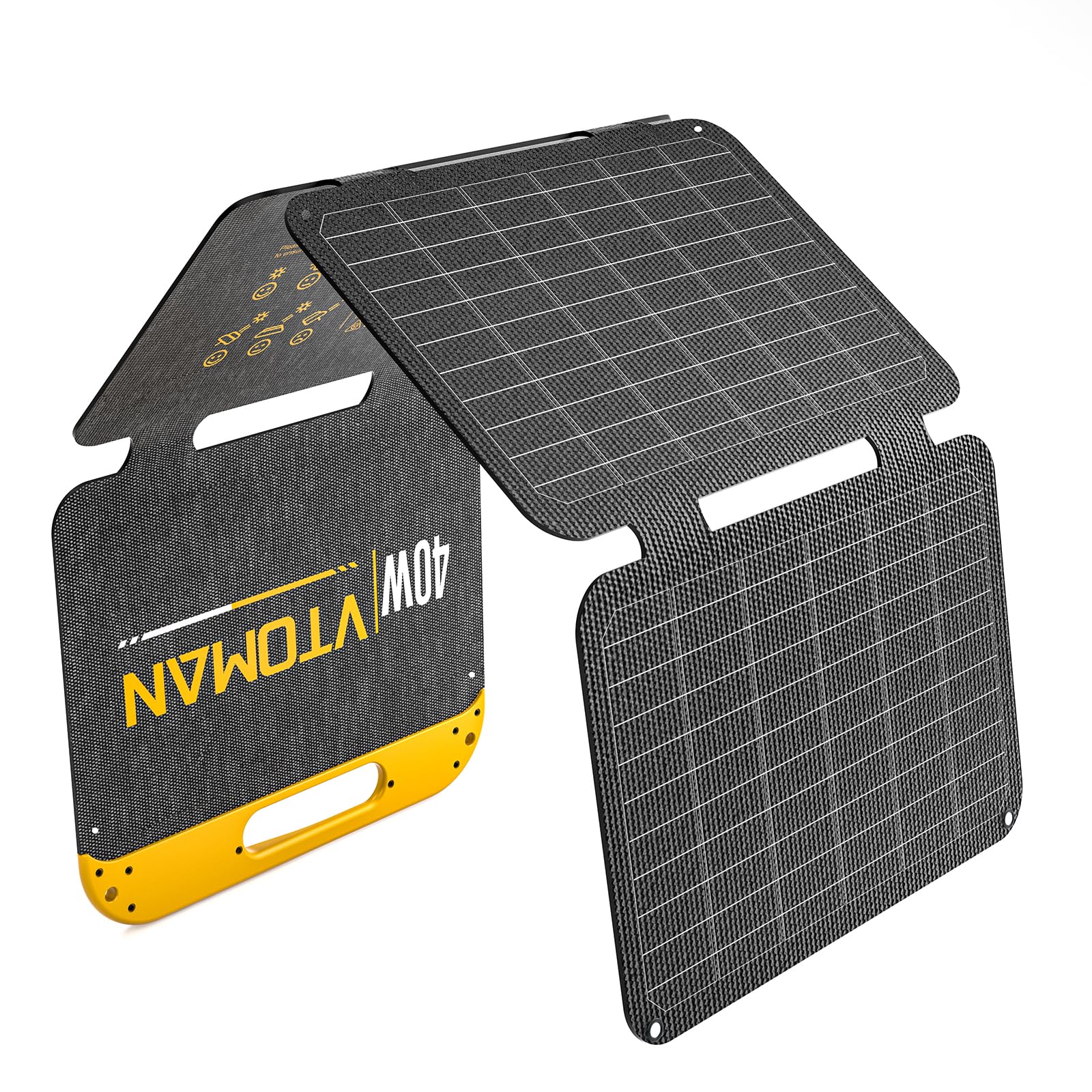
Clip it on a pack or tent and let it pull power all day.
The carry-first design leads here. Four-corner mounting holes and two carabiners let you hang this 40W panel on a backpack or tent flap and forget it while the sun works. At 1.81 pounds and folding to 11.02 x 11.97 x 0.94 inches, it packs into a daybag without a fight. Advanced monocrystalline cells convert 25% of sunlight, and the panel uses an ETFE laminate coat over the cells, which the maker rates as more abrasion-resistant than a standard PET face.
Two outputs take care of your gear: a USB-A and a 30W USB-C PD, so phone, iPad, camera and a small power station all have a place. IP67 covers dust and water, with one caveat straight from the maker: do not leave it submerged beyond 30 minutes, and angle it toward the sun for best output. Owners mention it doing the job — one ran it with an EcoFlow Delta 2 and saw it pull hard in direct sun, another had a full charge inside about two hours.
The fold-out legs are the weak spot. They are reported as awkward and not much help, so most people rig the panel with the carabiners or lay it at an angle instead. It is also a bare panel with no battery, so it needs a power bank or station to store the charge. As a hanging panel with a real efficiency edge, it is the one that keeps all-day power flowing.
The stand detail: the makers’ leg stands are fiddly, so plan to hang it by the carabiners or prop it against a rock instead.
Hands-down for: hikers and campers who want a panel hung on the move with a 30W USB-C port for a tablet or station.
Reconsider if: you want a built-in battery or a sturdy self-standing panel — the legs here are weak.
9. BigBlue 60W Portable Solar Panels
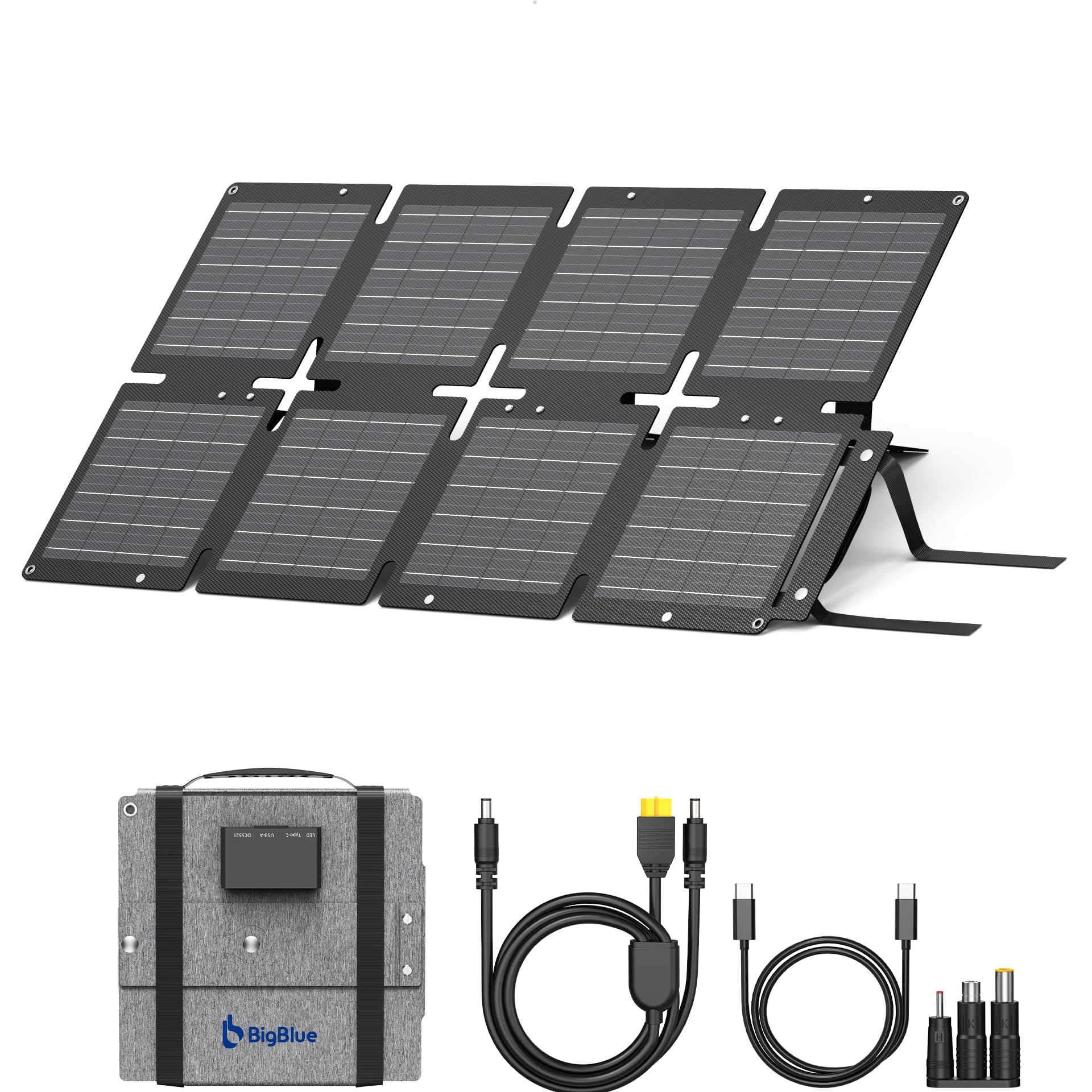
The high-output panel for filling a power station, not just a phone.
Sixty watts is the biggest panel in this group, and N-type cells hit 24.7% conversion efficiency, with the maker noting lower deterioration and better low-light performance than a standard panel. The outputs are built for serious gear: 45W PD USB-C and 20W USB-A, plus a DC 5521 port with adapters (DC7909, DC8020, DC35135) to fit most small power stations. That DC set is the reason it can top up a station the way phone-centric panels cannot.
Portability is still decent. It folds to 10.16 x 8.43 x 2.36 inches with a carrying handle and built-in kickstands to angle it at the sun. IP68 covers dust and water immersion, though the maker notes the junction box is not waterproof. Lightweight panels are easy to set up and take down, and the included Y-branch cable adds routing flexibility. One owner was pleased to see it fill a power station in a few hours in fair sun.
It also cannot store power, so the sun must be up while you use it. For a family or camper running a small power station, the 60W ceiling and DC adapter set make it the most capable here.
Where it wins
- 60W max output, the highest panel here
- DC 5521 plus adapters to fit most small power stations
- 24.7% N-type efficiency with folding kickstands
Trade-offs to accept
- Durability comes in mixed — handle it with a little care
- The heaviest panel here, so best for car or base camp
Point it at: campers and preppers topping up a portable power station from the sun.
Steer away if: you want a light carry or a self-contained battery — this is a fixed-spot panel.
Know the Specs
mAh (battery capacity)
Milliamp-hours measures how much charge a built-in battery holds. A 10,000 mAh bank fills a phone about a couple of times, while a 40,000 mAh pack holds several phone charges. Bigger numbers mean more reserve and more weight, so match the capacity to your trip length.
Solar panel wattage
Watts measure the most a solar panel can generate in ideal direct sun. A folding 30W panel and a 60W panel differ in peak output, not in how much your phone takes — port wattage caps that. Expect real-world output to fall below the printed wattage in clouds or shade.
IP rating
The IP number rates dust and water resistance. The first digit is dust (6 means dust-tight), the second is water (5 handles spray, 7 and 8 survive immersion). IPX5 means water protection only, with no dust rating. Higher ratings handle harsher weather, which matters on camping trips.
Conversion efficiency
This percentage tells you how much of the sunlight hitting the cells becomes usable current. Monocrystalline panels in this group run from 23% up through 26%. A higher figure turns the same patch of sun into more charge, which matters on a moving pack.
Common Questions
Can a solar power bank charge my phone without any sun?
How long does a solar panel take to charge a power bank?
Is a solar power bank or a foldable solar panel better for backpacking?
Can I use a solar panel to charge a laptop or power station?
Does a solar panel work on an overcast day?
Will a solar power bank charge my phone in direct sunlight only?
Is IPX5 enough for a camping trip?
Can a solar power bank get too hot in a tent or car?
How do I keep a folding solar panel aimed at the sun?
Are solar chargers waterproof enough for hiking in the rain?
The Bottom Line
For most campers and preppers, the solar power charger winner is the LuminAID Max 2-in-1. It earns 4.5+ stars across 400+ ratings because it does two jobs at once: it lights a whole tent and saves a phone in one light package. The MINRISE 40,000mAh holds far more reserve, which counts if you travel away from outlets for days. And if you run a portable power station at camp, the BigBlue 60W has the highest output of the group.
Whichever you pick, match it to how you travel: a pocket bank for the backpack, a folding panel for the trail, and a big reserve for base camp. Then plug in the night before you leave — the sun is a backup, not a fast charger.
How we choose
We do not accept paid placement. Every pick is matched to a real buyer and a real use-case; we do not hands-on test units.
Sources
Specifications: manufacturer listings and product documentation. Review insights: verified customer reviews, as of November 2026. Pricing: not shown on this page (it changes often); check the current price via the retailer link.
As an Amazon Associate, Tactical Gear Guy earns from qualifying purchases. This does not affect which products we feature.