Specs are compiled from manufacturer listings and verified buyer reviews and can change over time — please confirm the key details on the product page before buying.
If you want the short answer: buy an outdoor 4K camera that gets power from a cable if you can reach one. Wired Power-over-Ethernet models stream all day without a battery dying, and they keep full detail when a face walks onto your driveway at 2 a.m. Battery and solar cams are the right call only when there is no cable route at all, because every one of them trades constant recording for motion-triggered clips. One note before you scroll: this list uses flexible matching for native, true 4K resolution and weatherproof outdoor housing, so not every pick is the exact number or model you typed into the search bar. The nearest same-type camera serves the same job, and each entry tells you exactly which job that is.
This guide is built by comparing the manufacturers’ published specifications and the patterns across verified customer reviews, so you get each pick’s real strengths and trade-offs instead of marketing spin.
Below you get nine outdoor 4K cameras split by how they get power, what they do at night, and whether they lock you into a cloud plan. Each pick is judged on the specs that actually change your week: wide-angle coverage, night range, storage limits, and how much of the system you have to buy before it works. The plainest way to shop this shelf is to match the power source to your wall first and the megapixels second, which is exactly how this outdoor 4K camera list is ordered.
Top Picks

How To Choose The Best Outdoor 4K Camera
Start with power, because it decides everything else. A camera that draws from an Ethernet cable records around the clock, while a battery or solar camera wakes up when it senses motion and sleeps the rest of the time. Ask yourself one question before you compare megapixels: can I get a wire to that corner of the house?
Pick your power source before you pick a camera
A Power-over-Ethernet camera — a PoE camera, meaning it pulls both data and electricity through a single network cable — gives you continuous recording and no charging routine. The catch is that you need a PoE injector or a PoE switch to feed it, and those are usually sold separately. Battery and solar models mount anywhere with a Wi-Fi signal, but they film in bursts, so a car that cruises past between clips simply is not recorded.
Understand what true 4K actually gives you
True 4K means the camera’s sensor captures roughly 8 megapixels natively rather than upscaling a smaller image, which matters most when you zoom in on a face or a plate after the fact. Several picks here run 4K at 15fps, a frame rate that is fine for security footage and lighter on storage than 30fps. If you plan to read moving plates, a higher frame rate helps.
Look hard at the night spec, not just the daylight demo
Night range in feet is the number that decides whether your footage is usable. A camera with color night vision keeps a warm white LED on so you see a red jacket instead of a grey blob, while infrared gives you a sharper black-and-white image. Check how far each one claims, because a wide night range from a wide-angle lens still falls off at the edges.
Side-by-Side Comparison
| Model | Best For | Power | Field of View | Night Vision Range | Amazon |
|---|---|---|---|---|---|
| Amcrest UltraHD 4K PoE AI★ Best Overall | Detail at a distance | PoE (wired) | 129° | 49.2 ft color | Amazon |
| Anpviz 4K 8MP PoE TurretBest Budget PoE | Budget NVR build-out | PoE (wired) | 114° | — | Amazon |
| ANNKE 4K/8MP Bullet PoELongest Night Reach | Long night reach | PoE (wired) | 96° | 100 ft | Amazon |
| Tapo C560WS Pan/Tilt | Wide area sweep | Wired power + Wi-Fi | 360° | — | Amazon |
| Tapo MagCam C460 KIT | No-outlet installs | Solar + 10,000 mAh | — | — | Amazon |
| Reolink Lumus Pro 4K | Simple plug-in Wi-Fi | Plug-in + Wi-Fi 6 | — | — | Amazon |
| Reolink E1 Outdoor Pro | Zoom and pan control | Plug-in + Wi-Fi 6 | 355° pan | 100 ft | Amazon |
| Ring Outdoor Cam 4K Pro | Alerts and two-way talk | Plug-in | — | — | Amazon |
| aosu T2 Ultra 4K | Wire-free 360° coverage | Solar, wire-free | 360° | — | Amazon |
Detailed Reviews
1. Amcrest IP8M-2796EB-AI Camera
Our pick — 4.0+★ from 700+ verified ratings; the strongest balance of quality and price.
The wide-angle workhorse that reads plates and faces instead of guessing at shapes.
Here is the number that sells this camera: 129 degrees of field of view, which is the widest non-panning lens on this list. For the same corner mount, that means you cover most of a two-car driveway in one frame rather than a narrow slice of it. Compare that with the ANNKE bullet further down at 96 degrees and you are watching a far wider strip of your property with no extra hardware.
Night is where the 49.2 feet of color night vision earns its keep. A full-color image up to that distance means you see clothing color, car paint, and plate shapes rather than a silver-black silhouette. The ANNKE reaches 100 feet in infrared terms, so if pure darkness reach matters more than color, that pick leads here; this Amcrest wins on keeping that reach in color.
You get alerts that actually matter: the camera detects people, faces, and vehicles, and filters events so you are not pinged by every passing cat. It also supports tripwire and intrusion rules (virtual lines and zones that trigger a recording when crossed) for watching a perimeter. Setup, image quality, and night vision are what win people over, and the recurring note in the review pages is a frame-rate quibble — the camera runs 4K at 15fps (15 frames per second, a measure of motion smoothness), and one buyer measured closer to 25fps at that resolution. For driveway surveillance that is not a problem; for reading a fast-moving plate it is worth knowing. The catch is also the power: it needs a PoE injector or switch (Power over Ethernet hardware that sends power and data over one cable), sold separately, and its microSD card tops out at 256GB.
What this camera does best
- 129° field of view covers more yard per mount than the narrower bullets here
- 49.2 ft of color night vision keeps clothing and paint colors visible after dark
- Heavy-duty metal IP67 housing for rain, snow, and dust
- Built-in microphone plus H.265/H.264 compression to save drive space
- Human, face, and vehicle detection with tripwire and intrusion rules
Where it asks something of you
- PoE injector or switch is not included, so budget for that part
- 4K runs at 15fps, and the frame rate is the most common grumble
- microSD storage caps at 256GB
Reach for this if: you have a cable route and want the widest, most colorful 4K view of a driveway or side yard.
Think twice if: you have no way to run PoE or you need 30fps footage for fast plate reads.
2. Anpviz 4K PoE IP Camera
A metal-bodied turret that quietly undercuts every other wired camera here.
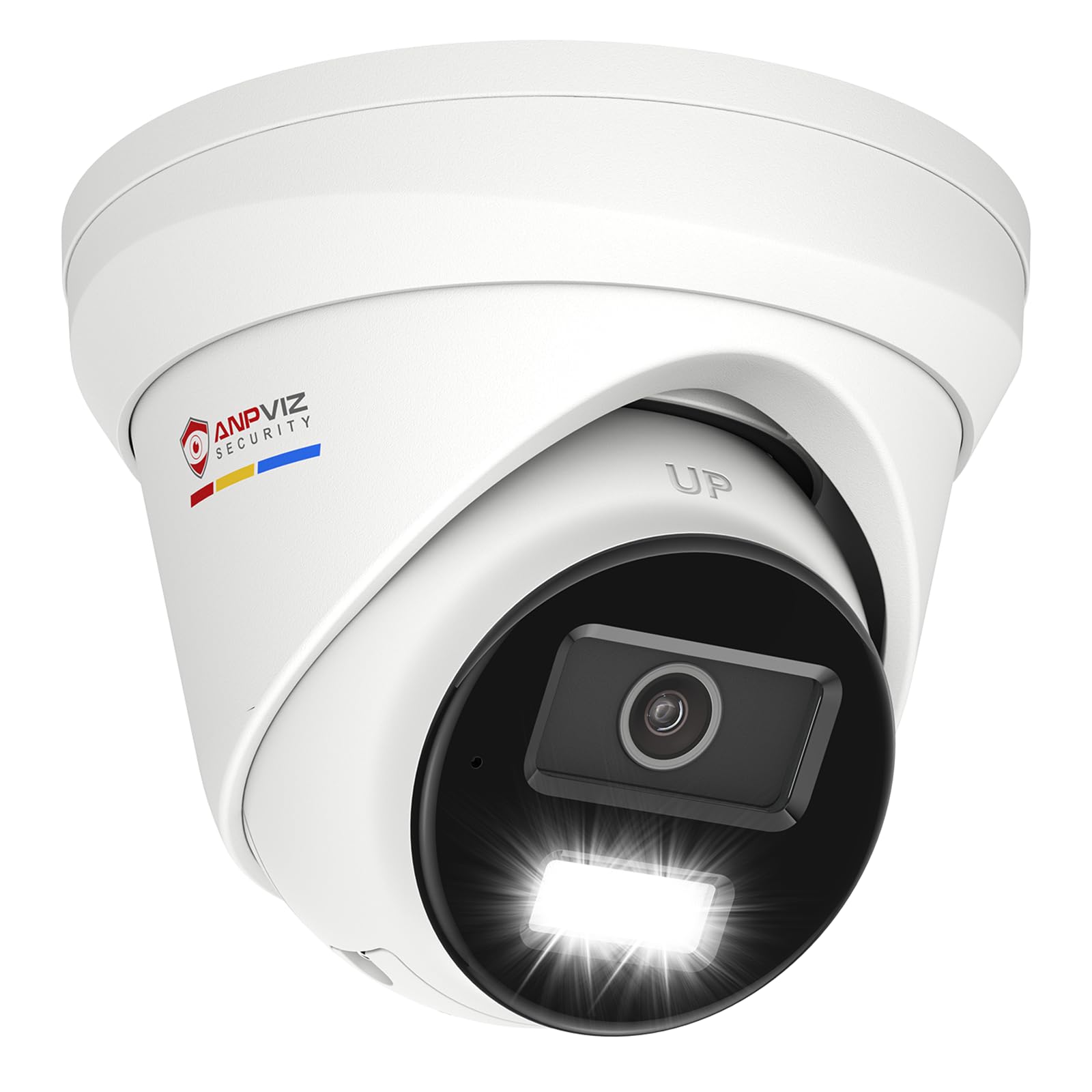
If you are building out a multi-camera NVR system on a tight budget, this is the one that lets you buy four instead of three. It shoots 3840×2160 at 15fps through a 2.8mm lens, giving you a 114-degree view — narrower than the Amcrest’s 129 degrees but a bit wider than the ANNKE’s 96. The metal case carries an IP67 rating, which means it shrugs off heavy rain and dust and runs in temperatures from -4F to 140F.
The dual-light trick is smart: when a person or vehicle is detected, white LEDs kick on for a color image, then it drops back to infrared for black-and-white when nothing is moving. That saves light pollution and keeps the color punch when it counts. The 120dB True WDR sensor is the sleeper spec here — high-contrast scenes like a sunlit driveway with a deep shadow across it stay readable instead of blowing out to white.
What wins people over is simply the picture: crisp 4K images that beat the older 4MP units it replaces, plus plug-and-play behavior with the maker’s own recorders. Two things to plan around. First, third-party NVRs and software like Blue Iris and Synology need the camera activated in the Anpviz Viewer app before you add it, and browser viewing is Windows only — no Mac, no Linux. Second, storage is a microSD you supply, listed up to 512GB, card not included.
Honest verdict: the widest-value wired 4K turret on this page, provided you are willing to activate it in the app first and feed it from a PoE switch or NVR.
Built for: the DIY installer wiring a 4-to-8 camera run who wants metal housings and WDR without paying premium dollars.
Look elsewhere if: you are a Mac household or want a no-app, straight-to-browser setup.
3. ANNKE 4K/8MP Bullet PoE Security Camera
For the back fence line where a face has to be caught 100 feet out.
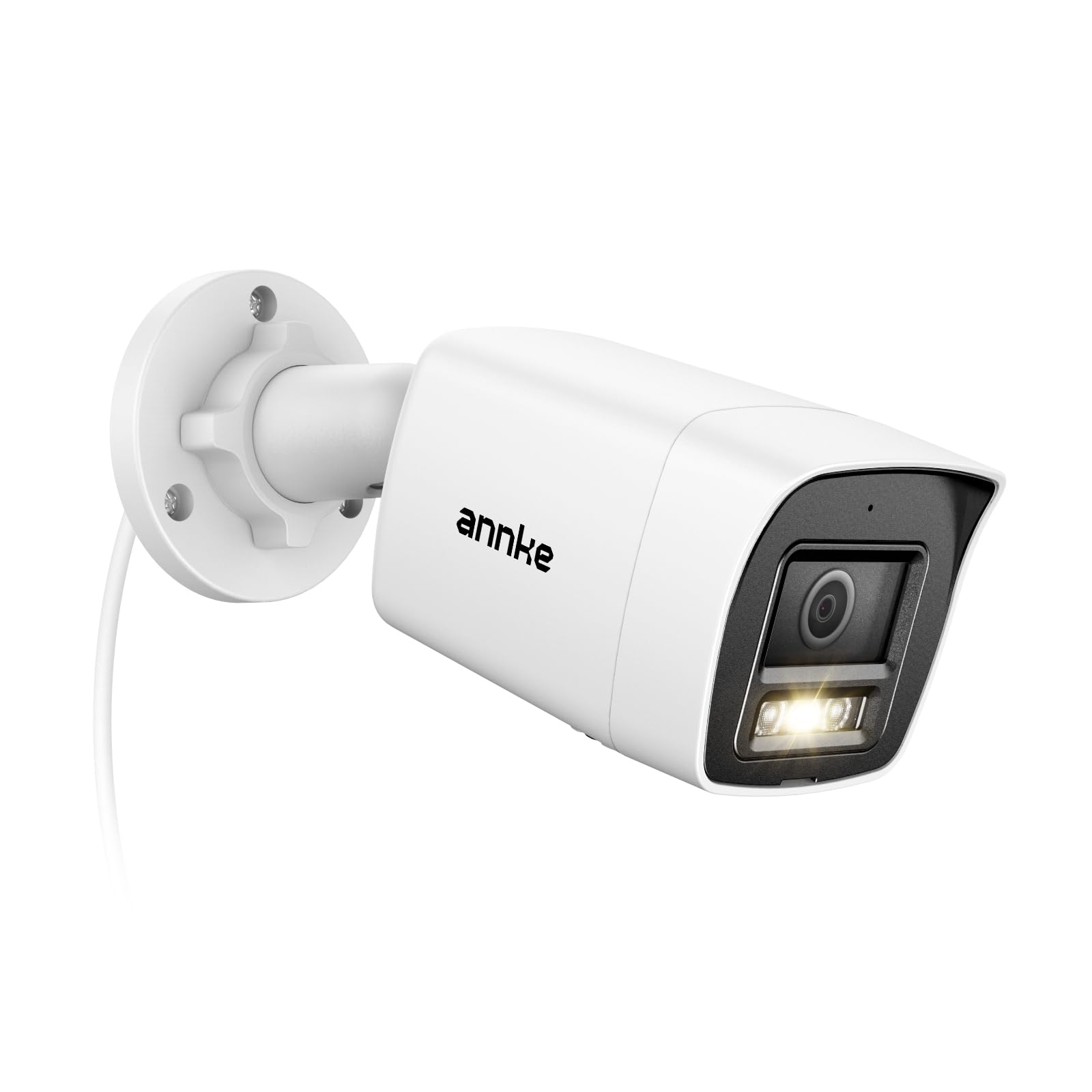
This bullet camera earns its spot on night reach: both its infrared (invisible light the camera sees but you cannot) and white-light modes cover up to 100 feet, more than double the Amcrest’s 49.2 feet of color night vision. That gap matters if you are watching a driveway gate or a far corner of a large lot. Three night modes let you pick black-and-white IR, straight color, or smart light that flips to color when a human or vehicle shows up.
The frame is 16:9 at 3840×2160, so it fills a widescreen monitor without the black bars and squished edges that a 4:3 camera produces. The trade-off baked into that long range is a 96-degree field of view, the narrowest wired lens here — you see deep but not wide, the opposite of the Amcrest’s wide-but-shorter setup. Storage efficiency is a real plus: H.265+ compression uses half the bandwidth of H.264, and the camera is listed to make the most of a 512GB card, double the Amcrest’s 256GB ceiling.
The one non-negotiable is the recorder. ANNKE builds this to run best with its own NVR, listing N46PCK, N98PBK, N84PBH and N931BB as matches, and the NVR must support 8MP or higher. That is less flexible than the ONVIF-open Anpviz, though owners do report running it on a Dahua recorder over ONVIF. The detail is genuinely strong for 8MP, and reliability earns the second-most praise in its review pages — one buyer has run a batch for a year without a hiccup. Plan the NVR into the purchase and it delivers.
The fit: owners of a long property or a wide gate approach who need maximum night distance over sweeping width.
Before you buy: confirm your NVR supports 8MP or higher, since the camera is tuned for ANNKE’s own recorders.
4. Tapo C560WS Security Camera
One camera that swings across the whole yard instead of staring at a slice of it.
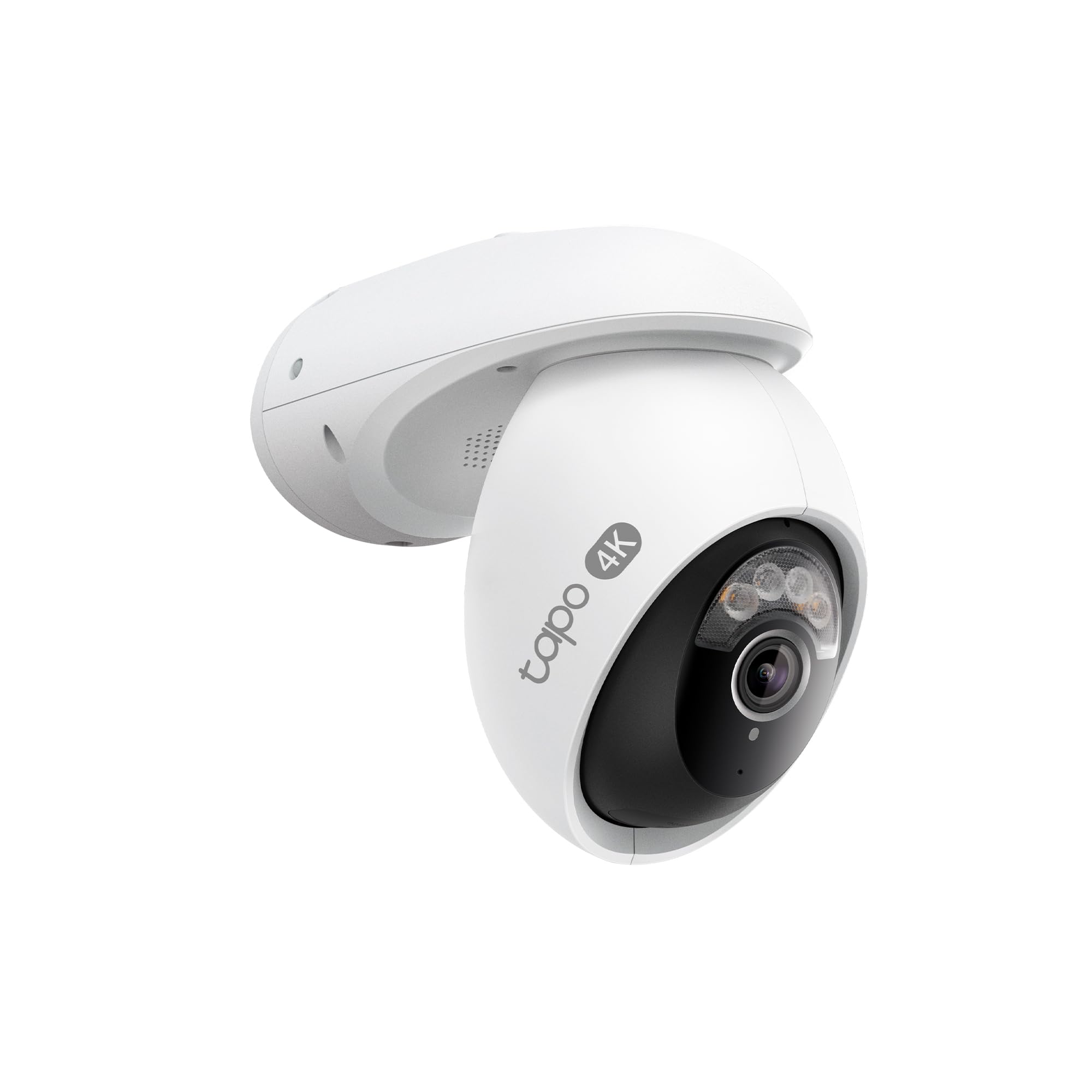
The headline is movement: 360 degrees of horizontal pan plus 98 degrees of vertical tilt, so a single mount can sweep your front walk, the side gate, and the driveway in turn. That is the biggest coverage number on this list by far — a full 360 degrees against the ANNKE’s fixed 96-degree window. A fixed bullet sees what it points at; this one goes looking.
It handles motion two ways. Smart tracking detects movement inside the frame and physically pans and tilts to follow the subject, and the free on-device AI sorts people, pets, vehicles, and loud sounds without a subscription. Facial recognition runs locally, so the sensitive data stays off the cloud. Add 18x zoom and 4K clarity that the maker describes as four times standard 1080p, and you have a camera built to pick a face out of a crowd rather than just log a blob.
Owners love the picture and the simple install, and the honest caveat is the pan-and-tilt reliability. Auto-tracking and the patrol routine draw mixed results — some units lose their centered position over time, and the motion detection sometimes calls a passing car a person. The wall-wart power supply with indoor-grade wiring bugs people who wanted a cleaner outdoor run, and the lens tilts downward enough that you may need to mount it high to see far. The 4K image is not in question here; the motor behavior is what to go in knowing.
Why the sweep matters: if you have one mounting spot and several approaches to cover, a motorized 360-degree head replaces two or three fixed cameras.
Best paired with: a single high corner that needs to watch an entire front or side yard by rotating.
Know the trade: tracking and patrol can be inconsistent, so it suits someone who will review footage manually rather than lean entirely on auto-tracking.
5. Tapo MagCam C460 KIT
The one you can stick to a fence post with no electrician and forget about for weeks.
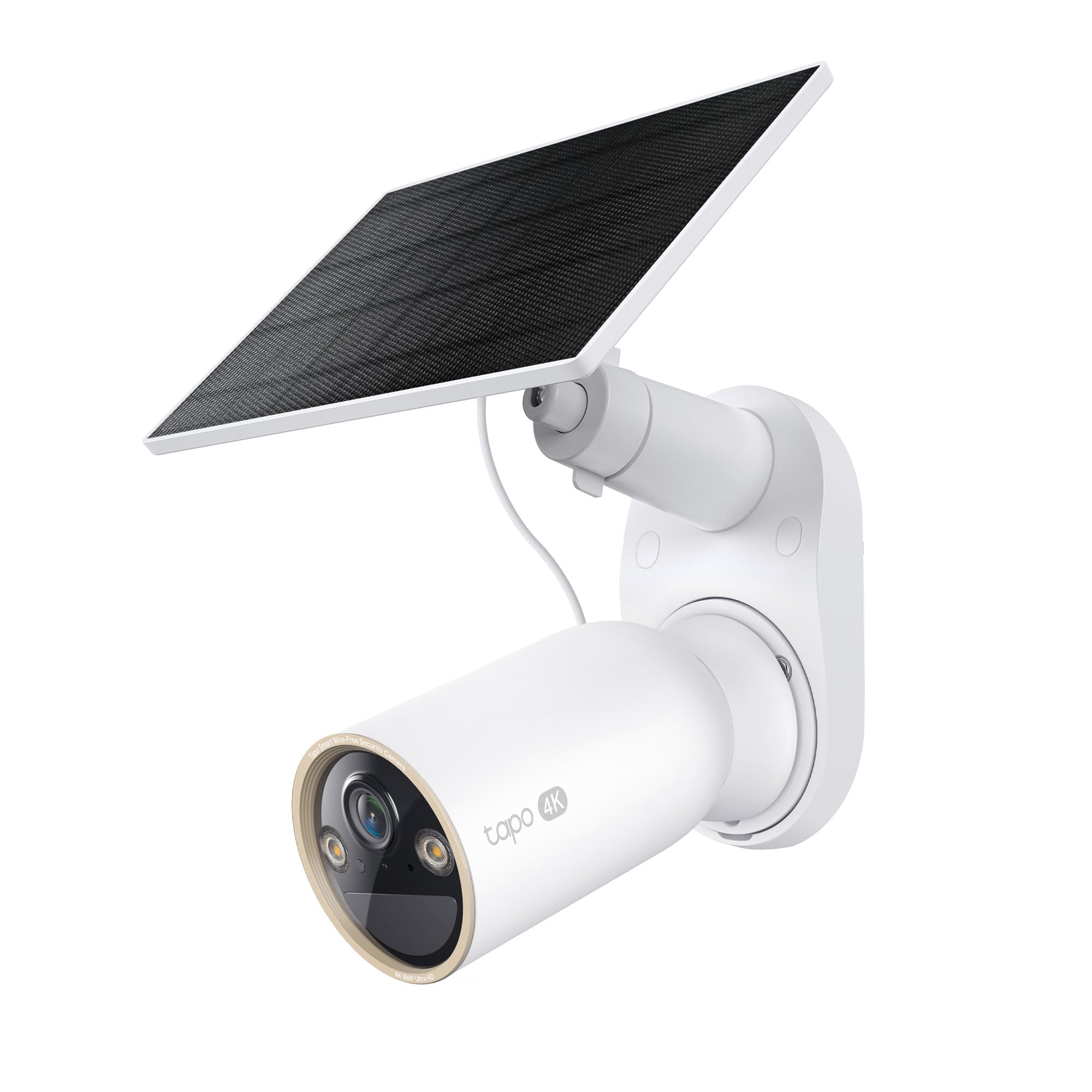
You can stop climbing a ladder to charge a camera: a 10,000 mAh rechargeable battery (a measure of stored power) pairs with a solar panel, and the maker rates it for up to 200 days on a single charge when the sun cannot keep up. A 13-foot cable lets you place the panel in the sun while the camera sits in shade, or clip them together on one mount. The magnetic base means you set the angle by hand in seconds and reposition whenever the season changes your yard shadows.
It films 4K with an Edge Improvement algorithm that sharpens text and facial features, and a starlight sensor with spotlights keeps the image in color at night. Around-the-clock capture is available at intervals you set from 1 to 60 seconds, which spreads visibility beyond a traditional heat sensor. Person, vehicle, and pet detection filters out the tree-branch alerts, and you can store locally on a microSD up to 512GB with no subscription at all.
Here is the honest split: this is a wireless, motion-driven camera, so it is not the same as a wired PoE running continuous full-frame video. That is the trade you accept for zero cabling. What wins people over is the battery behavior — the solar panel holds it near full, and the deep reserve means a cloudy stretch does not kill coverage. Two quirks to note: detection distance is a mixed bag, with a car sometimes picked up past 50 feet and other times missed, and the built-in AI is fine but not surgically precise. For a barn, a back shed, or a rental you cannot drill into, it is the category leader.
Real-life read: mount it in an afternoon, charge never crosses your mind again, and the 4K color night footage stays crisp enough to read a jacket logo.
Match for: a no-outlet location — fence line, detached garage, or rental — where mounting freedom beats continuous recording.
Less suited to: buyers who need a nonstop 24/7 uncut timeline, which the wired picks here handle better.
6. REOLINK Lumus Pro 4K Camera
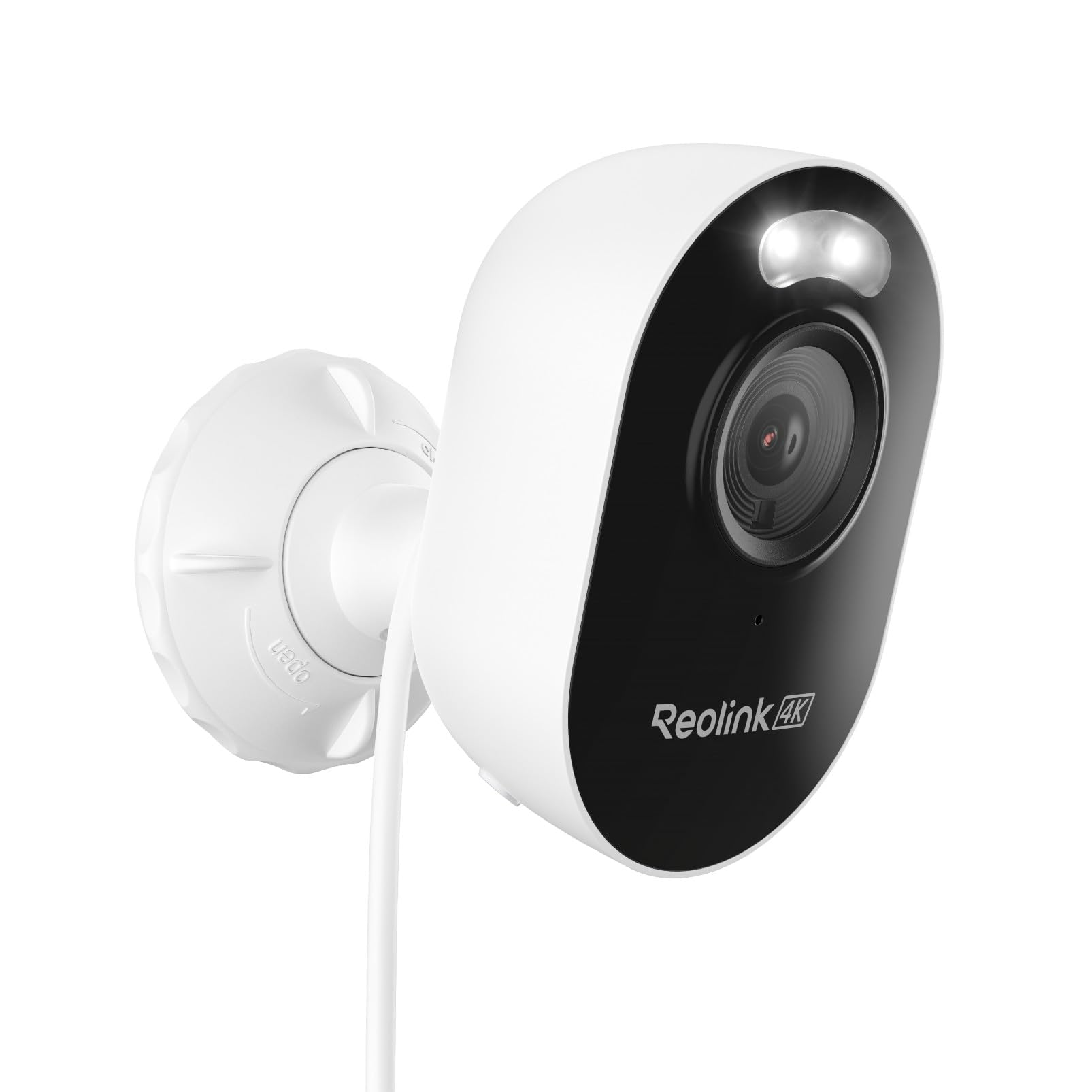
Plug it into an outlet, pair it by Bluetooth, and you are watching in minutes.
Some cameras assume you own a recorder; this one assumes you own a wall outlet. That is the entire pitch: run the power adapter, pair over Bluetooth, and the 4K feed lands on your phone through a Wi-Fi 6 dual-band connection at 2.4 or 5GHz. Wi-Fi 6 is the newer wireless standard built for crowded airwaves, so a video doorbell, a smart TV, and this camera are less likely to fight over the same channel.
The lens is an F1.6 aperture, meaning a wide opening that drinks in more light than the F2.0 lenses common on lesser cameras, and that is what keeps color in the night image. You get person, vehicle, and animal detection with adjustable zones and sensitivity, and no monthly fee to open up any of it. Recording goes to a microSD you supply — listed support runs to 256GB, though the spec sheet also notes up to 512GB — or to a Reolink Home Hub, an NVR, or your own FTP and NAS.
Ease of setup and image quality drive the praise here, and the honest watch-out is night-vision behavior: switching off the blue status light also turns off the IR lights, which catches people out. Connectivity and functionality get mixed notes, with an occasional report of the IR going dark or a dropped connection. Frame rate tops out at 20fps, and the default is 15fps. If you want a bare-minimum install with a strong 4K picture and no NVR, this is the fast lane — just leave the status light alone.
What you gain
- Bluetooth pairing and Wi-Fi 6 make setup quick and the signal steadier
- F1.6 aperture keeps color in the night picture
- No subscription needed for person, vehicle, and animal detection
- Share live view with up to 19 other users
- Storage flexibility: microSD, Home Hub, NVR, FTP, or NAS
What to keep in mind
- Turning off the status light also kills the IR lights
- Needs a power outlet within reach of the adapter cord
- Frame rate peaks at 20fps, default 15fps
Ideal for: someone who wants a quick 4K Wi-Fi camera near an outlet and does not want a recorder or a subscription.
Caveat to accept: it is corded, so the install freedom of the solar picks does not apply here.
7. REOLINK E1 Outdoor Pro 4K

The motorized eye that actually zooms in instead of just turning toward the noise.
Optical zoom is the feature that separates this REOLINK from every fixed-lens pick here. Three times optical zoom, which means the lens physically magnifies the image rather than digitally enlarging pixels — zoom out for the whole yard or in for a plate on a distant car and the detail holds. Combine that with 355 degrees of pan and 50 degrees of tilt, plus infrared night vision reaching 100 feet, and you have the most controllable viewpoint on the list.
Wi-Fi 6 and dual-band 2.4/5GHz keep the stream steady, and the camera can auto-track people and vehicles once it images their shapes. Customizable motion zones and schedules cut the noise. One real setup note the maker states plainly: for outdoor use, mount it upside down for proper water shedding, which is the kind of thing that trips people up mid-install.
The picture earns the most praise here, along with reliability, and the app is where opinions divide. This runs on REOLINK’s own app only — it will not join another brand’s camera app — and some find setup takes patience with poor documentation. Motion tracking and adjustability get mixed feedback in the review pages, with the recurring frustration being that the pan-tilt range, while wide, is not limitless. The 4K image itself is crisp, focus is sharp, and it drops right into a Reolink system or works over ONVIF with others. Go in expecting a one-app camera and it delivers.
Suits you if: you want true optical reach — a distant plate or gate — and are fine living inside the REOLINK app.
Skip the pairing if: multi-brand app integration is a must, since this camera stays in its own ecosystem.
8. Ring Outdoor Cam 4K Pro
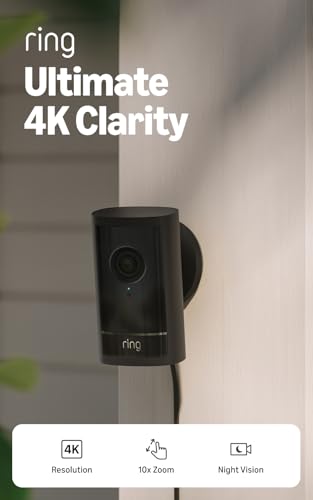
Built around the alert and the answer, not just the recording.
Radar is the differentiator. This camera uses 3D Motion Detection powered by radar to judge where something is moving and how far away, which is a step up from a simple heat sensor that pings at every passing leaf. Pair that with Live View and Two-Way Talk and the camera is less a silent recorder and more a front-door intercom you can answer from the couch.
Ring brands the video Retinal 4K, and Low-Light Sight keeps true color in dim light before switching to black-and-white in full dark. Ten times enhanced zoom reaches distant details, though the maker is upfront that image quality varies with internet bandwidth and device temperature — a fast, stable connection is part of the setup, not an afterthought. The camera is designed for mounting or placing to cover any space in any weather.
The ring of opinions here is mixed on bandwidth. Daytime clarity draws strong praise, and distance clarity is a clear jump over a 2K Ring camera. The recurring complaint is not the lens but the pipe: buyers without enough upload speed report pixelation when they push the 10x zoom hard, and a few report a dead unit after heavy rain. Night vision gets called fantastic by most and underwhelming by a smaller group. If you already live in the Ring ecosystem and have solid Wi-Fi, this slots right in — otherwise weigh the network demands.
The trade in one line: you are buying smart, precise alerting and two-way talk more than raw recording horsepower, so a strong internet connection is half the product.
Right for: a Ring household that wants radar-accurate alerts and talk-to-the-driver functionality out of one plug-in unit.
Weigh before: a slow upload speed, since 4K zoom quality depends on the bandwidth feeding it.
9. aosu T2 Ultra 4K Security Camera
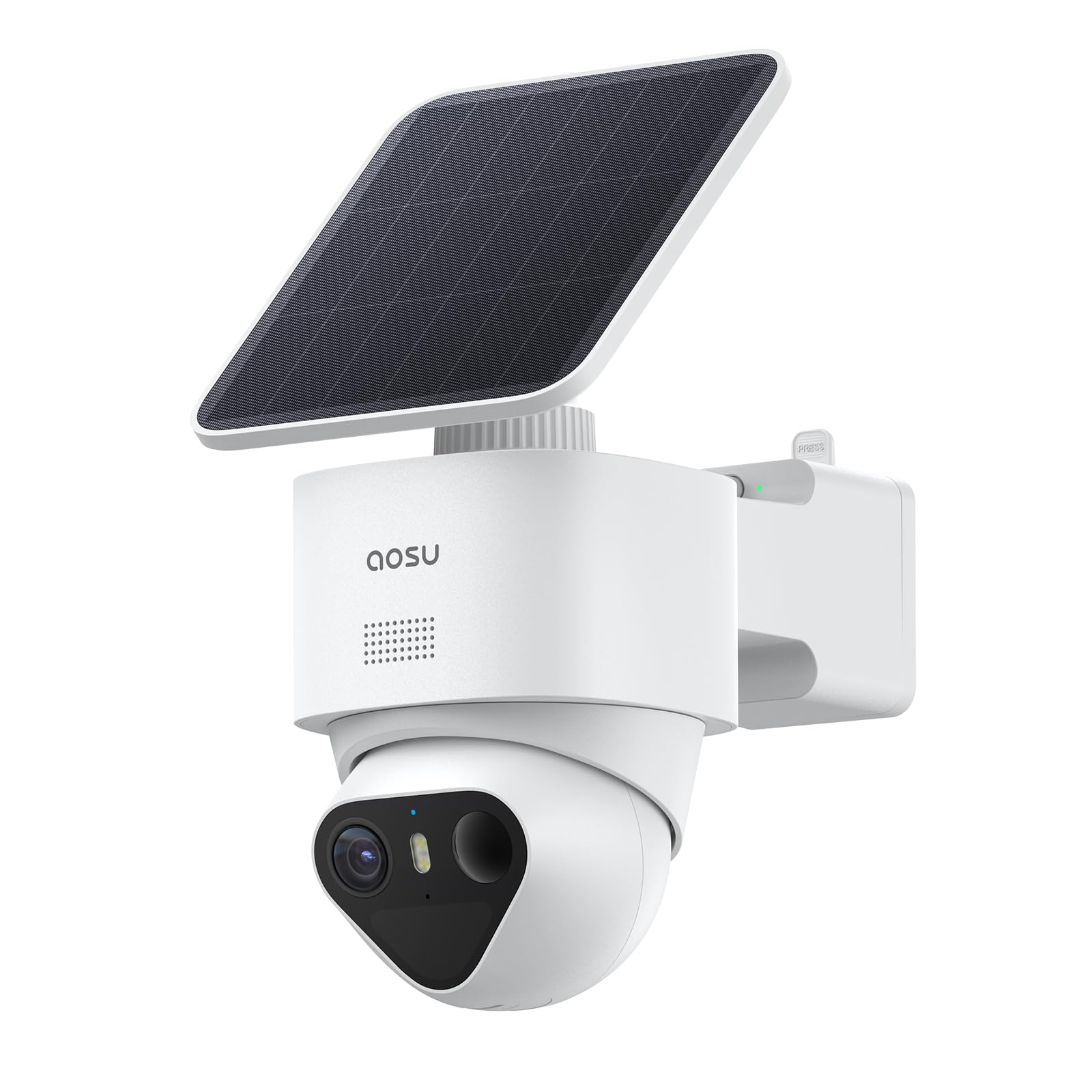
Three kinds of detection and a spinning head — all without a single wire.
Most cameras pick one way to notice you. This one combines three: PIR heat sensing, radar, and on-device AI working together to confirm a person, vehicle, or pet before it fires an alert. That triple layer is designed to throw out the tree-sway and weather-change false triggers that wear down patience on simpler cams. The head turns 355 degrees and tilts 90 degrees, with intelligent auto tracking that follows a moving object in real time.
Night is handled by a 1/1.8-inch sensor with an F1.0 aperture and an AI image chip, so TrueColor night vision keeps color even in near-total dark. You can run pure color, a low-light-disruption mode, or let the camera choose per scene. Power comes from a solar panel mounted to the body or split off with the included 9.8-foot cable so the panel finds the sun while the camera stays in shade, all wrapped in an IP65 weatherproof housing.
The setup genuinely is fast — under three minutes is the norm — and the picture wins the most praise day and night. Battery life is rarely a worry, and the solar keeps it topped off. The honest friction points are connectivity and tracking: pairing to Wi-Fi occasionally fights back, and the camera can drift off its default position over time. It also pairs with the aosuBase 2.0 hub for multi-camera tracking but not the older aosuBase 1.0. For a detached garage or back garden with no wiring, it earns its place.
Strengths worth the price
- PIR, radar, and on-device AI combine to cut false alarms
- 355° pan and 90° tilt give full wire-free coverage
- 1/1.8-inch sensor with F1.0 aperture for color night video
- Solar panel plus detachable 9.8-foot cable for flexible charging
- Local microSD up to 256GB, no subscription required
Where it strains
- Wi-Fi pairing can occasionally need a second attempt
- Auto-tracking may drift off its home position over time
- Multi-camera expansion requires the newer aosuBase 2.0 hub
The scenario: a wire-free spot on a shed or garden corner where three-way detection beats a plain heat sensor.
The one caveat: the wireless link is the weak point, so site it where your 2.4GHz Wi-Fi is strong.
Know the Specs
Power source: PoE, plug-in, or solar
A PoE camera, short for Power-over-Ethernet, takes its electricity through the same network cable that carries the video, so it records all the time with no charging routine. A plug-in Wi-Fi camera draws from a wall adapter and pairs over Wi-Fi instead of a cable, which is easier to install but still needs an outlet. A solar or battery camera mounts anywhere because it carries its own power, but it films in clips and wakes on motion rather than running continuous full-frame video. Match this choice to your wiring before anything else.
Night vision range and color mode
Night range in feet tells you how far the camera can still show a usable image after dark. Infrared night vision gives a sharp black-and-white picture, while a white LED or spotlight adds a full-color image so you can tell a red car from a blue one. A longer range on a wide-angle lens still softens toward the edges, so aim the camera where faces actually appear. Set your expectations by the night number, not the sunny demo video.
Frame rate at 4K
Frame rate counts how many images the camera captures each second, written as fps. Several outdoor 4K cameras here run at 15fps at full resolution, which is smooth enough to follow a person walking and lighter on storage than a higher rate. A faster frame rate helps with quick motion like a passing plate, but it eats more space on the card or drive. For most home surveillance, 15fps at 4K is a workable balance.
Field of view and pan, tilt, zoom
Field of view is the width the lens sees in degrees — a 129-degree lens covers far more yard than a 96-degree one from the same mount. A fixed lens holds that one window, while a pan-tilt-zoom camera (a camera that physically turns and can optically zoom to magnify a distant detail) moves to follow what you want to see. Wider coverage means fewer cameras, but the narrow lens often reaches farther at night. Pick based on if you need width or reach.
Common Questions
Do I need a special recorder for these outdoor 4K cameras?
What does PoE mean and why does it matter for a wired camera?
Will a solar camera record all night?
How much storage do I need for 4K footage?
Can I use these cameras without a monthly cloud subscription?
What is ONVIF compatibility and why should I care?
Is a 360-degree pan-tilt camera better than a fixed bullet?
How far does night vision actually reach on these cameras?
Do these outdoor 4K cameras work with Alexa or Google Assistant?
The Bottom Line
For most people who can reach a cable, the winner is the Amcrest UltraHD 4K PoE because its 129-degree view and 49.2 feet of color night vision give you the widest, most readable coverage without a battery routine. If night reach matters most on a long property, the ANNKE bullet reaches 100 feet. And for a wire-free install with no outlet in sight, the Tapo MagCam C460 KIT is the one to reach for. Match the power source to your wall, and the 4K detail follows.
How we choose
We do not accept paid placement. Every pick is matched to a real buyer and a real use-case; we do not hands-on test units.
Sources
Specifications: manufacturer listings and product documentation. Review insights: verified customer reviews, as of November 2026. Pricing: not shown on this page (it changes often); check the current price via the retailer link.
As an Amazon Associate, Tactical Gear Guy earns from qualifying purchases. This does not affect which products we feature.