Specs are compiled from manufacturer listings and verified buyer reviews and can change over time — please confirm the key details on the product page before buying.
Wildlife shots are lost in fractions of a second — a tail flick, a wing lift, a head turn — so the camera that matters is the one that locks focus fast and keeps it. The picks below are all interchangeable-lens bodies you can fit a long telephoto to, and each one is chosen for a different real-world wildlife job. Some are built to track birds across a treeline, some are built to shrug off rain and cold, and some are built to keep a beginner’s first safari from turning into a pile of blurry misses.
This guide is built by comparing the manufacturers’ published specifications and the patterns across verified customer reviews, so you get each pick’s real strengths and trade-offs instead of marketing spin.
Reach, burst speed and subject tracking are the three things that separate a keeper from a throwaway in the field. Here is how each pick lines up for a real wildlife photography camera setup you can carry all day.
Top Picks


How To Choose The Best Wildlife Photography Camera
You are standing in cover at first light, the light is poor, the animal is behind branches, and it will not hold still. That is the exact moment every spec on the box gets tested. A wildlife body has to find a small subject against busy background, hold that focus while the subject moves, and do it again and again before the moment passes. Three numbers predict how well a camera survives that moment more than any marketing line.
Autofocus points and subject detection
Autofocus points are the tiny zones the camera uses to judge focus — more of them spread wider usually means it can lock onto a small animal off to the side of the frame. Subject detection takes this further: it recognises the shape of a bird, an animal or a vehicle and keeps the focus on it as it moves. The Nikon Z50 II lists 231 autofocus points with dedicated bird and airplane modes, and it can automatically detect nine distinct subject types. The Canon EOS R5 goes wider still with 1,053 AF points covering roughly the whole frame, and tracks people, animals and vehicles using deep learning. For a bird half-hidden in a hedge, that coverage difference decides whether the camera holds the eye or grabs the twig in front of it.
Burst speed and buffer
Burst speed is how many photos the camera fires per second, written as fps. A leaping deer or a tern diving needs a fast burst so you catch the exact wing or leg position you want. The Canon EOS R7 reaches 15 fps with its mechanical shutter and 30 fps with the electronic shutter, plus a RAW Burst Mode with a 1/2-second pre-shooting buffer that records frames from before you pressed the button. The Nikon D7500 fires up to 8 fps, and the Canon EOS Rebel T7 manages up to 3.0 fps — a big difference when the subject is only sharp for a heartbeat.
Sensor size, crop factor and reach
Crop factor is a multiplier that tells you how much a smaller sensor narrows your field of view — effectively zooming in on the same lens. An APS-C sensor multiplies your reach, which is why telephoto shooters favour it. On the Nikon D7500 the focal length in 35mm equivalent runs about 1.5x the lens’s FX angle of view, and the Canon EOS R50 lists a 1.6 crop factor. Full-frame bodies like the Canon EOS R5 and Sony Alpha 7 IV give you cleaner low-light files but less magnification from the same lens, so you lean on longer, heavier glass to fill the frame with a distant animal.
Weather sealing and weight you actually carry
A camera you leave behind in drizzle is a camera that misses the shot. Look for a stated sealing rating — the OM SYSTEM OM-1 Mark II carries IP53-certified dustproof and splashproof protection, plus freezeproof performance down to -10°C (14°F), which suits a cold dawn stakeout. Weight matters just as much on a long walk: the OM-1 Mark II is built to be carried all day without fatigue, while a full-frame body with a telephoto slung on it starts to feel heavy by midday.
Side-by-Side Comparison
| Model | Best For | Autofocus Points | Continuous Shooting | Sensor | Amazon |
|---|---|---|---|---|---|
| Nikon D7500 with 18-140mm | All-round wildlife value | 51 | 8 fps | 20.9MP APS-C | Amazon |
| Canon EOS RP with RF 24-105mm | Full-frame on a budget | — | — | Full-frame | Amazon |
| Nikon Z50 II Two Lenses | Bird and animal detection | 231 | 5 fps | 20.9MP APS-C | Amazon |
| Sony Alpha a6700 Body | Hybrid photo and video | 759 | 11 fps | 26MP APS-C | Amazon |
| Sony Alpha 7 IV Body | Full-frame hybrid all-rounder | 693 | — | 33MP full-frame | Amazon |
| OM SYSTEM OM-1 Mark II | Weather-sealed field work | 1,053 | 10 fps | 20.4MP Four Thirds | Amazon |
| Canon EOS R5 Body | High-resolution flagship | 1,053 | 12 fps mechanical | 45MP full-frame | Amazon |
| LUMIX S1II Body | Hybrid full-frame video | 79 | 30 fps (SH Burst) | 24.1MP full-frame | Amazon |
| LUMIX S1RII Body | High-resolution hybrid | 399 | 30 fps (SH Burst) | 24.1MP full-frame | Amazon |
Detailed Reviews
1. Nikon D7500 DSLR Camera
A proven action DSLR that hands you 51 focus points and 8 fps without a flagship bill.
Here is the number that earns this body its spot on a wildlife list: 8 frames per second. That burst, paired with a 51-point autofocus system with 15 cross-type sensors and group area AF, lets you fire through a burst of a bird taking off and pick the frame where the wings sit where you want them. It beats the Canon EOS Rebel T7 on both counts — 8 fps against 3.0 fps, and 231 autofocus points against 9 on the Nikon Z50 II comparison, though the D7500 itself sits at 51 points. The 20.9MP APS-C sensor is described by the maker as equivalent to the award-winning D500 in image quality, ISO range and metering, which matters for the grey, dim edges of the day when wildlife is most active.
Reach comes built in. The 18–140mm lens focuses on details from a distance, and the APS-C sensor’s 1.5x crop factor, listed here as a focal length equivalence of about 1.5x the FX angle of view, turns that zoom into a longer effective reach than the number suggests. Add a 3.2-inch 922K-dot tilting touchscreen and 4K Ultra HD video with auto ISO, and you have a body that frames low to the ground without you lying in the mud. Camera quality draws the most owner mentions at 54, picture quality follows at 23, and low-light autofocus recurs across the review pages.
The honest catch is the menu. Settings are the one mixed note in the feedback, with even a 60-year photographer calling the sheer number of options intimidating at first; the point-and-shoot option carries you until the menus become second nature. There is also no second card slot, which is a fair trade since this body still undercuts the D500 it borrows its image engine from. The rapid-fire speed is described in the review pages as brilliant, especially set to sport — just budget a couple of weeks to learn the controls before a big trip.
What earns it the top slot
- 8 fps continuous shooting catches fast wing and leg movement
- 51-point AF with 15 cross-type sensors and group area AF
- 20.9MP APS-C sensor with ISO and metering billed as D500-equivalent
- 18–140mm lens plus a 1.5x crop factor gives strong effective reach
- 3.2-inch 922K-dot tilting touchscreen for low framing
Before you commit
- Menu depth is the one mixed note — plan a learning window
- No second memory card slot
- Settings take real study before they feel automatic
Reach for this if: you want serious burst speed and telephoto reach from a DSLR you can learn in a season.
Look elsewhere if: you shoot professionally and cannot work without a backup card slot.
2. Canon EOS Rebel T7 DSLR Camera
A full-frame body with a do-everything zoom for photographers still building their kit.
Going full-frame is the leap many wildlife shooters want to make for cleaner low-light files, and this kit is a measured way in. The RF 24–105mm f/4–7.1 IS STM lens covers a wide working range, so it handles landscape and hide-side scenics before you buy glass with real reach. Optical Image Stabilization gives up to 5 stops of shake correction, which is the kind of help that keeps a handheld shot steady in fading light when your shutter speed has to drop. The 4K UHD 2160p video and 14-bit files round out a solid hybrid body.
Image quality leads the praise here at 29 mentions, with vibrant colour and sharp print enlargements the recurring theme. Quality tops the list at 50. The flip-out touchscreen makes shooting from awkward angles simple, and the menu is easy to navigate, so you spend time on the animal rather than the settings. For a wildlife-first body this is not the classic pick, because 24–105mm will not pull a distant subject close without a longer lens later.
The catch worth sizing is autofocus, the one mixed area in the feedback with 15 mentions; it needs more work than the tracking you get from an action-tuned body. Battery life is also mixed at 8 mentions, with all-day outings demanding a nightly charge. As a first full-frame that grows with you — starting with scenics and closer wildlife, then adding a telephoto — it is a fair, honest step rather than a shortcut.
The honest read: the full-frame sensor and 5-stop stabilization give you real low-light headroom, but the 24–105mm zoom is a general-purpose lens, not a telephoto.
Plan for later: a longer lens is the next purchase that turns this into a proper wildlife rig.
Pick this when: you want full-frame image quality and a versatile zoom to grow a kit around.
Skip it for: distant birds and small animals — the 24–105mm range needs a longer lens to reach them.
3. Canon EOS R50 Mirrorless Camera
231 AF PointsBird Detection
Bird and airplane modes turn this into a smart little wildlife tracker.
The 231-point autofocus system is the number that stands out for wildlife. It packs dedicated bird and airplane modes, and it can automatically detect and track nine distinct subject types — people, dogs, cats, birds and vehicles among them. For a bird flicking through a hedge, that subject recognition saves you the job of chasing focus manually. It runs a 20.9MP DX-format (APS-C size) sensor billed as several times larger than a phone’s, and dual lenses are included: the NIKKOR Z DX 16–50mm f/3.5–6.3 VR and the 50–250mm f/4.5–6.3 VR, both with image stabilization.
Camera quality is the thing owners praise most, with 38 mentions, and image quality follows at 19. On top of that, 31 built-in Picture Control presets are a press away, so you can dial a look in the field without a computer. Wireless sharing through the free Nikon SnapBridge app sends photos to your phone in seconds. Video is generous too — 4K UHD/60p and in-camera 120p slow motion in Full HD, so a hovering kestrel can be slowed to a study.
The honest limit is 5 fps continuous shooting, which is well short of an action-specialist body — a hunting cheetah will test you, though a perched heron will not. The two kit lenses cap you at 250mm, so plan a longer lens once your reach needs grow. As a lightweight APS-C package with real animal recognition, it punches well for a beginner or intermediate shooter.
What it does for you: bird and airplane detection plus 9 subject types means the camera finds the animal for you, and 4K/60p with 120p slow motion freezes a hovering bird in a way a photo cannot.
What it is not: at 5 fps it is not a burst-speed specialist, and 250mm is the limit of the included lenses.
The matching buyer: a beginner or intermediate shooter who wants the camera to recognise and track a bird for them.
Know before buying: add a longer lens and accept a measured 5 fps burst for fast action.
4. Sony Alpha a6700 APS-C Mirrorless Camera Body 26MP 4K Black

A workhorse body that fuses a 26MP sensor with an AF brain tuned to moving subjects.
Sony hands this camera a dedicated AI processor and Real-time Recognition for subject tracking, backed by a 759-point autofocus array and Eye Detection and Face Detection. On a startled animal, that means the box stays on the eye rather than drifting to the background foliage. The 26.0MP APS-C Exmor R back-illuminated sensor and BIONZ XR processor produce sharp, detailed files with wide dynamic range and modest noise in tougher light. Burst speed runs at 11 fps, which comfortably outstrips the 5 fps on the Nikon Z50 II kit.
Image quality gets high marks, and the autofocus is described as the best the photographer has seen on any camera, praised as much for accuracy and reliability as for speed. It is compact but built solid enough to carry all day. Video is where it doubles down: 4K/60p 6K-oversampled 4:2:2 10-bit recording with Long GOP or All Intra formats, plus high frame rate 4K 120p. A wildlife videographer who wants a slow-motion wing flap gets it here without a second body.
The trade-offs are real but contained. Reliability is the one mixed area, with occasional reports of a body powering down after long use, and the menu is called cluttered and non-intuitive by some. If you are choosing this over a Canon action body, its strength is the 759-point AI tracking and the video reach; its limitation is that longer-session thermal behaviour is the thing to watch on hot, long shooting days.
The standout spec: 759 autofocus points with a dedicated AI processor and Real-time Recognition — the camera hunts the animal for you, even when it moves.
The honest trade: the menu takes learning, and a few long-session units have powered down on busy days.
Worth it for: a hybrid shooter who wants AI subject tracking and 4K 120p slow motion in a compact body.
Look at other picks if: you want the simplest possible menu straight out of the gate.
5. Sony Alpha 7 IV Mirrorless Camera

A do-everything full-frame with the resolution to crop into a distant animal.
Cropping is a wildlife photographer’s friend when the animal will not fill the frame, and the 33MP full-frame Exmor R back-illuminated sensor leaves a lot of room to crop and still keep detail. The autofocus is the other half of the story: 693 points with fast, accurate tracking. Pair that with low-light performance that the reviews describe as amazing, and you get a body that holds up when the light is thin. The BIONZ XR engine is billed as eight times more powerful than the previous generation, which is the muscle behind fast focus and clean files.
Image quality is a huge part of the appeal at 42 mentions, behind quality at 77, and the menu system is called improved compared with earlier models. Owners describe it as a fantastic hybrid for professionals and serious enthusiasts. Video is thorough: 4K 60p 10-bit 4:2:2 with full pixel readout, and 7K oversampling for 4K 30p 10-bit 4:2:2 with no pixel binning, plus S-Cinetone color. Screens, menus, versatility and a switchable photo-video mode all draw praise. This is a strong pick if you shoot stills and video on the same trip.
The honest limit is reach. A full-frame sensor does not multiply your lens the way APS-C does, so a distant owl needs a longer, heavier and costlier lens than the same shot on the Canon EOS R7. Performance is the one mixed note across the feedback, and battery life is mixed too, though some report well over 2,000 shots on a single battery across long shoots. Buyers weigh those against the low-light and resolution gains.
The buying logic: 33MP full-frame files let you crop hard into a subject, and 693 AF points keep a moving animal sharp, which is why it doubles as a superb video body.
The cost of that: full-frame means less free reach, so plan for longer glass than an APS-C shooter would.
Fits the photographer who: wants one body for high-resolution stills and serious video, and can pair it with long glass.
Weigh the reach: on distant subjects, an APS-C body gives more magnification from the same lens.
6. OM SYSTEM OM-1 Mark II Mirrorless Camera

The one you take out in the rain when everyone else packs up.
Rain, dust and a cold dawn are where this body earns its place. It carries IP53-certified dustproof and splashproof protection, plus freezeproof performance down to -10°C (14°F) — a stated sealing rating that most bodies in this list do not publish. Its autofocus is the widest here: 1,053-point Phase Detection Cross Quad Pixel AF, with all cross-type points across 100% of the image area, purpose-built for demanding wildlife and outdoor work. That coverage is built to keep a small moving subject tracked when the background is a tangle of branches.
The 20.4MP Stacked BSI Live MOS sensor and TruePic X processor deliver sharp, detailed files with rich colour and dynamic range, and continuous shooting reaches up to 120 frames per second in RAW. A 5-axis stabilization system gives up to 8.5 stops, which helps when you are hand-holding a long lens in poor light. Computational features are a genuine asset for field work: Handheld High Res up to 50MP, Tripod High Res up to 80MP, Live ND up to ND128, and Focus Stacking for a whole insect or flower in focus, front to back. Quality leads the praise at 32 mentions and image quality at 14, and the compact, light build is repeatedly called easy to carry all day.
The trade-off is the Four Thirds sensor — it is physically smaller than full-frame, so a full-frame body will pull ahead in absolute low-light depth. The other honest note is autofocus, which is praised as vastly superior to the previous M1X yet still occasionally loses focus for no clear reason. For a weather-sealed, all-day, wide-AF field camera, it is a specialist built around the job.
Why the field shooter wants it
- IP53 dustproof and splashproof, freezeproof to -10°C (14°F)
- 1,053-point cross-type AF across 100% of the frame
- Up to 120 fps RAW continuous shooting
- Up to 8.5 stops of 5-axis stabilization
- Live ND up to ND128 and Handheld High Res to 50MP
The honest counters
- Four Thirds sensor trails full-frame in absolute low light
- Autofocus occasionally loses a subject unexpectedly
The pick for: shooters who work in wet, cold or dusty conditions and value a light, sealed body with frame-wide AF.
Trade to accept: the smaller sensor gives up some low-light depth against a full-frame body.
7. Canon EOS R5 Mirrorless Camera (Body Only)

A 45MP flagship built for detail, with an animal-tracking AF that hunts by eye.
Detail is the reason to look here. A stacked, back-side illuminated 45-megapixel full-frame CMOS sensor captures phenomenal low-light performance, image clarity and fine texture — fur, feather, and the catchlight in an animal’s eye. Dual Pixel CMOS AF with 1,053 AF points covers roughly the entire frame and tracks people, animals and vehicles using deep learning. Eye Control AF is the a neat extra: you select focus points simply by looking at them through the viewfinder. The autofocus accuracy here is rated more accurate than even the newer Canon EOS R7 in the review pages, and with a Sigma 150–600mm attached, the detail is called astonishing.
Quality leads the praise at 84 mentions, image quality at 37, autofocus at 31. The electronic viewfinder is large, bright and sharp — nearsighted shooters note they can shoot without glasses. High-speed shooting reaches 12 fps with the mechanical shutter and 20 fps with the electronic shutter. Video is 8K RAW and 4K up to 120fps internal in all formats, so this is a full production tool as much as a stills body.
What you must budget for is the whole system. It is a premium-tier body, and the cost of long glass to match the sensor is significant. Reliability is the one mixed area, with a report of connection errors from day one, and long 8K recording runs hot. It is heavy kit to carry and a serious commitment — but for a shooter who needs the most resolution and the most accurate animal tracking, it is the flagship answer.
The case for it: 45MP of full-frame detail and 1,053 AF points with animal tracking, plus Eye Control AF for choosing focus by looking.
The real cost: a premium body that demands matching long glass, with heat to manage on long 8K runs.
For the shooter who: needs maximum resolution and the most accurate animal-eye tracking, and will pay for the glass to match.
Not for casual trips: the weight and the system cost reshape what you carry.
8. LUMIX S1II Mirrorless Camera

A full-frame hybrid tuned for video, with action bursts that reach 30 fps.
Action and footage both get serious treatment here. With the electronic shutter in SH Burst or SH Pre-Burst, this body fires up to 30 fps, and in H+ mode it shoots blackout-free at 10 fps with continuous autofocus — the maker names sports and wildlife shooting as the targets. A 24.1MP partially stacked BSI CMOS full-frame sensor feeds that speed, and a High Resolution mode produces 96MP-equivalent images handheld with no tripod. An 8.0-stop 5-axis stabilisation system steadies a long lens in dim conditions, and advanced AI recognition backs up the 79-point autofocus.
Video is where the S1II leads its class. Open gate 6K 30p (3:2) recording captures the full sensor height, so you can reframe a vertical crop from the same take, alongside 6K 30p 10-bit, C4K, 4K, 3.3K and FHD, with internal 4:2:2 10-bit. A working wildlife filmmaker gets flexibility no cropped format offers. The body carries LUMIX’s colour science, Photo Styles and REAL TIME LUT for a graded look straight from camera, and the workflow runs through LUMIX Lab, LUMIX Flow, Capture One and Frame.io.
The counterweight is autofocus point count. At 79 points it trails the frame-wide arrays on the Canon EOS R5 and the OM-1 Mark II, so pinpoint tracking of a small bird in clutter leans more on the AI recognition than on sheer coverage. This is a hybrid built first for film-makers who also shoot stills, not a birding specialist. If your work is as much motion as photograph, that trade is a fair one.
Where it pulls ahead: open gate 6K 30p and internal 4:2:2 10-bit give a filmmaker reframing room no cropped format matches, with 96MP-equivalent handheld stills as a bonus.
The honest gap: 79 autofocus points is modest next to frame-wide rivals, so small-subject tracking leans on AI recognition.
Made for: the hybrid creator whose work is half film, half frame, and who wants open gate flexibility.
Not the birding specialist: if pinpoint small-subject tracking is the whole job, a wider AF array serves you better.
9. LUMIX S1RII Mirrorless Camera
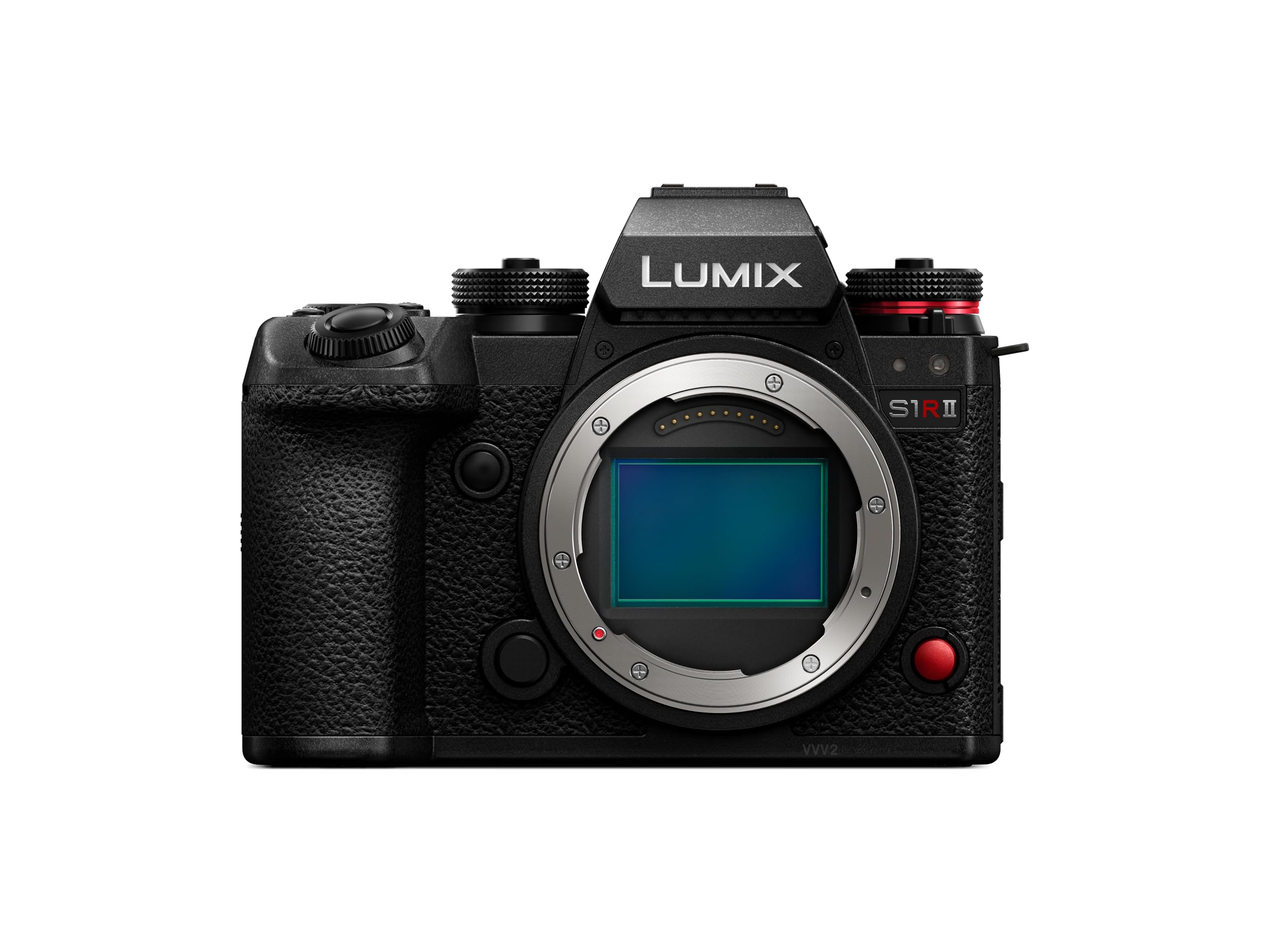
The hybrid for shooters chasing resolution first and reach second.
Resolution drives this pick. A partially stacked 24.1MP BSI CMOS full-frame sensor pairs with a High Resolution mode that outputs 96MP-equivalent images handheld, no tripod required — useful for a static subject where every feather barb matters. The 399-point hybrid autofocus more than doubles the coverage of its S1II sibling at 79 points, though it still sits behind the 1,053 points on the Canon EOS R5 and OM-1 Mark II. Advanced AI recognition and 8.0-stop 5-axis stabilisation round out the field kit.
Burst speed is strong when you need it: blackout-free 10 fps with autofocus in H+ mode, and up to 30 fps with the electronic shutter in SH Burst or SH Pre-Burst. Video covers 6K 30p 10-bit, C4K, 4K, 3.3K and FHD with internal 4:2:2 10-bit and open gate 6K 30p (3:2) recording. The body carries LUMIX colour science, REAL TIME LUT and a workflow through LUMIX Lab, LUMIX Flow, Capture One and Frame.io. In owner hands, it is called better than expected, a dream camera whose footage has gone completely cinematic, with super-fast autofocus noted after the v1.3 firmware.
The honest caveat is that this is a newer body with a thinner review base, so long-term field reports are still building. Reach is the other consideration — full-frame gives you less free magnification than APS-C, so budget for long glass. For a high-resolution hybrid where 8K video and 96MP stills share equal billing, it is a compelling pro tool.
The resolution headline: 96MP-equivalent handheld stills and 8K video in one full-frame body, with 399 AF points feeding AI recognition.
What is still forming: a newer model, so the long-term owner record is shorter than the established picks.
Choose this to: chase maximum resolution for stills and 8K footage from a single hybrid body.
Weigh first: full-frame reach runs shorter than APS-C, so long lenses are part of the plan.
Know the Specs
Autofocus points and subject detection
Autofocus points are the little zones a camera samples to decide what is in focus. More points spread wider across the frame make it easier to catch a small animal off to one side. Look at the spread, not just the raw count: the OM SYSTEM OM-1 Mark II uses 1,053 cross-type points covering 100% of the image area, while the Canon EOS Rebel T7 works with 9 points. Subject detection goes further — it recognises a bird’s or animal’s shape and holds focus as it moves, which is the difference between a sharp eye and a sharp twig.
Burst speed and pre-shooting
Burst speed, measured in frames per second (fps), is how many shots the camera fires in one press. Faster bursts raise your odds of catching the exact wing or leg position you wanted. The Canon EOS R7 reaches 15 fps with the mechanical shutter and 30 fps with the electronic one, and its RAW Burst Mode with 1/2-second pre-shooting even records frames from just before you pressed the button. Slower bodies like the 3.0 fps Canon EOS Rebel T7 suit perched and slow subjects better than sprinting ones.
Crop factor and telephoto reach
Crop factor is a multiplier that narrows your field of view on a smaller sensor, effectively zooming in. An APS-C body like the Nikon D7500 effectively multiplies your lens reach by about 1.5x in full-frame terms, and the Canon EOS R50 lists a 1.6 crop factor. A full-frame body gives cleaner low-light files but less magnification from the same lens, so a distant animal needs longer and heavier glass. This is the single biggest trade full-frame wildlife shooters make.
Weather sealing and image stabilisation
Weather sealing is a rated resistance to dust and water — the OM SYSTEM OM-1 Mark II publishes IP53-certified dustproof and splashproof protection plus freezeproof performance down to -10°C (14°F). Image stabilisation counters hand shake, quoted in stops of correction: the Canon EOS RP offers up to 5 stops, the OM-1 Mark II up to 8.5 stops. High stop counts help you hand-hold a long lens in dim light instead of hauling a tripod into the reeds.
Common Questions
Do I need a full-frame sensor for wildlife photography?
How many autofocus points do I need for tracking birds?
What burst speed do I need to catch fast animals?
Is a crop-sensor camera better for long telephoto shots?
Can I hand-hold a long lens or do I need a tripod?
What does an IP53 weather-sealing rating protect against?
Do I need 4K or 8K video on a wildlife camera?
Is a kit lens long enough for birds and distant animals?
How long does a mirrorless battery last on a full day of shooting?
The Bottom Line
The wildlife photography camera that balances reach, burst speed and learning curve best is the Nikon D7500 — it hands you 8 fps, a 51-point AF system and a 1.5x crop boost for real telephoto reach. If action is your whole job, the Canon EOS R7 pushes burst speed to 15 fps mechanical and 30 fps electronic with 651 AF zones. And for wet, cold, all-day field work, the sealed OM SYSTEM OM-1 Mark II with its 1,053 cross-type points is the one to reach for. The Nikon D7500 is the crowd favorite — 4.5+ stars across 700+ ratings — which makes it the safest first move if you want proven performance.
How we choose
We do not accept paid placement. Every pick is matched to a real buyer and a real use-case; we do not hands-on test units.
Sources
Specifications: manufacturer listings and product documentation. Review insights: verified customer reviews, as of November 2026. Pricing: not shown on this page (it changes often); check the current price via the retailer link.
As an Amazon Associate, Tactical Gear Guy earns from qualifying purchases. This does not affect which products we feature.