Specs are compiled from manufacturer listings and verified buyer reviews and can change over time — please confirm the key details on the product page before buying.
Your freezer is the one appliance you never think about until the food inside it starts to thaw. The fix is a small plug-in device that sits between the wall socket and the freezer, cuts the power when the voltage misbehaves, and waits a short beat before letting it flow again. That wait is the whole point — it stops the compressor from restarting into an unstable line.
This guide is built by comparing the manufacturers’ published specifications and the patterns across verified customer reviews, so you get each pick’s real strengths and trade-offs instead of marketing spin.
What follows is a plain-English walk through nine plug-in protectors, ranked by how well they fit a freezer rather than a TV or a laptop. You will see which ones handle high-draw compressors, which ones give you an audible alarm when the power dies, and which ones wait long enough before switching back on. If you want the short version, the best surge protection for freezer duty is the pick that combines a real joule rating with a proper restart delay.
Top Picks


How To Choose The Best Surge Protection for Freezer
A freezer is not a phone charger. It draws a big burst of current every time the compressor kicks in, and it hates being switched on and off in quick succession. That single fact reshapes everything worth checking here.
Match the amp and watt rating to the compressor
A standard household circuit runs at 15 amps, and most of the plugs on this list are built for exactly that. The wattage ceiling tells you how much appliance the unit can carry. A 1875W or 1800W unit handles a full-size freezer comfortably, while a 1400W unit is more suited to a smaller chest freezer or a secondary fridge. Check the sticker on your freezer before you buy.
The restart delay is the safety feature that counts
When the power flickers, the worst thing your freezer can do is fire the compressor back up instantly into a still-wobbly line. A delay of a few minutes lets the voltage settle first. Without one, a compressor can short-cycle — start and stop repeatedly — which is the sort of stress that shortens its life. Look for a stated delay and a delay indicator light so you know it is working.
Joules measure spike absorption, not runtime
A joule is a unit of absorbed energy. A higher joule figure means the device can soak up a bigger spike before it reaches your appliance. It says nothing about how long the unit lasts or how well it handles a long brownout. For freezer duty, a modest joule rating paired with a solid voltage cut-off is usually a smarter combination than a huge joule number with no delay.
One outlet or three?
If your freezer lives alone in a garage, a single-outlet plug is tidy and keeps the unit tight against the wall. If you are running a chest freezer plus a fridge plus a dehumidifier off the same corner, a multi-outlet adapter saves you buying three separate units. The trade-off is bulk: a three-way adapter sticks out further from the socket.
Side-by-Side Comparison
| Model | Best For | Rated Power | Outlets | Restart Delay | Amazon |
|---|---|---|---|---|---|
| Fosmon 3 Outlet 1200J★ Best Overall | One socket serving several appliances | 1875W / 15A | 3 | None stated | Amazon |
| Nippon Power 1875WLongest Delay | Freezers that need a long restart gap | 1800W | — | 4 minutes | Amazon |
| QWORK 2-Pack 1400WTwo For One | Two smaller appliances on one buy | 1400W / 11.67A | 2 | 3 minutes | Amazon |
| BSEED Voltage Protector 2-Pack | Reading live voltage at a glance | 1875W / 15A | 1 | 3 minutes | Amazon |
| BSEED Single Outlet 1800W | A single fridge or freezer, plug and play | 1800W / 15A | 1 | 3 minutes | Amazon |
| Ortis Alarm + Surge | Knowing the moment the power drops | 120VAC | 1 | — | Amazon |
| Appliance Shield 20 Amp | Big freezers and heavy-draw gear | 2000W / 20A | — | Configurable range | Amazon |
| BXST 3 Outlet 2-Pack | Off-grid and unstable-line setups | 1800W / 15A | 3 | 30 seconds | Amazon |
| Supco APP120 | Squeezing in behind a pushed-back fridge | 120V / 15A | 3 | Delay light | Amazon |
Detailed Reviews
1. Fosmon Refrigerator Surge Protector
Our pick — 4.5+★ from 3,500+ verified ratings; the strongest balance of quality and price.
Three sockets, 1200 joules, and a wall-hugging body that turns one outlet into a garage power hub.
The Fosmon earns the top spot because it does the multi-appliance job without asking you to think about it. It carries 1875W at 15A, so a full-size freezer plus a secondary fridge plus a garage door opener can all sit on one socket. That is the same 15A ceiling your household circuit already runs at, which means you are not pushing past what the wiring can deliver. Four of these come in the box, so a garage with several outlets gets covered in one purchase.
Owners keep coming back to its build quality and the fact that it simply works. One detail worth naming plainly: this is a surge absorber, not a voltage monitor, so there is no restart delay built in. If your power flickers rather than spikes, the compressor protection you want lives in the Nippon or the BSEED further down. The four-pack count is also where this model pulls ahead of every single-outlet pick here, including the BSEED plug, which ships one to a box against the Fosmon’s four.
The compactness is a genuine selling point in tight spaces. It sits flush against the outlet instead of dangling on a cord, so it fits behind a freezer that gets pushed to the wall. Each socket has its own LED indicator for both power and protection status, which is how you know the surge circuit is still alive rather than blown. The rated capacity of 1875W at 125V and 15A matches the standard North American appliance circuit, and it conforms to UL498A and UL1449 — the safety standards a plug-in adapter like this is tested against.
What earns it first place
- 4 units in the box covers an entire garage wall of outlets
- 1875W at 15A carries a full-size freezer plus a second appliance
- 1200J of surge absorption handles spike-prone neighborhoods
- Sits flush, so a pushed-back freezer does not crack the plug
- Separate LEDs for power and protection status
Where it stops short
- No restart delay, so a flickering line can still short-cycle the compressor
- Three sockets on one adapter stick out further than a single-outlet plug
Grab this one: your freezer shares a wall with a fridge, a chest unit, or a garage door opener and you want it all covered today.
Pass it by: brownout protection with a proper restart gap is what you are actually after.
2. Nippon Power Refrigerator Voltage Protector
Four full minutes of silence after the lights come back — the longest wait on this list.
Here is the number that decides it: a 4-minute safety cycle. That is a third longer than the 3-minute delay on the BSEED plugs, and it matters because a compressor that restarts too soon fights the pressure still sitting in its lines. Four minutes gives the system time to equalize. The unit is built for refrigerators, freezers, and water coolers specifically, and it carries appliances up to 1800 watts.
Its auto-switching between 50Hz and 60Hz power means it works on either grid without a setting to change. The AC 85-135V operating range covers the wobble you see in areas with weekly voltage swings. A detachable ground pin adds a bit of flexibility for older outlets that lack a proper ground.
The honest catch is durability. There are enough reports of units giving out within weeks, and of the protector cycling a fridge on and off to the point where it does more harm than good, that you should treat this as a device to watch rather than forget. That is worth knowing up front — it is a fit note, not a reason to rule the model out. The 3-minute-to-activate behavior some owners notice on restore is the same safety cycle working, just a little shorter than the spec sheet promises in real-world conditions.
The brownout argument: if voltage sag is your problem rather than lightning, the combination of a 1800W ceiling, an 85-135V window, and the longest restart gap here is exactly the tool for it.
Keep an eye on it: overseas quality slips on some units, so check the delay light is still cycling after the first month.
Built for: a freezer in a neighborhood where the lights dim and flutter several times a week.
Think twice if: you want a set-and-forget plug with no monitoring on your part.
3. QWORK Voltage Protector 2-Pack
Two protectors in one box, built to guard a chest freezer and a second appliance at the same time.
This pair is the smart buy if you have two mid-size appliances rather than one giant one. Each unit carries up to 1400 watts on a 120V line at 11.67A, which suits a chest freezer, a bar fridge, or an air conditioner. Buy the BSEED single instead and you get more headroom on one socket — 15A against the QWORK’s 11.67A — but only one protected outlet. QWORK gives you two units to spread across the garage.
The safety cycle delays power by 3 minutes and confirms voltage has normalized with an indicator light before letting current through. The LED display is the genuinely useful part: it shows normal, high, and low voltage states plus the time delay, so you can glance at it and know whether the line is healthy right now. That is more information than most plugs on this list give you.
Owners call these good quality and effective, though several wish for an override to power the appliance without sitting through the full delay. The 11.67A ceiling is the real limitation to weigh — it is the lowest amperage among the major picks here, so a large freezer that pulls hard on startup is better served by a 15A unit.
Suits you when: two separate appliances need guarding and you would rather buy once.
Look elsewhere if: your freezer is a big one that draws close to a full 15A circuit.
4. BSEED Voltage Protector 2 Pack

Four lights that tell you exactly what the wall is doing — normal, high, low, or waiting.
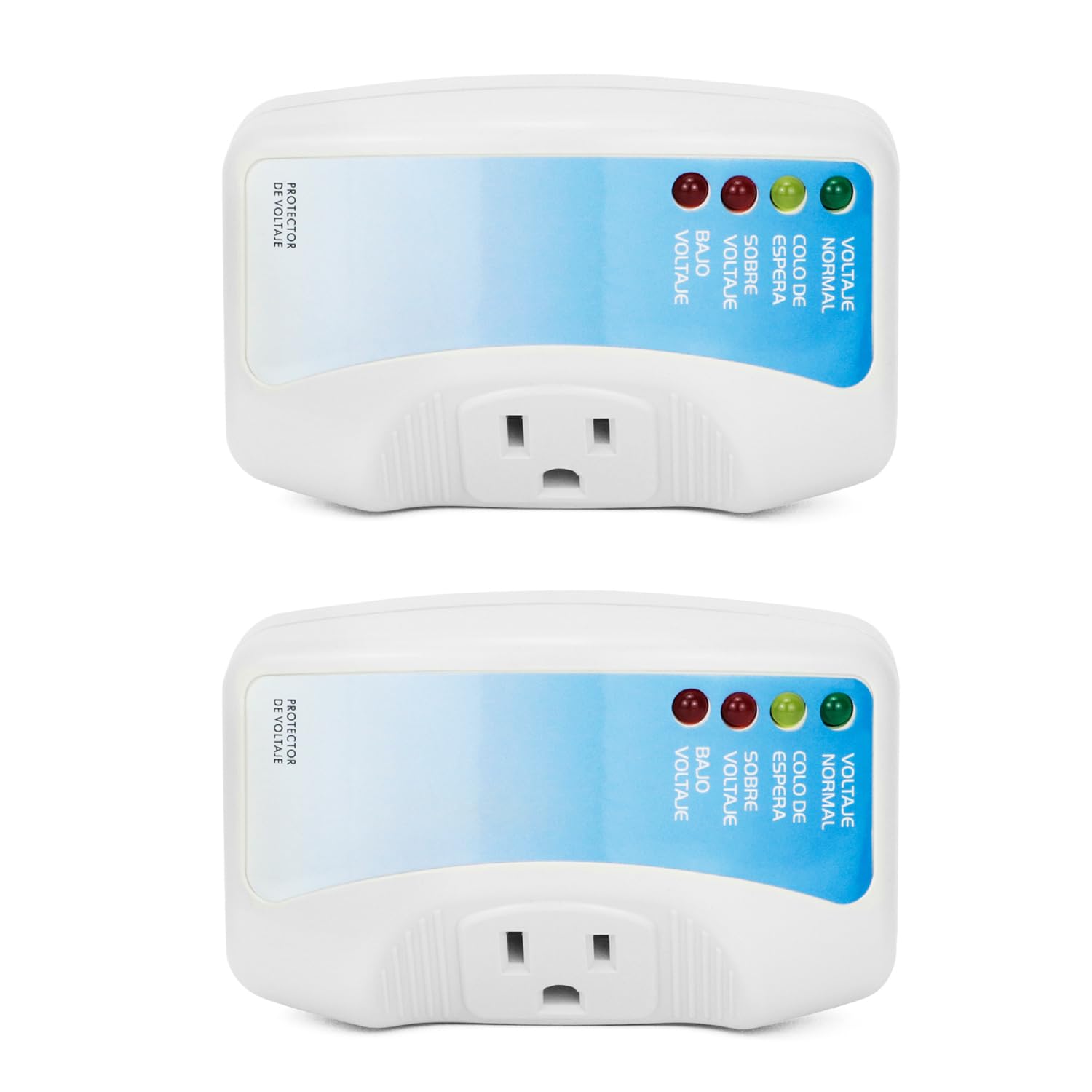
Most protectors give you a single glowing dot. This one gives you four separate indicators, one each for normal voltage, over voltage, low voltage, and the waiting cycle. For a freezer in a spot you walk past, that reads like a dashboard: you can see at a glance whether the unit is holding power back or passing it through.
The 3-minute period is deliberate. BSEED’s own reasoning is that several surges can land inside a single minute, and a fridge that power-cycles quickly risks damage to its compressor — so the plug waits before reconnecting. It runs 15A at 125V and 1875W, matching the Fosmon’s amperage, though it covers one appliance per plug rather than three. The 2-pack means a fridge and a washer both get covered.
Owners single out the build quality, with the voltage protection and the 3-minute delay drawing repeated praise. Two things to plan around: the socket faces downward rather than straight out, which changes how a bulky cord sits, and the plug is a three-prong type that needs a grounded outlet. Neither is a defect — just geometry to check before you buy.
Why the lights matter: a freezer protector you cannot read is a freezer protector you stop trusting — four labeled states fix that.
The angle to note: the outlet points down, so a right-angle cord is friendlier here than a straight one.
Reach for this if: you want to see the voltage state without plugging in a meter.
Better elsewhere if: you need three appliances on one socket instead of two on two.
5. BSEED Surge Protector 1800W
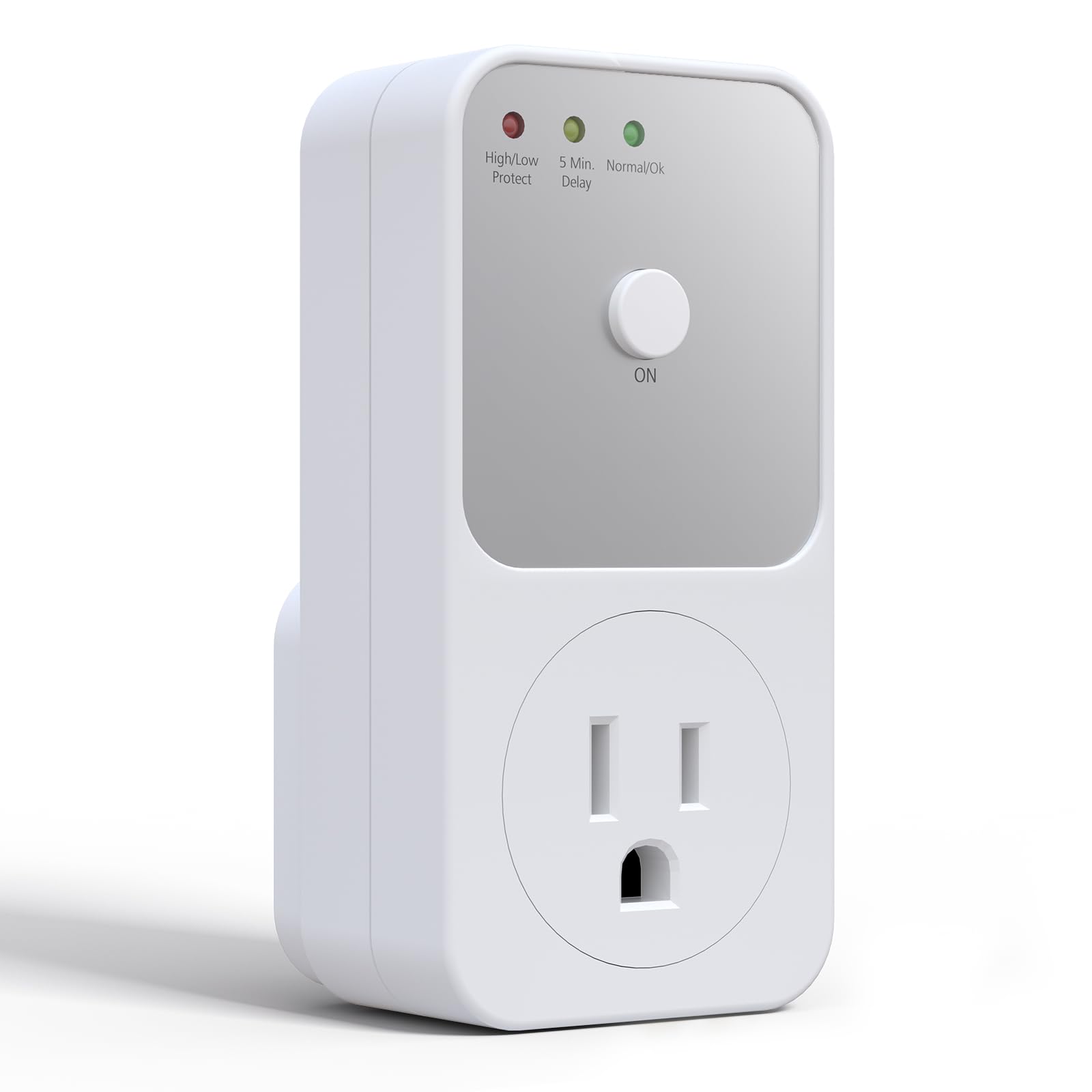
One socket, 1800 watts, and a flame-retardant shell that meets a named safety grade.
The enclosure on this one is made of ABS plastic rated to the UL94-V-1.0 flame-retardant standard — a specific, testable grade rather than a vague “fire resistant” claim. Behind a freezer in a hot garage, that is not a small detail. It carries 15A at 120V and 1800W, and it plugs straight into the wall with no cord to tuck away.
Operation is genuinely hands-off. The unit cuts power automatically when voltage drifts outside its limits, holds for a 3-minute delay, then lights the normal indicator and lets current flow again. Compatible devices run well past freezers — computers, TVs, microwaves, ice makers, and dishwashers all appear on the list, so it can migrate to another appliance if your setup changes.
Owners most often mention how broadly compatible it is and how it keeps working through outages. One practical note from the review pages — the delay that protects a compressor is less welcome on a TV or a computer, which do not care about short-cycling, so this is best kept on the motor-driven appliance.
Made for: a single freezer or fridge that needs one tidy plug and nothing else.
Not the one for: a garage row of appliances, since it protects one socket only.
6. Ortis Refrigerator Surge Protector & Power Failure Alarm

The only pick here that shouts at you when the power dies — 110 decibels of warning.
Every other device on this list protects your freezer silently. This one adds a 110dB alarm and flashing lights so you actually learn when the line drops, which is the difference between salvaging the food and finding out hours later. It is designed for 120VAC refrigerators, freezers, and sewage pumps, and it covers high and low voltage, spikes, instant surges, voltage fluctuation, and load shedding.
The built-in rechargeable lithium battery is what makes the alarm trustworthy — it plugs in and charges itself, so you are not relying on a battery you forgot to swap. The LED panel labels each voltage state outright instead of using unmarked dots. Appliances in the compatible list include freezers and sewage pumps alongside refrigerators, so a basement setup gets covered too.
What this unit does not publish is a restart delay figure or a joule rating, so if compressor protection on a flickering line is your main worry, a delay-equipped pick like the Nippon does that job more directly. Treat the Ortis as the device for the person whose real fear is spoiled food, not a fried circuit board.
The case for the alarm: a power cut you hear about in the first minute is a power cut you can act on.
The gap to know: no stated restart delay or joule number, so it is monitoring first and surge absorption second.
Choose it when: your freezer holds a season of meat and you want to know the instant the power fails.
Skip the upgrade if: a silent plug with a long restart delay is all you actually need.
7. Appliance Shield Surge Protector, 20 Amp, 2200 Watts

A 20-amp rating and a shell rated to withstand 1832°F — built for the heaviest appliance on the property.
The rating here is 20A, 2000W, 1HP — a step above the 15A ceiling most of this list runs at, and enough for freezers up to 32 cubic feet, air conditioners up to 18000 BTU, and even treadmills and garage door openers. That 32 cubic foot ceiling is the largest appliance capacity named by any pick in this article. The shell is flame-retardant V0 German bell plastic rated to 1832°F (1000°C), with a normal operating range of 41°F to 131°F.
What separates it from the rest is the adjustable voltage tolerance. You can set the minimum cut-off anywhere between 90V and 105V, with a maximum of 140V — so you tune the trip point to your local grid instead of accepting a fixed one. When the line goes unstable, it auto-disconnects and reconnects the appliance on its own.
Owner reports on reliability split both ways — some units run for years through storm season, others quit early. That spread is the honest picture on this model, so it is fair to say it performs well when it works and that long-term trust varies. The adjustable range is the compensating strength: very few of the fixed-threshold plugs here let you dial in the trip point yourself.
Where it leads: nothing else here states a 32 cubic foot appliance ceiling or a 20A rating, and the 90-105V adjustable floor is unique to it.
The honest risk: reliability stories are split, so treat the warranty and the return window as part of the purchase.
Pick this for: a hefty chest freezer or a workshop full of motor-driven gear that pushes past 15A.
skip it if: you want fixed, predictable behavior with no tuning and a lower chance of early failure.
8. BXST Surge Protector 2 Pack
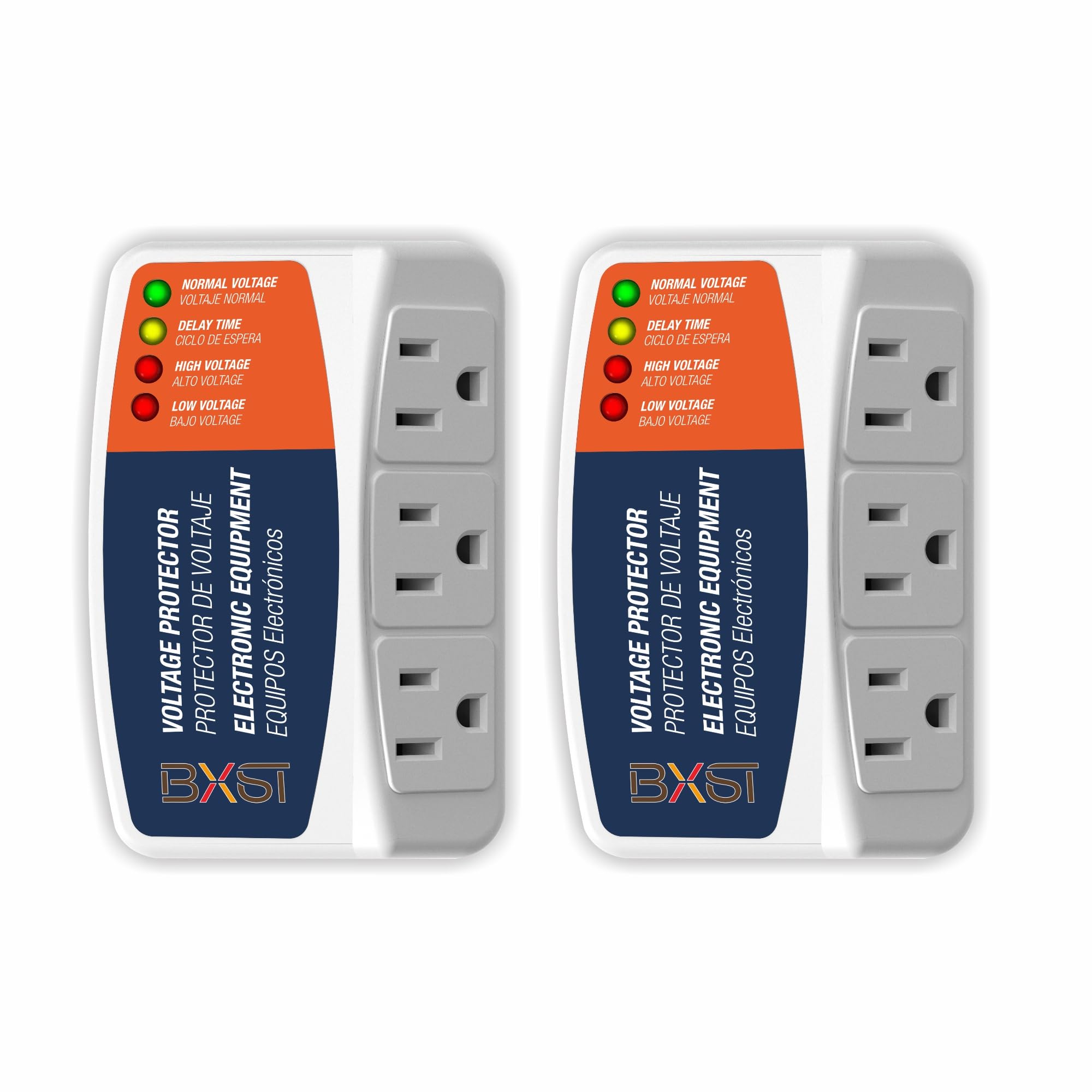
Three sockets per plug, a 140-joule absorber, and a 30-second hold that suits solar and off-grid lines.
The delay on this one is a 30-second hold rather than minutes, and that shorter gap is a deliberate design choice: it guards against repeated start-stop cycles without keeping your appliance dark for long. Power output resumes once the line stabilizes.
Where it shines is the voltage window. The LED indicators flag Normal Output, High Voltage above 140VAC, and Low Voltage below 90VAC, plus Delay Mode — so you can see exactly which side of the line you are on. The unit is built to run from -10°C to +65°C, and it covers a long appliance list including refrigerators, freezers, ice makers, washing machines, and water heaters. Three outlets per plug and two plugs per box gives you six protected sockets in total.
The cordless, flush design is what owners keep coming back to, along with the clear indicators. One practical note: the delay-equipped plug is best kept on the motor-driven appliance, since a TV or computer does not benefit from the wait. Off-grid users find the auto cut-off especially useful when the inverter line is uneven.
Reach for this if: your power comes from solar or an inverter and the voltage drifts through the day.
Better elsewhere if: a big spike from a thunderstorm is the threat you are guarding against.
9. Supco APP120 Surge Protector

The side-plug body lets you push the freezer flat to the wall without crushing the plug.
This is the pick for the person whose freezer is already jammed into a tight alcove. The side plugin and flat profile mean the appliance slides back without bending the cord or cracking the plug body — a small design choice that solves a real daily annoyance. It carries 15A at 120V with 3 outlets, so it covers a freezer plus a companion appliance from a single socket.
Three indicator lights cover Protection, Delay, and Ground, so you can confirm the surge circuit is live, that the delay is engaged, and that the outlet is actually grounded. It is built for critical appliances — refrigerators, washing machines, dryers, and air conditioners — though one caveat is printed right in the product notes: it is not for use with electric laundry dryers.
Its track record on protection is what sells it. Buyers report it saving a freezer through a thunderstorm and a new refrigerator through a storm, with the delayed restart after an outage working as intended. The mixed side is durability — a few units fail early or run hot — so keep an eye on the housing after the first season.
The design win: a flat side-entry body is worth more behind a tight fridge than any spec sheet number.
Worth watching: the enclosure can heat up under load, so leave a little breathing room and check the lights stay green.
Best matched to: a freezer or fridge boxed into a corner where clearance behind it is scarce.
Move along if: you need coverage for an electric dryer, which this model is not made for.
Know the Specs
Joules and what they actually absorb
A joule is a measure of energy absorbed before a spike reaches your appliance. A higher figure like 1200J means the device can soak up a bigger surge; a lower figure like 140J means it is aimed more at small spikes and brownouts than a full lightning strike. Joules say nothing about how long the unit lasts or whether it holds power during a brownout — those are separate jobs handled by the delay and the voltage cut-off.
Voltage cut-off windows explained
The cut-off window is the range of voltage the plug considers safe. Outside it, the unit disconnects the appliance. A wide window such as AC 85-135V tolerates a lot of wobble; a tighter, adjustable range like 90-105V minimum to 140V maximum lets you tune the trip point to your local grid. On an adjustable model you raise the floor to trip earlier or lower it to ride out mild dips.
Restart delays and short-cycling
A delay holds power back for a set time — 30 seconds, 3 minutes, or 4 minutes depending on the model — after voltage normalizes. This stops the compressor from restarting into an unstable line and short-cycling. Short-cycling is the repeated start-stop that stresses a compressor, so the delay is a genuine protective feature rather than a convenience.
Wattage, amperage, and appliance capacity
Amperage is the current ceiling; wattage is the power ceiling at a given voltage. Most household circuits and the plugs here run at 15A, which supports 1875W at 125V or 1800W at 120V. A unit rated 11.67A or 1400W carries less. Check your freezer’s rating so the plug’s ceiling sits above what the compressor pulls on startup.
Common Questions
Will a surge protector stop a brownout from damaging my freezer?
How long should the restart delay be for a freezer compressor?
Can I plug a chest freezer into a 15-amp surge protector?
What does 1200 joules actually protect against?
Is a surge protector the same as a voltage protector for a freezer?
Do these protectors work on an off-grid solar or inverter supply?
Will a surge protector guard my freezer through a lightning strike?
Can I put a smart plug or power strip after the surge protector?
How do I know the surge protection is still working?
Does a protector with a delay work on a TV or computer too?
The Bottom Line
For most households, the surge protection for freezer winner is the Fosmon 3 Outlet 1200J pack because four units in one box cover an entire garage wall at 1875W and 15A, with 1200J of spike absorption per plug. If a flickering line is your real problem, grab the Nippon Power — its 4-minute safety cycle is the longest delay here and the tool for brownout country. And if you want to hear the power die, the Ortis alarm unit adds a 110dB warning so a frozen season of food never thaws in silence.
How we choose
We do not accept paid placement. Every pick is matched to a real buyer and a real use-case; we do not hands-on test units.
Sources
Specifications: manufacturer listings and product documentation. Review insights: verified customer reviews, as of November 2026. Pricing: not shown on this page (it changes often); check the current price via the retailer link.
As an Amazon Associate, Tactical Gear Guy earns from qualifying purchases. This does not affect which products we feature.