Specs are compiled from manufacturer listings and verified buyer reviews and can change over time — please confirm the key details on the product page before buying.
If your sub punches hard but the bass comes out muddy or buzzing, the culprit is usually the enclosure, not the driver. A sealed 12 inch enclosure locks the driver inside an airtight chamber, and that trapped air is what forces the cone to stop cleanly and start fast. This guide ranks sealed 12 inch enclosures by vehicle fit, MDF wall thickness, and internal air space, so you can match the box to your sub’s depth and your cab’s dimensions.
This guide is built by comparing the manufacturers’ published specifications and the patterns across verified customer reviews, so you get each pick’s real strengths and trade-offs instead of marketing spin.
Below you’ll find truck-specific boxes, slanted hatchback wedges, and dual-sub cabinets, each pinned to the subwoofer depth and air space it actually gives you. Read on for the full breakdown of the best 12 inch sealed subwoofer boxes for regular cabs, hatchbacks, and dual-sub trunks.
Top Picks


How To Choose The Best 12 Inch Sealed Subwoofer Box
Three numbers decide whether a sealed box will sound good or sound broken: mounting depth, air space, and wall thickness. Nail all three and the sub plays tight and clean. Miss one and the driver either won’t fit or you get sloppy, rattling bass.
Mounting depth is the first gate you have to pass
Mounting depth is the distance from the front baffle to the back wall inside the box. Your sub’s magnet and frame need to slide in without touching that back panel. A box with 5.5″ of depth suits low-profile subs, while a deep 10.5″ chamber takes bigger, deeper motors. If the magnet presses hard against the rear wall, the box is too shallow and the bass suffers.
Air space decides the character of the bass
Air space is the sealed volume inside, measured in cubic feet. A smaller chamber, around 0.75 to 0.92 cubic feet, tends to give tight and punchy bass. A larger 1.25 to 1.50 cube chamber usually plays deeper and louder. Match the chamber to your sub’s recommended sealed volume for the best output.
Wall thickness resists flex and rattle
The enclosure walls are what keep the sound in. Thicker 3/4″ MDF (medium-density fiberboard, a dense pressed wood) flexes less under heavy bass than thinner 5/8″ panels. Less panel flex means less rattle and a cleaner, more accurate note. Airtight joints matter just as much, so look for glued and sealed seams.
Fit your vehicle before you fall for the specs
A box that fits a hatchback trunk won’t slide under a regular-cab truck seat. Measure the space you actually have, then match it to the box’s width, height, and depth. Vehicle-specific boxes are built for one cab style, so a Silverado extended cab box won’t drop into a Ram Quad Cab.
Side-by-Side Comparison
| Model | Best For | Mounting Depth | Air Space | MDF Thickness | Amazon |
|---|---|---|---|---|---|
| Atrend Bbox Single Sealed 12″★ Best Overall | First-time buyers and convertibles | 5.5″ | — | 3/4″ | Amazon |
| ASC 112TRUCK Single 12″Best for Regular Cabs | Regular cab trucks | 5 3/4″ | 0.80 Cubic Feet | 5/8″ | Amazon |
| Rockville RHB12Best for Hatchbacks | Hatchback trunks | — | 0.92 Cubic Feet | 3/4″ | Amazon |
| Belva 1TRUCK12 | Single cab and hatchback value | — | 0.75 Cubic Feet | 5/8″ | Amazon |
| ASC 112H Slanted Hatchback | Big sub, deep bass | 10.5″ | 1.50 Cubic Feet | — | Amazon |
| ASC 212PRF Dual 12″ | Two-sub systems | 13-1/2″ | 1.25 Cubic Feet | 3/4″ | Amazon |
| Atrend 12SAL Wedge | Hatchback wedge fit | 10″ | — | — | Amazon |
| Bbox Silverado/Sierra Extended Cab | GM extended cabs 99-07 | 6″ | — | 3/4″ | Amazon |
| Bbox Dodge Ram Quad Cab | Ram Quad Cab 02-18 | 6″ | — | 3/4″ | Amazon |
Detailed Reviews
1. Atrend Bbox Single Sealed 12 Inch Subwoofer Enclosure
Our pick — 4.5+★ from 200+ verified ratings; the strongest balance of quality and price.
The wedge that turns an open-air Jeep or convertible into a proper bass machine.
Start with the wall: this box is built from 3/4″ MDF (medium-density fiberboard, a dense pressed wood), and that thickness is what keeps the panels from flexing when a big sub throws its weight around. Each MDF joint gets a coat of aliphatic wood glue plus a second application around all internal joints after final assembly. Brad nails from a pneumatic gun hold the parts tight while the glue dries, which helps create an airtight, no-rattle chamber.
The depth figure you need to check is 5.5″. That mounting depth suits low-profile subs, so measure your driver’s magnet before you buy. In a tight 10″ deep cabinet, this slender depth leaves real room in tight spots. Open-air setups like Jeeps and convertibles are where this wedge earns its keep — the sealed chamber keeps the low end deep and clean even with the roof off.
Where owners get the most out of it is the way the sealed design locks in tight, accurate bass. The recurring gripe on the review pages is about the origin label — some buyers expected a made-in-USA build and found otherwise. That’s a labeling complaint, not a sound complaint. The Atrend is the crowd favorite here, and the specs back up the reputation.
What Earns The Top Spot
- 3/4″ MDF walls with glued, nailed seams for an airtight chamber
- Wedge shape and 5.5″ mounting depth fit tight open-air builds
- 11.125″ sub cutout and 20.13″ width suit most standard 12s
- Sealed tuning that stays clean in convertibles and Jeeps
What To Know Before You Buy
- 5.5″ depth rules out deep-motor subwoofers
- Some buyers expected a USA-made build and found otherwise
- Wedge shape is aimed at open-air rigs, not under-seat truck space
Top of the list for: anyone with a Jeep, convertible, or open-air cab who wants deep, controlled bass from a compact 20.13″ wide cabinet.
Check your sub first: if your driver’s magnet needs more than 5.5″ of rear clearance, this one won’t swallow it.
2. ASC 12 Inch Truck Sub Box
Built to slide behind a regular-cab seat without stealing your leg room.
The headline number is 0.80 cubic feet of air space. That’s the sealed volume your sub breathes in, and 0.80 cube suits a standard 12 that wants tight, punchy output rather than a booming trunk-filler. For contrast, the slanted ASC hatchback box above gives you a full 1.50 cubic feet. If you want the tighter bass and a smaller footprint in a regular cab, the 0.80 cube is the right call.
Mounting depth lands at 5 3/4″, which clears the majority of 12-inch subwoofers. The depth-two figure is 7-1/2″, so the wedge leans away from the seat and keeps a lower profile against your back. Built from 5/8″ MDF, this box is lighter than a 3/4″ cabinet, which helps when you’re wedging it in by yourself. Owners with a 1999 Ram regular cab and a 2005 Chevrolet regular cab say it dropped in without eating their seat travel.
The recurring gripe is box depth — the shallow wedge presses some big-magnet subs close to the back wall. If your driver has a massive motor, check the clearance before you commit. What buyers value most across the board is the solid build and the behind-the-seat fit, and this one delivers both at a budget-minded position on the list.
Fit-first build: a 20″ width, 15″ height, and 7-1/2″ slanted depth make this a natural drop-in for regular cab trucks, with a 0.80 cubic foot chamber that stays tight and controlled.
The trade-off: a shallow 7-1/2″ rear depth can crowd a sub with a deep magnet, so verify your driver’s rear clearance before ordering.
Worth a hard look from: regular cab owners who want the seat to stay all the way back and still get solid bass.
Hold off if: your sub runs a deep motor that needs more rear breathing room than a shallow wedge gives.
3. Rockville RHB12 12″ Sealed Hatchback Car Subwoofer Enclosure
A slanted wedge sized to disappear into a hatchback trunk without killing the air space.
0.92 cubic feet of sealed air is the middle ground here — bigger than the regular cab’s 0.80 cube and smaller than the deep 1.50 cube box, so it plays tight and controlled with a little more low-end reach. The slanted profile is 15.5″ wide by 12.75″ tall by 10.5″/12″ deep, which is where the Rockville leads: it’s a full 15.5″ of width versus the 20.13″ Atrend above, so it tucks into narrower hatchback wells.
Build quality is the thing that keeps buyers coming back — the 3/4″ Grade A MDF is glued, stapled, and silicone-sealed at the joints. That Grade A describes a higher panel grade, and the assembly method is what keeps it airtight. Rockford Fosgate P3D2-12, P3D4-12, and R2D2-12 drivers are named as fitting, which tells you the cutout is tuned around popular 12s.
Here’s the honest catch: the compact chamber is exactly why some buyers wish it were a little bigger, and a fresh-out-of-box glue smell is mentioned now and then. Both fade with use. What wins people over is how well it’s built for the footprint — a small hatchback box that still sounds clean.
Small footprint, solid shell: 15.5″ of width and 0.92 cubic feet of air give hatchback drivers a compact sealed box with genuine build quality.
Where it pinches: the compact chamber caps how deep the bass can go, so it suits tight and accurate more than ground-shaking.
Built for: hatchback owners who need a narrow 15.5″ wide wedge that still fits a standard 12.
Look elsewhere if: you run a Rockford Fosgate P3 or similar and want maximum low-end extension over a compact fit.
4. Belva 1TRUCK12 Subwoofer Box
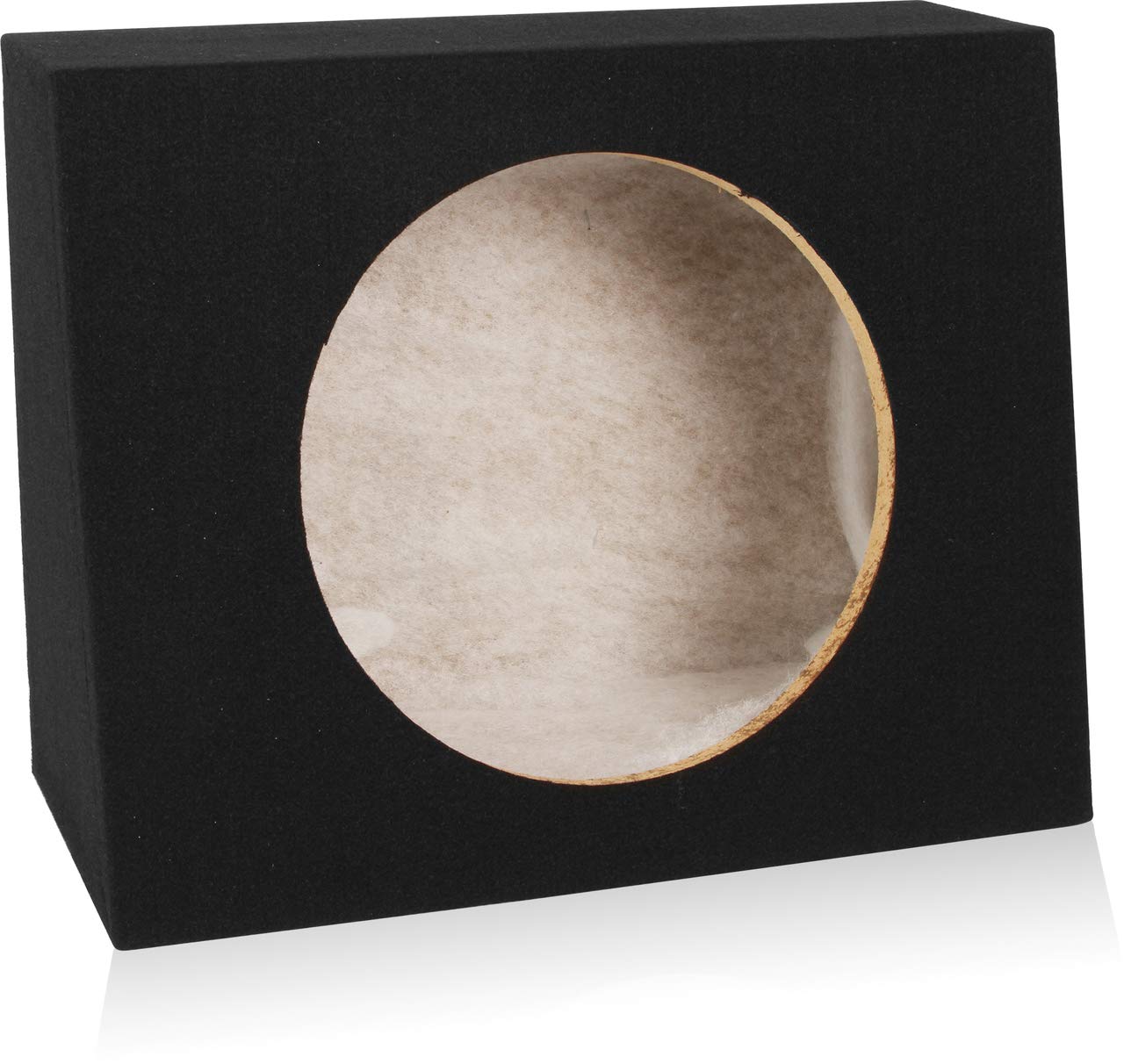
The one that ships with polyfill already inside, so you skip a step most boxes make you do.
Polyfill is loose stuffing that slows down the air inside a sealed box, and it can make a small chamber behave like a slightly larger one. Belva lines this enclosure with it from the factory, which is a real convenience — plenty of buyers end up adding polyfill to other boxes by hand. Air space is 0.75 cubic feet, the tightest chamber in this group, so expect punchy and controlled rather than deep and boomy.
The angled shape targets the tight spaces: single-cab trucks, extended cabs, and hatchbacks. Panels are 5/8″ MDF, thinner than the 3/4″ walls on the Atrend and Bbox boxes, so it’s lighter to maneuver into place. The CARB Phase 2 label means the MDF is made with lower-formaldehyde materials, which is a materials note worth having in a closed cab. Gold binding-post terminals give you a corrosion-resistant wire connection.
What owners keep coming back to is the build and the fit — it slides into tight truck space and still sounds solid. The honest limitation: 5/8″ panels and a 0.75 cube chamber favor a modest sub over a monster one. If you’re pushing a high-power 12 with a deep motor, a thicker 3/4″ box gives you more headroom.
Why It Works For Tight Builds
- Factory polyfill saves you a stuffing step and helps a small chamber
- CARB Phase 2 lower-formaldehyde MDF for a closed cab
- Gold binding posts resist corrosion at the wire connection
- Angled profile fits single cabs and hatchbacks
The Honest Limits
- 5/8″ MDF is lighter and flexes more than 3/4″ walls under heavy bass
- 0.75 cubic foot chamber favors modest subs, not deep motors
Reach for it when: you want an angled box that arrives ready to install with polyfill inside and a lower-formaldehyde build.
Pass if: your subwoofer is a high-power driver that wants thicker walls and a bigger chamber.
5. ASC 12 Inch Sealed Subwoofer Enclosure

The deep-bass monster of the group, with a chamber and depth built for serious subwoofers.
Two numbers set this box apart. The first is 1.50 cubic feet of air space — bigger than the 1.25 cube dual-sub cabinet and nearly double what the regular cab box gives you. The second is a 10.5″ mounting depth that swallows deep-motor subs the Atrend Bbox can’t take at its 5.5″ depth. If your sub needs room to breathe and you want the low end to really dig, this is the chamber for it.
The slanted hatchback profile is 22-1/4″ wide by 12-1/2″ tall, with an 10-1/4″/14-3/4″ depth that leans into hatchback wells. That 14-3/4″ depth-two figure is nearly double the regular cab box’s 7-1/2″, which is exactly how it fits a big driver and a big chamber in the same footprint.
The honest side: this is the box where reviewers split the most. Quality and value win people over, but a recurring theme is the carpet, the smell, and occasional sealing issues. Factor in a little extra care on the seams and terminals, and let the box air out before you mount it. For low-end output, though, that 1.50 cube is hard to match here.
The deep-bass pick: 1.50 cubic feet of sealed air and a 10.5″ mounting depth give big subwoofers the room most compact boxes deny them.
Go in aware: fresh-box odor and occasional sealing gripes show up, so check the seams and let it air out before install.
Made for: hatchback owners with a deep-motor 12 who want maximum air space and low-end extension.
Think twice if: you want a ready-to-run box with zero prep — this one rewards a quick seam and terminal check.
6. ASC 2 12 Inch Sub Box

Two 12s in one sealed shell, with a 13-1/2″ depth that takes serious drivers.
If you’re running a pair of 12-inch subs, a single cabinet beats two separate boxes for a clean, matched install. This one carries 1.25 cubic feet of sealed air, split between the two drivers, and it’s built from 3/4″ MDF (medium-density fiberboard, a dense pressed wood) to hold up under the extra output. The 13-1/2″ mounting depth is the deepest here, so deep-motor subs slide in without being squeezed.
The rear-angle shape tucks against the back of a car trunk or cargo area, and the cabinet is 30-1/4″ wide by 13″ tall, with a 13-3/4″/16-1/4″ slanted depth. That width is the widest in this group, so measure your cargo opening first. It ships with high-grade carpet and spring-loaded terminal cups for a tidy wire hookup.
The flip side of all that air space and depth is the footprint — 30-1/4″ of width won’t drop into a cramped hatchback well. And the extra chamber volume is split across two drivers, so each sub sees less air than a single-sub box of the same total volume. For a matched dual-sub build, though, this is the purpose-built option.
Right call when: you’re running a matched pair of 12s and want one clean cabinet with deep-motor clearance.
Measure first: 30-1/4″ of width and a 16-1/4″ slanted depth need real cargo room, so confirm your opening before ordering.
7. Atrend 12SAL Enclosure

A CNC-cut wedge that aims for an airtight seal down to the last joint.
The construction is the story here. CNC Miter and Dado joints mean the panels are cut on a computer-controlled machine to interlock, and that precision is what keeps the box airtight and rattle-free. Every MDF part gets a coat of specially formulated aliphatic wood glue, with a second application around all internal joints after assembly. Pneumatic brad nails pull the parts tight while the glue dries.
Mounting depth is 10″, enough to clear plenty of 12-inch subs, and the sub cutout is 11.125″. The cabinet runs 15.5″ wide by 15.5″ deep by 13.75″ tall as a wedge, and it comes in a premium charcoal finish. That 15.5″ width keeps it compact for a hatchback well, and the wedge shape leans against the rear of the trunk.
One thing to weigh: at 18 pounds, it’s the heftier build in a compact footprint, which is the trade-off for thicker-feeling, sealed construction. It’s an SQ-tuned box built for accurate low-frequency reproduction rather than pure boom. If you want a tight, precise sound and a hatchback-friendly wedge, this one’s aimed at you.
Built to seal: CNC Miter and Dado joints, double-glued seams, and a 10″ mounting depth give this wedge a precise, airtight chamber for accurate bass.
Consider the weight: 18 pounds in a 15.5″ wide cabinet means a solid build you won’t want to move often.
Pick it for: a hatchback build where airtight construction and accurate bass matter more than a big, boomy chamber.
Not for: someone chasing the deepest possible low end — this one leans precise and controlled.
8. Bbox 12 Inch Enclosure Silverado Sierra Extended Cab

Purpose-built to slide under the rear seat of a Silverado or Sierra extended cab.
This is a vehicle-specific box, engineered for 1999 and up GM extended cabs. The front height is 9.13″ and the rear height is 6.63″, so it slopes under the seat instead of blocking it, and the 24″ width fits that under-seat space. It’s built from 3/4″ MDF with a CNC Miter for an airtight, rattle-free chamber, and the seams get the double-glue treatment.
What fits and what doesn’t is the key detail: this one is made for the extended cab, not a standard crew cab. Owners with a 2003 Silverado report it drops right in under the back seat. The mounting depth suits a low-profile sub, so match your driver to that shallow space before you order.
The strong suit is the vehicle-specific fit — it’s the reason this box is a go-to for GM owners who don’t want to build their own. The trade-off is that it’s locked to one truck body, so anyone with a Ram or Ford should look elsewhere. For a Silverado or Sierra extended cab, though, it’s a matched solution that sounds great with a shallow sub.
Where It Shines
- Engineered fit for 1999 and up GM extended cabs
- Sloped front-to-rear height tucks under the seat
- 3/4″ MDF with CNC Miter joints for a sealed, rattle-free box
- Fits a low-profile 12 under the back seat
What It Won’t Do
- Locked to Silverado/Sierra extended cabs — not a universal box
- Under-seat height limits you to a shallow subwoofer
Made for: Silverado and Sierra extended cab owners who want a no-build under-seat solution.
Skip if: you drive a different truck body or run a deep-motor sub that won’t fit a shallow chamber.
9. Bbox 12 Inch Enclosure Dodge Ram Quad Cab
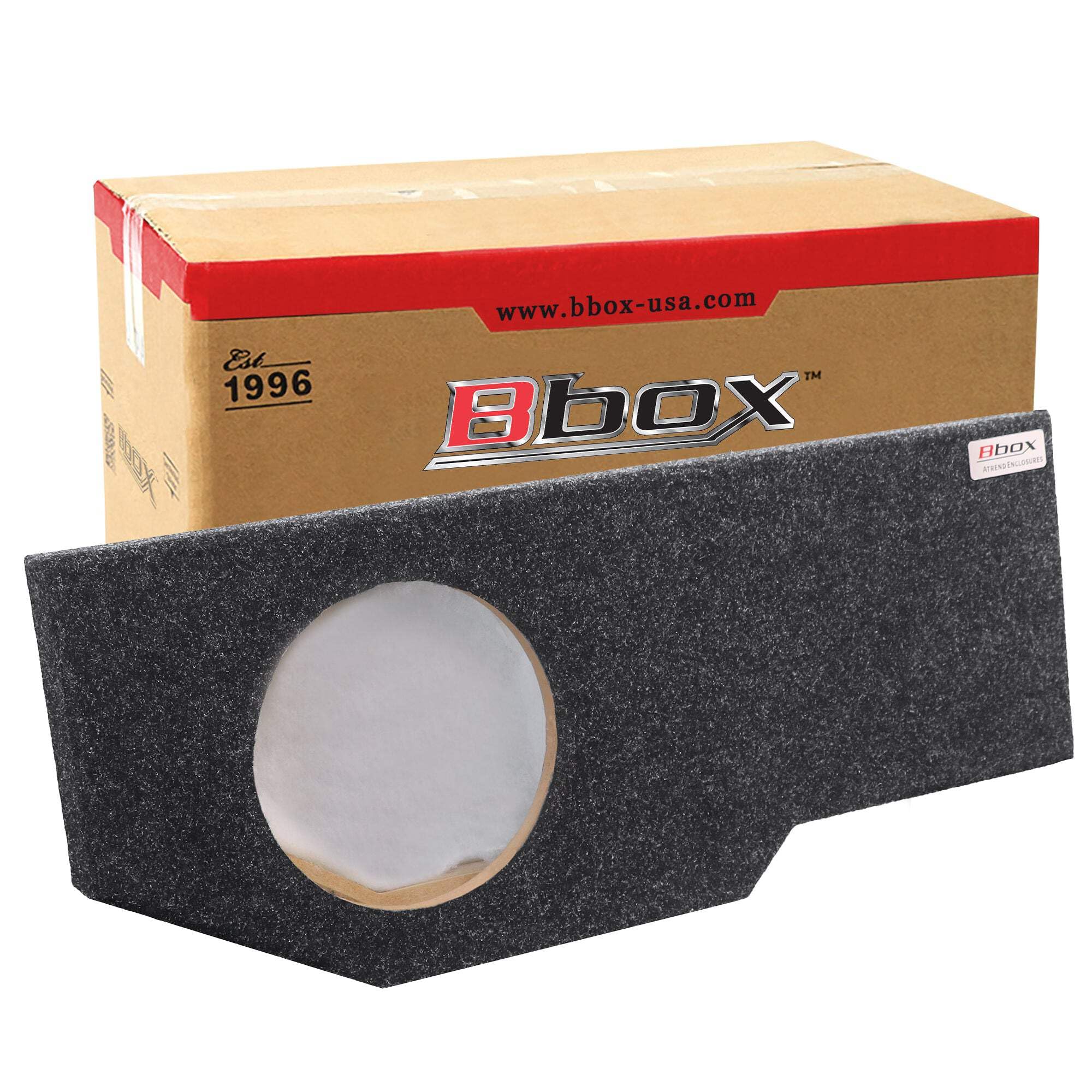
Factory-shaped for the Ram Quad Cab, with a 6″ depth for low-profile subs.
The 6″ mounting depth is the number to remember here. It’s built for low-profile subwoofers, so it clears a shallow driver without pressing the magnet against the rear wall. The box is engineered for 2002-2018 Dodge Ram Quad Cabs to fit like a factory part without blocking the back seat’s operation. Walls are 3/4″ MDF with a no-flex construction and airtight, glued panels.
Where it earns trust is the body-specific fit — Silverado owners can ignore this one, and Ram Quad Cab owners get a box shaped for their truck. The recurring note on the review pages is that the fit can run a little loose, with some preferring a snugger seat in the well. A few report slight rattle with certain subs, which is worth a look at your driver and mounting.
The upside is a purpose-built Ram enclosure that saves you the measuring and building. If your Ram is the Quad Cab body and your sub is low-profile, this is a direct-match option. Check the year range against your truck and confirm the driver depth before you commit.
Vehicle-matched: engineered for 2002-2018 Ram Quad Cabs with a 6″ depth for low-profile 12s and 3/4″ MDF walls.
Go in measured: fit can run loose in the well, so plan a little padding or bracing to keep it snug.
Reach for it when: you own a 2002-2018 Ram Quad Cab and want a factory-shaped box for a low-profile sub.
Look elsewhere if: your truck is a different body style or your sub needs more than 6″ of rear clearance.
Know the Specs
Mounting Depth
The distance from the front baffle to the back wall inside the box. Your sub’s magnet has to clear that rear wall without touching it. Shallow boxes run around 5.5″ to 6″ and suit low-profile subs, while deep cabinets at 10″ or more take big-motor drivers.
Air Space (Cubic Feet)
The sealed volume inside the enclosure. Smaller chambers, from about 0.75 to 0.92 cubic feet, tend to give tight, punchy bass. Larger volumes around 1.25 to 1.50 cubic feet usually play deeper and louder. Match it to your sub’s recommended volume.
MDF Thickness
MDF is medium-density fiberboard, a dense pressed wood. Thicker 3/4″ panels flex less under heavy bass than 5/8″ panels, which keeps the box from rattling and the notes accurate. Airtight glued joints matter just as much as thickness.
Sealed vs Ported
A sealed box is fully closed and traps air behind the sub, which helps the cone stop fast for tight, accurate bass. A ported box has a tuned vent that trades some accuracy for more output. This guide covers sealed enclosures only.
Common Questions
How do I know if my 12 inch sub will fit a sealed box?
Is a sealed subwoofer box better than a ported box for tight bass?
What air space does a 12 inch sealed sub box need?
Will a truck sub box fit behind the seat of my regular cab?
Does 5/8″ MDF rattle more than 3/4″ MDF?
What does polyfill do inside a sealed sub box?
Why does a new subwoofer box smell strong at first?
Can I use a 12 inch sealed box in a hatchback?
Do I need a vehicle-specific box or a universal one?
How deep can a 12 inch sub box go for the bass I want?
The Bottom Line
For most people, the 12 inch sealed subwoofer box winner is the Atrend Bbox Single Sealed 12″ because it pairs 3/4″ MDF walls and double-glued seams with a 5.5″ depth that fits tight open-air builds. If a regular cab is your home, grab the ASC 112TRUCK for its 0.80 cubic foot chamber and behind-the-seat fit. And for maximum low-end reach in a hatchback, the ASC 112H and its 1.50 cubic feet of air is the one to reach for.
How we choose
We do not accept paid placement. Every pick is matched to a real buyer and a real use-case; we do not hands-on test units.
Sources
Specifications: manufacturer listings and product documentation. Review insights: verified customer reviews, as of November 2026. Pricing: not shown on this page (it changes often); check the current price via the retailer link.
As an Amazon Associate, Tactical Gear Guy earns from qualifying purchases. This does not affect which products we feature.