Specs are compiled from manufacturer listings and verified buyer reviews and can change over time — please confirm the key details on the product page before buying.
Here is the short answer you actually want: every desktop below carries the same NVIDIA GeForce RTX 3060 with 12GB of video memory, so the graphics card is not the thing that separates them. What separates them is the processor sitting beside it, how much DDR4 memory and SSD storage you get, and how well the case moves air. Buy on those three things and you end up with a machine that holds up. Buy on the graphics card name alone and you can still land on a slow processor or a cramped 256GB drive.
This guide is built by comparing the manufacturers’ published specifications and the patterns across verified customer reviews, so you get each pick’s real strengths and trade-offs instead of marketing spin.
You will see the processor, memory, and storage numbers spelled out for every machine, plus the honest weak spots owners keep running into after a few months of use. The picks below are the strongest options for anyone shopping for the best RTX 3060 PC right now.
Top Picks


How To Choose The Best RTX 3060 PC
The graphics card is fixed across this whole list — the RTX 3060 12GB (a mid-range NVIDIA card with real-time ray tracing, which is lighting that behaves like real light, and 12GB of video memory, which is the card’s own private workbench for textures and game assets). Because that part is the same, your decision depends on everything wrapped around it. Get the processor, memory, storage, and cooling right and a 3060 machine will run today’s games smoothly for years.
The processor is what you should actually shop on
A fast card held back by a slow processor stutters in busy scenes no matter how good the graphics look. Generations matter here: a 10th-gen or 12th-gen Intel Core i7 is several years newer than an older 6th-gen chip, and newer silicon usually runs more efficiently and finishes game logic faster. The ASUS ROG Strix G15 uses an Intel Core i7-12700F with a 25MB cache (fast memory built into the CPU that it checks before reaching slower main memory) and a top speed of 4.9 GHz. Compare that to the STGAubron Core i7 machine with an 8MB cache and 3.9 GHz and you can see the gap before you ever boot a game.
System memory and storage decide your day-to-day comfort
8GB of DDR4 RAM is the minimum most games tolerate today, and it forces your PC to shuffle data in and out of the drive while you play. 16GB is the comfortable baseline, and 32GB means you can keep a browser full of tabs open while a game runs in the background. Storage works the same way: a 256GB SSD runs out fast once you install two or three modern titles, while a 1TB drive holds a real library. A small NVMe SSD (a stick-shaped drive that plugs straight into the motherboard and loads games dramatically faster than a spinning drive) is the single biggest upgrade to how snappy a machine feels.
Cooling and power: the boring specs that decide lifespan
Airflow is the most overlooked spec on a gaming desktop. A case with one intake and one exhaust fan will heat up under a long gaming session, and that heat is what shortens component life. Look for multiple fans, isolated air chambers, or a liquid cooler with a real radiator. Pay attention to the power supply too: a weak unit caps your upgrade path later, and even a well-built machine with a small supply leaves you no headroom for a stronger card down the road.
Side-by-Side Comparison
| Model | Best For | Processor | Memory | Storage | Amazon |
|---|---|---|---|---|---|
| ASUS ROG Strix G15 | All-round desktop gaming | Intel Core i7-12700F, 4.9 GHz | 16GB DDR4 | 1TB PCIe 4.0 SSD | Amazon |
| CyberpowerPC Gamer Xtreme VR | Widest owner base | Intel Core i5-11600KF, 3.9 GHz | 16GB DDR4 | 500GB NVMe SSD + 1TB HDD | Amazon |
| SkyTech Archangel 3.0 | 1440p gaming | AMD Ryzen 7 3700X, 4.4 GHz | 16GB DDR4 3200MHz | 1TB SSD | Amazon |
| VIPRTECH Ghost 2.0 | White-themed setups | AMD Ryzen 7 3700X, 4.4 GHz | 16GB DDR4 | 1TB SSD | Amazon |
| STGAubron Core i7-10700KF | Raw processing speed | Intel Core i7-10700KF, 5.1 GHz | 16GB DDR4 | 1TB SSD | Amazon |
| VIPRTECH Stryker 3.0 | Streaming and video editing | AMD Ryzen 7 3700X, 4.4 GHz | 16GB DDR4 | 1TB SSD | Amazon |
| Thermaltake LCGS Shadow 360 | Liquid cooling and open-frame looks | AMD Ryzen 5 5600X, 4.6 GHz | 16GB DDR4 3600MHz RGB | 1TB NVMe M.2 | Amazon |
| STGAubron Core I7 32G/1TB | Entry-level streaming setups | Intel Core i7, 3.9 GHz | 32GB | 1TB SSD | Amazon |
| HP Pavilion TG01-1183w | Casual and esports play | Intel Core i5-10400F, 4.3 GHz | 8GB RAM | 256GB SSD | Amazon |
Detailed Reviews
1. ASUS ROG Strix G15 Gaming Desktop PC
The newest processor on this list, paired with a case that actually plans its airflow.
The piece that earns this machine the top spot is the Intel Core i7-12700F — a 12-core chip running up to 4.9 GHz with a 25MB cache. That cache is a big deal in plain terms: it is the processor’s own scratch memory, and 25MB gives it far more room to keep frequent data close. Against the STGAubron Core I7 32G/1TB machine, which carries an 8MB cache and a 3.9 GHz ceiling, this chip is working with fundamentally newer silicon instead of a badge. It finishes game logic and heavy multitasking faster, so framerates hold steadier in crowded scenes.
Owners talk most about how the thing performs, and the word that keeps resurfacing is “fluid.” A 1TB M.2 PCIe SSD (a fast stick-style drive that mounts flat on the motherboard) means your whole game library sits on quick storage, and the 16GB DDR4 RAM lets you alt-tab out to a browser without a long stall. ASUS splits the case into two isolated air chambers with Flow Tech Ventilation, so heat from the CPU and GPU cannot cook the power supply or the drives — a real structural point, not a sticker promise. There is even a built-in handle for LAN nights and a side hook for your headset.
The honest caveat is airflow tuning. The case design is smart, but a couple of buyers report the GPU running hot with only the stock fans moving air, and others find the machine loud under load. Cooling comes up often enough that it is worth knowing before you buy — it is not a deal-breaker, but you may want to add a fan later. Reliability is also genuinely split in the feedback: some machines run for two years without a hiccup, while others have had ethernet port failures and one points out that NVIDIA no longer supports this particular card generation for newer driver features. Most owners end up happy; a minority do not.
Where this machine wins
- 12-core Intel Core i7-12700F at 4.9 GHz — the fastest chip in this group
- 25MB cache, roughly three times the buffer of the STGAubron budget builds
- 1TB PCIe 4.0 SSD holds a full game library without offloading to spinning disks
- Two-chamber case design keeps CPU and GPU heat away from the power supply and drives
- Keyboard and mouse included, so you can boot straight into a game
What to expect going in
- Stock cooling can leave the GPU running hot in long sessions
- Fans are noticeable under load
- Reliability stories are genuinely mixed across owners
Reach for this if: you want the newest processor and a full 1TB library in one box, and you are fine adding a fan later if thermals drift.
Look elsewhere if: you want a machine that arrives already tuned quiet and cool with zero tinkering.
2. CyberpowerPC Gamer Xtreme VR
The most-lived-in machine in this group — a huge owner base and a two-drive setup.
You can tell a lot about a prebuilt from how many people have actually lived with it, and this one has the deepest bench of experience on the list. The configuration is an Intel Core i5-11600KF 6-core at 3.9 GHz, 16GB DDR4, and a dual-storage layout: a 500GB PCI-E NVMe SSD for your fast boots plus a 1TB HDD (a traditional spinning drive) for bulk files. That split is smart in practice. Windows and your main games sit on the fast drive; screenshots, saved replays, and less-played titles go on the roomy spinning drive, so you never run out of space.
The RTX 3060 12GB is here in full, and you get a keyboard and a 7-color RGB mouse in the box. The case uses tempered glass with custom RGB lighting, and there is plenty of connectivity — 6 USB 3.1 ports, 2 USB 2.0, ethernet, and 802.11AC Wi-Fi. A 1-year parts and labor warranty with free lifetime tech support backs it up.
The thing that comes up most in owner feedback is performance — and overwhelmingly it is positive. People describe it as fast, quiet, packaged well, and ready to use. The repeating catch is heat: the included CPU cooler is described as small for the temperatures this chip reaches, and some owners see the machine shut down from overheating during long Fortnite sessions. Reliability is genuinely split — many machines run flawlessly for months, while others have had early failures. This is the safest mid-tier bet on the whole list for a first gaming PC, provided you understand that airflow is its soft spot.
The two-drive advantage: 500GB of NVMe for speed plus 1TB of HDD for bulk is more flexible than a single 1TB drive — you get both worlds without paying for 2TB of flash.
Cooler is the watch item: budget a small cooler upgrade or a repaste if you plan to game for hours at a stretch.
Pick it when: you want proof of a machine’s real-world reputation and a two-drive layout that keeps a library growing.
Choose another if: you run marathon gaming sessions and do not want to think about CPU temperatures.
3. SkyTech Archangel 3.0 Gaming PC
Built for 1440p at 60-plus frames, with a power supply that leaves you room to grow.
The headline here is that SkyTech tunes this build to run at 1440p Quad HD resolution at a smooth 60+ FPS at high to ultra settings. Driving the work is an AMD Ryzen 7 3700X — an 8-core, 16-thread processor that maxes out at 4.4 GHz — paired with 16GB of DDR4 3200MHz memory with heat spreaders and a 1TB SSD. The DDR4 3200 rating means the memory moves data at a brisk clip, which helps the Ryzen chip stay fed in busy scenes.
The part that earns respect from people who plan ahead is the 80 Plus Gold Certified 600 Watt power supply. Gold certification is an efficiency grade, and 600 watts gives you genuine headroom if you ever swap in a hungrier graphics card. Three RGB ring fans move air across the case, and the tempered glass panel and white finish make it one of the sharper-looking builds here. A 1-year parts and labor warranty with lifetime free tech support backs it, and it ships with a keyboard and mouse.
Owner sentiment on the graphics and speed is strong — “blazingly fast” and “excellent performance” show up repeatedly. The honest split is on reliability: some machines run flawlessly for 18 months, while others arrive dead or damaged and have to go through a repair cycle. That is a lottery scenario, not a guaranteed bad product, but you should buy this one with a clear-eyed view of that risk and keep the return window handy. Owners also note that the 16GB of RAM is adequate rather than generous.
Where this build leads
- Ryzen 7 3700X: 8 cores, 16 threads, 4.4 GHz max boost
- 600W 80 Plus Gold supply — future-proof headroom the other builds lack
- 1TB SSD and 16GB DDR4 3200MHz memory
- Targeted at 1440p at 60+ FPS at high to ultra settings
What you should know
- Reliability outcomes diverge: exceptional for most, broken on arrival for a minority
- 16GB of RAM is described as adequate rather than roomy
Worth it if: you plan to upgrade the graphics card later and want a 600W Gold supply already in the case.
Pass it up if: you need guaranteed uptime from day one and cannot tolerate the risk of a unit that arrives dead.
4. VIPRTECH Ghost 2.0 Gaming PC

The white-case build with a 700W supply and enough headroom for serious gaming.
Start with the power supply: 700W is the biggest in this group, and it is the piece that buys you future flexibility if you ever want to swap in a hungrier card. The rest of the build is a familiar rhythm — AMD Ryzen 7 3700X at 4.4 GHz turbo with 8 cores and 16 threads, 16GB DDR4, and a 1TB SSD, plus Windows 11 Pro and built-in WiFi and Bluetooth. That is ViprTech’s bet: familiar hardware in a case people actually want to look at.
The appearance is the thing that wins people over. The white and RGB finish is the draw, and the lighting is controlled by a button on the case, so you set your mood without software. The 1TB boot SSD is the storage you want — ViprTech pitches it as up to 30 times faster than a traditional hard drive, so Windows boots in seconds and games load without the long wait.
The trade-off is small-fan tuning: the cooling is described as a single CPU fan, and under load owners describe the fan winding up for the first minute after startup before it settles. Couple that with the smaller heatsink than a liquid build and you have a machine that is quiet at idle but audible during a grind. There is also a 1-year warranty and ViprTech assembles each machine in the USA with stress-testing before it ships. This is the pick for someone who wants their setup to be seen.
Rated for the look: this is the case you buy when the PC sits in the living room rather than a closet.
Air-cooled, not chilled: manageable at idle, louder during heavy load — plan around that if quiet matters most.
Made for you if: the PC is part of your room’s design and you want a 700W supply already in place.
Try a different build if: near-silent operation matters as much as the finish.
5. STGAubron Gaming PC Desktop, Core i7-10700KF
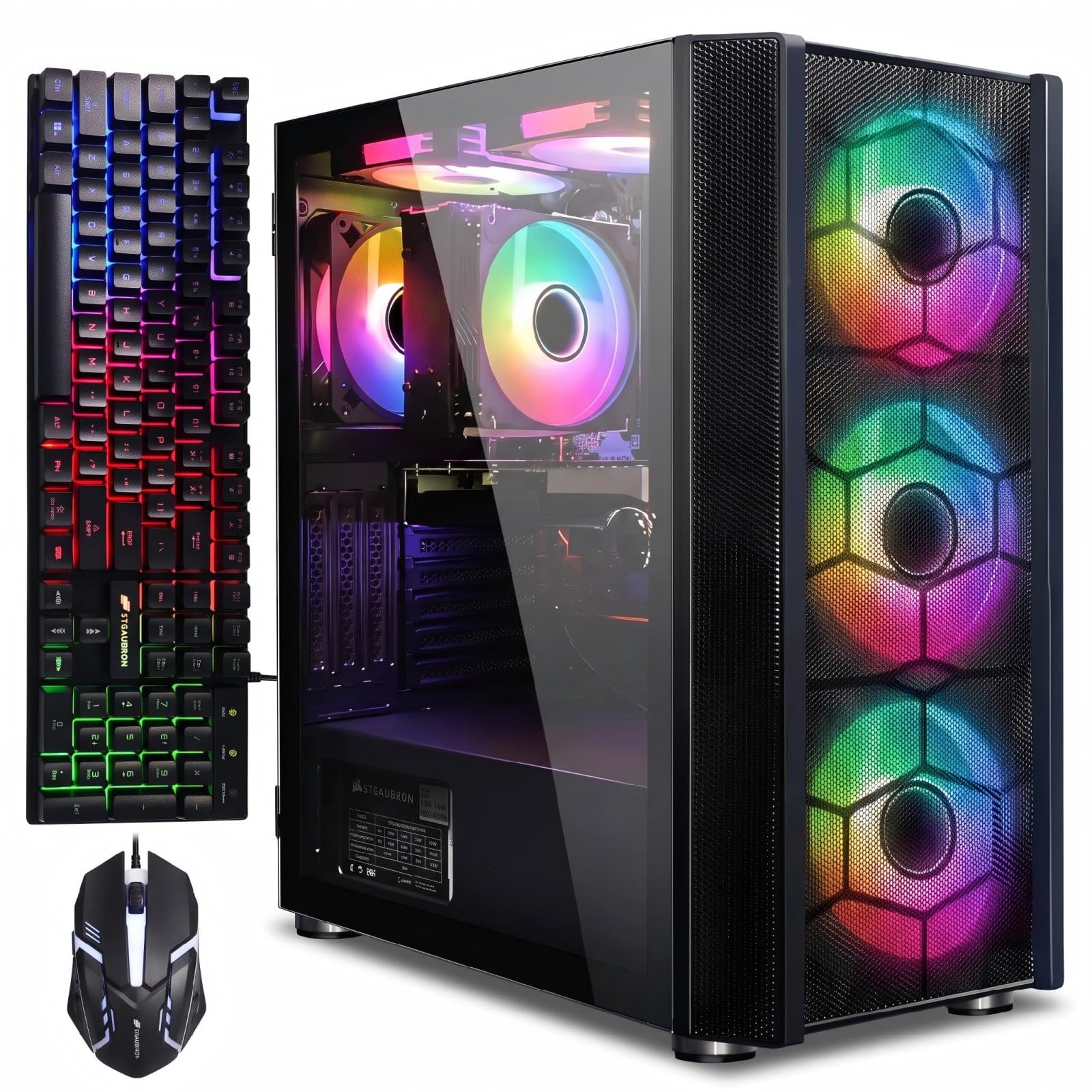
A 5.1 GHz processor and six RGB fans — this build chases raw speed.
The spec that jumps off the page is the Intel Core i7-10700KF at up to 5.1 GHz — the highest clock speed on this entire list, and a meaningful lead over the STGAubron Core I7 32G/1TB’s 3.9 GHz ceiling. That extra frequency is the difference between a machine that feels eager and one that feels like it is thinking about it. You get 16GB DDR4, a 1TB SSD, Windows 11 Home, and six RGB fans — more fans in the case than any other build here, which is exactly the kind of thing you want for long sessions.
Owners praise the speed and the value most: it runs World of Warcraft smoothly, the fans are described as quiet and effective, and it works well for a kid’s or starter setup. The 16MB cache gives it a solid buffer for everyday work as well. The ready-to-run package — keyboard and mouse included, Windows already installed — means you are gaming the same afternoon it arrives.
Here is the honest picture. Hard drive failures come up often enough in buyer feedback that they are the single most reported problem, some of them within a few months of use. One owner had a CPU core failure inside two months and was offered either a full return or a do-it-yourself board swap. The chip is fast, but the surrounding parts are where the money was saved. Go in knowing that and it can still be a great performance-per-dollar pick.
What makes it swift
- 5.1 GHz Core i7-10700KF — the highest clock here
- Six RGB fans for airflow during long sessions
- 1TB SSD and 16GB DDR4 as standard
- Ready to run, with keyboard and mouse in the box
What can bite you
- Drive failures are the most common reported issue
- Support for DIY fixes sometimes falls to the owner
- Gaming performance is more mid-level than flagship
One to grab if: you value raw clock speed and airflow above everything and you are comfortable handling a warranty claim if it comes.
Leave it alone if: you want a machine to run for years untouched and won’t tolerate a repair cycle.
6. STGAubron Gaming PC Desktop, Core i7-6700
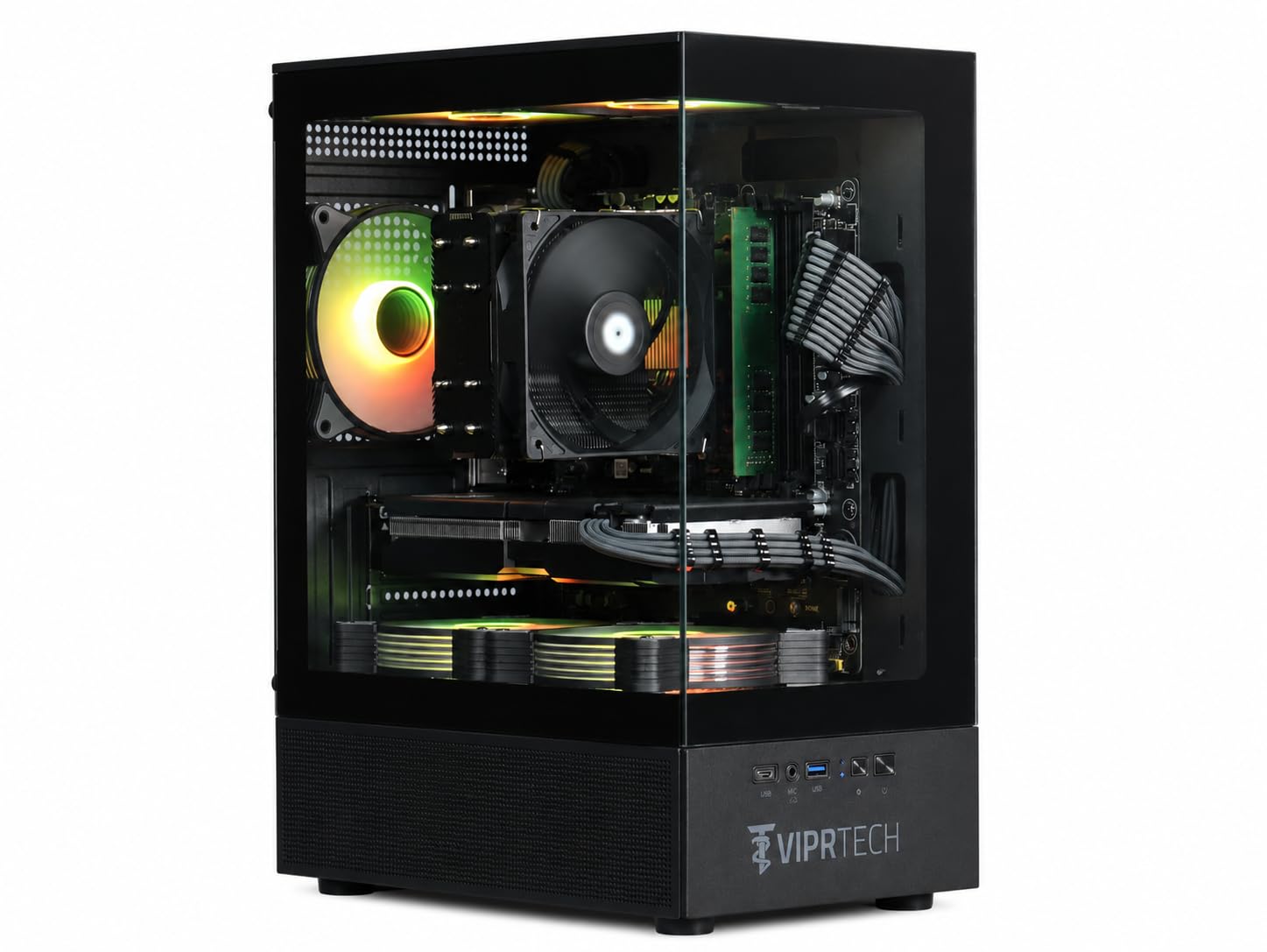
Ryzen 7 cores, Windows 11 Pro, and a case that means business.
Streamers will want to look closely: the AMD Ryzen 7 3700X with 8 cores and 16 threads is tuned for rendering a live stream while you game, and ViprTech explicitly positions this build for streaming, video editing, and rendering. The 16GB DDR4 memory and 1TB SSD keep projects and game libraries moving, and the Windows 11 Pro license is one step up from the Home edition on the other builds here. You also get genuine built-in Wi-Fi and Bluetooth antennas so the machine is online from the start.
Build quality gets real attention from ViprTech — every unit is hand-assembled in the USA and stress-tested before shipping, with a 1-year warranty behind it. The case is black with built-in RGB, controlled by a button on the top panel. Under the hood, the cooling is upgraded air cooling — ViprTech is honest in its listing that this is not a liquid-cooled machine, so set expectations there.
Owner sentiment leans on value: this is described as a solid machine for the money with a CPU that could be upgraded down the road. The honest friction point is a lag in shipping and support in some cases — at least one owner reports a broken unit taking 15 days to replace. That is one story, not a pattern, but it is worth knowing that resolution can stretch. Overall, this is the sensible pick for a creator who needs cores more than clocks.
The creator draw: 8 cores and 16 threads is the right tool for encoding a stream while the game runs.
Flat truth on cooling: it is air-cooled — the listing is candid about that, so plan to work within it.
The right call for: streamers, editors, and renderers who need processor cores and a Pro Windows license.
Not the one for: buyers who expect a liquid-cooled rig or cannot tolerate a slow replacement cycle.
7. Thermaltake LCGS Shadow 360 AIO Liquid Gaming PC

A closed-loop liquid cooler with a 360mm radiator — the only watercooled build here.
Every other machine on this list moves air. This one pumps coolant. The closed-loop AIO (an all-in-one liquid cooler) uses a 360mm radiator, which is a big cooling surface, and that is paired with an AMD Ryzen 5 5600X running up to 4.6 GHz and 16GB of ToughRam DDR4 3600MHz RGB memory. The 3600MHz memory speed is the fastest in this group, and the 1TB NVMe M.2 SSD handles storage. The case is a panoramic open-frame design with a 5mm thick tempered glass panel — the sort of thing you show off, not tuck under a desk.
The AMD B550 chipset motherboard and Windows 10 Home base both work, and you get WiFi, 16GB of RGB memory, and the RTX 3060 12GB. Note the graphics card brand is listed as varying — you are always getting a 3060, just not always the same manufacturer’s cooler design. The open-frame design and glass are the real story: this is a display piece as much as a gaming PC.
Here is the honest part: this is the thinnest review pool of any product on the list, so there is less real-world owner evidence to draw on than the SkyTech or CyberpowerPC builds. The 5600X is a strong 6-core chip, but it has fewer cores than the Ryzen 7s here, so it leans on the liquid cooler and the high-frequency memory for its edge. It is a considered purchase for the look and the cooling, not for the longest track record.
what separates it
- 360mm AIO liquid cooler — the only water-cooled build here
- 3800MHz ToughRam is the fastest memory in this group
- Open-frame panoramic design with 5mm tempered glass
- Ryzen 5 5600X and a 1TB NVMe M.2 SSD
What to weigh
- Smallest review pool of any pick, so less owner evidence
- 6-core Ryzen 5 has fewer cores than the Ryzen 7 builds
- Graphics card brand varies from unit to unit
Choose it if: the open-frame glass look and a real liquid cooler are the features you are shopping for.
Keep looking if: you want the longest owner track record to lean on before buying.
8. STGAubron Gaming PC Desktop, Core I7, 32G RAM, 1TB SSD
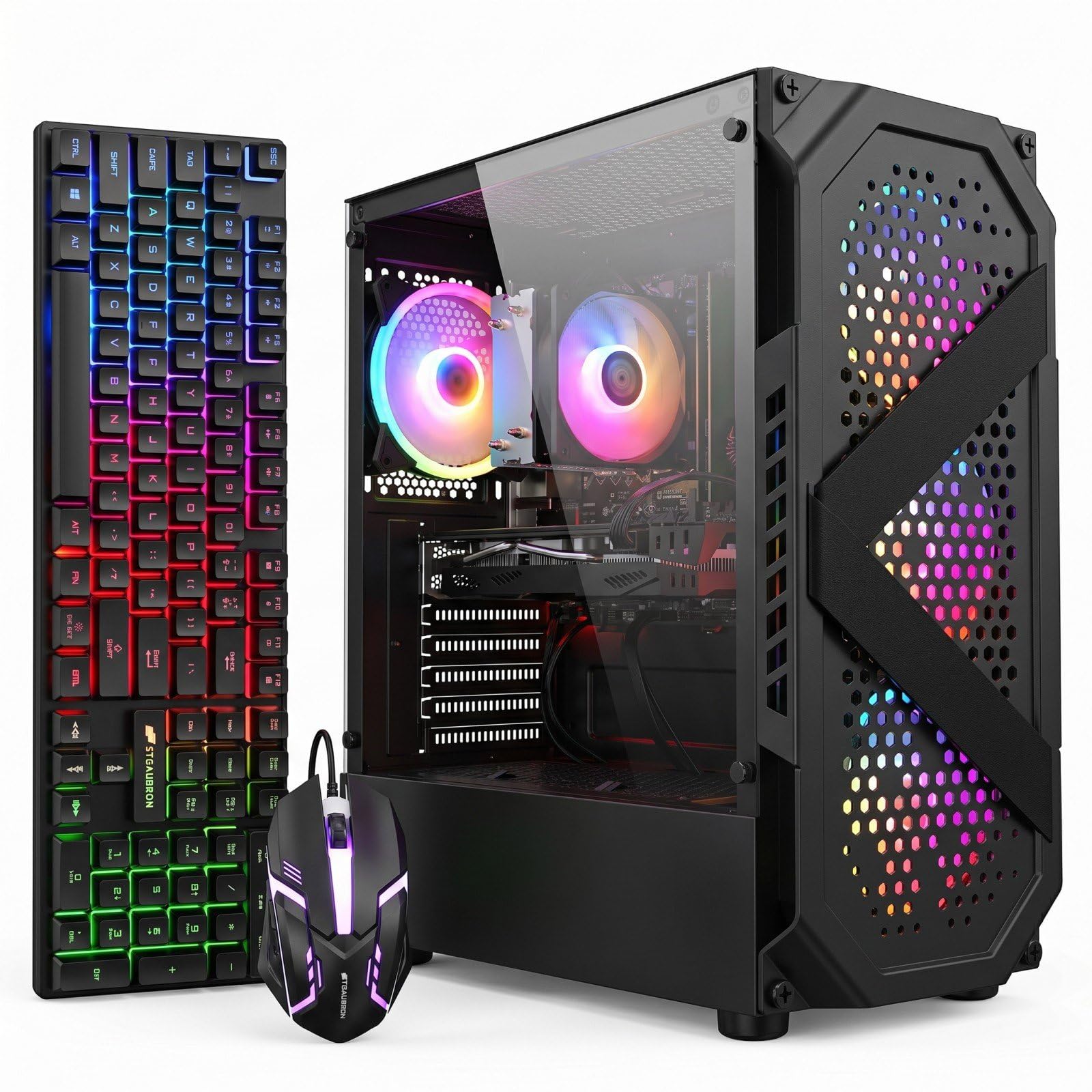
32GB and a terabyte — the builder the streamer crowd will appreciate.
The spec sheet here is generous across the board: an Intel Core i7 running up to 3.9 GHz with an 8MB cache, 32GB of memory, a 1TB SSD, and Windows 11 Home, all with Wi-Fi 6 and Bluetooth 5.0. The 1TB drive is twice the HP Pavilion’s capacity and the 32GB of memory is a luxury in this tier. Note the processor is simply labeled “Core i7” without a generation number — so clock speed, not generation, is the fair comparison here, and at 3.9 GHz it trails the top pick’s 4.9 GHz by a clear step.
The ease-of-setup experience is strong — one owner’s summary is essentially “plug it in, and it is ready.” Several folks report the machine runs popular games at a smooth 60 FPS or better, including Fortnite, Warzone, and Valorant. The four RGB fans and the ARGB keyboard and mouse are the visual draw, and the remote-controlled lighting is a nice touch for a desk setup.
What you should weigh is the support experience. A handful of customers note cards dying within a few months and the machine locking into a boot loop. The 32GB and 1TB look fantastic on paper, but the chip is a step behind the newer i7 builds, and the long-term experience is more variable. It still comes with a 1-year parts and labor warranty and free lifetime tech support — just know that the reliability record is not this build’s strong suit.
Where the money went: memory and storage — 32GB and 1TB in this tier is a lot of capacity for the budget.
Where it was saved: the processor is a step behind the 12th-gen and 10th-gen i7 builds here.
Right for you if: you want big memory and a full terabyte of storage for a starter streaming machine.
Choose another if: a newer, faster processor matters more to you than capacity.
9. HP Pavilion Gaming Desktop TG01-1183w

The lightest, most casual option — fine for esports, thin for the rest.
This one is for the person dipping a toe in. The Intel Core i5-10400F (6 cores, up to 4.3 GHz) is paired with 8GB of RAM and a 256GB SSD — the smallest memory and storage combo here, and that is the point. The 8GB means you can load a game and play comfortably at 1080p, but heavy multitasking will slow you down. The 256GB SSD is the tighter constraint — that stores a couple of modern titles before you need an external drive or a second SSD. What it does give you is a genuine RTX 3060 12GB in a compact tower, a keyboard and mouse in the box, and Windows 11 Home with Wi-Fi and Bluetooth built in.
Owner sentiment on this machine is pleasantly functional. It works for editors, esports, and casual gaming, and buyers who just want to see what modern games look like describe it as a genuinely cost-effective way in. One owner summed it up as “okay for a starter set,” adding that you “get what you pay for” — which is fair and honest framing for an entry-level machine. Realistically, this is a first PC, not a forever PC.
The catch is in the power supply. The unit ships with a 400W supply, which is a real ceiling on future upgrades — you cannot just drop in a stronger graphics card later without swapping the PSU too. There is also a mixed view on value: some see it as a smart entry point, while others figure they could have built it themselves for a similar outlay. No overheating drama here, but a “good enough” report card across the board.
What you get: an RTX 3060 12GB in a compact HP tower with Windows 11, at the most accessible point on this list.
What you trade: 8GB of RAM and 256GB of storage mean you live within limits — and the 400W supply limits future upgrades too.
Best for: a first gaming PC for esports, casual games, and older titles, where 1080p and a modest library are plenty.
Not the right fit if: you want to run large modern games side by side with a browser full of tabs, or plan to upgrade the graphics card later.
Know the Specs
Why 12GB of VRAM matters on a 3060
VRAM is the graphics card’s own memory — where it holds textures, shadows, and the geometry of the scene before it draws the picture. Twelve gigabytes gives this card a big scratch pad, so modern games at high settings do not have to awkwardly stream textures from your system memory. On a prebuilt, the 12GB figure on the listing is your confirmation you are getting the fully-loaded version of the card, not a trimmed one. Check it before you buy.
Processor, cache, and clock speed — in plain English
Clock speed is how many cycles a processor can complete per second; cache is its built-in fast memory. Both matter. A chip with a 4.9 GHz ceiling and a 25MB cache has more room in its pocket than one at 3.9 GHz with 8MB. For gaming, you mostly feel this in crowded scenes and frame pacing — a fast chip holds a smooth cadence where a slow one stutters. Generation matters as much as the badge: a 12th-gen i7 is meaningfully newer than a 6th-gen i7.
DDR4 memory and NVMe storage explained
DDR4 is the standard memory type in these builds. Higher-numbered speeds like 3200MHz or 3600MHz move data faster, which matters when the CPU is pulling and pushing data constantly. NVMe is a type of SSD that plugs straight into the motherboard and loads everything from Windows to game level transitions much faster than a spinning hard drive. An M.2 PCIe SSD is the same thing in a flat stick form that bolts to the board. Aim for 1TB if you plan to keep more than two or three large games installed.
Cooling, airflow, and power supply headroom
Air cooling is fine — the case just has to move air. Two or more intake and exhaust fans, or an isolated chamber design, keep the GPU and CPU from cooking the power supply and drives. A closed-loop liquid cooler with a 360mm radiator moves heat through coolant, which is more efficient but heavier and pricier. The power supply is a long-term spec: an 80 Plus Gold 600W unit or a 700W supply gives you room to grow, while a 400W unit caps what you can ever put into the machine.
Common Questions
Is the RTX 3060 12GB still worth buying for a desktop?
Will an RTX 3060 desktop run 1440p games smoothly?
How much RAM do I need for an RTX 3060 gaming PC?
Is a 256GB SSD enough for gaming?
Do these desktops come with Windows installed?
Is liquid cooling better than air cooling for a gaming PC?
Can I upgrade the graphics card in these prebuilts later?
Will a Ryzen 7 3700X bottleneck an RTX 3060?
What is the difference between the 3060 12GB and 8GB cards?
Do I need Wi-Fi or can I use ethernet?
The Bottom Line
For most buyers, the winner in this category is the ASUS ROG Strix G15 — its 12th-gen Intel Core i7-12700F at 4.9 GHz with a 25MB cache is a clear step above the other chips here, and the 1TB PCIe 4.0 SSD gives you a full library from the start. It carries a strong 4.5+ star rating across 180+ owners, the highest score on this list.
If reliability and a massive owner base matter more than processor generation, the CyberpowerPC Gamer Xtreme VR is the one to reach for — its 500GB NVMe plus 1TB HDD split is more flexible than a single drive, and it has been lived with by far more people than any other pick here. And if you are a streamer or creator who needs processor cores, the VIPRTECH Stryker 3.0 pairs a Ryzen 7 3700X with Windows 11 Pro and upgraded air cooling, which is the right tool for that job.
One honest note: the winner above has fewer total ratings than the CyberpowerPC build, but it holds the higher score — a reminder that a small, strong review base can beat a larger, more mixed one. Whatever you pick, watch the return window and confirm your power supply headroom before you plan any upgrades. Those two checks are worth more than any single spec on a box.
How we choose
We do not accept paid placement. Every pick is matched to a real buyer and a real use-case; we do not hands-on test units.
Sources
Specifications: manufacturer listings and product documentation. Review insights: verified customer reviews, as of November 2026. Pricing: not shown on this page (it changes often); check the current price via the retailer link.
As an Amazon Associate, Tactical Gear Guy earns from qualifying purchases. This does not affect which products we feature.