Specs are compiled from manufacturer listings and verified buyer reviews and can change over time — please confirm the key details on the product page before buying.
Here is the short answer: buy a compact refrigerator that fits under what you actually own without swallowing your floor space, and check the decibel rating (how loud it runs) before the cubic feet (how much food it holds). A fridge that freezes your lunch but hums through your work calls is a bad trade. Every pick below lists your real measurements up front — capacity in cubic feet, noise in decibels (dB, the unit of loudness), daily energy draw in kWh (kilowatt-hours, the unit on your power bill), and whether the freezer is a true separate compartment or a tiny ice box inside the main door.
This guide is built by comparing the manufacturers’ published specifications and the patterns across verified customer reviews, so you get each pick’s real strengths and trade-offs instead of marketing spin.
You are about to see which units hold steady at 33.8°F, which ones run near 37dB, and which have a freezer door you can open without letting the cold air out of the fridge side. The ten picks here cover cramped dorm corners, garage overflow duty, and everything between — this is the best compact refrigerators breakdown that starts with fit and noise, not spec-sheet glamour.
Top Picks

How To Choose The Best Compact Refrigerators
Start with the footprint (the floor space it takes up), not the capacity number. A compact refrigerator that lists 1.7 cubic feet can still be nearly 20 inches tall and 18 inches wide, so measure the gap under your desk or beside your dorm bed and compare it to the published width, depth, and height before anything else. Check whether the door swings left or right — a reversible door (one you can hang either way) is your escape hatch in a narrow room.
Freezer shape matters more than freezer size
A separate freezer door lets you grab ice without blasting the fridge side with room air. On single-door units, the freezer is usually a small internal compartment, often in the 0.2 cubic feet range, and it sits inside the same cavity as your food. Dual-door models split into a dedicated freezer zone and a fresh-food zone, which is the difference between ice cream that stays scoopable and ice cream that thaws and refreezes into a block.
Decibels decide where it can live
Anything rated near 37dB or 38dB belongs in a bedroom or office, because that is roughly the sound of a quiet library. Units that list “less than 42dB” are still fine for a kitchen, but expect a low hum you will notice in a silent room at night. If the refrigerator will sit within arm’s reach of where you sleep, prioritize the lowest published decibel figure you can find.
Manual defrost is a habit, not a defect
Most compact refrigerators use manual defrost, which means a thin layer of frost builds on the interior wall over weeks. Budget a short scrape-and-wipe session every few months so the freezer keeps its cooling power. A partial automatic defrost system keeps the fresh-food side frost-free and leaves only the freezer for you to handle. One-touch defrost buttons, found on some models, let you clear ice without unplugging.
Energy draw and the settling rule
Daily energy use on this class of fridge ranges from around 0.5 kWh to nearly 1 kWh, so check the annual kilowatt-hour figure on the label. Compressor oil also needs time to settle after the unit rides on its side during shipping. Nearly every maker recommends standing the fridge upright for several hours, commonly 6 to 12, before the first plug-in to protect quiet operation and long life.
Side-by-Side Comparison
| Model | Best For | Capacity | Freezer | Noise Rating | Amazon |
|---|---|---|---|---|---|
| Frestec 1.7 Cu.Ft Reversible Door★ Best Overall | Desk-side snack and drink duty | 1.7 cubic feet | 0.2 cubic feet | 37dB | Amazon |
| BANGSON 1.7 Cu.Ft with FreezerBest Value Pick | Bathroom counter and under-desk | 1.7 cubic feet | 0.2 cubic feet | Below 38dB | Amazon |
| DEMULLER 2.35ft³ Double DoorMost Distinctive Look | Dorm room with real frozen food | 2.35 cubic feet | 0.8 cubic feet | 38 dB | Amazon |
| Frigidaire EFR323 3.2 cu ft | Bedroom and studio corner | 3.2 cubic feet | 0.2 cubic feet | — | Amazon |
| Midea 3.3 Cu.ft | Garage drink fridge, no freezer | 3.3 cubic feet | None | Less than 42dB | Amazon |
| Frestec 3.2 CU.FT Two Door | Camper and small-family overflow | 3.2 cubic feet | 1 cubic foot | Lower than 37dB | Amazon |
| Electactic 2.5 Cu.Ft Double Door | Glam room and office fridge | 2.5 cubic feet | 0.65 cubic feet | Less than 38dB | Amazon |
| Feelfunn 3.2 Cu.Ft Two Door | Porch, deck, and med storage | 3.2 cubic feet | 0.96 cubic feet | ≤38 dB | Amazon |
| Manastin 3.6 Cu.Ft | Biggest dual-zone below 4 cu ft | 3.6 cubic feet | 1 cubic foot | Whisper-quiet compressor | Amazon |
| Frigidaire 4.5 Cubic Feet | Bar room and can-dispenser duty | 4.5 cubic feet | Built-in with ice tray | — | Amazon |
| GE 3.1 Cubic Ft. Clean Steel | Guest room and garage backup | 3.1 cubic feet | 0.93 cubic feet | — | Amazon |
Detailed Reviews
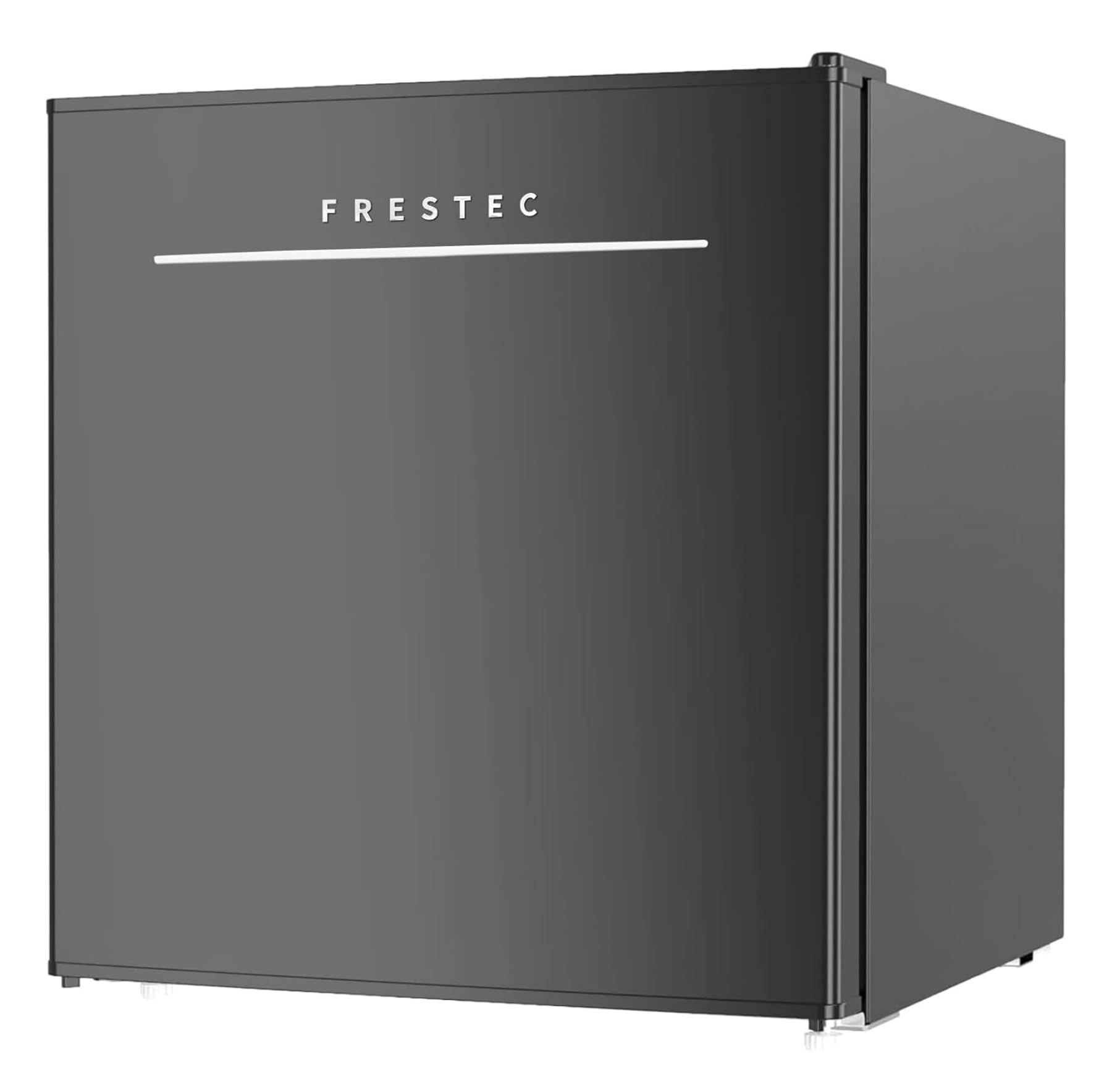
1. Frestec 1.7 Cu.Ft Mini Fridge
Our pick — 4.5+★ from 500+ verified ratings; the strongest balance of quality and price.
The desk-sized fridge that keeps a case of beer ice cold without eating your floor.
At 1.7 cubic feet, this Frestec splits into 1.5 cubic feet of fresh food and a 0.2 cubic-foot freezer, so your lunch and your ice cubes live in separate buildings. It measures 17.83″W x 18.05″D x 19.8″H — short enough to slide under a standard desk, which is exactly the placement this design was drawn around. You get to reach for a cold drink mid-task instead of walking to a shared kitchen.
What wins people over is how it performs: a compressor (the pump that does the cooling) pulls the temperature down fast and holds it. Buyers report the 0-6 thermostat rarely needs to climb high before drinks start icing over, and one describes a full case of beer coming out ice cold. That over-cold tendency is a feature when you want a hard chill and a caution when you are storing produce, so nudge the 0-6 knob gently.
Energy draw sits at 0.55 kWh per day, which is the kind of figure you stop thinking about. The 37dB rating puts it in quiet-library territory. What you trade for that low price is predictability on noise: the same compressor that some owners never hear, others find loud on a firm surface. That is the honest catch on a unit this small — placement and leveling do real work.
What earns it the top slot
- Fits under a desk at 19.8″ tall with a reversible door that opens either way
- Performance is the recurring theme — it cools fast and holds temperature
- 0.55 kWh per day keeps the running cost low
- One-touch defrost button saves the hand-scraping chore
What to plan around
- Noise divides owners — some hear nothing, others find it loud on an uneven surface
- Only 0.2 cubic feet of freezer, so no full ice cream tubs
Buy it for: a desk-side, bedroom, or classroom fridge where the footprint is tight and the budget is tighter.
Think twice if: you need a freezer that handles actual frozen meals, because 0.2 cubic feet is an ice-cube tray’s worth of space.
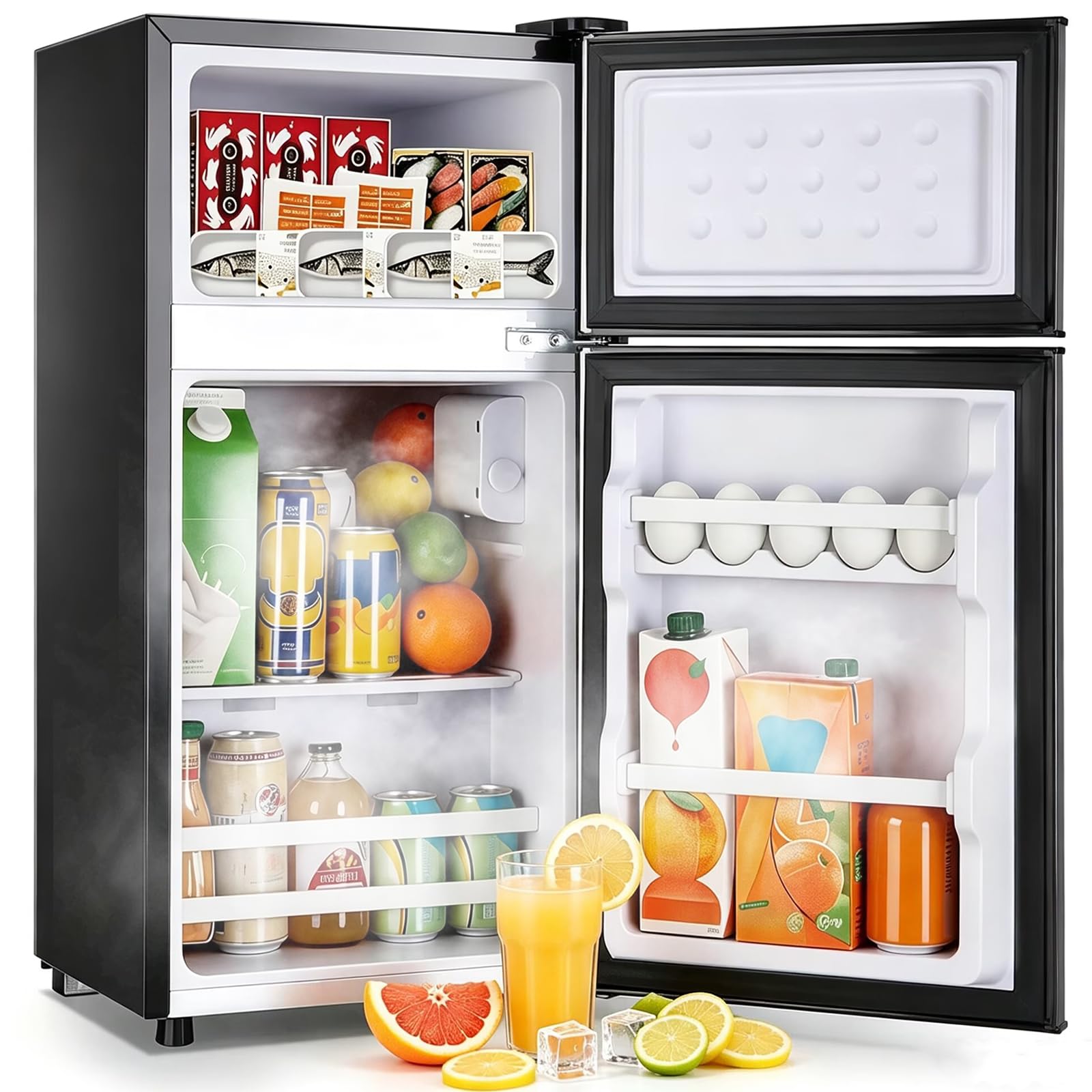
2. BANGSON 1.7 Cu.Ft Mini Fridge
Same cubic feet as the winner above, but this one rolls — and holds a tighter temperature band.
Here is the head-to-head that matters: the Frestec at the top of this list runs a wider thermostat swing from 28.4° to 50° Fahrenheit, while this BANGSON holds 33.8°F to 46.4°F across 5 levels. That narrower range is the quieter, more consistent kind of cold — less chance of a forgotten yogurt freezing solid at the back. Capacity is a dead heat at 1.7 cubic feet, and both include a 0.2 cubic-foot freezer compartment.
What makes this one easy to live with is the hardware around the box, not the box itself. Bottom rolling wheels mean you can reposition it without asking for help. Reversible door, adjustable leveling legs, and a matte finish round out a design that expects to be moved. Owners who park one in a bathroom or beside a bed report sub-38dB running and a steady 33.8°F to 46.4°F band overnight. The rolling wheels are the reason it edges out fixed-foot rivals for anyone in a rental or a room they rearrange often.
Two things sit outside the spec sheet. There is no interior light, which buyers notice when the fridge lives in a dark corner. And the refrigerator section is sized for 2-3 people cooking from scratch, but it will not swallow a full gallon jug — a quart fits on the door. That is a real limitation for milk-heavy households.
Where it wins: the combination of 33.8°F–46.4°F precision, rolling wheels, and sub-38dB sound makes it the best-value small unit for a room you actually sleep in.
The honest catch: no interior light and no gallon-bottle clearance on the shelves — plan around door storage for your milk.
Reach for this if: you want to wheel a fridge between rooms and keep drinks cold with a tighter thermostat band than the top pick.
Look elsewhere if: a gallon jug is a daily item in your house — the door rack caps at a quart.
3. DEMULLER 2.35ft³ Mini Fridge
A narrow-footprint tower with a real freezer door — the dorm-room cheat code.
This is the freezer play. Where the Frestec and BANGSON both offer 0.2 cubic feet of frozen space, this DEMULLER gives you 0.8 cubic feet behind its own door — four times the volume, if you want to think of it that way — plus 1.55 cubic feet of fresh food below. Ice cream tubs and frozen meals actually fit. The whole cabinet stands on a 14.9″W x 14.6″D footprint (the floor space it covers), so it takes a corner without taking the room.
Temperature control runs across seven thermostat positions with a range from -0.4°F to 50°F. That is a wide swing, and it is deliberately wide: the cold end is what lets the freezer side hit frozen-food territory while the fridge section stays food-safe. An R600a compressor keeps average running noise at 38 dB, which is quiet enough to share a dorm wall. Owners say it does the college-snack job — cold drinks, frozen treats, no drama.
The trade-off is internal geometry. The motor housing eats into usable space, and the door racks are narrow — smaller bottles like beer fit, a wine bottle does not. Some owners also wish the fridge compartment had a bit more room. Give the unit 6-12 hours upright before the first plug-in so the compressor oil settles; skip that step and you invite noise.
The reason it earns a spot: a 0.8 cubic-foot separate freezer at this footprint is a genuine advantage over the single-door competition above.
What to know first: narrow door racks and a motor that eats interior space mean your tall bottles and party platters will not fit.
Best match for: dorm students and small-apartment dwellers who care more about frozen food space than bottle clearance.
Not the one for: wine-bottle storage or anyone who needs wide shelves, because the door racks and motor housing set real limits.
4. Frigidaire EFR323 3.2 cu ft Compact Fridge, Stainless Steel
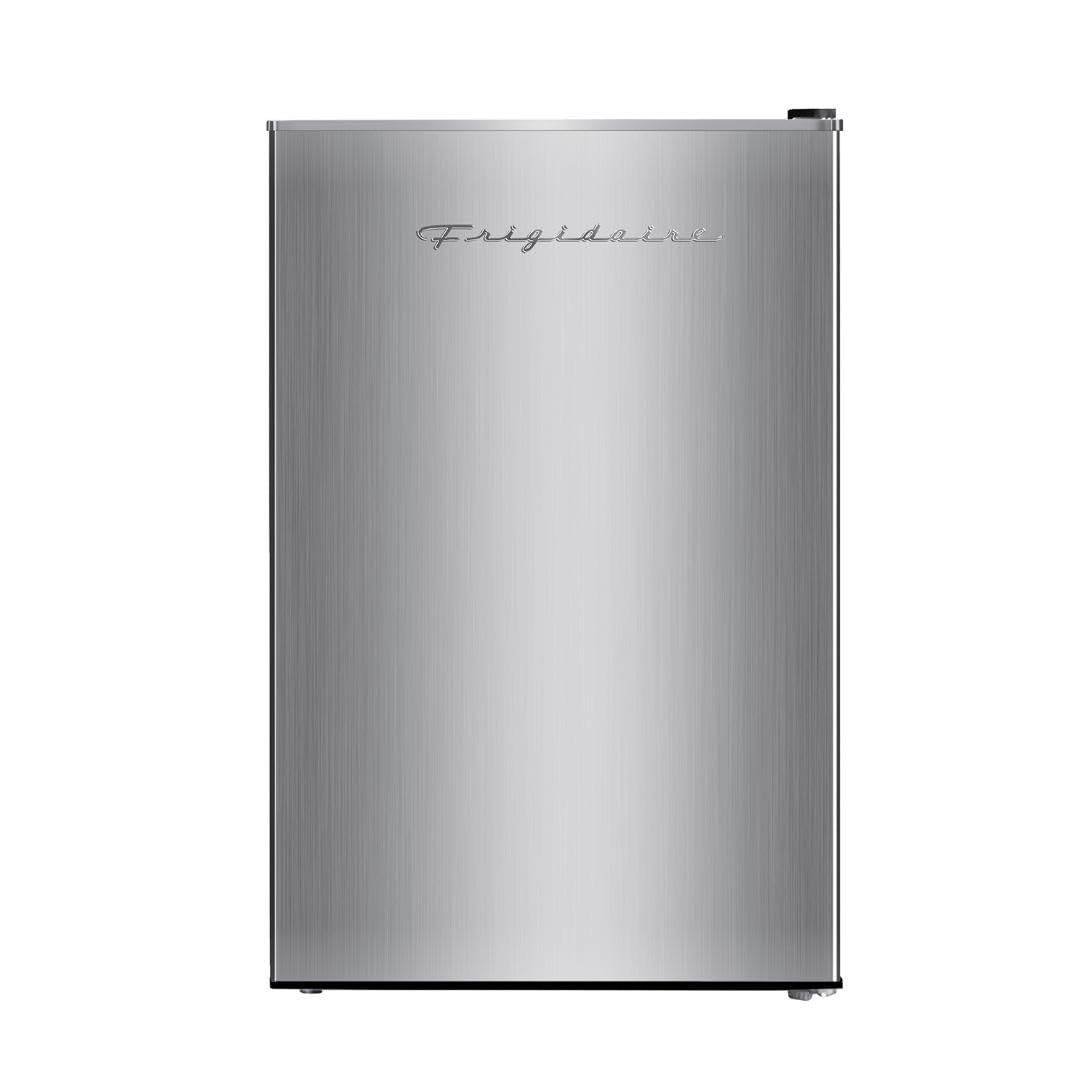
Stainless steel outside, a can dispenser on the door, and 3.2 cubic feet that disappear into a small room.
Frigidaire’s EFR323 takes the approach of hiding its size. The flat-back design lets it sit close to the wall instead of wasting four inches of air behind it. Two full-width glass shelves and a 2L door basket give you room for bottles and cans, and the door dispenser means soda comes out without shuffling the whole shelf. A chiller compartment with an ice cube tray handles freezing in the same compact body.
The steel finish is doing real work here. Owners say the stainless finish looks more expensive than the price suggests, and the flush-back cabinet reads as a built-in against a studio wall. Quality is the dominant theme across the feedback, with reliability close behind. Set the thermostat at halfway and owners mention the whole cabinet stays cold enough. The recessed handle keeps the front flush for a cleaner look in a bedroom or studio.
The durability conversation is real, though. Reports of dented doors and damage in transit come up often enough that you should inspect the box before signing for it and keep the packaging until you plug it in. Manual defrost means a regular frost scrape, though there is a defrost button to help.
Reasons it stands out
- Flush-back design boost usable floor room against a wall
- Dispense-a-can door storage keeps drinks retrievable without shelf juggling
- Build quality and reliability are the most-praised traits
Where it asks for patience
- Transit dents are a recurring report — inspect on arrival
- Only 0.2 cubic feet of freezer, so this is not a frozen-food fridge
Great fit for: a bedroom, studio, or dorm where appearance and a flush fit matter as much as capacity.
Skip if: you need meaningful freezer space or you cannot inspect a delivery before accepting it.
5. Midea 3.3 Cu.ft Mini Fridge
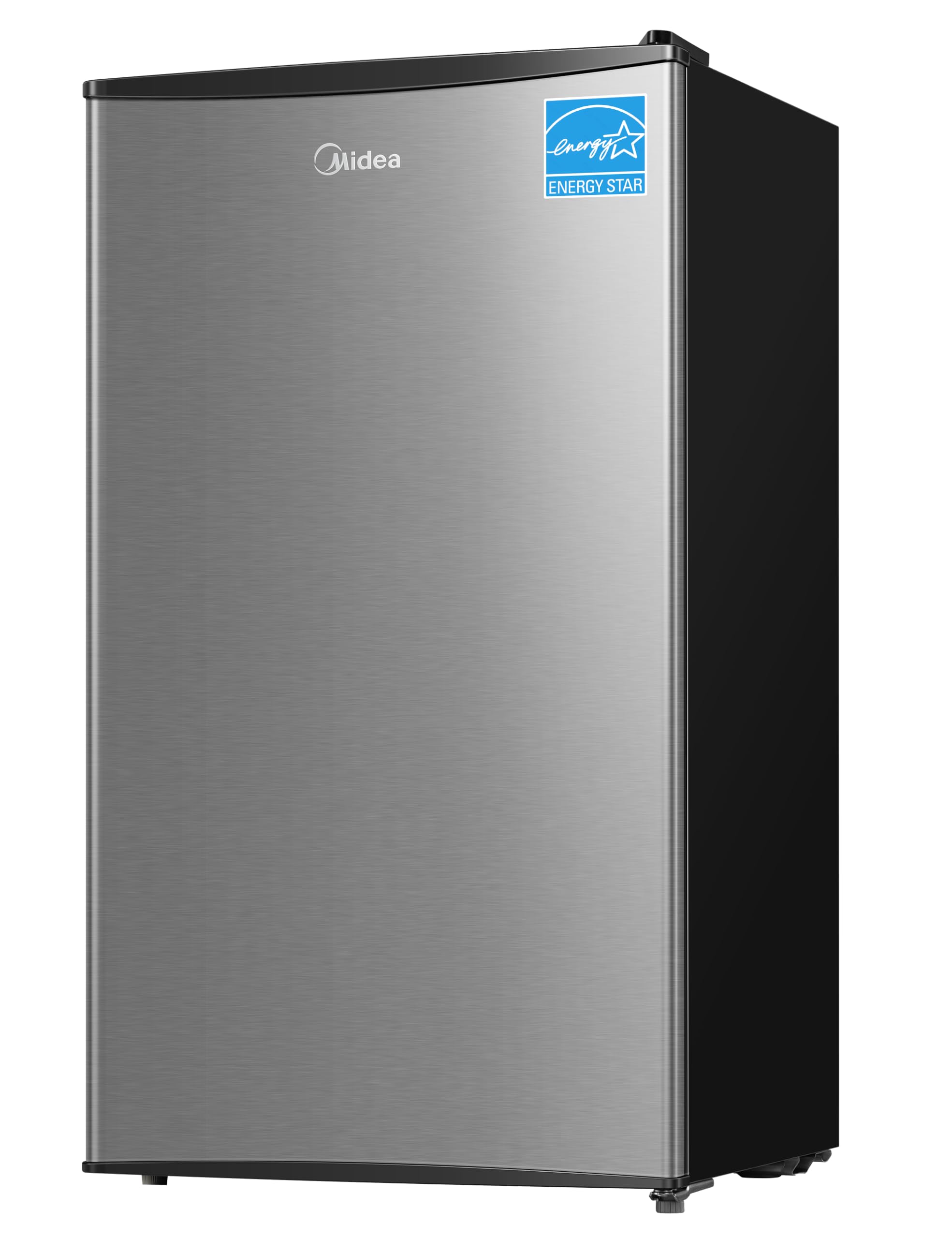
No freezer at all — and that is the whole point for a garage or workshop fridge.
If you have ever ruined a garage fridge by letting the tiny freezer compartment frost over, this design is your answer. The Midea MERM33S1AST is a 3.3 cubic-foot refrigerator with no freezer at all, so every cubic inch is usable food space. It holds 3.3 cubic feet against the 1.7 cubic feet of the Frestec up top — nearly double the room — and it packs in a 2L bottle rack plus an easy-access can rack so milk and soda live in their own slots.
The thermostat runs mechanically from 33.8°F to 50.0°F, and a multi-air-flow system pushes cold air more evenly so one corner of the fridge does not turn into an ice patch. An LED interior light makes late-night retrieval easy in a dark garage. The compressor is rated Energy Star, drawing 260 kWh per year. Owners use it as a pantry complement or a workshop drink fridge, and the quiet operation comes up as one of the reasons they keep it. One review describes it sitting 15 feet from a bed with no audible hum.
What you give up is frozen storage. There is no ice maker and no ice cream. There are also reports of temperature control quirks — a can freezing and bursting on a normal setting — so watch the dial the first week. The build is solid enough for a dusty garage, and the door seal holds up over time.
The buyer it is built for: anyone who wants maximum drink and food capacity with zero freezer maintenance.
What to watch: temperature control can be uneven in the first days, so check the dial before trusting a full load of cans.
Pick this one if: a garage, workshop, or bar area needs cold drinks and no frozen food.
Cross it off if: ice cream or frozen meals are part of your plan — this unit has no freezer compartment.
6. Frestec 3.2 CU.FT Mini Fridge with Freezer, Silver
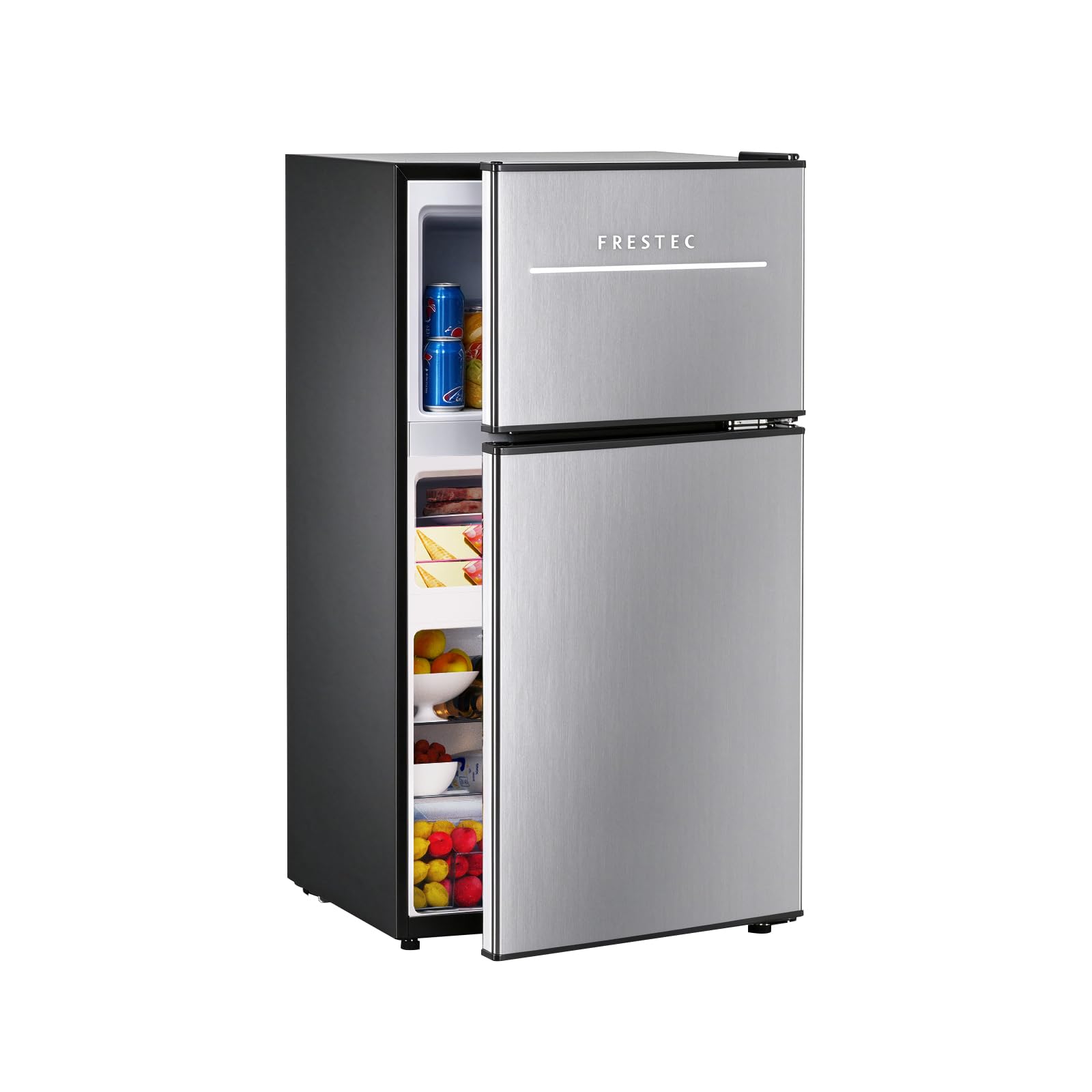
A dual-zone fridge that freezes solid in under three hours and whispers while it does it.
Most compact refrigerators promise a freezer; this Frestec delivers one worth using. The 3.2 cubic-foot cabinet splits into 2.2 cubic feet of fresh food and a 1 cubic-foot freezer that is big enough for ice cream and frozen meat. That freezer size outpaces the Frestec 1.7 cubic-foot model at the top of this list by a wide margin. Customers note items freezing solid in less than 3 hours. Seven thermostat settings run from 33.8°F to 46.4°F, and a crisper drawer keeps your produce out of the cold blast.
The noise figure is the headline for a bedroom or camper install: lower than 37dB, meaning the compressor is essentially a background whisper. Owners who run it in a camper and a guest room confirm the sub-37dB compressor does not disturb sleep. The interior LED light helps at night, the feet adjust for uneven floors, and both doors are reversible. At 17.8″W x 20.5″D x 33.5″H, it stands taller than the desk units but stays narrow enough for a tight kitchen corner.
The trade-offs are real but manageable. It draws 0.69 kWh per day, higher than the 1.7 cubic-foot models. Manual defrost applies to the freezer side, so a periodic scrape is part of ownership. And damage in transit shows up across the brand’s reviews — check the box before you sign. Give it the recommended 6-12 hours upright before first power.
The case for it
- 1 cubic-foot freezer freezes solid quickly and holds a real frozen-food load
- Below-37dB operation suits bedrooms and campers
- Crisper drawer and adjustable glass shelves give flexible storage
- Reversible doors and adjustable feet handle awkward layouts
The trade-offs
- 0.69 kWh per day is a higher draw than the smaller units here
- Freezer needs manual defrost; transit damage is a recurring report
It suits: a camper, guest room, or tiny kitchen where frozen food is a real priority and silence matters.
The single caveat: manual freezer defrost and a 0.69 kWh daily draw — fine if you are ready to scrape frost.
7. Electactic 2.5 Cu.Ft Mini Fridge with Freezer, Double-Door
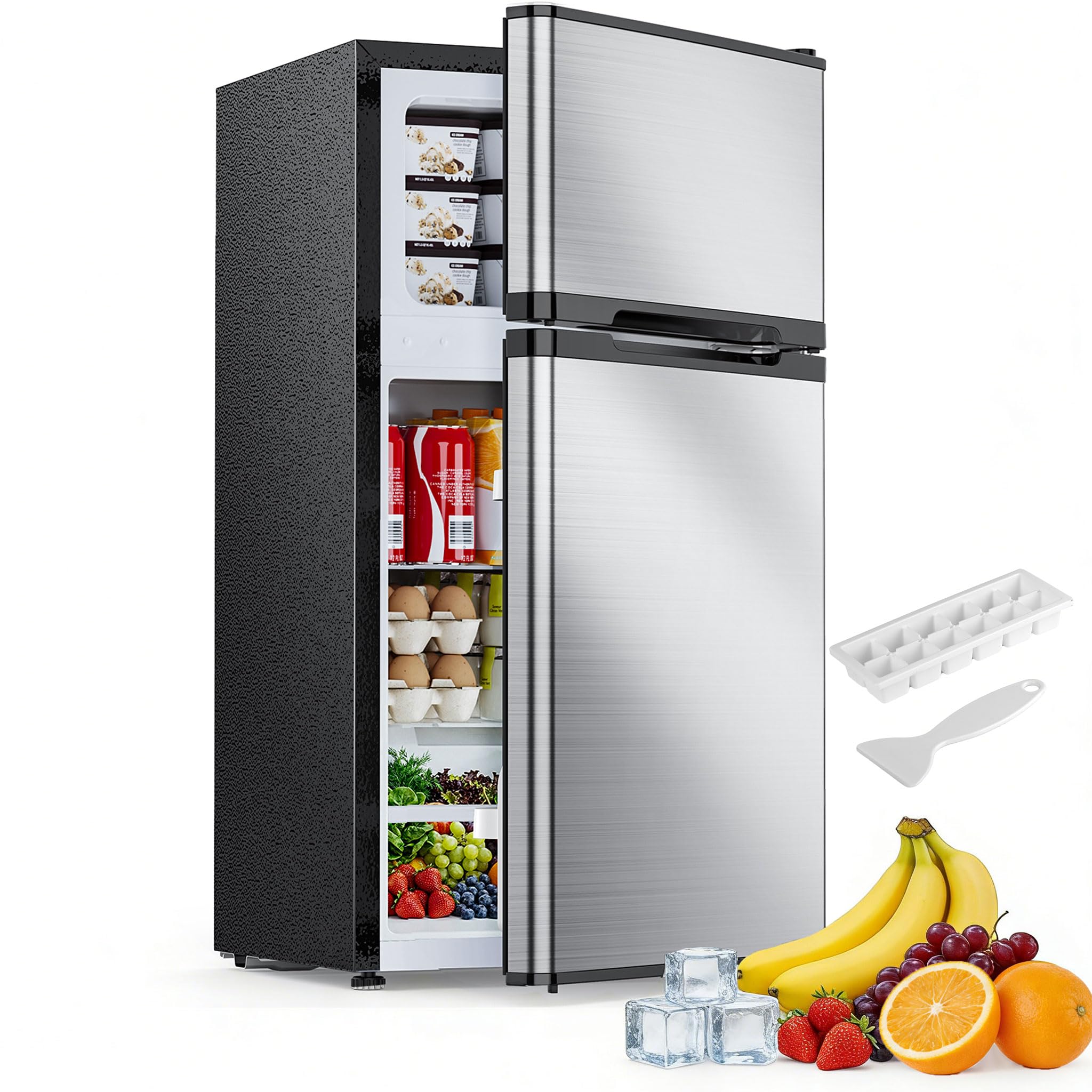
A 2.5 cubic-foot double-door with shelves you can move and a freezer that hits -4°F.
This Electactic earns its spot on feel and flexibility. It splits into 1.85 cubic feet of fridge and 0.65 cubic feet of freezer, with the fridge zone adjustable from 32°F to 50°F and the freezer from -4°F to 32°F. That freezer range reaches a true frozen set point, not just a “chilly” corner. Adjustable glass shelves slide out for cleaning, and the interior light lets you find your sparkling water without a flashlight.
The build quality is what buyers praise most — the cabinets feel solid, the doors close cleanly, and the fit and finish is a step above the entry-level boxes on this list. The R600 low-energy compressor keeps the sound below 38dB, so it can sit in an office or dorm without intruding. Leveling feet let you place it on an uneven floor. Owners use it in garages as an overflow fridge and in glam rooms for skincare bottles and mini champagne, so it handles both food and cosmetics.
The catch is defrost. There is no automatic defrost function, so the freezer needs manual attention over time. Cooling performance is the mixed note — most owners are happy, some find it less forceful than expected. Yearly energy use comes in at 350 kWh.
Where it earns its label: build quality is the recurring praise, followed by performance, and the -4°F freezer range backs it up.
The fair warning: no auto-defrost and a cooling output that some owners find modest — plan to manually clear frost.
Best for: an office, glam room, or garage overflow where solid construction and movable shelves matter.
Heads up: the manual defrost and modest cooling are the two things to accept before buying.
8. Feelfunn 3.2 Cu.Ft Mini Fridge
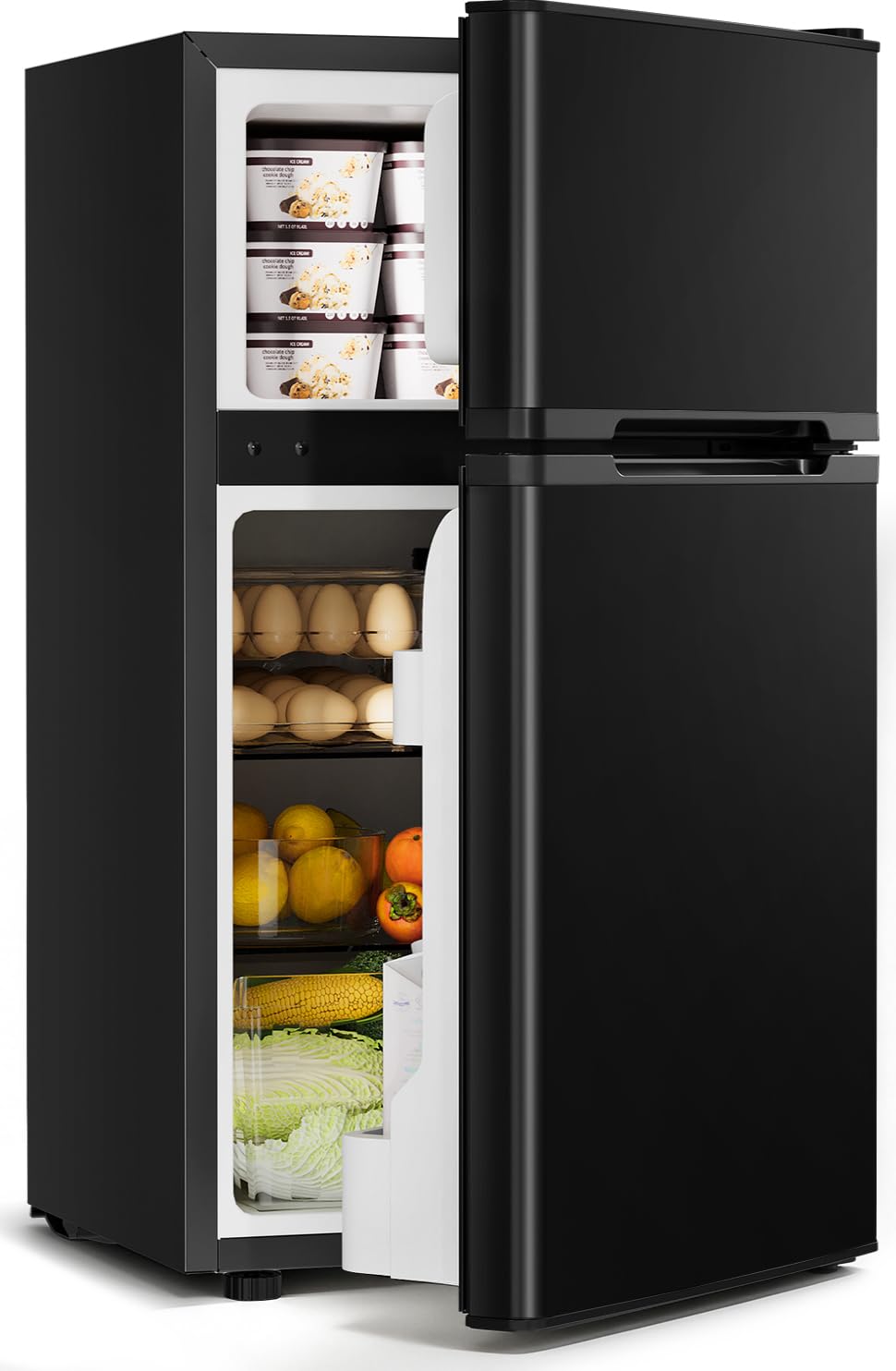
The 2.44 square-foot cabinet that hides 3.2 cubic feet of cold, freezer included.
Footprint is the number that decides whether a fridge fits your life, and this Feelfunn claims just 2.44 square feet of floor while holding 3.2 cubic feet of total volume. The split is 2.24 cubic feet of fresh food and 0.96 cubic feet of freezer — closely matched to the Frestec 3.2 above, which runs a 1 cubic-foot freezer against this 0.96. Both are effectively the same frozen capacity, and both beat the 0.2 cubic-foot boxes in this roundup by a wide margin.
Temperature control is simpler here. You get 3 thermostat levels rather than 7, holding 32°F to 50°F in the fridge and 21.2°F to -0.4°F in the freezer. Fewer settings mean less fuss, but also less fine-tuning. The 360° 4D uniform cooling system (cooling that circulates all around the cabinet) is designed to keep the whole box even. Owners use it as a porch, deck, or backup fridge, and the 0.96 cubic-foot separate freezer door is the feature they single out. Running noise stays at or below 38dB (decibels, the unit of loudness).
You should know about the frost. This is not frost-free, and ice builds on the back wall of the fridge section even at low settings. Plan a regular defrost routine and the fridge runs at its 0.98 kWh per day figure. A 1-year warranty and a dedicated crisper drawer round out the package.
What makes it tick: the footprint-plus-volume ratio is the best ratio in this group — 2.44 square feet of floor holding 3.2 cubic feet of space.
The recurring gripe: frost builds up quickly on the back wall, so manual defrost becomes a habit rather than an occasional chore.
The smart pick for: a porch, deck, or backup kitchen fridge where floor space is tighter than your cold-storage needs.
Only if you have: the patience to defrost — the frost build-up is the price of the compact footprint.
9. Manastin 3.6 Cu.Ft Mini Refrigerator with Freezer
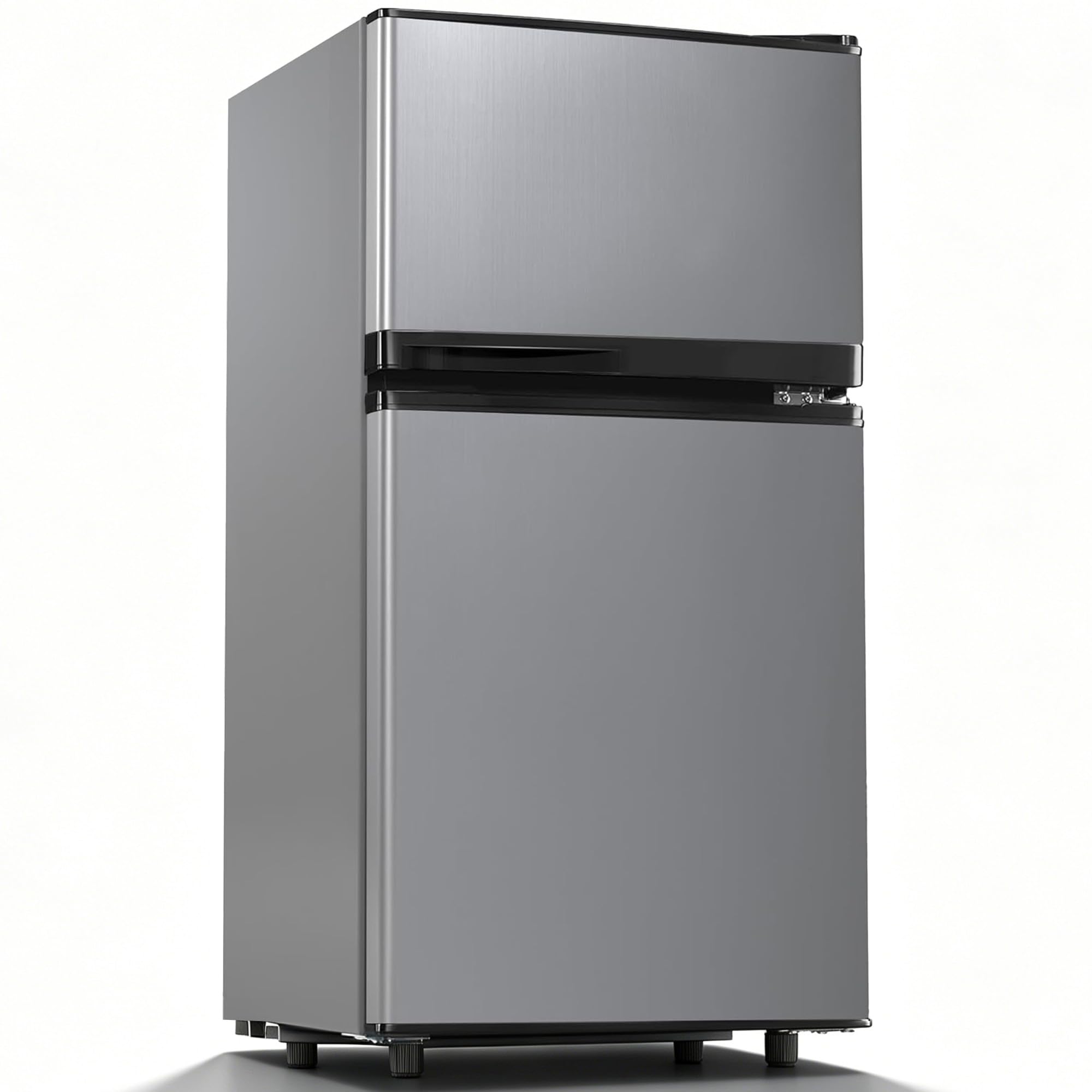
The biggest two-door compact here — 3.6 cubic feet with a full cubic foot of freezer.
Room is the reason to pick this Manastin. At 3.6 cubic feet, it tops the 3.2 cubic-foot Frestec and Feelfunn units by a clear margin, and the freezer is a full 1 cubic foot, which puts ice cream and boxed meals within easy reach. The separate freezer door means you grab a frozen dinner without draining cold air from the whole fridge. A 7-level thermostat offers finer control than the 3-level dial on the Feelfunn above, and a crisper drawer keeps vegetables hydrated.
Owners describe it as quiet enough to sleep next to — one review says the reviewer keeps it by the bed and barely hears it. The low-noise compressor is doing the heavy lifting, and the package ships with thickened foam and reinforced corner guards for transit. The 3-star energy rating and 320 kWh per year keep running costs in line with the other mid-size picks. Removable glass shelves make it easy to fit taller items, and the transparent crisper keeps your fruit out of the cold blast.
The honest limitation is cooling consistency. Some owners find it does not reach the cold you want, and there are reports of units that failed after plug-in. The door is right-hinged only, unlike the reversible doors on most picks here, so check your room layout before you commit. Let the unit stand upright for a full 6 hours before you plug it in.
Where it rises above the crowd
- 3.6 cubic feet is the largest dual-zone capacity in this roundup
- Full 1 cubic-foot freezer with its own door
- 7-level thermostat gives more precision than the 3-level models here
- Quiet enough that owners sleep beside it
What sets it back
- Cooling can fall short for some owners — watch the dial early on
- Right-hinged door only, so placement is less flexible than reversible-door rivals
Choose it when: maximum dual-zone capacity under 4 cubic feet is the goal and the door swing works for your room.
The real limitation: a right-hinged door and cooling that some find underwhelming — measure the swing before you buy.
10. Frigidaire Compact Fridge, 4.5 Cubic Feet, Stainless Steel

The 4.5 cubic-foot bartender — biggest cabinet here, with a can dispenser built in.
This is the capacity champion. The flush-back design keeps it tight to the wall, and a built-in can dispenser means a bar room or man cave can grab a soda without opening the whole fridge. Tempered glass shelves and a freezer compartment with an ice tray complete the package.
Owners love it as a bar-room and dining-room fridge. Owners say the stainless exterior looks pricier than the price tag, and the 4.5 cubic-foot cabinet swallows water bottles and canned drinks with room to spare. Quality is the most-praised trait by a wide margin, with effectiveness second. Set it to a middle setting and it holds temperature reliably. An adjustable thermostat, reversible doors, and adjustable leveling feet give it placement flexibility. Running cost is modest at 200 kWh per year.
Two issues keep it from a higher slot. Cooling and noise get mixed notes — some owners find it noisy and some find it does not get cold enough. The unit also needs careful leveling; an owner reports having to shim it because the front legs would not do the job alone. Durability complaints center on transit scratches and dents, so inspect the box on arrival.
The draw: 4.5 cubic feet with a can dispenser makes it a genuine bar-room workhorse, and the build quality is its most-praised trait.
What to factor in: mixed reports on noise and cooling, plus a leveling job that may need an extra shim — check the floor before you commit.
For: bar rooms, man caves, and dining rooms where cold cans and bottles are the priority and capacity matters most.
Think it through if: the fridge will sit near where people sleep or talk — noise is the mixed note on this one.
11. GE Mini Fridge With Freezer, 3.1 Cubic Ft., Clean Steel
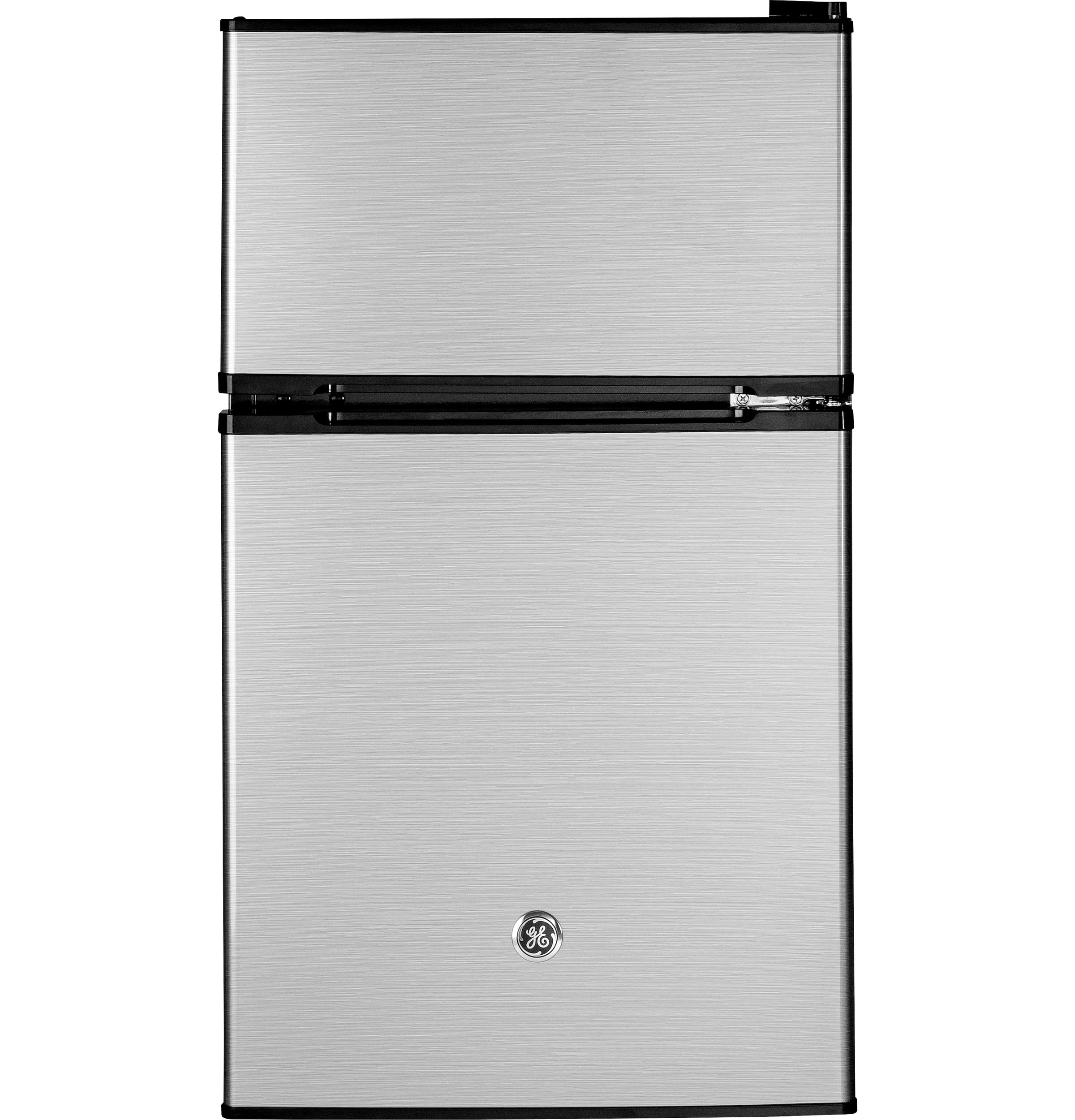
A true separate freezer with a closed door, plus partial automatic defrost on the fresh-food side.
GE takes the maintenance headache seriously here. The 3.1 cubic-foot fridge has a 0.93 cubic-foot freezer that holds an ice tray and boxed meals, and the fresh-food section stays frost-free thanks to partial automatic defrost — you only need to defrost the freezer. That is a real convenience versus the fully manual units above, and it lets you skip the regular fridge-side scrape. Two glass shelves, a clear crisper drawer, and door storage for tall bottles fill out the interior.
Construction is a step up. GE says the compressor was durability-tested for extremes, and the recessed handles keep the cabinet slim enough for a tight garage or guest-room corner. Owners say it runs so quietly the only way to tell it is on is to open the door, and the 0.93 cubic-foot freezer keeps ice crystals intact. The fridge-side storage and separate freezer get equal praise from people who treat this as a proper small household fridge rather than a glorified cooler. The 3.1 cubic-foot footprint fits a garage, dorm room, or guest bedroom without dominating the room.
The premium price asks a premium decision, and this one is not for everyone. Reaching a true refrigerator temperature in the fridge section takes effort on the highest setting for some owners, and there are complaints about packaging and dented arrivals. Automatic defrost covers the fresh-food side only, so the freezer still needs your attention at intervals.
Why pay more
- Partial automatic defrost keeps the fresh-food side frost-free
- 0.93 cubic-foot freezer behind its own door holds real frozen food
- Quiet enough that owners only notice it when they open the door
- Durability-tested compressor and recessed handles for a slim profile
The honest downsides
- Fridge-side cooling can be slow to reach temperature on the highest setting
- Freezer still requires manual defrost, and packaging complaints exist
Worth it for: a guest room, garage, or dorm setup where partial auto-defrost and a true separate freezer are worth the premium.
Not the one for: anyone who expects the fridge section to hit target temperature without adjustment — it can take patience on the dial.
Know the Specs
Capacity in cubic feet
Cubic feet measures the interior volume of the fridge, and it is the single number that tells you whether your weekly groceries will fit. A 1.7 cubic-foot fridge holds about a case of drinks and a few lunch containers. A 3.2 cubic-foot unit fits a small family’s overflow groceries or a week’s worth of food for one person. A 4.5 cubic-foot unit behaves like a small full-size fridge for bar or bar-room duty. Match the capacity to how often you restock.
Freezer capacity and separate compartments
Freezer capacity is the portion of that total reserved for frozen food. A 0.2 cubic-foot freezer is an ice-cube tray and not much else. Asingle cubic-foot freezer handles ice cream tubs and frozen dinners. A “separate freezer” or “double-door” design means frozen food sits behind its own door, so opening the fridge side does not warm the freezer. Single-door models house a small internal freezer box inside the same cavity. Check the freezer capacity figure before you commit if frozen food matters to you.
Noise level in decibels
Decibels measure how loud the compressor is when it runs. A rating around 37dB or 38dB sits in quiet-library territory — fine beside a bed or a desk. A “less than 42dB” rating is a low hum you will notice in a silent room at night. Lower is better for bedrooms, offices, and dorm rooms where the fridge shares your living space. Place the unit on a firm, level surface, because an uneven floor amplifies compressor vibration.
Manual versus automatic defrost
Manual defrost means frost builds on the interior wall over weeks and you clear it with a scraper and a wipe-down. Partial automatic defrost keeps the fresh-food section frost-free and leaves only the freezer for you to handle. A one-touch defrost button lets you clear ice without unplugging the unit. Cars and cans freeze faster when frost is thin, so stick to a routine and the cooling performance stays consistent.
Annual energy consumption in kWh
Annual energy consumption tells you the running cost over a year. Daily draw ranges from around 0.5 kWh on the smallest units up to nearly 1 kWh on the larger dual-zone models. Lower daily draw means a smaller utility bill and a lighter environmental footprint. The Energy Star label on some models signals efficiency certification; check the annual kWh figure on the listing and multiply it by your local rate to see the yearly cost.
Reversible door and leveling feet
A reversible door can be hinged to open from the left or the right, so you can place the fridge in a corner and still reach everything inside. Adjustable leveling feet handle uneven floors and keep the compressor from vibrating against the cabinet. Measure the door swing before you buy, and if the fridge is right-hinged only, check that the room layout allows it. These two details decide whether the fridge fits the space, not the specs alone.
Compressor type and settling time
An R600a compressor is a high-efficiency, low-energy design used in most modern compact refrigerators. It cools quickly and runs quietly when it is working correctly. Compressor oil needs time to settle at the bottom after shipping, so stand the unit upright for 6 to 12 hours before the first plug-in. Skip that step and you risk noise or a shorter working life. Check the manufacturer’s recommended settling time on the listing before you power it up.
Common Questions
Will a compact refrigerator fit under a standard desk?
How quiet is 37dB compared to a normal conversation?
Do I need to defrost a compact refrigerator with a freezer?
Is a separate freezer door worth it over a small internal freezer box?
How long should I let a mini fridge sit upright before plugging it in?
Will a 1.7 cubic-foot fridge hold a gallon of milk?
Do compact refrigerators use a lot of electricity?
Can a compact refrigerator go in a garage or an unheated space?
Do these compact refrigerators come with a movable or reversible door?
Is a manual defrost fridge a dealbreaker for a dorm room?
The Bottom Line
For most people, the compact refrigerator winner is the Frestec 1.7 Cu.Ft Reversible Door because it pairs a desk-friendly 19.8-inch height with 37dB operation and a fast-cooling compressor — and owners gravitate to it enough that it is the crowd favorite at 4.5+ stars across 500+ ratings. If a real freezer door matters more than a low profile, grab the DEMULLER 2.35ft³ with its 0.8 cubic-foot separate freezer. And for garage or bar-room duty where frozen food is a non-issue, the Midea 3.3 Cu.ft gives you 3.3 cubic feet of fresh-food space with no freezer maintenance at all. Measure your gap, check the decibel figure, and let the fit decide — that one check will do more for your daily life than any spec on this page.
How we choose
We do not accept paid placement. Every pick is matched to a real buyer and a real use-case; we do not hands-on test units.
Sources
Specifications: manufacturer listings and product documentation. Review insights: verified customer reviews, as of November 2026. Pricing: not shown on this page (it changes often); check the current price via the retailer link.
As an Amazon Associate, Tactical Gear Guy earns from qualifying purchases. This does not affect which products we feature.