Specs are compiled from manufacturer listings and verified buyer reviews and can change over time — please confirm the key details on the product page before buying.
A plant support cage holds a top-heavy plant upright through rain and wind without collapsing at the connector. The wrong one collapses under the same load, or snaps at the connector while you push it into the soil. This guide compares height range, ring width, stake thickness, and joint type so you can match a cage to the plant you grow.
This guide is built by comparing the manufacturers’ published specifications and the patterns across verified customer reviews, so you get each pick’s real strengths and trade-offs instead of marketing spin.
Every cage below is judged on what it holds and where it stops — tall vines, bushy peonies, or potted patio plants. Below are the plant support cage picks for tall vines, bushy peonies, and potted patio plants.
Top Picks

How To Choose The Best Plant Support Cage
Measure the plant before you shop for a cage. A peony bush that flops outward needs a wide ring low to the ground. A tomato vine that grows upward needs tall vertical support with room to climb. A low wide ring and a tall vertical tower are opposite shapes, and one cage rarely does both well.
Match the cage height to the plant’s real mature height
Adjustable cages list a range, like 16 to 24 inches or 16 to 192 inches. That range is built from stacking sections, so a taller quoted maximum means more joints to connect. More joints means more flex in wind — and more places for a plastic connector to give out.
Check the ring width against the plant’s spread
A 10-inch diameter ring suits a clump of peonies that stays tight. A 16-inch width suits a bushy tomato or cucumber that spreads wide. A ring narrower than the plant’s mature spread lets branches spill over the sides, so the cage stops holding the clump.
Look at how the pieces join
Push-fit connectors are fast but can slip under load. Screw-together tubes and snap-on arms hold tighter, which matters once a plant is heavy with fruit or soaked from rain. Steel-core rods with a plastic coating resist rust better than thin coated wire.
Side-by-Side Comparison
| Model | Best For | Max Height | Width | Pack Count | Amazon |
|---|---|---|---|---|---|
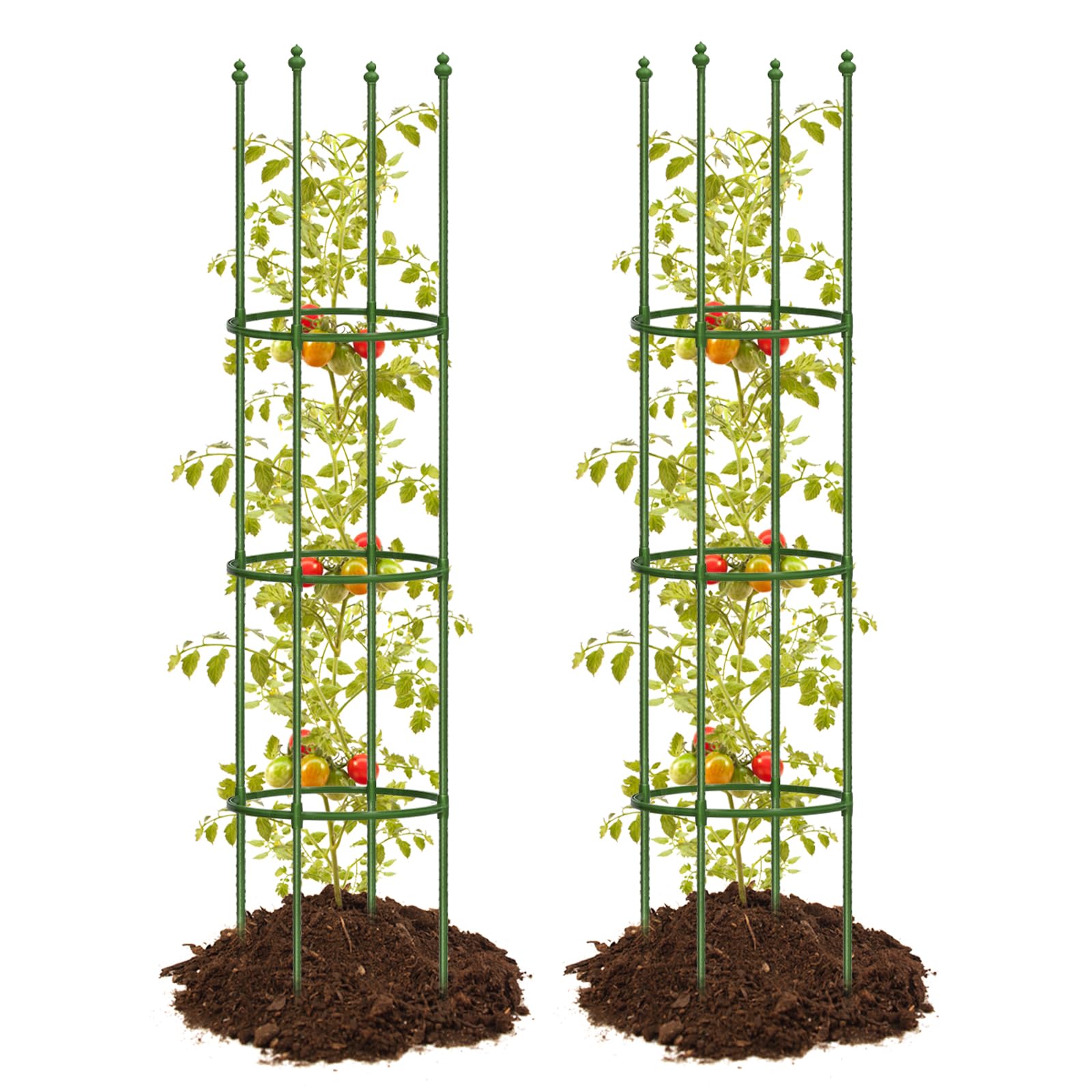
| K-Brands 6 Pack Peony Cages★ Best Overall | Peonies and tall grasses | 24 in | 10 in | 6 | Amazon |
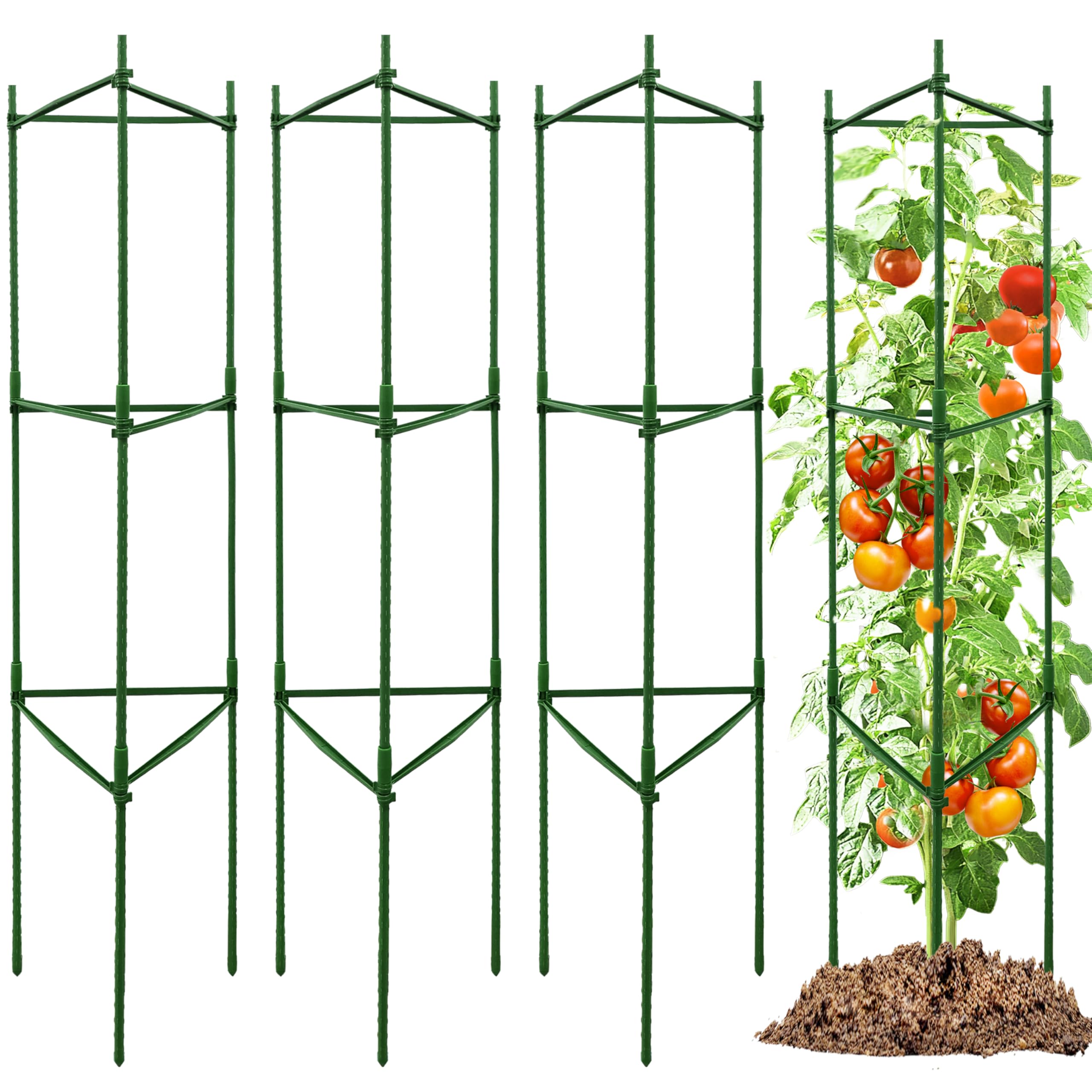
| TCBWFY 4-Pack Adjustable Tomato CagesStacks To The Sky | Climbing vines in beds and pots | 192 in | 48 in | 4 | Amazon |
| joyhalo 2 Pack Adjustable Tomato CagesWeight Rated | Heavy fruit load in large pots | 59 in | 11 in | 2 | Amazon |
| LOMNYIY Round Heavy Duty Tomato Cage | Patio pots and pole tomatoes | 55.1 in | 11.8 in | 1 | Amazon |
| OUREST 6 Pack Triangle Tomato Cage | Vine guidance in raised beds | 49 in | 16 in | 6 | Amazon |
| Moirsunt 66 Inch Tomato Cage | Tall indeterminate tomatoes | 66 in | 13 in | 4 | Amazon |
| MQHUAYU 3 Pack Square Tomato Cages | Square beds and greenhouse rows | 41.7 in | 13.7 in | 3 | Amazon |
| SORANGEUN 10 Pack Peony Cages | Flower beds and border shapes | 24 in | 10 in | 10 | Amazon |
| Kriulre 6-Pack 38.7 in Plant Support Stakes | Peonies, hydrangea, lilies | 38.7 in | 15 in | 6 | Amazon |
Detailed Reviews
1. K-Brands 6 Pack Plant Support Stakes
Our pick — 4.5+★ from 450+ verified ratings; the strongest balance of quality and price.
Six steel-core rings that hold a floppy peony clump upright without staking a single stem.
Here is the number that decides it for most flower growers: each stake adjusts between 16 inches and 24 inches, with a 10-inch ring diameter. That is a low, wide hold — exactly the shape a peony bush or a heavy grass clump needs at the base. The ring sits at ground level and the stems lean into it instead of sprawling onto the soil.
What wins people over is the build. The core is alloy steel under a plastic powder coating, and each stake is rated by the maker as rustproof. The pieces screw together rather than just sliding on, which is the difference between a joint that holds through a windy week and one that pops apart. Six stakes in the set means you can ring a single large bush with two or three, then point the rest at the next clump.
The catch is scale. At 24 inches of usable height and a 10-inch ring, this is a flower and shrub support, not a tomato tower. If you are growing indeterminates that reach five feet, look at the taller cages further down. You also get a 10-foot plant tie roll in the pack, which is genuinely useful for the stems the ring does not reach.
What Holds Up
- Screwed joints stay tight in wind, unlike push-fit stakes
- Alloy steel core with a plastic powder coating per the maker
- Six stakes plus a 10-foot tie roll covers several clumps
- Dark green finish disappears into the foliage
Where It Stops
- 24-inch maximum is too short for tall tomato vines
- 10-inch ring is tight for wide-spreading bushy plants
Reach for this if: you grow peonies, gladiolus, or tall grasses that flop outward at the base.
Look elsewhere if: your plants climb past two feet and need vertical height.
2. TCBWFY 4-Pack 48-Inch Adjustable Tomato Cages
A modular trellis that starts at 16 inches and stacks all the way to 192.
Now for the contrast that matters. This TCBWFY set tops out at 192 inches of height and 48 inches of width, against the K-Brands pick’s 24 inches of height and 10 inches of width. That is a different class of cage entirely — a wall of plastic-coated steel you build up as the vine climbs, rather than a low ring you set once. Four stacks in the box cover a whole raised bed.
The design is deliberate: connect the stakes with rust-resistant connectors, push them into soil, and add sections as the plant grows. That suits seedlings right through to mature vines, and it does not punish you for starting early. The plastic coating on the steel is what stops rust and keeps the green finish looking clean.
Honest note on strength: the sturdiness divide shows up clearly in owner feedback, with plenty calling the gauge heavy and a fair share calling it flimsy. The pattern tends to track what you plant — light beans and cherry tomatoes sit happily, while heavy beefsteak fruit on a long stack puts real load on the joints. Treat the maximum height as a limit for light climbers, not a promise for a loaded vine.
Built for flexibility: the modular shape lets you bend the run to fit a raised bed or container edge, and it breaks down flat for winter storage.
The real constraint: height is adjustable, strength is not — a fully stacked cage is for light plants.
Best for: gardeners who want one system that scales from seedlings to a tall vine run.
Think twice if: you grow heavy-fruited tomatoes and want a cage that holds without extra staking.
3. joyhalo 2 Pack Up to 59 Inch Adjustable Tomato Cages
Three tiers of four-stake bracing, built to carry fruit weight up to 22 lbs.
This is the pick that answers the load question directly. Each of the three tiers is braced by four stakes, and the maker rates the assembled tower to hold up to 22 lbs of fruit. That figure is the reason to choose it over a plain wire ring — a heavy beefsteak truss is exactly the load that bends thin cages sideways. Total height runs to 59 inches with all three tiers in place.
Assembly is refreshingly plain. Each tier is four stakes and four connectors, and the pointed ends push straight into soil with no tools. Sturdiness is the clear standout in owner experience — that is the thing the review pages keep coming back to, along with how easily the thing goes together and comes apart for winter storage. It also doubles as a green bean trellis in a tight bed.
Where it slips is longevity under rough handling. The structure can bend in a moderately strong wind, and a few buyers find the joints loosen over a season. It is a fair caveat rather than a flaw for most gardeners — this is a seasonal plant cage, not a permanent garden structure, and it packs down small when the season ends.
Why It Earns Its Spot
- Rated by the maker to hold up to 22 lbs of fruit per tower
- Fits large pots, down to the base footprint
- No tools needed — pointed stake ends push into soil
- Disassembles flat for off-season storage
The Honest Limits
- Can bend in moderately strong wind
- Joints loosen over a season of heavy use
Grab it if: you grow tomatoes in large pots and want a tower that carries the fruit weight.
Pass if: you need a rigid structure that never flexes in open, windy ground.
4. LOMNYIY Round Heavy Duty Tomato Cage, 55 Inch

One round cage with a double-layer tube joint, sized to sit neatly in a patio pot.
Picture a single cage on a deck, not a row in a field. This one measures 55.1 inches high by 11.8 inches wide and weighs 0.87 kg — which makes it the lighter of the two weighed cages in this list, against the K-Brands pick at 1.12 kg. That lightness is the point for a pot: you can move the whole thing, plant and all, when the season turns.
The joint design is the clever bit. The maker uses a plug-in connection with a double-layer metal tube interface, so the poles sit tighter than a simple sleeve joint. The middle shelf is a circular ring with a card slot that grips the support rod and resists slipping. Three rings in total give a tiered hold that keeps a spreading vine tidy rather than letting it bulge out one side.
Rust is the honest split here. The maker says the poles are coated entirely in plastic to stop rusting, and plenty of buyers use these season after season without issue. But a durable faction of buyers reports the tips rusting within a year, which matters on a deck where the cage stays out in weather. Snap the sections together gently, too; the joints are the part that takes the stress.
What it does well: the circular ring with a card slot keeps vines guided upward, and the whole cage looks tidy on a deck or patio.
The one to watch: tip rust shows up for some owners after a season outdoors — bring it in or cover it if the cage lives outside year-round.
Fits best: patio and pole tomatoes in a single large pot where looks matter.
Not the one for: a full garden row — this is a one-cage pack, so you would need several.
5. OUREST 6 Pack Triangle Tomato Cage, Up to 49 Inches
Triangular towers with clips and gloves in the box, spread across six separate cages.
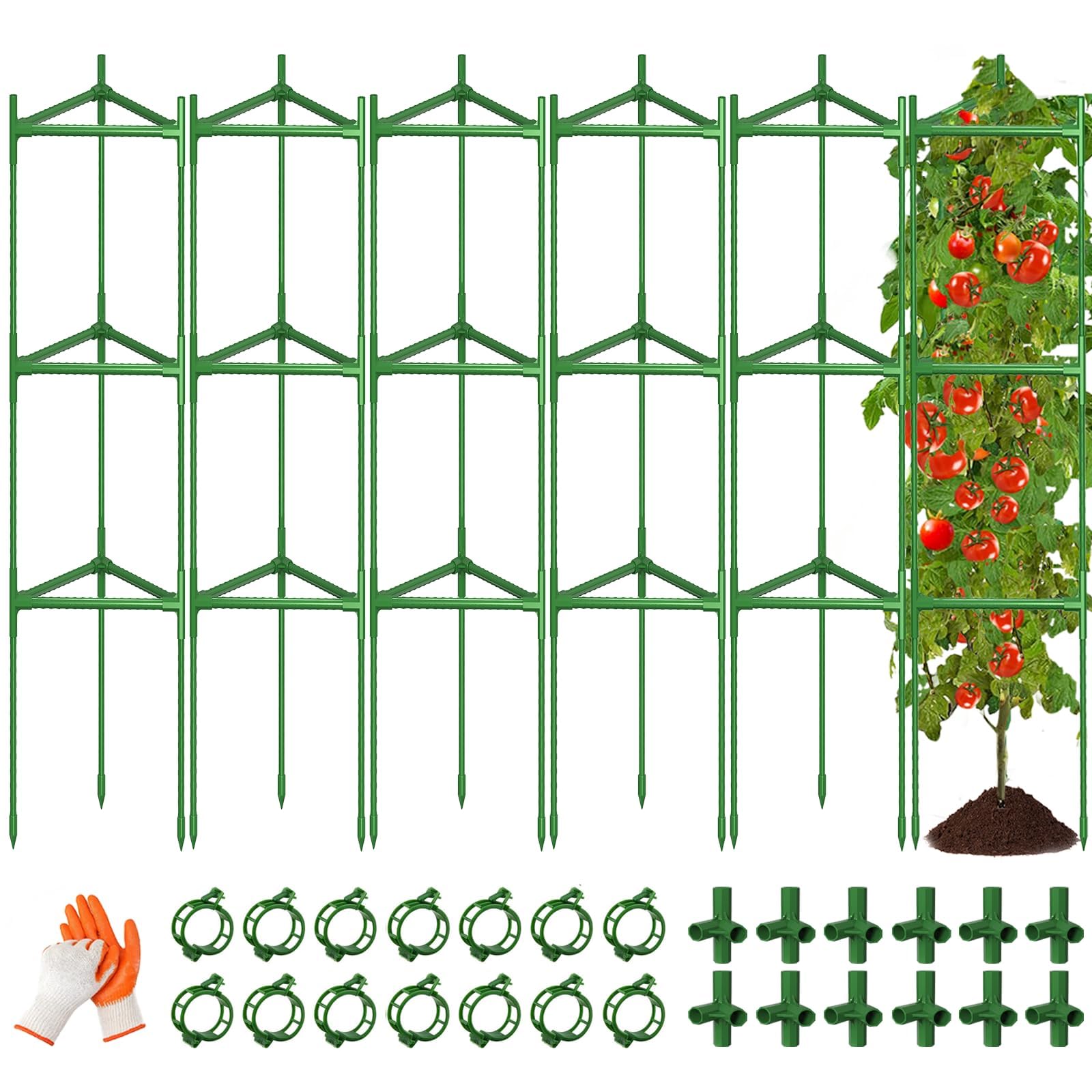
The parts count tells you what you are buying: 90 straight tubes at 16 inches each, 18 pointed tubes at 17 inches, 54 connecting tubes, and 30 plant clips. That builds six triangular cages up to 49 inches high and 16 inches wide — six units, against the single cage in the LOMNYIY pick. For a raised bed with several plants, that difference is the whole decision.
The triangle is a real design choice. A triangular cage is sturdier than a round wire coil for the same tube thickness, because the three flat faces resist bowing. Add to that the plant clips, which let you pin a vine to a face instead of threading it, and the whole build is quicker than wrestling a stem through a wire grid. Gloves in the box are a small thing that suggests the maker thought about assembly.
The weak point is the plastic connectors. They are the load-bearing joint, and under the weight of a grown plant a few have sheared off within a season. Size is also worth checking up front — the cage scales with how many sections you add, so measure the plant you have rather than assuming the maximum. Light climbers and peppers sit comfortably; a heavy indeterminate vine will test those joints.
What You Get
- Six cages plus 30 clips and a pair of gloves
- 16-inch triangular faces resist bowing better than round wire
- Adjustable to 49 inches as the plant climbs
- Clips let you guide vines without threading
The Trade-Off
- Plastic connectors can shear off under a heavy plant
- Height depends on how many sections you use
Worth it for: a raised bed that needs several cages at once without buying more than one set.
Look elsewhere if: you plan to load a single cage with heavy fruit.
6. Moirsunt 66 Inch Tomato Cage, 4 Pack
One set that forms a triangle, a quad, or a trapezoid, up to 66 inches tall.
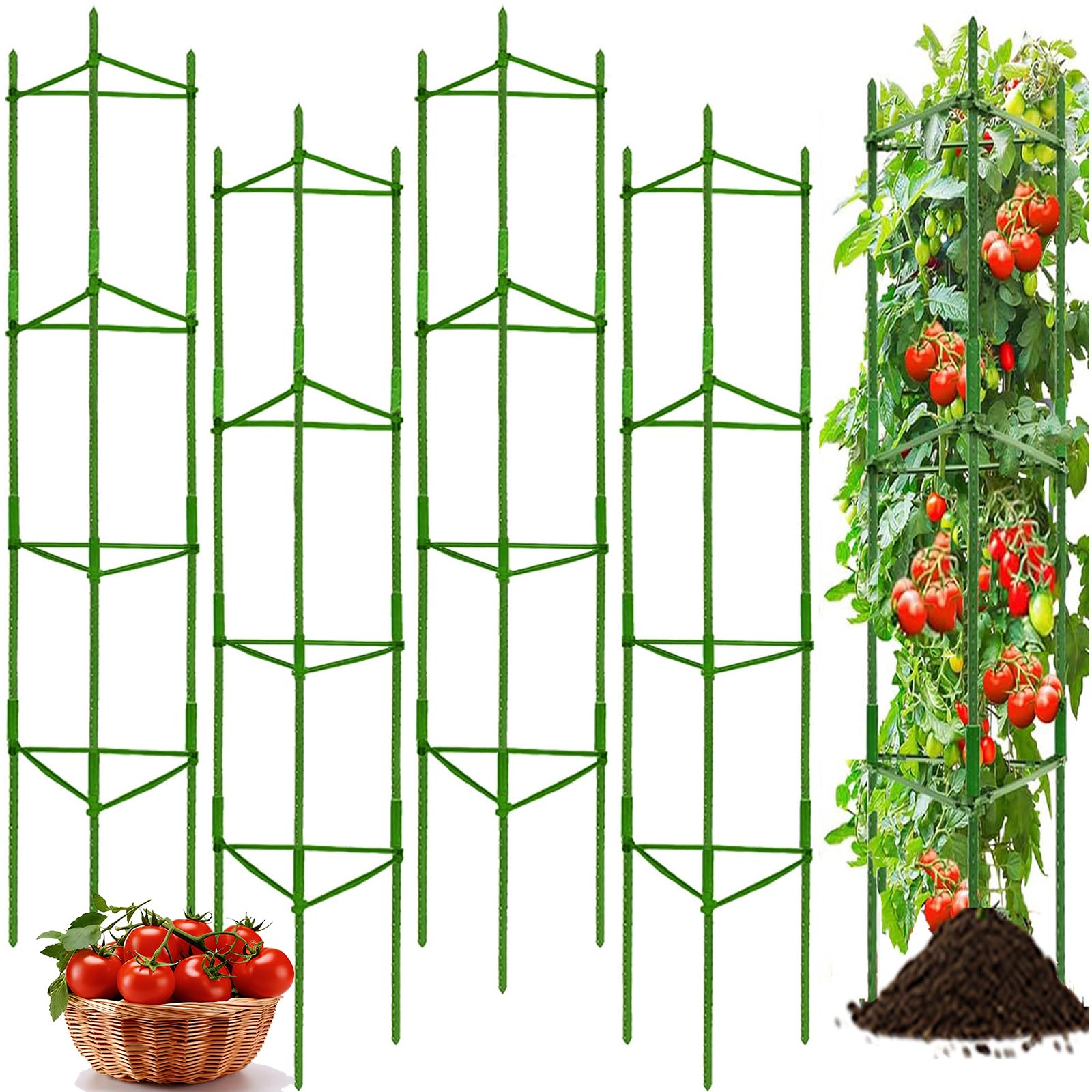
Shape flexibility is the reason to look here. The same set of parts builds a triangular cage up to 66 inches high, or a quadrilateral, or a trapezoid, in whatever height you need. That matters when a bed is narrow, or when a plant wants more room at the base than a triangle gives. Four cages come in the box, and the parts include 48 plastic core stakes, 48 snap-on arms, and 36 connecting pipes.
Snap-on arms are the assembly story, and it works in your favour. You adjust height by adding pipes, and the arms click into place without tools — so you can actually raise the cage mid-season as a tomato grows, which is the point of an adjustable cage. The metal is coated in non-fading green plastic for weather and rust protection, and the pointed ends push cleanly into soil.
Two things worth knowing before you commit. At 2 pounds the cage is lighter than the square MQHUAYU set at 6.2 pounds, so it flexes more under a heavy vine — good on a protected patio, less sure in a wind tunnel. And the snap-on arms are the moving part; keep them seated, since a loose arm is where the hold gives way.
The draw: three possible shapes from one set of parts, with snap-on arms you can raise as the plant climbs.
What to expect: a light cage meant for vertical guidance, not a rigid wall against strong wind.
Best suited to: tall indeterminate tomatoes on a patio or in a sheltered bed where height is the aim.
skip it if: you need a cage that stands rigid in open, exposed ground.
7. MQHUAYU 3 Pack Square Tomato Cages, 41.7 Inches
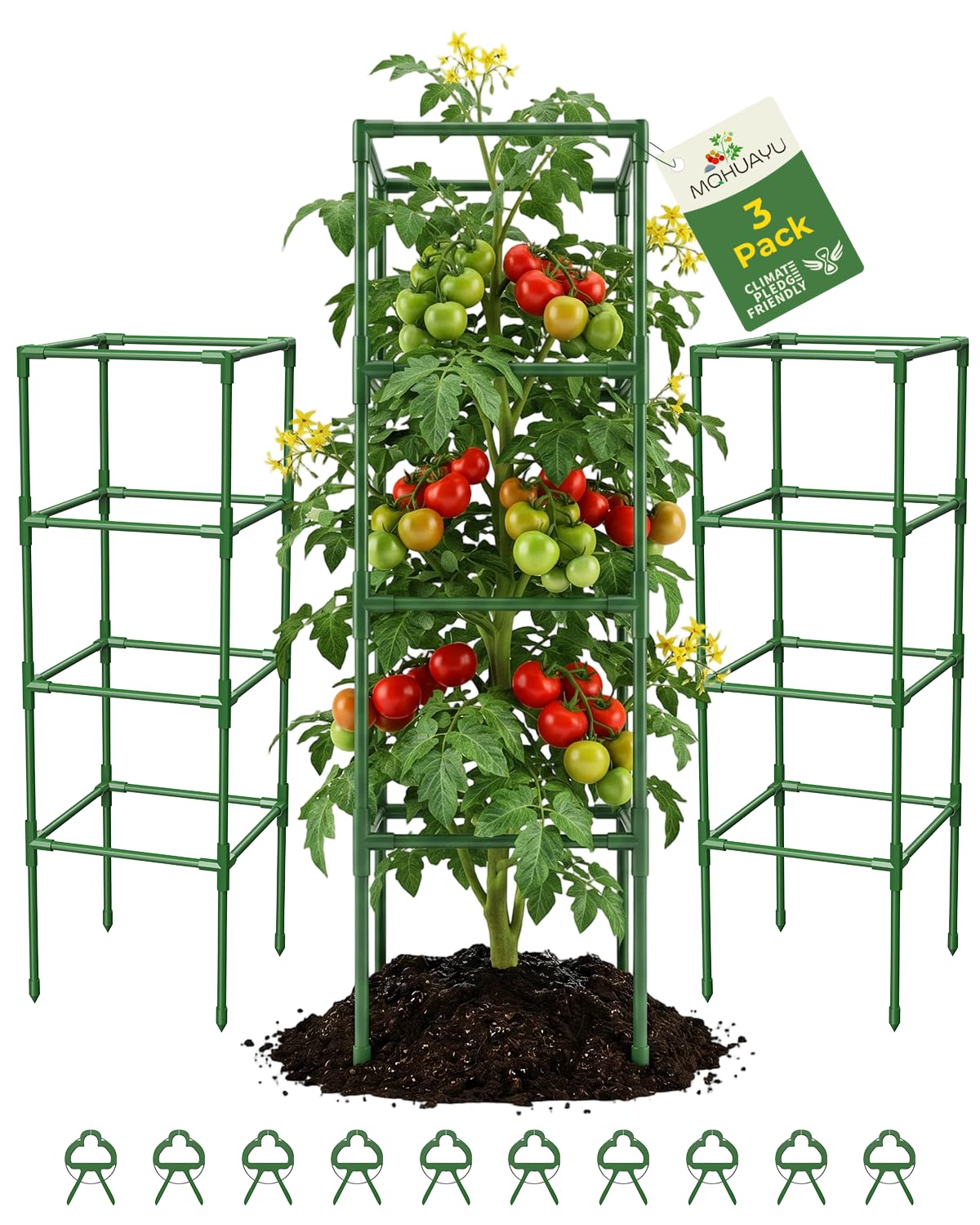
Square steel towers that weigh 6.2 lbs — the heaviest cage in this lineup.
Weight is the honest measure of a steel cage, and this one is 6.2 pounds for a set that measures 13.7 inches by 13.7 inches by 41.7 inches per tower. Compared with the Moirsunt pick at 2 pounds, that is a different animal entirely — heavier steel, more resistance to bowing, and a cage that stays put in weather. Three towers come in the pack, plus 10 clamps.
The square shape earns its keep in a specific setup. Flat faces mean full sun exposure on four sides, which the maker points to as better light for the fruit. In a greenhouse row, the flat sides also line up neatly against each other, so the whole run looks organised instead of scattered. The steel pipe wrapping is there to resist rust, and the height is adjustable as the plant grows.
The recurring gripe is size versus the listing — a fair few buyers find the towers smaller than they pictured, and a share report missing parts in the box. Neither is a defect in the design, but both argue for opening and counting your pieces early. Check the 41.7-inch height against your plant before ordering, especially if that plant is a full-size indeterminate.
What Stands Out
- 6.2 lbs of steel resists bowing in wind
- Flat 13.7-inch faces give even sun on four sides
- Adjustable height as the plant grows
- Square shape lines up cleanly in greenhouse rows
Check Before You Buy
- Towers can read smaller than the listing suggests
- Some sets arrive with pieces missing
Pick this if: you want a heavy, rigid square cage for a greenhouse row or a garden bed that gets wind.
Choose another if: you need a tall cage for a plant that outgrows 41.7 inches.
8. SORANGEUN 10 Pack Peony Cages and Supports

Ten half-hoops that link into a fence, a ring, or a clover leaf for flower beds.
The semi-circular shape is what separates this from a tube cage. Each support is a half hoop, so two of them make a full circle around a plant, and a run of them makes a low fence along a border. Ten in the pack means you can ring a row of peonies or shape a curved border edge without running short. Height is 24 inches and reach is 10 inches.
Material is heavy-duty PCM steel with an anti-rust coating, and the maker lists them across multiple sizes — 16, 24, and 32 inches. The dead-simple install is the part that earns its keep: push the rod into the ground and the hoops are up in seconds. What comes through most in owner experience is exactly that — sturdy enough to lift a heavy branch, and quick to set.
Height is the honest limit. At 24 inches, a full peony in bloom or a tall bush will outgrow the hoop, and a few owners find them too short for the biggest plants. Treat this as border and clump support — peonies, mums, low shrubs — rather than tall vine support. Bring the pack count into the maths, though: ten hoops covers a lot of bed for a single purchase.
The clever part: half hoops that interlock into circles or fences, so you size the shape around the plant instead of forcing the plant into a fixed cage.
Know the ceiling: 24 inches is the top of the hoop — tall bloomers will need a taller option.
Go for it if: you have a border of peonies or mums and want low, tidy support in bulk.
Not for you if: your plants grow past two feet and need a tall cage.
9. Kriulre 6-Pack 38.7 Inch Plant Support Stakes
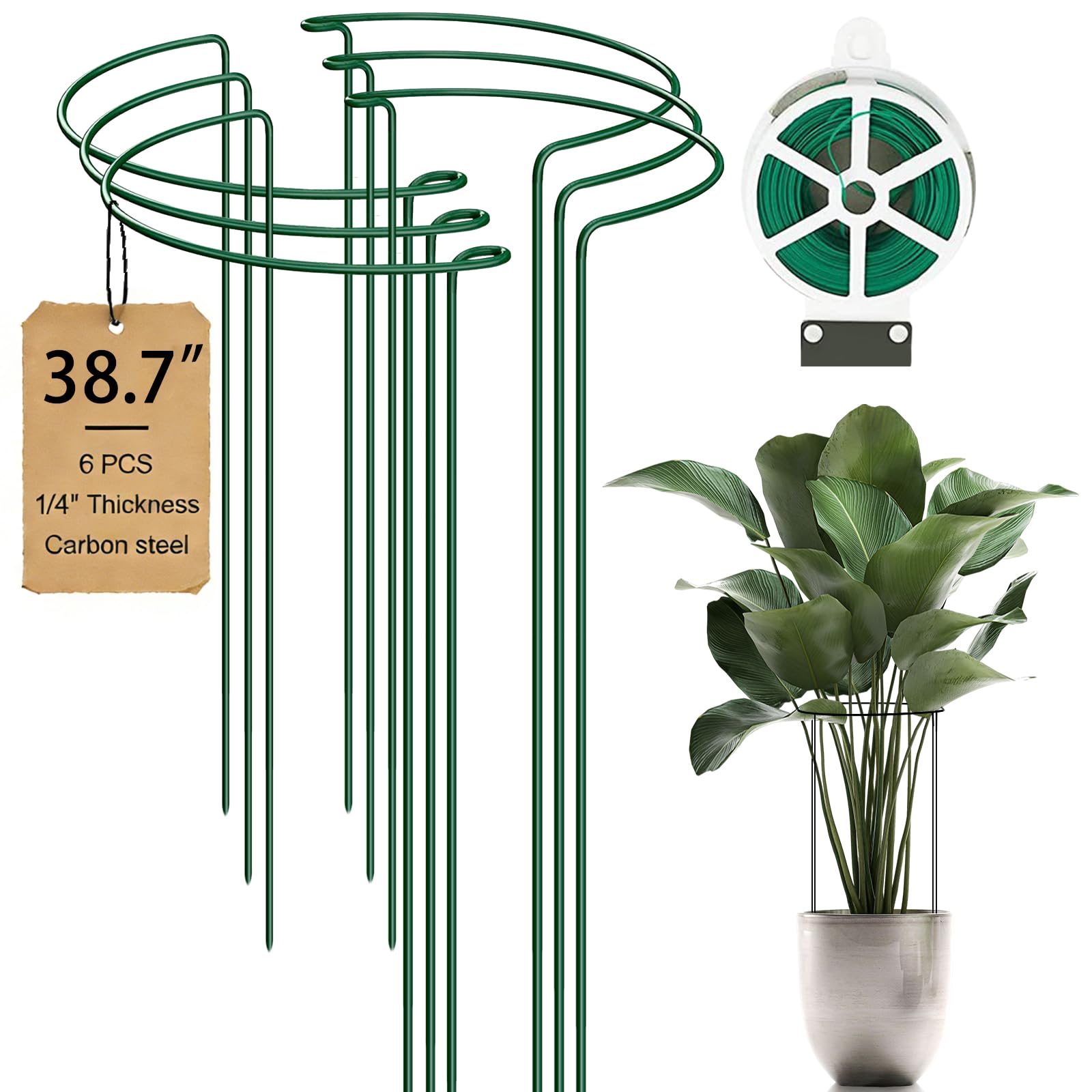
Half-inch steel tube, half-round hoops, and a 15-inch ring built for heavy bloomers.
The tube thickness is the headline: 0.24-inch steel, which the maker describes as thicker than standard plant support stakes. Six half-round stakes come in the pack, each with a 15-inch diameter support ring, a 16.7-inch upper steel tube, and a 22-inch threaded lower tube. Assembled, that is 38.7 inches tall — enough for a peony in full bloom, a hydrangea, or a tall lily.
Each stake has semi-circle ends that slot into the next, so two halves make a full circle and several make a longer run. Slip them around an existing plant without disturbing the roots, then twist the threaded tubes together and push the pointed base in. The weather-resistant green powder coat is there to keep the steel from warping or breaking down.
Two genuine caveats. The threaded joints are the stress point — one owner reports a stake snapping where the extension meets the base while driving it into the ground, so ease it in rather than forcing it. And the quality reads mixed overall: sturdy for many, prone to bending for some. This is a kit for plants with real weight, not for a vine you plan to trellis to the sky.
Where It Wins
- 0.24-inch steel tube is thicker than standard stakes
- 15-inch ring gives heavy blooms room to sit inside
- Half-rounds interlock into circles or longer runs
- Ships with 164 feet of plant ties
Where To Be Careful
- Threaded joint is the weak link under forced insertion
- Some stakes bend more easily than expected
Choose this when: you need a wide-ring support for heavy bloomers like peonies and hydrangeas.
Look on if: you want a cage that takes a long vine without adding sections.
Know the Specs
Height range, ring width, and joint type tell you most of what a cage will do. Coating, pack count, and shape matter, but only after those three.
Height Range And Adjustability
An adjustable cage lists a top and a bottom, like 16 to 24 inches or 16 to 59 inches. The top is built by stacking sections, so a taller number means more joints. More joints means more flex in wind and more places for a plastic connector to give out. Match the top number to your plant’s mature height, not to your seedling’s current size.
Ring Width And Cage Shape
Width is the ring or face measurement across the cage. A 10-inch ring suits a tight clump of peonies; a 15-inch ring suits a heavier bloomer that spreads. Shape matters too — square faces line up in rows and give even sun, round rings guide a vine, and triangles resist bowing on three flat sides.
Tube Thickness And Joint Type
Tube thickness in inches is the honest gauge of steel. The thicker the tube, the less the cage bows under fruit or wind. Joints matter just as much: screw-together and snap-on arms hold tighter than push-fit sleeve connectors, which can slip once a plant is heavy or soaked from rain.
Coating And Rust Protection
Most cages are steel with a plastic or powder coating. The coating is what stops rust and keeps the finish looking clean. It also protects the joints, which are the first place moisture gets in. Store a cage indoors for the off-season and the coating lasts far longer than one left out in weather.
Common Questions
Will a plant support cage work for peonies that flop outward?
How tall should a cage be for an indeterminate tomato?
Do these cages fit in large pots or only garden beds?
Is a square cage better than a round cage for tomatoes?
How long does a steel plant cage last in the garden?
Can I add height to a cage as the plant grows?
What is the difference between a peony cage and a tomato cage?
Will the plastic connectors hold a heavy plant all season?
How many cages do I need for a raised garden bed?
The Bottom Line
For most flower growers, the plant support cage winner is the K-Brands 6 Pack Peony Cages. Its 16 to 24-inch height range and 10-inch ring sit exactly where a floppy peony or grass clump needs support, and the screws hold the joints tight. Want a cage that scales with a climbing vine? Grab the TCBWFY 4-Pack and stack it as the plant grows. And for heavy fruit in a large pot, reach for the joyhalo 2 Pack, with its maker-rated 22 lbs of fruit capacity.
How we choose
We do not accept paid placement. Every pick is matched to a real buyer and a real use-case; we do not hands-on test units.
Sources
Specifications: manufacturer listings and product documentation. Review insights: verified customer reviews, as of November 2026. Pricing: not shown on this page (it changes often); check the current price via the retailer link.
As an Amazon Associate, Tactical Gear Guy earns from qualifying purchases. This does not affect which products we feature.