Specs are compiled from manufacturer listings and verified buyer reviews and can change over time — please confirm the key details on the product page before buying.
You do not need a UPS to survive a storm. You need one to survive the two-second flicker that happens on an ordinary Tuesday and kills the document you never saved. A good PC UPS battery holds your desktop, router and NAS alive long enough to save your work and shut down cleanly — or, on the bigger units, keeps the whole desk running until the grid comes back.
This guide is built by comparing the manufacturers’ published specifications and the patterns across verified customer reviews, so you get each pick’s real strengths and trade-offs instead of marketing spin.
What follows is nine real units sorted by what they actually do well — runtime, outlet count, sine-wave output and battery chemistry — so you can match one to your desk instead of guessing. This is the practical shortlist of the best PC UPS battery for a home office that cannot afford a dirty shutdown.
Top Picks


How To Choose The Best PC UPS Battery
Start with the wattage your PC pulls, not the volt-ampere rating on the box. A UPS is rated in VA (apparent power) and in watts (real power), and the watt figure is the one that decides whether your machine stays up. Manufacturers usually put both numbers on the front — the CyberPower AVRG900LCD, for instance, is a 900VA/480W unit — and you want your connected load comfortably below the watt rating.
Match the outlets to your actual desk
Count what needs battery power versus what just needs surge protection. Monitors, routers and a NAS want battery-backed outlets; a desk lamp and a printer do not. More outlets means less daisy-chaining of power strips, which is why a model like the CyberPower AVRG900LCD with 12 outlets spreads a full workstation across one box, while the Eaton Tripp Lite BC600R gives you 4 and expects you to be selective.
Understand sine wave before you buy
A simulated sine wave (a stepped approximation of the smooth wave your wall outlet supplies) works fine for most standard desktop power supplies. A pure sine wave output, which the GOLDENMATE 1000VA produces, is the cleaner waveform and is the safer match for sensitive gear and active power-factor-correction supplies. If your PC has a high-efficiency PSU, this is the spec worth paying attention to.
Decide how much runtime is enough
Most people need seconds, not hours — enough time to save and shut down. If you want to keep working through a short outage, look at the runtime figure at a stated load. The APC BX1500M publishes up to 68 minutes of battery runtime at a 100W load, and the APC BE600M1 lists 23 minutes of runtime at 100W. Those numbers are measured at light loads, so a loaded gaming tower will get far less.
Side-by-Side Comparison
| Model | Best For | Capacity (VA/W) | Outlets | Battery Type | Amazon |
|---|---|---|---|---|---|
| CyberPower AVRG900LCD★ Best Overall | Full desk with AVR and LCD | 900VA/480W | 12 | Lead Acid | Amazon |
| APC BE600M1Crowd Favorite | Router and NAS uptime | 600VA | 7 | Lead Acid | Amazon |
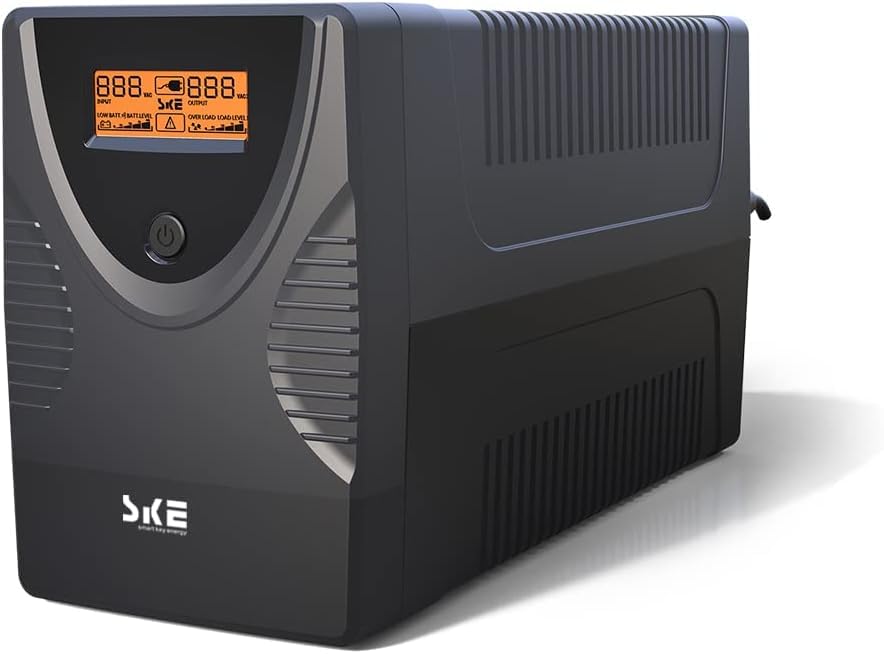
| SKE SK850Best Tower Build | Workstation on a budget | 850VA/480W | 6 | Lead Acid | Amazon |
| CyberPower SL950U | Tight spaces and wall mounts | 950VA/510W | 8 | Other Than Listed | Amazon |
| Eaton Tripp Lite BC600R | Rack and VESA mounting | 600VA/300W | 4 | Sealed Lead Acid | Amazon |
| APC BX1500M | Long runtime, heavy load | 1500VA/900W | 10 | Lead Acid | Amazon |
| Vertiv PowerUPS 200 PSA6-1500LVT | POS and retail counters | 1500VA/935W | 10 | Lead Acid | Amazon |
| Vertiv PowerUPS 100 PST6-1100LVMT | Single PC and peripherals | 1100VA/670W | 8 | Lead Acid | Amazon |
| GOLDENMATE 1000VA/600W | Long-life lithium chemistry | 1000VA/600W | 8 | Lithium-Phosphate | Amazon |
Detailed Reviews
1. CyberPower AVRG900LCD Intelligent LCD UPS Battery Backup
Our pick — 4.5+★ from 650+ verified ratings; the strongest balance of quality and price.
One box that swallows an entire workstation and still has outlets to spare.
The 12 outlets here are the whole argument. Six of them keep your gear alive during an outage and six handle surge duty only, which is a split that makes a full desk — PC, two monitors, router, modem, speakers, printer — fit without a single daisy-chained strip. That is a real, physical convenience most compact units cannot match.
The power quality is what wins people over. It runs a simulated sine wave (a stepped stand-in for the smooth wave from your wall socket) and pairs it with automatic voltage regulation, which quietly corrects brownouts without draining the battery. That means your PC rides out the dim flickers that would otherwise reboot it. The LCD panel tells you load, battery and input voltage at a glance, so you are never guessing whether the battery is actually holding.
The honest catch is longevity. Lead-acid batteries age, and this one carries a stated battery average life of 3 years — after which you replace the battery, not the unit. The 3-year warranty that includes the battery softens that. And while it holds a strong 4.5+ star score, it sits on fewer total reviews than the two APC picks below, so you are trusting a smaller but very consistent body of feedback. The crowd favorite overall remains the APC BE600M1 with its much deeper review base.
Where it leads clearly is outlet count. CyberPower puts 12 outlets on this unit versus 4 on the Eaton Tripp Lite BC600R — a 3.0x gap — so if your desk is crowded, this one ends the power-strip pile-up.
What earns its keep
- Six battery-backed plus six surge-only outlets on a single 900VA/480W unit
- Automatic voltage regulation smooths brownouts without using the battery
- LCD shows load, battery charge and input voltage in real time
- 3-year warranty that covers the battery itself
What to plan around
- Stated 3-year battery life means a replacement cycle down the road
- Fewer total reviews than the APC flagships, though a higher score
The fit: Buy this if your desk has more plugs than sense and you want one box to rule all of them.
The trade-off: Lead-acid chemistry means you will be swapping the battery in a few years, not a decade.
2. APC UPS Battery Backup & Surge Protector BE600M1
The small APC that keeps your router alive so your work-from-home day never drops.
This is the obvious pick for a router, modem and NAS cluster. It gives you 5 well-spaced outlets with full battery backup and surge protection, plus 2 surge-only outlets for less critical gear — enough to keep the internet up while the neighborhood goes dark. The published runtime is 23 minutes at a 100W load, which is roughly “save your work and shut down calmly” territory, not “finish the project” territory.
The details that matter for daily use: a built-in 1.5A USB port keeps charging your phone even during an outage, and the battery is user-replaceable with APC part APCRBC154 so you are not throwing out the whole box when the cells age. Charge time from empty is listed at 10 hours. There is a reason this is the most-reviewed unit on this list — it is the one people buy two and three of, for the TV, the security system and the laptops.
Two honest notes. It runs a simulated sine wave, so an active power-factor-correction desktop supply is better served by a pure sine unit. And the entry-level capacity is modest — a 600VA box will hold a router and a small desktop, but not a gaming tower plus monitors. Match the load to the box and you will be happy.
Where the value lands: Five battery-backed outlets, a phone charger, and a replaceable battery at a budget-friendly tier — it covers the essentials without fanfare.
Who it is not for: A loaded workstation needs more wattage than this; step up to the APC BX1500M if your tower is power-hungry.
Reach for this if: Your priority is keeping the router, modem and a small PC online through short outages.
Look elsewhere if: You are backing up a full gaming rig — this one wants lighter loads.
3. SKE SK850 850VA/480W UPS Battery Backup & Surge Protector
A metal-bodied tower that treats your workbench like a server room.
The SK850 is a 480-watt, 850VA unit in a metal tower enclosure with 6 outlets and an LCD panel, sized for a workstation or a NAS rack. What earns it a place here is build feel — metal housing instead of plastic is a real difference if the unit lives under a desk where it gets kicked. It is not a featherweight, either: at 10.1 pounds it is 2.3x the weight of the Eaton Tripp Lite BC600R at 4.4 pounds, and that mass is mostly transformer and heatsink.
Buyers consistently praise its reliability through frequent outages. The AVR keeps voltage stable without leaning on the battery, which is exactly what you want in a region with dirty power. Setup is plug-and-play with an LCD for at-a-glance status.
Two caveats worth knowing before checkout. Its dimensions run 12.4 x 3.94 x 5.63 inches, and compared to the CyberPower SL950U at 2.76 x 12.76 x 5.4 inches it is a bulkier footprint, so measure your shelf first. And its USB communication leans on proprietary Windows software, which is a non-starter for Mac or Linux users who want automated shutdown — the shutdown works, just not on your terms. Battery is lead-acid, so plan for a replacement eventually.
The core pitch: Metal tower housing, 480W of capacity and an LCD, tuned for a workbench that takes abuse.
The honest snag: Windows-only monitoring software limits automated shutdown on Mac and Linux.
Pick it if: You want a sturdy tower for a desktop or NAS and you are on Windows.
Think twice if: You need cross-platform shutdown software or a very shallow footprint.
4. CyberPower SL950U Standby UPS

The one that slides behind a wall-mounted TV where nothing else fits.
Slim design is the entire point here. At 2.76 inches deep and 12.76 inches wide, the SL950U tucks behind furniture, under a console table or on a narrow shelf where a full tower simply will not go. Buyers with wall-mounted TVs and tight media corners single out that footprint as the reason they bought a second one. If space is your constraint, this is the shape you want.
It is not just thin — it is a 950VA/510W unit with 8 outlets (5 battery-backed, 3 surge-only), two of which are widely spaced to swallow chunky transformer plugs without blocking their neighbors. It adds a 2.4-amp USB-A port and an 18W USB-C PD port, so it doubles as a tablet and phone charger. The LED status lights flag power-on and wiring faults, and it carries a 3-year warranty that includes the battery.
Compared to the CyberPower AVRG900LCD above, this one gives you 950VA versus 900VA and a far slimmer body, but gives up 4 outlets — 8 versus 12. So if outlet count is your bottleneck, the AVRG900LCD wins; if depth is your bottleneck, this one wins. Its battery chemistry is listed as “other than listed,” so if exact cell type matters to you, ask before buying.
The wins that matter
- 2.76-inch depth fits behind TVs and in tight corners
- 950VA/510W with 8 outlets, two widely spaced for big plugs
- USB-A 2.4A and USB-C 18W PD charging built in
- Battery included in the 3-year warranty
Where it gives ground
- 8 outlets is fewer than the AVRG900LCD’s 12
- Battery cell type is not specified on the listing
The buyer it suits: Anyone whose power protection has to disappear behind furniture.
The one gap: Fewer outlets than the full-width AVR unit, so a densely packed desk may run short.
5. Eaton Tripp Lite BC600R 600VA Small UPS 300W Battery Backup
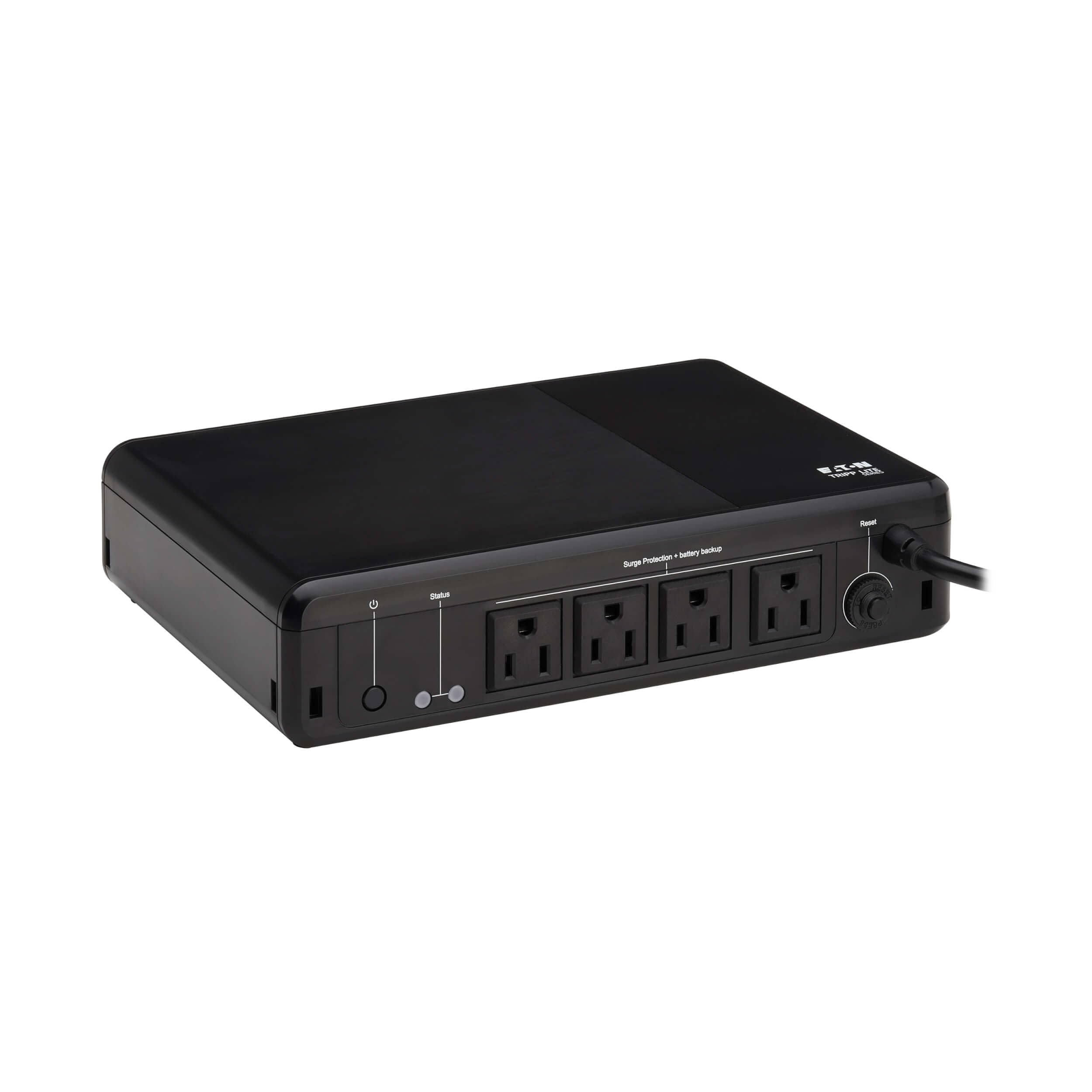
Four outlets, 4.4 pounds, and keyhole slots that let it live on a wall.
This is a niche unit and it knows it. The BC600R is a 600VA/300W UPS with just 4 outlets and a 190-joule surge rating, but its trick is mounting — the keyhole slots on the bottom are spaced in a 100 x 100 mm VESA pattern, so it hangs off the back of a monitor or a wall stand instead of eating desk space. If you are mounting a small appliance or an ONT box, that is genuinely useful.
It shines in tight enclosures. Owners run it inside DeskPi RackMate T0 and T1 10-inch racks and it fits them cleanly, which is rare for a UPS. It restarts automatically when power returns regardless of battery charge, and it filters out EMI/RFI disturbances that can stress hardware. The internal battery is replaceable with Eaton’s AG-075D cartridge, and a resettable circuit breaker guards against overloads.
Two things to weigh. At 300W / 600VA it is the smallest capacity in this group, so it is for cameras, routers and light gear, not a full desktop. And battery runtime is listed at 1.2 minutes at rated load — that is a “hold the line for a moment” figure, not a work-through-it figure. It also has no PC communication port, so automated shutdown is off the table; this is a keep-the-link-alive box, not a graceful-shutdown box.
Mount-and-forget: Made for cameras, ONTs and small rack gear where a wall or rack install beats a desk box.
The limit to respect: 300W and no data port — it buys you a moment, not a workflow.
6. APC UPS Battery Backup & Surge Protector BX1500M
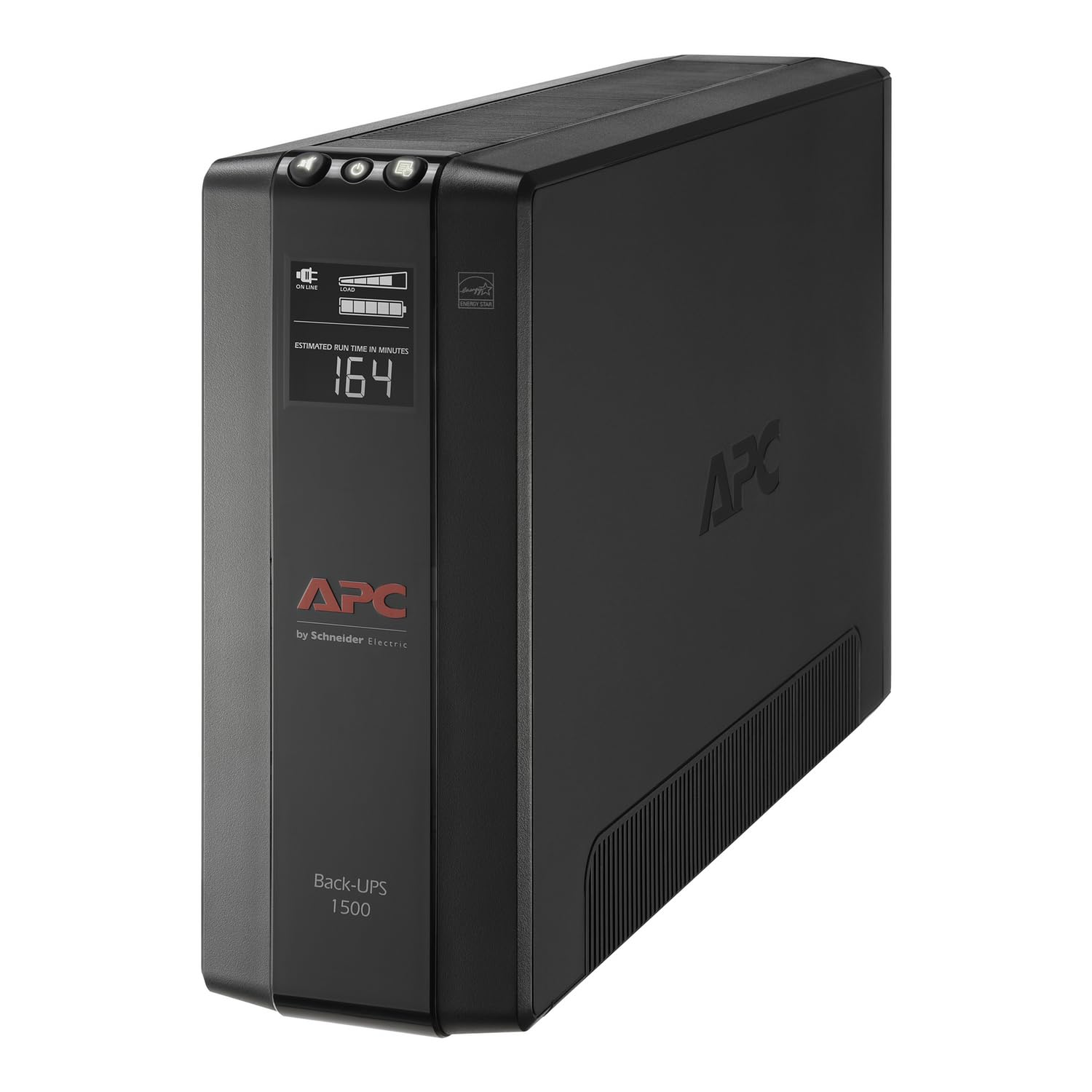
The big APC that hands your workstation nearly an hour when the lights go out.
Runtime is the headline: up to 68 minutes of battery backup at a 100W load. That is a genuinely different class of protection than the 23 minutes the APC BE600M1 offers at the same load — 68 versus 23 is the difference between “save and shut down” and “keep working through the outage.” For a power-hungry tower, the higher load will cut that number, but the ceiling is clearly higher.
The BX1500M carries 10 outlets split 5 battery-backed and 5 surge-only, plus coaxial and Ethernet dataline protection for network gear. Automatic voltage regulation keeps output steady at 120V without burning battery, and it is active PFC compatible, which matters for modern high-efficiency power supplies. The LCD shows charge, estimated runtime, load and input voltage — useful, but the display is a nice-to-have versus knowing the internal battery is sealed lead-acid rated for about 3 years.
Worth flagging for anyone comparing to the CyberPower AVRG900LCD: the BX1500M tops out at 900 watts versus 480 watts, and gives up only 2 outlets relative to that 12-outlet unit. It is also ENERGY STAR certified, and the battery is replaceable with APC part APCRBC124. The one design gripe with larger lead-acid units applies here too — they are not light, and they want a firm, flat spot rather than a crowded power strip.
Why it earns a spot: 900 watts and up to 68 minutes at light load make it the runtime leader for a serious workstation.
The practical caveat: Large and lead-acid; it needs real floor or desk space and a battery swap in a few years.
Made for: A power-hungry desktop where finishing the render or the call matters more than saving a few minutes.
Probably too much if: You only run a router and a laptop, where the BE600M1 is plenty.
7. Vertiv Liebert PowerUPS 200 PSA6-1500LVT UPS
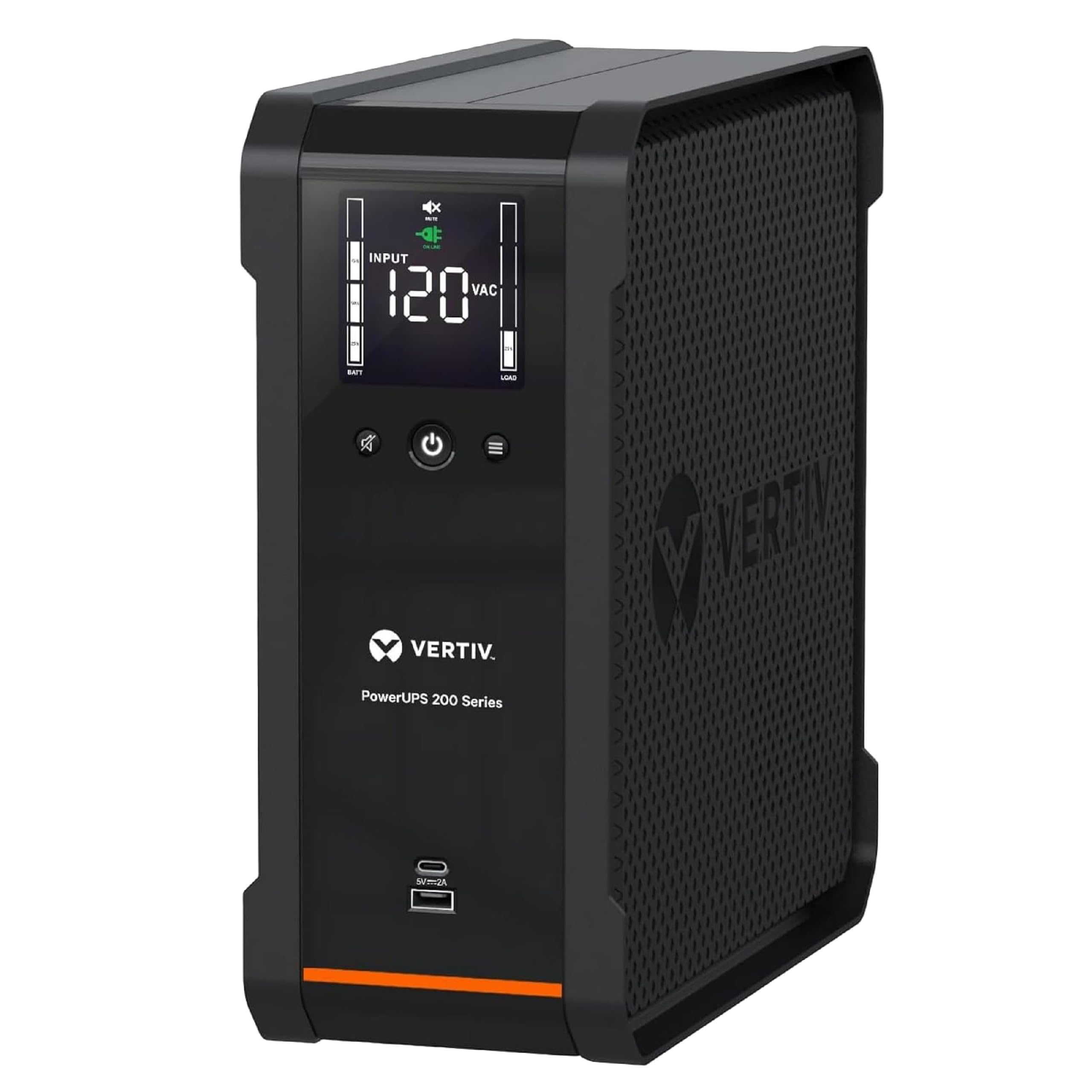
A retail-counter UPS with a color screen and one very quiet button.
This one is built for point-of-sale and small offices rather than desks. It is a 1500VA/935W line-interactive unit with a bright color LCD showing input voltage, battery level and load in real time, plus a dedicated alarm mute button — press once and the beeping stops without killing system alerts. Ten outlets and USB-C plus USB-A charging round out the ports.
The AVR corrects voltage fluctuations without jumping to battery, which is what keeps a cash register or a POS terminal steady during retail-level brownouts. Batteries are user-replaceable and hot-swappable, and it carries a 3-year full-unit and battery warranty with advanced replacement. The build is serious — 26.5 pounds in a metal-and-plastic enclosure that is meant to sit on a counter, not under a monitor.
Two honest points before you buy. First, it is heavy and large — at 16.93 inches deep it takes real counter space. Second, some owners on specific NAS hardware report compatibility quirks with shutdown signaling, so if automated shutdown on a particular NAS is your goal, confirm compatibility first. For plain backup power to a dedicated PC and internet gear, it performs its job.
Where it wins: Retail counters and small offices that want a readable color display, mute control and hot-swap batteries.
Where to check first: Confirm NAS shutdown compatibility if you plan to pair it with a server.
8. Vertiv Liebert PowerUPS 100 PST6-1100LVMT UPS
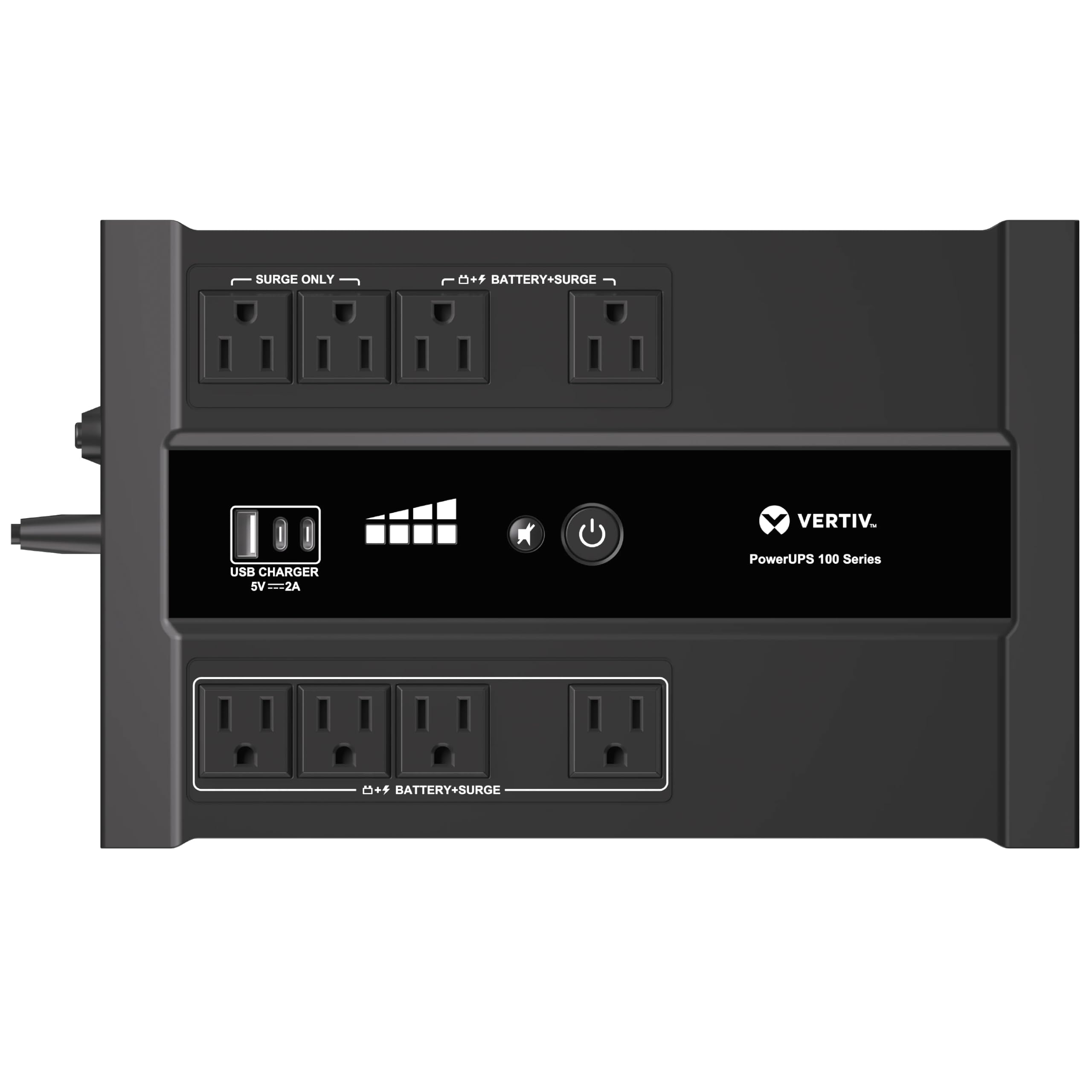
A 9.7-pound box that keeps one PC and its peripherals going through an outage.
This is the sensible middle. It is a 1100VA/670W unit in a compact metal body, 8 outlets with surge protection, and both USB-A and USB-C charging ports built into the front. It weighs 9.7 pounds — easy to tuck beside a tower or under a desk without needing help to move it. For a single PC, monitor, router and a couple of peripherals, that is the right amount of box.
Power quality is the selling point. It delivers stable output and its 3-year full-unit and battery warranty mirrors its bigger sibling, with hot-swappable user-replaceable batteries so you are never shipping the whole unit back over an aging cell. The alarm mute button kills the beep after you have seen the alert, which matters if the thing lives in a shared room. During a long outage it held a full array of gear long enough for power to return.
The catch is that it is designed around an isolated PC and its peripherals — not a loaded tower with hungry graphics. And 670 watts, while good, sits below the BX1500M’s 900 watts, so if your machine is power-hungry, that APC is the better fit. For a standard desktop and network stack, this Vertiv is more than enough.
The core case: Compact metal body, 670W, and hot-swappable batteries for a single-PC setup.
Where it stops short: Not built for a high-draw gaming tower, and its outlet count is modest at 8.
Buy it if: You want a tidy, compact 1100VA unit for one desktop and its peripherals with easy battery swaps.
Don’t if: Your PC pulls more than what 670 watts can comfortably cover.
9. GOLDENMATE 1000VA/600W Lithium UPS

A lithium UPS you buy once and forget for a decade.
Chemistry is the story. This runs a LiFePO4 battery rated over 10 years and 5000+ charge cycles, versus the 3-year average life of the lead-acid units here. The maker claims a 40% lower total cost of ownership than lead-acid over the unit’s life. You swap lead-acid every few years; this battery is listed at a 10-year average life.
It also outputs a pure sine wave, the cleanest waveform here, which is the safer match for sensitive gear and modern power supplies. The 1000VA/600W capacity covers a desktop and its peripherals, 8 NEMA 5-15P outlets provide surge plus battery backup, and the color LCD plus buzzer-mute button make it easy to live with. It has been the steady pick for people whose living room and home office lose power often.
The trade-offs are real. It is a tower, not a slim one — at 12.99 x 4.13 x 9.84 inches it wants its own space, and the low-noise cooling fan (under 50 dB) only kicks on during heavy battery use. Charge time is 6 hours, so after a long outage plan for a slow refill. And 90–140V AC input means it wants a standard 110V household outlet, so verify your voltage before plugging in.
What makes it different
- LiFePO4 battery rated over 10 years and 5000+ charge cycles
- Pure sine wave output for sensitive electronics
- Color LCD and buzzer-mute for easy monitoring
- 8 outlets with surge and battery backup
What to plan for
- Large tower footprint that wants its own spot
- 6-hour charge time after a full drain
Best for: Buyers who want to skip the 3-year lead-acid battery swap.
Space check: It is a full-size tower, so measure the shelf before committing.
Know the Specs
VA versus watts
VA (volt-amperes) is the total apparent power a UPS can pass, while watts is the real power your gear actually uses. A unit like the CyberPower AVRG900LCD lists both — 900VA and 480W — and the watt number is the one that decides whether your PC stays up. Choose a UPS whose watt rating sits above your PC’s real draw, and treat VA as the headline figure and watts as the one that matters.
Simulated versus pure sine wave
A simulated sine wave approximates the smooth wave from your wall with steps; a pure sine wave matches it more closely. Most standard power supplies handle simulated fine, but a high-efficiency power-factor-correction supply prefers pure sine. The GOLDENMATE 1000VA runs a pure sine wave, while the APC BE600M1 and CyberPower units run simulated. If your PSU is modern and efficient, this is the spec to weigh.
Battery chemistry and lifespan
Lead-acid cells carry a typical 3-year average life in units like the CyberPower AVRG900LCD and APC BX1500M, and they are replaceable so the box survives a battery swap. The GOLDENMATE’s LiFePO4 cells are rated over 10 years and 5000+ cycles. The chemistry decides how often you buy a new battery — not whether the unit works.
Runtime at a stated load
Runtime figures mean almost nothing without the load they were measured at. The APC BX1500M quotes up to 68 minutes at a 100W load, and the APC BE600M1 quotes 23 minutes at 100W. At a heavier load, both numbers drop. If you need to finish a task through an outage, the runtime figure at light load is your best starting estimate, but your actual draw decides the real number.
Common Questions
How many outlets do I need on a PC UPS battery?
Will a UPS keep my PC running through a long outage?
What is the difference between simulated and pure sine wave UPS output?
Can I plug a NAS into a small UPS?
Do I need a pure sine wave UPS for my gaming PC?
How often do lead-acid UPS batteries need replacing?
Can I wall-mount a UPS under my desk or behind a TV?
Will my UPS beep constantly during an outage?
Is 600W enough to back up my desktop and monitors?
The Bottom Line
For most buyers, the pc ups battery winner is the CyberPower AVRG900LCD because 12 outlets and automatic voltage regulation cover a whole desk without daisy-chaining. If you want the deepest trust in your router and NAS protection, grab the APC BE600M1, the most-reviewed unit here. And for a full workstation that needs to keep working through a long outage, the APC BX1500M is the one to reach for.
How we choose
We do not accept paid placement. Every pick is matched to a real buyer and a real use-case; we do not hands-on test units.
Sources
Specifications: manufacturer listings and product documentation. Review insights: verified customer reviews, as of November 2026. Pricing: not shown on this page (it changes often); check the current price via the retailer link.
As an Amazon Associate, Tactical Gear Guy earns from qualifying purchases. This does not affect which products we feature.