Specs are compiled from manufacturer listings and verified buyer reviews and can change over time — please confirm the key details on the product page before buying.
If your room sounds hollow, your video calls echo, or you can hear every footstep from the next room, the fix is not a rug and it is not egg-crate foam. You need panels dense enough to actually swallow sound — and the good news is that the strongest pick here also happens to look like real interior design rather than a recording booth. Start with the NeatiEase wood slat panels: they cover about 33 sq.ft., install with screws or superglue, and pull double duty as a feature wall. Everything below is sorted so you know exactly which panel matches your room, your budget tier, and whether you are chasing echo or actual noise transfer.
This guide is built by comparing the manufacturers’ published specifications and the patterns across verified customer reviews, so you get each pick’s real strengths and trade-offs instead of marketing spin.
Below you will find the honest trade-offs that matter — thickness, density, coverage per pack, and whether the adhesive actually holds — laid out so you can pick in one pass. This breakdown of the sound reducing panels worth your wall space covers density, coverage, and mounting.
Top Picks


How To Choose The Best Sound Reducing Panels
The single biggest mistake buyers make is grabbing the cheapest foam squares and expecting a wall to go silent. Thin panels soften the sharp slap of echo inside a room. They do not stop noise passing through drywall from the other side. Decide first which problem you actually have.
Measure your echo, not your neighbours
Clap once in the middle of the room. If you hear a ringing tail, you have an echo problem and absorption panels will fix it. If you hear your neighbour’s television but your own room sounds flat, panels on your wall will only chip away at it. Absorption works on sound already inside the room.
Density and thickness carry the weight
A dense panel converts sound energy into a tiny amount of heat instead of bouncing it back. Thicker material reaches lower frequencies, which is why a 2-inch panel does more work than a 0.4-inch one. Coverage matters just as much — makers commonly suggest treating a portion of the wall rather than every inch, so a four-pack rarely finishes a whole room.
Decide how you will mount it
Peel-and-stick backing saves an afternoon but commits you to that spot, and adhesive residue on painted drywall is the most common complaint in this category. Removable strips, screws, or construction adhesive give you an exit plan. Renters should treat mounting method as the deciding factor, not the pattern.
Side-by-Side Comparison
| Model | Best For | Panel Size | Panels Per Pack | Thickness | Amazon |
|---|---|---|---|---|---|
| NeatiEase Wood Slat Wall Panels★ Best Overall | Feature-wall looks plus echo control | 96″ x 12.6″ | 4 | — | Amazon |
| Ekkogo Hexagon Acoustic PanelsBest Value | Hex-pattern office and studio walls | 12″ x 10″ | 12 | 0.4″ | Amazon |
| Self-Adhesive Polyester Panels (Black)Easiest Install | Fast peel-and-stick echo fix | 12″ x 12″ | 12 | 0.4″ | Amazon |
| Dailycooper Y-Lined Panels | Studio corners and beveled-edge styling | 12″ x 10″ | 12 | 0.4″ | Amazon |
| 4 Pack Acoustic Foam Panels | Drum rooms and dense wedge coverage | 48″ x 24″ | 4 | 2″ | Amazon |
| Fiberglass Acoustic Panels (Beige) | Meeting rooms and large halls | 23.6″ x 11.8″ | 4 | 2″ | Amazon |
| TONOR Dual-Layer Panels | Big flat coverage with peel-and-stick | 47.2″ x 23.6″ | 4 | 0.72″ | Amazon |
| AudioSilk Room Kit | Podcast studios in rented rooms | 45.7″ x 22.8″ | 4 | 0.4″ | Amazon |
| Art3d Wood Slat Panels | Large walnut feature walls | 94.5″ x 7.9″ | 6 | — | Amazon |
Detailed Reviews
1. NeatiEase Wood Panels for Wall, 4-Piece 96″ x 12.6″
Our pick — 4.5+★ from 600+ verified ratings; the strongest balance of quality and price.
Four tall slat panels that quiet a room while doubling as the wall everyone photographs.
Each panel runs 96 inches long and 12.6 inches wide, and four of them cover roughly 33 square feet — enough for a genuine accent wall in a home office or bedroom rather than a token square above a sofa. You hang them vertically or horizontally and you cut them to any shape, so a sloped ceiling or an outlet in the wrong spot is not a roadblock.
What wins people over is the build. The slats are laminated MDF over high-density polyester fiber, and the combination reads as furniture-grade once it is up. Owners consistently describe the finished wall as looking high-end, even in a half bath. The acoustics follow the looks: the fiber backing absorbs sound, cuts echo, and takes the harshness off a room without turning it into a padded cell.
The catch is authenticity, and it is worth being clear-eyed about. The slats are laminated MDF, not solid wood — a few buyers expected grain they could sand and stain. Cut edges can expose the MDF underneath, and a matching touch-up marker handles that fine. Expect a strong smell for the first day or two after unboxing, too; it fades, but plan to ventilate.
Why this earns the top slot
- Roughly 33 sq.ft. of coverage from four 96″ x 12.6″ panels — a real accent wall
- Hangs horizontally or vertically and cuts to any shape
- MDF and high-density polyester fiber construction with low TVOC levels
- Absorbs sound and reduces echo while serving as 3D wall decor
- Goes up with screws or superglue — no specialty tools
Where it asks a little patience
- The slats are laminated MDF, not solid wood — sanding or staining is off the table
- Cut edges can show the core material until you touch them up
- A noticeable odor during the first stretch after installation
- No stated warranty
Go this way if: you want one wall to do both jobs — absorb echo and look like you hired a designer — and you are comfortable with laminate in exchange for the finish.
Look elsewhere if: you need genuine hardwood slats you can refinish, or your room needs full-wall coverage rather than one statement surface.
2. Ekkogo Acoustic Panels, 12-Pack 12″ x 10.4″ x 0.4″ Hexagon
Twelve hexagons that turn a blank office wall into a pattern people comment on.
These are the panels for the person who wants a visible, deliberate arrangement rather than a rectangle. Twelve hexagons at 12 by 10.4 inches with a beveled edge let you build a honeycomb cluster, and the shape hides seams that square tiles expose. Each one is cut from high-density poly-fiber at 5.9 oz/ft² (1800 g/m²) — a heavier sheet than budget foam — and the pack carries an NRC rating of up to 0.95, meaning most sound that reaches it gets absorbed instead of reflected.
Owners treat these as a decorative upgrade that also happens to work. The recurring scene is an office or bedroom wall where the echo off hard surfaces softens noticeably, and the pattern adds colour at the same time. They cut easily, so trimming around a light switch or a corner is a knife job, not a project. The environmental angle is real too: each panel contains the equivalent of four recycled water bottles, and the material is odorless, formaldehyde-free, and flame retardant.
Here is the honest part — no adhesive is in the box. You supply construction adhesive or strong double-sided tape, and mounting choice determines how it goes. Buyers who used proper 3M mounting tape report the panels staying put; a few who went lighter watched them drop. The sound reduction is also genuinely mixed: for a small office or a podcast corner they take the edge off, but they will not silence a room. Expect a trim-and-fit step, since a couple of buyers found tiles that did not seat perfectly together.
The shape advantage: Hexagons do something squares cannot — a staggered cluster looks intentional at any size, so three panels on a narrow wall still read as a design choice rather than an unfinished job.
Budget the mounting: Because the adhesive is not included, price out a roll of proper tape or a tube of construction adhesive before you start. That single decision is what separates a wall that holds for years from one that sheds panels overnight.
Pick these up for: a home office, blog room, or bedroom where you want the echo tamed and the wall to look better afterwards.
Pass if: you expected peel-and-stick convenience in the box, or you are trying to block noise from another room rather than absorb echo in this one.
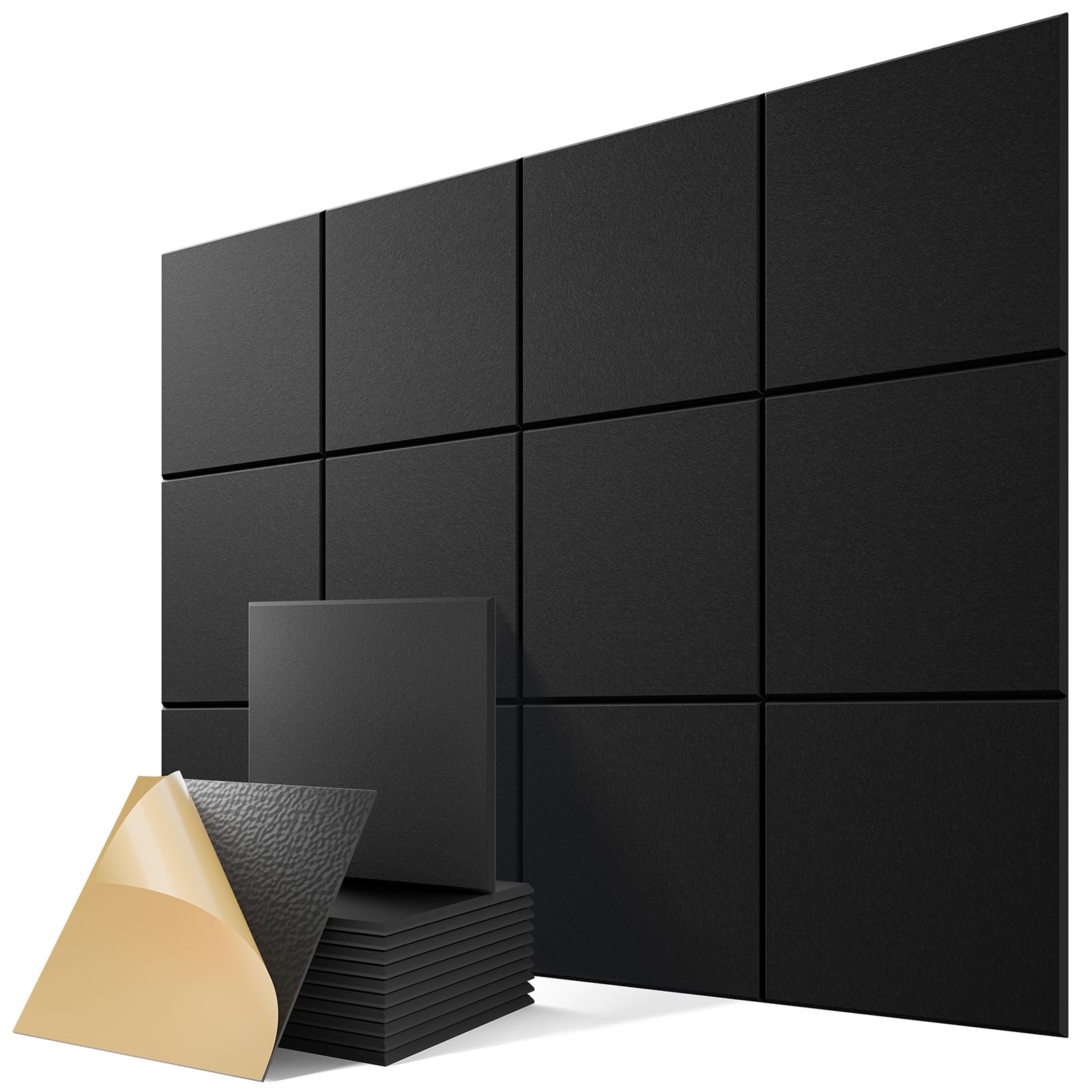
3. 12 Pack Self-Adhesive Acoustic Panels 12″ x 12″ x 0.4″
The renters’ answer — peel, press, and the room stops ringing in an afternoon.
Twelve square panels at 12 by 12 inches and 0.4 inch thick, each with a strong adhesive backing already on. No tape, no tube, no tools. For anyone in an apartment who wants the echo gone before a lease ends, that backing is the whole pitch, and it works on smooth walls, ceilings, doors, and even windows.
The material is eco-friendly polyester fiber rather than cheap foam, so it holds up instead of crumbling and shedding dust onto a desk. Owners describe putting these over a rough, patched-up wall and having the surface look finished afterwards. The acoustic payoff shows up in small, specific ways — a bank of computer fans that used to whine now fades into the background, and music comes through clearly at a lower volume. The pack weighs 3.5 pounds total, so a single person can hang all twelve without help.
Set your expectations on the word “cancel.” One owner summed up the honest position: the noise is softened, not cancelled. That matches the material — 0.4 inch of polyester is an echo treatment, not a soundproofing barrier. The adhesive is the other thing to think through. It grips well going on, but removing a panel can peel paint or leave residue behind, so test one in an inconspicuous corner first.
What the math looks like: Flat, lightweight, and quick — twelve panels mean you can build a staggered pattern across a full wall in one session, and the square shape lines up flush with ceiling and trim lines without cutting.
Before you commit a wall: This is a permanent-ish decision for painted drywall.
Made for: renters and quick-fix buyers who want visible echo relief today and are mounting on smooth, sound surfaces.
Think twice if: you need to block noise through a wall, or you are mounting on delicate paint you cannot repaint.
4. Dailycooper 12 Pack Acoustic Panels

A beveled Y-line groove that makes cheap sound treatment look deliberate.
Density is the number that separates these from the foam crowd: 9.4 lb/ft³, a genuinely heavy polyester fiber sheet for its 0.4 inch thickness. Denser material absorbs more, and owners back it up — the panels go up over a noisy shoppe or an office desk and the person next door becomes inaudible.
Twelve panels at 12 by 10 inches give you about 7.5 square feet of coverage, which is a corner treatment or a door surround rather than a full wall. That is not a flaw, it is a scope note — the maker itself recommends covering roughly 20 to 30 percent of your wall surface for proper results, so buy accordingly. The beveled edge and Y-line groove create a directional pattern, and owners describe the finished look as a futuristic vibe. Cutting with a knife lets you build custom shapes around outlets and corners.
The self-adhesive backing is the convenient part and the risky part at once. There is no tape to buy, which saves a step, and the stick is strong on first contact. But sound results split down the middle — plenty of people report a controlled, quieter room, while some found it only softened the echo. That is the honest ceiling of a 0.4 inch panel. Also check colour consistency on arrival; a mismatched piece has turned up in a pack before, and it cannot be used in the pattern.
The details that hold up
- 9.4 lb/ft³ high-density polyester fiber — heavy for its thickness
- Self-adhesive backing, no tape or extra adhesive to buy
- Flame retardant, odorless, safe to breathe and touch
- Beveled Y-line pattern that hangs like art, not like a studio wedge
- Knife-cuttable for custom shapes and tight corners
Set expectations here
- About 7.5 sq.ft. total — a corner or door, not a whole wall
- Echo reduction rather than soundproofing, which some buyers read as underdelivering
- Peeling the backing can leave paint damage on removal
- Occasional colour mismatch between pieces in one pack
Reach for this if: you are treating a corner, a doorway, or a gaming nook and you want the pattern to carry the room’s look.
Not the one if: you are covering a large wall and need more square footage per order than 7.5.
5. 4 Pack Acoustic Foam Panels, 48 x 24 x 2″

Two inches of dense wedge that finally lets a drummer play in the basement.
Four panels, each 48 by 24 inches and a full 2 inches thick, with a uniform density and firmness across the face. That thickness is the reason these work on low-end energy — kick drums and bass notes that 0.4 inch panels simply slide past. The fire-retardant polyester construction adds a sensible safety layer in a room full of cables and amps.
The most convincing evidence for these comes from people making real noise. A drummer in a basement room reported the sound softened enough that a spouse noticed. Another turned an apartment dining room into a studio and found the echo deadened dramatically. The panels also handle the unglamorous job well: they can be cut to fit around obstacles without losing performance, and each one regains its shape within 5 seconds of opening the vacuum-sealed package.
Compression is the thing to plan around. The panels ship vacuum-sealed to comply with shipping rules, and while most bounce back fast, a few arrive flattened and stay that way. Open and lay them out before you judge them. Adhesive is not the strong suit either — the included stickers are the weak link, and T Pins or construction adhesive are the safer bet on drywall. Weigh 6.08 pounds across the set and you understand why tape alone struggles.
The thickness payoff: At 2 inches these are the thickest panels on this list, and thickness is what converts a room from “ringing” to “controlled” when instruments are involved.
Skip the included stickers: T Pins on drywall or a proper construction adhesive solve the falling-panel problem entirely, and the panels are light enough that either option holds cleanly.
Suits: drummers, guitar players, and home-studio builders who need low-frequency control and have a wall they can pin into.
Wrong pick if: you need a peel-and-stick finish on finished drywall — the mounting hardware here is on you.
6. 4 Pack Acoustic Fiberglass Panels 23.6″ x 11.8″, Beige

Fiberglass core, 2-inch depth, and a 0.95 NRC score built for rooms with hard ceilings.
These are the panels you specify when the room is the problem, not the wall. Each is 2 inches thick with a fiberglass inner wrapped in 100 percent polyester high-density fabric, and the pair carries an NRC of 0.95 — the maker’s own comparison puts it well ahead of a 1-inch poly fiber panel. The E0 environmental rating on the fiberglass core is a real plus over yellow fiberglass alternatives.
Where they shine is volume. Halls, meeting rooms, cinemas, recording rooms, gyms, hotels, and shopping malls are the listed applications, and a small church setting is one of the settings owners describe as a clear win. One owner in a shared apartment bought a second set of four after the first quieted the room. Four panels at 23.6 by 11.8 inches each is a modest footprint, so treat the pack as a starting block rather than a finished job.
Two things to know before ordering. First, the old peel-and-stick backing is gone on current stock — installation now involves actual mounting, and the included hardware is what you get. Second, fiberglass needs handling care: one owner found the panels covered in loose fiberglass. Wipe them down and wear gloves during install. Wall attachment is the recurring weak point, with panels coming down overnight in a couple of cases.
The spec that matters: A 2-inch fiberglass core at NRC 0.95 out-absorbs thin polyester across the frequency range, which is why this belongs in a large room rather than a bedroom corner.
Handle like insulation: Gloves on, a quick wipe down, and a proper mechanical fixing — that routine turns a finicky install into a permanent one.
Choose these for: meeting rooms, halls, and church or studio spaces where 2-inch fiberglass earns its keep across a large ceiling.
Leave them if: you want peel-and-stick simplicity or you are uneasy handling fiberglass material.
7. TONOR Dual-Layer Thickened Acoustic Wall Panels, 4 Pack

Four big panels at 47.2 by 23.6 inches — the fastest way to cover a large flat wall.
Square footage is the story here. Four panels, each 47.2 by 23.6 inches at 0.72 inch thick, and the maker lists roughly 4400 square inches of coverage. Compare that scope to the 7.5 square feet in a twelve-pack of small tiles and you see why one order can treat a whole living-room wall rather than a corner.
The dual-layer thickened construction is the engineering claim, and it does disperse echo and noise better than a single-layer sheet of the same footprint. The 100 percent high-density polyester fiber is safe to breathe and touch, and the classic stripe pattern works as wall decor in a studio, living room, bedroom, or home theater — it cuts easily, so window and door openings are not a problem. The felt-like surface reads soft rather than plasticky in person. Add a stated two-year warranty and the spec sheet is stronger than most of the pack.
The mounting is genuinely simple — peel and stick with a strong adhesive on the back, no extra tape — and buyers report the panels staying put, including where a door swings nearby. Where this one asks for care is the seams. A panel can work loose at an edge if you did not press it firmly along the whole face during install, so take the extra minute. Sound insulation lands good rather than exceptional; the maker is not claiming to be the deepest absorber on the market and the panels do not try to be.
Coverage math that wins: Four oversized panels cover more wall in one order than any small-tile pack here, and the self-adhesive back means no hardware run.
Press the whole face: The one failure mode is an edge lifting near a doorway — firm, even pressure corner to corner is the fix.
Fits the bill for: a living room, bedroom, or home theater wall where you want big flat coverage without a hardware install.
Keep looking if: you need maximum absorption at very low frequencies rather than a wide, even treatment.
8. AudioSilk Acoustic Panels 4 Pack

Built for people who cannot put a hole in the wall but still need a quiet studio.
Four large panels at 45.7 by 22.8 inches with a 0.4 inch profile, made from post-consumer recycled PET. No harsh chemical smell, no shrinkage, no peeling — the material stays where you put it. The NRC of up to 0.91 means it absorbs the great majority of sound that hits it, and that is the number to weigh against any foam product making similar claims with a lower score.
The mounting method is the real differentiator. The panels go up in seconds on removable sticky strips sold separately, and they come down just as cleanly with no marks behind. For a project studio in a rented space, or a bedroom musician who may move next year, that is the feature that matters most. Owners back the approach — command strips in each corner and one in the middle hold reliably, and adhesive Velcro strips work too. Podcasters describe fewer wall reflections reaching the microphone; conference calls stop echoing.
The thickness question is where opinion splits, so be honest with yourself about scope. At 0.4 inch these are absorption panels, and a few owners found them too thin to make a substantial dent in a hard, reverberant room. Treat them as echo control in a small-to-medium space rather than a cure for a booming one. The maker also includes free advice on measuring a room and placing panels, which is genuinely useful if this is your first treatment.
The rental advantage: Removable strips plus recycled PET construction equals a studio treatment you can take down and rebuild in the next place without patching drywall.
Size your ambition: Four panels of this footprint help noticeably in a bedroom or small studio, but they will not flatten a large, echo-heavy room on their own.
Right for you if: you are recording or taking calls in a rented room and want treatment you can remove without leaving evidence.
Not your match if: your space is large and reverberant, or you want mounting hardware included in the box.
9. Art3d 6-Pack Wood Slat Wall Panels
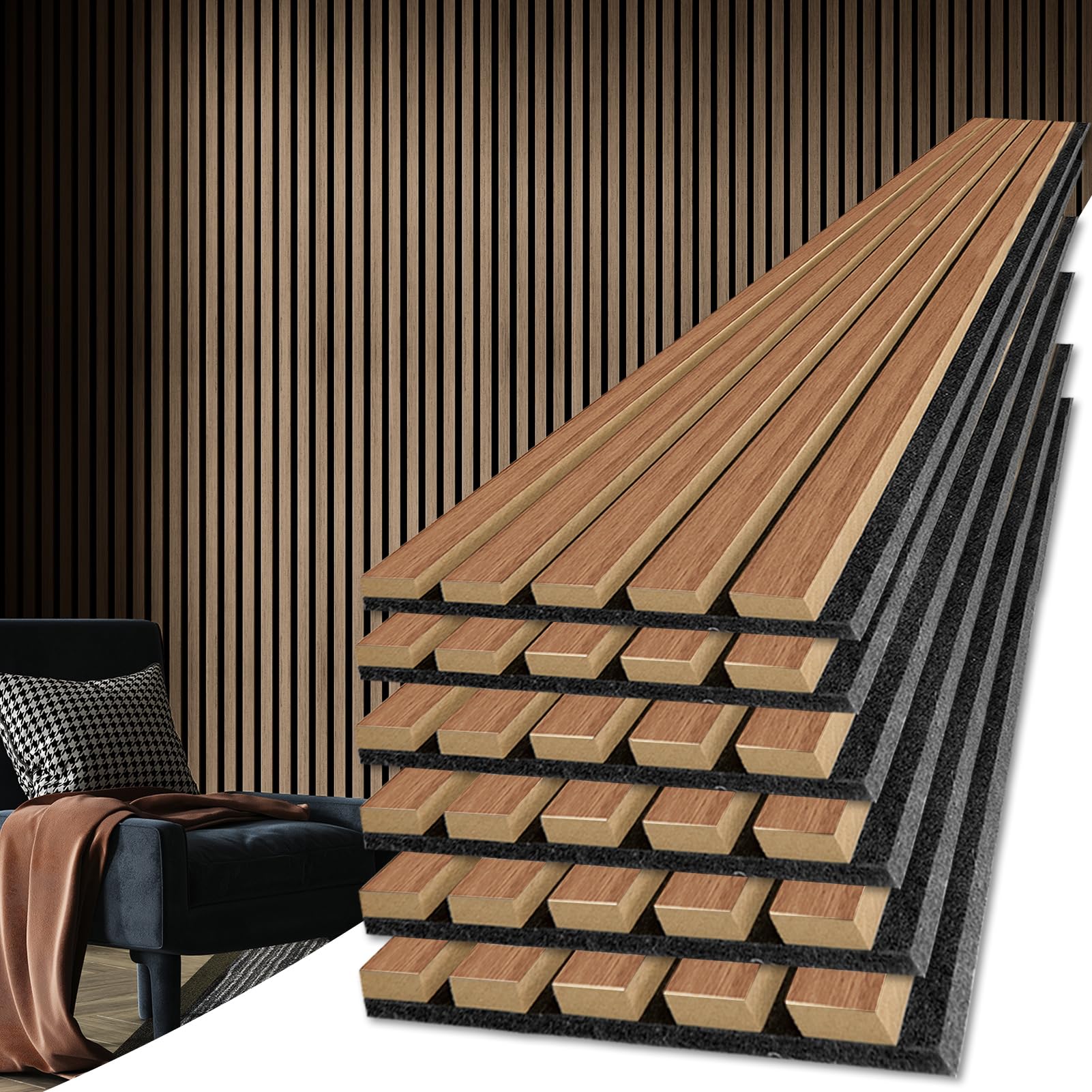
Six slender walnut slats that finish a feature wall in a single day of work.
Six fluted panels at 94.5 by 7.9 inches each, covering about 31.5 square feet — a wide, tall run of narrow slats that reads as a full wall application rather than a patch. The walnut finish is the draw, and it lands: owners describe the room’s look as complete once the panels are up, with the finish matching the photos across multiple boxes.
What buyers talk about most is how quickly it all goes together. Basic tools, a short session, and the wall is done — one account puts the whole job at 45 minutes, and cutting is straightforward enough that edges come out clean. The construction holds up under handling too: the MDF laminate over high-density polyester fiber is described as sturdy and rigid, with a thick black backing that does not flex. The acoustic side is a genuine bonus rather than a marketing line — owners record content in front of these without echo coming back.
The honest caveat is the material. The slats are MDF with a wood-grain laminate, not solid walnut, so sanding or refinishing is off the table. Edges can arrive sharp enough to warrant a light sanding and a careful hand during install. And while the finish justifies itself once installed, value is the one point owners split on — the maker suggests ordering a sample pack first to confirm the finish before committing to a full run.
Speed of install: Cutting and mounting a full slat run in an afternoon is the standout, and it is why the panels suit a weekend project rather than a contractor job.
Sample first: Order a sample of the finish before the full pack — it is the cheapest way to avoid a colour surprise across a large wall.
The pick for: anyone building a walnut feature wall who wants the acoustic benefit and the look delivered together.
Different route if: you want solid wood you can refinish, or you are treating a room for serious sound control rather than a decorative wall.
Know the Specs
Density (lb/ft3 and oz/ft2)
Density is how much material is packed into a given space, and it is the single best predictor of whether a panel absorbs sound or just decorates the wall. A denser sheet converts more sound energy into a tiny amount of heat instead of bouncing it back. A listing quoting 9.4 lb/ft³ or 5.9 oz/ft² (1800 g/m²) is telling you the panel is heavier than a cheap foam tile of the same size. Heavier means more absorption and, usually, a panel that holds its shape instead of crumbling.
NRC (Noise Reduction Coefficient)
NRC is a score from 0 to 1 that tells you how much sound hitting a surface gets absorbed rather than reflected. A bare painted wall sits near zero. A panel rated up to 0.95 soaks up the great majority of the sound that reaches it. A high NRC is most useful in rooms with hard floors, hard ceilings, and glass — the places where sound bounces and stacks into an echo. Note that NRC describes absorption inside the room, not how well a wall blocks noise travelling from next door.
Thickness and Frequency
Thicker panels reach deeper into the low end. A 0.4 inch panel handles the sharp, high-frequency slap of an echo, while a 2 inch panel gets closer to bass notes and drum hits. If your complaint is a ringing voice or a clattering keyboard, thin is fine. If a bass guitar or a kick drum is rattling the room, thickness is what buys you control — which is why music rooms and studios tend to specify the deeper panels.
Coverage Per Pack
Coverage is the total wall area your order actually treats, and it is where most buyers get caught short. A twelve-pack of small tiles may cover around 7.5 square feet, while four oversized panels can reach dozens. Makers commonly suggest treating a portion of your wall surface rather than all of it, so measure your wall, work out the square footage, and buy to that number. Two smaller orders placed at different times rarely match in colour.
Common Questions
Will acoustic panels actually stop noise coming through my wall from the next room?
How much of my wall do I need to cover for the panels to work?
Is a 0.4 inch panel thick enough, or do I need the 2 inch version?
Do self-adhesive panels damage paint when you take them off?
Wood slat panels or fabric-wrapped foam — which one should I buy?
Can I cut acoustic panels to fit around outlets and corners?
Are these panels safe around outlets and heat sources?
Why did my panels arrive compressed or flat?
Do I need professional installation for a full feature wall?
How many packs will finish a normal bedroom wall?
The Bottom Line
For most people sorting through the sound reducing panels on offer, the wall that does the most work is the NeatiEase Wood Panels — roughly 33 square feet of coverage from four 96-inch slat panels, mounted horizontally or vertically, that absorb echo and finish the room at the same time. It holds 4.7 stars across 600+ owners, edging the Art3d slat pack’s 4.6 across a much larger owner base — a higher score for a shorter run of panels.
If your problem is a ringing corner rather than a whole wall, the Ekkogo hexagon set earns its place — twelve panels at an NRC of up to 0.95 and a pattern that hides seams. Need to treat a full living-room wall without a hardware run? The TONOR four-pack puts the largest coverage on the wall with peel-and-stick backing. And for a drummer or a bass player fighting low-end boom, the 2-inch wedge pack is the only pick here thick enough to reach those frequencies.
One nudge before you buy: the slat and oversized panels cover far more wall per order than a twelve-pack of small tiles ever will, so measure first and order once. Mixing packs bought months apart is how colour mismatches happen.
How we choose
We do not accept paid placement. Every pick is matched to a real buyer and a real use-case; we do not hands-on test units.
Sources
Specifications: manufacturer listings and product documentation. Review insights: verified customer reviews, as of November 2026. Pricing: not shown on this page (it changes often); check the current price via the retailer link.
As an Amazon Associate, Tactical Gear Guy earns from qualifying purchases. This does not affect which products we feature.