Specs are compiled from manufacturer listings and verified buyer reviews and can change over time — please confirm the key details on the product page before buying.
A pop-up batting cage should give you a net you can trust, not a weekly repair job. Every cage here uses fiberglass or light steel poles, and the staking kit decides whether it survives a windy afternoon. Buy on pole diameter, mesh ply, and stake count — not on the length printed on the box.
This guide is built by comparing the manufacturers’ published specifications and the patterns across verified customer reviews, so you get each pick’s real strengths and trade-offs instead of marketing spin.
You will see which cages use reinforced poles and real ground anchors, and which ones hide a short net behind a long spec sheet. Below are the nine pop-up cages I compared on pole diameter, mesh ply, and ground anchors for a backyard, a park, or a team setup.
Top Picks

How To Choose The Best Pop-Up Batting Cage
Most buyers assume a longer cage is always the better cage, but a 40-foot cage with weak poles and a sagging net gives you less usable practice than a tight 22-foot one. In practice, the net and the staking kit matter more than the length, because a 40-foot cage with weak poles and a sagging net gives you less usable practice than a tight 22-foot one. Here is what to weigh before you click buy.
Frame And Pole Diameter
Fiberglass poles bend and spring back, which is why pop-up cages use them instead of rigid steel tubes. Thicker walls hold their shape under wind and mis-hits. A cage built on 12.7mm fiberglass poles (about half an inch thick) has more meat than one using a 10mm frame, and it shows up in how little the cage wobbles on a gusty day. Steel frames are heavier and stiffer but generally depend on a spring-buckle bottom tube to fold down.
Mesh Ply And Net Material
Ply count is how many layers of thread are twisted into the net material. A 3-ply polyester net is the common baseline, a 4-ply or 5-ply net is built to take repeated hard contact, and a denser 1-inch mesh catches balls more reliably than a wider 1.25-inch opening. The edge fabric matters too — a 600D nylon or Oxford band around the corners is what stops the net tearing where the poles push through.
Anchoring: Stakes, Ropes, And Ground System
A cage is a sail, so the stakes and ropes carry the whole load. A thin ground kit is what fails first in a storm, whatever the frame. Count what comes in the box: U-shaped stakes, metal ground stakes, tie ropes, and windproof support ropes all add up. A cage that ships with 8 supporting ropes and both U-shaped and metal stakes is giving the wind far more to fight than one with four short spikes.
Size, Ceiling Height, And Your Yard
A 10 ft ceiling lets a player take a full swing without clipping the top. A 22x12x8 ft model is the compact standard for a small yard, while a 30x10x10 ft or a 22x12x8 ft footprint still needs clear ground and room to pull the net tight. Measure the space before you buy, and leave slack for the ropes.
Training Features: Pitching Port And Door
A pitching machine opening lets you work solo without a second person feeding balls. Port sizes vary widely, so match the port to your machine. A zippered door on one end gives you a way in and out, and a removable door turns the cage into a clean hitting lane.
Side-by-Side Comparison
| Model | Best For | Cage Size | Frame | Net / Mesh | Amazon |
|---|---|---|---|---|---|
| 40 Foot Collapsable Batting Cage★ Best Overall | Long tunnel practice | 40 ft | Poles + netting kit | — | Amazon |
| VEVOR Baseball Batting CageBest Value | Backyard practice on a budget | 12.0 x 10.2 x 7.6 ft | Fiberglass poles | 4-ply reinforced polyester | Amazon |
| Shopsource Batting CageDenser Mesh | Small yard, soft toss | 22x12x8 feet | Supporting rods | 1-inch mesh | Amazon |
| ZivPlay Pop-Up Cage | Kids and starter hitting | 22x12x8 Ft | 12.7mm fiberglass | 3-ply stretchable polyester | Amazon |
| KuiBonu Portable Cage | Machines and multi-sport | 22ft x 12ft x 8ft | 14mm fiberglass | 5-ply oxford, 1.25 inch | Amazon |
| PLAYAPUT Batting Cage | Target practice with a machine | 22x12x8 ft | Steel poles | Nylon mesh | Amazon |
| RIIFRILY Steel Frame Cage | Longer openings, leaved outdoors | 20 ft L x 12 ft W x 8 ft H | Powder-coated steel | HDPE net | Amazon |
| FORZA Pop-Up Batting Cage | Team practice, size choices | 20ft | Fiberglass poles | 3-ply knotless polyester, 1-inch mesh | Amazon |
Detailed Reviews
1. 40 Foot Collapsable Batting Cage
Our pick — 4.0+★ from 80+ verified ratings; the strongest balance of quality and price.
A full 40-foot tunnel of net and frame in one box, no permanent build required.
This is the pick for the family with real yard depth who wants to see a pitch travel. At 40 feet you get a genuine ball flight from the mound to the plate, which is why the younger hitters in these reviews settle straight into it. Everything arrives together — all poles and netting are included in the box — so there is no separate frame order to chase.
Assembly is where it earns its keep. Owners consistently call out clear instructions and an easy build, and one practical tip runs through the reviews: run the net outside the frame and it sits perfectly without sagging. Collapsibility is a real feature here rather than a marketing line — it folds down and fits a small yard. Value is the other thing buyers keep coming back to; owners describe it as a lot of cage for what you pay.
The honest catch is the frame. It is the heaviest package on this list at 138 pounds, so the box arrives as two people and a dolly, not a one-person carry. Pole stability is the recurring fit note, and poles have rusted over a few months in some setups — so plan on a ground mat or drying the poles after rain. Treat hard-hitting teens gently and it holds up better. This is the crowd favorite at 4.0+ stars across 80+ buyers, and if your yard can take it, the tunnel length is the reason to choose it.
What It Delivers
- 40 feet of usable ball flight from mound to plate in one complete package
- Net and frame ship together — nothing else to order
- Clear instructions and a genuinely collapsible frame
- Fits a small yard even at full length, per owner feedback
Where It Gives Ground
- 138 pounds means a two-person setup on arrival
- Poles reported rusting after a few months outdoors
- Stability of the poles is the recurring gripe
- Net life drops fast against hard, heavy hitters
Your match if: you have real yard length and want a full tunnel without pouring concrete.
Take a pass when: you plan to leave it outside year-round — the poles want shelter from rain.
2. VEVOR Baseball Batting Cage
Seventeen pounds of fiberglass and polyester that packs into 36 inches of box.
If portability is your whole point, this is the cage to beat. It weighs 17.3 pounds against the 40 Foot Collapsable cage’s 138 pounds, so you can actually carry this one from the garage to the yard without help. The package measures 36.22 x 7.68 x 7.48 inches, which slides into a car trunk that a steel frame would never fit.
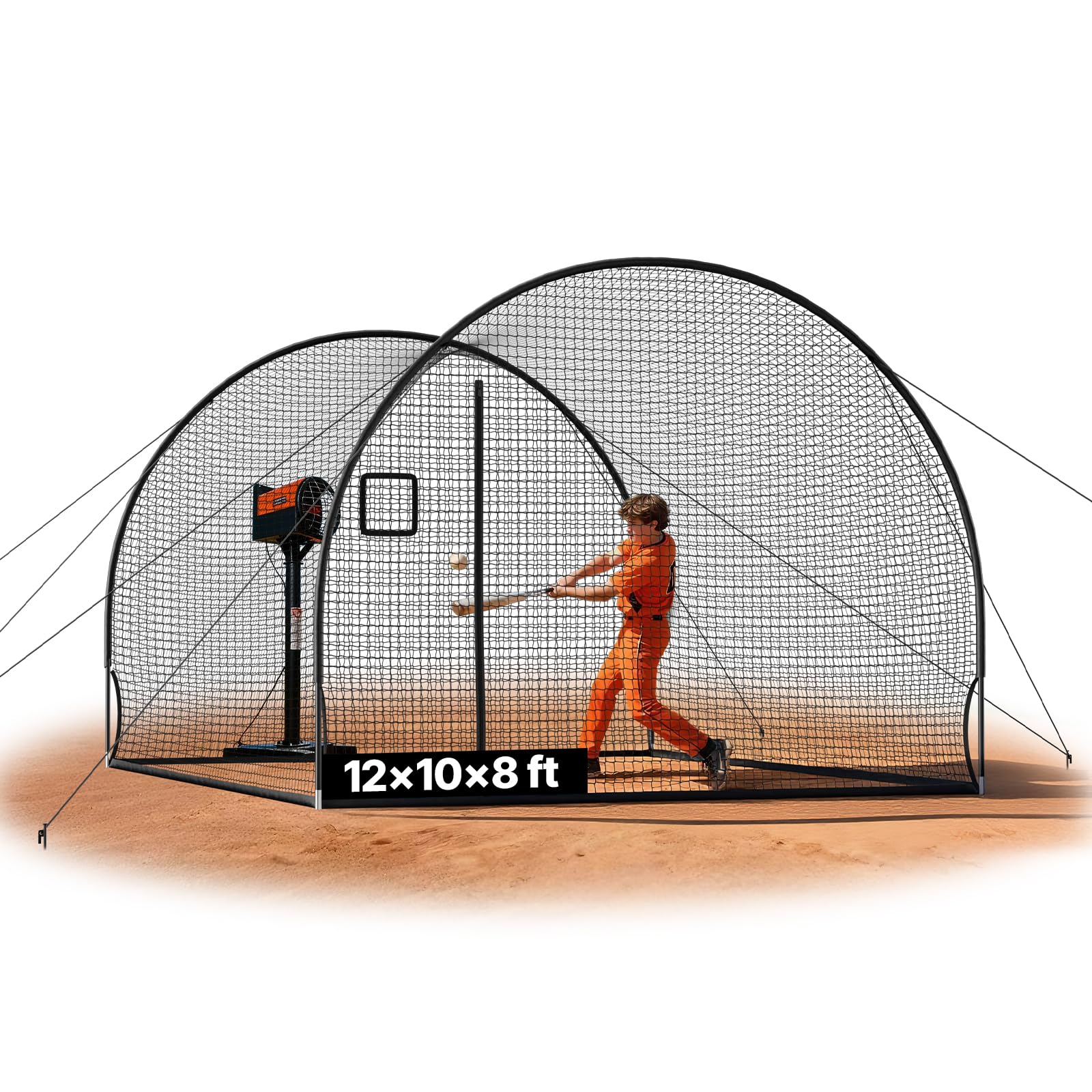
The training zone measures 12.0 x 10.2 x 7.6 ft, and the fully enclosed design keeps balls inside the netting. The net itself is 4-ply reinforced polyester mesh with a thick 600D nylon edge fabric and reinforced corners — that edge band is what protects the net where the poles load it. A removable door and a pitching machine opening let you feed balls from outside the cage. High-heat cured fiberglass rods and reinforced joints are the chosen frame, and the maker’s own note is to store it rather than leave it out in the long term. Ground gear is thorough: four U-shaped stakes, six metal stakes, eight tie ropes, plus electrical tape and a repair module.
Budget cage, real trade-offs. The staking kit works when installed properly, but several owners find the going rough — unclear instructions are the most-discussed issue, and a few say the supplied stakes are too short to hold the frame against wind. The netting takes hard contact, though it tears after a few uses for some. Best read: a light, packable cage for a careful owner who sets it up and takes it down each session. It only runs 3.5+ stars across 100+ ratings, but at this weight there is little else that travels.
The real advantage: 17.3 pounds and a 36-inch box mean you can move this cage alone, which changes how often you actually use it.
Read the manual twice: the instructions are the weak link. Lay every part out and watch the pitching port fit before you thread a single pole.
Buy it for the trunk space: a park-and-practice cage that stores in a bag.
Not your cage if: you want to stake it once and leave it through a windy season.
3. Shopsource Batting Cage
Tighter 1-inch mesh where most rivals leave a wider hole.
Mesh density is the quiet spec that decides whether a net feels firm or springy. This cage uses 1-inch mesh holes against competitors’ 1.25-inch openings — a smaller gap means the ball meets more thread and less give. It is the kind of detail you feel on the second bucket of balls, not the first. The frame pairs sturdy supporting rods with ground nails, anchors, and an elastic rope system, so the structure has some spring built in rather than fighting every hit.
The 22x12x8 feet footprint is the compact standard for a small yard, and a black polyester shell keeps it unobtrusive against a fence. There is a large removable door opening built to take most pitching machines, so solo sessions are on the table. A carrying bag is included, and the maker’s listed warranty runs one year. Setup is pitched as clear and detailed, which suits a buyer who wants a straightforward hour in the yard rather than an engineering project.
On a cage listed at a modest 4.0+ stars with a smaller review pool, the honest read is that the design choices look right but the track record is still thin. The spec sheet is honest about materials and sizes; what you cannot see is how the mesh and rods age through a full season. If you want denser netting than the wider-mesh crowd without paying for a premium frame, this is where to look — just keep expectations calibrated to a newer listing.
Reach for this if: denser mesh and a removable machine door are your two non-negotiables.
Think twice if: you want a long, documented durability record behind your purchase.
4. ZivPlay Pop-Up Batting Cage

A 22x12x8 backyard cage that younger players take to immediately.
Pole thickness is where the ZivPlay makes its case. It runs 12.7mm fiberglass poles where other cages in this range use 10mm frames, so there is more material in every rod. The net is a 3-ply stretchable polyester the maker says rebounds softly, and eight supporting ropes with ground pegs pull it down against wind. Assembly is quoted at under 30 minutes with no tools, and a visual instruction manual walks you through it.
Training flexibility is the second draw. A 20 x 40 inch pitching hole lets you work with a machine, and the detachable door opens it up for a live pitcher. Its real lane, though, is younger hitters. Kids — eight-year-olds in particular — take to this cage and treat it as their own, which is exactly the audience an 8-foot ceiling serves. Functionality is the note that comes up again and again: it does the job.
The build quality is where opinions split. Fiberglass poles have snapped for some owners, and replacements are reportedly hard to source, so a hard-hitting teen is a mismatch for this net. It also runs 3.5+ stars across 250+ ratings — a big crowd with mixed experiences on assembly. Set it up with patience, keep stronger hitters out of it, and the lightweight package makes a lot of sense for a backyard starter cage.
Standout spec: 12.7mm poles against a common 10mm frame — noticeable when you flex one in your hand.
Fit note: this is a starter cage. Young hitters and soft toss, not a varsity lineup swinging wood.
Great first cage: kids, tee work, and a small yard with a pitching machine.
Look elsewhere if: you need a frame that survives a grown hitter’s best swing day after day.
5. KuiBonu Portable Batting Cage
The thickest rods on this list, wrapped in heavy 5-ply netting.
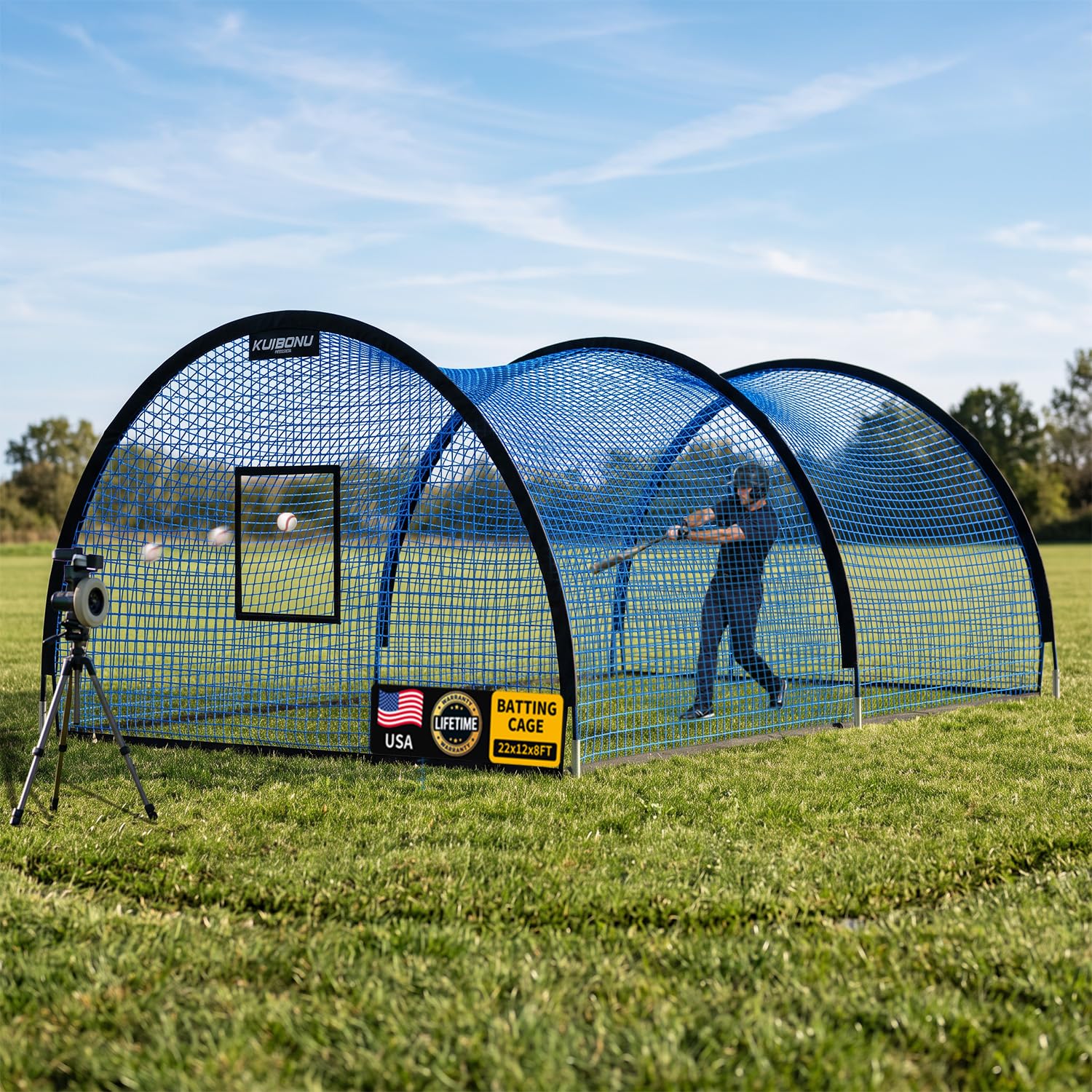
Fourteen-millimeter fiberglass poles are the headline. The KuiBonu runs 14mm rods where the ZivPlay above sits at 12.7mm and the VEVOR uses 10mm, so it is the beefiest fiberglass frame in this lineup. Pair that with 5-ply oxford netting and you get a cage made for repeated hard contact, and the maker puts its abrasion resistance at double older models.
A vivid blue mesh raises visibility so you can track the ball off the bat, and that makes a difference on a dull overcast afternoon. The 31.5 x 31.5 inch zippered pitching hole is built to take a pitching machine, and a zippered backing door means no balls slip out through gaps. Ground anchoring uses metal anchors in place of flimsy plastic stakes, and 420D oxford cloth reinforces the wear points. The cage footprint measures 22ft x 12ft x 8ft; it weighs 29.2 pounds and packs into a carry bag.
One thing to note before you commit: this listing has only a small pool of buyers behind it, so the durability picture is early rather than settled. The spec sheet reads strong, with a 2 Year Manufacturer warranty listed and a claim of an email reply within 12 hours on quality issues. Buy the frame specs and the warranty; let the long-term verdict come later.
Choose it for the frame: 14mm poles and 5-ply net are the most substantial combination here.
Hold off if: you need a proven durability record — this listing is still building one.
6. PLAYAPUT Batting Cage

Steel poles, red target zones, and a machine port for solo work.
Most cages leave you guessing where the ball went. This one paints red target areas onto the net so a batter has something specific to aim at, and that turns an open net into an accuracy drill. The frame is steel rather than fiberglass, which brings a stiffer, heavier feel, and the maker lists the build as able to withstand the hardest hits. A guide rope and 12 ground stakes are included for holding it down.
The 22x12x8 ft span gives real room between the machine and the hitter. Pitching holes measure 18 in. x 48 in. for machine work, and a removable door lets a live pitcher step in. Multi-sport use is written into the design — baseball, softball, and golf are all named, so this one can pull double duty. It ships with netting, poles, and a two-year warranty, with a 24-hour response promised on questions.
Assembly is the part to plan around. Setup is pitched as tool-free, and it has gone up easily for some, but going at it alone is a slower job — the manufacturer’s own recommendation is four people. The track record sits at 3.5+ stars with quality as the most-praised theme and assembly the split one.
What stands out: red target zones make this a hitting drill net, not just an enclosure.
Plan the build: tool-free is true, but four hands make it an afternoon rather than an evening.
Good match for: a hitter who wants aim feedback and machine-ready openings in one cage.
skip it if: you want a fold-and-carry cage for a single adult.
7. RIIFRILY Steel Frame Cage

A powder-coated steel frame that folds apart on spring buckles.
Steel instead of fiberglass is the whole pitch. The frame uses powder-coated heavy-duty steel tubing, which resists the weather and keeps a black finish instead of rusting like bare metal. A spring buckle system on a T-shaped bottom tube lets it break down without tools, so you get a stiff frame that still comes apart. The net is HDPE — a high-density polyethylene the maker rates for tear resistance and repeated impacts — and that same strength is said to cut the rebound risk of a ball coming back at the batter.
Lengths run to a 20 ft L x 12 ft W x 8 ft H footprint, which is a shorter lane than the 40-foot tunnel above but plenty for tee and front-toss work. Everything packs into a carry bag. Durability claims and real life do not always agree, and this is the most-discussed topic on the listing — one rod has snapped inside a week for a buyer, and the note about weak poles comes up. Ground stakes are the other weak point; they refuse to stay put in some soils, so the net has to be stretched tight to make up for it.
Value is what keeps this one relevant. It runs 3.5+ stars and the consensus is that it delivers for the outlay, and it holds up well in a sheltered spot where wind is not a constant fight. A buyer with a carport, barn, or wind-sheltered yard gets a stiffer frame than fiberglass for a modest outlay. Out in the open on a breezy lot, add your own anchors.
Fits a sheltered setup: a barn or carport brings out the best in this steel frame.
Budget for extra anchors: open ground needs more than the supplied stakes.
8. FORZA Pop-Up Batting Cage

Flexible fiberglass and elasticated sections that spring into shape.
The instant-setup claim is built into the design, not bolted on. Flexible fiberglass poles with elasticated sections flex into place and lock together as the frame stands up, so there is less threading and more hitting. Sizes run from a compact 20ft model up to an extensive 80ft tunnel cage, and each option takes customization — you are not locked into one footprint. The net is high-strength knotless 3ply polyester with 1-inch square mesh, and knotless mesh sits flatter for less rebound.
The frame lasts longer because the 600D PU Oxford fabric banding and sleeves sit around the frame edges — that band is what the fiberglass poles press into, the wear point that decides how long the frame lasts. sturdy fiberglass poles and ground pegs come with it. A heavy-duty carry bag makes the whole thing transportable, which is how a high school team puts it up before practice and takes it down after. Team use on a 20-foot cage is where the quality theme shows up.
The recurring fit note is at the wear point. The holes the poles push through break down over a couple of years of sun, wind, and rain, and a tight yard makes it hard to stand up. At 48 pounds it is heavier than the fiberglass featherweights, and the maker’s warranty runs 12 Months. Come to it as a quality build for team practice and the setup time is the reward.
Why Team Coaches Pick It
- Instant setup with elasticated fiberglass sections
- Sizes from 20ft to 80ft tunnels
- Knotless 3-ply polyester with 1-inch mesh cuts rebound
- Heavy-duty carry bag for field transport
What To Watch Over Time
- Pole sleeves break down after years in weather
- 48 pounds is not a light solo carry
- Needs clear space to stand the frame up
- Open net setting lets wind add to the load
Best for a team: coaches who want a cage up before practice and down after it.
Pause if: your setup stays outside through years of weather — the pole sleeves take the beating.
Know the Specs
Mesh Ply Count
Ply counts the layers twisted into the net thread. A 3-ply net is the common starting point, a 4-ply or 5-ply net is built to take harder, repeated contact. Higher ply also tends to mean less stretch on impact.
Pole Diameter
Fiberglass pole diameter usually runs 10mm to 14mm. Thicker poles resist bending on a hard wind shift and take more load before they snap. Check pole diameter before mesh ply or length.
Staking And Ropes
A cage behaves like a sail, so more anchors spread the wind load and keep the net from bowing inward. Count U-shaped stakes, metal stakes, tie ropes, and support ropes — more anchors spread the wind load and keep the net from bowing inward. Short stakes let a frame walk.
Cage Footprint
A 22x12x8 ft cage fits a small yard; a 30x10x10 ft gives a full swing a taller ceiling. Leave room around the frame to pull the net tight and to stand the poles up.
Common Questions
What size pop-up batting cage fits a small backyard?
How thick should fiberglass batting cage poles be?
Will a pitching machine fit through the cage port?
How many people does it take to set up a pop-up cage?
How do I keep a batting cage standing in wind?
Can a batting cage stay outside all year?
What is the difference between 3-ply and 5-ply netting?
Does a denser mesh mean a better batting cage?
How much does a pop-up batting cage weigh?
Is a steel frame better than fiberglass for a batting cage?
The Bottom Line
The pop-up batting cage winner is the 40 Foot Collapsable Batting Cage because it gives you a full tunnel of ball flight with the net and frame in one box. If you need to carry your cage to a park, the VEVOR at 17.3 pounds travels where a 138-pound tunnel cannot. And for a small yard with a young hitter, the ZivPlay is a sensible first cage. If you have a sheltered spot and want a stiff steel frame, the RIIFRILY is worth a look before you commit.
How we choose
We do not accept paid placement. Every pick is matched to a real buyer and a real use-case; we do not hands-on test units.
Sources
Specifications: manufacturer listings and product documentation. Review insights: verified customer reviews, as of November 2026. Pricing: not shown on this page (it changes often); check the current price via the retailer link.
As an Amazon Associate, Tactical Gear Guy earns from qualifying purchases. This does not affect which products we feature.