Specs are compiled from manufacturer listings and verified buyer reviews and can change over time — please confirm the key details on the product page before buying.
If your pump kicks on every time you open a tap, the problem is usually the tank and switch package, not the pump itself. A pressure tank stores water under air pressure so the pump runs less often, and the pressure switch tells the pump when to start and stop. Match both to your well and the pump stops short cycling. Get them wrong and you get short cycling, air in the lines, and a pump that wears out early.
This guide is built by comparing the manufacturers’ published specifications and the patterns across verified customer reviews, so you get each pick’s real strengths and trade-offs instead of marketing spin.
A matched tank and switch deliver steady pressure on demand. The picks below range from a full jet pump and tank combo for a cabin to a standalone tank with a brass tee kit. Each one is judged on capacity, switch settings, and how hard it is to install. Here is the shortlist of the best pressure tank and switch setups for a shallow well or booster system.
Top Picks
How To Choose The Best Pressure Tank and Switch
The two parts of this package do different jobs, and both have to fit your well. The tank holds a cushion of pressurized water so the pump does not have to run for every glass you pour. The switch is the referee that turns the pump on at a low pressure and off at a high pressure. Buy a tank that is too small and the switch will be clicking constantly.
Tank volume in gallons
A tank’s total volume is not the same as the water it actually delivers between pump cycles — the air charge takes up part of that space. As a rule, a bigger tank means fewer pump starts per day, which is easier on the motor. If you are feeding a whole house, aim higher. If it is a camp or a garden tap, a smaller tank is fine.
Switch settings: 30/50 versus 40/60
Those numbers are pounds per square inch (psi) — the pressure at which the pump cuts in and cuts out. A 30/50 switch starts the pump at 30 psi and stops it at 50 psi. A 40/60 switch runs the system at a higher pressure band. Higher settings feel stronger at the shower head, but they work the pump harder, so match them to what your pump and pipes are rated for.
Combo unit or tank-only kit
A combo package bundles the jet pump, the tank, the switch, and the gauge together, factory assembled. That is the simplest path if you are starting from nothing. A tank-and-tee kit is for replacing a failed tank on a pump you are keeping. Check whether the kit includes the brass tee, the union, and the switch before you order, because those are the parts that slow a job down.
Side-by-Side Comparison
| Model | Best For | Type | Flow Rate | Switch Setting | Amazon |
|---|---|---|---|---|---|
| Goulds V60 HydroPro Tank Kit★ Best Overall | Whole-house replacement | Tank + tee kit | — | FSG2 40-60 | Amazon |
| FOTING 1.5HP Shallow Well PumpBest for Lawns | Garden and lawn irrigation | Pump + 5 gal tank | 22.3 gpm | 1.5 bar on / 3 bar off | Amazon |
| Acquaer 115V Stainless Steel Pump | Boosting house pressure | Pump + pressure tank | 22.33 gpm | — | Amazon |
| Red Lion RL-SWJ50/RL6H | Cabin and camp water | Pump + 5.8 gal tank | 12 gpm | 30/50 | Amazon |
| Well-x-trol Amtrol WX-202 Kit | Big-tank whole-house storage | Tank + brass tee kit | 6.2 gpm | FSG2 30/50 | Amazon |
Detailed Reviews
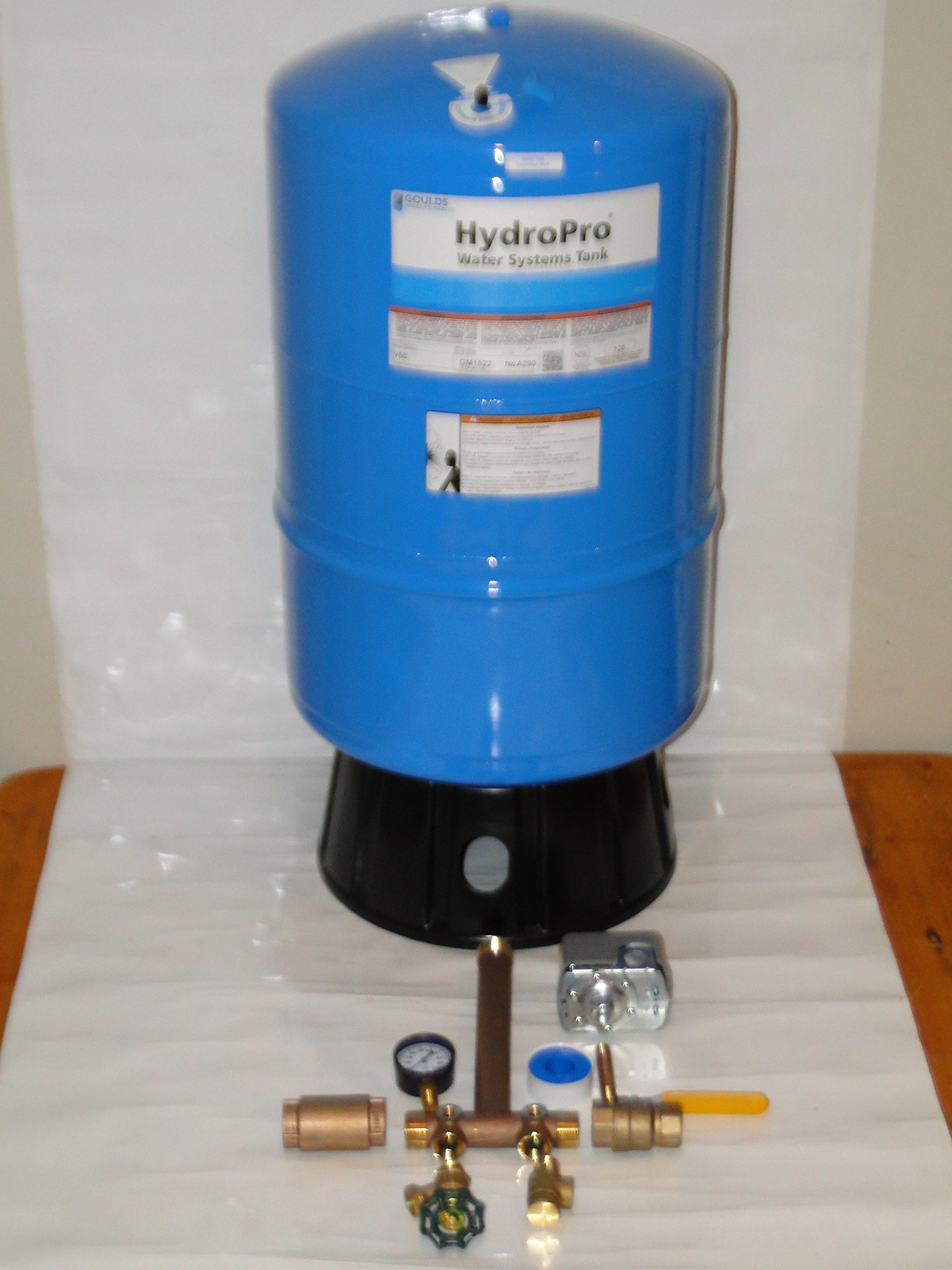
1. Goulds V60 HydroPro Pressure Tank Kit
Our pick — 4.5+★ from 100+ verified ratings; the strongest balance of quality and price.
A factory-sealed tank kit that arrives already charged, so the job is a swap rather than a build.
For anyone replacing a tired tank on a working pump, this kit does the most work for you. You get the V60 tank, a lead-free brass tee, a union, valves, and a Square D FSG2 pressure switch preset to 40-60 psi (pounds per square inch — the pressure band the pump cycles between). The union is the quiet hero here: it lets you break the connection for service later without cutting pipe.
What wins people over is that it cures the short cycling outright. A failed tank with a torn diaphragm stops holding air, so the pump starts and stops constantly — exactly the short-cycling this kit cures. Installation is the second thing that gets talked about, and the reviews back it up: most of these jobs wrap up fast because the tank ships pre-pressurized. As owners put it, the box holds “everything an amateur plumber could wish for,” teflon tape included.
The tank carries a 5-year warranty — the longest in this group. One thing to know before you order: the standard switch is 40-60, and the 30-50 setting or an m4 variant has to be requested, so confirm your settings at checkout. It is also a tank-only kit — no pump — so it is the wrong buy if your pump is the part that failed.
Why it earns the top spot
- Ships pre-charged and factory boxed, so install is a straightforward swap
- Union tee makes future service far easier than a hard-piped tank
- Lead-free brass fittings and a Square D FSG2 switch in the box
- 5-year warranty on the tank
What to check first
- Default switch is 40-60; 30-50 and m4 variants must be requested
- Tank and fittings only — the pump is not included
Built for: replacing a dead tank on a pump you are keeping, especially a whole-house system that needs the union tee.
Look elsewhere if: your pump is also failing — a combo package covers both parts in one order.
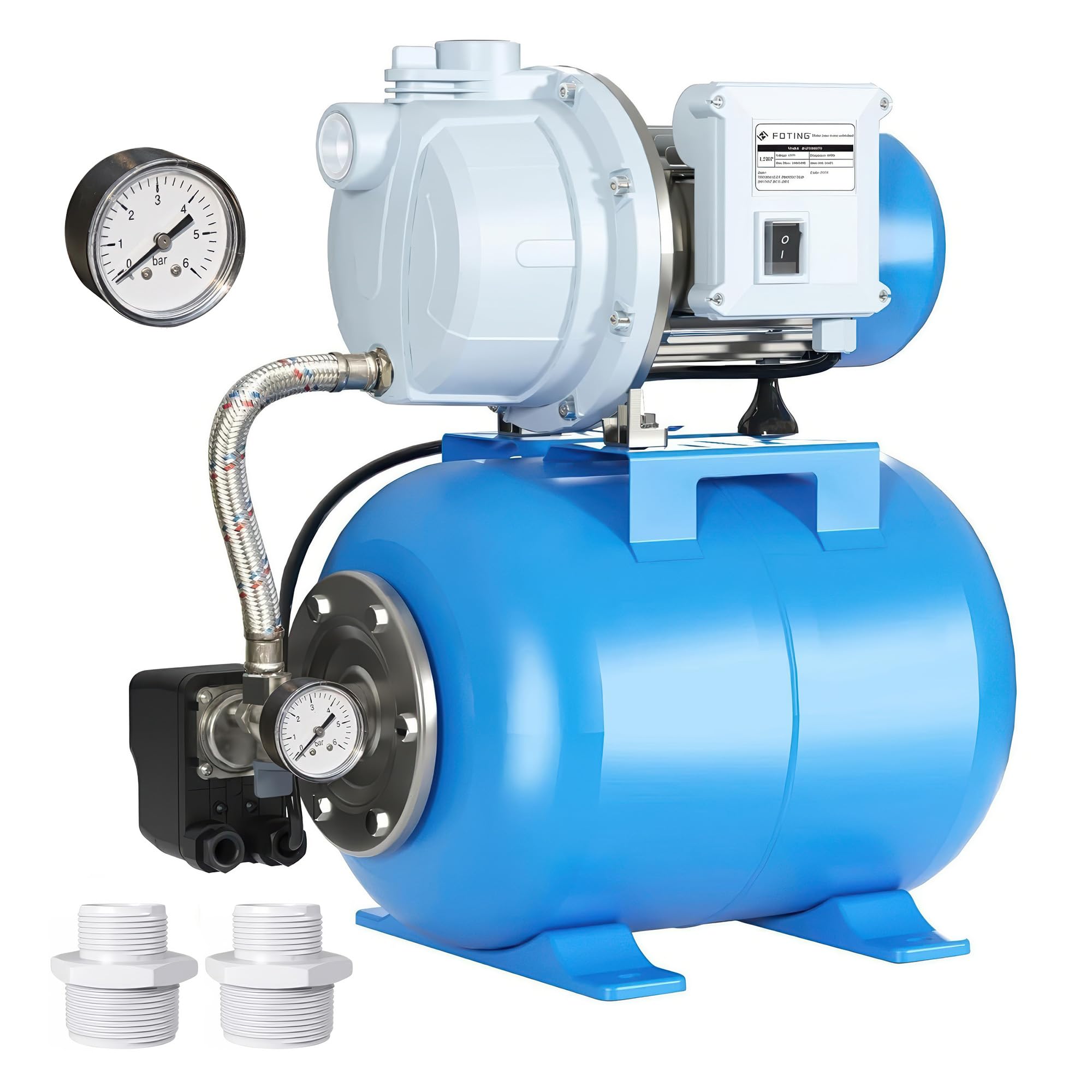
2. FOTING 1.5HP Shallow Well Pump with Pressure Tank
Sprinkler duty on a budget: a 1.5 hp motor that moves 22.3 gallons a minute.
This is the pick for a garden, a lawn, or a small job site where you want water pressure without a plumber. The 5-gallon pressure tank keeps the tap flowing without the motor stuttering on and off.
Set-up is the part that needs your attention. The switch is preset to start the pump at 1.5 bar and stop it at 3 bar, and the gauge on the front lets you watch the pressure as it runs. It comes with two adapters to convert the 1-inch NPT (national pipe thread — the standard tapered thread on water fittings) ports down to a garden hose thread. It is not self-priming, so you must fill the pump body with water before the first run.
The honest read is that this is a value-tier combo, and the reviews split on it. Some users run soaker hoses off a 500-foot line and report no pressure trouble, while others find it will not hold constant pressure and needs re-priming after about five minutes. Its 1.5 hp motor pairs with a 23-foot suction limit, shorter than the Acquaer’s 26 feet. Buy it for irrigation duty and expect to prime it carefully, and it will do the job.
Where it shines: lawn and garden pumping where the high 22.3 gpm flow matters more than a big storage tank.
Reach for this if: you are watering a yard or feeding a job site and want pump and tank in one box.
Think twice if: you need rock-steady house pressure — the tank is small and priming discipline matters.
3. Acquaer 115V Stainless Steel Garden Pump with Pressure Tank
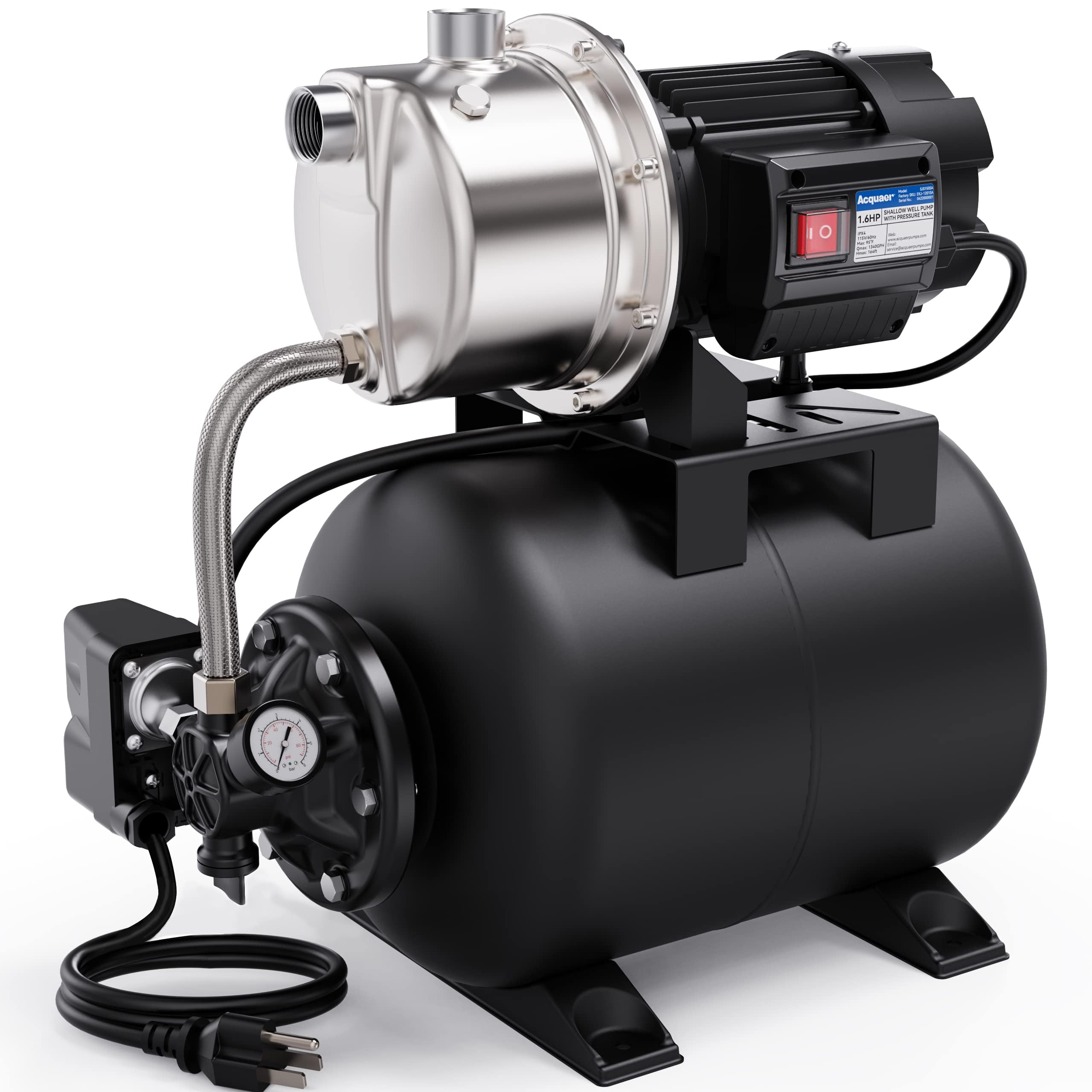
The stainless-steel body and 1.6 hp motor make this the strongest sucker of the mid-range combos.
Start with the number that separates it: the 1.6 hp motor (horsepower, a measure of pumping strength) rates higher than the FOTING’s 1.5 hp. Its suction reaches 26 feet versus the FOTING’s 23-foot pull, so it can draw water from deeper. It moves 22.33 gallons per minute with a 164-foot lift, so long hose runs and tall head pressures are handled. The stainless steel casing resists corrosion, and the aluminum motor housing keeps the weight down enough for the iron carry handle to make sense.
Owners mostly buy this for shallow wells and house pressure, and it delivers — one long line runs it to boost pressure across an entire home. It is not self-priming, so you fill the pump body with water first and make sure the foot valve is seated. Built-in thermal overload protection shuts the motor down if it runs dry, which saves the motor from burning out. A carbon ceramic seal (a hard, water-lubricated face seal that keeps water from leaking past the shaft) keeps leaks in check.
The catch is the pressure switch itself. Buyers find it does not have a low-pressure cut-out, so the pump can run when the well goes dry — several swap the switch for one that does. The motor also earns its reputation for noise, which is fine outdoors and less welcome in a basement. It arrives with 1-inch NPT ports, a 3/4-inch garden hose adapter, and PTFE tape, and carries a two-year warranty.
4. Red Lion RL-SWJ50 Shallow Well Jet Pump

Factory-assembled, dual-voltage, and sized for a cabin that only draws water now and then.
This one is for the cabin, camp, or trailer setup where you want a complete system and you want it simple. The 1/2 hp motor pulls 8.4 amps at 115 volts or 4.2 amps at 230 volts, so it can be wired either way — it ships at 230 and switches to 115. The 5.8-gallon pre-charged tank and 30/50 switch are already bolted to the pump, so the box is a turn-key install rather than a puzzle.
For a cabin that draws water now and then, that is the right trade. Owners run these on lake water to a cabin 60 feet uphill and report strong pressure at the tap. Quiet running and a reasonable outlay come up again and again, and a 2-year manufacturer warranty backs the unit.
Two things to budget for. Priming can be stubborn on a fresh install, so keep a jug handy and follow the instructions closely. The build quality is the split point — the cast iron casing holds up, but the plastic fittings are the weak link if you over-tighten them, and the occasional gauge arrives damaged in transit. Handle the fittings gently and this is a dependable cabin workhorse.
The honest trade-off: you give up top-end flow and lift compared with the stainless Acquaer, and you gain a factory-built package that is easier to get water flowing from on day one.
Best matched to: off-grid cabins, camps, and trailer setups that need a ready-to-run pump and tank.
Skip if: you need maximum head pressure or long continuous household draw.
5. Well-x-trol Amtrol WX-202 Pressure Tank

The biggest tank here — 20 gallons of storage for a house that wants fewer pump starts.
If short cycling is your whole complaint, capacity is the fix, and this is the largest tank in the group at 20 gallons total volume. That volume gives your well pump a longer rest between cycles. The kit pairs it with a 1×11 lead-free brass tank tee, a Square D FSG2 30/50 switch, and seven pieces total, so the connections are covered from the start.
This is the specialist pick for a whole-house system where storage beats speed. The tank stands 32 inches tall, with an above-ground style built for residential water supply, water treatment, and emergency water storage. It is a tank kit, not a pump, so it is the right purchase when your pump is healthy but your old tank has lost its air charge.
The trade-offs are real. At 6.2 gallons per minute it is rated far slower than the pump combos here, so it is about reserve, not output. It is also the biggest and heaviest format in the list, so plan where it lives before it arrives. And do not expect the brass tee to pre-assemble itself — budget time for the fittings and have PTFE tape on hand. Buy it for reserve capacity, not flow rate.
Why the capacity matters: 20 gallons of total volume is the largest reserve of the five, so the pump cycles the least.
Buy this when: your pump is fine and you want a large reserve tank with a quality brass tee and switch included.
Not the pick if: you want a pump in the box or high flow — this is storage-first.
Know the Specs
Tank volume and drawdown
Gallons of total volume tells you how much air-and-water cushion the tank holds. Only part of that becomes usable water between pump cycles. A larger tank stretches the time between starts, which is easier on the motor and quieter in the house. Small tanks suit camps and garden taps where demand is brief.
Switch pressure band
The 30/50 and 40/60 figures are psi — the cut-in and cut-out pressures for the pump. A 40/60 band keeps house pressure higher, while 30/50 is gentler on the system. Match the band to what your pump and pipes are built for, and know that some switches lack a low-pressure cut-out to protect against a dry well.
Flow rate and lift
Flow rate in gallons per minute tells you how fast the pump moves water; lift in feet tells you how high it can push it. A lawn pump wants high flow. A cabin on a hill wants lift. Match flow and lift to the job the pump actually does.
Suction and priming
Suction depth is how far down the pump can pull water. Most shallow well pumps are not self-priming, so you fill the pump body before the first run and keep the foot valve seated. Prime carefully and the system holds pressure; skip that step and you get air and lost pressure.
Common Questions
What does a pressure tank actually do for my well pump?
What is the difference between a 30/50 and a 40/60 pressure switch?
Do I need a pump-and-tank combo or just a tank kit?
How do I know if my pressure tank has failed?
Can these shallow well pumps be used for whole-house water?
Why is my new pump losing pressure after a few minutes?
Should I run a 115V or 230V pump?
What is a tank tee kit and do I need one?
How much suction lift do I need for a shallow well?
The Bottom Line
For most well owners replacing a tired tank, the winner is the Goulds V60 HydroPro kit because it ships pre-charged with a lead-free brass tee, a union, and a Square D FSG2 switch (a pressure switch that turns the pump on and off), all backed by a 5-year tank warranty. If you are starting from scratch on a lawn or job site, grab the FOTING 1.5HP combo for its 22.3 gpm flow (gallons per minute, how much water it moves) and 5-gallon tank. And for a cabin or camp that wants a factory-built package, the Red Lion RL-SWJ50 is the one to reach for.
How we choose
We do not accept paid placement. Every pick is matched to a real buyer and a real use-case; we do not hands-on test units.
Sources
Specifications: manufacturer listings and product documentation. Review insights: verified customer reviews, as of November 2026. Pricing: not shown on this page (it changes often); check the current price via the retailer link.
As an Amazon Associate, Tactical Gear Guy earns from qualifying purchases. This does not affect which products we feature.