Specs are compiled from manufacturer listings and verified buyer reviews and can change over time — please confirm the key details on the product page before buying.
Your Steam Deck dying at 30% is not a software bug — it is a worn-out cell, and the right replacement is the one that matches your exact model number and connector before anything else. If you want the shortest answer: match the part number on your current pack (F7G for OLED, F7A for LCD), then check the milliamp-hour figure and the tools in the box. Everything below walks through three packs that fit that job.
This guide is built by comparing the manufacturers’ published specifications and the patterns across verified customer reviews, so you get each pick’s real strengths and trade-offs instead of marketing spin.
Cracking open a handheld to swap its power cell is a job where one wrong number means a pack that will not seat or will not wake up, so each pick here is scored on fitment, capacity, and what actually comes in the box. Here is the honest breakdown of the steam deck battery.
Top Picks
How To Choose The Best Steam Deck Battery
Buying a replacement pack is not a shopping decision, it is a fitment decision. Almost every pack that fails to work was bought for the wrong model or installed without a proper wake-up cycle. Get fitment and the wake-up cycle right, and the rest depends on capacity.
Read your part number before you read anything else
The LCD model and the OLED model do not take the same pack. The part numbers F7A and F7G appear on the options here, and some packs list both while others list a longer code like 2(ICP6/47/36+ICP6/57/80)-2. Pop the back cover, look at the label on your current cell, and match that string. Order only a pack whose listing names your exact part number.
Know what 6880 mAh actually buys you
A milliamp-hour (mAh) rating measures how much charge a cell can hold — think of it as the size of the fuel tank. The watt-hour figure (Wh) combines that capacity with voltage to describe total stored energy. A pack rated 6880 mAh at 7.74 volts stores more energy than one rated 6470 mAh at the same voltage. That 410 mAh gap is roughly the difference between finishing a boss fight and losing power mid-fight.
Tools and safe-removal rules are part of the product
On this job, the pry tools matter as much as the cell. The tricky part of this job is prying a glued-down pack out without puncturing it. Look for a kit that includes a screwdriver sized for the Deck’s screws, a stiff pry bar, and thin cards for slicing adhesive. Also note whether the maker warns you to run the old pack below a quarter charge before you open the shell — that single step is the difference between a clean removal and a fire hazard.
The wake-up cycle nobody tells beginners about
A fresh pack can read as dead the moment you power on. One of the picks here spells out the drill: charge and discharge a few times before the console recognizes the full capacity. If the new cell is not seen at all, reseat the connector. Budget time for that first cycle so you are not convinced you bought a dud.
Side-by-Side Comparison
| Model | Best For | Capacity | Voltage | Cell Type | Amazon |
|---|---|---|---|---|---|
| FJP 6880 mAh (OLED/LCD F7G F7A)★ Best Overall | Full kit with tools for a first install | 6880 mAh / 53 Wh | 7.74 V | Lithium Ion | Amazon |
| ZTHY 53Wh F7A F7G Replacement | Highest stored energy of the three | 6880 mAh / 53 Wh | 7.7 V | Lithium Polymer | Amazon |
| HBFVG F7G F7A (50.08Wh) | LCD owners watching the budget | 6470 mAh / 50.08 Wh | 7.74 V | Lithium Ion | Amazon |
Detailed Reviews
1. FJP 6880 mAh Battery
The one that hands you every tool you need and matches both model numbers.
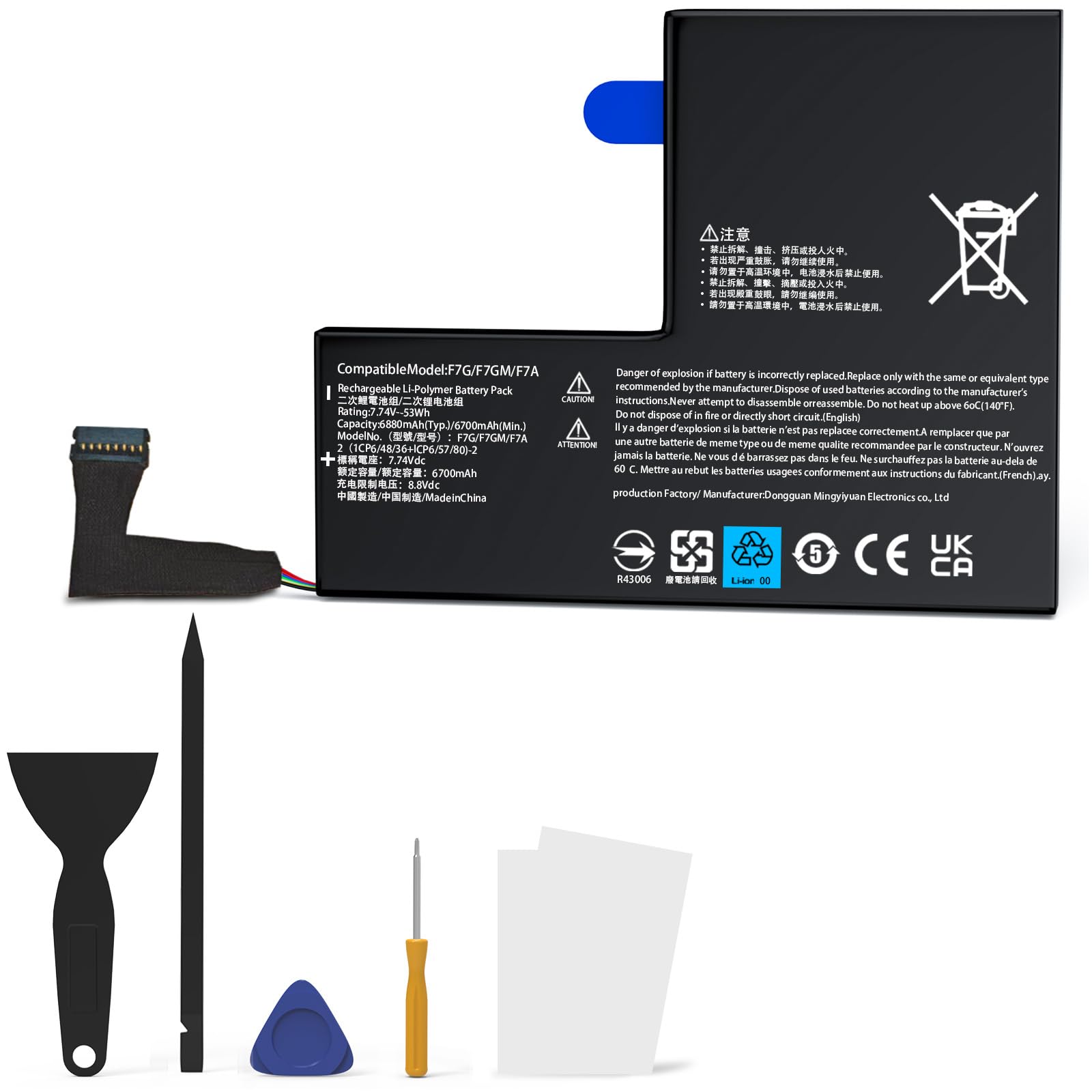
This is the pick for someone who has never opened a handheld before. It is rated 6880 mAh at 7.74 volts for 53 Wh of stored energy — a full-size cell that restores original play time rather than trimming it. It is built for the OLED F7G and the LCD F7A or F7GM, so both Deck generations are covered by one part number list.
What wins people over is what lands in the box. You get the battery plus a PH0 screwdriver, an anti-static nylon pry bar, a thin prying sheet, and two flexible disassembly cards. That covers the screwdriver and pry tools this teardown actually requires. The pack also carries a built-in microchip that guards against overcharging, overheating, and short circuits, and it reconnects to your original charger to handle the power-on sequence.
The capacity story lines up with the owner experience over time. Buyers report the Deck running unplugged again after a pack that had gone flat, and several say the cell holds up after weeks of steady use. Against the HBFVG below, this one leads on stored energy at 53 Wh versus 50.08 Wh. On voltage it sits a whisker above the ZTHY pack at 7.74 volts versus 7.7 volts. The honest catch is the procedure: the maker insists you discharge your old pack below twenty-five percent before opening the shell, and you must pull the microSD card before the back cover comes off. Skip either step and you risk a punctured cell or a snapped card.
What lands in the box
- 53 Wh at 7.74 volts from 6880 mAh cells — full-size energy, not a trimmed-down substitute
- Comes with a PH0 screwdriver, nylon pry bar, thin prying sheet, and two disassembly cards
- Covers OLED F7G plus LCD F7A and F7GM in one listing
- Protection chip handles overcharge, overheating, and short circuits
Where it asks more of you
- You must run the old pack under 25% charge before you start prying
- The microSD card has to come out first or the cover can snap it
Reach for this if: you want your first battery swap to arrive with the right screwdriver and pry tools already inside the package.
Look elsewhere if: you already own a full electronics toolkit and would rather not pay for duplicates.
2. 53Wh F7A F7G Battery
A lithium-polymer pack that stores the most energy here and tells you exactly how to wake it up.
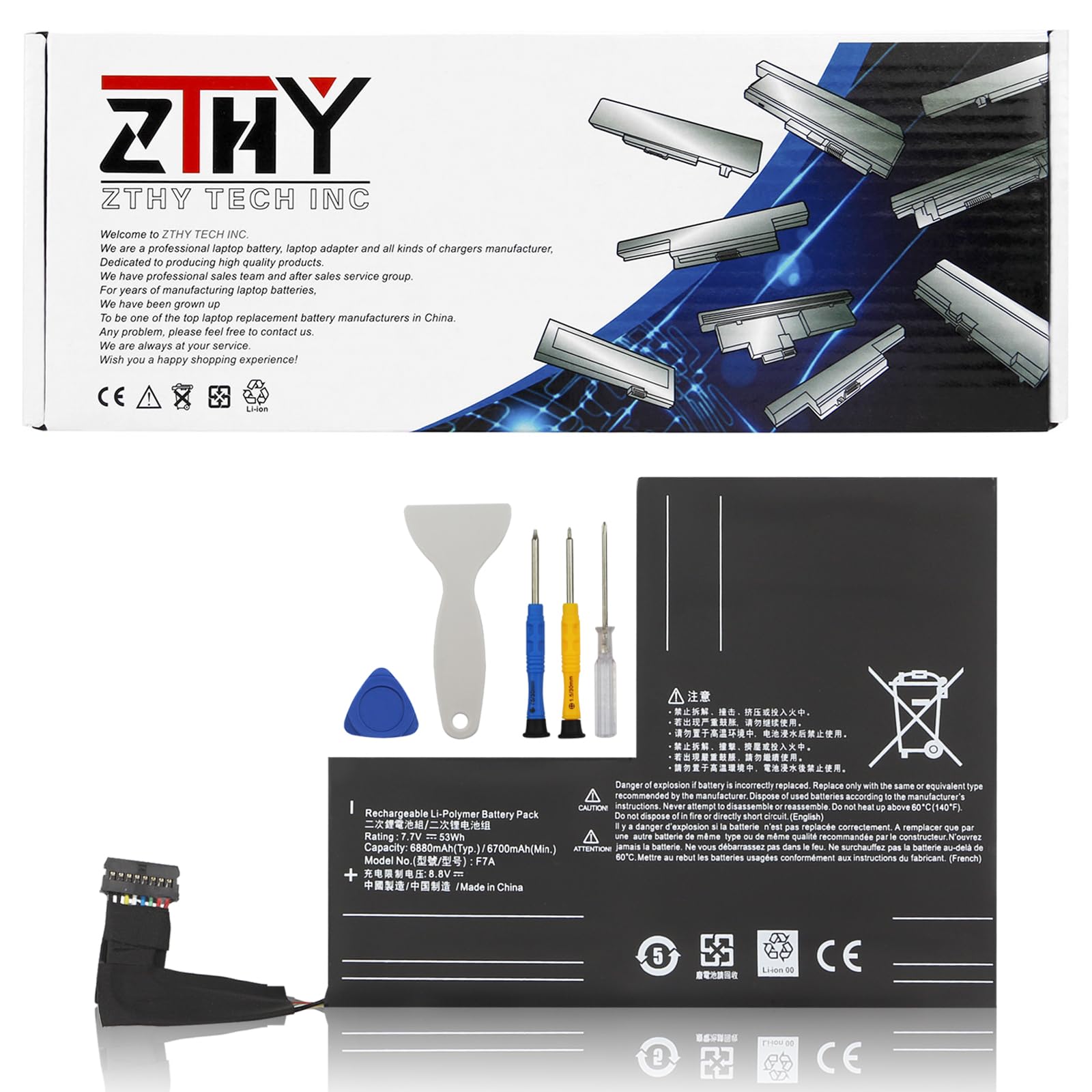
The number to start with is 53 Wh. That is the largest stored-energy figure on this list, drawn from 6880 mAh cells running at 7.7 volts. For a buyer comparing numbers on a screen, this is the pack that gives up the least ground to the original cell. It is a lithium-polymer build, and it is listed as certified by CE and UL for safety.
What separates it from the other two is the instruction sheet. The maker spells out the wake-up drill: if the console does not recognize the new cell at first, reseat the connector and confirm the interface is fully seated. Then discharge to somewhere between 10 and 20 percent — expressly not to zero — and run it through three or four charge cycles. That is the kind of plain guidance most listings leave out, and it is the reason a lot of “dead on arrival” packs get sent back when they were fine.
Here is the trade-off you should weigh. This pack comes on its own — no screwdriver, no pry bar, no cards. If you do not already own a PH0 driver and a stiff prying tool, you are buying those separately, which is where the FJP above earns its place for a first-timer. Against that same FJP, the voltage difference is tiny: 7.7 volts here versus 7.74 volts there. The part number coverage runs F7A, F7G, and F7GM with the longer 2(ICP6/47/36+ICP6/57/80)-2 code spelled out, so check your label against it before ordering.
Straight read: highest stored energy on the list at 53 Wh, backed by CE and UL certification and a twelve-month warranty.
The tool gap: nothing to pry with and nothing to unscrew with in the box — plan for that before the pack arrives.
Pick this when: you already keep a driver set and pry tools on the bench and only want the cell itself.
Think twice if: this is your first teardown and you would rather not hunt for a pry bar mid-job.
3. HBFVG F7G F7A Battery
The LCD crowd’s steady pick, with a little spatula that makes the old cell let go.
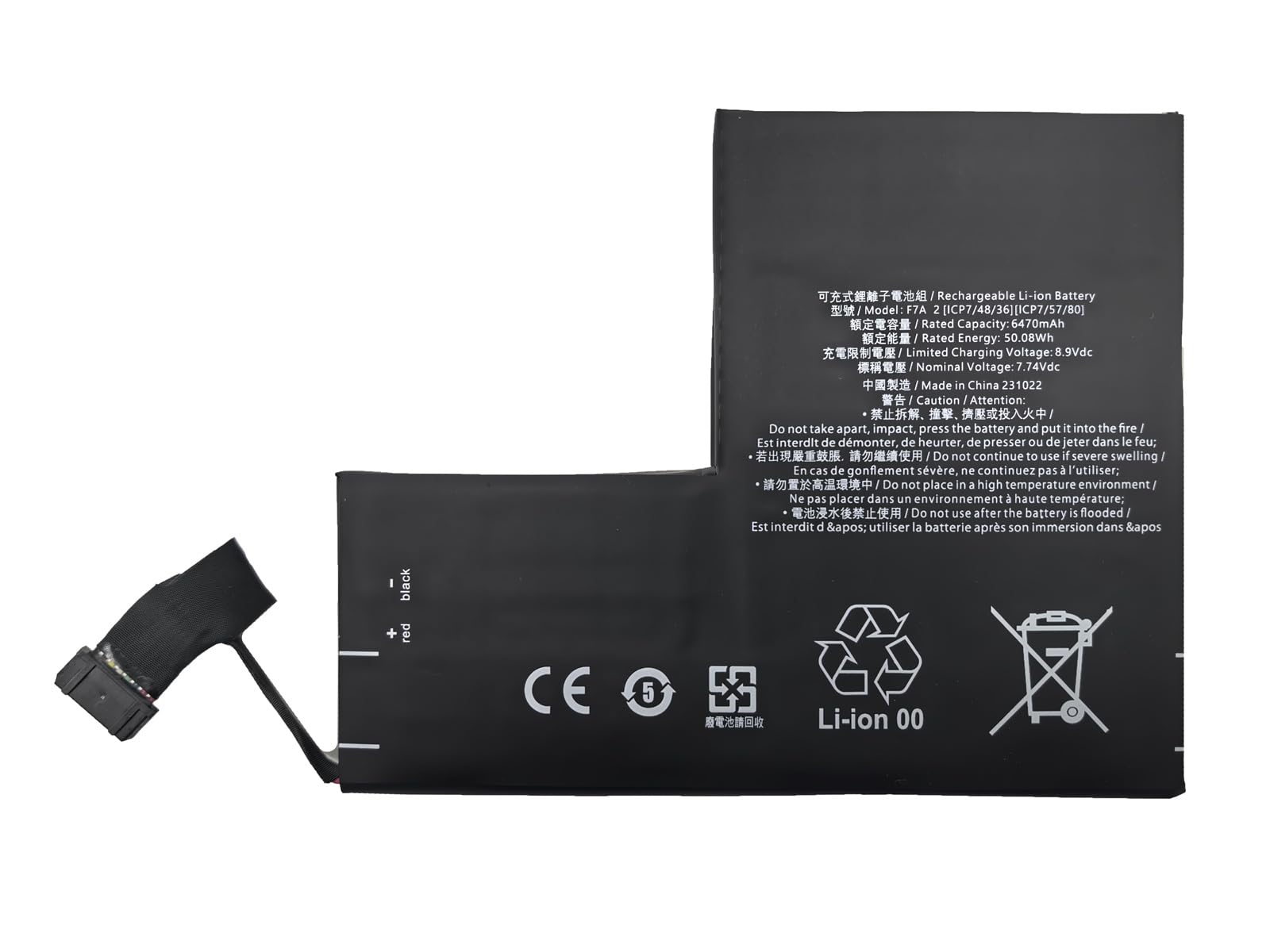
Start with fitment, because that is where this one has built its reputation. It names the F7G, the F7A, and the long 2(ICP6/47/36+ICP6/57/80)-2 code straight on the listing, and it is aimed at LCD and OLED handhelds alike. Run at 7.74 volts, the same voltage as the FJP above, it keeps the electrical side simple.
Capacity is where it gives ground. That is the honest trade for a pack aimed at buyers who want a known-good fit without chasing the biggest number. Owners say the console boots and runs normally once installed, with longer play time per charge. The spatula tool that ships with it gets called out as genuinely useful for levering the old pack free, which is the step most people dread.
It carries CE, FCC, and RoHS certification and comes with twelve months of after-sales cover plus a thirty-day refund promise and round-the-clock email support. So where does it land? If you own an LCD Deck and you want a pack with a tool in the box and a support line behind it, this does the job cleanly. The lower capacity is the one thing to accept going in — you will not match the 53 Wh packs on raw stored energy.
What it nails: clear part-number coverage for LCD and OLED, a working spatula in the box, and CE, FCC, and RoHS certification.
What you give up: 50.08 Wh against the 53 Wh packs — a real capacity gap, not a rounding error.
Best matched to: LCD owners who want a straightforward swap with a prying tool included and a warranty to fall back on.
Less ideal for: anyone chasing maximum stored energy, since two packs here out-capacity it.
Know the Specs
mAh and Wh: the two capacity numbers
Milliamp-hours (mAh) describe how much charge a cell holds, and watt-hours (Wh) fold in the voltage to describe total stored energy. A 6880 mAh pack at 7.7 volts lands at 53 Wh. A 6470 mAh pack at 7.74 volts lands at 50.08 Wh. The higher the Wh, the more energy you have to spend on a gaming session before you reach for the charger.
Voltage: match it, do not exceed it
These packs run in the 7.7 to 7.74 volt range. Voltage is the pressure the cell pushes, and it must line up with what your Deck expects. The gap between 7.7 and 7.74 volts is small, but it tells you these are built to the same spec family. Never substitute a pack rated for a different voltage class, no matter how good the capacity looks.
Cell chemistry: lithium ion versus lithium polymer
Two packs here use lithium ion and one uses lithium polymer. Both are rechargeable and both do the same job in a handheld. The practical difference for you is packaging and weight rather than how the console runs. What matters more is the protection circuitry, which guards against overcharge, overheating, and short circuits.
Installation and the wake-up cycle
A new pack can need a few charge and discharge cycles before the console reads its full capacity. One listing here specifies discharging to 10 to 20 percent, then cycling three or four times. If the cell is not detected at all, reseat the connector first. Before you open the shell, run the old pack below 25 percent charge and pull the microSD card.
Common Questions
Will the F7A battery fit my OLED Steam Deck?
How many mAh should a replacement Steam Deck battery have?
Why does my new battery show as empty or not detected?
Do I need to drain my old battery before opening the console?
What tools do I need to swap a Steam Deck battery?
Is a higher voltage replacement battery safe?
How long does a replacement pack last before it wears out?
Can I use a replacement battery with both the LCD and OLED model?
What happens if the protection chip fails on a cheap pack?
Should I buy the pack with the tools or the bare cell?
The Bottom Line
For most people tearing into a Deck for the first time, the winner is the FJP 6880 mAh pack, because it pairs 53 Wh of stored energy with a screwdriver and pry tools in the box, and it names both the OLED F7G and the LCD F7A. If you already own the tools and want the most capacity on the list, the ZTHY 53Wh pack is the one to grab. And for an LCD owner who wants a spatula in the box and a warranty line to call, the HBFVG 50.08Wh pack is the steady reach. Whichever you pick, match the part number on your current cell first — that single check decides whether the pack works at all.
How we choose
We do not accept paid placement. Every pick is matched to a real buyer and a real use-case; we do not hands-on test units.
Sources
Specifications: manufacturer listings and product documentation. Review insights: verified customer reviews, as of November 2026. Pricing: not shown on this page (it changes often); check the current price via the retailer link.
As an Amazon Associate, Tactical Gear Guy earns from qualifying purchases. This does not affect which products we feature.