Specs are compiled from manufacturer listings and verified buyer reviews and can change over time — please confirm the key details on the product page before buying.
You want one honest number every time you crouch by a valve stem — and that is what separates a gauge worth keeping from one that quietly drifts two pounds off. The short answer: a mechanical dual-head pencil gauge wins on truck and trailer dual wheels, a digital gauge wins on recessed stems and 0.1 PSI readouts, and a plastic-bodied coin-cell unit is the one to verify before you trust it. This guide sorts nine gauges by chuck style, PSI range, and resolution, using manufacturer specs and verified owner reviews.
This guide is built by comparing the manufacturers’ published specifications and the patterns across verified customer reviews, so you get each pick’s real strengths and trade-offs instead of marketing spin.
Tire pressure is a one-minute job you can do yourself, as long as the chuck seals on the stem and the gauge holds its reading. Below you will find the picks broken down by how they measure and who they suit, followed by a plain-English breakdown of PSI ranges, resolution, and chuck styles so you can pick the right reliable tire pressure gauge on the first try.
Top Picks


How To Choose The Best Reliable Tire Pressure Gauge
A reliable gauge does two jobs: it seals on the valve stem without hissing air past the chuck, and it returns the same number on a second check of the same tire. Backlighting, batteries, and bleeder valves are conveniences layered on top of those two basics.
Match the PSI range to your vehicles
A gauge scaled to 100 or 150 PSI covers passenger cars, SUVs, and most light trucks in one sweep. If you tow a trailer or run a semi, a 150 PSI ceiling with a 2 PSI increment keeps the numbers meaningful up top. Low-pressure rigs — ATVs, UTVs, dirt bikes, lawnmowers — need a dedicated 0-30 PSI dial, because a 150 PSI gauge simply cannot resolve a 3 PSI drop with any confidence.
Mechanical or digital
Mechanical pencil gauges and dial gauges need no battery and survive being left in a truck bed for a season. Digital gauges read to 0.1 PSI and light up in a dark garage, but they depend on batteries, and a battery that dies in storage is the most common way a digital gauge lets you down. Neither style is inherently more accurate — the build quality behind the sensor or the bourdon tube is what matters.
The chuck is where most gauges fail
A straight foot chuck reaches inner dual wheels. A 30-degree reverse chuck handles outer wheels and angled stems. A 360-degree swivel head with a rubber or braided hose lets you read the dial from any angle and, more importantly, reach valve stems tucked behind saddle bags or reversed rims. Pick the chuck for the wheels in your driveway — straight foot for inner duals, 30-degree reverse for outer, swivel for recessed stems.
Side-by-Side Comparison
| Model | Best For | PSI Range | Display / Resolution | Power | Amazon |
|---|---|---|---|---|---|
| GODESON Dual Head Pencil Gauge (2-Pack)★ Best Overall | Truck and trailer dual wheels | 10-150 PSI | Bar scale, 2 PSI increment | None required | Amazon |
| CRAFTSMAN Digital Tire Pressure Gauge (CMMT14134)Backlit Budget | Night checks with a backlit dial | 0-100 PSI | Backlit digital, PSI/BAR/KPA/KGF-CM2 | Battery | Amazon |
| JACO Elite 100 PSITop Performer | One-handed dial reading with a lock-in needle | 0-100 PSI | 2-inch glow dial, 1 PSI | None required | Amazon |
| PINKJOY Digital 230 PSI | RV and truck use in dim light | 0-230 PSI | Blue backlit LCD, 0.1 PSI | Battery | Amazon |
| ETENWOLF T600 | Recessed stems and glovebox carry | 0-250 PSI | Backlit LCD, 0.1 PSI | 2 AA batteries | Amazon |
| LUMITECO 2-Pack Extended Tube Pencil | Semi truck and travel trailer checks | 10-150 PSI / 1-10 Bar | Dual-sided bar, 2 PSI increment | None required | Amazon |
| JACO Elite Low Pressure 30 PSI | ATV, UTV and tractor low-PSI tires | 0-30 PSI | 2-inch glow dial, low-PSI scale | None required | Amazon |
| Rhino USA Digital 250 PSI | Reversed rims and motorcycle saddle bags | 0-250 PSI | 2-inch LED glow dial | Battery | Amazon |
| Milton S-568 Digital Inflator | Inflating and checking in one motion | 0-255 PSI | Backlit digital, 0.1 PSI | 2 AAA batteries | Amazon |
Detailed Reviews
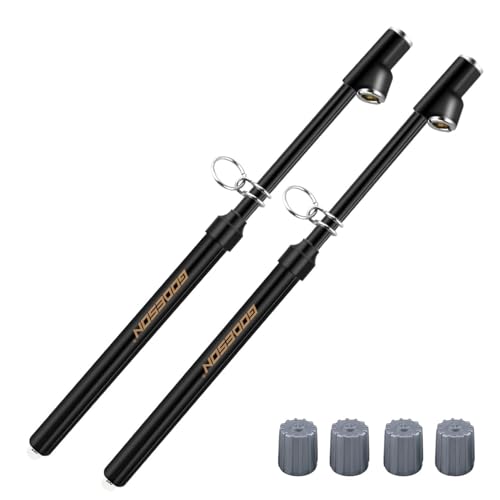
1. GODESON Dual Head Tire Pressure Gauge Pack of 2
Our pick — 4.5+★ from 500+ verified ratings; the strongest balance of quality and price.
Two chucks, no batteries, and a 10-150 PSI bar that reads the same in a snowbank as in a driveway.
This is the pick for anyone working dual rear wheels on a truck, trailer, or RV. The straight foot chuck reaches the inner wheel while the 30-degree reverse chuck handles the outer one, so you are not crawling under the truck twice with two different tools. The range runs 10-150 PSI across a two-sided ABS bar with a 2 PSI increment — far enough up to cover a loaded semi and low enough to be sensible on a passenger car.
The build is the reason it sits at the top. A zinc alloy chuck wrapped around a solid brass core, a stainless steel body, and black powder coating with a hanging ring mean there is no battery to die in storage and nothing electronic to fail in the cold. The scale bar slides out when you press the chuck on the valve, you read the pressure, and you push it back. Two gauges in the pack means one lives in the truck and one lives in the garage.
What wins people over is the build quality — it is the most-discussed strength here by a wide margin, with accuracy close behind. Owners run it against tires calling for 33, 55, and 75 PSI and report readings within 1 PSI of the required pressure, and at least a few have cross-checked it against their vehicle’s TPMS and found agreement. The catch is the format itself: a slide-out bar gives you no lock-in memory of the last reading, so if you check four tires you need to note each number before you touch the next valve. It is also a two-hand tool — one to seat the chuck, one to hold the body steady.
Where it earns its place
- Dual head covers both inner and outer dual wheels with one tool
- Zinc alloy chuck on a solid brass core with a stainless steel body
- No battery, so it works in any temperature and never needs charging
- 10-150 PSI range with a 2 PSI increment reads clearly at truck pressures
- Two gauges in the pack for truck and garage
What to know before you buy
- The slide-out bar does not lock a reading, so note each number as you go
- Readers who rate it as a backup tool rather than a primary gauge have a point for daily precision work
Reach for this if: you own a truck, trailer, or RV with dual wheels and want a gauge that survives being left in the cab.
Look elsewhere if: you want a needle that parks on the last reading while you walk around the vehicle.
2. CRAFTSMAN Digital Tire Pressure Gauge (CMMT14134)
A lit nozzle and a lifetime warranty, wrapped around the one weakness digital gauges cannot seem to shake.
The gauge reads from 0 to 100 PSI and displays in PSI, BAR, KPA, or KGF/CM2 — handy if your vehicle’s door placard or your compressor’s manual speaks a different unit than your gauge. A 30-second automatic shutoff is there to protect the battery.
Where this one splits buyers is reliability, and it is the most-discussed theme on the listing for a reason. Some units arrive working and keep working; others arrive with dead batteries or fail after a couple of uses. The housing is plastic rather than metal, and a fair share of the criticism lands there. If you get a good unit, the accuracy is genuinely good and the four-unit readout is more useful than most gauges at this tier.
The lifetime warranty is the honest counterweight to that risk — CRAFTSMAN backs it for life, which is more coverage than most gauges in this group offer. Treat it as a tool you verify on arrival rather than a benchmark instrument you trust blindly. Check it against a known-good gauge in the first week, and if the numbers agree, you have a solid night-time reader for not much money.
The plain verdict: buy it for the lighted nozzle and the four-unit display, verify it in the first week, and let the lifetime warranty do the rest.
Best fit: a commuter who checks pressures after dark and wants a single number without squinting.
Suits you if: a backlit display and a no-questions lifetime warranty outweigh the risk of a dud unit.
Not for you if: you want a gauge you can drop in a toolbox and forget about for five years — the plastic body and battery dependence work against that.
3. JACO Elite Tire Pressure Gauge – 100 PSI
The needle parks where it lands, so you can check four tires and read them all at the end.
If your gripe with pencil gauges is that the number vanishes the moment you pull the chuck off, this is the fix. The 2-inch dial face holds its reading until you press the reset button on the neck, and the scale is marked in 1 PSI increments up to 100 PSI with glow-in-the-dark markings for night checks. That lock-in behavior is the whole reason people pay for a dial gauge over a bar gauge.
It is also the most compact of the dial options here — solid brass under a shock-resistant rubberized gear-style guard, with a thick 2.25-inch brass stem. A built-in air bleeder valve lets you drop an overinflated tire a pound at a time without disconnecting, and the 360-degree swivel chuck reaches angled valve stems. The scale is calibrated to ANSI B40.1 standards at ±1.5%, and the pitch here is straightforward: a precise mechanical reading that never needs a battery.
What owners praise most is the build — the sheer count of people calling it quality made dwarfs every other theme on the listing, with ease of use a clear second. Set it on four tires reading 32 PSI and it holds 32 across the board. The honest caveat is durability against drops: the mechanism is happy for years of gentle use, but a knock directly on the brass stem can knock the needle off zero, and there are accounts of units arriving with the needle stuck. Store it in the included bag, not loose in a toolbox.
Why the dial wins: a 1 PSI resolution, a glow dial, and a needle that stays put make this the easiest gauge in the group to read after the fact.
The trade-off to respect: this is a precision instrument, not a hammer — protect the stem and it will outlast the batteries in every digital gauge here.
Buy it for: walk-around pressure checks where you want the reading waiting for you after each tire.
skip it if: your gauge lives loose in a toolbox and gets dropped regularly — the brass stem is the part to protect.
4. PINKJOY Digital Tire Pressure Gauge 230 PSI
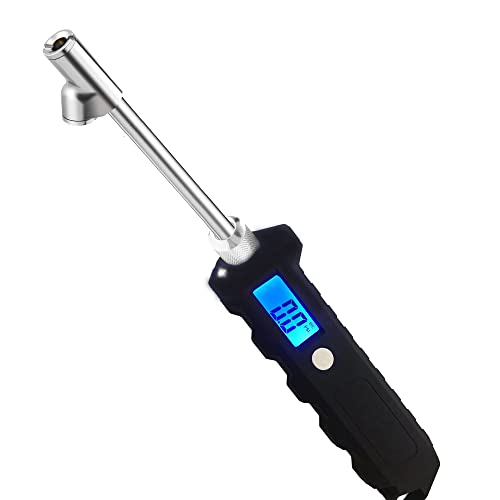
A stainless body and a flashlight for the RV pad at dusk, built to reach pressures a pencil gauge cannot.
Twenty-three hundred PSI in the headline is really 230 PSI, and that ceiling is the point — it covers RV and truck tires that would peg a 100 PSI gauge. The nozzle seals onto the valve stem and reads in 0.1 PSI increments, with four selectable ranges: 0-230 PSI, 0-16 Bar, 0-16 Kg/cm2, and 0-1585 Kpa. A blue backlit LCD and a built-in flashlight handle the visibility problem on a dim campsite.
The body is stainless steel, which is more substantial than the plastic digital gauges at this tier, and it weighs 4.8 ounces — heavy enough to feel like a tool, light enough to live in a glovebox. A single ON/UNIT/OFF button cycles power, units, and shutdown, and it auto-off after 30-40 seconds to save the batteries, which are included. Non-slip texturing on the housing keeps it steady against a wet valve stem.
Where the story gets honest: reliability is the most-discussed theme on this listing, and it splits both ways. Some units work perfectly and get used on rear dual tires on an RV; others drain batteries in storage even when unused. Practicality and value come through as the real strengths — one owner uses it on a motorhome and calls it practical, while another finds it awkward on garbage truck tires. Store it without batteries if it lives in a vehicle for months at a stretch, and it will behave.
What you actually get: a 230 PSI ceiling, 0.1 PSI resolution, a flashlight, and a stainless shell for RV and truck duty.
One honest note: the battery drain in storage is real — pull the cells if it sits unused for a season.
Pick this one: if you run an RV, box truck, or big trailer and want a lit, high-range reader with a stainless body.
Choose differently if: your vehicle is a passenger car and you never go above 100 PSI — a smaller-range gauge will read more precisely for the same money.
5. ETENWOLF T600 Digital Tire Pressure Gauge 250 PSI
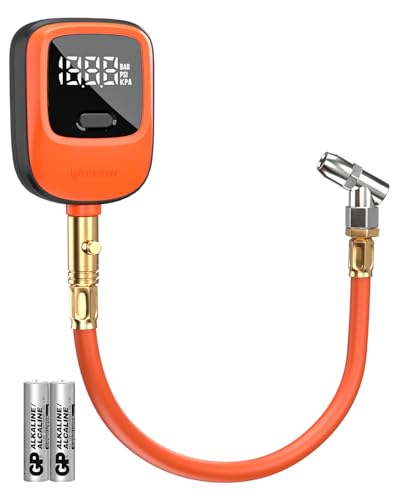
One button, 0.1 PSI resolution, and a rubber hose that bends into valve stems nothing else reaches.
The number that matters here is ±0.5% of full scale, calibrated to ANSI B40.7 Grade 2A — that is the tightest accuracy figure in this group, and it pairs with a 0.1 PSI display resolution across a 0-250 PSI range. Against the JACO Elite’s 1 PSI mechanical resolution, that is a tenfold finer readout on paper. The single button does everything: power, zero the reading, and cycle between PSI, BAR, and kPa.
This is the tool for recessed and awkward stems. A flexible rubber hose runs to a 360-degree rotating angled chuck, so you can seat it blind behind a wheel and still read the backlit display. There is a built-in air bleeder too — press it while connected and the display updates as the pressure drops, so you can fine-tune without a second trip to the compressor. It does not inflate; it checks and it bleeds. The unit is rated to operate from -14°F to 140°F.
Quality is what owners praise most here, with accuracy following close behind, and the display is bright enough that it stays readable in direct sun. It weighs 2.4 ounces and fits a glovebox or console easily. Two AA batteries are included but ship separately inside the package, so install them before you first try it — that one detail frustrates more new owners than any design flaw. The chuck uses a standard 1/4-inch NPT connection, so a damaged chuck can be swapped for a compatible one.
The spec worth the money: ANSI B40.7 Grade 2A calibration and a 0.1 PSI readout make this the most precise reader in the article.
The catch to expect: the screen is only as good as the batteries — keep two spares in the glovebox.
The right call for: anyone fighting deep or recessed valve stems, or watching pressures down to the tenth of a pound.
Another route: if you want a gauge that never needs batteries and a needle that locks, the JACO Elite is the mechanical equivalent.
6. LUMITECO 2-Pack Dual Head Tire Pressure Gauge, 10-150 PSI

Twelve inches of reach for dual tires, sold as a pair with spare valve caps in the box.
Where the GODESON above keeps its dual head at a standard length, this one stretches the tube to 12 inches — enough that you can stand clear of the wheel and still plant the chuck on an inner dual. A straight foot chuck and a 30-degree reverse chuck cover the inner and outer positions, the same split-head approach that makes dual-wheel checks bearable. Four spare valve stem caps are included, which is a small thing until the morning you lose one on the roadside.
The scale is a dual-sided ABS bar reading 10-150 PSI and 1-10 Bar in a 2 PSI increment. The body is zinc alloy over a solid brass core with a black matte-textured steel shell and a hanging ring, and like the other pencil gauges here it needs no battery. Weight lands at 318 g, which is heavier than a bare-bones plastic gauge but feels like a tool in hand. The two-pack means one gauge per truck.
Functionality is the top theme on this listing by a wide count, with quality second — and the strongest use-case note is that it works perfectly for a husband’s semi truck and reaches into tight spots on dual tires. The trade-off is the same format limitation as any pencil gauge: the bar slides back and you lose the reading, so chase each tire with a notepad or a phone. For a semi or a travel trailer, the reach more than offsets that small nuisance.
Why semi drivers tend to keep it
- 12-inch tube keeps you clear of the wheel while reaching inner duals
- Straight foot and 30-degree reverse chucks in one head
- Zinc alloy chuck on a solid brass core with a steel body
- Dual-sided 10-150 PSI / 1-10 Bar scale with a 2 PSI increment
- Two gauges and four spare valve caps in the pack
The honest limitations
- The slide-out bar does not hold a reading after you pull the chuck
- 318 g is heavier in a jacket pocket than a small digital unit
Made for: semi trucks, travel trailers, and any rig where the valve stem sits far behind the wheel face.
Not the one for: passenger cars — the 12-inch reach is more tool than a sedan needs, and a short pencil gauge fits a door pocket better.
7. JACO Elite Low Pressure Tire Gauge – 30 PSI

A 30 PSI ceiling that turns a one-pound change on a lawnmower tire into a visible move of the needle.
Most gauges fail at low pressures for a simple mechanical reason: on a 150 PSI scale, one pound of air is a hair-width of dial. This one stops at 30 PSI, so the sweep from 0 to 30 spreads across the whole 2-inch face and the needle actually moves when you drop from 6 PSI to 5. That is why it exists — ATVs, UTVs, dirt bikes, tractors, and off-road rigs that run low-pressure tires.
The hardware is the same JACO formula that made the 100 PSI pick a favorite: solid brass under a shock-resistant rubberized guard, a thick 2.25-inch brass stem with a 360-degree swivel chuck and an extended tip for a proper seal, and a glow-in-the-dark dial that locks the reading until reset. It is calibrated to ANSI standards at ±1.5%, and it never needs a battery. A built-in deflator valve lets you air down a pound at a time on the trail.
Quality is what owners praise most, and accuracy runs second, with real usefulness for UTV and lawnmower tires coming up repeatedly. A side-by-side against a professional tire shop’s far more expensive gauge reportedly showed agreement. The recurring trade-off is reading stability: if you move the gauge around while the chuck is seated, the needle can wander until you find a clean seal. Seat it firmly, hold still, and let the lock-in needle do the work.
Where it shines: airing a UTV or ATV down to single-digit pressures without guessing between 5 and 6.
What it will not do: check your wife’s sedan at 35 PSI — the scale tops out at 30, so you need a second gauge for the daily drivers.
Buy it alongside: your 100 or 150 PSI gauge if you own an ATV, UTV, tractor, or anything on knobby tires.
Not a daily driver’s tool: it maxes at 30 PSI, so a highway car at 35 PSI is out of its range.
8. Rhino USA Digital Tire Pressure Gauge (250 PSI)

A braided steel hose and a solid brass swivel head that snake behind reversed rims and saddle bags.
The build formula here is a metal braided hose married to a solid brass 360-degree swivel head, with a heavy-duty air bleeder valve on the chuck. That combination is designed for the cases where a straight gauge simply cannot go: reversed-mount rims, wheels with a large offset, and motorcycle valve stems tucked behind saddle bags. The swivel head lets you seat the chuck at any angle and still position the dial face where you can read it.
The dial is a large 2-inch LED-backlit glow dial, so low-light checks in a garage or at a rest stop are no issue. It is rated to 250 PSI and marketed against the ANSI B40.7 accuracy standard. There is no temperature rating listed, so treat it as an indoor and fair-weather tool rather than a piece of arctic kit. A bleeder valve makes it easy to drop an overinflated tire to spec without disconnecting.
Quality is what wins people over here, accuracy right behind it. Owners who have only used a slide-type gauge tend to note the step up in ease — you seat the chuck, read the number, and press the relief valve when you want to bleed. The recurring caveat is value: some feel the price sits high for what is essentially a hose and a dial, and a few question the made-in-USA claim. Neither of those undermines the tool’s function, but they are fair to raise before buying. Buying from a father-and-son American business is part of the pitch too.
The buying case: a braided steel hose, a brass 360-degree swivel, and a lit 2-inch dial for the wheels a straight chuck cannot reach.
One honest note: it is a premium-priced option, and the origin question is worth reading the listing for rather than assuming from the badge.
Best matched to: motorcycle riders and anyone with reversed rims or offset wheels who needs the hose to snake into place.
Overkill for: a plain sedan with exposed valve stems — a pencil or short dial gauge does the same job with less to store.
9. Milton S-568 Heavy-Duty Digital Tire Inflator with Gauge
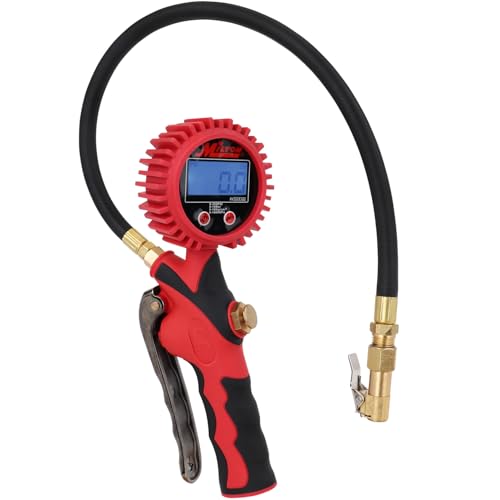
The only tool here that inflates and reads at once, with a clip-on chuck that stays put while you work.
This one is a different animal from the rest — it is an inflator with a gauge built in, not just a gauge. The pistol grip has an integrated inflate/deflate trigger, an easy lock-on brass clip chuck, and a 20-inch rubber air hose rated to 300 PSI. You clip it on the valve, pull the trigger to add air, and watch the backlit digital readout at 0.1 PSI resolution as the number climbs. The air inlet is 1/4-inch NPT.
The pressure range is 0-255 PSI, and it reads in PSI, kPa (0-1800), kg/cm2 (0-18), and Bar (0-18) — more unit options than most of the group. That display auto-on the moment it senses tire pressure and shuts off after 15 seconds of inactivity to preserve the two AAA batteries that ship with it. A 360-degree swivel gauge head lays flat in a tool drawer between uses, and the pistol grip handle is molded for one-handed work.
Quality is the top theme on this listing, with accuracy just behind, and buyers report setting even pressure on all four tires of two vehicles quickly with the quick-connect hub. The honest weakness is longevity — some units last years, and others have been reported leaking at the valve handle after eight months of use. If you are running a home shop, treat the hose connections as wear items. For a home garage compressor setup, the trade of convenience for that risk is often still worth it.
Worth knowing: a pistol grip with an inflate/deflate trigger, a lock-on clip chuck, and a 20-inch hose make this the fastest way to top off and confirm in one pass.
Fair warning: the handle valve is the part that ages, so check the seal periodically rather than waiting for a leak.
For home garage setups: if you keep a compressor, this replaces both your inflator and your gauge.
Not the right first gauge: you need a compressor and 1/4-inch NPT air line for this to work at all, so it is not a take-anywhere tool.
Know the Specs
PSI Range
PSI stands for pounds per square inch — the unit the tire pressure number on your door placard is measured in. A gauge’s range is the ceiling it can read to. A 0-100 PSI or 10-150 PSI range covers passenger cars, SUVs, and most trucks. A 0-250 PSI range covers semis, RVs, and heavy trailers. A 0-30 PSI gauge exists for low-pressure tires like those on ATVs and lawnmowers, where the smaller range spreads the scale out so single-pound changes are visible.
Resolution and Accuracy
Resolution is the smallest step the gauge can display — 1 PSI on a mechanical dial, 0.1 PSI on a digital display. Accuracy is how close the reading is to the true pressure. The two are not the same. A gauge can display 32.4 PSI (fine resolution) and still be 2 PSI off the true pressure (poor accuracy). Accuracy is stated as a percentage of full scale, like ±0.5% or ±1.5%, or as a standard such as ANSI B40.1 or B40.7. A tighter percentage and a lower PSI range generally mean a more precise tool for the pressures you actually run.
Chuck Style
The chuck is the fitting that presses onto the valve stem. A straight foot chuck points straight down and reaches inner dual wheels. A 30-degree reverse chuck is angled for outer wheels and hard-to-reach stems. A swivel chuck rotates 360 degrees so you can seat it at any angle, and a clip-on chuck locks in place so you can work with both hands. A rubber or braided steel hose extends reach beyond the length of the gauge body itself.
Bleeder Valve
A bleeder valve releases air through the gauge while it is still connected, letting you lower an overinflated tire in controlled steps. On digital gauges, the display updates live as pressure drops. On mechanical dial gauges, the needle follows the pressure down. This saves a walk back to the compressor and lets you fine-tune to the exact pressure your placard calls for.
Common Questions
Will a 150 PSI gauge work on a passenger car tire?
Is a digital tire pressure gauge more accurate than a dial gauge?
How often should I check my tire pressure with a gauge?
What does the 2 PSI increment on a pencil gauge mean?
Why does my digital gauge read differently from my car’s TPMS?
Do I need a different gauge for dual rear wheels on a truck?
Can I use a 30 PSI gauge on a regular car?
What is a bleeder valve for on a tire gauge?
Do digital tire gauges drain batteries when stored?
Should I buy an inflator with a built-in gauge instead of a standalone gauge?
The Bottom Line
For most people the reliable tire pressure gauge winner is the GODESON Dual Head Pencil Gauge because it covers 10-150 PSI with two chucks, a brass core, and no battery to fail — and it comes as a pair. If you want a needle that locks and glows in the dark, grab the JACO Elite 100 PSI. And for recessed valve stems or a tenth-of-a-pound readout, the ETENWOLF T600 is the one to reach for.
One last nudge: match the PSI range to the vehicle you drive today, check the new gauge against a known-good one in the first week, and store it where it will not get dropped. One gauge that holds its calibration for years beats three that sit in a drawer because they drifted or drained.
How we choose
We do not accept paid placement. Every pick is matched to a real buyer and a real use-case; we do not hands-on test units.
Sources
Specifications: manufacturer listings and product documentation. Review insights: verified customer reviews, as of November 2026. Pricing: not shown on this page (it changes often); check the current price via the retailer link.
As an Amazon Associate, Tactical Gear Guy earns from qualifying purchases. This does not affect which products we feature.