Specs are compiled from manufacturer listings and verified buyer reviews and can change over time — please confirm the key details on the product page before buying.
You want a tent that lights itself — no dangling lantern, no fumbling for a headlamp at 2 a.m. Every pick below has a light built in or wired in, and each one is a genuinely different answer to the same question. The CORE earns the top slot because it solves the whole problem in one package: a cabin-size instant tent with ceiling LEDs you switch from the wall, four levels of nothing to think about.
This guide is built by comparing the manufacturers’ published specifications and the patterns across verified customer reviews, so you get each pick’s real strengths and trade-offs instead of marketing spin.
Some of these are family car-camping cabins you stand up inside, and some are rooftop hard-shells that pop with gas struts. What they share is the feature that ends the flashlight search. Here is how each one handles the light — and the weather — so you can choose a tent and light combination that actually fits the way you camp.
Top Picks


How To Choose The Best Tent and Light
What separates a tent you love from one you tolerate is how the lighting is powered, how fast it goes up, and how the fabric handles a wet night. Work through these four decisions in order and the shortlist builds itself.
Work out where the light gets its power
A ceiling light wired to a wall switch means no cable hunting once you are inside — that is the CORE’s approach, with three brightness levels and a night-light mode. A USB-powered strip, which is how the Naturehike does it, means you bring your own power bank. That is not worse, just different: you control the runtime, but you must remember the bank. The two rooftop shells run their LED strips off the vehicle, so the light arrives with the campsite already set up.
Decide between instant poles and gas struts
Pre-attached poles that lock into place get a ground tent standing in about a minute of work, and one cabin model here comes in at 60 seconds. Rooftop hardshells flip that: you open up a lid and let gas struts lift the roof. The trade-off is the mounting. A rooftop tent needs crossbars rated for the load, and that step happens before you ever leave the driveway.
Read the waterproof numbers, not the words
A fabric rating in millimeters tells you how much water column the material resists. Higher is more protective. Pair that number with taped seams and a full rainfly, because a strong fabric with exposed stitching still lets water through. Ventilation matters just as much — lower vents and a mesh ceiling move hot air out so condensation does not build up on the inside walls.
Match the footprint to your people
Floor area in square feet is the honest measure of how many sleepers fit with gear. A cabin rated for six without gear is a three-person tent once bags, cots and a cooler move in. If you want to stand up and change clothes, check the center height — a 6-foot peak is the line where most adults clear the roof.
Side-by-Side Comparison
| Model | Best For | Light Source | Sleeping Capacity | Floor Area | Amazon |
|---|---|---|---|---|---|
| CORE Family Camping Instant Lighted Cabin Tent★ Best Overall | Family base camp | Ceiling LEDs, wall switch | 3 with gear, up to 6 without | 99 sq ft | Amazon |
| Coleman Skydome 4-Person Tent with LED LightsBest for Weekends | Quick weekend trips | Warm diffused LEDs | 4 people | — | Amazon |
| Naturehike Village Instant Tent | Sleeping past sunrise | USB-powered built-in lights | 4 with mattresses, up to 8 | 140 sq ft | Amazon |
| Adventurer Pro Rooftop Tent Hard Shell | Overlanding rigs | Built-in LED strip | 2 adults and 1 child | 4325 sq in | Amazon |
| SanHima Hotham Rooftop Tent Hard Shell | Low-profile vehicle travel | Full-ceiling LEDs | 2 adults | 3761.3 sq in | Amazon |
Detailed Reviews
1. CORE Family Camping Instant Lighted Cabin Tent
Our pick — 4.0+★ from 900+ verified ratings; the strongest balance of quality and price.
A 99-square-foot instant cabin whose ceiling-pole LEDs run off a wall switch, so there is no lantern to hang.
The LEDs sit inside the ceiling pole, and you control them from a switch mounted on the wall — three levels of illumination plus a night-light setting. No lantern hanging from a loop, no cable to trip over. That single design choice is why this one sits at the top of the list.
Setup is genuinely instant: the pre-attached poles lock into place in 60 seconds or less. The floor plan is 11 by 9 feet with a 72-inch center height, which fits two queen-size air beds and sleeps 3 with gear or up to 6 without. That 99 square feet of floor area puts it just shy of the Naturehike cabin’s 140, so pick this one if a stand-up family tent that goes up in a minute matters more than maximum floor space.
Weather hardware is real: H20 Block Technology with 1200mm fabric, a fully taped rainfly, sealed seams and fully zipped windows. Lower vents pull cool air off the ground while the mesh ceiling lets hot air escape. The hanging organizer keeps keys and phones off the floor. The catch is durability at the seams — a small share of buyers have opened the box to find netting or a floor seam already compromised. That is a small slice of an otherwise well-loved tent, and the fix is usually a straight swap.
Where it wins
- Ceiling-pole LEDs with three levels and a night light, all from a wall switch
- 60-second setup with pre-attached poles
- 72-inch center height and 99 square feet of floor
- Fully taped rainfly and sealed seams on 1200mm fabric
Where to watch it
- Seam durability is the recurring weak point in owner feedback
- Up to 6 sleepers is a no-gear number — three is realistic with bags
Reach for this if: you want a family cabin that lights itself and stands up before the kids lose patience.
Look elsewhere if: you need the most floor space per person — that is the Naturehike’s job.
2. Coleman Skydome 4-Person Tent
A four-person dome with warm diffused LEDs and preattached poles that pitch in 5 minutes.
This is the tent you hand to a teenager with zero camping experience and no supervision beyond a shrug. The preattached poles get the Skydome standing in 5 minutes, which is the second-fastest time in this group — only the CORE’s 60 seconds beats it, and rooftop shells don’t count because they need a vehicle underneath.
It throws warm, diffused glow across the inside — not a harsh beam, more like the inside of a lit cab. Plenty of buyers describe it as their favourite part of the tent, and it makes an evening card game feel natural rather than flashlight-lit. Four people is a genuine four, since this is the only dome here that does not upsell its capacity.
Where it gets honest: the durability read is split. Some campers ride out soggy festivals dry while neighbors flood, and others have watched the poles give way in strong wind. Weigh that against the modest review base and the picture is a light-use tent that rewards fair weather and careful handling. Packing it back into its stuff sack is also a squeeze — expect a wrestling match at the end of the trip.
The climate it suits: calm summer weekends, scout trips, festival fields and back gardens. The LED glow is a genuine upgrade over lantern light, and five-minute pitching is a real gift when the sky is turning grey.
The honest limit: if you camp where gusts are a routine, spend a tier higher — the Skydome is a fair-weather companion, not a storm shelter.
Go for it if: you want a simple, cheap-to-enter four-person with a lovely indoor glow.
Pass if: your camping calendar runs through exposed ridgelines in autumn.
3. Naturehike Village Instant Tent
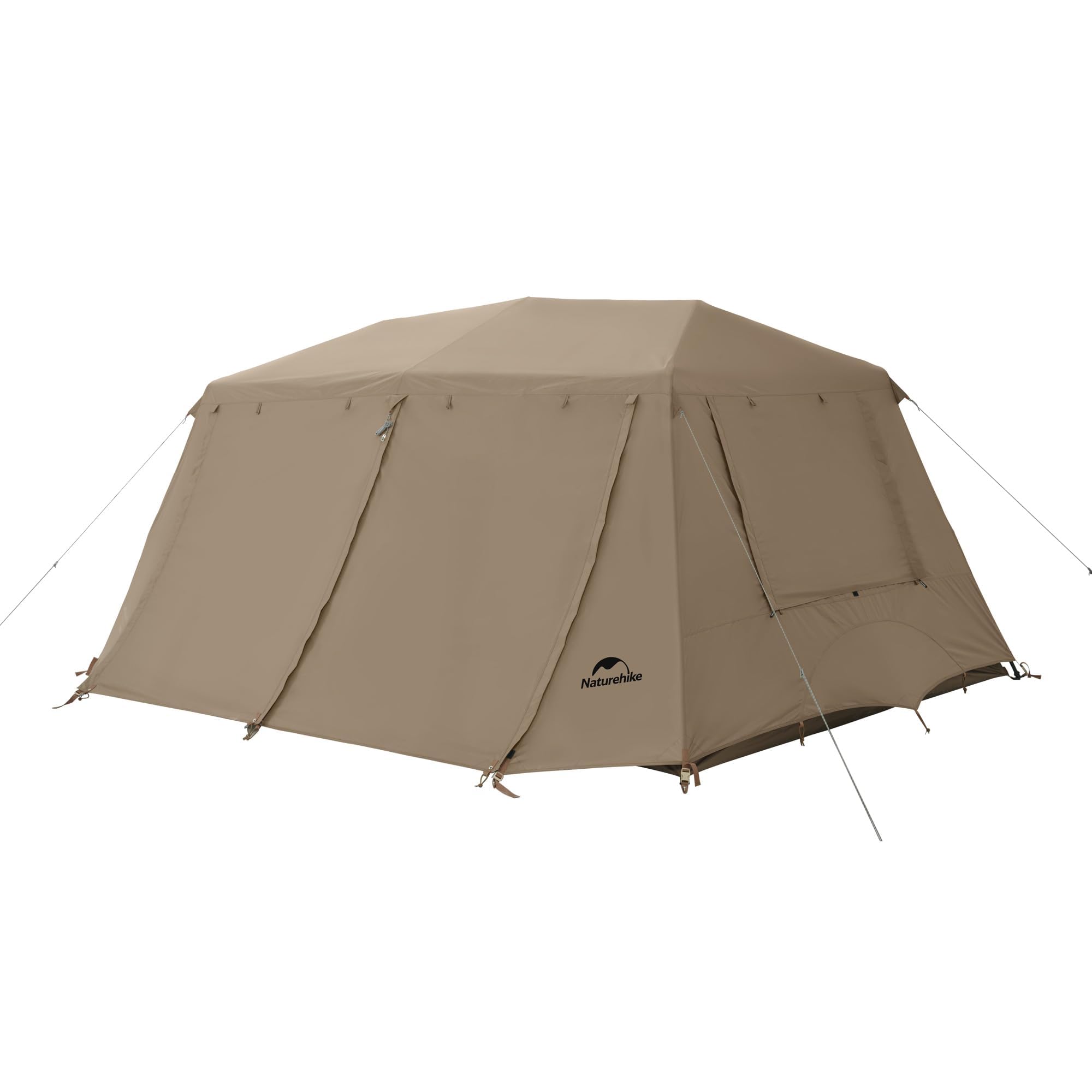
A 140-square-foot blackout cabin with a 6-foot peak and USB lights that run off your own power bank.
Nothing else here gets close on floor space. The Village measures 155.5 inches long by 106.3 inches wide — 140 square feet — and that width is more than twice the 51.57-inch floor of the Adventurer Pro rooftop shell. The same applies to the height: a 6-foot peak means most adults stand upright to change, and the two-room design with a dividing curtain gives you a place to dress without an audience.
The blackout fabric is the sleeper feature. The 150D Ti Black Technology material carries a UPF 50+ rating and a waterproof rating above 2000mm, and it dims the inside to pitch black when you close it up. If you have ever been woken at first light in a regular tent, that alone justifies the upgrade. The built-in lights run off USB to a power bank you supply — a wall switch is not part of the deal, so pack the bank.
The trade-offs show up in wind and in the roof. Stability through rain storms is praised, and the build quality is the single most-talked-about strength. But the rainfly has split at seams for some owners in a 23mph gust, and the standard durability read is genuinely mixed. The fly also will not fold neatly back into its stuff sack — you knew that going in. One more thing: tall campers over 5-foot-11 will find the peak tight.
What owners keep coming back to
- 140 square feet of floor and a 6-foot peak you can stand in
- Blackout fabric that turns the interior pitch dark
- Two-room layout with a dividing privacy curtain
- Instant setup in 60 seconds with pre-attached poles
- Five-sided ventilation with mesh windows for stargazing
What to plan around
- Lights need a USB power bank that is not included
- The rainfly has torn at seams in strong gusts for some owners
- Tall sleepers feel the 72-inch peak
This is your tent if: you sleep late and want to actually walk around inside.
Leave it on the shelf if: you need a rainfly that shrugs off mountain squalls.
4. Adventurer Pro Rooftop Tent Hard Shell
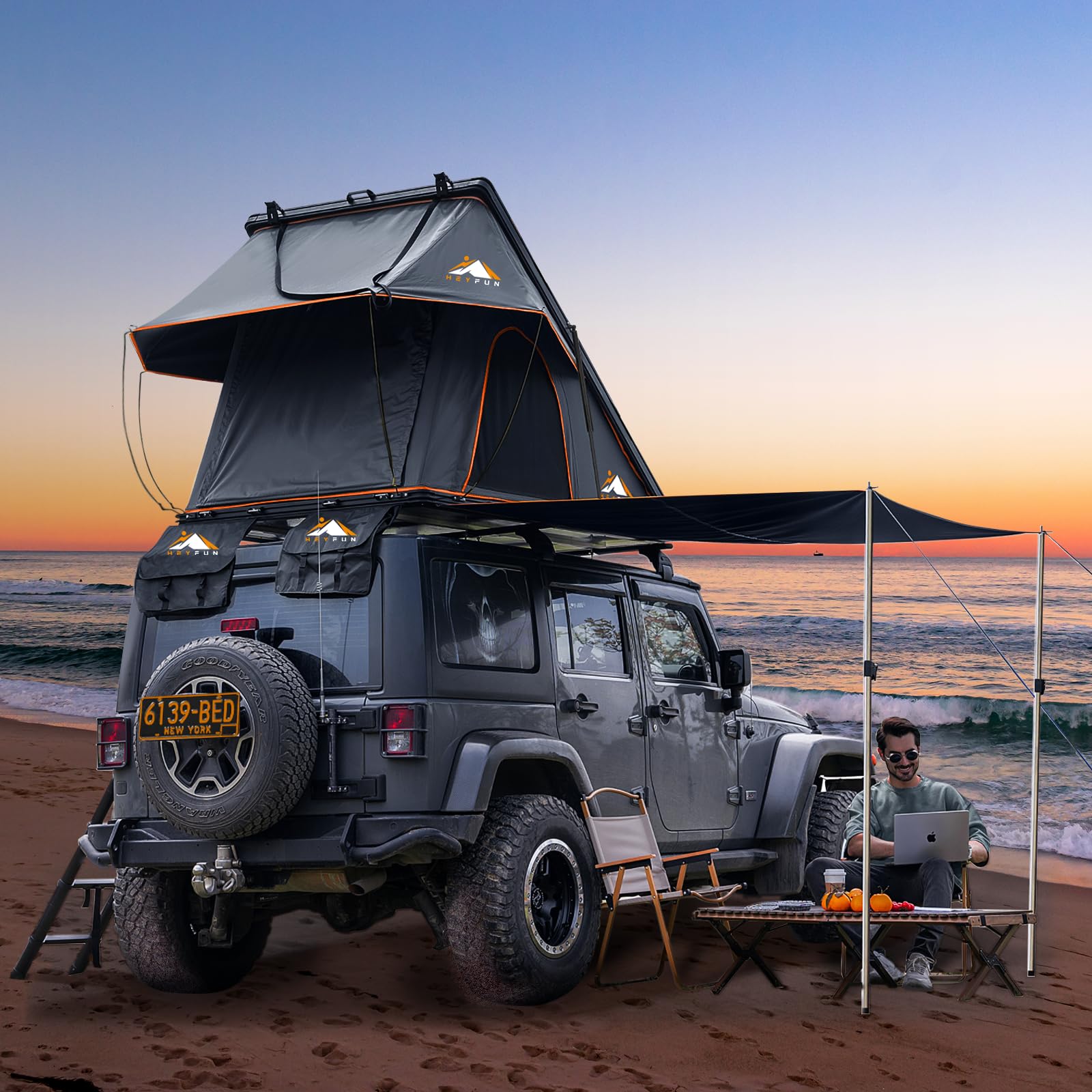
An aluminum hard-shell rooftop that gas struts open in a claimed 5 seconds, rated for 660 lbs.
Five seconds. That is the claimed open-and-close time on this hydraulic shell, thanks to gas struts and dual buckles, and buyers back it — the pop-up speed is what surprises people most. Compare that to the 10 minutes of assembly time the maker lists for mounting and setup, and to the Coleman’s 5-minute ground pitch, and you see the difference between a rooftop shell and a floor tent.
The hard shell is aircraft-grade aluminum, and it shows in the load rating: 660lbs maximum across a floor area of 4325 square inches. Closed, it measures 83.86 inches long by 51.57 inches wide by 7.00 inches tall — that thin twin-slab profile feels far more like a roof box than a canvas turret. Open, it reaches 62.99 inches, enough for two adults plus a child. Inside you get a flocked lining floor, a sleeping mat, a condensation mat, 13 ceiling and sidewall pouches, a telescopic ladder and a built-in LED light strip.
What buyers actually report: the construction is solid, the gas struts are strong, and the tent handled 15+ hours of rain without issues — one buyer’s words. That same strut strength is the honest catch, because what opens easily also resists closing. Two people make the job easier; three is ideal. And before any of this, plan for crossbars rated to at least 165 lbs. Skip that step and the tent does not go on the vehicle.
The pitch that lands: four-season hardware — waterproof, windproof, rainproof and snowproof — plus a side awning, a shoe bag and a light strip that runs off your rig. For overland travel, that is a full campsite in one lift.
The honest limit: closing the shell fights the struts every time, and setup wants a second pair of hands.
Built for you if: your vehicle is already set up for roof cargo and you sleep roadside or off-grid.
Not your match if: your crossbars are rated under 165 lbs or you camp solo without help lifting.
5. SanHima Hotham Rooftop Tent Hard Shell
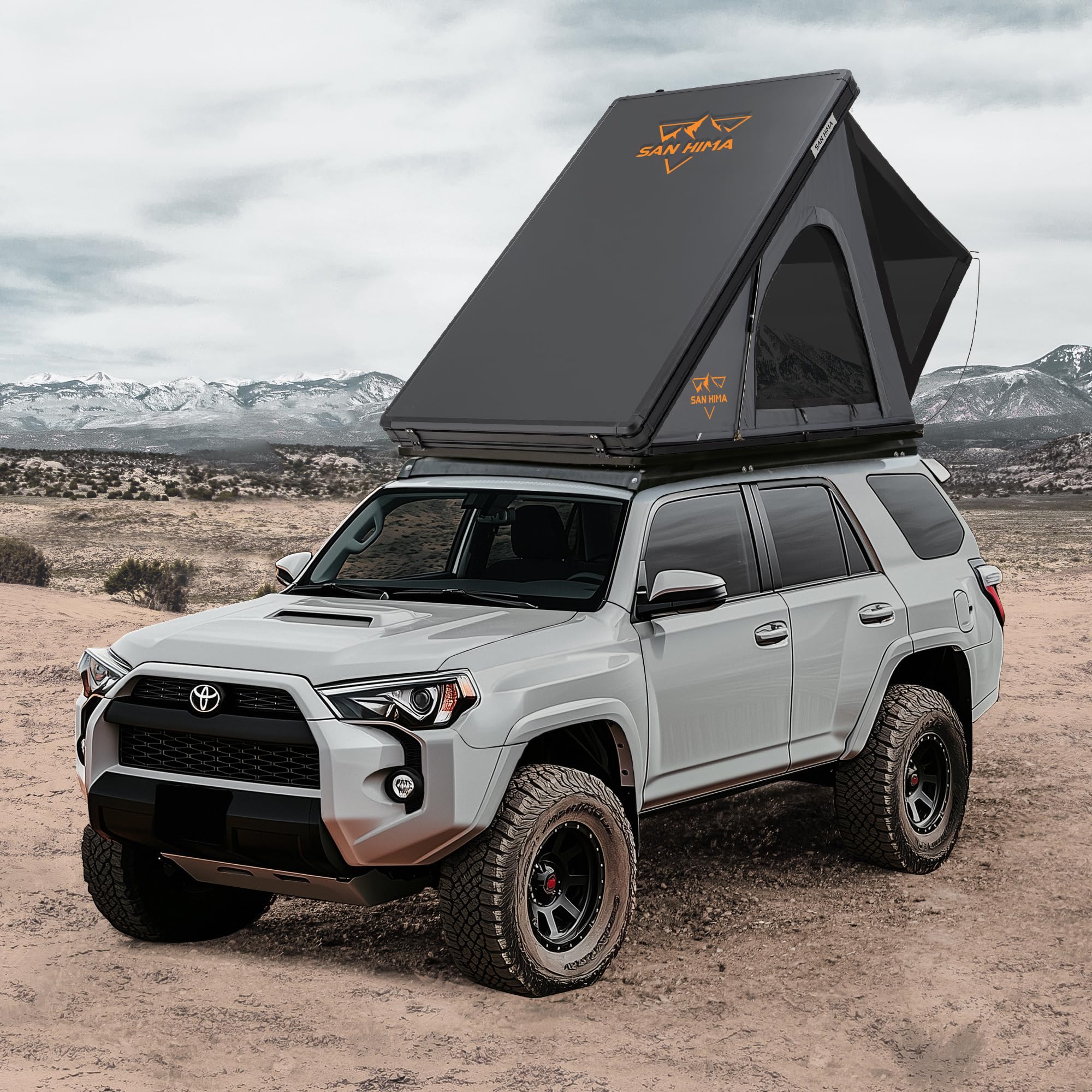
A 133.40 lb aluminum rooftop shell that closes to 4.57 inches, low enough for most garage doors.
Most rooftop tents end the same way: you love the sleep, then discover the thing will not fit under the car park barrier. The Hotham solves that with a 4.57-inch closed thickness and a 133.40 lbs shell the maker says is 32% lighter than its standard model. Buyers agree the lightweight sit is real — one describes lifting it onto the vehicle with two strong people — and it keeps the vehicle quieter and more fuel-efficient on the road.
Inside, the room is 81.50 by 46.06 inches, with a 2.36-inch self-inflating mattress and a silver lining that blocks light and holds heat. The fabric is 420D double ripstop Oxford with 280G poly-cotton, carrying 5,000mm waterproofing and UV50+, and a 1.57-inch raised base keeps standing water away from the seams. The LEDs run the full ceiling and shift between bright white, natural daylight and amber. The rainfly sets itself when you open the shell, so no rods to thread.
Setup is open up, lift, and let the struts lift the roof — the maker quotes 30 seconds and buyers report it quick. A telescopic ladder rated for 330.69 lbs clips on, and a digital panel with USB-C, USB-A and a CIG socket handles charging. The catch is the aftermarket step: this shell needs rooftop brackets, and the fit read is genuinely mixed — some rigs mount perfectly and some need extra spend on hardware. Plan for the brackets before you buy.
The good stuff
- 4.57-inch closed profile fits most garages and car parks
- Full-ceiling LEDs with three color settings
- 5,000mm waterproofing with a 1.57-inch raised base
- Self-setting rainfly and a 330.69 lb rated ladder
- USB-C, USB-A and CIG sockets on a digital panel
What to budget for
- Rooftop brackets are a separate purchase and the fit is mixed
- The mattress is on the thin side for side sleepers
Make it yours if: you park in a garage and want the light, the rainfly and the low profile together.
Look at the Adventurer instead if: you would rather have the bigger open floor than the slimmer shell.
Know the Specs
Waterproof Ratings in Millimeters
A rating like 1200mm or 2000mm describes how tall a column of water the fabric resists before it starts to seep. It is a fabric measure, not a promise that the whole tent stays dry — sealed seams and a taped rainfly carry just as much weight. The SanHima’s 5,000mm rating is the most protective fabric in this group; the CORE uses 1200mm with a fully taped rainfly and sealed seams to compensate.
Instant Setup Versus Gas Struts
Instant tents use poles pre-attached to the fabric that lock into position. The CORE and Naturehike both quote 60 seconds. Rooftop shells flip the mechanism: gas struts lift a hard shell, and the Adventurer claims 5 seconds open and close. The difference is that a ground tent needs your hands, while a rooftop shell needs a mounted, load-rated crossbar system first.
How the Built-In Lights Are Powered
Three power approaches appear here. The CORE wires LEDs into the ceiling pole with a wall switch and three levels. The Naturehike requires a USB power bank you supply yourself — it is not included. Both rooftop shells run LED strips from the vehicle. The thing to note is that only the CORE gives you a light with nothing extra to pack.
Blackout, UPF and Interior Comfort
Blackout fabric is measured by how much visible and UV light it blocks. The Naturehike’s 150D Ti Black Technology carries a UPF 50+ rating and dims the interior to pitch black, which matters when you want a nap at midday or a slow morning. The SanHima’s silver lining and full-ceiling LEDs follow the same logic — control the light, both coming in and going out.
Common Questions
Do I need a power bank for the Naturehike Village’s built-in lights?
How many people really fit in the CORE 6-person cabin?
Will the Adventurer rooftop tent fit my SUV?
Which of these tents can I stand up inside?
How long does the Skydome take to pitch compared with the other tents?
Is the Naturehike Village good for hot weather?
Do rooftop tents need two people to open and close?
What does the SanHima’s 5,000mm waterproof rating actually mean?
Can I add a light to a tent that lacks built-in LEDs?
How does the Coleman Skydome hold up in wind compared with the cabin tents?
The Bottom Line
For most campers, the tent and light setup that simply works is the CORE Family Camping Instant Lighted Cabin Tent. The ceiling LEDs with a wall switch end the flashlight problem, the 60-second setup gets you inside fast, and the 99 square feet fits a family with gear. If you sleep late and want a bedroom you can stand in, the Naturehike Village blackout cabin gives you 140 square feet of pitch-black floor. And for overland travel, the Adventurer Pro Rooftop Tent pops open in 5 seconds with a built-in LED strip — provided your crossbars are rated for the load.
The cleanest way to settle on one is to decide how the light gets its power. A wall switch means nothing extra to pack. A USB strip means you control the runtime. A vehicle-wired rooftop means the light arrives with the campsite. Match that choice to your trip and the rest follows.
How we choose
We do not accept paid placement. Every pick is matched to a real buyer and a real use-case; we do not hands-on test units.
Sources
Specifications: manufacturer listings and product documentation. Review insights: verified customer reviews, as of November 2026. Pricing: not shown on this page (it changes often); check the current price via the retailer link.
As an Amazon Associate, Tactical Gear Guy earns from qualifying purchases. This does not affect which products we feature.