Specs are compiled from manufacturer listings and verified buyer reviews and can change over time — please confirm the key details on the product page before buying.
A corded electric trim nailer is for running baseboard, shoe mold, or picture-frame trim in a finished room without dragging an air compressor and hose in. A corded electric trim nailer plugs into a wall outlet, fires 18-gauge brads into trim, and lets you work in a finished room without hauling heavy gear. The DEWALT DWFP12233R takes the top spot here because it gives you real depth control and a jam release you can work without tools, and it holds the strongest owner feedback of the three picks at 4.0+ stars across 100+ ratings.
This guide is built by comparing the manufacturers’ published specifications and the patterns across verified customer reviews, so you get each pick’s real strengths and trade-offs instead of marketing spin.
Three corded options are covered below, sorted by what they realistically handle on a trim job. To get straight to the point, here is the short version of the electric trim nailer list so you can pick fast and get back to your project today.
Top Picks

How To Choose The Best Electric Trim Nailer
A trim nailer succeeds or fails on depth of drive: whether the brad sinks just below the surface and stops there. Trim is soft, thin, and visible, so a nail that blows through the face or sits proud of the surface means filler, sanding, and a repair you did not plan for.
Gauge and fastener length first
Gauge is the thickness of the nail, and 18-gauge is the standard for interior trim because the hole it leaves is small enough to fill with a dab of putty. All three picks here run 18-gauge brads, so the real split is length range. The DEWALT drives brads from 5/8 inch up to 2-1/8 inch, which covers shoe mold through thicker casing. The Batavia covers 5/8 to 1.25 inch, and the Arrow tops out at 1 1/4 inch. If your job includes thick crown or stacked baseboard, length range narrows the field fast.
Depth adjustment is essential
Wood density changes from one board to the next, even within a single room. A depth dial or tool-free depth adjuster lets you dial the drive in so the head sits just below the surface on pine and does not crater on oak. Tools without usable depth control cause proud or over-driven brads, the exact complaint in the Batavia feedback.
Power source and cord reality
All three are corded-electric, which means no compressor, no hose, and no battery to charge. The trade-off is a cord trailing behind you, so check the cord length before you buy. The Arrow ships with a durable 10-foot cord, and Arrow also notes that any extension cord you add needs to be 12 gauge or heavier, because a thinner cord makes the tool fire with less power.
Safety systems and firing speed
A contact sensor or dual safety switch means the tool only fires when the nose is pressed against the work, which protects fingers and prevents a stray shot across the room. Firing speed matters too. The Arrow is rated at 20 fires per minute, with Arrow recommending at least 3 seconds between shots for the tool to work optimally — slow that down if you are used to a pneumatic gun.
Side-by-Side Comparison
| Model | Best For | Fastener Range | Power Source | Weight | Amazon |
|---|---|---|---|---|---|
| DEWALT DWFP12233R 18-Gauge Brad Nailer (Renewed)★ Best Overall | Trim and casing with depth control | 18 GA brads, 5/8″ to 2-1/8″ | Corded-electric | 5.37 lb | Amazon |
| Batavia 2-in-1 Staple Gun Brad Nailer 18 Gauge | DIY and upholstery on a light budget | 18 GA brads 5/8″–1.25″; 1/4″ crown staples 5/8″–1″ | 120V corded electric | 1.6 lb | Amazon |
| Arrow Fastener ET200 Heavy Duty Electric Nail Gun | Small jobs and weekend projects | Brads up to 1 1/4″ | Corded-electric | 2 lb | Amazon |
Detailed Reviews
1. DEWALT DWFP12233R Brad Nailer
Our pick — 4.0+★ from 100+ verified ratings; the strongest balance of quality and price.
Reaches 2-1/8 inch — the longest brad run of the three by a clear margin.
That 2-1/8-inch maximum is what earns this tool its place. Trim carpenters stack baseboard, cap it, and run casing on door frames, and those jobs call for longer brads than a 1 1/4-inch ceiling allows. This DEWALT drives 18-gauge brads anywhere from 5/8 inch up to that 2-1/8 inch maximum, so one tool covers shoe mold and window casing in the same afternoon.
The second half of the pitch is depth. A tool-free depth-of-drive adjuster lets you set how far the head sinks without hunting for an Allen key, so you can leave the nail just below the surface on pine and back it off on harder stock. The trigger is selectable between sequential and contact actuation, giving you a deliberate shot-per-trigger-pull mode or a faster bump-fire mode for long runs.
Compare the physical side against the Arrow ET200 below and the difference is stark. This DEWALT weighs 5.37 pounds against the Arrow’s 2 pounds, and measures 11.3 x 3.2 x 9.5 inches against the Arrow’s 8 x 4 x 6 inches. That extra heft and length buy you the longer fastener range and the depth mechanism, but it is a two-hand tool, not a one-hand palm gun — plan to set it down between boards. One more thing to know going in: this is a renewed unit sold under a 90 days limited warranty, and the pattern across owner feedback is that it arrives looking untouched and runs as well as new. The most-discussed strength is build quality, with reliability close behind, and the loudest recurring note is that a renewed DEWALT is simply a smart way to get into one.
What Sells Me On It
- Drives 18-gauge brads from 5/8 inch all the way to 2-1/8 inch — enough length for real casing work
- Tool-free depth-of-drive adjustment so nail heads set properly without extra tools
- Tool-free jam release gets you back to work after a misfire
- Rear exhaust keeps debris away from the work surface
- Selectable sequential or contact trigger for controlled shots or fast runs
Where It Costs You
- At 5.37 pounds and 11.3 x 3.2 x 9.5 inches it is a two-hand tool that you set down between boards
- Renewed stock carries a 90 days limited warranty, not a full new-tool term
- Steepest learning curve of the three if you have never run a brad nailer
My call: Buy this one if your trim work runs to thicker casing, stacked baseboard, or crown where a 2-1/8 inch brad is the difference between a job done and a job stalled.
Think again if: You want a featherweight palm gun for quick picture frames — the Arrow below fits that hand better.
2. Batavia 2-in-1 Staple Gun Brad Nailer
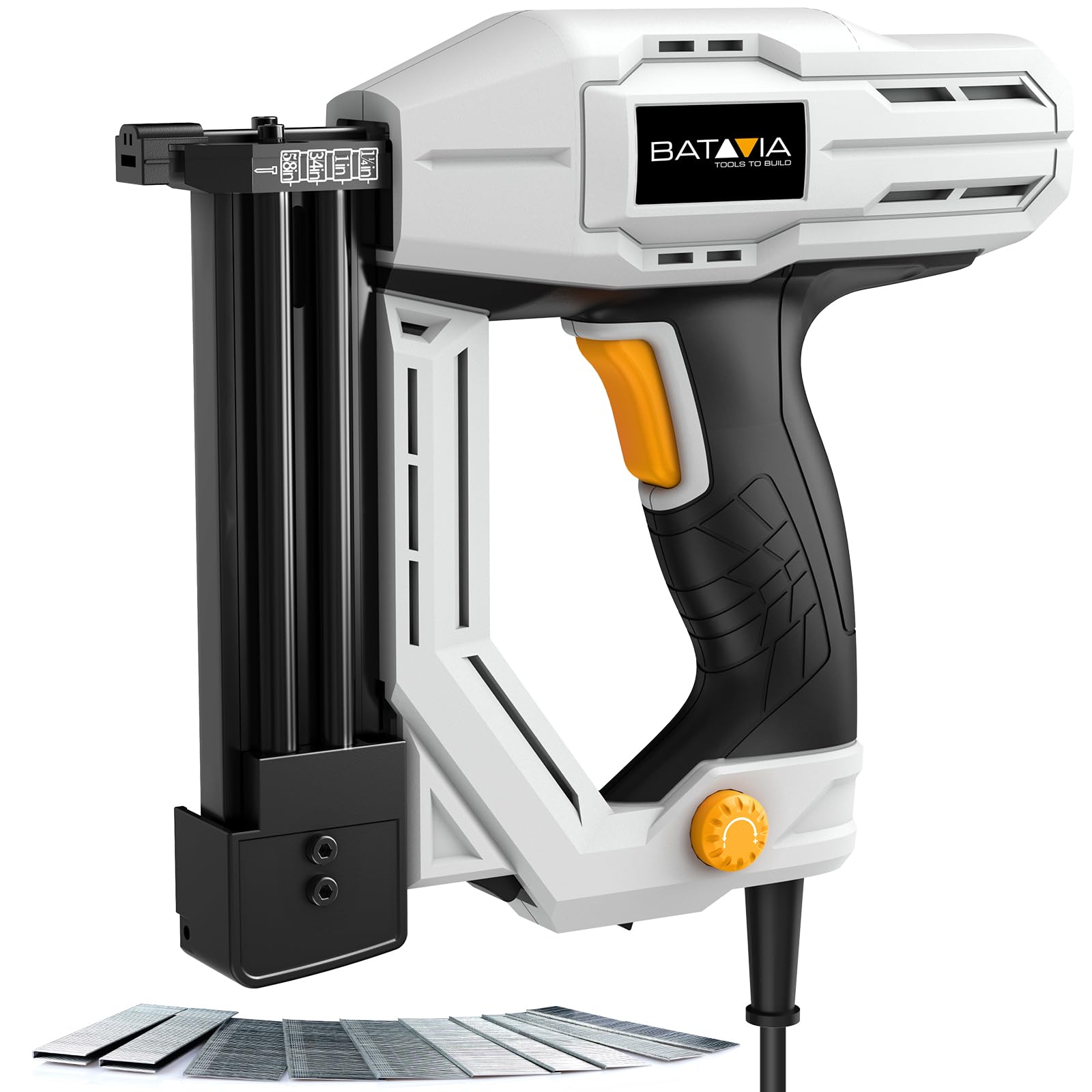
Two tools in one body at 1.6 pounds, with 1,000 fasteners in the box to start.
If your projects hop between re-covering a chair seat and tacking up a picture frame backer, this is the shape that makes sense. The Batavia fires 18-gauge brad nails from 5/8 inch to 1.25 inch and 1/4-inch narrow crown staples from 5/8 inch to 1 inch, and the box includes 200 staples and 800 nails, so you can start the first job without a separate fastener run. Batavia puts the body at 1.6 pounds with a soft-grip handle, which is the lightest of the three picks and the easiest to hold through a long session. Note the two-hand operation requirement — that is a deliberate stability feature, not a fault.
What wins owners over is how little setup the tool requires. It runs off a standard 120V outlet with no compressor or hose, the non-marring rubber nose tip keeps oak and MDF scratch-free, and a force dial lets you turn down the drive for delicate fabric or up for dense hardwood — always on scrap first, as Batavia recommends. The triple safety setup (power switch, contact sensor, and trigger lock) means it fires only when the nose is fully depressed. Owners consistently describe it as easy to use and versatile for DIY and home projects, and the finger-safety angle is the refrain that shows up again and again.
The honest part: this is where the star count sits lower than the other two picks. Power and reliability draw split opinions: some owners find it strong enough for trim and light carpentry, others report it falling short on dense material, and there is a distinct thread about nails not landing flush on trim installs even after adjusting the depth knob. Treat this as a fit question rather than a defect. It is a genuinely good DIY and upholstery tool at a budget-friendly tier, and Batavia itself lists it as not recommended for drywall, flooring, baseboards, or electrical wiring. If finish-grade baseboard is the whole point of the purchase, step up to the DEWALT above.
The value read: Two fastener types, 1,000 pieces in the box, and a 1.6 lb body make this the cheapest way to cover upholstery and light carpentry with one corded tool.
The trade-off to accept: Power tops out earlier than the DEWALT and flush trim nailing is the weak spot — this is a DIY workhorse, not a finish carpenter’s gun.
Reach for this: Upholstery, picture framing, pet house assembly, and mixed DIY jobs where one light tool and a starter box of fasteners gets you moving.
Look elsewhere: Your job is finish baseboard or trim where every single nail must sit flush on the first pass.
3. Arrow Fastener ET200 Electric Nail Gun

A 2-pound gun with a 10-foot cord — reach without dragging an extension around.
Start with the cord, because it is the detail that changes how a small job flows. Arrow builds in a durable 10-foot cord, so you can set the tool down and cross a room without hunting for an outlet. The body comes in at 2 pounds and 8 x 4 x 6 inches, a full 3.37 pounds lighter and far more compact than the DEWALT at 5.37 pounds and 11.3 x 3.2 x 9.5 inches. On ladder work or overhead trim, that gap is the whole story. Hardened steel moving parts and an impact-resistant housing, plus an ergonomic grip, are aimed squarely at fatigue and jobsite knocks.
Where Arrow draws clear lines is in the specs it publishes. The tool fires 20 times per minute, with Arrow recommending at least 3 seconds between firings so it works optimally — this is a paced tool, not a rapid-fire pneumatic replacement. The 12-gauge-or-heavier extension cord note matters too: run it on a thinner cord and Arrow states the tool will fire with less power. And it tops out at 1 1/4-inch brads, so thick casing and crown stay out of reach. What it does well is the weekend-warrior tier: a face frame that needs 8 brads, hobby work, small assemblies. The most-discussed strength is versatility for small jobs, and owners note it lacks some of the punch of a pneumatic gun, which is a fair expectation to set going in.
The recurring gripes are worth knowing. Brad feed is the fussy part — jams happen more often than the ideal, and the nails tend to be the culprit, so buy quality fasteners and clear a jam instead of forcing it. The light cover is another small point that shows up when the tool is in use. Quality and reliability land as mixed overall: plenty of owners get solid results and see it as a real saving over buying a compressor and brad nailer attachment, while others hit units that never ran right. The final judgment is that this belongs in a hobbyist or occasional-user toolbox and not on a daily finish-trim crew.
Why it still earns a slot: The 10-foot cord, the 2-pound body, and the dual safety switches make it the most comfortable of the three for short jobs in awkward spots.
The limit to respect: A 1 1/4-inch brad ceiling and a 20-per-minute firing rate mean trim work above that length or a need for speed is out of scope.
Suits you if: You want one light-handed corded gun for occasional small assemblies and you are happy pacing your shots.
Not the one if: You are building out a room of baseboard and expect pneumatic-level speed and drive.
Know the Specs
Gauge and Brad Length
Gauge is the wire thickness of the nail. 18-gauge is the interior-trim standard because the head leaves a small hole you can putty over, and all three picks run it. Length is the practical split: 5/8 inch to 2-1/8 inch on the DEWALT covers casing and stacked baseboard, while 1 1/4 inches (Batavia and Arrow) is shoe mold, face frames, and light assembly. Match the ceiling of the range to the thickest trim you actually plan to run.
Depth of Drive
This is the control that decides whether a nail head sits just under the surface or punches clean through pine. Look for tool-free adjustment so you can tweak it between boards without stopping for a wrench. Softwoods like pine need a lighter setting than oak or MDF, which is why adjustable drive is a must for visible trim and why a tool with poor depth control frustrates trim installers.
Corded Power and Amperage Draw
A corded-electric trim nailer pulls power from the outlet, so there is no compressor, no hose, and no battery to charge. The cost is a cord, and cord length plus extension-cord gauge matter. Arrow states plainly that a 12-gauge or heavier extension cord is required — thinner cord saps the firing power.
Safety Systems and Fire Rate
A contact sensor or dual safety switch means the tool fires only when the nose sits firmly against the workpiece, which protects fingers and prevents stray shots. Fire rate caps how fast you work: the Arrow is rated at 20 firings per minute with at least 3 seconds recommended between shots. A selectable trigger, as on the DEWALT, lets you choose sequential (one shot per pull) or contact (bump fire) mode.
Common Questions
Will an 18-gauge electric nailer handle baseboard and shoe mold?
Do I need an air compressor for these nail guns?
What extension cord can I use with the Arrow ET200?
How fast can these electric trim nailers fire?
What is the difference between the Batavia 2-in-1 and a dedicated brad nailer?
Why does a trim nailer need depth-of-drive adjustment?
Is a renewed DEWALT nailer a safe buy?
Are these nail guns safe for one-handed use?
Can the Batavia shoot staples into pine when brads are not enough?
What materials should I avoid with these trim nailers?
The Bottom Line
For most trim projects, the electric trim nailer that wins is the DEWALT DWFP12233R, because it reaches 2-1/8-inch brads and offers tool-free depth adjustment — the two things that determine whether trim nails come out clean. If you are covering upholstery and light carpentry on a budget, the Batavia 2-in-1 fires staples and brads from one 1.6 lb body with 1,000 fasteners included. And for short jobs, ladder work, or quick assemblies where a 10-foot cord and a 2-pound gun keep you moving, the Arrow ET200 is the right reach. Whichever you pick, check your brad length against the thickest trim on the job before you buy — that single spec decides more than anything else on this list.
How we choose
We do not accept paid placement. Every pick is matched to a real buyer and a real use-case; we do not hands-on test units.
Sources
Specifications: manufacturer listings and product documentation. Review insights: verified customer reviews, as of November 2026. Pricing: not shown on this page (it changes often); check the current price via the retailer link.
As an Amazon Associate, Tactical Gear Guy earns from qualifying purchases. This does not affect which products we feature.