Specs are compiled from manufacturer listings and verified buyer reviews and can change over time — please confirm the key details on the product page before buying.
You want to stand up on the first try, not swim back to shore. That is the whole job of a beginner board: a wide deck, a stiff hull once inflated, and a kit that actually includes a pump, a leash, and a paddle. The picks below are sorted by who they genuinely suit — the widest and most stable platforms first, the specialist touring shapes after that, and the budget-friendly all-rounders where they belong.
This guide is built by comparing the manufacturers’ published specifications and the patterns across verified customer reviews, so you get each pick’s real strengths and trade-offs instead of marketing spin.
Wobble is the enemy of a first session, and every board here is chosen to shrink it. Width, thickness, and inflation pressure decide how steady you feel, so this breakdown of the best paddle board for beginner paddlers leans on exactly those numbers.
Top Picks
How To Choose The Best Paddle Board for Beginner Riders
Most first-time buyers worry about the wrong thing — length. A 10’6″ board and an 11’6″ board feel almost identical to a beginner. What you actually feel under your feet is width, thickness, and how hard the hull gets when you pump it up.
Width is your training wheels
A 32″ wide deck is the common starting point, and a 33″ to 35″ deck gives you noticeably more room to correct a wobble. The trade-off is drag: a wider board pushes more water, so it glides a little slower. For a first season, take the stability and let the speed come later.
Look at the PSI ceiling, not the pump
PSI (pounds per square inch) is how much air pressure the board holds, and it is the number that decides whether the board feels like a firm deck or a soft mattress. A board rated to 20 PSI can be pumped harder than one capped at 15 psi, which means less flex under your knees. Most boards recommend running somewhere below their maximum, so check the ceiling before you buy.
Weight capacity sets who can ride with you
If you paddle solo on flat water, a 300-pound capacity is plenty. If a child, a dog, or a cooler is coming along, the higher-capacity boards start around 420 to 450 pounds and give you a much bigger margin. Match the capacity to your realistic load, not to your solo weight.
Count the kit before you commit
A complete package should include a pump, an adjustable paddle, a leash, at least one removable fin, a repair kit, and a carry backpack. Missing one of those means another purchase before your first launch, and a cheap hand pump can turn a ten-minute setup into a chore.
Side-by-Side Comparison
| Model | Best For | Deck Width | Max Capacity | Max Pressure | Amazon |
|---|---|---|---|---|---|
| Roc Inflatable 10’6″★ Best Overall | First-time riders who want the proven all-rounder | 33″ | 350 lbs | — | Amazon |
| BM Paddle Board 10’6″Best for Travel | Paddlers who want a light, packable kit | 32″ | 308 lbs | 15 psi | Amazon |
| PORTAL SUP 10’6″Best Deck Grip | Beginners who want a safety-rope deck for gear | 33″ | 300 lbs | — | Amazon |
| SLOOSH Ripple 10’6″ | Riders carrying a dog or a child | 33″ | 450 lbs | 20 psi | Amazon |
| TIGERXBANG Polar 11’6″ | Paddlers who want to sit and paddle too | 35″ | 220 kg | — | Amazon |
| FLYPARK 11’x34″ | Families hauling gear and pets | 34″ | 420 lbs | — | Amazon |
| ATPROSS 11’6″x35″ | Bigger paddlers wanting the widest deck | 35″ | 450 lbs | — | Amazon |
| Retrospec Weekender Plus | Paddlers who want a kayak conversion | 32″ | 300 lbs | 15 psi | Amazon |
| Niphean 12’6″ Touring | Long-distance paddlers who still want stability | 33″ | 550 lbs | — | Amazon |
| Atoll New Cove 11′ | Lightweight one-board-does-all buyers | 32″ | 400 lbs | 15 psi | Amazon |
| BOTE WULF Aero 11’4″ | Beginners who value brand construction and a 34″ deck | 34″ | 315 lbs | 15 psi | Amazon |
Detailed Reviews
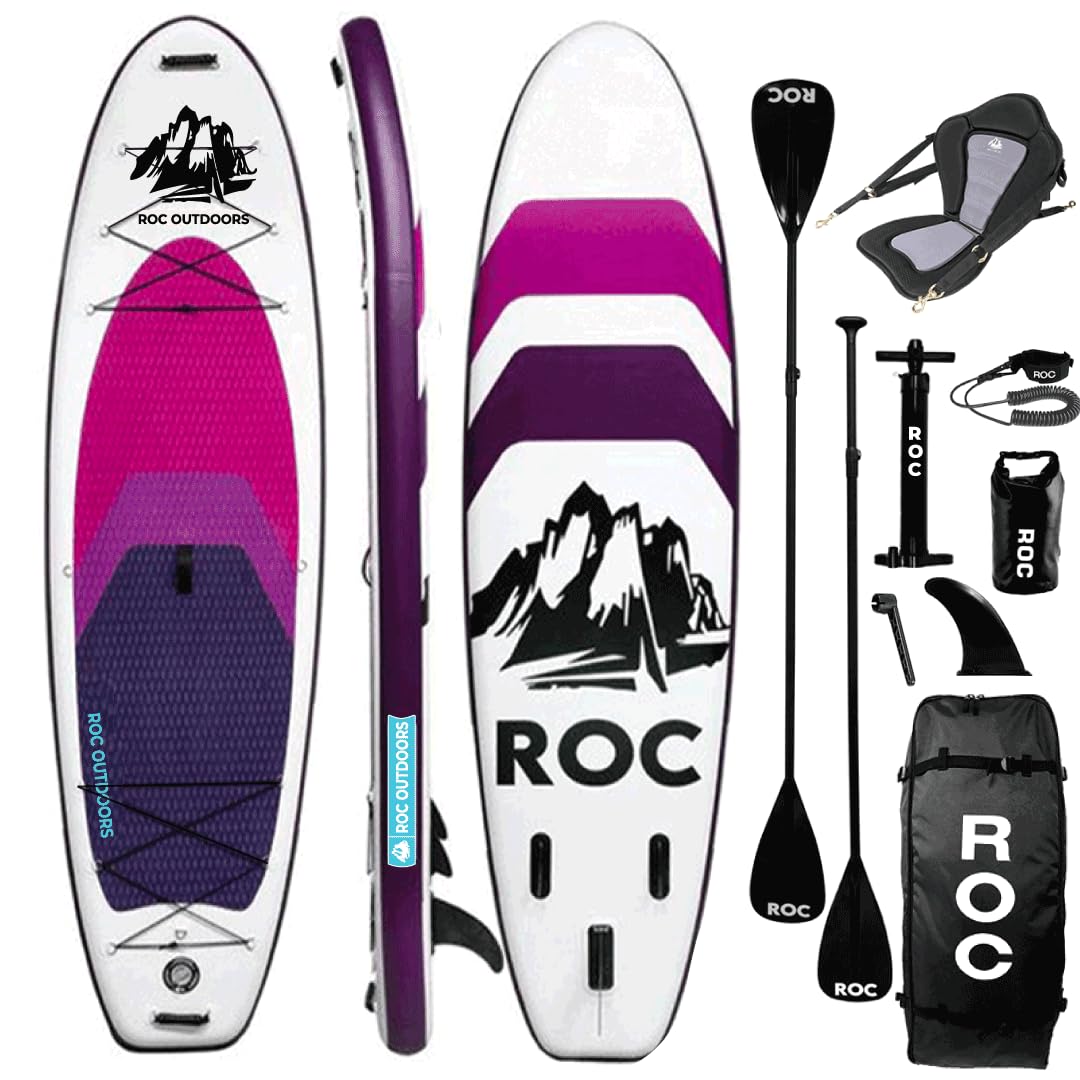
1. Roc Inflatable Stand Up Paddle Board 10′ 6″
Our pick — 4.5+★ from 18,000+ verified ratings; the strongest balance of quality and price.
The board that turns first-timers into standing paddlers without a swim break.
Here is the pick to start with if you want the safest bet on the water. The Roc carries a 4.5+ rating across 18,000+ owners, and the reason is simple: it does everything a beginner needs without asking you to learn anything first. The deck is 33″ wide and 6″ thick, and it holds a 350-pound maximum weight recommendation — enough for a full-grown adult plus a day bag.
What wins people over is the build. Roc claims its high-grade build is 50% stronger than competitor boards, and the 33″ deck stays planted when you shift your weight. The 126″ length paired with that 33″ width gives you a long, forgiving platform — long enough to track straight across a lake, wide enough that a stray knee does not tip you. Owners routinely mention paddling rivers, lakes, and open water on it without drama, and it stays firm when pumped to the recommended pressure.
Portability is the quiet win. At 17.5 pounds, it is 0.3 pounds lighter than the PORTAL SUP below, and owners of smaller stature report carrying it under one arm from the car to the shoreline. Everything — board, paddle, pump, leash, fins — fits in the included backpack, which is why it works as a grab-and-go board for a spontaneous afternoon. The 3-year manufacturer warranty is the longest on this list, backed by a USA-based company with its own support line.
The honest catch: a 10’6″ all-rounder is not a fast board. If your goal is covering serious distance on open water, the touring-shaped Niphean further down will glide better. And the hand pump that ships with it is a workout — many paddlers end up adding an electric pump after a few sessions. Neither is a flaw so much as a fit question.
What earns it the top spot
- 33″ wide deck with a 6″ thickness stays planted under a shifting beginner stance
- 350 lb capacity handles an adult plus gear, pets, or a small passenger
- 17.5 lb weight is light enough to carry under one arm when inflated
- Full kit plus a 3-year manufacturer warranty, the longest coverage here
Where it gives ground
- An all-around shape, so it is not the fastest board for long tours
- The included hand pump takes real effort to reach pressure
Buy this one if: you want the most trusted all-round beginner board and you value a long warranty.
Hold off if: you already know you will be paddling miles of open water every weekend.
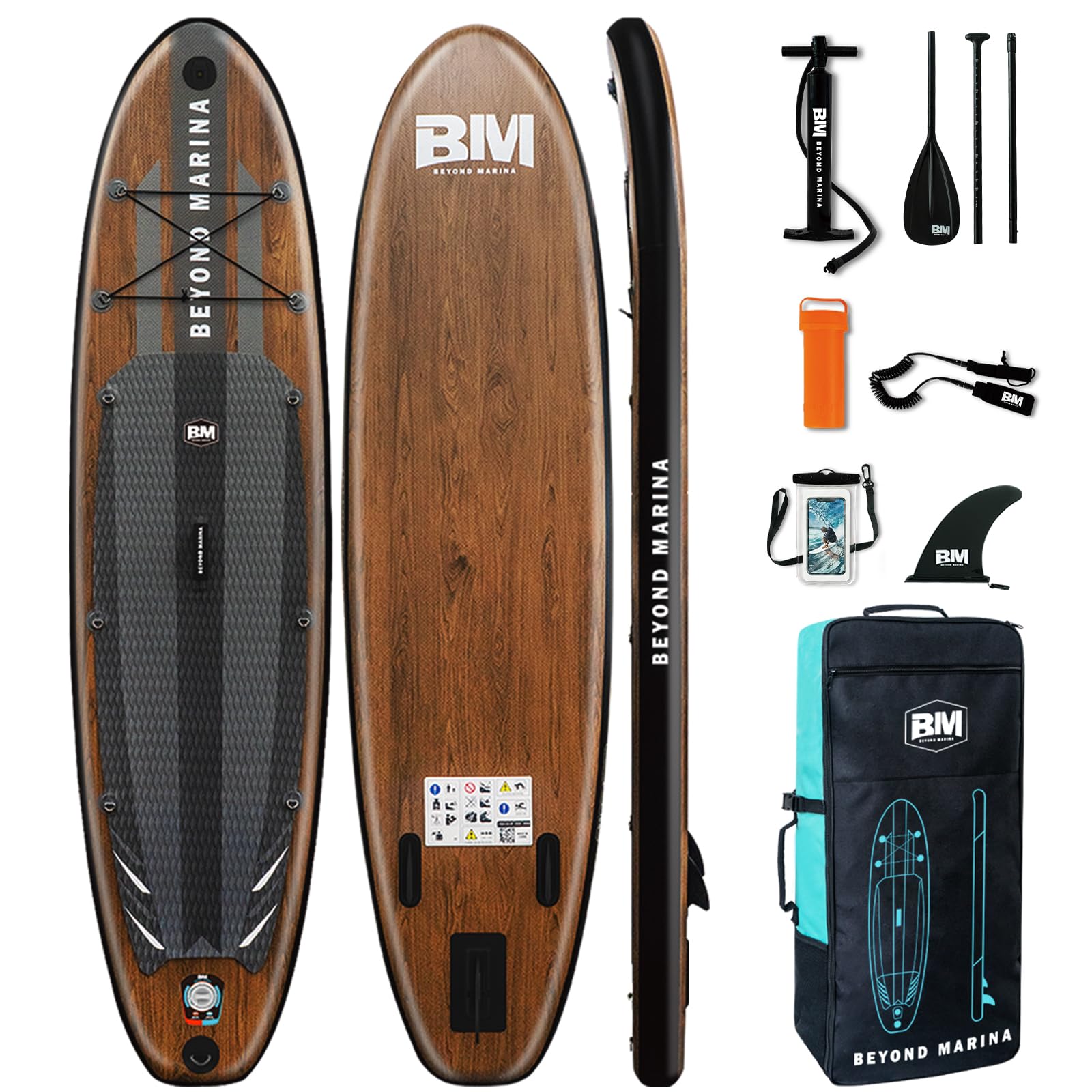
2. BM Paddle Board Inflatable Stand Up Paddle Board 10’6″
The teak-deck board that folds down into a backpack and shrugs off sun fade.
If your paddling happens two hours from home, this is the shape of board you want. The BM packs into an 85-liter travel backpack — big enough for the board, the pump, the paddle, and the included waterproof phone case — and the whole thing slings on your back for the walk to the water. The wood-grain finish is printed rather than UV-printed, which the maker says resists fading under sun, so the teak look survives a season of beach days.
The numbers put it slightly behind the Roc above: 32″ wide against the Roc’s 33″, and a 308-pound capacity against 350. The 15 psi maximum pressure is the same ceiling as several boards here. Where it does pull ahead is rigidity-per-pound — at 12 kg with a 6″ thickness, the deck firms up fast, and the included double-action pump moves air on both the push and the pull stroke. You can be on the water in roughly the time it takes to drink a coffee.
One thing to know before you buy: the pump divides opinion. Some paddlers find it quick, others call it a chore and eventually switch to an electric pump. There are also the standard first-gen hiccups — a missing valve piece has shown up on a board or two — so give the kit a once-over when it lands. Beyond that, the snap-in tool-less fin and the 360-degree twist ankle leash are the kind of small conveniences that make setup quicker on day one.
The traveler’s verdict: a well-finished board for paddlers whose water is not at the end of the driveway, with a cabin-bag-sized kit and a rigid deck at 15 psi.
The trade-off to weigh: 308 pounds is the lowest capacity of the wide-deck boards here, so a big adult plus a dog will be closer to the limit than they would be on the Roc.
Reach for this if: the board lives in your trunk and comes out on weekends.
Look elsewhere if: your typical load is two adults or a big dog.
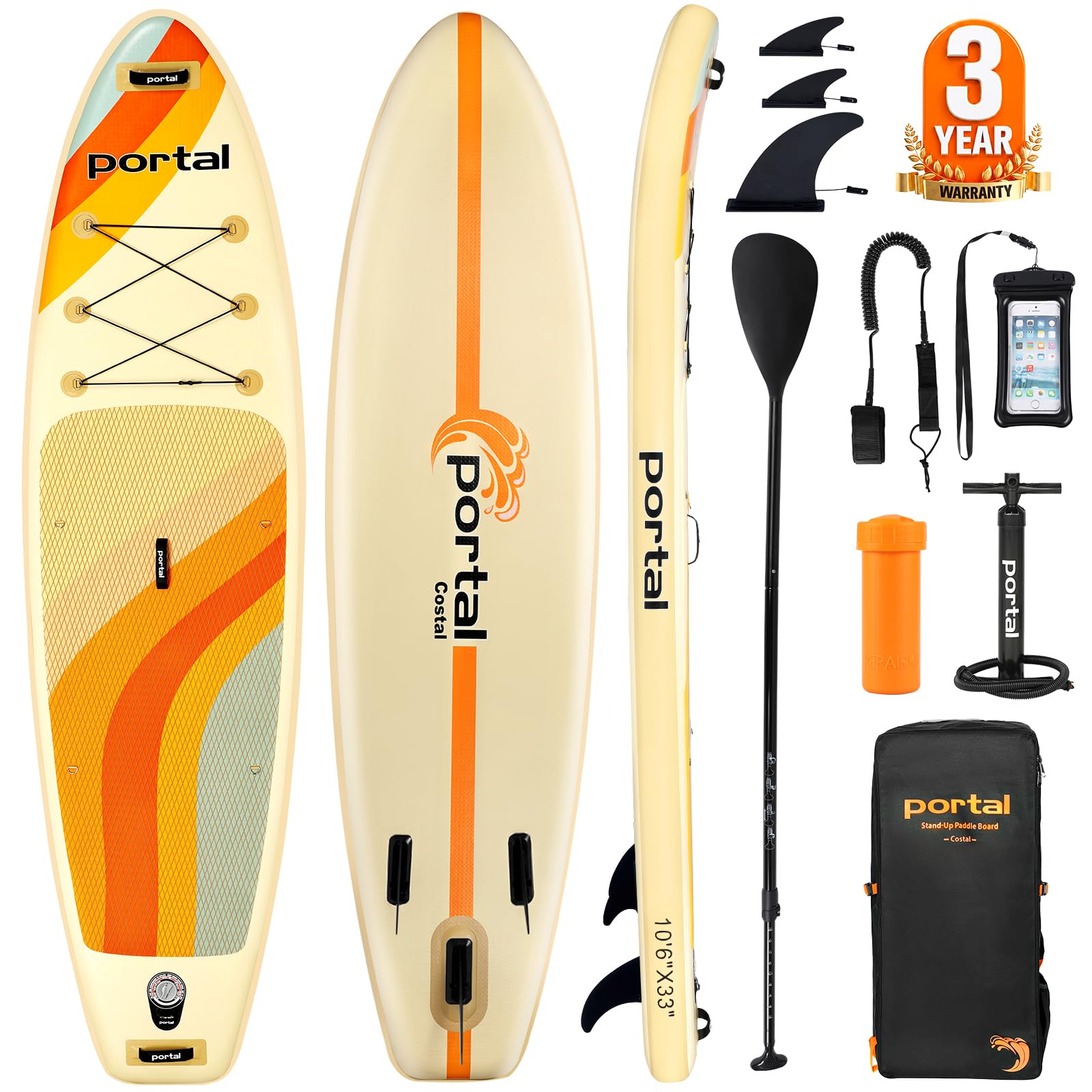
3. PORTAL SUP Inflatable Paddle Board for Adults 10’6″
A 33″ deck with criss-cross ropes for the paddler who brings gear along.
PORTAL’s board is the one to pick when you plan to fish or carry a dry bag. The upgraded criss-cross safety ropes across the deck hold a tackle box or a cooler in place during a paddle, and the non-slip EVA deck — a textured foam surface that gives your feet grip — keeps you planted when you shift to reach back. The board runs 0.3 pounds heavier than the Roc at 17.8 pounds, but the trade for the extra bungee and the stainless steel D-rings is worth it for gear-heavy days.
The setup numbers are the best part. Buyers report inflating it in around 5 minutes to 13 PSI and deflating in about 5, which makes for short transitions. The 33″ width and 6″ thickness give it a 300-pound capacity, and the two fixed fins plus one detachable snap-in center fin are the standard configuration for a beginner-friendly tri-fin setup. The D-rings also let you add a kayak seat later if you want to sit and paddle.
There is one small design detail to keep an eye on: the center fin is held by a screw, and a few owners have lost it after a session. Check it’s tight and keep the screw in your repair kit. The rest of the package — backpack, ankle leash, hand pump, repair kit, waterproof phone bag — is complete. Given the board’s strong quality and appearance feedback, this is a well-built pick, not a bargain-bin one.
The gear-hauler’s case
- Criss-cross safety ropes keep a bag or cooler planted on the deck
- Roughly 5 minutes to 13 PSI and 5 minutes to deflate makes for quick turnaround
- Stainless steel D-rings let you bolt on a kayak seat later
- EVA foam deck gives real grip underfoot
Worth knowing before you buy
- The center-fin screw can work loose — tighten and stash a spare
- 300 lb capacity is the lower end of this list
Best fit for: the beginner whose paddle involves a tackle box, a dry bag, or a camera.
Think twice if: you plan to carry a second adult — 300 pounds leaves little margin.
4. SLOOSH Ripple Inflatable Stand Up Paddle Board 10’6″
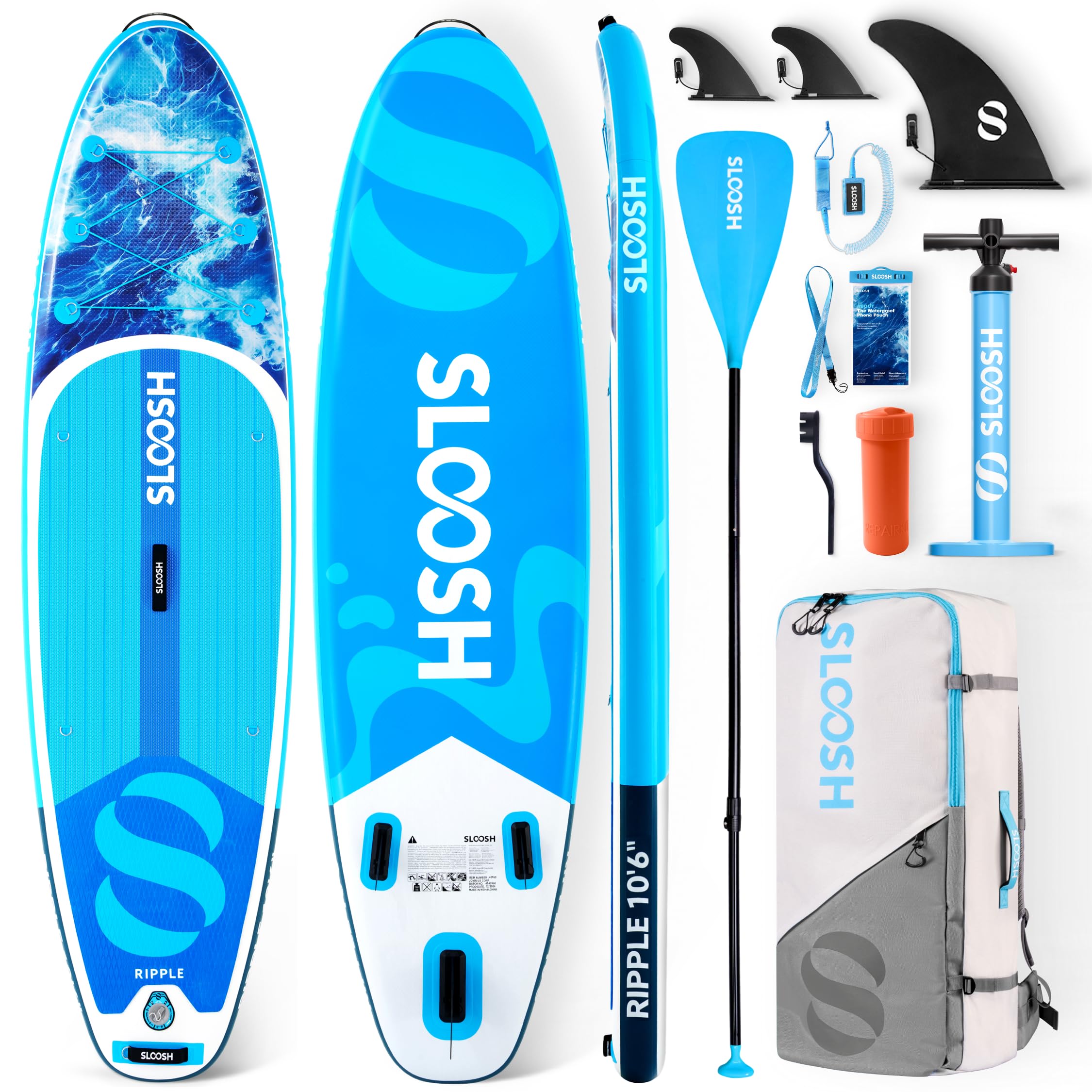
450 pounds of capacity on a 33″ deck — the family-and-dog board at a mid-range price.
The SLOOSH Ripple answers a question most beginners do not ask until their dog jumps on: how much weight will this really hold? That headroom is the difference between paddling comfortably and paddling carefully.
The 20 psi maximum is the highest ceiling here — 5 psi above the BM’s 15 psi cap — and it firms the deck close to a hard board when fully inflated. The recommended range is 12 to 15 psi, so you can ride softer for stability or firm for glide. The tri-fin setup helps the board track straight, and the round nose and wide tail give the deck a forgiving edge for a first-timer.
Two details separate it from the pack. First, the dual-action pump fills in double-action mode at low pressure then switches to single-action for the high-pressure push — SLOOSH claims that dual-action mode cuts inflation time by 30%. Second, the backpack is padded on the shoulders, waist, and back, which matters if you are hiking it to a beach access point. The 15.08 kg weight is the one place it feels mid-range rather than premium; the Roc is lighter if you carry your board far.
Why families lean this way: 450 pounds of capacity with a 20 psi ceiling gives you a rigid deck even with a kid, a dog, and a cooler aboard.
The one to size honestly: at 15.08 kg, it is heavier than the 17.5 lb Roc — pick it for the water, not for a long hike.
Made for: the paddler whose board doubles as a family float.
Not the pick for: solo riders who prize the lightest possible carry.
5. TIGERXBANG Polar Rose 11’6″ Inflatable Paddle Board
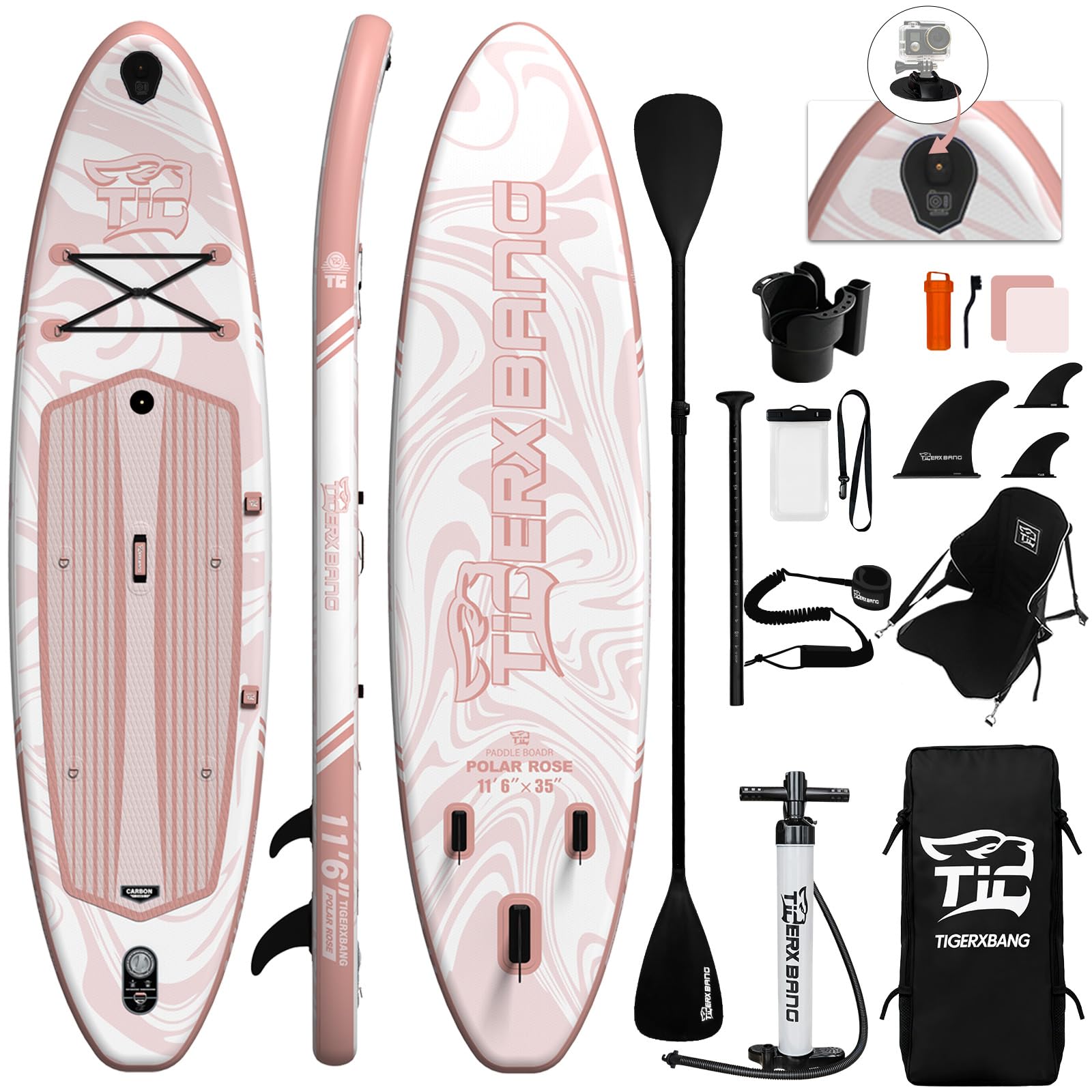
A 35″ wide deck with a kayak seat, camera mount, and cup holder baked in.
This is the pick for a beginner who suspects they would rather sit down half the time. The Polar Rose ships with a comfortable kayak seat that clips onto the deck, so you can switch between standing and sitting on the same board. The double-blade paddle lets you paddle kayak-style, and the back rest takes the strain when you want to lean back and drift.
At 35″ wide and 11’6″ long, the deck is one of the widest here — 2″ wider than the 33″ boards mid-list — giving you more room to correct a wobble. The 6″ thickness and PVC construction support up to 220 kg. There is a camera mount on the nose, a cup holder base in the center, and a Velcro paddle holder, which is the sort of built-in detail that keeps your hands free on the water. Owners mention it fits kids, dogs, and life jackets on the deck without feeling crowded.
The one honest caution is durability at the margins. A few owners have noted the bungee and backpack showing wear sooner than expected, so treat the included accessories with care and use the repair kit if a cord frays. The board itself holds up under the weight of two adults, and the 1-year warranty plus 30-day return window covers the early season. Given the size and included extras, it is a lot of board for the mid-range tier.
Choose this if: you want one board that does stand-up paddling and sitting in equal measure.
Pick another if: you need the accessories to survive heavy daily abuse.
6. FLYPARK 11’x34″ Inflatable Paddle Board
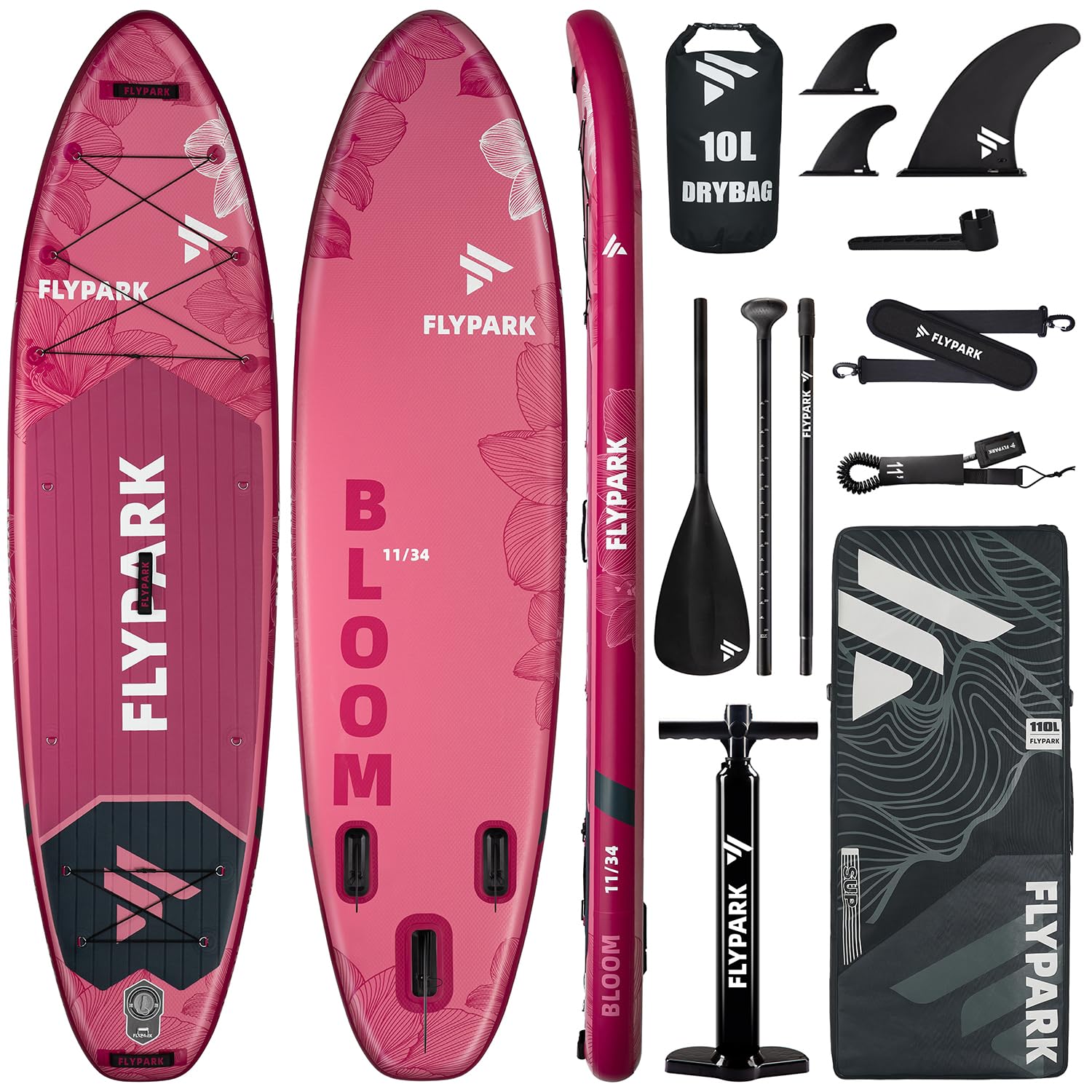
A 34″ wide deck rated to 420 pounds, built for two adults and a Labrador.
FLYPARK’s board is sized for the family that cannot agree on who rides. The 420-pound capacity covers two adults plus a child or a large pet, and the 34″ width is wider than the standard 32″ boards here. The deck is finished in a square-cube EVA grip — a textured foam pattern that gives your feet something to push against when the board tilts over a wake. That extra grip is most useful to beginners and kids.
The construction is the reason it makes the family list. Marine-grade PVC resists sand, saltwater, and UV rays, and the drop-stitch technology — a network of threads inside the board that keeps the deck flat rather than bulging — keeps the platform level when you load it up. The fin setup is a 9″ tool-free center fin plus two 4.5″ side fins, which gives directional stability in wind and helps the board hold a line on a lake. The 3-piece aluminum paddle adjusts from 67″ to 77″ to fit different heights.
For gear, the front 6-point bungee and rear 4-point tie-downs give you storage front and rear, and the 4 center D-rings let you add a kayak seat or a shoulder strap. The kit includes a 10L dry bag and a 110L backpack, both of which matter if you are carrying everything from the car. The trade-off is weight: at 19 pounds, it is heavier than the Roc, so a far hike to the water is a two-person job.
The family read: 420 pounds and 34 inches of deck give you the room to bring two adults and a kid without paddling on eggshells.
What to plan for: the 19-pound carry weight means the launch spot should be close to the car.
Ideal for: a household that paddles together and needs the deck space.
Pass if: you paddle solo and want the lightest board to haul.
7. ATPROSS Inflatable Paddle Board 11’6″x35″
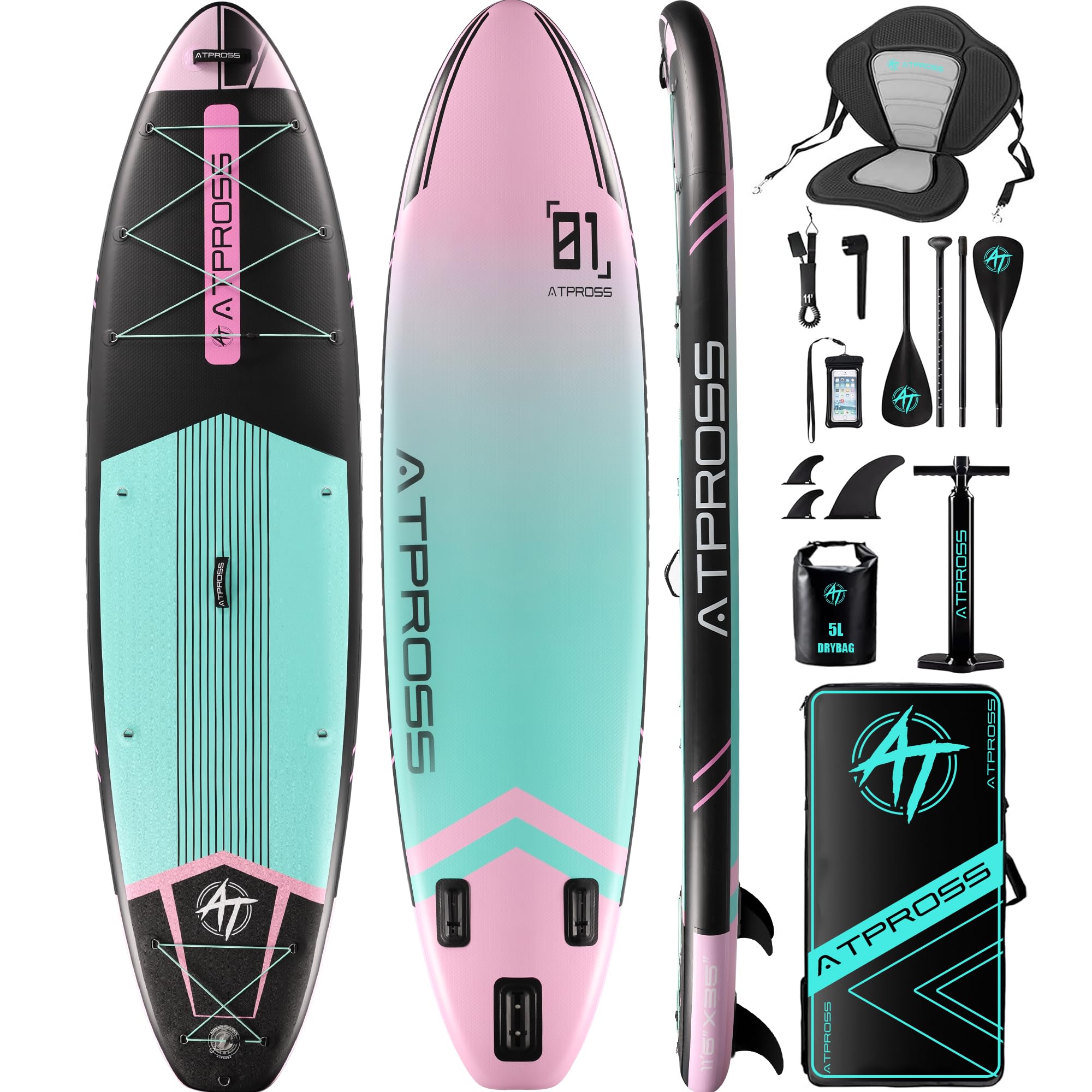
The 35″ platform for the bigger paddler who has felt a narrower board flex.
ATPROSS builds the widest deck in this lineup alongside the TIGERXBANG — 35″ against the 32″ standard — and that extra 3″ is the difference you feel when you are learning to stand. The 6″ thickness and 138″ length give it a long, wide footprint, and the 450-pound capacity handles a bigger adult without the hull squashing under them. If you are over 200 pounds and nervous about a wobbly first session, this is the board to try.
The seat is the feature that surprises people. An ergonomic inflatable seat clips in with a tool-free QuickLink system, turning the board into a kayak-style cruiser in seconds. The cushioning cushions your hips and back on a longer paddle, and the single paddle converts to a dual-purpose format. The full kit also includes a 600D Oxford backpack, large and small fins, a dual-purpose paddle, an ankle leash, a two-way hand pump, and a 5L dry bag — the most complete accessory list in this group.
The steady trade is speed. A 35″ wide board pushes more water and glides slower than a 32″ board, and owners note this is a stability-first pick rather than a fast one. If you are paddling for fitness and want distance, the narrower touring board further down will reward you more. But for a first-timer who wants to stand up reliably, that width is exactly the right compromise.
Why it suits bigger paddlers
- 35″ width is the widest on this list, with room for a wider stance
- 450 lb capacity carries a heavy adult without hull flex
- Inflatable kayak seat clips in for sit-down cruising
- The fullest accessory kit here, including a 5L dry bag
The honest ledger
- A 35″ beam tracks slower than narrower boards
- Hand pump effort is real on a board this size
Best for: heavier or taller beginners who have wobbled on a 32″ deck.
skip it if: you are training for distance and speed on flat water.
8. Retrospec Weekender Plus 10’6″
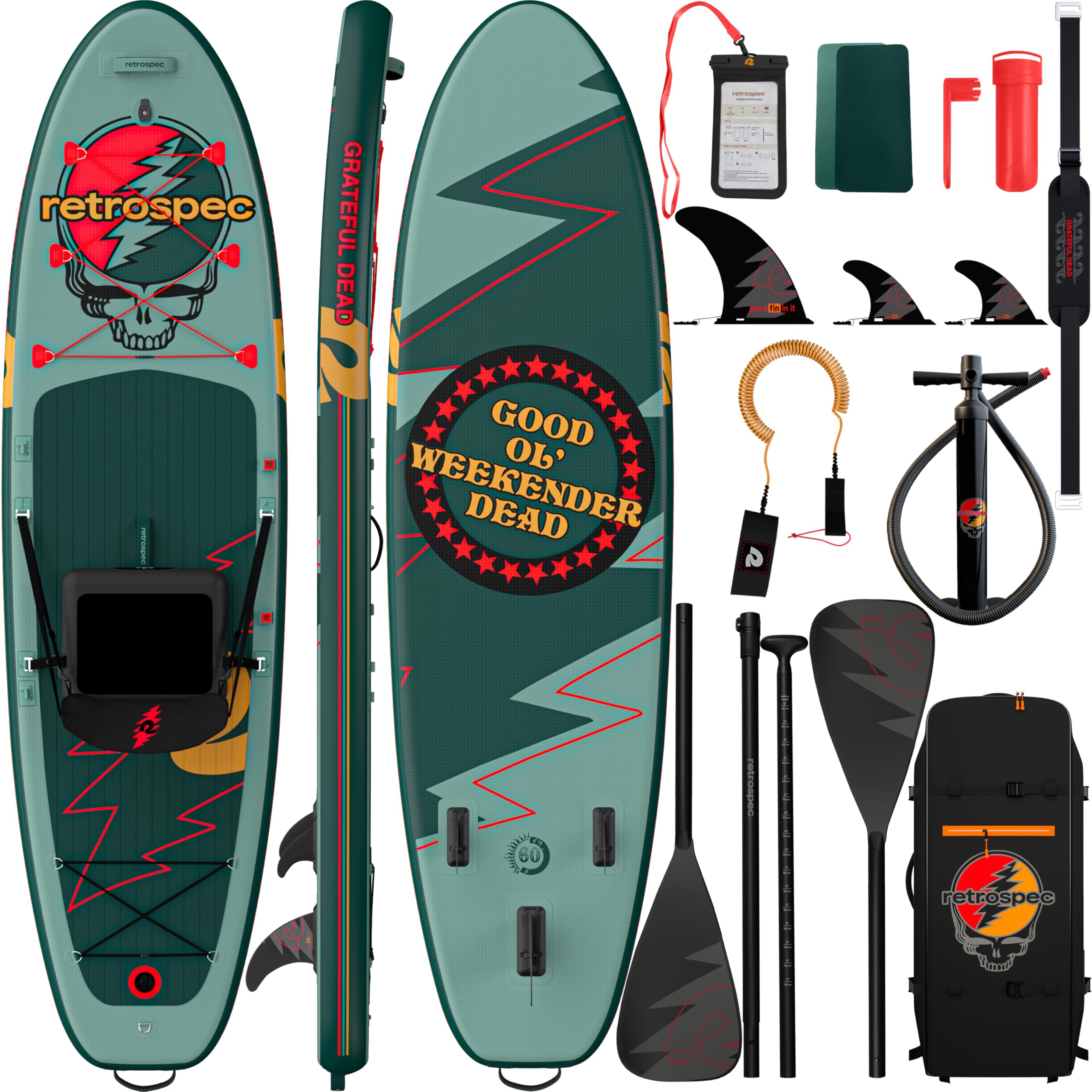
A surfboard-shaped all-rounder that converts to a kayak when the wind picks up.
The Weekender Plus is the polished pick for the beginner who wants a board that feels like a board. Its dual-layer PVC with AerGlide-Fusion construction gives it a rigid, hard-board feel, and the surfboard-inspired shape — rounded nose, square tail — delivers a smooth glide on flat water. The 6″ thickness and a 15 psi ceiling mean it firms up nicely.
The conversion kit is the reason to pick this one. The included AerComfort kayak seat and 4-piece convertible paddle let you switch from standing to sitting without a second board. The dual-fold Velcro on the leash keeps it from tangling loose, a small detail that matters when you are moving around the deck. The full kit also includes a pump, rucksack backpack, removable fins, repair kit, and waterproof phone case.
Where it gives ground is inflation effort. At 31 pounds, it is the heaviest board in this lineup, and a portion of that is the double-layer construction. Pumping it to the recommended PSI is a real workout — several owners say it is hard to inflate — so budget for an electric pump if the idea of sweating before you paddle does not appeal. The 32″ width and 300-pound capacity are the standard tier, so it is not the board for a big load. It is the board for a paddler who wants a refined feel.
The refined-feel case: dual-layer PVC and a surfboard-friendly shape give it a more natural glide than the boxy starters.
The catch worth naming: 31 pounds plus a 15 psi target means the hand pump is a pre-paddle workout.
Worth it if: you want a polished, surf-inspired board with a kayak seat option.
Look elsewhere if: pumping effort or a 300-pound limit is a problem for you.
9. Niphean 12’6” Inflatable Paddle Board
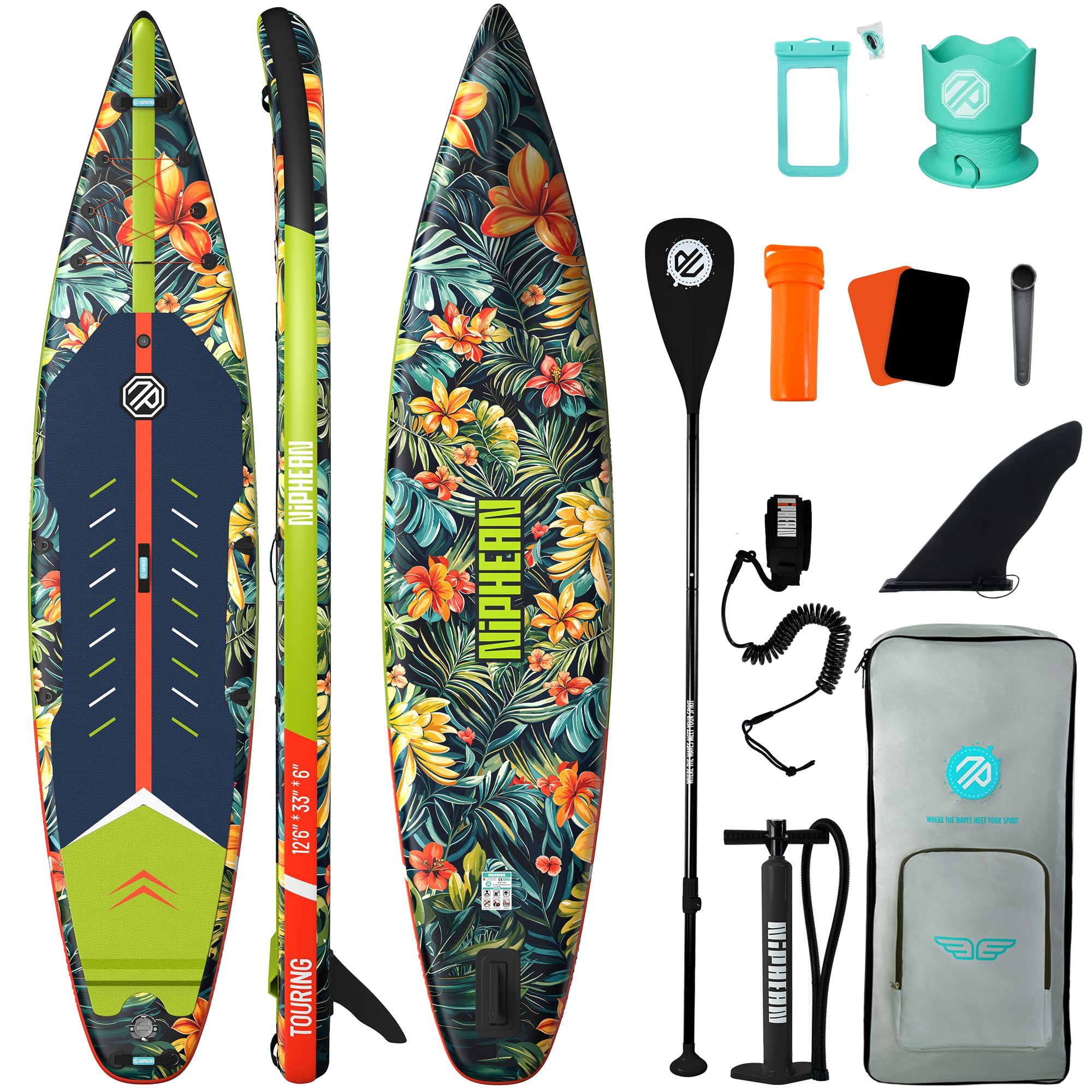
A 12’6″ touring board with a V-hull nose and the highest capacity here.
The Niphean is the board for a beginner who already knows they will paddle far. Its streamlined touring nose and V-hull shape cut cleanly through water, so you cover more ground per stroke than on a boxy all-rounder. At 12’6″, it is longer than the 10’6″ boards that dominate this list — length translates to better tracking and less zigzag, which matters on a big lake.
The construction is where it justifies itself. Niphean says its woven drop-stitch build makes the board up to 160% stiffer when inflated, closer to a hardboard underfoot. The 550-pound capacity is the highest here, well above the 450-pound boards and the 300-pound tier, so a dry bag, cooler, and camping gear all fit within the limit. And at 20.39 pounds, it is light enough to haul to the water despite its length — lighter than several shorter boards here.
What you give up is the easy-going all-round feel. A touring nose is less forgiving if you are not yet steady, and the 33″ deck matches the mid-tier width rather than the 35″ family decks. The 3-year warranty is a strong signal of confidence, and the kick pad at the tail lets you lean back and pivot. If you want a board that grows with your skills rather than capping out in your first season, this is a smart stretch.
Pick this if: you want room to progress and plan long days on open water.
Not for you if: you want the widest, most forgiving deck for nervous first sessions.
10. Atoll New Cove 11′ Inflatable Paddle Board

Heat-welded seams and a 17.5-pound carry make this the lightest board worth buying.
The Atoll Cove is the lightweight pick. At 17.5 pounds, it matches the Roc’s carry weight on an 11′ board, so a petite paddler can get it from the car to the water alone. The 32″ width and 11′ length give you a stable, all-around platform that suits lakes, rivers, harbors, and the occasional coastline. The 6″ thickness and 15 psi maximum pressure are the standard tier, and the 400-pound capacity is a welcome step above the 300-pound boards.
The standout detail is the construction. Atoll builds the Cove with heat-welded seams instead of glued ones, which is a stronger, longer-lasting bond — fewer seams to fail means fewer slow leaks over the seasons. The 17.5-pound weight is what you feel most, and it is why this board suits someone who carries their board rather than rolling it. The kit includes the paddle, backpack, pump, and the rest of the accessories, so it is a complete first purchase.
The catch is that heat-welded construction and light weight come at a premium, which is why this sits in the higher tier of this list. The 32″ width is also one inch narrower than the 33″ boards in the middle of the list, so if you are a heavier beginner, a wider deck will feel more forgiving. For a light paddler or a smaller paddler, the Cove is the board that feels like it was made for you.
The light-paddler’s win
- 17.5 lb carry weight for a one-person walk to the water
- Heat-welded seams hold up longer than glued seams
- 400 lb capacity gives more headroom than the 300-pound tier
Where the fit is tighter
- 32″ deck is narrower than the 33″ to 35″ boards here
- Premium-tier construction means a higher outlay than the starter picks
Right for: smaller or lighter paddlers who want a premium-built, easy-carry board.
Wrong for: heavier beginners who want maximum deck width and stability.
11. BOTE WULF Aero 11’4″ Inflatable Paddle Board
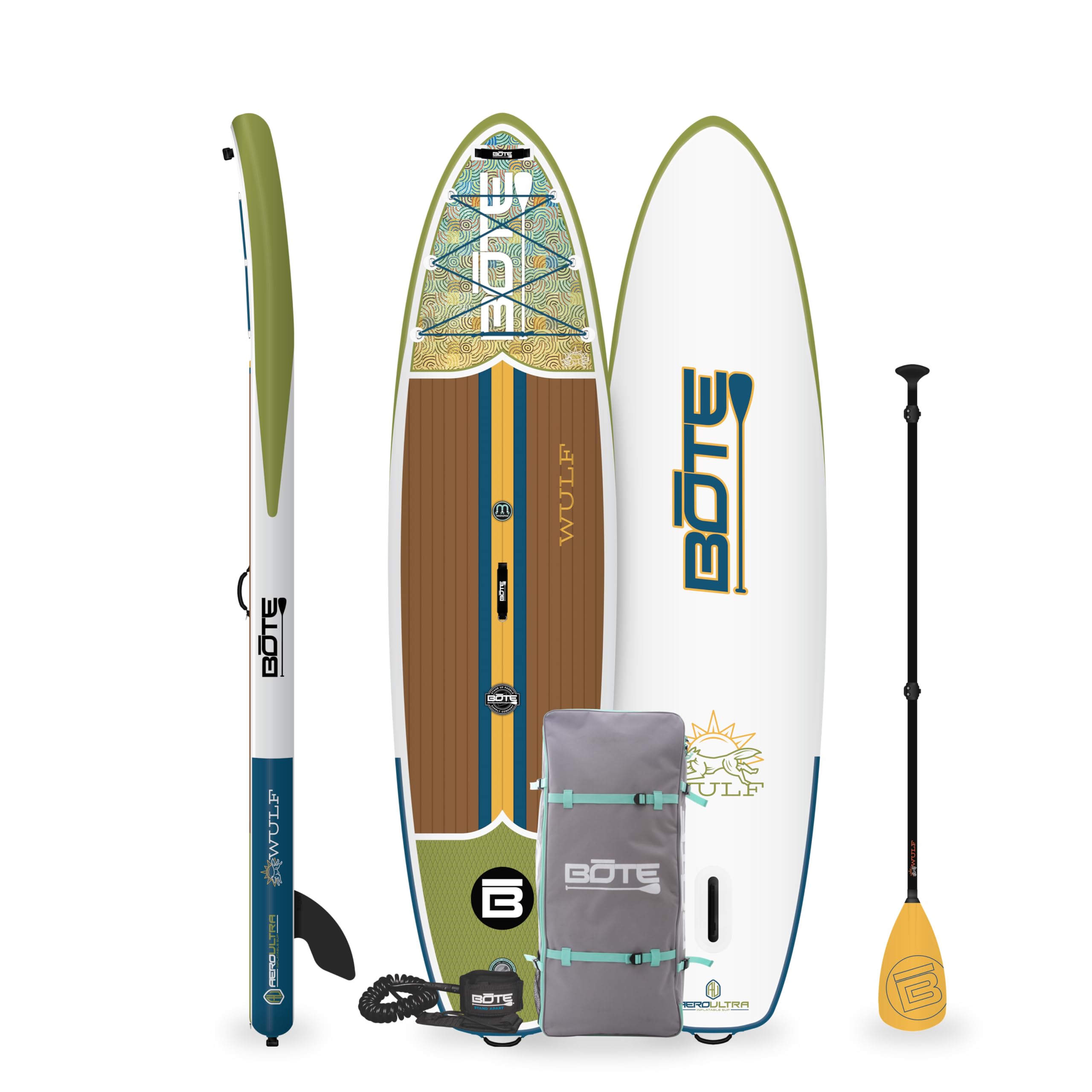
A 34″ wide, brand-name board for the beginner who wants to buy once.
The WULF Aero is the premium starter. BOTE builds the 11’4″ board with AeroULTRA construction — a lightweight build that the maker says keeps durability without the bulk — and pairs it with a 34″ wide deck that gives new paddlers room to balance. The 6″ thickness and 15 psi maximum pressure are the standard tier, and the 315-pound capacity handles a solo adult plus a day bag.
The extras are where it earns its place. A MAGNEPOD mount lets you click on compatible accessories like a cup holder, keeping your drink close. The included 10″ removable Aero center fin gives directional stability, and the coiled leash keeps you attached without tangling. The kit ships with a 3-piece adjustable aluminum paddle, a hand pump, and a fabric backpack travel bag. At 22 pounds, it is heavier than the Roc and the Atoll, so it is not the board to carry for a mile — but it is the board to trust on the water.
The thing to weigh is the premium tier. BOTE’s build quality is real, but this is the highest-price pick here, and the capacity (315 pounds) is lower than the 450-pound value boards. If you want the most stable deck per pound, a 35″ width from a mid-tier brand beats a 34″ premium. But if you prize construction and a recognized brand above all, the WULF Aero is the one to check.
The buy-once argument: a branded 34″ deck with AeroULTRA construction and a complete kit is a confident first board.
The honest math: 315 pounds of capacity is less than the 420- to 450-pound value boards here, so match it to your actual load.
The pick for: a beginner who values brand construction and a 34″ deck over maximum capacity.
Not the pick for: a heavy paddler or a family that needs the wide-deck capacity.
Know the Specs
PSI (Pounds Per Square Inch)
PSI measures the air pressure inside the board. A board rated to 20 psi can be pumped firmer than one capped at 15 psi, which makes the deck feel more like a hard board. A firmer deck reduces the flex under your knees, which is why it matters most when you first learn to stand.
Deck Width
The width across the deck is the single biggest factor in beginner stability. A 32″ deck is the common starting point, and 33″ to 35″ gives you more room to correct a wobble. Wider boards push more water and glide slower, so it is a balance between steadiness and speed.
Common Questions
How many PSI should a beginner board be inflated to?
Is a 32-inch or 34-inch wide board better for a beginner?
How long does it take to inflate an inflatable paddle board?
Can an inflatable paddle board handle a dog?
What accessories should come with a beginner paddle board kit?
Do I need an electric pump for an inflatable paddle board?
Can a beginner paddle board convert into a kayak?
How much weight can an inflatable paddle board hold?
How do I store and transport an inflatable paddle board?
The Bottom Line
The best paddle board for beginner winner is the Roc Inflatable 10′ 6″ because it combines a 33″ wide deck, a 350-pound capacity, and a 3-year warranty with the lightest carry weight among the full-kit picks. If you plan to bring a dog or a child, grab the SLOOSH Ripple for its 450-pound capacity and 20 psi ceiling. And for a board that grows with you on long open-water days, the Niphean 12’6″ is the one to reach for.
How we choose
We do not accept paid placement. Every pick is matched to a real buyer and a real use-case; we do not hands-on test units.
Sources
Specifications: manufacturer listings and product documentation. Review insights: verified customer reviews, as of November 2026. Pricing: not shown on this page (it changes often); check the current price via the retailer link.
As an Amazon Associate, Tactical Gear Guy earns from qualifying purchases. This does not affect which products we feature.