Specs are compiled from manufacturer listings and verified buyer reviews and can change over time — please confirm the key details on the product page before buying.
You want rotis that come off the plate round, evenly cooked and soft all the way through — and what decides that is how evenly the plate holds heat and how firmly the press grips the dough. It is how well the plate holds a steady heat and whether the press grips your dough instead of spitting it out. This guide covers the presses worth your counter space and the ones that only look the part.
This guide is built by comparing the manufacturers’ published specifications and the patterns across verified customer reviews, so you get each pick’s real strengths and trade-offs instead of marketing spin.
A flatbread press is a simple machine, but plate diameter, handle leverage and thermostat control decide how your rotis turn out every single day. I separate the two by what owners actually live with, so you can check the roti maker machine choices below against your own kitchen routine.
Top Picks
How To Choose The Best Roti Maker Machine
Buying one of these is less about picking the highest wattage and more about matching plate diameter to the bread you actually make. A press with a dough-cupping plate and even heat will beat a more powerful machine that lets the ball slide out the side every time.
Start with the plate diameter, not the label
The cooking surface is the first thing to measure. A 10-inch plate swallows a full-size wrap tortilla that an 8-inch plate simply cannot hold. If your dough balls are small and your pan space is tight, an 8-inch plate cooks just as well and stores easier.
Look at how the handle presses
Even pressure across the plate is what makes a roti round instead of lopsided. A broad ergonomic handle spreads the force across the plate so one side doesn’t end up thicker than the other. A detachable handle helps two ways: it takes up less cabinet room and it survives storage better.
Check the heating setup and indicator lights
An indicator light that tells you when the plates are ready removes a lot of guesswork. A thermostat that holds a steady temperature keeps one roti from burning while the next stays pale. A thermostat that holds steady heat matters more than a high wattage number on its own.
Think about the finish and the feet
Non-stick plates wipe clean with a damp cloth, which saves scraping between rotis when you are making a batch of ten. Non-slip feet keep the unit planted while you lean on the handle. Cool-touch handles protect your hand on the press side.
Side-by-Side Comparison
| Model | Best For | Plate Diameter | Weight | Voltage | Amazon |
|---|---|---|---|---|---|
| 8″ Electric Tortilla Press Maker Tortilladora Gonzalez★ Best Overall | Tortillas and roti with insulated grip points | 8 inches | 5.09 pounds | 110 Volts | Amazon |
| Compact Roti Maker, 8” Electric Tortilla Maker MachineBest Value | Small kitchens and everyday roti on a budget | 8 inches | — | 120 volts | Amazon |
| Brentwood TS-127 Stainless Steel Non-Stick Electric Tortilla Maker | Lightweight countertop storage | 8 inch | 2.6 pounds | — | Amazon |
| Compact 10” Roti Maker Machine with Detachable Handle | Full-size wraps and burrito shells | 10 inches | 3.9 pounds | — | Amazon |
| Saachi SA1650 Electric Non-Stick Roti Chapati Maker | Flat rotis with a stovetop finish step | — | 6 pounds | — | Amazon |
| Libra Roti Maker Machine 8.5-inch | Automatic temperature control and cool-touch handles | 8.5-inch | 1.5 kg | 230 volts | Amazon |
| Starfrit Electric Roti Maker | Hot heating with a brushed steel case | 12 INCH (listed) | 4.1 pounds | — | Amazon |
Detailed Reviews
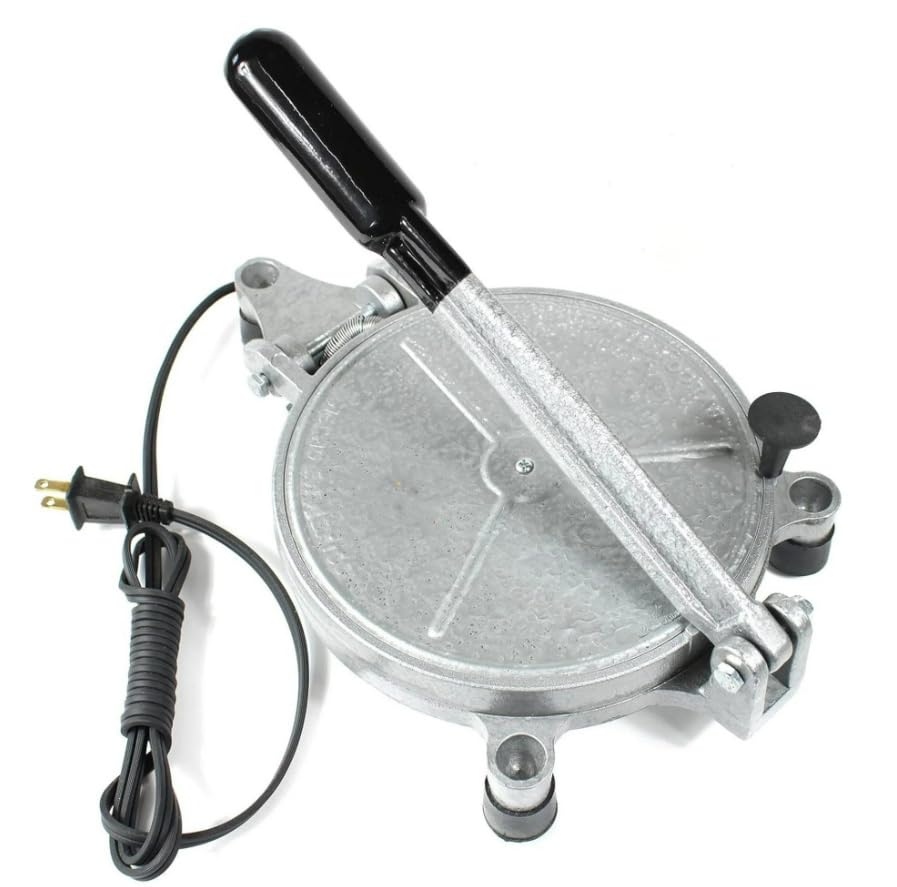
1. Gonzalez Electric Tortilla Press
A press built in Mexico with insulated legs so your counter stays cool under the heat.
The 8-inch plate is the headline here, and it is sized for dough balls that fit your palm. That covers flour tortillas and roti without a fight, and it keeps the unit small enough to leave out on the counter.
Two details do the real work. The insulated legs keep the hot base off your worktop so you can set it down straight after cooking. The insulated handle does the same for your hand when you lean in to press.
At 5.09 pounds it feels planted rather than skittish, so it doesn’t wander while you squeeze. Compare that with the Brentwood TS-127 at 2.6 pounds — the Gonzalez weighs noticeably more, which buys you stability on the press-down. It runs on 110 Volts, so check that against your kitchen outlet before you order.
What earns the top spot
- 8-inch plate handles roti and flour tortilla dough equally well
- Insulated legs protect the countertop immediately after use
- Insulated handle keeps the press side comfortable
- 5.09 pounds gives it a stable, planted feel on the counter
Fits who, skips who
- 110 Volts — verify your outlet matches before ordering
- An 8-inch plate won’t hold a full-size burrito wrap
- Newer listing, so the track record is shorter than older picks
Reach for this if: you make roti and flour tortillas at home and want a press that stays cool to the touch on both the base and the handle.
Look elsewhere if: your dough balls are big enough to need a wider plate than 8 inches.
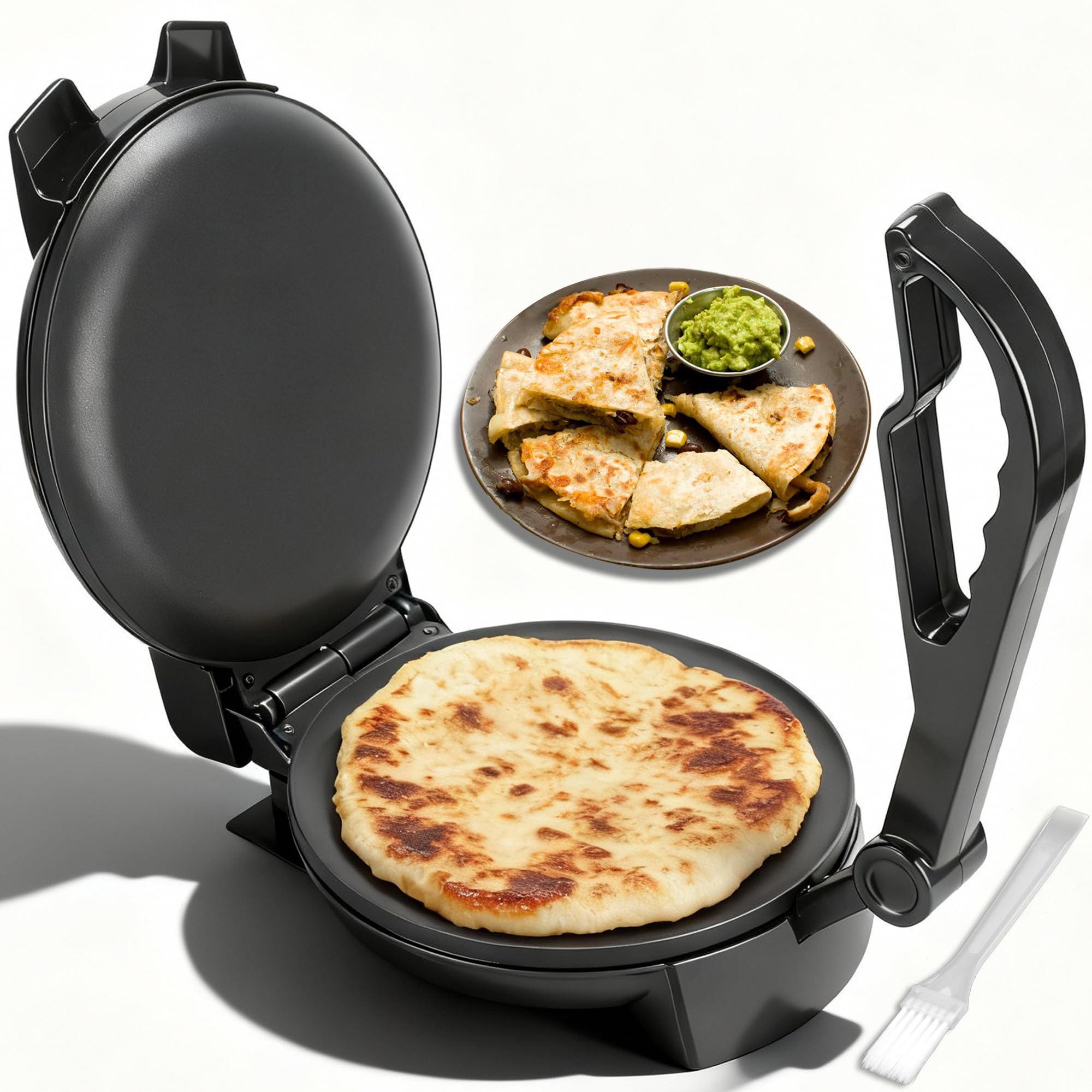
2. Compact Roti Maker 8”
The entry-level press with a U-shaped plate that keeps your dough where you put it.
That U-shaped baking plate is the clever bit — it cups the dough so it can’t slide off the tray mid-press. Anyone who has watched a ball of dough escape the side of a flat plate will appreciate the difference.
It runs at 1000 watts on 120 volts, which brings the plates up to heat quickly and spreads it across the surface. The temperature dial lets you pick a softer, fluffier roti or a crisper, browner one, so the texture is your call rather than the machine’s.
It also reaches beyond roti — crepes, chapatis, tortillas and mini pancakes all work on the same plate. The non-stick coating wipes down with a damp cloth so a batch of ten doesn’t leave you scraping. Keep in mind it is a compact build, so share it with big wrap tortillas and you’ll be pressing in batches.
The value read: a dial-controlled plate, a dough-catching shape and quick heat, all in a footprint small enough to leave on the counter.
The honest catch: a 12″D x 7″W x 8″H body means it is compact by design — expect to cook larger flatbreads one at a time.
Best for: first-time buyers who want a dial-controlled press without stretching the budget.
Skip if: every flatbread you make is wider than 8 inches.
3. Brentwood TS-127 Tortilla Maker

Barely over two pounds, so it lives in a drawer instead of owning your counter.
At 2.6 pounds this is the lightest press on the list, and it is 4.9 pounds lighter than the Saachi SA1650 at 6 pounds. That gap matters if you pull the unit out and put it away every day rather than leaving it on the counter.
The 8-inch non-stick aluminum plates make round tortillas, and an adjustable heat dial takes you from soft to crispy. Power and pre-heat indicator lights tell you when the plate is actually ready, which saves the pale first roti.
What wins people over is how simple it is to run — the machine handles rotis, parathas and tortillas without a fuss. Not every report is rosy, though. Functionality comes in mixed for a fair share of owners, and the recurring gripes are heat that doesn’t always get hot enough and a press that can break the dough instead of flattening it. Treat it as a light, budget-friendly press rather than a heavy-duty one.
Why it’s here: lightest body on the list, adjustable heat, and indicator lights that take the guesswork out of preheating.
What to weigh: heat output is the most-discussed weak point — if you make thick parathas every morning, size your expectations.
Pick this if: you want a light, drawer-friendly press with a heat dial and ready lights.
Think twice if: you need a heavy, high-pressure press for dense dough.
4. Roti Maker Machine 10”
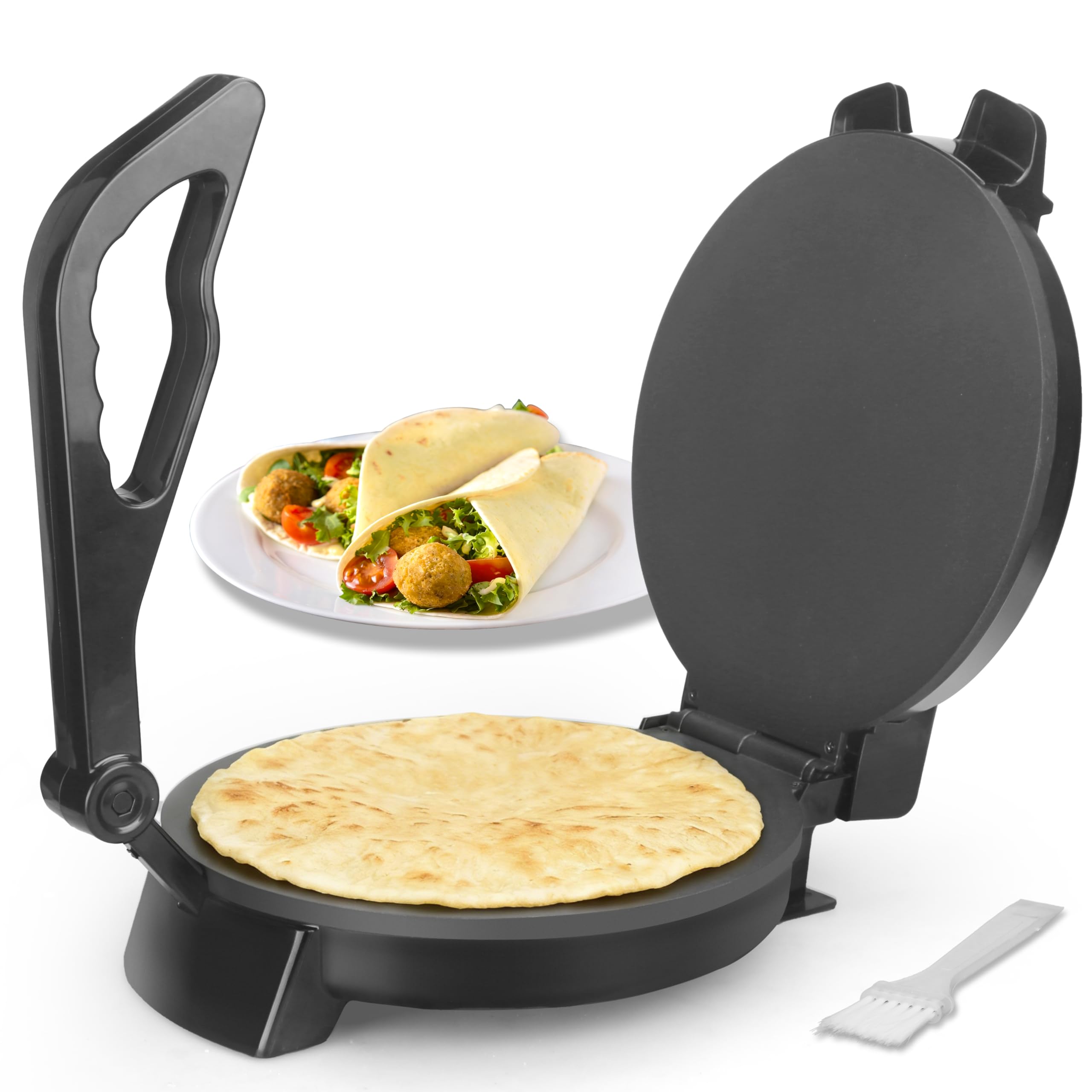
Ten inches of flat plate, so even a full-size wrap tortilla fits without folding.
That 10-inch cooking surface is 2 inches wider than the 8-inch plates on the Brentwood and the Gonzalez — enough to change what you can make. Full-size wrap tortillas, taco shells and wide rotis all sit flat instead of curling at the edge.
The handle comes off, which is a practical win in a small kitchen: store the body in a cupboard and the handle beside it. Pressing is comfortable while it’s attached, and the goal is a rounder, more evenly pressed tortilla.
Ease of use and cleaning get the bulk of the praise, and owners who cook tortillas instead of buying them rate it as money well spent. The honest caveat is consistency: some units press unevenly, with gaps that stop the dough reaching full size, and a few report one side browning before the other. At 3.9 pounds it is light enough to move around, and it comes with a brush and a recipe booklet to get you started.
Why the wide plate wins
- 10-inch surface fits full-size wraps and burrito shells
- Detachable handle saves cabinet space
- Brush and recipe booklet included
- 3.9 pounds — easy to lift and store
Where it can fall short
- Press consistency is mixed — some units leave gaps
- Uneven browning can show on one side
- Single heat setting, so no fine temperature dialing
Go with this if: your flatbreads are wide and you need the extra cooking surface.
Hold off if: you want precise temperature dialing for different doughs.
5. Saachi SA1650 Roti Chapati Maker

A chrome-finished press that flattens and bakes flat rotis, with a stovetop step for puffing.
Saachi is upfront about what this machine does: it makes flat rotis, not fluffed-up phulkas. If you want a chapati to balloon, you move the cooked roti to the stove flame for that last step. Knowing that before you buy is half the decision.
The thermostat lets you set the plate heat, and a cool-touch top handle makes the press-down comfortable. The non-stick plates release the bread and wipe clean with a cloth. An auto ON/OFF/Ready light shows when the plates are up to temperature, and the chrome body stores compactly.
The biggest honest caveat is long-term reliability: a steady thread of buyers report the unit quitting within months, and a thinner-than-average result when the dough isn’t pressed evenly. Buy it for flat rotis and treat it as a light-duty appliance.
The straight answer: flat rotis, a controllable thermostat and a cool-touch handle — solid for everyday simple flatbreads.
The catch worth knowing: it won’t puff a chapati on its own, and durability is the recurring concern.
Suits you if: flat rotis are your goal and you don’t mind a quick stovetop finish for puffing.
Not for you if: you want a single machine to bake and puff a soft chapati start to finish.
6. Libra Roti Maker Machine with Non-Stick 8.5-inch Plates

Automatic temperature control and a 950W element for quick, hands-off heating.
The 8.5-inch plate is a half-inch up on the standard 8-inch plates on the Brentwood and the Gonzalez — enough that a slightly larger roti or dosa sits flat. The 950W element brings the plate up fast and holds a consistent heat while the automatic control handles the dialing for you.
Indicator lights show when it is ready, so no more guessing at the pale first roti. Cool-touch handles, non-slip feet and an automatic shut-off all work toward a safer press-down. It also does pizzas, crepes and sandwiches, and a long power cable gives you placement freedom.
The honest note is build quality. Longevity and quality are the most-discussed themes, and they split — some units run for months and then work loose, while others arrive damaged. Treat it as a press that needs a careful first inspection and firm, even pressure, and keep the one-year manufacturer warranty number on file.
Where it shines: automatic heat control, a 950W element and cool-touch handles make the daily press a low-effort job.
The trade-off: build quality is the recurring question mark — inspect it on arrival.
A good fit for: cooks who want automatic heat and a slightly roomier 8.5-inch plate.
Second-guess it if: you need a press you don’t have to keep an eye on for build issues.
7. Starfrit Electric Roti Maker
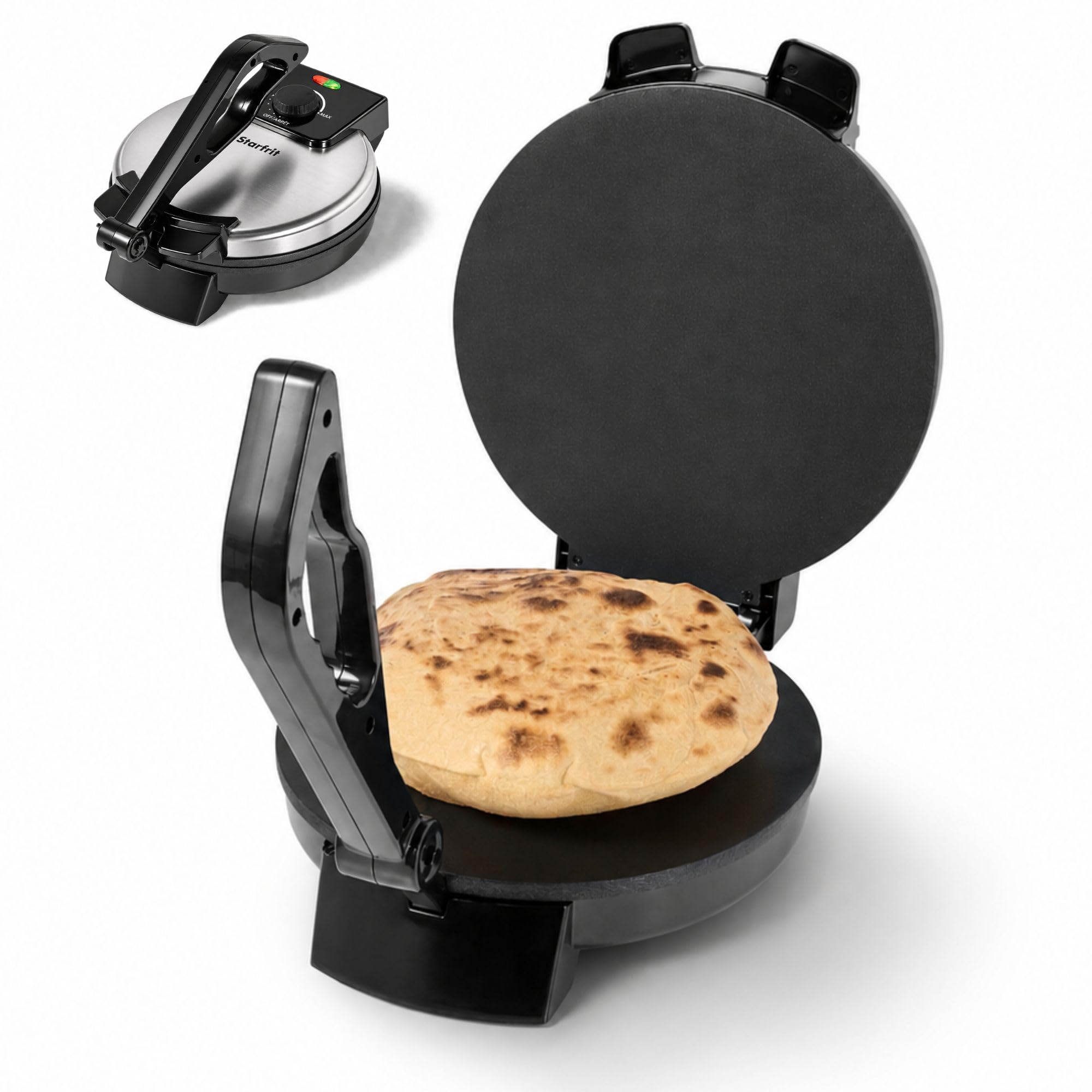
The 1200W press that heats like a skillet and looks like a brushed-steel counter piece.
1200W is the strongest heating system in this lineup, and it earns its place when you’re cooking a batch and don’t want to wait between rotis. The large non-stick baking trays hold thin rotis, papad, poori, chapati and Mexican tortillas, so it covers a whole family’s worth of bread styles.
The wide ergonomic handle spreads your pressing force across the plate for more even thickness. Cool handles, thermostat control, power lights and non-slip feet round out the safety side. A brushed stainless steel case with a place to wind the cable keeps the finish looking sharp and the counter tidy.
It weighs 4.1 pounds, which puts it between the featherweight Brentwood and the heavier Saachi — planted without being a chore to move. The listing is muddled on plate size, describing both a 12-inch and a 10-inch surface, so confirm what you’re buying before ordering. The brushed steel body reads well on an open counter, though it holds fingerprints.
What stands out
- 1200W heating for fast, even batch cooking
- Handles roti, papad, poori, chapati and tortillas
- Wide handle spreads pressing force evenly
- Built-in cable storage and cool-touch handles
Worth checking first
- Plate size is stated inconsistently in the listing
- Brushed steel shows smudges between wipes
- Single heat setting rather than a graduated dial
The one to take if: you cook a lot of flatbreads and want the strongest heating and a family-size plate.
Pass if: you want a fine temperature dial to tune each dough type.
Know the Specs
Plate diameter
This is the cooking surface measurement and the spec that decides what fits. A 10-inch plate holds a full-size wrap tortilla flat; an 8-inch plate is better for palm-sized roti dough. Match the plate to your dough balls before you look at anything else.
Wattage and heat control
Wattage is how much heating power the elements deliver, while a thermostat or temperature dial is what keeps that heat steady. High wattage brings the plate up fast; steady control keeps the second roti from burning. Look for both.
Weight and counter footprint
Weight tells you how planted the press feels and how easy it is to move. A lighter body is easier to store but can shift while you press. Heavier bodies sit still, but pulling one in and out of a cupboard gets old.
Voltage and safety features
Voltage must match your kitchen outlet — 110 or 120 volts is the common US household standard. Cool-touch handles, non-slip feet and indicator lights that show when the plate is ready all make the daily press safer and less fiddly.
Common Questions
Will an electric roti maker puff a chapati on its own?
What plate size do I need for large rotis?
How long does a roti maker take to heat up?
Why does my dough keep sliding out of the press?
Do I need a detachable handle on a roti maker?
Is a higher wattage roti maker always better?
How do I clean a non-stick roti maker plate?
Will 110 or 120 volts work on my US outlet?
Can a roti maker also cook tortillas and crepes?
Why do some roti makers break down within months?
The Bottom Line
For most kitchens, the roti maker machine that does the job cleanly is the Gonzalez 8-Inch Electric Tortilla Press, because the insulated handle and insulated legs keep both your hand and your counter safe while the 8-inch plate handles everyday roti and tortilla dough. If you need plate width for large wraps, the Compact 10” Roti Maker gives you the fullest cooking surface. And if you want automatic heat control with cool-touch handles, the Libra Roti Maker is the one to reach for — though check its build quality on arrival, since that’s the theme worth watching.
How we choose
We do not accept paid placement. Every pick is matched to a real buyer and a real use-case; we do not hands-on test units.
Sources
Specifications: manufacturer listings and product documentation. Review insights: verified customer reviews, as of November 2026. Pricing: not shown on this page (it changes often); check the current price via the retailer link.
As an Amazon Associate, Tactical Gear Guy earns from qualifying purchases. This does not affect which products we feature.