Specs are compiled from manufacturer listings and verified buyer reviews and can change over time — please confirm the key details on the product page before buying.
If you want one recommendation and nothing else: the Nidecker OG Supermatic rear-entry bindings are the strongest pick here, because they get you strapped in without bending over and they stay put once you are in. The rest of the list covers bindings, boots, and complete packages for different riders, budgets, and mountains. The one thing that separates a great day on the hill from a miserable one is whether your boots and bindings actually agree with each other.
This guide is built by comparing the manufacturers’ published specifications and the patterns across verified customer reviews, so you get each pick’s real strengths and trade-offs instead of marketing spin.
Snow gear is expensive and it fails in predictable ways — worn ratchets, mismatched boots, blown-out liners — so knowing which part matters most saves you money and a wasted lift ticket. Read on for the bindings, boots, and complete packages that hold up on real snow.
Top Picks

How To Choose The Best Skiing and Snowboarding Equipment
Most people buy a board first and figure out the boots last. That is backwards. Your boots are the only part of the setup physically touching your feet, and a boot that does not fit will ruin a board that costs three times as much. Get the boot right, match the binding to it, then pick the board.
Boots decide your whole day
A snowboard boot has a flex rating, usually written out of 10. A low number like Flex 2/10 means a soft, forgiving boot that lets you move your ankle freely. That suits a newer rider or someone who wants a relaxed, surfy feel. A high number is stiff and transfers every bit of your movement into the board edge, which is what advanced riders want on hard, icy slopes.
The other boot number that matters is your exact size. Snowboard boots are not sneakers, and a half size too big lets your heel lift inside the boot. When your heel lifts, you cannot steer the board with precision no matter how good your bindings are.
Bindings have to match your boot, not just your board
This is where most first-time buyers get caught. Step-on and rear-entry binding systems require a matching boot, and a binding that claims to be compatible with your boot may not actually click in cleanly. Strapped bindings work with almost any boot, which is why they remain the safe default. Rear-entry and step-on systems trade that universal fit for speed at the lift line.
Cross country skis and downhill gear are different sports
A cross country package is built around a light ski, a low-cut boot, and an NNN binding that lets your heel lift so you can stride forward. Downhill ski and snowboard gear locks your foot down for edge control. If you have never bought either, pick the sport you actually intend to do — this is not an interchangeable purchase.
Side-by-Side Comparison
| Model | Best For | Type | Weight | Size | Amazon |
|---|---|---|---|---|---|
| Nidecker OG Supermatic Bindings★ Best Overall | Fast lift-line laps | Rear-entry bindings | 6 pounds | Small (US Men’s 4.0-5.5) | Amazon |
| GSOU SNOW Ski SuitBest Value | Staying warm and dry | One-piece snowsuit | — | — | Amazon |
| K2 Market BOA BootsBest for Beginners | Beginner-to-casual riders | Snowboard boots | — | 9.5 | Amazon |
| Burton Step On Re:Flex Bindings | Quick click-in convenience | Step-on bindings | 4.6 pounds | Medium (8.5-10.5) | Amazon |
| Whitewoods NNN Cross Country Package | Nordic touring | Complete ski package | 12 pounds | 207cm skis, size 42 | Amazon |
| Camp Seven Drifter & APX Package | All-mountain riding | Complete snowboard package | — | Boot Size 11 | Amazon |
| Camp Seven Valdez Package | Intermediate to advanced | Complete snowboard package | — | Boot Size 9 | Amazon |
| Symbolic Arctic Package | Big-footed riders | Complete snowboard package | 30 pounds | 13 Mens Boots | Amazon |
| System MTN & APX Package | First-time buyers | Complete snowboard package | — | Boot Size 9 | Amazon |
Detailed Reviews
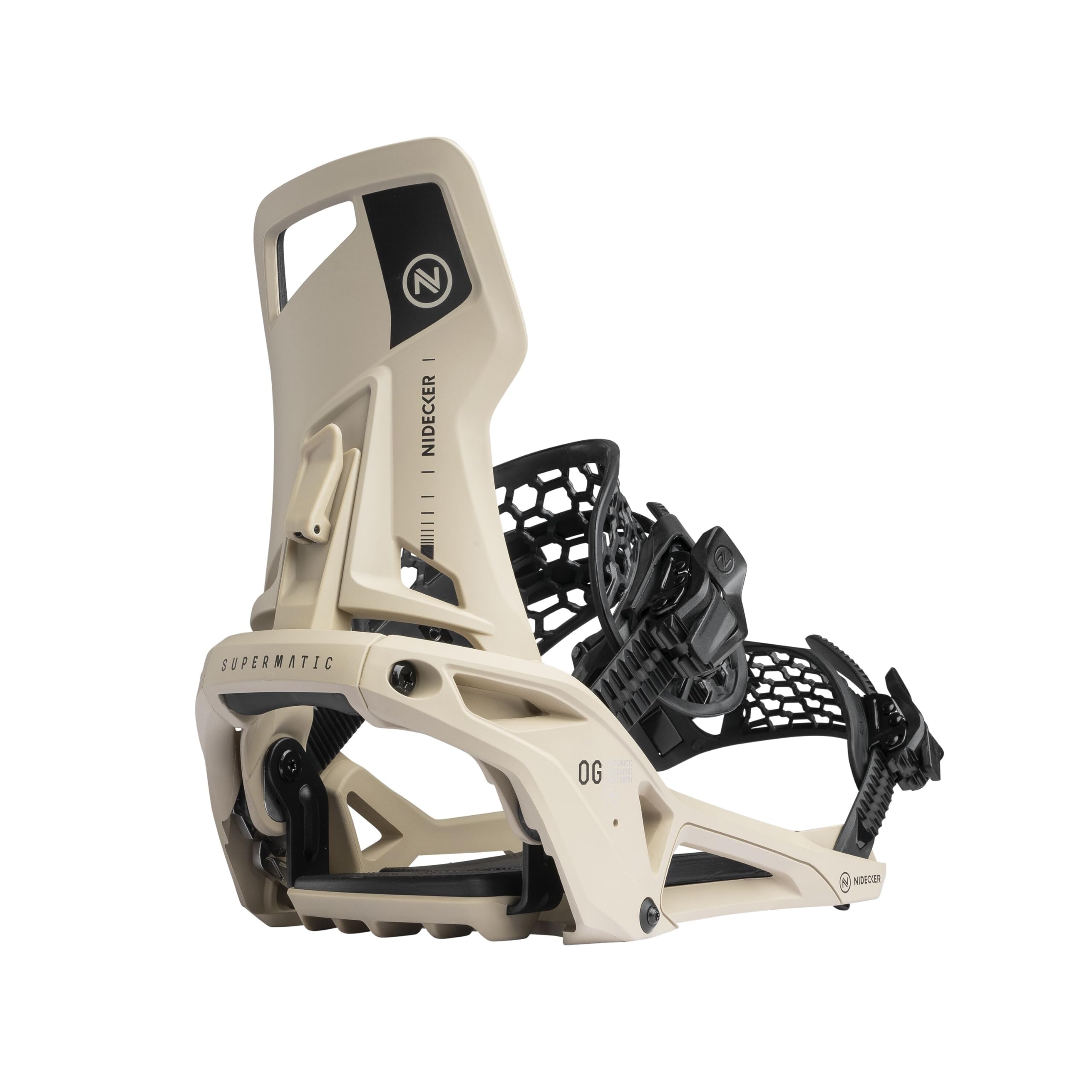
1. Nidecker OG Supermatic Men’s Rear-Entry Snowboard Bindings
Our pick — 4.5+★ from 200+ verified ratings; the strongest balance of quality and price.
The binding that lets you drop in without unclipping your gloves.
What you get here is speed. These are rear-entry bindings, which means you step your boot in from the back and the highback closes over your heel instead of you wrestling with two straps every lap. For a rider who hates standing in the queue bent double, that is the whole reason to buy them. They weigh 6 pounds for the pair, which is about as heavy as a decent pair of strapped bindings and not a concern on the lift.
The build is what earns the top slot. The highback is flax fiber, the hanger and post are recycled carbon, and the buckles are nylon — a mix that keeps the platform rigid enough to push energy into your edges for carving and jumps without going numb underfoot. A shock-absorbing footbed soaks up the chatter you feel on hardpack, which is the difference between riding all day and calling it quits at lunch. Boot fit is the interesting part: unlike the Burton Step On below, this system does not lock you into one specific boot, and you can adjust tension on the boot rather than everything being fixed.
The honest catch is the mechanism itself. The ratchet is the part that takes the abuse, and a broken plastic ratchet is the failure that shows up. Treat the lever with a little care when you snap it shut and this held up fine. It is the comfortable middle ground between an old-school strap binding and a closed step-on system, at a price well below the Burton option.
Where It Wins
- Rear-entry closure cuts seconds off every lap.
- Rigid flax-fiber and recycled-carbon platform transfers energy cleanly.
- Works with a range of boots, not just one proprietary model.
- Adjustable tension lets you dial in how locked-in you feel.
What To Watch
- The plastic ratchet is the weak link — close it gently.
- Not as stiff as a dedicated freeride binding for charging icy steeps.
- Small size only covers US Men’s 4.0-5.5.
Right for: riders who want faster transitions and a binding that works with boots they already own.
Look elsewhere if: you need a specific larger size or you are chasing maximum charging stiffness.
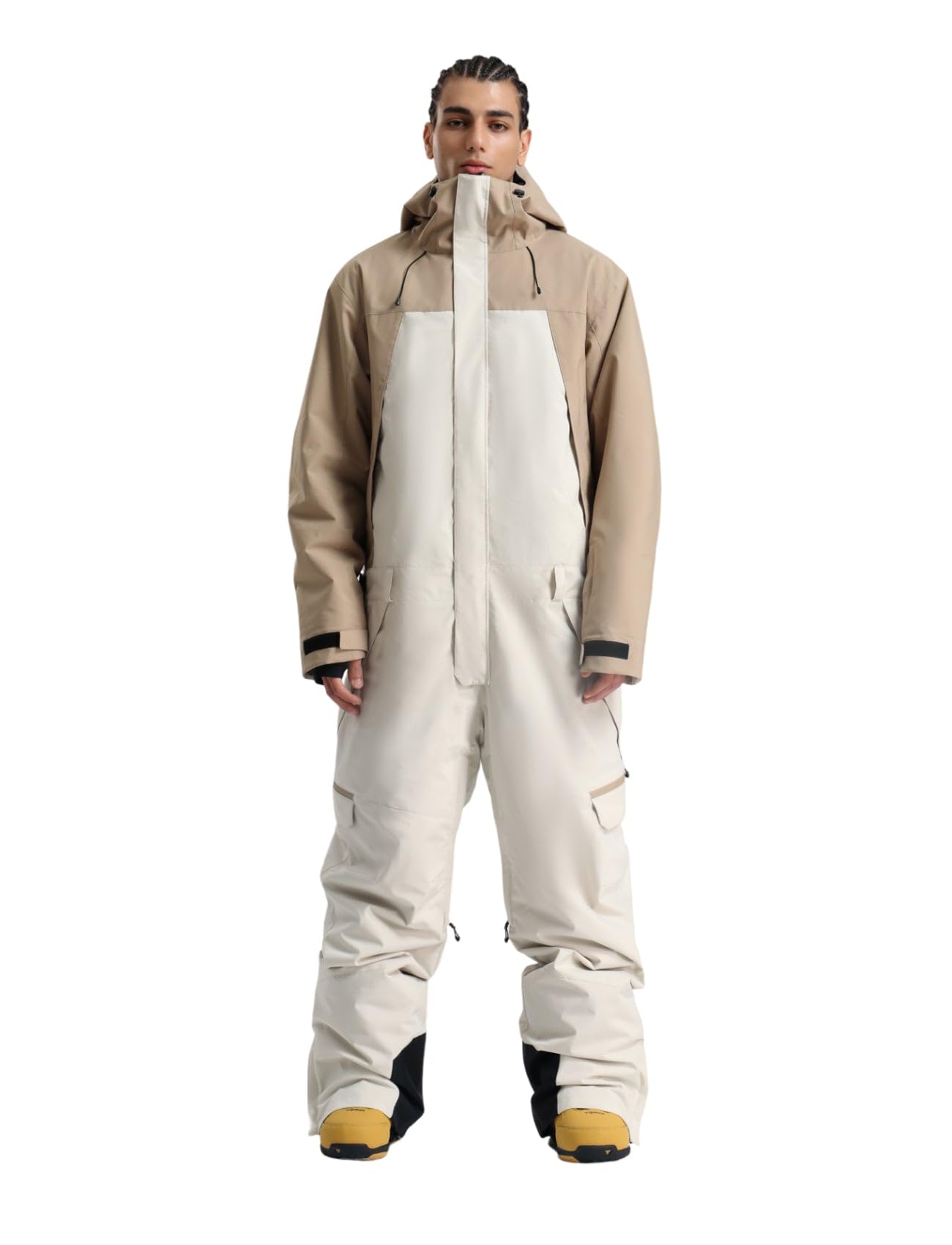
2. GSOU SNOW Ski Suit
The one-piece snowsuit that keeps the snow out no matter how hard you fall.
A one-piece snowsuit fixes the single most annoying thing about jacket-and-pants combinations: snow creeping up your back when you wipe out. Because the top and bottom are sewn together, there is no gap to exploit. GSOU builds this one as an insulated, waterproof men’s ski suit with a baggy snowsuit cut, so you get room to layer underneath and a look a lot of people seem happy to wear — the appearance draws steady praise.
Warmth is the second thing it gets right, and water resistance holds up for keeping you dry over a long day out. The build quality is the thing that wins people over, and it is the single aspect most discussed. In real use, this is the suit you reach for on a cold resort day when you want one zip to get dressed and one zip to get out of it at the lodge.
Here is where you need to pay attention: sizing is genuinely mixed. Some buyers find it fits well, while others say it runs larger than expected, and several note the pants run long. The practical fix is to read the size chart and plan for a little extra length in the leg. That is a fit quibble, not a defect — the suit itself is sound.
Warmth and weather: insulated, waterproof, and confirmed dry through real winter days. The sizing note: order with the chart in hand and factor in longer pant legs.
Reach for this if: you want a single zip-in outfit that keeps powder out and warmth in.
Think twice if: you are between sizes or short in the leg — dial the sizing carefully first.
3. K2 Market BOA Men’s Snowboard Boots
A soft, forgiving boot that gets beginners riding without a fight.
Flex 2/10 is the number that defines this boot. That is a soft flex, meaning the boot bends easily with your ankle so you can learn to ride with a relaxed, surfy feel instead of fighting a stiff shell. If you are new to snowboarding or you only get out a few weekends a year, that forgiveness is exactly what you want underfoot.
The BOA dial is the other headline. Instead of laces, you twist a dial and a steel cable tightens the whole boot in seconds. K2 built the H4 version here so the dial ejects on a severe impact and can be re-inserted on the spot, which is a smart bit of insurance against the classic dial-snaps-in-the-parking-lot problem. The comfort EVA foam liner is soft and warm, and the die-cut EVA footbed adds cushioning underfoot. Fit runs true to size, and the upper articulates independently so the flex stays distortion-free.
Compared to the Burton Step On bindings lower down, this is the versatile path: a conventional boot that works with standard strapped bindings, no proprietary lock-in. The trade-off is that a Flex 2/10 boot is soft on purpose — an aggressive advanced rider carving hard ice will want something stiffer. For everyone learning and cruising, it does exactly the job.
The dial does the work: twist to tighten, no lacing, with an eject-and-reinsert design that survives a bad hit. The soft-flex promise: forgiveness for learners and casual riders, less edge-driving punch for experts.
Best for: new riders and casual weekend boarders who want easy entry and a soft, comfortable ride.
Upgrade past these if: you are an advanced rider who wants a stiffer boot for hard carving.
4. Men’s Burton Step On Re:Flex Snowboard Bindings

The click-in system that saves your back and your knees at the lift line.
Step On is Burton’s system where your boot clicks directly into the binding — two toe points and one heel point — with no straps to pull. At 4.6 pounds for the pair, it is noticeably lighter than the Nidecker rear-entry bindings at 6 pounds, and it is far more compact because there is no harness of straps hanging off it. If you have ever winced bending over to strap in, that weight and the click-in motion are the point.
The Re:Flex mounting system is what makes these ride like a normal setup underfoot. It lets the board flex naturally between the bindings, which keeps the feel playful instead of locked and dead. The FullBED cushioning underfoot reduces fatigue, and the trap-door design gives you access to the mounting hardware without pulling the whole binding apart. The Zero forward lean hi-back and FLAD system let you micro-adjust your stance from relaxed to responsive.
The thing you must get right is boot compatibility. Step On only clicks into a Step On boot, so if you already own boots, check they are the right ones before you order — a mismatch here leaves you with bindings that will not lock in. Riders who use the matched boot talk about the hold feeling solid and snow not clogging the mechanism. Get the pairing right and this is the fastest system on the list.
The Wins
- Click-in entry, no bending or strap fumbling.
- 4.6 pounds for the pair is noticeably lighter than strap bindings.
- Re:Flex mount keeps board flex natural and playful.
- Adjustable forward lean lets you tune the stance.
The Catch
- Only works with compatible Step On boots — no universal fit.
- Boot pairing must be exact or the bindings are unusable.
- Performance on rough terrain draws a mix of reaction.
Match it to: a rider who already has or will buy the matching Step On boots and wants the fastest possible transitions.
Skip if: you want to keep using your current boots or you want a universal compatibility safety net.
5. Whitewoods Adult NNN Cross Country Ski Package

One box, all four pieces — skis, bindings, poles, and boots for the touring track.
If you want to try cross country skiing without piecing a kit together, this package removes the homework. You get 207cm skis built for skiers 180 pounds and up, Rottefella NNN touring bindings already mounted on the skis, cross trail Nordic poles, and Whitewoods 302-NNN boots, all together. The ski itself uses a laminated wood core with a light cap construction and a machined wax-less base, so you can head out without a waxing setup. The 64-55-59 side-cut and powder tip are spec’d for light touring both in-track and off-track.
At 12 pounds for the package, this is the heaviest setup here — the Symbolic Arctic snowboard package below weighs 30 pounds, so cross country gear is far lighter on balance, but do not expect to hike it far in a pack. The bindings are the Basic model, which steps in and out easily and does not require mounting plates, which suits someone who skis occasionally rather than every week. The boots are lined with 100 grams of Thinsulate and a quick-dry liner, which is what keeps your toes from going numb on a cold track.
The detail to note is the ski length. At 207cm it is sized for a larger rider — 180 pounds and up — so a lighter person will find it long and harder to manage on tight turns. Read the sizing charts in the images before you order. For the right rider, this is a complete, ready-to-stride kit at a fair price.
Ready to go: skis, mounted NNN bindings, poles, and Thinsulate-lined boots all in one order. The size gate: the 207cm ski is built for 180 pounds and up, so smaller riders need to size down.
Choose this if: you are a heavier rider or a beginning cross country skier who wants a full kit without the research.
Look elsewhere if: you are under 180 pounds or mostly ski downhill, because this is built for the touring track.
6. Drifter and APX Men’s Complete Snowboard Package New

Board, bindings, and boots that were designed to be ridden together.
The Drifter is an all-mountain board built on the CRCX camber profile — a rocker-dominant “camber-rocker-camber” shape. In plain terms, that means it floats easily in powder and lifts the contact points so you do not catch an edge, which is exactly the behavior a developing rider wants. Camp Seven pairs it with the System APX bindings and APX boots to make a matched three-piece set. Boot size 11 here, so check the sizing.
The bindings carry a serious wish list: a full length EVA base pad for vibration damping, either-or toe straps you can run over the toe cap or the forefoot, gel insert contoured straps, aluminum 4 tooth ratchets, and 15% fiber in both the baseplate and highback. The boots add Thermofit heat moldable liners and an articulating cuff for a smooth flex. All of it comes under a 3 year warranty, which is a long promise for a package at this level.
Where this earns its spot is value and durability. Quality is what buyers praise most, with value next in line — the board and boots are reported to hold up over time, and beginners find it forgiving to learn on. One honest note from owners: the boots are functional but not the highlight, so if you can afford to upgrade one piece down the line, the boots are the place to spend. Still, as a complete first setup, it is a smart pick.
The matched build: rocker-dominant camber makes it float in powder and resist catching an edge, with a full binding spec underfoot. The upgrade path: the boots are decent but the place to spend if you upgrade later, all backed by a 3 year warranty.
Right for: a first-time or improving rider who wants a matched board, binding, and boot set with a warranty.
Worth considering elsewhere if: you already own good boots and would rather buy a board on its own.
7. Valdez Snowboard Summit Bindings & APX Boots

The package built for riders who carve, not just ride.
The Valdez package is aimed at intermediate and advanced riders, and the construction backs that up. It uses Camp Seven’s DD2 dual density core with Edgelock — hand-selected poplar running tip to tail with high-density stringers down each edge. In practice, that stronger rail is what helps you drive your edge into the snow on icy days, which is precisely where softer beginner packages fall short.
The board runs a CRCX profile with full rocker in the center for float and catch-free riding, then mild camber in the tip and tail for pop on ollies and jumps. The bindings are Camp Seven Summit with a full length EVA base pad, either-or toe straps, and aluminum 4 tooth ratchets, and the boots are System APX with Thermofit heat moldable liners. The whole thing carries a 3 year manufacturer warranty.
The honest caveat is durability, which reads mixed. Some boards hold up well while others show scuffs and scratches quickly — normal wear on a board that sees ice and park, but worth a quick shop tune to keep it in shape. The bindings also draw a mix of feedback, with a report of the screws loosening over several trips. Neither is a reason to skip it — just check your hardware before each trip.
Grip where it counts: high-density edge stringers drive the rail into hard, icy surfaces. The maintenance note: boards pick up scratches and binding screws can loosen, so do a pre-trip check.
Best for: the intermediate or advanced rider who wants a stiffer, edge-gripping board and a full matched set.
skip it if: you are a complete beginner who wants the softest, most forgiving ride.
8. Symbolic Arctic Snowboard & Bindings & Boots
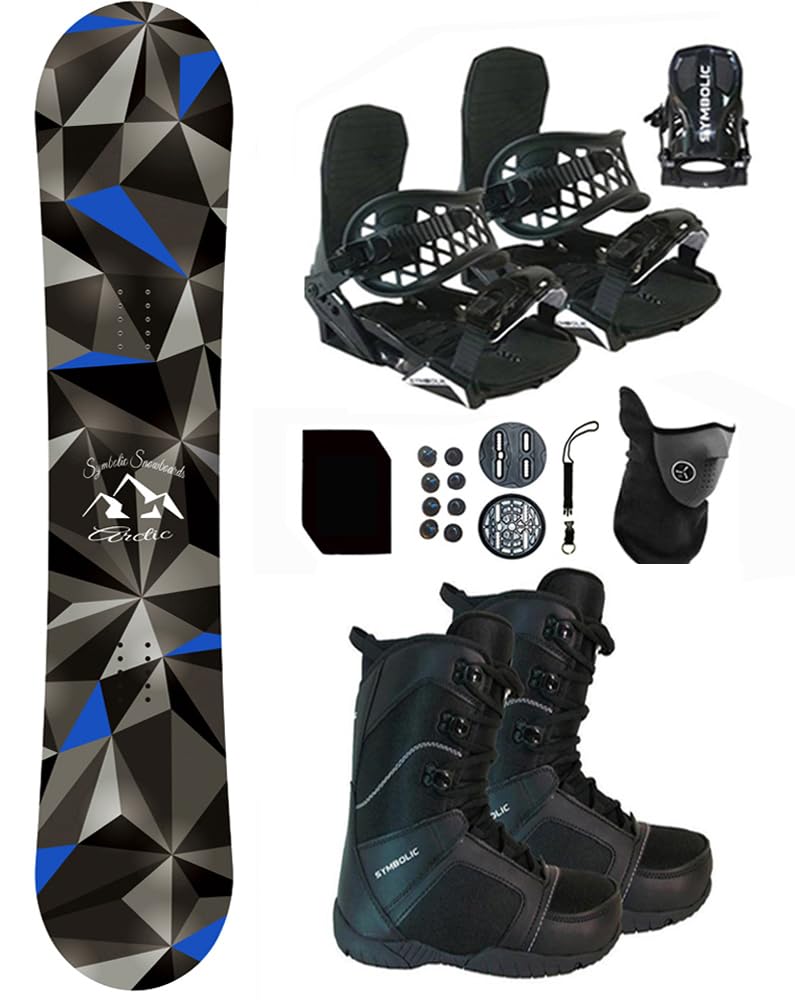
A full six-piece kit in a size 13 for riders other packages leave out.
Most packages top out before they reach you if you have big feet. This one comes in a size 13 men’s boots with black bindings, which is the whole reason a large-footed rider should look here. Beyond the board, it bundles bindings, boots, a leash, a stomp pad, and a gaiter into a single order. At 30 pounds for the package, it is heavy, so plan to transport it rather than carry it far.
The board itself suits all skill levels and comes in a regular or wide option, which a size 13 boot needs so your toes are not dragging on the snow during a turn. Quality and value are the two things buyers keep returning to, and one larger rider reports the fit working well for a 13 shoe. As a do-it-all freeride and freestyle setup, the wide option is the smart call for anyone whose feet run off the average chart.
Durability is the honest footnote here. Reports split — some boards hold up to jumps and carving without complaint, others show nicks and scratches easily. Since a size 13 rider has fewer package options, this remains the practical pick; just protect the base with a tune-in and store it carefully between trips.
The Standouts
- Runs to a size 13 boot with a wide board option for big-footed riders.
- Six pieces in one package — board, bindings, boots, leash, stomp pad, and gaiter.
- Fit for large feet is the real feature most packages skip.
- All-mountain profile rated for every skill level.
The Trade-offs
- 30 pounds makes it bulky to transport.
- The board scratches and nicks fairly easily.
- Durability is a mix of long-lasting and quick-to-mark.
Choose this if: you wear a size 13 boot or larger and need a full package that actually fits.
Look elsewhere if: you have average-sized feet or you want to avoid a heavier, bulkier kit.
9. System MTN and APX Complete Men’s Snowboard Package
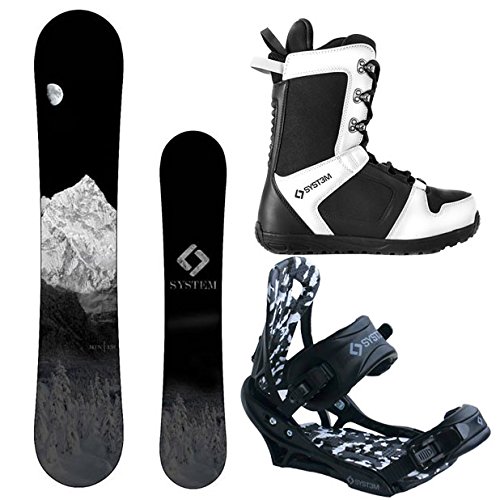
The package that gets a brand-new rider down the mountain without the sticker shock.
The System MTN is built around a camber-rocker-camber profile, which works like this: the rocker center floats in powder, and the small cambered sections in the nose and tail only engage when you push, giving you pop for ollies and jumps. The core uses a 3D build — poplar running tip to tail, two high-density stringers set just outside the center, and a heartwood stringer down the middle. In plain terms, that combination of woods is how a board of this tier manages to grip ice and stay maneuverable in the park at the same time.
Camp Seven’s APX bindings bring a full length EVA base pad, either-or toe straps, gel insert contoured straps, and aluminum 4 tooth ratchets. The APX boots run Thermofit heat moldable liners and an articulating cuff. That is a complete board, binding, and boot set for a first season, and the 3 year warranty applies to each component separately. For a budget package, that warranty is a better safety net than most higher-priced single items carry.
The recurring gripe is the bindings. The straps go around the toe and can be fiddly to fasten snugly, and some riders find them loosen over time. Quality is what owners praise most — the board itself holds up and rides with good control, and the edges grip ice well. Treat the bindings as the part you might upgrade down the road and this is a strong beginner package for the money.
Board that overdelivers: ice-gripping edges and easy park maneuverability from a budget-tier package. The binding caveat: toe straps can be awkward to lock tight and may loosen, so budget for an eventual upgrade.
Best for: the first-time buyer who wants a complete, warranted package without stretching the budget.
Upgrade past it if: you are already riding at a level where fiddly bindings will frustrate you.
Know the Specs
Boot Flex Rating
A snowboard boot flex is a scale, usually out of 10. A number like K2’s Flex 2/10 means a soft, bending boot for beginners and casual riders. A higher number is a stiff boot that drives edges hard on ice. Match the flex to your skill level: soft for learners, stiff for hard-ice carving.
Binding Compatibility
Step-on and rear-entry bindings require boots built for that specific system, while strapped bindings fit almost any boot. Before you buy, confirm your boot and binding speak the same language — a mismatch leaves gear you cannot click in.
Board Profile
Camber-rocker profiles place rocker in the center for float and camber at the tip and tail for pop. A rocker-dominant profile floats well in powder and is forgiving on edge catches, which is why beginner packages lean that way.
Ski Length and Weight
Cross country ski length is matched to rider weight. The Whitewoods package uses 207cm skis rated for skiers 180 pounds and up, so a lighter rider needs a shorter ski to control it on tight turns.
Common Questions
Will Burton Step On bindings work with my existing snowboard boots?
What does a Flex 2/10 boot mean for a beginner?
How do I pick the right cross country ski length?
Is a rear-entry binding as secure as a strapped binding?
Should I buy a complete snowboard package or separate pieces?
What is a wide snowboard and do I need one?
How long should snowboard boots last?
Is a one-piece ski suit warmer than a jacket and pants?
How often should I tune or wax my snowboard?
Can I use downhill ski boots with a cross country binding?
The Bottom Line
For most riders, the skiing and snowboarding equipment winner is the Nidecker OG Supermatic bindings because they cut the time you spend fumbling at the lift line, work with a range of boots, and transfer energy cleanly into your edges. If you want the fastest click-in entry and are willing to buy the matching boot, grab the Burton Step On Re:Flex bindings. And for a true one-and-done starter package, the System MTN and APX package covers board, bindings, and boots under a per-component warranty. Pick the one that matches your boot size and terrain, and the mountain takes care of the rest.
How we choose
We do not accept paid placement. Every pick is matched to a real buyer and a real use-case; we do not hands-on test units.
Sources
Specifications: manufacturer listings and product documentation. Review insights: verified customer reviews, as of November 2026. Pricing: not shown on this page (it changes often); check the current price via the retailer link.
As an Amazon Associate, Tactical Gear Guy earns from qualifying purchases. This does not affect which products we feature.