Specs are compiled from manufacturer listings and verified buyer reviews and can change over time — please confirm the key details on the product page before buying.
If you are gluing up a panel and you need both hands free, the clamp that saves you is the one with a trigger you can pull with your palm while your other hand holds the joint shut. That one-handed release is what separates a clamp you reach for from one that sits in the drawer. Below are six clamps that all have a real quick-release mechanism, sorted by what each one actually does well, so you can match the clamp to the work instead of guessing from the picture.
This guide is built by comparing the manufacturers’ published specifications and the patterns across verified customer reviews, so you get each pick’s real strengths and trade-offs instead of marketing spin.
Clamping force and jaw opening are the two numbers that decide whether a clamp can handle your glue-up, and both are printed on every box. The trick is knowing which number you actually need before you buy, and this breakdown of the quick release pipe clamp covers from top to bottom.
Top Picks
How To Choose The Best Quick Release Pipe Clamp
The mistake most first-time buyers make is shopping by jaw length alone. A long clamp that cannot squeeze hard enough will let a glue line creep open while it cures, and no amount of extra reach fixes that. Start with force, then work out how far the jaws need to open, then check how the release actually works in your hand.
Start with clamping force, not jaw length
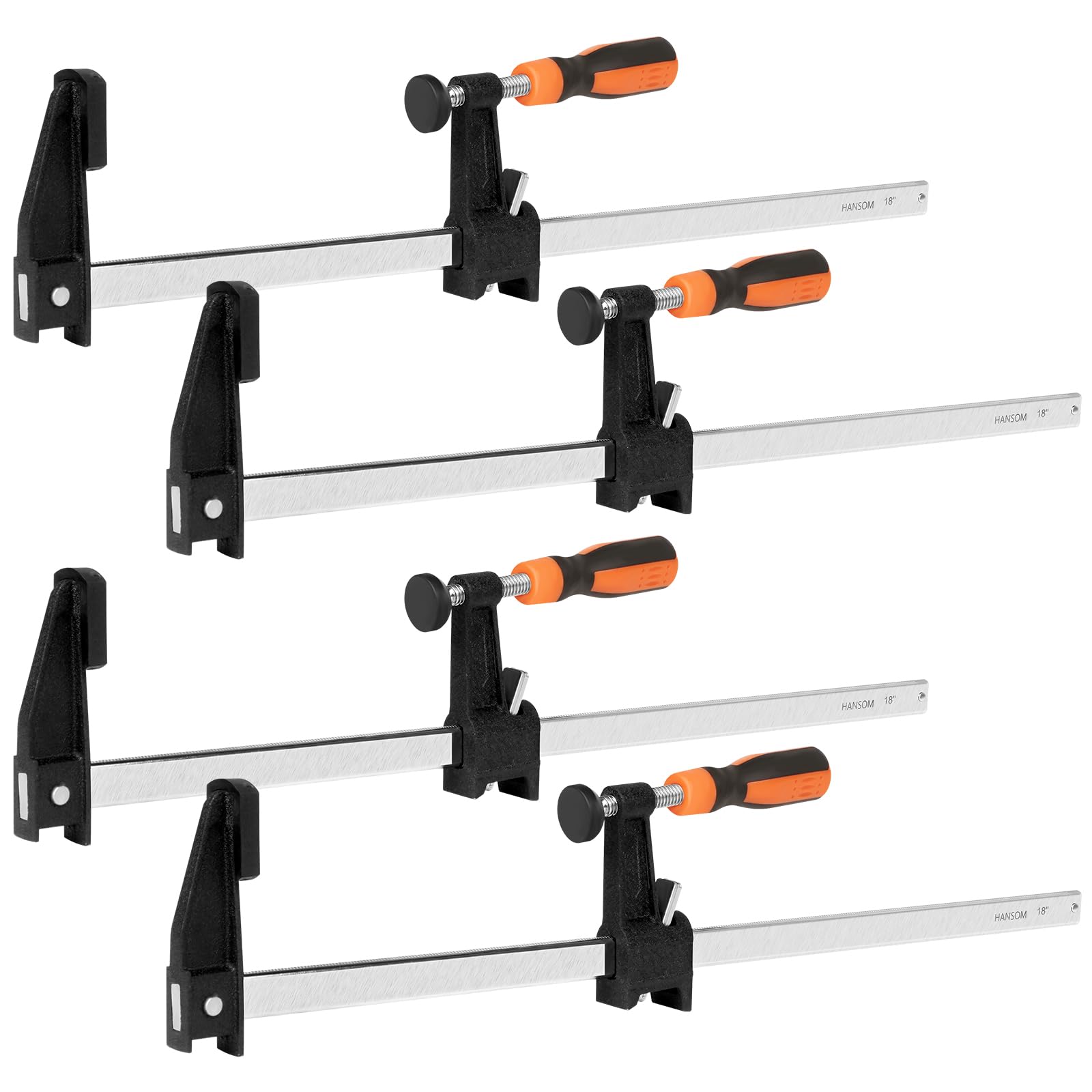
Clamping force is the squeeze the clamp puts on your workpiece, measured in pounds. The HANSOM four-pack is rated to 600 pounds of force, which is enough to close a stubborn joint and hold it while the glue sets. The ELEAD three-pack is rated to 350 pounds, and the SEDY and HORUSDY sets are rated to 150 pounds each. Those lower numbers are fine for light glue-ups and trim work, but on a thick hardwood panel you will feel the difference.
Decide if you need a bar clamp or a pipe fixture
A bar clamp has its rail built in, so it arrives ready to use. A pipe clamp fixture is only the jaw assembly, and you slide it onto a length of 1/2 inch threaded pipe you supply yourself. That lets you build a clamp as long as your pipe, which is why pipe fixtures are popular for large glue-ups and bench work. The trade-off is that the pipe is an extra purchase and extra storage.
Check how the release works with one hand
Quick-release means the jaw lets go fast so you can slide it into position instead of cranking a screw for inches. On most trigger clamps you squeeze a trigger to advance the jaw and press a release to back it off. On the Strong Hand Tools alignment clamp the release is a button that lets a threaded screw glide, which is a different feel but the same idea: fast repositioning without spinning a handle.
Side-by-Side Comparison
| Model | Best For | Clamping Force | Max Opening | Quick Release Type | Amazon |
|---|---|---|---|---|---|
| HANSOM 4-Pack 18 inch Bar Clamps★ Best Overall | Heavy glue-ups that need real squeeze | 600 lbs | 18 in | Quick-release latch | Amazon |
| ELEAD 3-Pack 12-Inch Bar ClampBest for One-Handed Work | One-handed cabinet and frame assembly | 350 lbs | 12 in | Quick-release trigger | Amazon |
| SEDY 6-Pack 12 Inch Bar Clamps | Long boards joined from shorter clamps | 150 lbs | 12 in, extends past 24 in | Red quick-change button | Amazon |
| HORUSDY 8-Pack Bar Clamps | Mixed 6 in and 12 in jobs in one set | 150 lbs | 12 in, extends to 24 in | Quick-change button | Amazon |
| ATPEAM 6 Pack 1/2” Pipe Clamps | Building clamps as long as your pipe | — | Any 1/2 in threaded pipe | Spring lever | Amazon |
| Strong Hand Tools CPA120 | Pipe fit-up and weld alignment | — | 4-1/2 to 12 in pipe | Quick-acting screw button | Amazon |
Detailed Reviews
1. 4-Pack 18 inch Bar Clamps
Our pick — 4.5+★ from 250+ verified ratings; the strongest balance of quality and price.
The clamp that squeezes hardest in this lineup, and it does it with an 18-inch reach.
Squeeze is the reason to start here. These bars are rated to 600 pounds of clamping force each, which is enough to pull a bowed hardwood panel flat and keep it there while the glue cures.
Reach is the second win. Each clamp opens to 18 inches, and the throat depth — the gap between the bar and the jaw face, where your workpiece actually sits — measures 2.5 inches. That depth lets you clamp past a raised edge or over a thick glue-up block. The SEDY and HORUSDY clamps stop at 12 inches of opening, and only the SEDY and HORUSDY sets extend further by bolting two clamps together. Here you get the length in one piece with nothing to connect.
What wins people over is the build. Ductile iron and carbon steel, with a rubber handle that stays put when your palms are sweaty — a real fix for the wooden-handle slip that plagues cheap clamps. The recurring gripe is the release button, which a few find stiff to work with wet or tired hands. It is a fair note, not a flaw that undoes the tool. The soft jaw pads protect your surface, and an owner gluing a piano soundboard to its inner rim called the size perfect for that job.
What earns it first place
- 600 pounds of clamping force per clamp — the highest rated in this lineup
- 18-inch opening plus 2.5-inch throat depth for thick, raised glue-ups
- Ductile iron and carbon steel bars that hold their shape under load
- Rubber handle grips when your hands are wet or sweating
Where it asks for patience
- The release button is stiff for some hands and takes a firm push
- Four clamps at 3.56 kg total is real weight to hang on a wall rack
- No connectors included, so you cannot bolt two into a longer clamp
Made for: anyone gluing hardwood panels or assembling thick stock who needs the joint to close and stay closed.
Think twice if: you only do light trim work where 150 pounds of force is plenty and less weight on the bench is welcome.
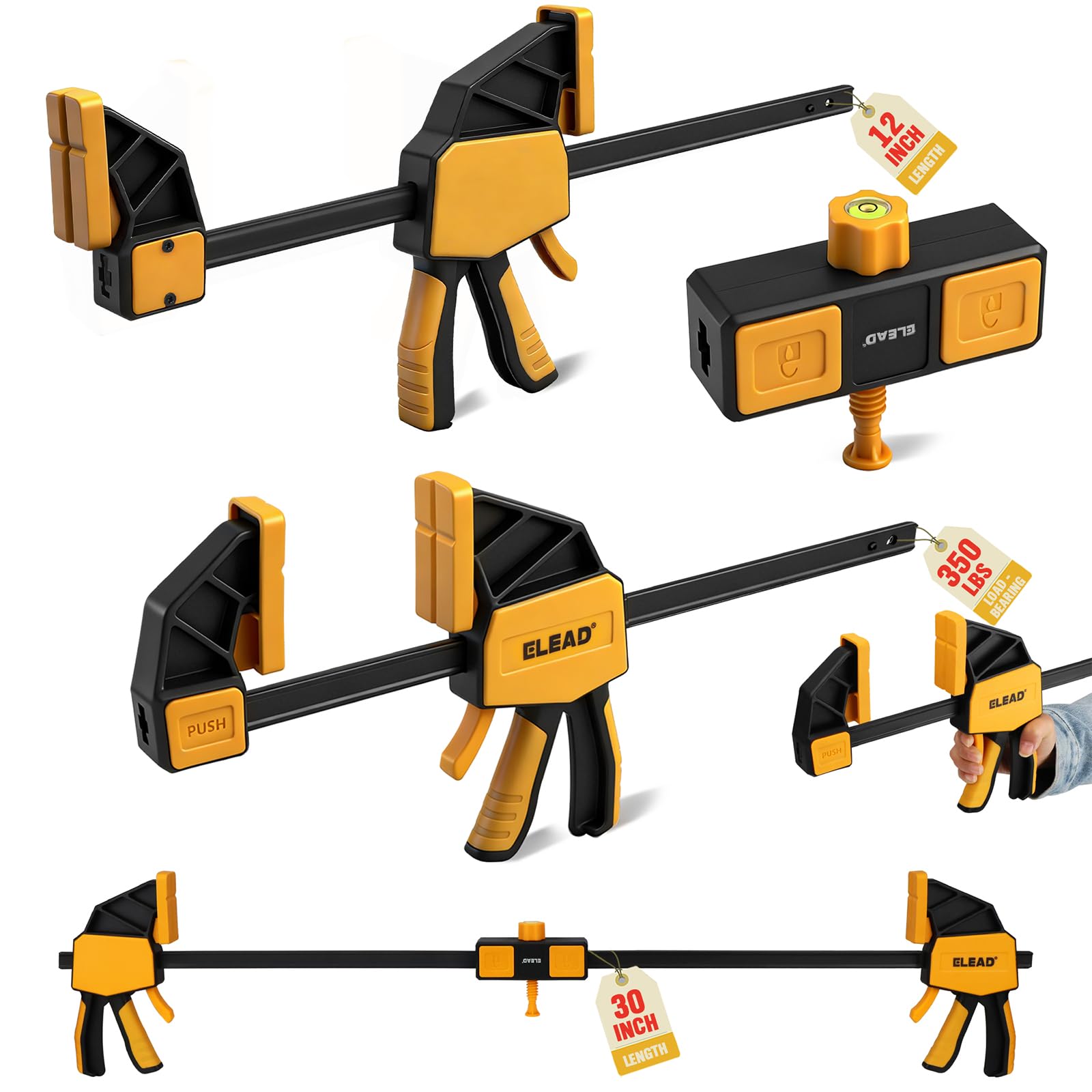
2. 3-Pack 12-Inch Bar Clamp
Three clamps built for the moment you need a second hand and only have one.
A single-handed clamp earns its place during cabinet assembly, when one hand is holding a panel square and the other is doing the tightening. The trigger here lets you advance and release the jaw with one hand, and the padded handle is shaped to reduce fatigue across a long session. Each clamp carries a 350-pound load limit, which sits between the 600-pound HANSOM and the 150-pound SEDY and HORUSDY sets — enough for cabinet and furniture work without the bulk of the heaviest bars.
The feature that sets this set apart is the connectors. They are sized to fit 6x18mm I-bars from most major clamp brands, so you can join these to clamps you already own and build a longer array for a big glue-up. Reverse the jaw components and the same clamp becomes a spreader for pushing panels apart or aligning a frame. Three clamps that each clamp and spread is the point.
Twelve inches of opening covers cabinet doors and drawer boxes, but a full sheet-goods panel needs more reach. For those wider jobs you will be linking clamps or buying longer bars. Owners consistently find the pressure strong for the size and the value fair against name-brand equivalents. For cabinet doors and drawer boxes rather than wide panels, this is the balance.
Why three is the right count: most cabinet and frame glue-ups need two clamps to hold alignment and a third for the final squeeze, and this pack lands exactly there with the connector to spare.
The honest limit: it is a 12-inch clamp. Wide glue-ups will need the connectors and a second set, which is a planning issue rather than a defect.
Reach for this if: you assemble cabinets and frames and want one-handed control plus spreader duty in the same tool.
Look elsewhere if: your projects are wide panels that need 18 inches of opening in a single clamp.
3. 6-Pack 12 Inch Bar Clamps
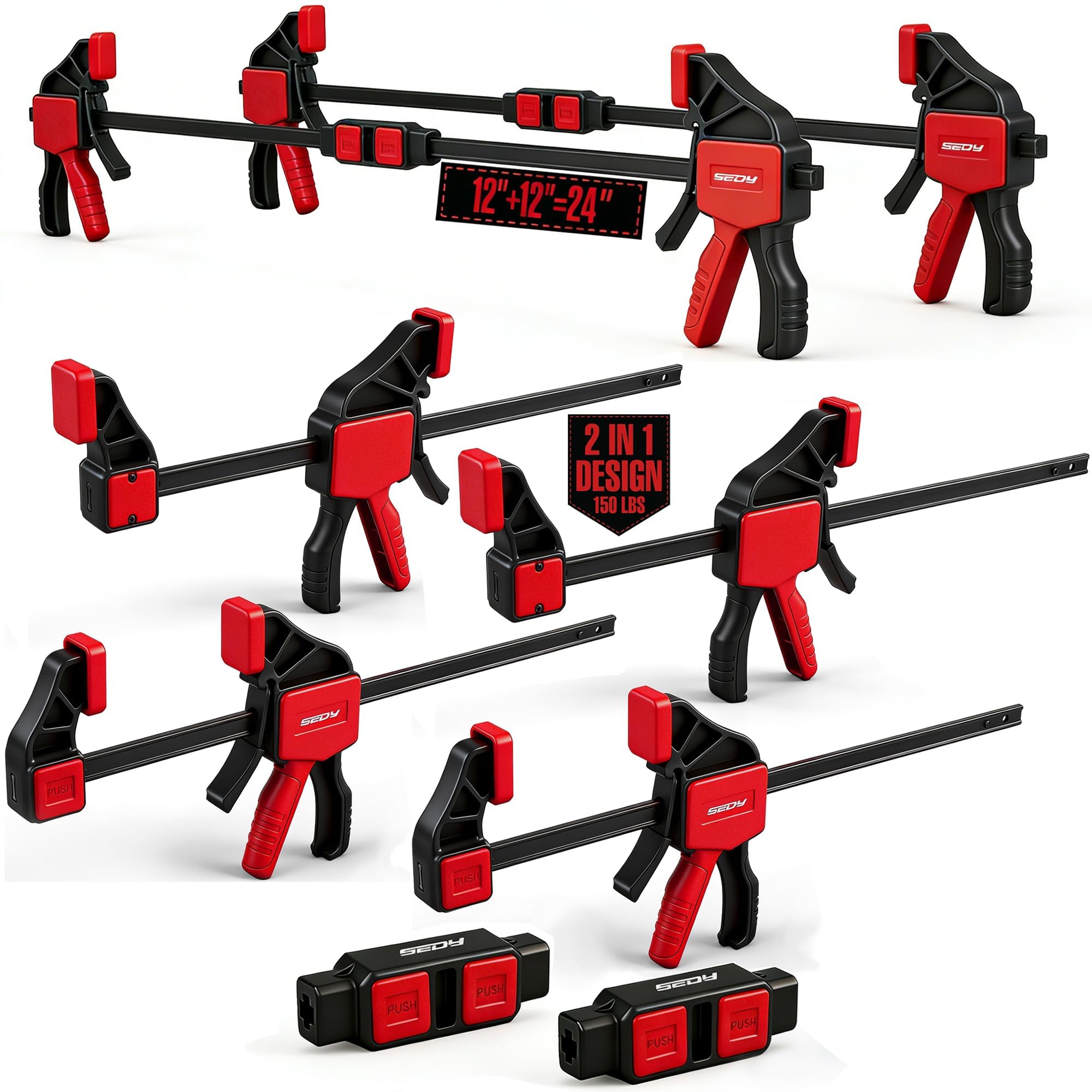
Six clamps that turn into three longer ones the moment a board outgrows twelve inches.
Here the connector is the headline. Two of them ship in the box, and each one links a pair of clamps end to end so a 12-inch clamp becomes a clamp that reaches past 24 inches. That is a different bargain than the HANSOM, which gives you 18 inches in one solid piece — this set gives you six shorter clamps that can be reconfigured rather than four fixed long ones.
Each clamp is rated to 150 pounds of clamping force (the squeeze it can hold). That is the light-duty end of this group, well under the 350 pounds of the ELEAD and the 600 pounds of the HANSOM. So treat this as a set for glue-ups, trim, and assembly rather than for pulling heavy hardwood flat. The red quick-change button pulls the jaw off and flips it so any clamp becomes a spreader (a tool that pushes parts apart). The soft non-marring pads keep finished faces free of marks.
Buyers praise the clamp quality itself, and the connector idea shows up again and again as the reason people pick this set over a plain six-pack. The build is solid and the grip locks down hard once you seat it properly. One dissenting note worth knowing: a buyer found the grip did not hold on their particular job and suggested shopping around. That is a single experience on a set many others use happily for shower surrounds and similar homeowner work. Six clamps plus two connectors at this price is the volume play.
The case for the six-pack
- Two connectors let you link clamps past 24 inches of reach
- Six clamps cover a full glue-up without buying a second set
- Quick-change button flips any clamp into a spreader
- Non-marring pads protect finished surfaces during clamping
What to weigh first
- 150 pounds of force per clamp is the light end of this lineup
- Joined clamps flex more than one solid bar at full extension
- Getting the joint to seat and hold takes a firm, even hand
The right call for: homeowners and DIY gluing who want a big set that grows longer when the board does.
Not the one for: heavy hardwood panels that demand maximum squeeze in a single rigid bar.
4. HORUSDY 8-Pack Bar Clamps
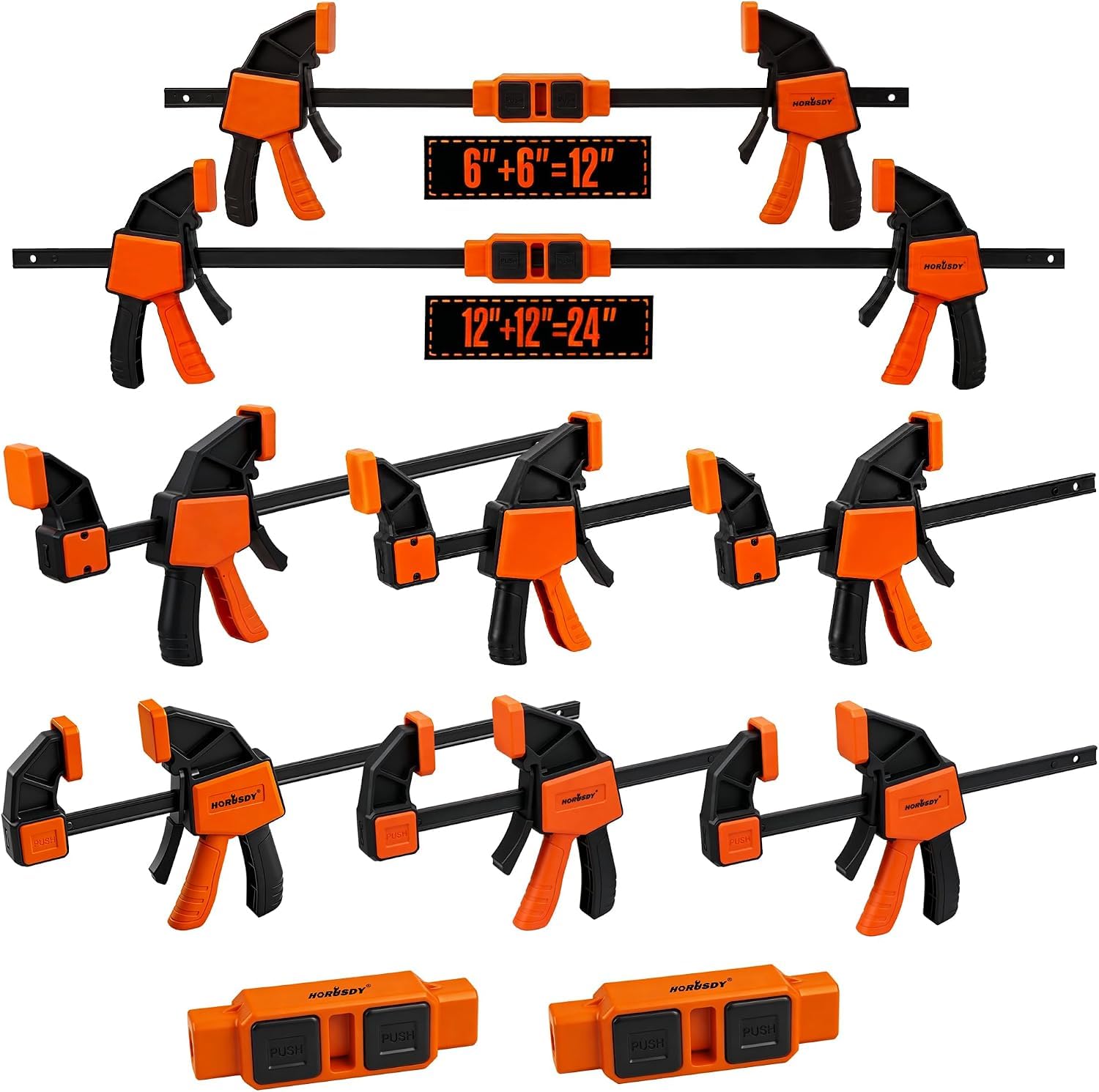
Eight clamps in two sizes, so the small jobs and the bigger boards share one box.
Two sizes in one set is the practical argument. You get four 6-inch clamps for small assemblies, trim, and tight corners, plus two 12-inch clamps for wider work, plus two connectors for linking them. That is eight pieces in total — the SEDY three-pack is three pieces by comparison — and the mix means you are not swapping jaws around mid-project to suit a small joint.
Force stays at 150 pounds per clamp, same as the SEDY set, and the quick-change button lets you pull and reverse any jaw to turn a clamp into a spreader. The non-marring pads protect finished stock, and the connectors push the working reach out to 24 inches when you need it. For a steady mix of small boxes and mid-size panels, this set covers both without buying two kits.
The trade-off is that you are trading squeeze for count. With 150 pounds on tap you should not expect to close a thick, cupped hardwood panel the way the 600-pound HANSOM can. Think of this as the light-to-medium duty set for a workshop that does a bit of everything.
Count over force: eight pieces in two lengths covers more project types than four heavy clamps, as long as your joints are light to medium duty.
The catch: at 150 pounds of clamping force, this set will not muscle a stubborn hardwood glue-up shut the way a high-force bar clamp will.
Suits you if: you want one box that handles small boxes, trim, and mid-size panels without hunting for the right size.
Pass it by if: your glue-ups are thick hardwood that needs serious clamping pressure.
5. ATPEAM 6 Pack 1/2” Pipe Clamps
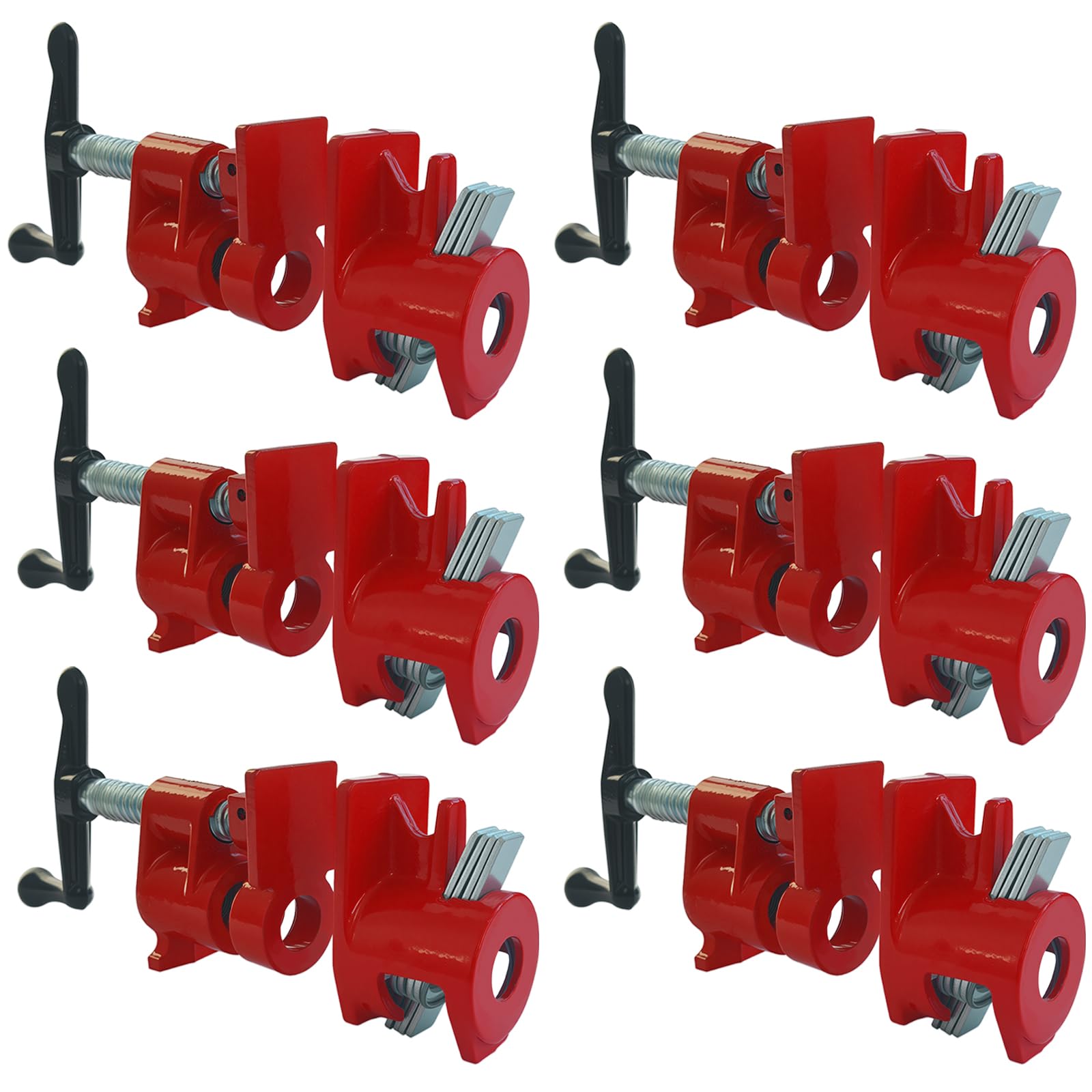
Six cast iron jaw sets that let your pipe decide how long the clamp is.
This is the pipe fixture approach, and it works differently from everything else here. Each unit is a jaw assembly you slide onto a length of 1/2-inch threaded pipe that you supply. Want a four-foot clamp for a tabletop glue-up? Cut a four-foot pipe. Want eight feet? Use a longer pipe. No fixed bar clamp can match that, because its length is set at the factory.
The build is cast iron with a red rust-protection coating, and the release is a spring lever that locks the jaw where you set it and lets go when you press it. The ergonomic grip handle lets you apply the squeeze fast. Six fixtures ship together, which is a lot of clamping stations for the tier.
Two things to plan for. First, the pipe is not included, so price your threaded pipe and coupling before you commit — it is the hidden cost of this style. Second, the set carries a lower rating than the bar clamps above, and fixtures like these generally reward a careful hand, since cast iron jaws will bite harder than a padded plastic jaw. Bring the pads or scrap wood if your finish is delicate.
Where the fixture style wins
- Clamp length is limited only by the pipe you choose
- Cast iron jaws with a rust-protection coating on the outside
- Spring lever locks and releases in one motion
- Six fixtures give you a full bench of clamping stations
What you are signing up for
- Pipe is sold separately — that is real extra cost and storage
- Threaded pipe and couplings add setup time before first use
- Cast iron jaws can mark soft wood without a pad
Worth it when: your projects keep getting bigger than any fixed bar clamp you own.
Skip the style if: you want to unbox and clamp today without sourcing pipe first.
6. Strong Hand Tools Pipe Alignment Clamp
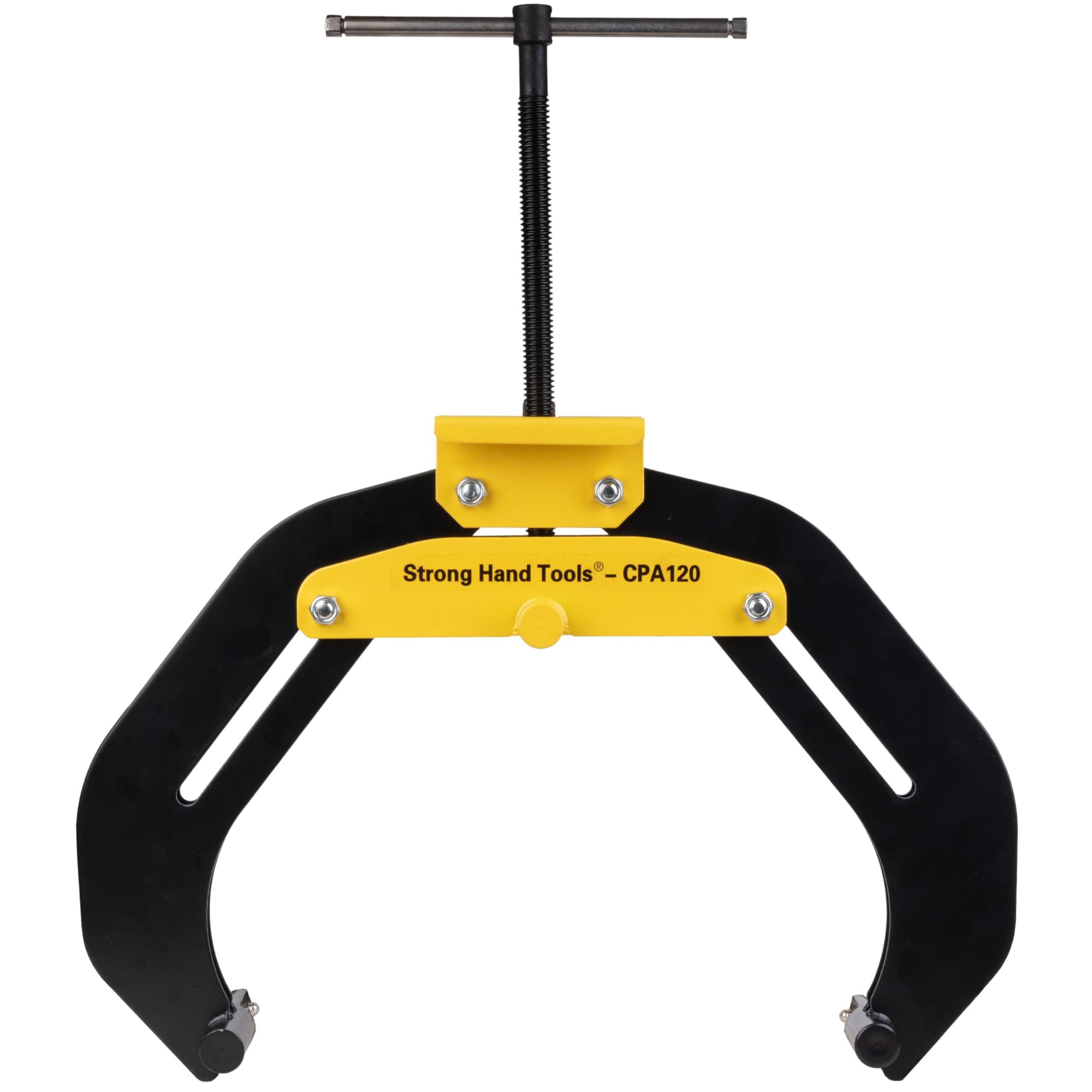
Not a woodworking clamp at all — a weld-fit tool for holding real pipe in line.
Every other pick here squeezes wood. This one aligns pipe for welding, and its job is getting pipe walls flush so the weld gap is even. It handles 4-1/2 to 12 inch pipe, elbows, tees, and flanges, in the shop or on site. Three wing-nut fine-adjustment screws push the pipe walls flush and take the high-low misalignment out of the joint. If you are fitting Schedule 40, Schedule 80, or heavier walls, that is the task this tool was designed for.
The release is a quick-acting screw. Press the built-in button and the threaded screw glides up or down so you can open the jaws fast, set the clamp, or pull it off after welding without spinning the screw the whole way. Two wide grip plates let one fabricator hold the clamp with one hand and position heavy pipe with the other, which is the difference between a two-person job and a solo one.
The contact screws are solid stainless steel, so clamping stainless, aluminum, or exotic alloys will not leave carbon steel marks on the finished pipe. The frame is double-walled powder-coated steel at 17.0 lb, built to last through heavy industrial work. For a fabricator welding pipe daily, the one-handed setup cuts the time spent aligning each joint. If you glue wood, it is the wrong tool entirely.
The job it does that nothing else here can: holding pipe, elbows, and flanges in alignment for a weld with the walls flush and the gap even.
Why it costs more: stainless contact screws, a double-walled steel frame at 17.0 lb, and wing-nut fine adjustment are precision fabrication features, not woodworking features.
Built for: pipe fitters and fabricators aligning 4-1/2 to 12 inch pipe for a clean, consistent weld gap.
Wrong tool if: you are clamping wood — a bar clamp from this list does that job for a fraction of the tier.
Know the Specs
Clamping force in pounds
This is how hard the jaws squeeze, rated in pounds. Higher force pulls a bowed board flat and keeps the glue line tight. The HANSOM set is rated to 600 pounds, the ELEAD to 350, and the SEDY and HORUSDY sets to 150 each. Match the force to your material: light trim and small boxes do fine at 150, thick hardwood wants the higher rating.
Max opening and throat depth
Max opening is how far the jaws spread, so it decides the widest board the clamp can span. Throat depth is the gap from the bar to the jaw face, so it decides how deep a piece you can clamp past. The HANSOM clamps open to 18 inches with a 2.5-inch throat, the ELEAD, SEDY, and HORUSDY clamps open to 12 inches, and the Strong Hand tool handles 4-1/2 to 12 inch pipe.
Quick-release mechanism
This is the feature the whole category is named for. On a trigger clamp you squeeze to advance the jaw and press a release to back it off. On the SEDY and HORUSDY sets it is a quick-change button that also lets you pull and flip the jaw. On the Strong Hand tool a button frees a threaded screw to glide. On the ATPEAM fixtures a spring lever locks and releases the jaw.
Connectors and spreader function
Some sets include connectors that link two clamps end to end to reach further. The SEDY set includes two connectors that take 12 inches past 24 inches, and the HORUSDY set includes two that reach 24 inches. The ELEAD connectors fit 6x18mm I-bars from most brands. Reversing the jaw components on these sets turns a clamp into a spreader that pushes panels apart.
Common Questions
What does the quick release actually do on a pipe clamp?
Do I need to buy pipe separately for the ATPEAM pipe clamp set?
Is 150 pounds of clamping force enough for a hardwood glue-up?
Can I join two bar clamps to make a longer one?
What is the difference between a bar clamp and a pipe clamp fixture?
Will clamping steel pipe mark stainless or aluminum pipe?
What does throat depth mean and why does it matter?
Can these clamps be used as spreaders?
How much clamping force do I need for cabinet assembly?
Do the jaw pads protect my finished surface?
The Bottom Line
For most woodworkers the quick release pipe clamp winner is the HANSOM 4-Pack 18 inch Bar Clamps. Its 600 pounds of squeeze in an 18-inch bar is the combination that actually closes a hardwood joint. It also carries a 4.5+ star rating across 200+ ratings. If you want one-handed control and spreader duty for cabinets, grab the ELEAD 3-Pack 12-Inch Bar Clamp. And for pipe fit-up where the weld gap has to be even, the Strong Hand Tools CPA120 is the one to reach for.
How we choose
We do not accept paid placement. Every pick is matched to a real buyer and a real use-case; we do not hands-on test units.
Sources
Specifications: manufacturer listings and product documentation. Review insights: verified customer reviews, as of November 2026. Pricing: not shown on this page (it changes often); check the current price via the retailer link.
As an Amazon Associate, Tactical Gear Guy earns from qualifying purchases. This does not affect which products we feature.