Specs are compiled from manufacturer listings and verified buyer reviews and can change over time — please confirm the key details on the product page before buying.
Your first real decision is simple: do you want a phone on your wrist that needs charging every night, or a toughened training tool that survives a month in the wild? Answer that and your shortlist narrows before any spec matters. Every pick below earns its place on verified owner reviews, not on marketing copy.
This guide is built by comparing the manufacturers’ published specifications and the patterns across verified customer reviews, so you get each pick’s real strengths and trade-offs instead of marketing spin.
The rest of this breakdown covers the specs that decide whether a watch stays on your wrist or ends up in a drawer.
Top Picks


How To Choose The Best Top Rated Smartwatch for Men
The wrong watch is rarely a bad watch — it is a good watch that fights your routine. A 24-hour battery is fine if you charge your phone nightly anyway. It is a nuisance if you spend three days on a trail. Start with how you live, then match the spec to it.
Decide your battery camp before anything else
A watch rated 24 hours of normal use expects a daily top-up. That is the Apple Watch Series 12 pattern — a quick 15-minute fast-charge gives back up to 12 hours. Watches rated in the 15-day to 28-day range, like the Garmin Instinct 3 Solar or the Amazfit T-Rex 3 Pro, treat the charger as a monthly errand. Hybrids sit furthest out at 35 days, and that changes how you pack for a trip.
Match the case material to your day
Fiber-reinforced polymer and titanium alloy shrug off knocks from rock and gym equipment. Stainless steel with sapphire glass looks sharper at a desk and still resists scratches. Aluminum cases with strengthened glass are lighter and dressier but want a bit more care around concrete. None of these is fragile — the difference is how much banging you expect.
Check your phone platform first
An Apple Watch needs an iPhone. Samsung’s Galaxy watches pair with Samsung phones and also work with other Android phones. If you carry an iPhone, the Samsung Galaxy Watch Ultra2 will not work with it at all. Garmin, Amazfit, SOUYIE and Withings cross the platform line and pair with both iOS and Android.
Side-by-Side Comparison
| Model | Best For | Battery Life | Case Material | Water / Durability Rating | Amazon |
|---|---|---|---|---|---|
| Apple Watch Series 12 42mm★ Best Overall | Everyday phone-on-wrist duty | Up to 24 hours | Aluminum with Ceramic Shield 2 | — | Amazon |
| SOUYIE Luxury Smart WatchTwo Looks, One Watch | Two looks from one watch | 7 days (7–10 days quoted) | Metal | Splash and rain only | Amazon |
| Garmin Instinct 3 Solar 45mmSolar Survivor | Off-grid trips and solar charging | 28 days | Fiber-reinforced polymer | 10 ATM / MIL-STD-810 | Amazon |
| Amazfit T-Rex 3 Pro | Bright screen and offline maps | 27 days | Titanium alloy bezel, sapphire glass | 10 ATM, dive certified to 45m | Amazon |
| Samsung Galaxy Watch 8 Classic 46mm | The rotating bezel feel | 30 hours | — | — | Amazon |
| Withings ScanWatch 2 38mm | Analog looks, month-long charging | 35 days | Stainless steel with sapphire glass | — | Amazon |
| Garmin Forerunner 970 47mm | Race training and recovery data | Up to 15 days (26 hours GPS) | Titanium bezel, sapphire lens | — | Amazon |
| Samsung Galaxy Watch Ultra2 47mm | Trail navigation on LTE | — | Titanium | IP69K / 10 ATM to 100m | Amazon |
| Apple Watch Ultra 4 49mm | Ultramarathon battery and satellite help | Up to 45 hours extended workout | Titanium with sapphire crystal | Water resistant to 100m | Amazon |
Detailed Reviews
1. Apple Watch Series 12 GPS 42mm Smartwatch
Our pick — 4.5+★ from 550+ verified ratings; the strongest balance of quality and price.
A heart sensor that reads every five seconds and a day of battery you top up in 15 minutes.
The number that sets this watch apart is a pairing, not a single figure. It records HRV — heart rate variability, the small gap between beats that hints at stress and recovery — as often as every five minutes. Background heart rate runs every five seconds. That density of data is what makes the readiness score and the Vitals overnight summary worth glancing at in the morning, rather than a vague guess.
Battery is the honest trade here. Apple rates it at up to 24 hours of normal use, so this is a charge-every-night watch. The compensation is speed: 15 minutes on the charger returns up to 12 hours. If you already dock a phone each night, a second dock on the nightstand is barely a change. Owners do report stretching it further — the common thread on the review pages is that a well-managed day can run close to two days before the low-battery prompt.
Build quality is where this earns its place up top. The aluminum case now uses Ceramic Shield 2, which Apple calls tougher than any smartwatch glass, and the titanium and ceramic variants step up to crack-resistant sapphire crystal. A 9.2-ounce package is substantial, and the 42mm case is the smaller of the two sizes, so it suits a wrist under about seven inches without looking like a wall clock. Pair it with an iPhone and the safety net — fall detection, crash detection, automatic emergency contact alerts — is the kind of feature you hope never activates.
What earns it top spot
- HRV logged as often as every five minutes, with background heart rate every five seconds
- 15-minute fast-charge returns up to 12 hours of use
- Ceramic Shield 2 on aluminum cases, sapphire crystal on titanium and ceramic
- Fall and crash detection with automatic emergency contact alerts
Where it asks something of you
- Up to 24 hours of normal use means a nightly charging habit
- GPS version needs an iPhone or Wi-Fi to stay connected
- 42mm is the compact case — bigger wrists may prefer the larger size
Made for: the iPhone owner who wants the sharpest health sensor on a watch and does not mind charging while he sleeps.
Think twice if: you spend nights away from a charger — 24 hours of normal use will not carry a weekend.
2. SOUYIE Smart Watch
A metal-and-silicone two-strap kit that walks into a boardroom and then straight to the gym.
Most men end up owning two watches because one cannot do both jobs. This one covers both from the box: a steel band on a double pusher foldover clasp (a clasp you press on two sides to open) for formal days, a silicone strap for everything else, and a band tool included for a swap the maker puts at one minute. If your watch has to look right at dinner and still take a run, that two-strap flexibility is the whole argument.
You read this screen outdoors in direct sun, and it holds up. It is a 1.43-inch AMOLED (a bright panel with deep blacks) at 466×466 resolution, with anti-glare treatment so text stays legible in daylight and an always-on mode that the maker says does not drain the battery. Fifteen watch faces ship on the watch and more than 100 more come from the app. On capacity, its 400mAh battery is the largest in this lineup by raw size — the Garmin Instinct 3 Solar runs a 300mAh cell to a 28-day rating, while this one is quoted at 7 to 10 days of use or up to 30 days on standby, and a 2-hour charge refills it.
Who it fits: a man who wears a suit four days a week and wants one watch that crosses over without a second purchase.
The fine print: listed as suitable for handwashing and jogging in rain, but explicitly not for swimming, diving, showering or sauna — so treat water as an enemy.
Reach for this if: style and calling from your wrist matter more than lab-grade step counts.
Look elsewhere if: you swim laps or expect years of trouble-free charging — the metal seems the weakest link in the box.
3. Garmin Instinct 3 Solar, Rugged GPS Smartwatch, 45mm, Black
Twenty-eight days between charges, plus a flashlight — the watch for people who forget chargers exist.
If you have ever finished a week away with a dead watch on your wrist, the 28-day rating is the fix. The 28-day battery rating is the longest in this lineup short of the analog Withings hybrid, and it gets there with a 300mAh cell rather than brute capacity. The solar lens stretches it further — Garmin’s unlimited-battery claim assumes all-day wear with 3 hours per day outside in 50,000 lux conditions, which is bright, direct sun. Owners also report real-world runs of about two weeks, and one review page sums up the pattern: the watch hits “around 28 days on a full charge.”
The 45mm fiber-reinforced polymer case with a metal-reinforced bezel is built for punishment: 10 ATM water rating handles swimming, and MIL-STD-810 covers thermal and shock resistance. That flashlight is a genuinely useful addition — variable intensities and strobe modes for finding a trail marker at dusk or changing a tyre at night. Navigation comes from multi-band GPS with SatIQ, plus a 3-axis compass and barometric altimeter, so the watch keeps its fix under tree cover and still protects battery life.
The thing to know before you buy: the 0.9-inch display is small and not in color, a point that surfaces plainly in the reviews. If a vivid color touchscreen is what you picture when you hear “smartwatch,” this will feel like a step backward. What it does instead is tell you the time, your pace, your elevation and your heart rate in direct sun, on one charge, for a month.
Built for the long haul
- 28-day battery rating, with solar charging extending it in direct sun
- 10 ATM water rating plus MIL-STD-810 thermal and shock resistance
- Built-in LED flashlight with variable intensities and strobe modes
- Multi-band GPS with SatIQ, 3-axis compass and barometric altimeter
The honest catches
- 0.9-inch non-color display feels dated next to an AMOLED
- Solar gain depends on hours of bright outdoor sun, not indoor light
Best matched to: hikers, hunters and field workers who want a watch that outlasts the trip.
Not your pick if: you want a bright color touchscreen or a phone-call speaker on your wrist.
4. Amazfit T-Rex 3 Pro Smart Watch, 1.5″ AMOLED Sapphire Glass
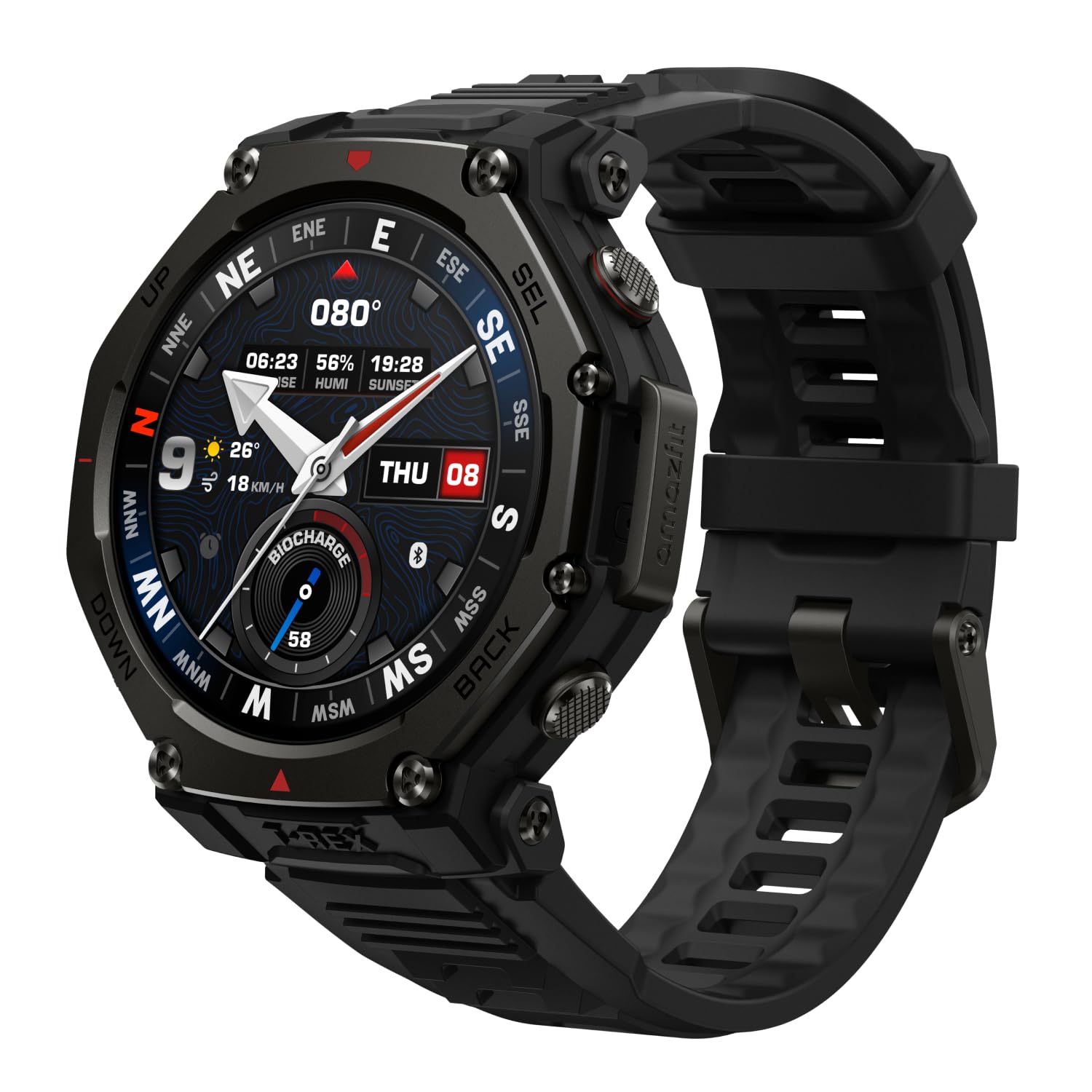
A 3000-nit screen behind sapphire glass, with offline maps and a 700mAh cell behind it.
A nit measures screen brightness, and 3000 of them is a lot for a watch. That rating is the reason this display stays readable on a snowfield or a sun-blasted ridge, where a dimmer panel turns into a mirror. The sapphire glass over it and the titanium alloy bezel and buttons mean the brightness is not the fragile part. It comes in 48mm or 44mm, so you can pick the fit that matches your wrist.
Capacity is where the T-Rex 3 Pro stands openly apart from the SOUYIE above: its 700mAh battery is the biggest in this lineup, and the rated life is 27 days. It also holds a 3-hour charge cycle, so you refill overnight and forget it. Offline POI search, auto rerouting, round-trip route creation and detailed ski maps mean the watch still navigates when signal drops, and dual-band GPS pulling from six satellite systems keeps the line clean under tall buildings and dense canopy.
The full package adds 180+ sport modes, HYROX training, 10 ATM water resistance and diving certification to 45m, plus a two-color flashlight with a Turbo Mode and an SOS signal. Owned users find the menu easy to navigate and the battery stretches roughly two weeks in mixed use. The recurring gripe is the silicone band, which has a reputation for wearing out faster than the watch. Software is the other point where opinions split — it works, and it is not as polished as the top-end systems.
Standout detail: six satellite systems on dual-band GPS, so a canyon run keeps its line even when the sky is crowded.
Where it gives ground: a band that can wear quickly, and software that feels less finished than the hardware underneath it.
Reach for this if: you need the screen to read in full sun and want maps on your wrist without a data connection.
skip it if: you want the most polished interface in the field — a Garmin or Apple will feel tighter day to day.
5. Samsung Galaxy Watch 8 Classic 46mm Bluetooth Smartwatch
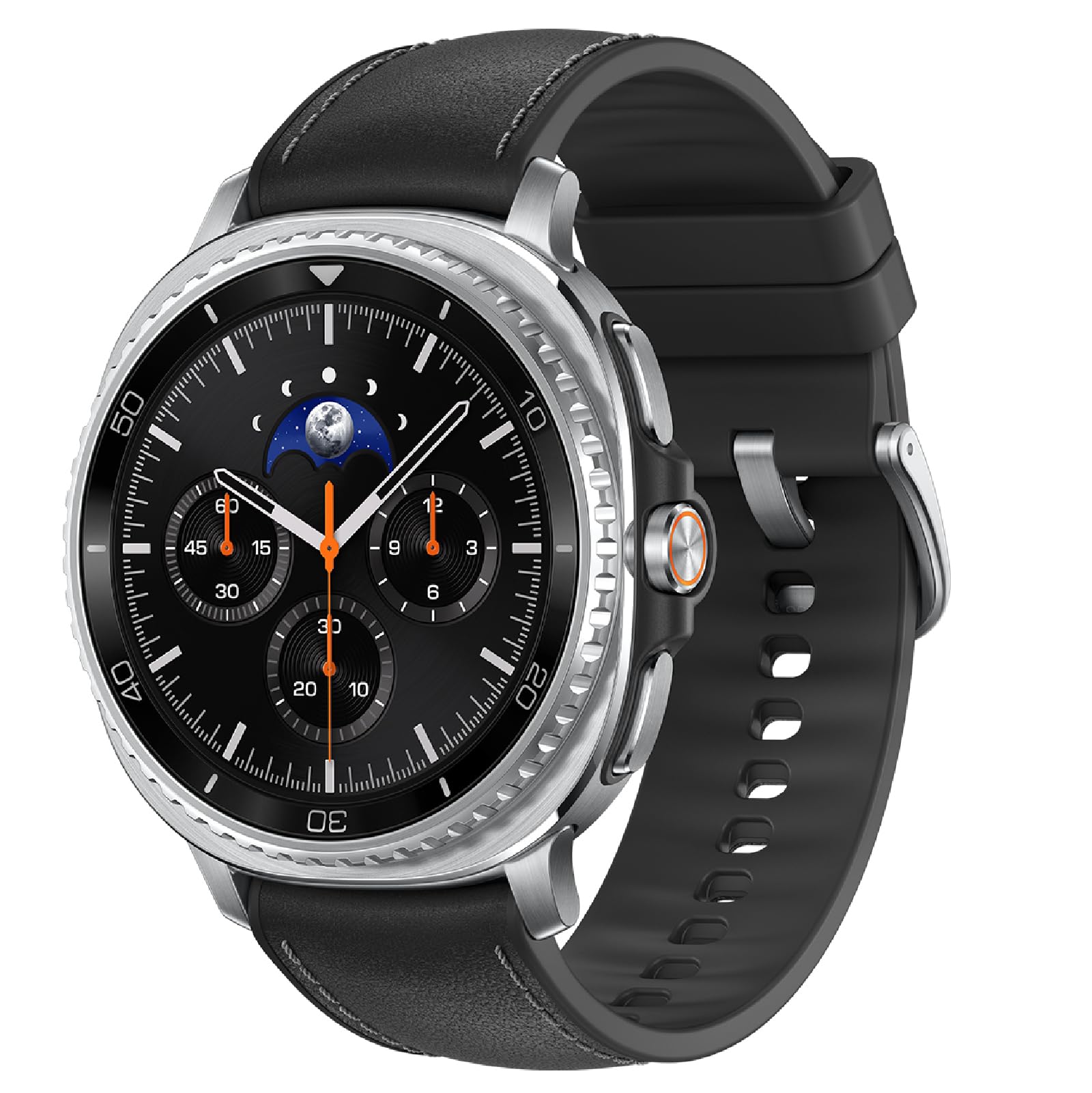
The physical ring you twist to move through apps — and the watch that looks like a proper timepiece.
Touchscreens on a 46mm case get smudged and fiddly. The rotating bezel here is a physical control you turn with a thumb, and it is the single reason this watch feels different from every slab-shaped screen in this lineup. It sits inside a cushion design with a brighter display and a new lug system for swapping bands without fuss. There is also a Quick Button for grabbing the features you reach for most.
The health tools go deeper than the bezel suggests. Advanced Sleep Coaching builds a plan around your sleep, Running Coach analyzes your age, weight, oxygen levels and heart rate to pace a run, and the Energy Score rolls yesterday’s sleep, activity and heart rate into one number for the day. Blood pressure tracking works after you calibrate against a cuff sold separately. The personal AI assistant takes spoken commands hands-free, and Now Bar keeps weather and news on your main screen.
Battery is where the discussion gets real. Samsung rates it at 30 hours of use, so this is another near-daily charger, and the review pages flag both a heavy feel on the wrist and charge that slips overnight. Pairing is the practical catch — it works smoothly with Samsung phones and with other Android phones, but not with an iPhone. The 46mm case is large, so try one on before committing. What earns the watch its following is appearance: the classic look with a metal ring draws more love than any other feature, and owners describe the health monitoring as far more complete than earlier Galaxy models.
Why men keep choosing it
- Rotating bezel gives physical, smudge-free control of apps
- Running Coach and Advanced Sleep Coaching turn data into guidance
- Blood pressure tracking via calibration against a separate cuff
- Classic cushion design with a new lug system for easy band swaps
What to weigh up
- 30 hours of use means charging most nights
- 46mm case feels heavy on smaller wrists
- Android only — it will not pair with an iPhone
Suits you if: you carry an Android phone and want a traditional-looking watch you control by feel.
Choose another if: you need multi-day battery or you are tied into the iPhone ecosystem.
6. WITHINGS ScanWatch 2 38mm
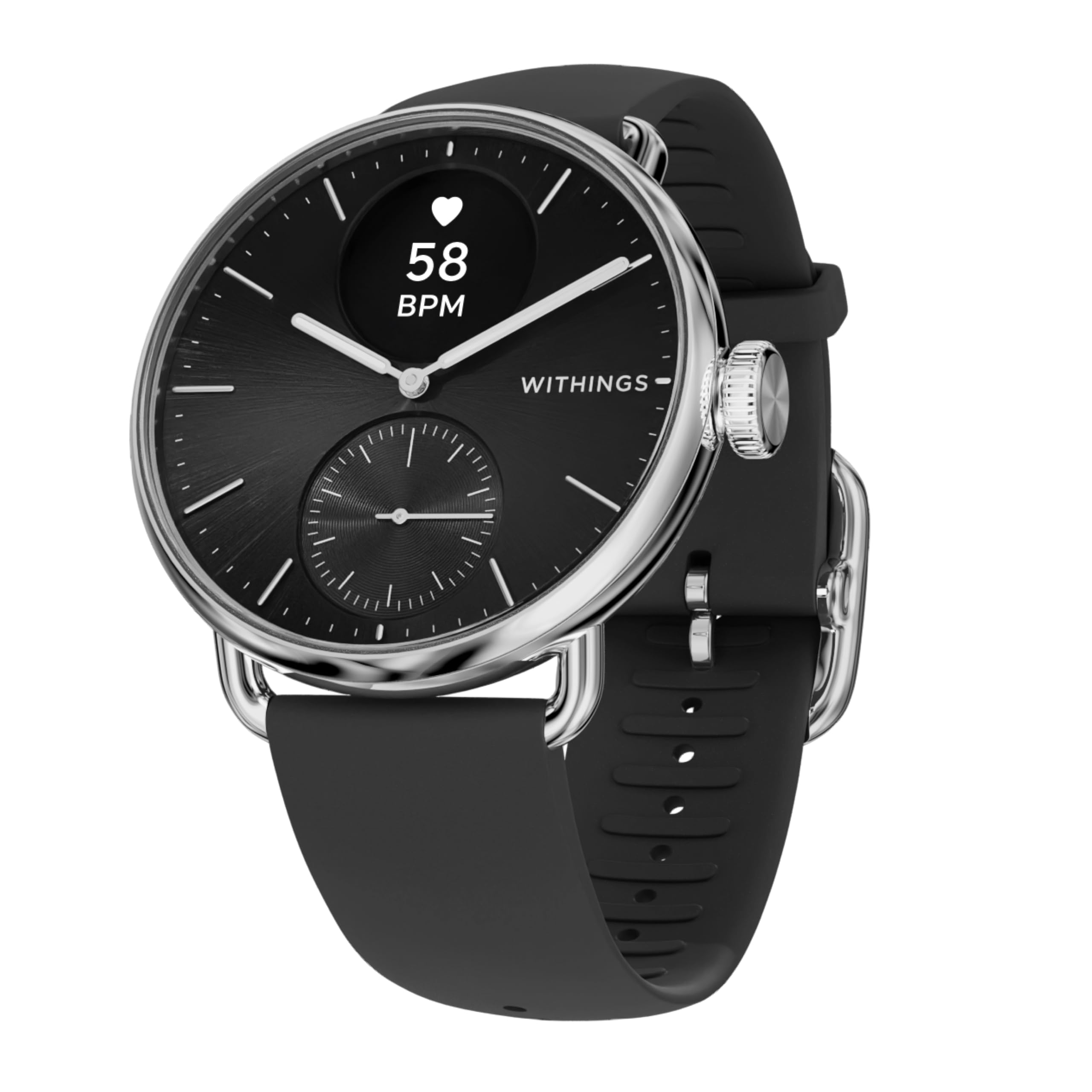
Analog hands over a stainless steel case, tracking health for 35 days on one charge.
Some men want a watch that does not look like a computer on the wrist. This is that watch — real hands sweeping over a stainless steel case with sapphire glass, and a health tracker running quietly underneath. It is the longest-running watch here at a stated 35 days of continuous use, which means you charge it roughly once a month rather than once a night. It is a different kind of smartwatch, and for a lot of wrists it is the right kind.
The medical side is the feature that earns attention. A 30-second ECG records your heart rhythm and checks for signs of AFib (an irregular heartbeat), with high and low heart rate notifications on top. Sleep stages, breathing, over 40 sports with VO₂ max and heart rate zones all feed a daily Vitality Score. The HealthSense OS runs its analysis on the watch itself rather than shipping everything to the cloud, and the Withings App works across Android and iOS.
Be honest about the trade-off, because this watch shows what hybrid design costs. Moving metal hands doing two jobs at once is a tighter engineering puzzle, and buyers report the strain: hands that lose time and step counts that run wrong. One review page carries a sensible warning — “Do not buy if you have a pacemaker or internal defibrillator.” If you need the most bulletproof tracker in the lineup, a digital watch is the safer bet. If you want a watch that reads analog and tracks health in the background, this remains the only real answer at this level.
what separates it: 35 days between charges with a real analog face and sapphire glass (a scratch-resistant crystal) over a steel case.
What to know before buying: the hands-over-screen design is fussier than a pure digital watch, and an occasional unit drifts on time or step counts.
Fits you if: you wear a watch with a suit and want health tracking that disappears into the background.
Better to pass if: you have a pacemaker or internal defibrillator, or you depend on dialled-in step accuracy.
7. Garmin Forerunner 970, 47mm, Soft Gold Titanium

Titanium and sapphire over a training brain that knows when you should back off.
This watch is for the man with a race on the calendar. Its brightest AMOLED touchscreen comes with button controls for a sweat-soaked finger, a lightweight titanium bezel and sapphire lens, and a built-in LED flashlight for dark early runs. Running economy tracks how efficiently you move, and running tolerance tells you the real toll a session takes so you can pull back before overload. Those insights are where the watch earns the titanium, not the case itself.
Battery splits honestly across two modes: up to 15 days in smartwatch mode and up to 26 hours in GPS mode. That GPS figure matters on race day — a marathon with a full course map loaded will not leave you wondering at mile 22. Full-color built-in maps plus multi-band GPS handle route navigation, and dynamic round-trip routing rebuilds a course if you break off the path, keeping the mileage consistent. A 560mAh cell sits behind it all, the largest battery on any Garmin here.
The rest works like a coach on your wrist: training readiness scored from sleep quality, recovery, training load and HRV status (heart rate variability, a recovery signal); personalized Garmin Coach running and triathlon plans that adapt; multisport auto-transition detecting swim, bike and run splits on its own. The built-in microphone and speaker make phone calls from your wrist when paired to your phone. Wrist-based running power, cadence, stride length and ground contact time round out the data. The one thing to accept is the price of the package — “a bit pricey but worth every penny” is how one review page frames it, and the sapphire glass means no screen protector is needed.
The training edge: running economy and running tolerance turn raw data into a decision about whether to push or rest.
The trade-off: you pay for race-grade analytics, and some features like step speed loss want an HRM 600 monitor sold separately.
Built for: a runner or triathlete chasing a personal best who wants the watch to explain the recovery cost.
Overkill for: a casual walker — most of this data needs a training plan to be worth it.
8. Samsung Galaxy Watch Ultra2 47mm
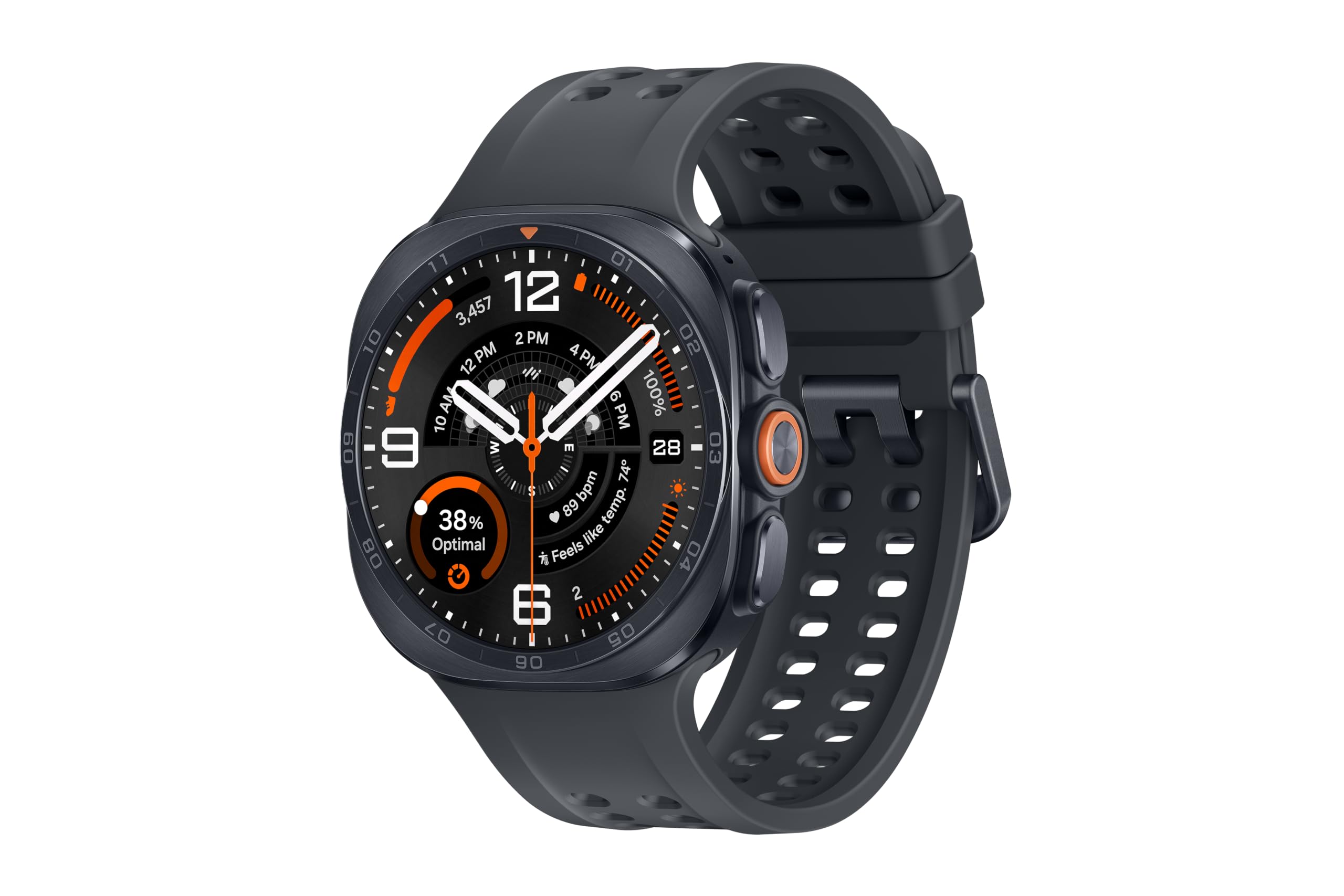
Five thousand nits of screen and a dive computer built in — a wrist tool for hard outdoor days.
The display is the headline: up to 5,000 nits of brightness. Nit by nit that is the brightest watch in this lineup, and it means a sunlit hike or a lunchtime run never turns the screen into a guessing game. Add a titanium case and IP69K plus 10 ATM ratings — dust-tight and water resistant to 100m — and this is built for the outdoors rather than the office.
Trail features go well past step counting. Path, elevation and pace guidance keep you on route, with personalized hydration alerts as you run. The Mares dive computer app is EN13319-certified, with real-time ascent and descent monitoring, a limit-depth notification and safety stop info. Vitals tracks five health metrics while you sleep, spotting shifts from your usual patterns and offering tailored guidance. A single personalized heart health score rolls the picture into something readable at a glance.
Built-in LTE is the quiet luxury: calls, texts and updates even when your phone stays behind on the trailhead. Raise your wrist and the AI assistant starts listening with no wake phrase, so you ask a question without breaking stride. The catches are real, though. This pairs with Samsung phones and other Android phones — it will not work with an iPhone. Battery opinions split sharply, and one review describes it as not cheap but worth every penny for not having to carry a cell around the farm.
Where it shines outdoors
- Up to 5,000 nits makes the display readable in direct sun
- IP69K and 10 ATM rated, water resistant to 100m
- Mares dive computer app with EN13319 certification
- Built-in LTE keeps calls and texts without your phone
What might put you off
- Android only — no iPhone compatibility
- Battery life draws mixed reactions from owners
- Voice assistant sometimes misses a raise-to-face command
Pick this one if: you carry an Android phone and want dive-ready hardware with a screen you can read in any light.
Pass if: you are on iOS or need a watch that reliably runs several days per charge.
9. Apple Watch Ultra 4 GPS + Cellular 49mm Smartwatch

Forty-five hours of workout tracking and satellite help when the signal disappears.
This is the Apple Watch for someone who already knows a standard watch will not do. Up to 45 hours of Max Extended Workout tracking covers an ultramarathon without a stay at a wall socket, and a 15-minute fast-charge puts back up to 18 hours of use. Compare that with the 24-hour rating on the Series 12 above and the gap is obvious — one watch lives on the trail, the other on the charging puck.
Heart rate is the other number worth knowing: HRV is measured as often as every five minutes, and background heart rate every five seconds. Precision dual-frequency GPS handles the course, with Pacer, Heart Rate Zones, Custom Workouts and training load rounding out the running tools. Safety is a headline here. The watch detects a hard fall or severe car crash, and if you have no cell service or Wi-Fi, built-in satellite communications let you text emergency services for help. That is a real lifeline at altitude, not a gadget.
The titanium case and sapphire crystal display are rated water resistant to 100m, so swimmers, divers and water sports fans can take it anywhere. Cellular means calls, streamed music and podcasts with no iPhone nearby — paired with AirPods, it works as a standalone wrist phone. The 15.1-ounce item weight is the heftiest in the lineup, and 49mm is the biggest case, so try one on before you decide. Cost is the one soft spot: several owners call it a little pricey even while saying it earns its keep.
The lifeline: satellite communications let you text emergency services when cell service and Wi-Fi are both gone.
The cost of the armour: 15.1 ounces and a 49mm case make it the heaviest watch here — a noticeable presence on the wrist.
Choose it if: you run long distances or work far from cell coverage and want an iPhone watch with the biggest battery.
Think smaller if: you want a light everyday watch — the weight and size are the first things you will notice.
Know the Specs
Battery ratings and what they actually measure
A battery rating describes one specific mode, not every day you will own the watch. “Up to 24 hours of normal use” on the Apple Watch Series 12 assumes everyday smartwatch behaviour, while “up to 45 hours” on the Ultra 4 refers to Max Extended Workout tracking. The Garmin Instinct 3 Solar quotes 28 days under normal wear, with unlimited solar charging only when you get the assumed 3 hours per day outside in 50,000 lux conditions (bright daylight). Read the mode label, not just the number. Capacity in milliamp-hours (mAh, a measure of battery size) — 300 on the Instinct 3 Solar, 400 on the SOUYIE, 560 on the Forerunner 970 and 700 on the T-Rex 3 Pro — hints at stamina but never replaces the rated life figure, because efficiency matters just as much as raw size.
Nits, AMOLED and why brightness is a buying decision
A nit is a unit of screen brightness. On a watch it decides whether you can read a notification in the open sun at midday. A 3000-nit AMOLED on the Amazfit T-Rex 3 Pro or a 5000-nit display on the Samsung Galaxy Watch Ultra2 both stay legible where a dimmer panel washes out. AMOLED is the panel type where each pixel lights itself, which produces deeper blacks and usually allows an always-on mode without the whole backlight running. Anti-glare treatment, like the coating on the SOUYIE screen, adds a second layer of protection in daylight. Water and shock ratings are their own language: 10 ATM means swimming-safe, IP69K adds dust-tight sealing, and MIL-STD-810 covers thermal and shock resistance.
Common Questions
Will the Apple Watch Series 12 work with an Android phone?
Can I swim with the Garmin Instinct 3 Solar?
Do I lose health features if I choose a hybrid watch like the Withings ScanWatch 2?
What does HRV tracking actually tell me about my training?
How long does the Garmin Instinct 3 Solar battery really last without sun?
Do the Samsung Galaxy watches work with a Verizon SIM or an iPhone?
Which watch here is best for a weak wrist or a smaller frame?
Do I need to buy extra accessories to get everything from these watches?
Which watch lasts longest between charges?
Are the health readings on a watch a substitute for a doctor?
The Bottom Line
The winning top rated smartwatch for men depends on how many days you want between charges. For most men, the Apple Watch Series 12 takes the crown — an iPhone-tied health tracker that measures HRV as often as every five minutes and fast-charges in 15 minutes for up to 12 hours of use. If you want a watch that survives a month without a plug, the Garmin Instinct 3 Solar gives you 28 days and a flashlight. And for the man who wants a proper metal face with analog hands, the Withings ScanWatch 2 is the only member of this group that goes 35 days.
Two more to keep in mind. Android users should start with the Samsung Galaxy Watch 8 Classic for the rotating bezel, or the Galaxy Watch Ultra2 if you need the 5,000-nit display and LTE. And if your training calendar matters more than your calendar app, the Garmin Forerunner 970 tells you when to back off before you break.
One last nudge: the Apple Watch Series 12 is the highest-rated watch in this lineup with 4.5+ stars across 500+ ratings, and the Ultra 4 matches that 4.8 while adding satellite emergency messaging. If you already carry an iPhone, that pair is the one to weigh — everything else here wins on battery, ruggedness or looks.
How we choose
We do not accept paid placement. Every pick is matched to a real buyer and a real use-case; we do not hands-on test units.
Sources
Specifications: manufacturer listings and product documentation. Review insights: verified customer reviews, as of November 2026. Pricing: not shown on this page (it changes often); check the current price via the retailer link.
As an Amazon Associate, Tactical Gear Guy earns from qualifying purchases. This does not affect which products we feature.